行政院國家科學委員會專題研究計畫 成果報告
智慧型家庭的開發--子計畫五:智慧型家庭媒體中心(II) 研究成果報告(精簡版)
計 畫 類 別 : 整合型
計 畫 編 號 : NSC 97-2221-E-011-086-
執 行 期 間 : 97 年 08 月 01 日至 98 年 10 月 31 日 執 行 單 位 : 國立臺灣科技大學電機工程系
計 畫 主 持 人 : 陳建中 共 同 主 持 人 : 蘇順豐
報 告 附 件 : 出席國際會議研究心得報告及發表論文
處 理 方 式 : 本計畫涉及專利或其他智慧財產權,1 年後可公開查詢
中 華 民 國 98 年 11 月 02 日
行政院國家科學委員會專題研究計畫成果報告
計畫編號: NSC 97-2221-E-011-086
執行期限: 97 年 8 月 1 日至 98 年 7 月 31 日
主 持 人: 陳建中 國立台灣科技大學電機系 助理教授
計畫參與人員:蘇俊榮、游函諺、劉欣和 國立台灣科技大學電機所 Abstract
A real-time P2P-IPTV system has been developed in this experiment. The system comprises: one digital right management server (DRM server), one media server and many IPMP terminal peers. When one new peer requests the media server to join the IPTV system, the DRM server after recognizing its ID, transmit by secured data a key to unlock the input stream and the certification for displaying the file according to granted right. To improve the IPTV service efficiency, the system would select a parent peer with low-delay and uplink capability better than the incoming peer. It would maintain the basic stable transmission framework. When one peer would leave, it has to find for each children peer a new parent peer according to above rules before updating the parent peer parameter of current one. In addition, the system can adjust the streaming size of media server in accordance with current network condition. When one peer imports the streaming, it would also out-port the streaming to other online peers, which would help to distribute the transmission loading for the whole IPTV system. The key of user profile is encrypted with AES. The certificate is encrypted with regularly updated DES keys to prevent hacker attack. Experiments show that the average frame rate and the transmission delay are maintained in good performances even when most peers are with low uplink capability.
Index Terms — IPTV, P2P, multicast, DRM, security.
1. Introduction
With the explosive growth of the Internet and society’s increasing reliance on multimedia information, we are moving toward a ubiquitous era of streaming multimedia over the Internet: anyone can access the multimedia content on the Internet anywhere, anytime. For this reason, streaming multimedia over the Internet to a large number of users has become an important research topic and application. With the advance of multimedia compression technologies and the growth of network bandwidth, the media streaming service become more and more important. Related applications include IPTV [1], video conference and distant learning etc. For these applications, IP multicast is probably the most efficient way to deliver video bit-stream. It effectively changes the traditional non real-time file downloading to real-time media streaming. In addition, it improves the server-client streaming delivery to peer-to-peer (P2P) multicast, in which the later is much more flexible than the former. The major contribution of the P2P multicast is that it enables the server to distribute the working loading to all active peers.
In other words, all participants have to share the computation and transmission loading.
However, due to different connection and computation capability, it would induce bandwidth allocation, delay jitter and quality of service problems. The proposed system tries to maintain a stable transmission backbone and integrate different codec, transmission and security functions to solve these problems.
In the P2P network, users share legal media content with each other but it then induce some other illegal behaviors. That is, the system has to guarantee legal video
consumption. It adopts the digital right management (DRM) [2] for the P2P multicast system to provide secured multimedia transmission and assure user priority. The DRM is a generic term that refers to access control technologies [3] that can be used by hardware manufacturers, publishers, copyright holders and individuals to impose usage rules of digital contents and devices. It also describes any technology which inhibits illegal usage.
It can also refer to limitations associated with specific instances of digital contents or devices. The DRM generally doesn’t refer to other forms of copy protection, which can be circumvented without modifying the file or device, such as license, serial numbers or decipher keys etc. Current DRM is designed for non-real-time digital contents, and it has to handle the secured delivery of real-time media multicast. In additional to content security, it has to deal with real-time encryption and transmission, which would induce delay.
In terms of media streaming, the proposed system adopted the wavelet-based image codec, JPEG2000 (JP2) [4], to provide scalable media streams. The JP2 standard can provide bit-streams that can be truncated at any rate to provide quality scalable streaming.
The system can dynamically adjust the transmitted image quality according to the current network condition. In addition, it can also afford to set access privilege or levels for users to provide usage rule control services.
The P2P network framework is composed of participants that make a portion of their resources (such as processing power, disk storage, and network band width) available directly to their peers without intermediary network hosts or servers. Peers act as both supplier and consumer of resources. For traditional server-client framework, the server suffers heavy working load and may induce network congestion. On the contrary, the P2P can utilizes all the resources of connected active peers with the cost of frequent inter-peer message passing. Applications comprise: Emula, Bit Torrent, KaZaa and media streaming applications comprise: PPLive, Sopcast and PPstream. The P2P network was also used in VoIP applications, such as Skype. Due to different application requirement, each P2Pbased system was developed under different network framework. These methods can be categorized according to their system centralization: (1) purely decentralized; (2) partial centralized and (3) hybrid decentralized architecture [5].
(A) P2P network model
Although in the purely decentralized model, the P2P overlay networks are supposed to be totally decentralized. However, it isn’t always true and systems with various infrastructure of centralization can be found by many. Purely Decentralized Architectures: All nodes in the network perform exactly the same tasks, acting both as servers and clients, and there is no central coordination of their activities. The nodes of such networks are often termed “servents” (SERVers+clieENTS), as shown in Fig. 1(a).
Partially Centralized Architectures: The basis is the same as with purely decentralized systems. Some of the nodes, however, assume a more important role, acting as local central indexes for files shared by local peers. Note that these super-nodes do not constitute single points of failure for a P2P network, since they are dynamically assigned.
If they fail, the network will automatically take action to replace them with others, as shown in Fig. 1(b). Hybrid Decentralized Architectures: In these systems, there is a central server facilitating the interaction between peers by maintaining peer list of metadata, describing the shared files stored by the peer nodes. Although the end-to-end interaction and file exchanges may take place directly between two peer nodes, the
central servers facilitate this interaction by performing the lookups and identifying the nodes storing the files, as shown in Fig. 1(c).
(a) Purely decentralized (b) Partially centralized (c) Hybrid decentralized
(B) P2P network
The P2P streaming network is different from the general P2P file sharing. The way of fetch media contents is not downloading, but streaming delivery. Because it needs to transmit the media bit-stream in real-time and the end users need not to reserve a large disk space to store the whole media bit-stream. There are several related researches about the P2P streaming network. The streaming delivery can be classified into three approaches, according to content distribution: (1) Tree-based algorithm [2]; (2) mesh-based algorithm and (3) gossip-based algorithm [4].
(C) Security
Security issues in a streaming delivery system include: (1) content confidentiality; (2) content integrity; (3) content availability; (4) user authentication and (5) DRM. Most key distribution schemes are carried out by a media-independent approach, i.e., the key generation is triggered by time or an event, which is independent of the media content.
However, these control schemes cannot meet the security requirement of P2P streaming because: (1) users in the P2P network may view different content/frames at the same time and; (2) the overhead of updating keys is too high. To solve these problems, the media-dependent approach is adopted, i.e., keys are bundled with media content packets.
Specifically, we use two types of keys, session keys and cluster keys; Generating session keys is time-driven while generating cluster keys is event-driven. Compared to the media independent approach, the media-dependent one can significantly reduce the communication overhead for key updating keys, and improves security by imposing rules for embedding keys in media packets.
2. System Implementation
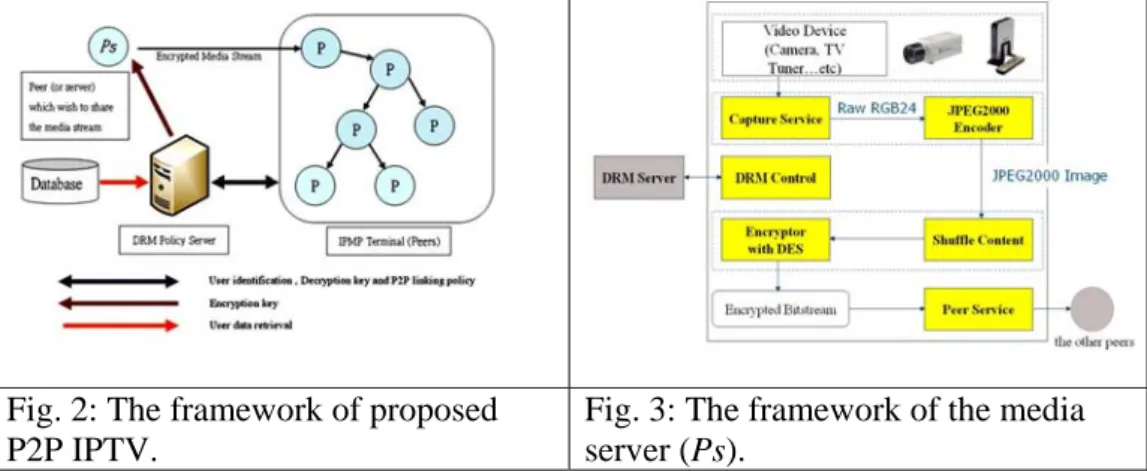
The proposed IPTV system is developed based on the Visual Studio platform and the Directshow framework. The P2P-IPTV system comprises three main components: (1) Media Server; (2) DRM server and; (3) IPMP Terminal. The overall framework is demonstrated in Fig. 2. For the P2P network model, we adopted the centralized P2P model at current stage for easy control. The tasks operated by DRM server comprise: user login and authentification, media codec and license check, and manage the P2P network connections. The media server captures the real-time video and then compresses the time-domain video into bit-streams. The license provided by DRM is used to perform content encryption and deliver the cipher-text to user. The IPMP terminal provides a
login interface. After identifying user by DRM authentification, the DRM transfer the information of certificate, video codec, connection policy back to the IPMP terminal, which then can begin to receive and decoder the media streams. Each IPMP terminal may have different decoding parameters specified by the certification data. When one peer joined the P2P network, it would receive media packets from its parent peer and also provides these received packets for possible children peer.
Our system adopts Centralized P2P architecture. The DRM server has some tasks, such as user login, user authentication, providing codec and license, it also need to take charge P2P connection mechanisms, build and manage the network. The media server is in charge of the capture of real-time image, and then be compressed. It uses license provides by DRM to content encryption, and then deliver cipher-text to user. IPMP terminal offers user a login interface. After user identity authentication by DRM, and then it passes back some information, such as certificate, video codec, cipher and linking policy to IPMP terminal. Then, IPMP terminal begins receiving streaming packet that be captured by streaming server according to bandwidth and delay. Every terminal have one’s own decoding parameter according to certificate Authority. Terminals join P2P network, and then they become nodes in this network.
(A) Media Server
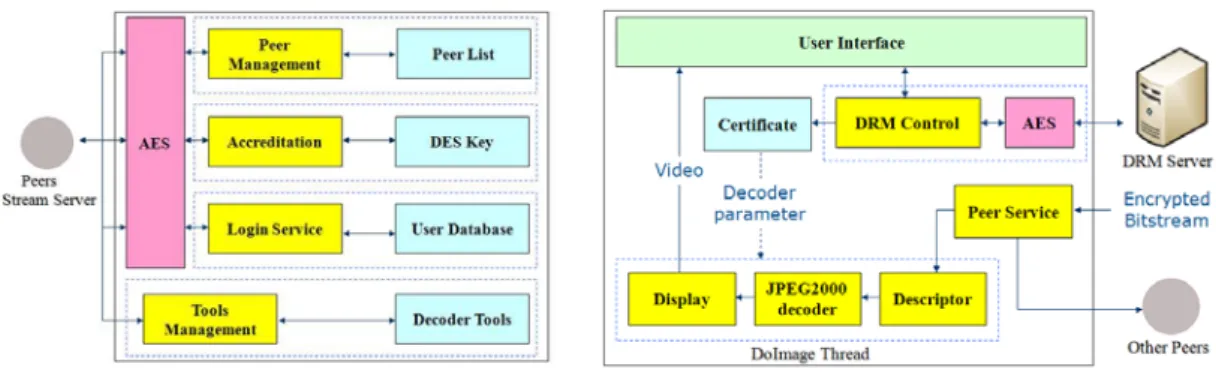
The media server framework is shown on Fig. 3. The video signal source can be from live TV tuner, webcam or media stream files, which would be captured by the DirectShow development tool. The captured video signal is compressed by motion JPEG2000 approach. The compressed bit-streams are then shuffled and are encrypted by the cipher key provided by DRM. The capture service unit acquires images from the input video with RGB24 format. The frame rate and image resolution can be adjusted according to the network condition. The DRM control unit deals with the message transfer with the DRM server. The handshake between DRM server and streaming server can be described with the following steps: (1) When the streaming server is invoked, it will register to inform the DRM server for live streaming; (2) The DRM server transfers back the deciphering key and requests the peer connection information of the streaming server to enable the P2P streaming; (3) When one new peer requests connection from the streaming server, the DRM will inform the streaming server that the new peer is legal and the streaming server can start to streaming to the new peer.
Fig. 2: The framework of proposed P2P IPTV.
Fig. 3: The framework of the media server (Ps).
(B) DRM and IPMP Terminal
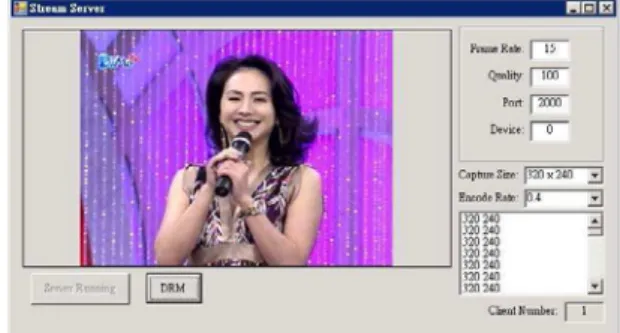
The DRM server plays a critical role in the P2P-IPTV system. The framework is shown in Fig. 4. It records the core data elements of the DRM for user, digital media and digital right. It will protect the media from illegal copy, transfer or conversion to other format. When one client peer want to join the P2P-IPTV system, it needs DRM to perform authentification and provide the license to decode the encrypted contents. The DRM plays a critical role to ensure the secured communication between DRM, IPMP and media server. All communication data are encrypted by 128-bit AES. The login service unit deals with the communication between streaming server and the client peer. When the streaming server started, it has to inform the DRM server to begin media streaming.
After the DRM server transfer the ciphering key for content encryption, it can start to build the P2P-IPTV system by this media streaming server. The accreditation unit generates and manages the ciphering key for stream encryption. It generates the cipher key for the media server or client peer according to the instruction of login service unit.
The peer management unit deals with the interconnection and maintains the peer listP={pi}. When a new peer finished the login procedure and got its license, the peer list would be updated to the latest status. The tool management unit manages decoder tools.
The default tools for a client peer are basic codecs and would be updated when needed.
The framework of IPMP terminal is shown in Fig. 5. The DoImage Thread deals with the bit-stream deciphering, decoding and display. The user interface handles user login/logout. It also setup the upload bandwidth, decoding parameter, and output image size for the client peer. The DRM control unit manages the communication between DRM server and the client peer. When the client peer was identified by DRM server, the Certificate and P2P connection information will be passed to the client peer. The certificate unit stores the license from DRM, which records the user identity and usage right of media. The media player decodes and plays media according to the license contents, which comprises: decoding parameters, image resolution and access level. The DoImage Thread processes and decodes the received media stream.
Fig. 4: The framework of DRM server. Fig. 5: The framework of IPMP terminal.
(C) P2P network and peer management
The P2P-IPTV system adopts the centralized P2P network model for efficient control. The DRM server handles the message exchange between peers. It also manages the peer status and maintains a peer list. The peer list P is stored in DRM server. When
one new peer joined the system and received the cipher key, it would report its information to the peer management unit, which will assign the connection point for the new one. The P will add this new peer to the list when finished connection. The DRM server explicitly controls the peer connection legal under the centralized P2P framework.
The pros and cons of this approach are high peer connection efficiency and high system loading, respectively. In addition, the system scalability is confined by DRM server under centralized P2P-IPTV framework.
3. Experimental study
To verify the streaming efficiency, a practical P2P-IPTV system has been implemented to test its operation effectiveness. Several computers are designed to act as the client peer nodes to playback live TV streaming. Each computer is assigned a public IP address. The DRM server is designed to supervise the peer communications, maintain the P2P-IPTV system and handle peer login. The media server captures the live TV signal and then encodes it by encrypted JPEG2000 bit-stream. The resolution is set to be 320*240 and the bit rate is 0.4bps.
Fig. 6: The GUI of an IPMP. Fig. 7: The interface of the media server.
(A) IPTV Operation
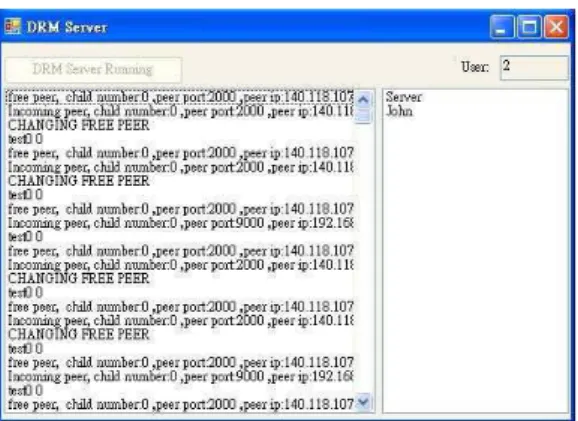
At the client side, the user input login name and password at the IPMP terminal, shown in Fig. 6. After identify the user, the DRM server transmits certification, license and connection port for the client peer. These client peers then connect to its parent node according to the connection information provided by DRM server. As shown in Fig. 6, the frame rate is 15 fps and the received media stream is stable and normal. The GUI of media server is shown in Fig. 7. This GUI allows users to change the frame size and encoded bit rate dynamically when streaming. The frame rate and quality for the streaming video are displayed on the GUI. The DRM interface is shown in Fig. 8. The left sub-window shows the parameters such that the system operation status can be known by the operator. The right sub-window demonstrates that there are two on-line users at this moment.
Table 1: JPEG2000 streaming bit rate an resolution.
0.1 0.5 1
320 × 240 15.46 72.75 144.78
Bit/Pixel Resolution
640 × 480 57.21 287.94 575.40
(B) Performance evaluation
The most distinguished feature of the proposed system framework is that it can maintain stable network transmission for the multicast tree when the uploading bandwidths of most active peers were insufficient. For the practical ADSL communication environment, the upload bandwidth is much smaller than the download one. Table 1 shows the resolution and streaming bit rate of the JPEG2000 image coder with frame rate 15fps. The administrator can adjust the bit-rate dynamically according to the number of on-line users or the network condition. Fig. 9 shows the FPS of the client peers at level 4, 8, 12, 16, and 20 which are measured with 3 minutes duration. As shown, the real-time streaming can maintain the FPS to be 14 at different level nodes. Because the transmission tree is constructed to maximize the backbone transmission rate, it can afford to accommodate overloading transmission.
Fig. 8: The implementation of DRM server.
(a) n=4 (b) n=8 (c) n=12
(d) n=16 (e) n=20
Fig. 9: The FPS of the node located at level n in this system.
4. Conclusions
The goal of this paper is to design a P2P-IPTV system that can effectively adjust the streaming rates according to available bandwidth, device computing capability and user priority to provide universal media access platform. It integrated the JPEG2000 codec to provide spatial and quality scalable bit-streams. The encryption function is also integrated to protect the media content from illegal usage. The implementation is carried out from the following considerations: (1) For one UMA media server, it has to provide encode once and decoded by many, instead of providing individual streaming for different devices or users, which would induce heavy CPU loading and memory usage if no specific hardware support. The JPEG2000 is adopted to provide spatial, quality and temporal scalable control for multicast streaming. (2) The JPEG2000 is a computation expensive codec such that it cannot afford to provide real-time coding for a general purpose PC. To make the real-time coding feasible, the server PC is used to provide motion-JPEG2000 streaming with satisfiable video quality at current stage. We are working on utilizing the advanced video codec standard, H.264, to provide better video transmission quality. (3) The encryption procedure is embedded into the media server. In general, the encryption procedure is independent to the video coding procedure. Each terminal can use different encryption tools to protect streaming contents. It can also impose different update strategy for the private keys to enhance the security. (4) The centralized P2P model is adopted to provide strict client node management. The DRM server is used to manage the inter-peer connection control. The decipher key and decoding parameters are stored in the license to provide security and scalable control for media consumption. The super-node control approach, that can provide better system scalable control, was not adopted in that distributing the administrator privilege to super-node may expose the security control in a unsafe status.
The proposed system was carried out under limited hardware and time schedule, such that there are several research topics deserved further study: (1) No complete solution for the P2P-IPTV system such that it’s not easy to find one for comparisons. (2) The decryption key is set to be identical for all clients for simplicity. How to set different decryption key for different user is considered as a future work. (3) The centralized P2P model is adopted in considering complete security control under the tradeoff of limited system scalability. How to distribute the Administrator privilege to super-nodes while maintaining secured transmission is considered as a future research. (4) The motion JPEG2000 does not take temporal correlation into consideration to improve the compression ratio. Integrating the MC/ME based video codec, H.264, into the system is under development to provide efficient code and transmission performance.
References
[1] X. Zhang, J. Liu, B. Li, and T. S. P. Yum. “Coolstreaming/DONet: A data-driven overlay network for live media streaming,” IEEE INFOCOM, 2005.
[2] S. R Subramanya, and B. K. Yi, “Digital Rights Managements,” IEEE Potentials, vol. 25, pp. 31-34, 2006.
[3] Q. Liu, R. S. Naini and N. P. Sheppard, “Digital rights management for content distribution,” in Proc.
Australasian information security workshop conference, vol. 21, pp. 49-58,2003.
[4] A. Skodras, C. Christopoulos, and T. Ebrahimi, “The JPEG2000 still image compression standard,”
IEEE Signal Processing Mag., vol. 18, pp. 36-58, Sept. 2001.
[5] B. Pourebrahimi, K. Bertels, and S. Vassiliadis, “A survey of Peer-to-Peer networks,” in Proc.
Annual Workshop on Circuits, 2005.
[6] S. Banerjee, et al., “Scalable application layer multicast,” in Proc. Applications, technologies, architectures, and protocols for computer communications, pp. 205-217, 2002.
[7] Y. H. Chu, S. G. Rao, and H. Zhang. “case for end system multicast,” in Proc. ACM SIGMETRICS, pp. 1-12, 2000.
[8] A. J. Ganesh, A. M. Kemarrec, and L. Massoulie, “Peer-to-peer membership management for gossip-based protocols,” IEEE Trans. Comput., vol.52, no.2, Feb. 2003.
Self assessment
本研究已達成原計畫所規劃之工作項目:(1) 研究並建構具數位權利管理 (DRM); (2) 研究數位媒體中心與 IPMP 使用者端之互動與控制方法; (3) 發展多重 媒體同步 (simultaneous media) 與整合顯示技術。主要的重點在第一、二項之媒 體中心之整合探討,IPMP 相容之數位智財權管理與保護系統,它有一個網頁伺 服器提供給每一個客戶瀏覽所有的數位內容,播放程式也設計的讓一般大眾容易 使用。認證中心 (Certificate Authority) 保存著信用架構和使用者的資料,數位物 件識別碼 (Digital Object Identifier) 被用來辨別不同的數位內容。由於目前的系 統,每 IPMP terminal 皆持相同的加密金鑰,在加密金鑰的管理產生漏洞。所以如 何在每 IPMP terminal 持有不同的加密金鑰條件下,系統能有效率的工作,這是未 來研究重點之一。目前系統未考慮到影像間的相關性,來減少壓縮後的影像大小,
因此採用 Interframe 小波壓縮是未來的一項課題。未來將可採用 Wavelet video coder 的檔案,例如 MCTF、3D-SPIHT、3D-EZW 小波視訊編碼架構來提供更高 彈性的碼流控管。
綜合評估:本計畫產出相當多具有學術與應用價值的成果,目前正準備投稿期 刊論文中,並已準備提出專利。另外,也培育高科技人才,整體成效良好。相關的 學術論文發表如下:
[1] Han-Yen Yu and Jiann-Jone Chen, “The RFID-based Object Location and Live Camera Spotting,”
Int. conf. Ubiquitous Robot and Ambient Intelligence, Oct. 28-31, 2009.
[2] J. J. Chen and C. R. Su, “Volume Image Segmentaton by Dual Multi-Scale Morphological Reconstructions,” Int. Conf. Intelligent Info. Hiding Multimedia Signal Processing, IIHMSP 2009.
[3] Chung-Rong Su and Jiann-Jone Chen, “Volume Image Segmentation by Dual Multi-Scale Morphological Reconstructions,” in Proc. CVGIP 2009.
[4] Han-Yen Yu and Jiann-Jone Chen, “The RFID-Based Object Location And Live Camera Spotting,”
in Proc. CVGIP 2009.
[5] Chin-Hwa Chen and Jiann-Jone Chen, “Residual Image Coding For A Multiple Description Coder Embedded With Distributed Video Coder,” in Proc. CVGIP 2009.
行政院國家科學委員會補助國內專家學者出席國際學術會議報告
98 年 10 月 19 日
報告人姓名
陳建中 服務機構
及職稱 國立台灣科技大學電機工程系 助理教授
會議時間 會議地點
自民國 98 年 09 月 12 日 至民國 98 年 09 月 14 日 日本 京都
本會核定
補助文號 NSC 97-2221-E-011 -086
會議 名稱
(中文) 2009 國際智慧型資訊隱藏與多媒體信號處理研討會 (英文) 2009 International Conference on Intelligent Information
Hiding and Multimedia Signal Processing 發表
論文 題目
(中文) 運用多重對偶型態學重建運算於資料庫影像之前景物件分割 (英文) Volume Image Segmentation by Dual Multi-Scale Morphological
Reconstructions
附件I
一. 參加會議經過
2009 國 際 智 慧 型 資 訊 隱 藏 與 多 媒 體 信 號 處 理 研 討 會 (2009 International Conference on Intelligent Information Hiding and Multimedia Signal Processing) IIHMSP2009 於二 0 0 九年九月十二日至十四日為期三天,假日本京都 Mielparque Kyoto 飯店舉行◦ 此會議由日本 Ritsumeikan University 主辦, IEEE, KES International 以及 ubiquitous International 協辦,此研討會主要研究發表在多媒體信號處理以及 資料隱藏,是從事多媒體研究的一個重要會議,多媒體技術的發展已從早期的編碼 效能,轉向發展智慧型多媒體技術,以因應需要連結不同特性的網路以及不同資訊 形式之全球資訊平台◦本研討會旨在提供一個讓研究學者、以及各專業人士一個優 良的討論環境,並讓各專家學者、科學家、工程師以及學術研究者展示所研究或開
發的資訊隱藏以及多媒體信號處理相關技術◦在研討會期間,可以促成各種過往以
及未來前瞻技術研究的合作機會◦本研討會並於三天的會議期間,於每天的早上安 排國際知名學者之專題演講。
第一天的專題演由日本京都大學智慧型科學與技術學系的 Takashi Matsuyama
教授兼副校長專題演講,講題是有關精確 3D 立體形狀以及動量重建的技術,以及
高准度視覺和 3D Video 之高效編碼 Takashi Matsuyama 教授在演講中首先說明 3D video 並不是電腦動畫,而是一個新的立體影像動態視覺之媒體錄影技術媒體錄影 技術。其目標是以高精準度錄影隨時間變化的立體物件形狀特性(例如顏色和紋 理)。相關的應用涵蓋各人以及社群活動之娛樂(例如 3D game 和 3D TV),教育 (3D animation picture book),運動(運動技術效能分析),醫學(3D 手術模擬監控)以 及文化(3 傳統舞蹈之立體儲藏櫃)等等。Takashi Matsuyama 教授展示他們研究開發 之電腦叢集運算技術,以提供即時從多視角攝影機之動態物件立體重建所需之運算
量需求。接著說明運用 3D 可變模型以及 graph-cut 演算法,以精確處理立體動態物
件之形狀以及移動估測。並展示如何提供符合視覺之高精準度顏色對 61C9 之色彩
處理。展示的項目為互動式之日本傳統舞蹈之立體視訊。在第一天的論文報告中,
相關的主題有多媒體安全管理、浮水印技術、無線多媒體網路相關應用技術、監控 技術以及隨處多媒體服務與應用,其中有關隨處多媒體服務與應用的論文發表數目 最多,可以想見結合多媒體處理與網路互動之應用,以隨著網路的普遍與數位多媒 體技術的進步,成為網路多媒體發展的主流。其他相關的研究主題也包含多媒體信 號處理之電路、生物辨識技術等。在多媒體的應用領域中,實在有相當多具潛力的 應用。我所報告的論文場次安排在第一天下午,一共有八篇論文,相較於其他場次
本session 並無人缺席,session 主持人為日本東京大學 Dr. Akira Nishimura, 因為報
告者多為其熟識之研究學者,因此本 session 討論的氣氛相當熱絡,輪到我本人報
告 時 已 經 超 過 預 期 的 時 間 甚 多 , 我 所 報 告 的 論 文 , 題 目 為“Volume Image Segmentation by Dual Multi-Scale Morphological Reconstructions”,亦和與會學者有
相當熱絡的討論與交流。因為本 session 的學者多為日本各大學的年輕教授,因此
在語文及技術的互動上比較流暢。
第二天的早上,由韓國大學資訊管理與安全研究所之 Hyoung Joong Kim 教授 主講有關運用資料隱藏方法來達成視訊壓縮的研究成果,金教授從最基本的算數編 碼(arithmetic)開始介紹,並說明充分運用資訊相關性的編碼樹減縮法,以有效的達 到資料隱藏以及壓縮的目的,金教授的研究比較偏向基礎理論的研究,因此在資料 壓縮的見解上也頗獨特。金教授在資料隱藏和壓縮的研究上有多篇國際期刊論文,
因此在晚宴會後以及演講後我與他交換名片及研究心得時,有進一步的討論到壓縮 與資訊關連性的交互運用技術,也有討論到發表學術論文的心得與有關在多媒體編 碼相關的論文發表之經驗,金教授還客氣的說「有關他的演講,歡迎多多指教或者 以郵件討論」,金教授算是我與三位講者之中互動最佳的一位。我也收穫良多。有 關第二天的論文發表內容,相關的主題有與安全管理有關之編碼技術、行為分析與 事件偵測、多媒體保護、智慧型文件處理與管理技術、數位多媒體資料庫、智慧型 浮水印技術、影像處理與超大型積體電路技術,我選擇了 session B05:Behavior Analysis and Abnormal Event Detection, Session B07: Digital Archives and Digital Heritages(I)以及 Session B15:Application of Intelligent Computing to Signal and Image Processing 三個場次深入學習,雖然每篇論文只是簡短的二十分鐘,卻可以 學到每一位學者在論文發表背後的研發題目之動機與過程,也看到許多實際展示的 系統,例如行為分析車輛偵測與行為統計、人臉辨識之侷限性與潛在應用,如年齡 辨識、語音辨識用於電話偵測、以及多媒體資料庫檢索用於博物館美術館等。發展 這些應用的技術深度或許不難,但是與相關的應用整合,成果就相當令人印象深 刻,從這一天的論文報告中,也體會到提供好的成果展示系統相當重要。
第三天由目前為中國排名第三這將大學特聘教授及中國工程院院士譚建榮博士 主講有關如何運用虛擬實境的技術,來為大型自動化控制之裝配場提供流程模擬以 及潛在的碰撞問題,雖然英文報告不太流暢,但是其所展示的系統卻相當生動,譚 博士具備院士身份,因此其轄下之研究計畫與相關研究人員者眾,所展示的電腦虛 擬實境與電腦動畫相當生動,可以想見其背後所投入的人力及財力之紮實努力過
程。會後我也與譚博士討論,有說到他們做大型計畫的過程,並與另一位浙江大學 工程與計算機圖形學研究所劉振宇副教授討論有關進行大型計畫的心得以及中國學 術研究現況。本人對其所展示的研究成果印象相當深刻,可以感受到中國人苦幹實 幹的研發精神,也體會到科技與實際需求結合的產業革命衝擊。第三天的論文報 告,主題為多媒體信號處理,相關的論文有multi-dimensional signal processing,處
理醫學影像之重建、人臉辨識、人類影像辨識等,其他的為 poster session,主要的
研究都跟數位浮水印技術相關。相關的應用如影像、視訊、聲音訊號以及網路傳輸 加密等,都可以運用加密技術,達到資料安全管理的目的,因此相關的論文也很 多 。 在 Session C01 : Advanced Data Hiding and Coding Techniques for Audio Signals 中,把所有的媒體應用資料隱藏的範圍都涵蓋了,應是 session chair 努力邀 稿與阻織,令人印象深刻,其他有關多媒體信號處理的論文,包含影像特徵擷取、
影像錯誤偵測、工業資訊隱藏技術等,其中以人臉辨識的展示系統較令人印象深 刻,資料隱藏的影像圖展示需要比較專業的評估才可以判斷效能。
以上是我直接與論文發表人討論的報告,因為時間有限,所能夠掌握的還是有 限。不過,經由參加這次會議可以瞭解多媒體的整體發展趨勢,雖然所發表的論文 在非常多樣。但是,主要還是隨著多媒體網路化的趨勢發展,這是最主要的主軸。
二. 與會心得
1. 網路多媒體技術已成為進來多媒體工業發展的主流,碼流頻寬即時調適與多
媒體資料安全保護,利用影像相關性與編碼架構,可以有效的提供 scalable
video bitstream,以因應需整合多種異質網路的全域平台之互動需求,因為頻寬
和傳輸特性都不一樣,因此也就需要不同等級資料保護機制。相關的 quality
control 與 Error Concealment, Error Correcting Coding, Network Bandwidth Estimation 等,也仍是熱門研究題材。
2. 多媒體傳輸之安全性則需資料隱藏與加密的技術來提供所需的工業應用需 求,引此在本次會議中,有關資料隱藏的技術用於影像、視訊、聲音或者傳 輸碼中等,都可以運用資料隱藏的技術來達到媒體產權管理的目的。
3. 多媒體通訊與整合的趨勢。整合多重型態媒體訊息以提供智慧型空間中的人 物活動。因為不同的生物訊息特性差異很大。但是彼此之間卻會有一些交 集。因此,多重訊息的善用,可以幫助辨識與定位智慧型空間的人物活動,
這些技術在影像視訊檢索上的應用,也是可以互相技術支援。但是,太多種
類的媒體訊息要整合,仍然存在許多瓶頸。
4. 其它如人臉偵測與分析(人臉辨識、人臉年紀判斷)、行為分析應用於交通 工具、立體電腦圖像處理(包括編碼、加速處理與色彩處理等)、以及多媒 體資料庫的建置與檢索功能的開發。都是相當熱門的研究項目。
三. 建議
舉辦國際研討會除了研究成果的分享與討論,還可以讓世界各國瞭解主辦地主 國的歷史和文化,有助提昇國際名聲。同時,主辦單位悉心籌備議程、住宿和交通 旅遊等都提供無微不至的協助。希望可以多補助校內教師參與國際研討會,以保持 本校學術、研發與國際水準一致,掌握國際上科技發展的脈動,全面提升學術與業 界的水準。另一方面,除了鼓勵學界、業界多舉辦國際型研討會,也要注意文化遺 產的維護與傳統文化的發揚,此次京都之行,也讓世界各國人士瞭解日本人維護古 蹟與環境的用心,這是我國在提昇國際知名度上可以努力學習的地方。
四. 攜回資料名稱及內容
會議的論文集共一片光碟
五. 結語及其他
本人非常感謝國科會能夠補助參加此次的 IIHMSP2009 之國際研討會。除了 發表計畫研究成果, 並且可以來自世界各國的專家學者、以及業界先進一起討 論,交換研究心得並探討網路多媒體與資料安全的發展趨勢。對於身為國內學術 研究一員的個人,在關於未來的研究方向和教學內容的選擇,有相當重要的啟發 與靈感。除增廣見聞,也瞭解各國在網路多媒體的發展趨勢。參加本次研討會也 要感謝學校補助相關費用,個人得以進一步掌握最新的研究趨勢,並將交流的技 術與學生做進一步討論,提昇研究水準。