Transformation of benzimidazole anthelmintic agents from reactions with manganese oxide
Sin-Yi Liou, Wan-Ru Chen
Department of Environmental Engineering, National Cheng Kung University, Tainan, Taiwan E-mail: [email protected]
Abstract
Benzimidazole and its derivatives are extensively used as anthelmintic agents and fungicides to control intestinal parasites and fungal pathogens. Benzimidazole-based compounds have high Kow (octanol - water partition coefficient), and therefore are easy to remain in the soil environment. This study aims to investigate their possible degradation by manganese oxides which possess high oxidation power and are relatively abundant in the soil. Four different benzimidazole compounds, including albendazole (ABZ), mebendazole (MBZ), flubendazole (FLU) and thiabendazole (TBZ) were studied. Due to their low water solubility, the benzimidazole stock solutions were prepared in methanol, as in other similar studies. Only ABZ was found to transform slowly in the presence of MnO2. However, it was observed that when preparing the benzimidazole stock solutions in water, MBZ, FLU and ABZ yielded a number of hydrolysis products which were not revealed in the literatures. ABZ and its hydrolysis products reacted rapidly with MnO2 and the degradation rate with MnO2 was significantly enhanced without the interference of methanol. This suggested that preparing benzimidazoles in methanol may lead to false conclusion about their reaction with MnO2. The ionic strength and presence of metal cations showed minor effects on the reaction. However, change of pH greatly affected the reaction rate, which decreased dramatically when pH was above 4.5. One of the ABZ transformation products was evaluated by HPLC-DAD and LC/ESI (+) -MS. It suggested that the oxidation of ABZ by MnO2 did not take place in the core structure of the benzene ring, imidazole ring, or methyl carbamate. It was the propylthio substituent on which the redox reaction was carried out.
1. Introduction
Benzimidazoles are widely used as veterinary anthelmintic drugs on humans, house pets, livestock breeding and aquaculture to control intestinal parasite infections. Some benzimidazoles were also found to be used to kill fungal pathogens [1-6]. Thiabendazole (TBZ) was the first marketed benzimidazole since 1961 [2]. After its introduction, a number of reformative forms of benzimidazoles were developed, such as albendazole (ABZ), mebendazole (MBZ) and flubendazole (FLU) [7]. After the administrations of these drugs, some of them may remain in the human or animal bodies [8]while others may be excreted into the environment, such as surface water, ground water, or soils, in the form of their original structure or metabolites [9]. Sometimes the transformed compounds may have higher toxicity than the original ones [10].
A lot of literatures reported that benzimidazoles have bio-toxicity, especially teratogenicity. ABZ was found to cause malformations of head and tail and embryonic lethality at the dosage of 0.3 µM in zebrafish [11]. Other studies also showed ABZ and its metabolites have significant teratogenic toxicity in rats [12-14]. Wagil investigated aquatic organisms like marine bacteria, green algae, duckweed and crustacean, and found only a few µg/L of FLU and fenbendazole could harm these species [15]. Rat fetuses given a single dose of 7.83 mg/kg of FLU could lead to gross, skeletal and other internal anomalies [16]. Speare indicated with 50 mg/kg/d of MBZ for 5 - 6 days, pademelon developed severe hematological diseases, as well as bone marrow aplasia [17]. TBZ was also reported to have acute toxic effects on the kidneys in mice [18].
Benzimidazoles have been found at concentration around ng/L to µg/L level in natural water. 0.3 µg/L of FLU was detected in leachate from agricultural manure to drainage waters. [19] It was also detected in the range of 19.9 - 89.7 µg/L for the influent of a pharmaceutical industrial area and 55.0 - 671 ng/L for the effluent after its treatment processes [20]. 32.9 ng/L of TBZ was found in the effluent of a waste water treatment plant (WWTP) in Nebraska, USA and 3.9 ng/L was found in the downstream of the same plant [21]. TBZ was also detected at the concentration of 17 µg/L in a river near a banana planting area in Costa Rica and 435 µg/kg was found in its sediments (dry weight) [22].
These researches showed that the environment had been polluted by benzimidazoles. It might lead to problems of drug resistance [23] or impacts on non-target creatures [24].
Benzimidazoles are highly sensitive to light [9]. Some literatures discussed about their photo-degradation mechanisms [25, 26]. The ester groups of ABZ, MBZ and FLU can be demethlylated and then be decarboxylated to form amine derivatives under sunlight [27]. TBZ was found in seven photolysis products in Murthy’s research by GC-MS [26]. Once these anthelmintic agents are absorbed by organisms, ABZ can be oxidized to albendazole sulfoxide (ABZ-SO) and further oxidized to albendazole sulfone (ABZ-SO2) with catalysis of monooxygenase or cytochrome
strength is still controversial. ABZ-SO2 was thought to be more inactive than the other two and does not show any anthelmintic activity [11-14]. MBZ and FLU possess a keto group that may be reduced to form a hydroxyl group [29, 31-35]. In addition, ABZ, MBZ and FLU possess a carbamate group that may be hydrolyzed to form amino-benzimidazoles [9]. On the other hand, TBZ can be utilized by enzymes of organisms, like methyltransferase, sulfotransferase and glucuronosyltransferase, and generate several metabolites [29, 36-38]. It was also reported that ABZ may go through biotransformation by fungi and bacteria [39-42]. However, there were few researches regarding the residue and transformed products of these chemials in soil environment. The adsorption interactions of benzimidazoles with mineral and soil surfaces were also not well studied, except TBZ [43-46].
According to their high Kow (octanol-water partition coefficient) and Koc (soil organic carbon-water partitioning coefficient) (Table 1), which were usually used to estimate the mobility and fates of chemical compounds in soil and sediment [47, 48], benzimidazoles were thought to have high hydrophobicity and prefer to stay in soil. This study aims to find other transformation pathways for benzimidazoles excluding photo-degradation and bio-degradation in soil environment.
Manganese is an abundant trace element in earth’s crust. Total Mn content in soil was registered between 450 - 40,000 mg/kg and 900 mg/kg in average [49]. Mn(IV) oxide (MnO2) is the most common form of manganese in soils and sediments, which plays an important role in inducing the transformations of organic compounds because of its high oxidative capacity [50, 51]. Due to the characteristics of MnO2 and benzimidazoles, it was assumed that MnO2 has the potential of transforming these benzimidazole-based compounds in soil environment.
The objective of this study was to investigate the oxidation of benzimidazoles by MnO2 to understand their transformation, pathways and mechanisms. We studied four commonly used benzimidazoles, including ABZ, MBZ, FLU and TBZ. All of them have the same core structure which consists of one benzing ring fused with one heterocycle containing two nitrogens. Their structures, water solubility, Kow, Koc, pKa, etc. are shown in Table 1.
4 Table 1 Physicochemical properties of benzimidazoles pKa
3.5 [9]
3.6 /9.6 [9]
3.37 /9.93[9]
4.7 [9]
Log Koc
3.00 [9]
3.05 [9]
2.94 [9]
2.69[[9]
Log Kow
2.71[9]
2.91[9]
3.07 [9]
2.47 [9]
Experimental Sw (mg/L)
0.27
0.07
0.23
14.4 literature
Sw (mg/L)
10 [9]
9.8 - 35.4 [52]
<10 [35]
194.3 [9]
10 [9]
138 [53]
50 [52]
Molecular weight
295.30
313.29
265.33
201.25 Structure
Pharmaceutical
Mebendazole [C16H13N3O3]
(MBZ)
Flubendazole [C16H12FN3O3]
(FLU)
Albendazole [C12H15N3O2S]
(ABZ)
Thiabendazole [C10H7N3S]
(TBZ)
(Sw:water solubility in room temperature)
2. Materials and Methods
2.1 Chemicals
ABZ and FLU were obtained from Sigma-Aldrich and MBZ and TBZ were from Tokyo Chemical Industry. All of them were at 98 - 99 % purity. Other reagents and chemicals used (e.g., buffers, ion strength agents, acids, reagents for MnO2 synthesis, etc.) were obtained from Sigma and Merck. Reagent water was produced from a Lotun Technic Purity purification system equipped with Microprocessor Water Quality Monitor EC-410. ABZ and MBZ stocks were prepared as 50 mg/L solutions in methanol containing 5 % acetic acid. 50 mg/L of FLU and TBZ stocks were prepared in methanol containing 2.5 % acetic acid. All stocks were protected from light and stored in 4°C.
Throughout the experiment, 10 mM acetic acid, 3- (N-morpholino) propanesulfonic acid (MOPS) and 2- (cyclohexylamino) ethanesulfonic acid (CHES) were used as buffers to maintain the pH and NaNO3 was utilized to control ionic strength.
2.2 Preparation of MnO2
Manganese dioxide (δ-MnO2) was synthesized using the method of Zhang [54]. In brief, reagent water was purged with N2 gas for 2 h, and 80 mL of 0.1 M KMnO4 and 160 mL of 0.1 M NaOH were mixed with 1640 mL of the N2-purged water. The mixture was then purged with N2 gas for 30 min followed by the dropwise addition of 120 mL of 0.1 M MnCl2. The solution was then purged for another 30 min. The formed MnO2 particles were allowed to settle down by gravity, and the supernatant was decanted and then replenished with water. The processes of decantation and replenishment were repeated for several times until no Cl- was found in the supernatant, which was checked by adding appropriate amount of AgNO3. The concentration of MnO2 was then determined using ICP-OES.
2.3 Kinetic Experiments
Reactions of benzimidazoles with MnO2 were conducted in batch reactors. Batch kinetic studies (with 0.7 – 0.8 µM of the parent compound and 40 µM of MnO2) were conducted in 50 mL screw-cap amber glass bottles completely coated with aluminum foil under constant stirring in 300 rpm at 22 ±3 °C. The reactions were quenched by additions of excess amount of oxalic acid in order to reduce dissolve MnO2 particles to Mn(II) ions or by filtrations through 0.22 µm PVDF membrane filters (Advangene Consumables, Inc.) driven by plastic syringes. Using oxalic acid coupled with filtration can help to distinguish the amount of concentration decayed which is caused by adsorption or degradation. If the analytes accumulate on MnO2 surface, the detected concentration of filtration sample will be lower than that treated by oxalic acid. All samples after quenching were acidified to near pH 1 by HCl to cope with the different sensitivity of detectors due to pH and to improve analytical results.
2.4 Analytical Methods
Benzimidazoles were monitored by a Dionex UHPLC 3000, Thermo Fisher high-performance liquid chromatography (HPLC) system with diode array UV-Vis detector (DAD) and fluorescence detector (FLD). A C18 column (Acclaim 120 series, 3µm, 4.6×150 mm) was used. The detecting wavelengths were 300 nm in DAD for all benzimidazoles and Ex.= 300 nm/ Em.=507 nm for ABZ in FLD. The mobile phase A consisted of 4 % acetic acid, while the mobile phase B was pure acetonitrile [9]. Gradient elution was run at a flow rate of 0.7 mL/min to separate the four target benzimidazols and their reaction products.
Transformation products were identified using HPLC-MS/MS (tandem triple quadrupole MS) coupled with an electrospray ionization source. MS analysis was conducted by positive electrospray ionization. The HPLC was an Agilent 1260 infinity system and the mass spectrometry used was Thermo scientific TSQ quantum ULTRA. A C18 column (Acclaim 120 series, 3µm, 4.6×150 mm) was used. The mobile phase composition was the same as previously mentioned and was applied in isocratic elution (A : B = 40 % : 60 %) at a flow rate of 0.25 mL/min. The spray voltage was 3500 V and the vaporizer temperature was 385°C. The collision energy was 12 eV and the collision voltage was 20 V.
3. Results and discussion
3.1 Preliminary Test
In the preliminary test, 1 mg/L benzimidazoles (from stocks containing methanol) was mixed with 40 µM of MnO2 and sampled at 96 h and 200 h. The pH wasn’t adjusted and was measured to be 3.4. After 96 h, the ABZ concentration had a significant decrease about 98.4 % from the results of fluorescence detector and a transformation product was also detected in DAD (300 nm). After 200 h, ABZ almost degraded and completely tramsformed into its product. In contrast, MBZ, FLU and TBZ were not found to react with MnO2. From the concentration difference between samples treated by oxalic acid addition and filtration, adsorptions of benzimidazoles on MnO2 surface can be determined. In summary, ABZ degraded and adsorbed on MnO2. MBZ and FLU only adsorbed while TBZ neither decayed nor adsorbed. Comparing the chemical structures of these four benzimidazoles, it was suggested that the oxidation occurred neither on the core structure nor on the methyl carbomate group because only can ABZ be oxidized by MnO2.
3.2 Product Identification
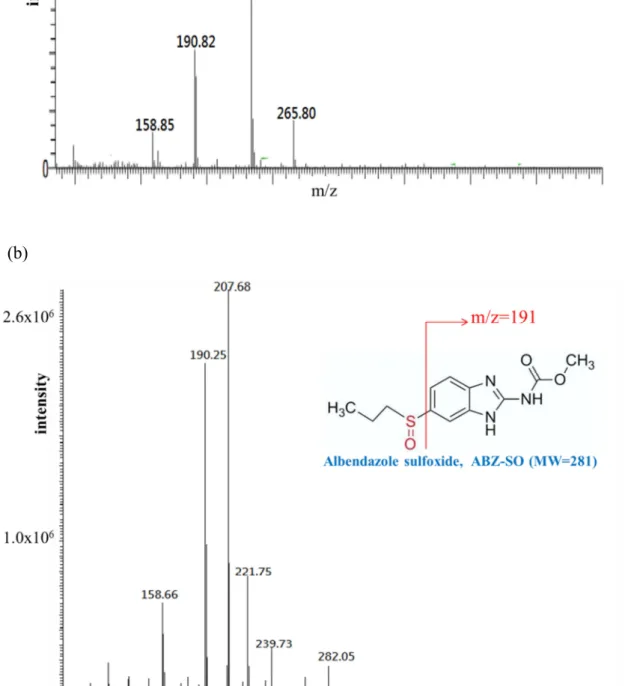
The transformation product of ABZ was identified with HPLC/ESI (+)-MS as described in references [55, 56]. Figure 1 is the mass spectrum of ABZ standard and its transformation product.
The molecular ion of ABZ was at m/z 266 which has two major fragments at m/z 191 (the core structure plus methyl carbomate group) and m/z 234. The product also has a fragment at m/z 191, indicating that the oxidation must not take place in the region which contributed to m/z 191. The molecular ion of the transformation product was at m/z 282 and it is 16 times higher than ABZ. We speculated that there is an oxygen atom attaching to the sulfur on the substituent of the benzene ring to generate albendazole sulfoxide (ABZ-SO), one of the metabolites of ABZ. This result confirmed the hypothesis that the oxidation position is not in the core structure and methyl carbomate group.
However, no other transformation product like albendazole sulfone (ABZ-SO2) was observed.
Figure 1 Mass spectrum of ABZ and its transformation product (a)
(b)
3.3 Reaction Kinetics of ABZ with MnO2
Effects of pH
Figure 2(a) shows the reaction kinetics of ABZ (3.8 µM) with MnO2 (40 µM) in different pH condition (pH4-9). 10 mM of acetic acid (for pH4 and 5), MOPS (for pH6 and 7) and CHES (for pH8 and 9) were used as buffers. Note that the reactions were conducted using the ABZ stock with 1.9 % methanol. ABZ decayed most rapidly in pH4 and almost all transformed into ABZ-SO within 2 days. Nevertheless, the reactions were significantly suppressed between pH 5 and 9 and no adsorption was observed in this pH range. This observation was not consistent with the high Kow and Koc characteristics of ABZ. However, the chargeability of MnO2 surface and the species distribution of ABZ in different pH condition may be the key to the reason why the reaction was relatively rapid in pH 4. The pKa1 of ABZ is 3.37 (Table 1) and the pHzpc of MnO2 was reported to be 2.8 [57]. That means the positively charged ABZ is much more abundant in low pH and the surface of MnO2 is mainly negative at the meantime, which leads to a higher reactivity. Methanol was thought to be responsible for the suppression of ABZ adsorption on MnO2. ABZ can be easily dissolved in methanol due to its high Kow and preparing ABZ in methanol interferes the contact of ABZ with MnO2 and further restrains the adsorption and degradation. After 3 days, only 5 % ABZ degraded in pH 5, about 10 - 15% in pH 6 and 7, and 25 % in pH 8 and 9. It was obvious that the reaction rate increase with pH rising from pH 5 to 9. In the similar way as methanol, the buffers used in the reaction greatly interfered ABZ adsorption.
Therefore, a new experimental set up was conducted with ABZ stock solution prepared in pure water. In order to eliminate the interferences of organic matter, no buffer was used in this batch.
Unlike the previous experiments, the accumulation of ABZ concentration on MnO2 can be observed.
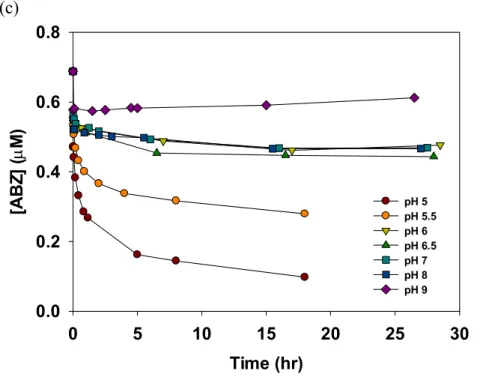
The results in Figure 2(b) (c) shows ABZ almost degraded within 1 hour below pH 4 and the reactivity significantly decreased with the increase of pH value. However, the reactions were also inhibited in higher pH condition. It was supposed that only limited amount of ABZ could adsorb on MnO2 because of the repulsion of charges, so the concentrations of ABZ reach equilibriums after ABZ attaching on it in the beginning were totally oxidized and no further reaction could occur. The equilibrium concentration in pH 9 was the highest, which means least ABZ can adsorb on MnO2 in such a high pH condition.
Time (hr)
0 20 40 60 80
C/C0 (%)
0 20 40 60 80 100
pH 4 pH 5 pH 6 pH 7 pH 8 pH 9
Time (min)
0 20 40 60 80
[ABZ] (µM)
0.0 0.2 0.4 0.6 0.8
pH 2.5 pH 4 pH 4.5
(a)
(b)
Time (hr)
0 5 10 15 20 25 30
[ABZ] (µM)
0.0 0.2 0.4 0.6 0.8
pH 5 pH 5.5 pH 6 pH 6.5 pH 7 pH 8 pH 9
Figure 2 Kinetics of pH effect
Reaction condition: (a) [ABZ]0 = 3.8 µM, [MnO2]0 = 40 µM; (b)(c) [ABZ]0 = 0.7 µM, [MnO2]0 = 40 µM
Effects of ionic strength and metal cations
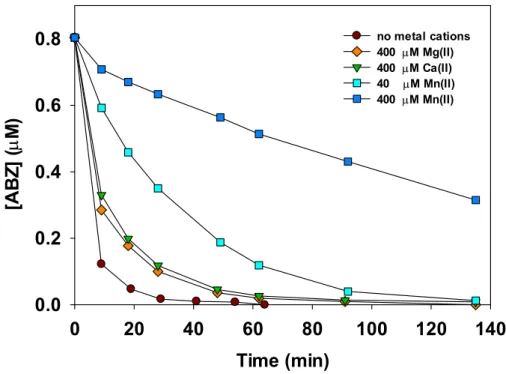
The reactivity with different ionic strength and metal cations including Ca(II), Mg(II) and Mn(II) were studied in pH4 (10 mM acetic acid was used as buffer). Ionic strength was found to have very minor effect. Figure 3 shows the influence of different metal cations. Ca(II) and Mg(II) also had slight effects on the reactivity because their adsorption tendencies to MnO2 surface are relatively low [58, 59]. However, Mn(II) significantly interfered the reactions because MnO2 could be reduced by Mn(II) to trivalent form and lose its oxidative capacity, which undergo this reaction: Mn2+ + MnO2 + 2 H2O ⇋ 2 MnOOH+ 2 H+ [59, 60]. In short, the effects were stronger with higher ionic strength and metal cations concentration.
(c)
Time (min)
0 20 40 60 80 100 120 140
0.0 0.2 0.4 0.6
0.8 no metal cations
400 µM Mg(II) 400 µM Ca(II) 40 µM Mn(II) 400 µM Mn(II)
[ABZ] (µM)
Figure 3 Kinetics of metal cations effect in pH 4
Reaction condition: [ABZ]0 = 0.8 µM, [MnO2]0 = 40 µM
Effects of organic matter
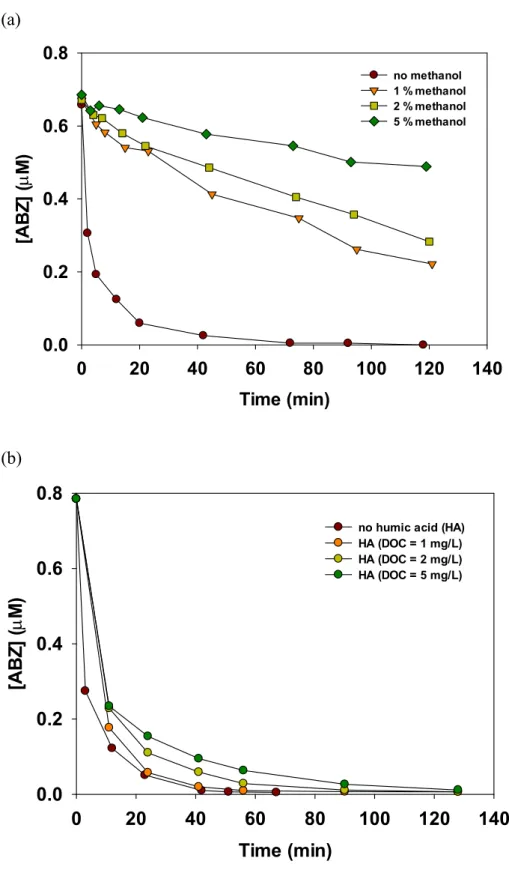
In the previous results, methanol was thought to suppress the reactions, so it was suspected natural organic matters in the soil could also interfere with the reactivity. Figure 4 shows the effects of methanol and humic acid studied in pH4 (10 mM acetic acid was used as buffer). When there was no other organic matter in the solution, ABZ could be completely transferred within one hour.
However, after 120 min of reaction, 30 % ABZ was left in a 1 % methanol (~3,000 mg C/L) solution, 45 % left with 2 % methanol (~6,000 mg C/L), and 80 % left with 5 % methanol (~15,000 mg C/L).
Humic acid appeared effect on the reaction rate as well (Figure 4 (b)).
Time (min)
0 20 40 60 80 100 120 140
[ABZ] (µM)
0.0 0.2 0.4 0.6 0.8
no methanol 1 % methanol 2 % methanol 5 % methanol
Time (min)
0 20 40 60 80 100 120 140
[ABZ] (µM)
0.0 0.2 0.4 0.6 0.8
no humic acid (HA) HA (DOC = 1 mg/L) HA (DOC = 2 mg/L) HA (DOC = 5 mg/L)
Figure 4 Kinetics of organic matter effect in pH 4.
(a)
(b)
3.4 Hydrolysis products
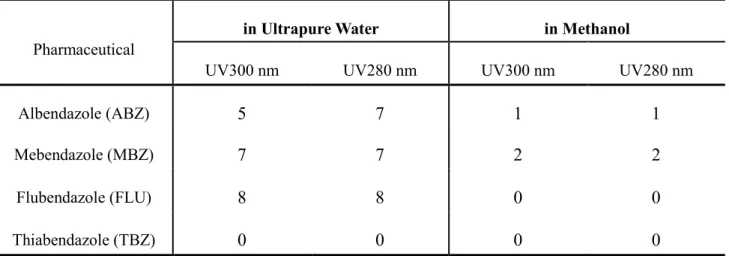
Due to the low water solubility of benzimidazoles, the stock solutions were prepared in methanol in most related studies. However, we have found that their behaviors in solution with organic matter are different from a water only condition. In the solubility test, the four benzimidazoles we concerned were dissolved in ultrapure water and methanol for over 30 days with stirring in 300 rpm. The water solubility we determined had large differences (over 10 times lower) from other literatures, as shown in Table 1. Besides, many derivatives were detected in UV300 and 280 nm when the benzimidazoles dissolved in ultrapure water. The number of hydrolysis products and their detecting condition are organized in the Table 2.
Table 2 Number of hydrolysis products observed in ultrapure water and methanol
Pharmaceutical
in Ultrapure Water in Methanol
UV300 nm UV280 nm UV300 nm UV280 nm
Albendazole (ABZ) 5 7 1 1
Mebendazole (MBZ) 7 7 2 2
Flubendazole (FLU) 8 8 0 0
Thiabendazole (TBZ) 0 0 0 0
At least seven derivatives generated when ABZ dissolved in ultrapure water. As ABZ dissolved in methanol, only one derivative and ABZ itself were observed. In the preliminary test, ABZ reacted with MnO2 in the solution containing methanol, only one transformation product (ABZ-SO) could be detected. However, in the reaction without methanol, two products were observed in UV300 nm and three products could be seen in UV280 nm after the addition of MnO2. Besides, three derivatives of ABZ decreased and one stayed unchanged.
Seven derivatives generated when MBZ dissolved in ultrapure water. All of them could be detected both in UV280 and UV300 nm. As MBZ dissolved in methanol, only two main derivatives were detected. At least eight derivatives yielded when FLU dissolved in ultrapure water. In the condition with methanol, only FLU itself was observed. The structure of FLU is very similar to MBZ.
chromatograms of their derivatives are very similar. These derivatives and products may relate to some compounds mentioned in previous researches. Unlike ABZ, MBZ and FLU, TBZ did not generate any hydrolysis product both in pure water and methanol. It is suggested that the chemical structure of TBZ is much more different from the other three compounds and its water solubility is higher as well.
4. Conclusion
ABZ, MBZ and FLU can adsorb on the surface of MnO2, but only ABZ can react with MnO2 then generate several transformation products. The reactions of ABZ were rapid in low pH condition.
TBZ neither adsorbed nor reacted. One of the transformation products of ABZ was identified by LC/ESI (+)-MS. It was suggested that the oxidation of ABZ with MnO2 do not take place in the core structure of the benzene ring and imidazole ring as well as the methyl carbamate group, but on the propylthio substituent. The pH can significantly affect the reactions of ABZ with MnO2. Ionic strength and the presence of alkaline earth metals caused very minor effects. However, Mn(II) could greatly suppress the reactions. Organic solvent such as methanol may lead to a false interpretation of the reactions and it was reasonably suspected that natural organic matters also have the possibility to inhibit the degradation. Based on the high reactivity of ABZ for oxidative transformations by MnO2, it is quite likely that ABZ will transform with the presence of MnO2 in soils. To sum up, the reaction kinetics of ABZ and MnO2 are related to pH, the presence of metal ions and organic matters. The studies of water solubility and derivatives in water also provided useful information of benzimidazole potential fate in soil-water environment.
Acknowledgments
This work is supported by Ministry of Science and Technology of Taiwan. Research grant:
104-2815-C-006-087-E.
References
3. McCracken, R.O. and W.H. Stillwell, A possible biochemical mode of action for benzimidazole anthelmintics. International Journal for Parasitology, 1991. 21(1): p. 99-104.
4. Seiler, J.P., The mutagenicity of benzimidazole and benzimidazole derivatives I. Forward and reverse mutations in Salmonella typhimurium caused by benzimidazole and some of its derivatives. Mutation Research/Fundamental and Molecular Mechanisms of Mutagenesis, 1972. 15(3): p. 273-276.
5. The Merck Veterinary Manual, http://www.merckvetmanual.com/mvm/index.html.
6. McKellar, Q.A. and F. Jackson, Veterinary anthelmintics: old and new. Trends in Parasitology, 2004. 20(10): p. 456-461.
7. Horton, J., Albendazole: a review of anthelmintic efficacy and safety in humans. Parasitology, 2000. 121(SupplementS1): p. S113-S132.
8. Kinsella, B., J. O’Mahony, E. Malone, M. Moloney, H. Cantwell, A. Furey, and M. Danaher, Current trends in sample preparation for growth promoter and veterinary drug residue analysis. Journal of Chromatography A, 2009. 1216(46): p. 7977-8015.
9. Horvat, A.J.M., S. Babić, D.M. Pavlović, D. Ašperger, S. Pelko, M. Kaštelan-Macan, M.
Petrović, and A.D. Mance, Analysis, occurrence and fate of anthelmintics and their transformation products in the environment. TrAC Trends in Analytical Chemistry, 2012. 31:
p. 61-84.
10. Lacey, E., R.L. Brady, R.K. Prichard, and T.R. Watson, Comparison of inhibition of polymerisation of mammalian tubulin and helminth ovicidal activity by benzimidazole carbamates. Veterinary Parasitology, 1987. 23(1–2): p. 105-119.
11. Carlsson, G., J. Patring, E. Ullerås, and A. Oskarsson, Developmental toxicity of albendazole and its three main metabolites in zebrafish embryos. Reproductive Toxicology, 2011. 32(1): p.
129-137.
12. Capece, B.P.S., M. Navarro, T. Arcalis, G. Castells, L. Toribio, F. Perez, A. Carretero, J.
Ruberte, M. Arboix, and C. Cristòfol, Albendazole Sulphoxide Enantiomers in Pregnant Rats Embryo Concentrations and Developmental Toxicity. The Veterinary Journal, 2003. 165(3): p.
266-275.
13. Cristòfol, C., M. Navarro, C. Franquelo, J.E. Valladares, A. Carretero, J. Ruberte, and M.
Arboix, Disposition of Netobimin, Albendazole, and Its Metabolites in the Pregnant Rat:
Developmental Toxicity. Toxicology and Applied Pharmacology, 1997. 144(1): p. 56-61.
14. Whittaker, S.G. and E.M. Faustman, Effects of albendazole and albendazole sulfoxide on cultures of differentiating rodent embryonic cells. Toxicology and Applied Pharmacology, 1991. 109(1): p. 73-84.
15. Wagil, M., A. Białk-Bielińska, A. Puckowski, K. Wychodnik, J. Maszkowska, E. Mulkiewicz, J. Kumirska, P. Stepnowski, and S. Stolte, Toxicity of anthelmintic drugs (fenbendazole and flubendazole) to aquatic organisms. Environmental Science and Pollution Research, 2014.
22(4): p. 2566-2573.
16. Yoshimura, H., Effect of oral dosing vehicles on the developmental toxicity of flubendazole in rats. Reproductive Toxicology, 2003. 17(4): p. 377-385.
17. Speare, R., L.F. Skerratt, L. Berger, and P.M. Johnson, Toxic effects of mebendazole at high dose on the haematology of red-legged pademelons (Thylogale stigmatica). Australian Veterinary Journal, 2004. 82(5): p. 300-303.
18. Tada, Y., T. Fujitani, and M. Yoneyama, Acute renal toxicity of thiabendazole (TBZ) in ICR mice. Food and Chemical Toxicology, 1992. 30(12): p. 1021-1030.
19. Weiss, K., W. Schüssler, and M. Porzelt, Sulfamethazine and flubendazole in seepage water after the sprinkling of manured areas. Chemosphere, 2008. 72(9): p. 1292-1297.
20. Van De Steene, J.C. and W.E. Lambert, Validation of a solid-phase extraction and liquid chromatography–electrospray tandem mass spectrometric method for the determination of nine basic pharmaceuticals in wastewater and surface water samples. Journal of Chromatography A, 2008. 1182(2): p. 153-160.
21. Bartelt-Hunt, S.L., D.D. Snow, T. Damon, J. Shockley, and K. Hoagland, The occurrence of illicit and therapeutic pharmaceuticals in wastewater effluent and surface waters in Nebraska. Environmental Pollution, 2009. 157(3): p. 786-791.
22. Castillo, L.E., C. Ruepert, and E. Solis, Pesticide residues in the aquatic environment of banana plantation areas in the North Atlantic Zone of Costa Rica. Environmental Toxicology and Chemistry, 2000. 19(8): p. 1942-1950.
23. Taylor, M.A., K.R. Hunt, and K.L. Goodyear, The effects of stage-specific selection on the development of benzimidazole resistance in Haemonchus contortus in sheep. Veterinary Parasitology, 2002. 109(1–2): p. 29-43.
24. Jjemba, P.K., Excretion and ecotoxicity of pharmaceutical and personal care products in the environment. Ecotoxicology and Environmental Safety, 2006. 63(1): p. 113-130.
25. Ragno, G., A. Risoli, G. Ioele, and M. De Luca, Photo- and Thermal-Stability Studies on Benzimidazole Anthelmintics by HPLC and GC-MS. Chemical and Pharmaceutical Bulletin, 2006. 54(6): p. 802-806.
26. Murthy, N.B.K., P.N. Moza, K. Hustert, K. Raghu, and A. Kettrup, Photolysis of thiabendazole in aqueous solution and in the presence of fulvic and humic acids.
Chemosphere, 1996. 33(10): p. 1915-1920.
27. Ragno, G., A. Risoli, G. Ioele, and M.D. Luca, Photo- and Thermal-Stability Studies on Benzimidazole Anthelmintics by HPLC and GC-MS. Chemical and Pharmaceutical Bulletin, 2006. 54(6): p. 802-806.
28. Li, L., D.-X. Xing, Q.-R. Li, Y. Xiao, M.-Q. Ye, and Q. Yang, Determination of Albendazole
30. Gyurik, R.J., A.W. Chow, B. Zaber, E.L. Brunner, J.A. Miller, A.J. Villani, L.A. Petka, and R.C. Parish, Metabolism of albendazole in cattle, sheep, rats and mice. Drug Metabolism and Disposition, 1981. 9(6): p. 503-508.
31. Al-Kurdi, Z., T. Al-Jallad, A. Badwan, and A.M.Y. Jaber, High performance liquid chromatography method for determination of methyl-5-benzoyl-2-benzimidazole carbamate (mebendazole) and its main degradation product in pharmaceutical dosage forms. Talanta, 1999. 50(5): p. 1089-1097.
32. RJ, A., G. HT, and W. TR., Two high-performance liquid chromatographic determinations for mebendazole and its metabolites in human plasma using a rapid Sep Pak C18 extraction.
Journal of Chromatography A, 1980. 183(3): p. 311-9.
33. De Ruyck, H., E. Daeseleire, K. Grijspeerdt, H. De Ridder, R. Van Renterghem, and G.
Huyghebaert, Distribution and depletion of flubendazole and its metabolites in edible tissues of guinea fowl. British Poultry Science, 2004. 45(4): p. 540-549.
34. Elkhoudary, M.M., R.A. Abdel Salam, and G.M. Hadad, Stability-Indicating Methods for Determination of Flubendazole and Its Degradants. Journal of Chromatographic Science, 2015. 53(6): p. 915-924.
35. Nobilis, M., Z. Vybíralová, V. Křížová, V. Kubíček, M. Soukupová, J. Lamka, B. Szotáková, and L. Skálová, Sensitive chiral high-performance liquid chromatographic determination of anthelmintic flubendazole and its phase I metabolites in blood plasma using UV photodiode-array and fluorescence detection: Application to pharmacokinetic studies in sheep. Journal of Chromatography B, 2008. 876(1): p. 89-96.
36. Danaher, M., H. De Ruyck, S.R.H. Crooks, G. Dowling, and M. O’Keeffe, Review of methodology for the determination of benzimidazole residues in biological matrices. Journal of Chromatography B, 2007. 845(1): p. 1-37.
37. Calza, P., S. Baudino, R. Aigotti, C. Baiocchi, and E. Pelizzetti, Ion trap tandem mass spectrometric identification of thiabendazole phototransformation products on titanium dioxide. Journal of Chromatography A, 2003. 984(1): p. 59-66.
38. Tocco, D.J., R.P. Buhs, H.D. Brown, A.R. Matzuk, H.E. Mertel, R.E. Harman, and N.R.
Trenner, The Metabolic Fate of Thiabendazole in Sheep1. Journal of Medicinal Chemistry, 1964. 7(4): p. 399-405.
39. Hilário, V.C., D.B. Carrão, T. Barth, K.B. Borges, N.A.J.C. Furtado, M.T. Pupo, and A.R.M.
de Oliveira, Assessment of the stereoselective fungal biotransformation of albendazole and its analysis by HPLC in polar organic mode. Journal of Pharmaceutical and Biomedical Analysis, 2012. 61: p. 100-107.
40. Prasad, G.S., S. Girisham, and S.M. Reddy, Studies on microbial transformation of albendazole by soil fungi. Indian Journal of Experimental Biology, 2009. 8(4): p. 425-429.
41. Prasad, G.S., S. Girisham, and S.M. Reddy, Microbial transformation of albendazole. Indian Journal of Experimental Biology, 2010. 48(4): p. 415-20.
42. DB, C., B. KB, B. T, P. MT, B. PS, and d.O. AR., Capillary electrophoresis and hollow fiber liquid-phase microextraction for the enantioselective determination of albendazole sulfoxide after biotransformation of albendazole by an endophytic fungus. Electrophoresis, 2011.
31(19): p. 2746-56.
43. Lombardi, B., M. Baschini, and R.M. Torres Sánchez, Optimization of parameters and adsorption mechanism of thiabendazole fungicide by a montmorillonite of North Patagonia, Argentina. Applied Clay Science, 2003. 24(1–2): p. 43-50.
44. Roca Jalil, M.E., R.S. Vieira, D. Azevedo, M. Baschini, and K. Sapag, Improvement in the adsorption of thiabendazole by using aluminum pillared clays. Applied Clay Science, 2013.
71: p. 55-63.
45. Aharonson, N. and U. Kafkafi, Adsorption of benzimidazole fungicides on montmorillonite and kaolinite clay surfaces. Journal of Agricultural and Food Chemistry, 1975. 23(3): p.
434-437.
46. Aharonson, N. and U. Kafkafi, Adsorption, mobility, and persistence of thiabendazole and methyl 2-benzimidazolecarbamate in soils. Journal of Agricultural and Food Chemistry, 1975.
23(4): p. 720-724.
47. Hodson, J. and N.A. Williams, The estimation of the adsorption coefficient (Koc) for soils by high performance liquid chromatography. Chemosphere, 1988. 17(1): p. 67-77.
48. Pussemier, L., G. Szabó, and R.A. Bulman, Prediction of the soil adsorption coefficient Koc for aromatic pollutants. Chemosphere, 1990. 21(10–11): p. 1199-1212.
49. Millaleo, R., M. Reyes- Diaz, A.G. Ivanov, M.L. Mora, and M. Alberdi, Manganese as essential and toxic element for plants: transport, accumulation and resistance mechanisms.
Journal of soil science and plant nutrition, 2010. 10: p. 470-481.
50. Zhang, H., W.-R. Chen, and C.-H. Huang, Kinetic Modeling of Oxidation of Antibacterial Agents by Manganese Oxide. Environmental Science & Technology, 2008. 42(15): p.
5548-5554.
51. Li, H., L.S. Lee, D.G. Schulze, and C.A. Guest, Role of Soil Manganese in the Oxidation of Aromatic Amines. Environmental Science & Technology, 2003. 37(12): p. 2686-2693.
52. Yalkowsky, S.H., Y. He, and P. Jain, Handbook of aqueous solubility data. 2010, Boca Raton, Fla.: CRC Press.
53. Human Metabolome Database, http://www.hmdb.ca.
54. Zhang, H. and C.-H. Huang, Oxidative Transformation of Triclosan and Chlorophene by Manganese Oxides. Environmental Science & Technology, 2003. 37(11): p. 2421-2430.
55. Maurin, A.J.M., Y. Iamamoto, N.P. Lopes, J.R. Lindsay-Smith, and P.S. Bonato, LC-MS-MS
tandem mass spectrometry. Journal of Chromatography B, 2010. 878(30): p. 3174-3180.
57. Morgan, J.J. and W. Stumm, Colloid-chemical properties of manganese dioxide. Journal of Colloid Science, 1964. 19(4): p. 347-359.
58. Murray, J.W., The interaction of metal ions at the manganese dioxide-solution interface.
Geochimica et Cosmochimica Acta, 1975. 39(4): p. 505-519.
59. Posselt, H.S., F.J. Anderson, and W.J. Weber, Cation sorption on colloidal hydrous manganese dioxide. Environmental Science & Technology, 1968. 2(12): p. 1087-1093.
60. Gabano, J.P., P. Etienne, and J.F. Laurent, Etude des proprietes de surface du bioxyde de manganese. Electrochimica Acta, 1965. 10(9): p. 947-963.