Chapter II LITERATURE REVIEW
This chapter reviews the related literature on HR outsourcing, roles of HR professionals, and competencies of HR professionals. On the basis of what is currently studied about these concepts, the researcher thus formulates the basis of this study.
Roles of Human Resource Professionals Definition of Roles
Upon investigating the roles of Human Resource professionals, it is important to first identify the definition of “roles”. Robbins (1997) defined roles as a set of expected behaviors patterns attributed to someone by occupying a given position in a social unit. 張火燦(1997) pointed out that the concept of “roles” is composed of the following three fundamental elements: the expected behavior on a job function, self-perceived responsibilities, and the actual performed actions of an individual.
Roles of Human Resource Professionals
In describing HR practices based on organizational differences, Chen and Pfeffer described four perspectives for explaining the organizational determinants of human resource management (HRM) practices: the technical, control, institutional, and political perspectives (Jackson and Shuler, 1992). The technical perspective presumes that organizations wish to plan, staff, appraise, compensate, train, and develop their employees in order to ensure that right people are in the right place at the right time (Collins, 1979). The technical perspective leads to research designed to develop techniques for maximizing the match between employees’ knowledge,
skills and abilities on the one hand and the demand of the jobs on the other. The control perspective views HRM practices as a means for organizations to ensure the predictability and reliability of social interactions, ensuring that employees behave as solid citizens, living according to organizationally approved norms and values. The institutional perspective assumes that legitimacy and acceptance are important objectives for most organizations. The political perspective holds that HRM practices reflect the distribution of power in an organization. Katz & Kahn focused on another perspective, the role theory perspective. They assumed HRM as the organizations’ primary means for sending role information through the organization, supporting desired behaviors, and evaluating role performances. Effective HRM helps employees meet the expectations of role partners (i.e. supervisors, peers, subordinates, customers, clients) within the organization and between organizations (Jackson and Shuler, 1995). In regards the role of “change maker”, Kemske (1998) also pointed out that leading change was the greatest contribution that HR brought to an organization, in which HR professionals initiated change and promoted results.
Kesler (1995) stated that the HR departed should carry out the following functions. These functions were also regarded as competencies:
1. Catalytic influence
2. Diagnostics and fact-based analysis
3. Innovating business structures and process 4. Assuring standards
5. Administration and services 6. Problem-solving.
The above assumptions of HR roles merely list out the different roles of HR professionals in different organizational contexts. However, we must consider one key issue in the evolution of roles of HR professional – a movement toward a more
strategic HR.
Movement towards a More Strategic HR
The role of HR professionals in organizations has been evolving dramatically in recent years. As mentioned previously, one of the important transformations in the evolution is the movement toward being strategic. The overall nature of the corporate HR department changes with a strategic approach.
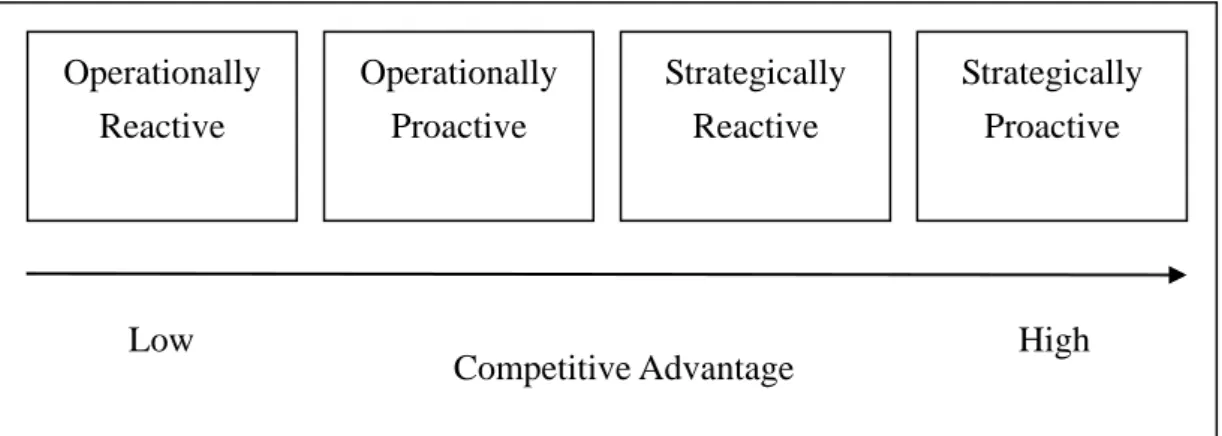
Brockbank (1999) argued that HR could add greater value by holding itself to the standards of being more strategic (as opposed to operational) and more proactive (as opposed to reactive). The goal is to have HR create values and thus lead to
competitiveness. Please refer to the following figure.
Figure 2.1: HR Competitive Advantage Index Source: Brockbank, 1999.
Operational HR activities generally referred to the routine, day-to-day delivery of HR basics. The strategic level of HR activity was more complex and involved five criteria: long term, comprehensive, planned, integrated, and high value-added.
Specific HR agendas and activities may be associated with each of these levels of HR as competitive advantage. Focusing on the strategic side, the strategically reactive and strategically proactive arenas of HR involvement are reviewed. In being
Operationally Reactive
Operationally Proactive
Strategically Reactive
Strategically Proactive
Low High
Competitive Advantage
strategically reactive, HR engages in linking HR tactics to specific business strategies and associated tactics, creating the culture that is necessary to execute business strategies, and providing change management techniques and processes. In being strategically proactive, HR engages in creating the corporate culture of innovation and creativity, contributing to each phase of the merger and acquisition processes, and leading the effort to oink internal capabilities to external market requirements. In conclusion, as HR moves from operationally reactive, to strategically proactive, its focus shifts from the day-to day basics of business to implementing and creating business strategic alternatives.
One of the driving forces behind this is movement toward a strategic HR is that the HR function has been in crisis, increasingly under fire to justify itself (Shuler, 1990, Steward, 1996). Often times, it is confronted with the very real prospect that a significant portion of its traditional responsibilities will be outsourced. In other words, the refocus of HR as strategic roles provide incentives for corporations to outsource costly HR transactions. This action has also dramatically increased the strategic value of a skilled, motivated, adaptable workforce. It is important to note that the causal relationship from a strategic HR to outsourcing HR functions can be reversed. As HR functions are being outsourced, their roles are becoming even more strategic (嚴家瑩, 2004).
Applying this concept, Storey (1992) has proposed one of the earliest
frameworks on the basis of strategic vs. operational. In his model, the roles of HR functions could be viewed on the basis of “organization involvement”, and “strategic vs. operational” as the following four roles: advisor, handmaiden, regulator, and change maker. Please refer to the figure below.
Figure 2.2: Roles of Human Resource Management Source: Storey, 1992.
Such categorization and definition of roles aimed at self-redefinition of identity for HR professionals and serves as a foundation for the next model that will be review, and one that will be used for this study.
A Multiple-Role Model for Human Resources Management
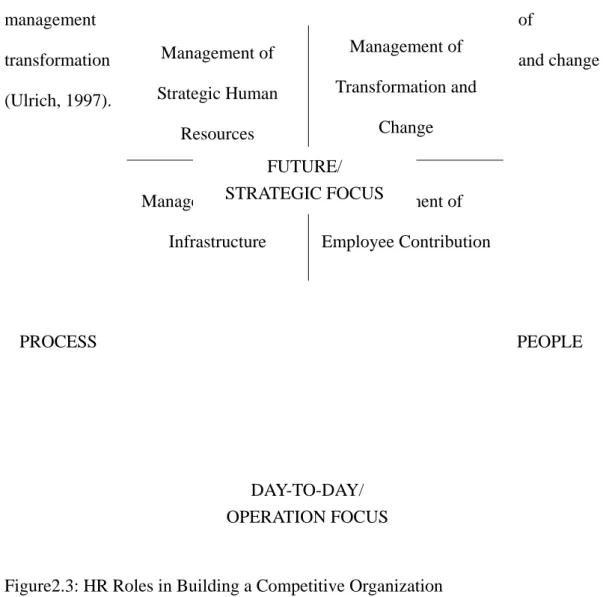
The above framework has identified an essence for this next model by Ulrich, one of the most prominent figures in the field of human resources. According to Ulrich (1997), the roles undertaken by HR professionals are multiple, not single. An effective HR professional needs to fulfill both operational and strategic roles and they must take responsibility for both qualitative and quantitative goals over the short and long run. For HR professionals to create value and deliver results playing the increasingly complex roles, they must focus on defining the “deliverables” of their work. Deliverables lead to outcome and through the fulfillment of the following four roles that HR professionals carry out the defined deliverables as presented in the
Change Maker Advisor
Regulator Handmaiden STRATEGIC
TACTICAL
INVENTIONARY NON-
INTERVENTIONARY
figure below. These four roles include: management of strategic human resources, management of firm infrastructure, management of employee contribution, and
management of
transformation and change
(Ulrich, 1997).
Figure2.3: HR Roles in Building a Competitive Organization Source: Ulrich, 1997
HR professionals must learn to be both strategic and operational, focusing on the long and short term. Therefore, the two axes represent the HR professional’s focus and activities, in which focus ranges from long-term/strategic to
short-term/operational. Activities range from managing processes (HR tools and systems) to managing people. These two axes describe and derive the four principal HR roles mentioned above. To understand each of these roles more fully, we must consider these three issues: the “deliverables” that constitute the outcome of the role,
Management of Strategic Human
Resources
Management of Transformation and
Change
Management of Firm Infrastructure
Management of Employee Contribution FUTURE/
STRATEGIC FOCUS
DAY-TO-DAY/
OPERATION FOCUS
PROCESS PEOPLE
the characteristic “metaphor” or visual image that accompanies the role, and the
“activities” HR professionals must perform to fulfill the role. The following table (Table 2.1) summarized these issues for each of the roles identified in Figure 2.2.
Table 2.1: Definition of HR Roles
Role
Deliverable
Outcome Metaphor Activity Management of
Strategic Human Resources
Executing strategy Strategic Partner Aligning HR and business strategy:
“Organizational diagnosis”
Management of Firm Infrastructure
Building an efficient infrastructure
Administrative Expert
Reengineering Organization Processes: “Shared Services”
Management of Employee Contribution
Increasing employee
commitment and capability
Employee Champion
Listening and responding to Employees:
“Providing resources to employees”
Management of Creating a renewed Change Agent Managing
Transformation and Change
organization transformation and
change: “Ensuring capacity for change”
Source: Ulrich, 1997.
The framework of this study will employ the metaphor of each role. This particular model is adopted for the study as it adequately considers the important issue of movement of strategic HR, and defines clearly the outcomes and activities
expected out of each role. In addition, it ranks on the top as the most
widely-accepted frameworks. When Ulrich advised this framework over the course of his work with dozens of companies and hundreds of HR professionals; many
companies have since used it as a way to describe the deliverables of their HR work.
As a concluding thought in reviewing the roles of HR professionals, they are viewed less as administrators and mush more as partners with the business units in assuring their success. Consequently, a strategic approach to HR involves not only changes in how people are managed but also changes in how HR does its work, for which competencies of HR professionals are in need to being identified as the next step in this study.
Competencies of Human Resource Professionals Definition of Competency
In this era of changes, the demand for professional knowledge and capabilities of HR professionals are being recognized by the business world. Competent HR professionals are demanded by business organizations (Michael R. Losey, 1999).
This section will review the different definitions of competency in general before focusing on the competencies needed by HR professionals.
One of the earliest definitions of competency is one proposed by McClelland in 1973, stating that competency is closely related to clusters of life outcomes and affects one’s performance. This is a generalization that considers factors of success, both psychological and behavioral, and leads to a more definite meaning of
competencies over time. Such definition that emerges refers competency as knowledge, skills, abilities, and other characteristics, called “KSAO’s” in short.
However, such proposition lacks business perspectives. It merely points out the meaning of competency by names of different types, but fails to consider contribution toward business strategies. In 1983, based on a study, “Model for Excellence”
sponsored by ASTD, McLagan has defined competency as a series of knowledge, skills, and ability and behaviors required for successful performance of job duties.
In 1990, Prohalad & Hame further proposed the concept of core competence, referring to the intellectual competence, process competence, and product competence, all of which are associated with market competitiveness. In 1993, Spencer pointed out that competency refers to the underlying characteristic of an individual, which is the casually related with a standard level of effectiveness and/or with a superior
development in a work or situation. Page and Wilson (1994) defined competency as required skills, abilities, personal characteristics for a good management figure, focusing on both the tangible aspects as knowledge and skills, as well as intangible aspects as personal characteristics that cannot be easily evaluated. Boyatzis (1996) offered a “classic” definition that embraces both the “being” and “doing” aspects of competence as “an effective mix of motives, traits, skills, aspects of ones self image or social role, of body of knowledge used by an individual.” Motive is defined as “a factor or circumstance that induces a person to act in a particular way.” The
implication of this definition is that underlying traits or qualities become
competencies when they are activated in particular ways. In Upon reviewing these
different definitions of competencies, we need to address the challenge of whether competence is portable and generic or contextual and hence specific. Studies have shown little evidence to suggest that generic lists of competencies can be produced.
To gain a better understanding of competencies, reviewing the different categorizations of competencies is needed.
Categorizations of Competencies
In seeking a better understanding of competencies and its implication, this section will discuss the different categorization of competencies proposed by different scholars. Spencer (1993) proposed the Iceberg model, classifying human
competencies into two broad categories: hidden and visible competencies. These two groupings ought to be regarded as a continuum of perceptibility, not a separate, either-or category. The hidden grouping includes motives, traits and self-concept.
These three types of competencies are termed as “hidden” because they are closer to the inner part of a person’s personality, and thus, difficult to assess. On the other hand, knowledge and skill are more visible and more easily to assess in terms of action or behavior. Similarly, the visible skills and knowledge are easily trained and developed compared to the hidden traits. Please refer to the figure below:
Skill, Knowledge
Self-Concept Traits Motivation Visible
Hidden
Figure 2.4: The Icerberg Model
Source: Yeung, 1996
The crux of this model is that a person’s “intent” guides that person’s action. In other words, motives, traits, self-concept and knowledge are the drives for skill action behaviors and, finally, job performance.
Blancero, Boroski, and Dyer (1996) proposed that competency includes
knowledge, skills, abilities, and attributes, and is categorized into the following eight types:
1. Managerial 2. Business 3. Technical 4. Interpersonal
5. Cognitive/Imaginative 6. Influence style
7. Organization 8. Personal
All the models presented above lacked the indication of importance and
positioning in business operations. In seeking a model that considers significance of competency and categorize accordingly, the model proposed by Kochanski and Ruae (1996) is reviewed. In this model, competency is divided into four levels according to this positioning and importance: strategic, core, requisite, and misfit. The strategic level mainly aims at driving competitive advantages and adding values to customers. The core level enables strategies. The requisite level emphasized on
unique, necessary competencies. The misfits are those outside of strategic direction and the redundant.
The models mentioned are categorizations of competency that are for general business figures. These models have not placed the focus on the HR professionals.
It is still important to review these models, as they serve as the foundation for the one that will be chosen as the framework of this study. The following section will review the competencies for HR professionals.
Competencies Needed by HR Professionals
Based on a series of studies conducted by Ulrich, (Ulrich et al., 1989a, 1989b;
Ulrich & Yeung, 1989), the competencies needed by HR professionals can be divided into three types: knowledge of business, delivery of human resources, and
management of change. Lawson (1990), after conducting a research on 70 experts, found out the key competencies for HR professionals are as follows: goal and action management, functional and organizational leadership, influence management, business knowledge, and human resource technical proficiencies. This model merely points out competencies of HR professionals as a whole, and lacks to define the competencies for specific levels or positions of HR. Spencer, (1993) further
proposed a model that defines the competencies by separate levels of HR professional.
According to this model, executives, managers, and employees, as HR professionals, should acquire the following:
1. For executive: strategic thinking, change leadership, and relationship management.
2. For managers: flexibility, change implementation, entrepreneurial innovation, interpersonal understanding, empowering, team facilitation, and portability.
3. For employees: flexibility, information-seeking motivation and ability to learn,
achievement motivation, work motivation under time pressure, compatibility, and customer service orientation.
Upon reviewing the competencies of HR professionals, it is essential to examine the model proposed by a prominent scholar in competency models – one proposed Boyatzis in 1996. According to Boyatzis, HR professionals should acquire the following three types of competencies: 1. Goal and action management abilities.
2. Interpersonal/people management. 3. Analytic or cognitive reasoning. The components for each type are presented as follows:
Table 2.2: Competencies of HR Professionals
Type Competency of HR
Goal and Action Management Abilities Efficiency orientation Planning
Initiative or efficacy Attention to details Self control
Flexibility
Interpersonal/People Management Empathy Persuasiveness Networking Negotiating Self-confidence
Group management or team leadership Developing others
Oral communication
Analytic Reasoning or Cognitive System thinking Pattern recognition Social Objectivity Written communication
Source: Yeung, 1996.
The above model is a well thought-out classification of competencies of HR professionals. However, it does not take in consideration the individual, tangible tasks of HR professionals in their operations. Nevertheless, it serves as a foundation for the next one proposed by McLagan. In 1983, McLagan proposed a model called the “Model for Excellence”, defining 15 roles, 31 competencies. Having this as the foundation, with sponsorship from the American Society of Training and
Development (ASTD), another model called, “Model for HRD Practice”, was
developed. It considers the changes associated with the roles of HR, and defined 74 items of work outs and relative quality requirements, 35 items of competencies, and 11 roles. The 35 items of competencies are divided into four groups: technical competencies, business competencies, interpersonal competencies, and intellectual competencies. This model, being one of the prominent and important models in defining HR competencies, clearly identifies the tasks of HR associated with each type of competencies and thus will be used for this study. The following table illustrates the components of this model.
Table 2.3: Model for HRD Practice
Group Competency
Technical Competencies 1. Adult learning understanding 2. Career development theories and
techniques understanding 3. Competency identification skill 4. Computer Competence
5. Electronic system skill 6. Facilities skill
7. Objectives preparation skill 8. Performance observation skill
9. Subject matter understanding 10. Training and Development theories
and techniques understanding 11. Research skill
Business Competencies 12. Business understanding 13. Cost-benefit analysis skill 14. Delegation skill
15. Industry understanding
16. Organization behavior understanding 17. Organization development theories
and technical understanding 18. Organization understanding 19. Project management skill 20. Records management skill
Interpersonal Competencies 21. Coaching skill 22. feedback skill 23. Group process skill 24. Negotiation skill 25. Presentation skill 26. Questioning skill
27. Relationship building skill 28. Writing skill
Intellectual Competencies 29. Data reduction skill 30. Information search skill 31. Intellectual versatility 32. Model building skill 33. Observing skill 34. Self-knowledge 35. Visioning skill Source: McLagan, 1989
Human Resources Outsourcing Definition of Outsourcing
In this competitive business environment, business organizations reallocate resources in new ways in order to exploit their core abilities and thus reach business
goals. Consequently, outsourcing has become an essential business strategy in these organizations. Multiple business functions, including finance, research and
development (R & D), marketing, information technology (IT), etc. are being
outsourced. The term outsourcing has an extensively diverse meaning. It primarily means strategically utilizing external resources to deliver functions and execute activities traditionally carried out by internal employees and resources.
The term outsourcing has an extensively diverse meaning. According to Greer, Youngblood, and Gray, outsourcing is an agreement concluded between a business and a third party for the ongoing management and the improvement of activities related to a part or to the whole of business functions (e.g. human resources, marketing, payroll, billing), an infrastructure (e.g. information systems, security systems, telecommunications networks), and operating processes (e.g. procurement of raw materials, industrial production, operation of a telecommunications network).
Some executives view the process of outsourcing differently from purchasing,
procurement, and subcontracting. In their view, outsourcing occurs when a company contracts with a vendor to perform an activity previously performed by the company, which procurement generally means that the company has not performed the activity before. Some executives view outsourcing as permanent, whereas subcontracting is temporary (Greer, Youngblood, Gray, 1999). In this sense, outsourcing is referred as the performance, by outside parties on a recurring basis, of HR tasks that would otherwise be performed in-house.
The Trend towards HR Outsourcing
Outsourcing itself has changed considerably in recent years. In 1970’s, outsourcing was highly motivated by a need to leverage and extend resource
capabilities. In recent years, outsourcing has taken on a more strategic role, offering
strategic values otherwise not attainable. It is often connected to a reengineering or quality initiative and may intentionally challenge traditional approaches and cultural norms in an organization.
Outsourcing of human resource functions is increasingly gaining attention and growing rapidly. An American Management Association survey found that 77 percent of firms, surveyed in 1996 outsourced some of their HR activities, up from 60 percent in 1994 (Carney, 1996). The 1997 Survey of Human Resource trends of 1,700 organizations reported that 53 percent planned to outsource more in the future.
The Yankee Group projects that the global human resources outsourcing market will reach $80 billion by 2008. Worldwide, the industry is expected to achieve a
compound annual growth rate of 12% from 2004 to 2008. The research firm estimates that the U.S. market for HR outsourcing will account for $24 billion in 2004 and is set to rise to $42 billion by 2008 (Greer, Youngblood, Stuart, 1999). In Taiwan, the level of HR outsourcing engaged local companies still has space for growth.
Companies, both multinational and local, outsource their HR activities to different levels according to different needs, such as saving cost or receiving professional aid.
Research has shown that approximately 27% of companies outsource HR functions, within which the manufacture and service sector each comprises 10%, and the financial industry make up for the rest 7%. A study by Gartner Datarequest in June of 2002 on HR outsourcing in Asia Pacific area showed that only a quarter of
companies has not yet, or considered outsourcing HR functions. This suggests that the level of HR outsourcing in Taiwan the relative low in comparison to the whole Asia-Pacific region. In addition, Human resource consulting firms and training centers are the major and the most requested providers of HR services. The parts of HR functions being outsourced are the administrative, non-core functions. The core functions remain to be performed in-house in most cases (嚴家瑩, 1994).
Driving Forces of Outsourcing Human Resources
Upon interviewing HR professionals and executives from 25 organizations with experience in outsourcing, Greer, Gary, and Youngblood identified five competitive forces driving companies to outsource some or all of their HR activities: downsizing, rapid growth or decline, globalization, increased competition, and restructuring. All of these driving forces can be traced back to two major purposes of outsourcing: cost reduction and obtaining specialized expertise. While the ultimate goal of a
corporation is to achieve competitiveness, outsourcing offers HR an option to satisfy competing demands for improved and value-added service and products at a
reasonable cost. Downsizing, as one of the dominant forces for HR outsourcing for the past decade, is often a demand for reducing cost on HR services. These forces have altered the focus of HR imperatives from specific HR tasks toward the alignment of HR practices with business strategy. HR managers, in turn, have been
admonished to partner with line managers to deliver more value-added services at a lower cost.
Consequences of Outsourcing HR
New roles of HR emerging as a consequence of outsourcing depend in large part on how senior HR executives view the roles of the HR functions (Greer, Youngblood, Gary). Dessler stated that in order to avoid being “extinct” in such condition, the HR department should perform more than just traditional, day-to-day functions and administrative operations, such as recruitment and wage payment, and focus on value-adding activities for the corporation, such as strategic planning, change management, and human capital development (2002). Further supporting this phenomenon, Bates stated that job titles and functions of human resource
professionals will likely to remain in flux for some time, and some of the standard niches – such as HR generalist and benefits specialist – will become less common and less important, giving way over time to new ones such as HR financial analyst.
Consequently, outsourcing can dramatically increase the strategic value of a skilled and motivated workforce. As the trend of outsourcing human resources continues to grow, some executives and human resources experts remain wary of the trend. They argue that a number of HR tasks are so closely entwined with the culture of a company, that letting go of them is dangerous. In outsourcing training, for example, an employer runs the risk of putting generic employee education courses in the place of in-house work-force development programs that are born out of a
company’s own way of doing things. That’s a false step for any enterprise that hopes to differentiate itself, says Patrick Wright, professor of human resources at Cornell University’s School of Industrial and Labor Relations (Mendel, 2004).
Some additional related studies have found that the professional competencies of HR professionals need to be strengthened after HR outsourcing. In addition, it was found that the more dynamic environment the company, the higher HR outsourcing level of HR outsourcing (嚴家瑩, 1994).
As a concluding thought after reviewing the related literature on HR outsourcing, it is obvious that outsourcing has furthur pushed HR professionals toward a strategic role. The future of HR professionals is becoming increasingly ambiguous, largely due to downsizing and outsourcing. Therefore, it is essential to redefine the values of HR professionals by investigating the new roles and competencies that may result as a consequence of HR outsourcing.