Department of Foreign Languages and Literatures College of Liberal Arts
National Taiwan University Master’s Thesis
Cinema of Distance: Midi Z’s “Homecoming Trilogy” and the Borders of the Postcolonial and the Sinophone
Kun Xian Shen
Advisor: Guy Beauregard, Ph.D.
107 7
July, 2018
Acknowledgements
As a graduate student in a Department of Foreign Languages and Literatures in Taiwan, it has not always been an easy task to combine my studies with academic fields as diverse as film studies, postcolonial studies, and Sinophone studies. Thankfully, during the process of my research on the director Midi Z and his films, many people and institutions both within and beyond academia have generously offered me their support, without which I would not be able to finish this thesis.
Among these people, I would first like to express my heartfelt gratitude to my mentor and thesis advisor Professor Guy Beauregard, who not only shared my interest in postcolonial cinema and suggested the analysis of Midi Z’s films as the topic of my thesis in the first place, but also provided me with many valuable chances to learn, to write, and even to teach throughout the years of my graduate studies at National Taiwan University. This project would not have been possible without the countless times of his attentive reading and editing of my work. I would also remember his cheerfulness and sincerity, especially his generous sharing of the good food and urban experiences in Taipei City with his students. Without his guidance, this thesis would not be imaginable.
I would also like to thank the other two members on my thesis committee,
Professor Hsiao-ying Shen and Professor Chun-yen Chen, both of whom have provided me with critical questions and insightful suggestions. Prior to the thesis defense,
Professor Shen’s graduate seminar “Readings in Film Studies” had already been a direct influence on the lines of analysis and argument in my thesis. Similarly, Professor Chen’s seminar “Visual Culture Theory” offered at National Taiwan Normal University was also an inspirational source for this research. I am deeply indebted to their teachings as
I have benefitted greatly from the critical insights from many scholars whom I met at several international conferences, where I presented parts of the earlier drafts of this thesis. I would like to thank the Inter-Asia Cultural Studies Global Network Winter Camp hosted by the International Institute for Cultural Studies at National Chiao Tung University for providing me with a scholarship in support of my research project; in particular, I want like to thank Professor Joyce C. H. Liu and Professor Andy Chih-ming Wang, who warmly welcomed me at the Winter Camp and pushed me to tighten my project. I would like to thank the North American Taiwan Studies Association Annual Conference, the committee of which generously offered me a grant to travel to Stanford University to present my research; specifically, I am grateful for Professor Shu-mei Shih’s cordial encouragement during the conference. I would also like to thank
Professor Wei-min Tang, who kindly served as the discussant at my presentation at the Annual Conference of the Cultural Studies Association at Tamkang University and thoughtfully commented on my research. Lastly, I also acknowledge the support I received from the College of Liberal Arts at National Taiwan University, which generously supported my participation in academic conferences.
In addition, my research has been enabled by the assistance of many friends working in different parts of the film community in Taiwan. First, I would like to thank Flash Forward Entertainment for allowing me to use the screenshots from Midi Z’s Homecoming Trilogy in this thesis. Second, I wish to thank editor Allen
Jien-Luan Hong at the film magazine Funscreen and editor Elek Yi Li at the literary magazine Secret Reader, as both of them invited me to adapt parts of my research into critical reviews to be presented in their publications. Last but not least, I would like to thank Yu Lin at Far East Transvideo and Yu Hao Wei at Swallow Wings Film for their efforts in helping me locate crucial film materials and contacting key people.
During the time of writing this thesis, I have also been blessed with the kindness and care from many of my friends. Since my undergraduate studies at National Chengchi University, I have been fortunate to be acquainted with a group of brilliant friends that includes I-lun Shih, Angel Jui-ti Hsieh, Mong Han Zhou, Kai Xiang Zhang, Jun-yi Lin, and many others, all of whom have stimulated me in various respects. The addition of Junjay Lin, Hsi Chen, and Po-Sheng Lee to this group also strengthened the ties of this big family. Throughout my experience as an exchange student at the
University of California, Berkeley, I enjoyed the company of Andrea Jung-an Liu, Allen Ching-chang Huang, and Lawrence Zi-qiao Yang, all of whom have remained
inspirational to me until today. Many of my senior classmates at National Taiwan University have taken good care of me; without the guidance of Joe Jen-hao Chin, Jerry Chi-yu Lin, Yana Ya-chu Chang, and Sabrina Teng-io Chung, I would not have survived my graduate studies. Other fellow graduate students such as Yong-ying Zhang,
Guangyan Luo, Keliang Ng, and Zhen-kai Wang have been equally motivational to me.
Lastly, I must express my deepest appreciation to my family members. My father Cong-ming Shen and my mother Qiu-xuan Wang have always kept their faith in me and continued to be extremely supportive. I am deeply indebted to their unconditional love and wholehearted care. My cousin Yi-ting Tsai has also given me his greatest hospitality as he provided accommodation for me during my studies in a costly city. No words can describe my gratitude for their support, without which this thesis would not have been possible.
Abstract
This thesis investigates the representations of the Burmese Chinese characters’
failed inter-Asian migrations in Midi Z’s Homecoming Trilogy—including Return to Burma (2011), Poor Folk (2012), and Ice Poison (2014)—by discussing this trilogy as a
“cinema of distance.” Through this discussion, this thesis suggests that Midi Z’s films not only challenge narratives of linear migration, but also push at the epistemological borders of postcolonial studies and Sinophone studies. Chapter One first reveals the incongruity between the mainstream discursive formation of Midi Z as a successful ethnic minority director, a discourse based upon a colonial unconscious in Taiwan, and the dominant theme of failed inter-Asian migrations in his films. This chapter also introduces critical ideas from the fields of postcolonial studies and Sinophone studies and provides a definition of a cinema of distance to introduce alternative ways to analyze his films. Chapter Two analyzes how discourses of the Taiwanese dream and Burmese reforms that attract migrants are critiqued through the story of return migration in Return to Burma, while specifically listening to this film’s use of sounds. Chapter Three explores the quality of in-betweenness embodied by the Thailand-Burma border space and the border-crossing migrants in Poor Folk, while paying special attention to the aspect of performance in the film. Chapter Four examines the dialectic between mobility and immobility faced by lower-class ethnic Chinese in Burma as they are represented in Ice Poison through a discussion of this film’s use of camera movement.
Chapter Five concludes this thesis and asks: how does Midi Z’s cinema of distance complicate the dichotomy between “foreign” and “native” in a Department of Foreign Languages and Literatures in Taiwan? Through a discussion of the term “distance” and the position of Burmese Chinese students, the thesis suggests a radical reconsideration
of certain uncritical distances that have been maintained between different disciplines and subjects in Taiwan.
Key Words: Midi Z, Homecoming Trilogy, postcolonial studies, Sinophone studies, inter-Asian migrancy, Burmese Chinese, distance
— 2011
2012 2014 —
Table of Contents
Acknowledgements………....i
English Abstract………....iv
Chinese Abstract………...vi
Chapter One: Introduction……….1
Introduction: Midi Z and the Cinema of Distance Literature Review: Reimagining Borders and Communities Overview of Subsequent Chapters Chapter Two: Moving Back: Return to Burma and Sound….………...26
The Sound of Silence: Ironizing the Taiwanese Dream The Sound of Media: Ironizing Burmese Reforms The Distancing Effect of Sound Chapter Three: Moving In-Between: Poor Folk and Performance………..48
The Performance of Identity: Transforming the Migrants The Performance of Materiality: Transforming the Border The Distancing Effect of Performance Chapter Four: Non-Moving: Ice Poison and Camera Movement………71
The Stillness of Action: Framing Local Immobility The Movement of Emotion: Framing Precarious Mobility The Distancing Effect of Camera Movement Chapter Five: Conclusion……….92
What’s in a Distance? Appendix………...101
Works Cited………..104
List of Figures
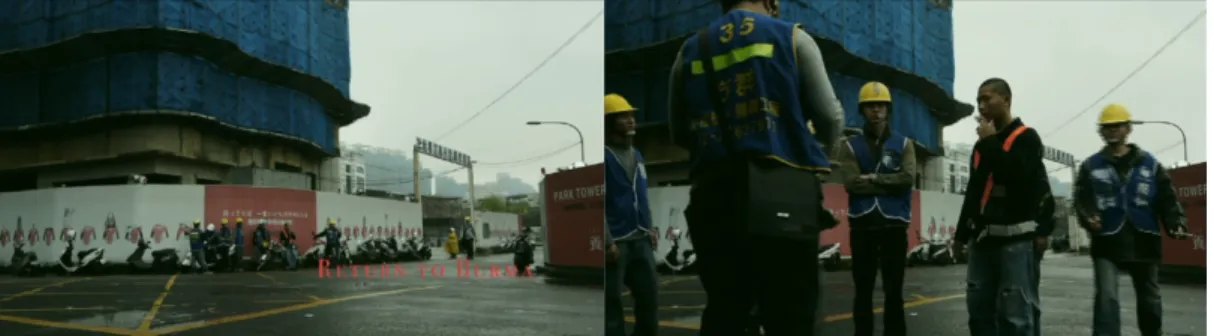
Figure 1: Burmese Chinese workers dwarfed in the background………....33
Figure 2: The workers come to the foreground of the shot to speak………...33
Figure 3: The lyrics of the song: “We freely cast the vote that speaks our mind”……..42
Figure 4: A melodrama that exudes pessimism for (marital) union………42
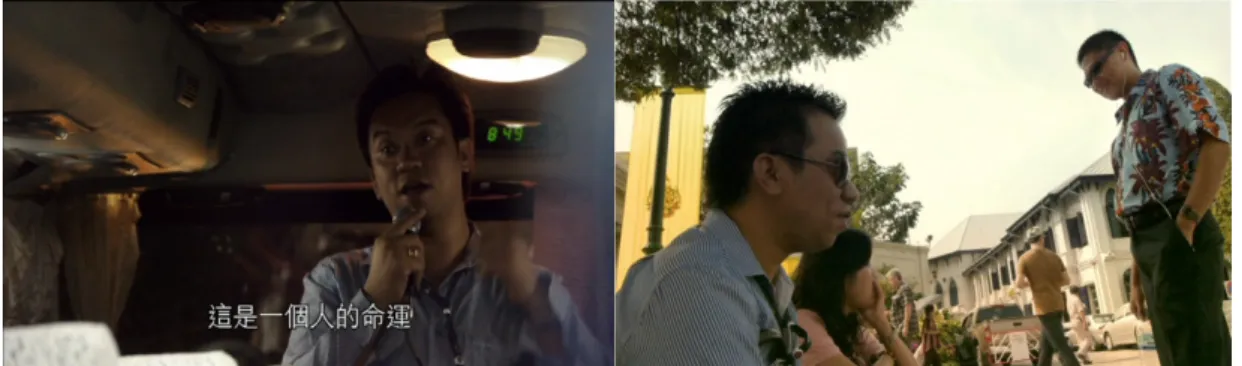
Figure 5: A-Fu’s performance on the bus in front of the tourists………55
Figure 6: A-Fu chatting with his countrymen in private……….55
Figure 7: The female migrant is framed in the middle in the background………..61
Figure 8: A cameo of Midi Z as a gunman in the background………61
Figure 9: The trembling camera in the chasing scene……….66
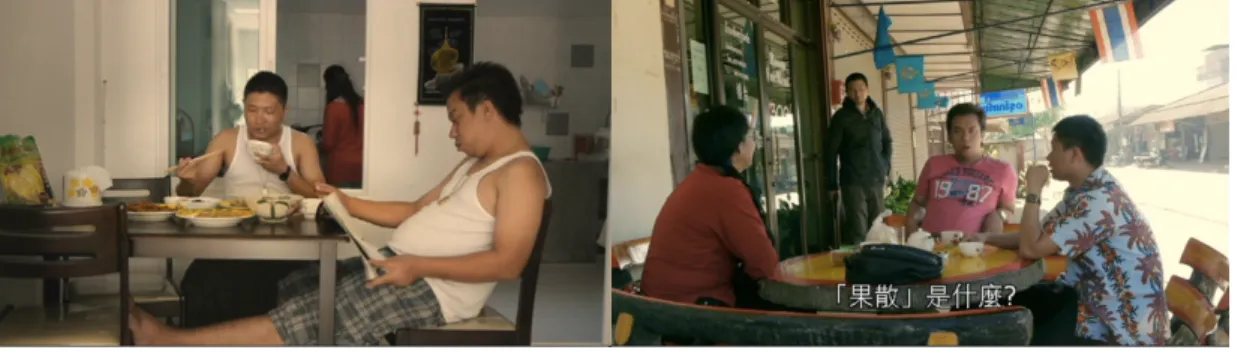
Figure 10: The male protagonist discusses his livelihood with his father………...81
Figure 11: Sun-mei discusses her livelihood with her mother……….81
Figure 12: Sun-mei on the scooter when she first meets the male protagonist………...88
Figure 13: Sun-mei delivering ice poison to a buyer………...88
Figure 14: After taking the drug, both protagonists happily ride the scooter…………..89
Figure 15: A college scholarship exclusively for Burmese Chinese students………….99
Chapter One:
Introduction
At the 53rd Golden Horse Awards Ceremony that took place in Taipei in November 2016, Taiwan-based Burmese Chinese director Midi Z (Zhao De-yin
) received the award “Outstanding Taiwanese Filmmaker of the Year” for
“expanding the field and definition of Taiwanese cinema” (“Announcement”).1 Expressing his gratitude to the general Taiwanese public, he claimed:
If it were not for the diversity and freedom in Taiwan . . . I, Midi Z, could not have possibly stood here on the stage today. . . . If even a Burmese kid who had never dreamt of anything beyond survival can obtain this award . . . and if this is an inspirational story, then Taiwan is the only place in the world that such inspirational story can happen! (qtd. in “Acceptance”) As he referred to himself as “a Burmese kid,” Midi Z chose to self-consciously foreground his identity as an ethnic minority in Taiwan, and to claim that it is the freedom to express his unique cultural background that has pushed him to his success.
At first glance, this achievement may seem counter-intuitive, as the apparently nationalistic title “Outstanding Taiwanese Filmmaker” is more often associated with an imagined and constructed “Taiwaneseness” that prioritizes the grassroots culture of
1 As an ethnic Chinese growing up in Burma, Midi Z has been described with different titles, including
“Burmese Chinese,” “Myanmar-born Taiwanese” and “Sino-Burmese.” In this thesis, I use the term
“Burmese Chinese,” as “Myanmar-born Taiwanese” and “Sino-Burmese” both seem to strengthen given nationalities instead of pointing toward a more flexible cultural identity. However, I would like to note that Midi Z often characterizes himself with each of these terms in different contexts. Midi Z also goes by many different names that indicate his cross-cultural background. In Taiwan, he is usually referred to as Zhao De-yin, the pronunciation of his name in Standard Mandarin (guoyu in Taiwan; putonghua in China). However, in international contexts (e.g. international film festivals), he chooses to be called Midi Z, with “Midi” ( ) meaning “younger brother” in
Southwestern Mandarin (xinanguanhua ) and “Z” indicating the first letter in the Romanized version of his family name Zhao. Furthermore, as it is the custom for Burmese Chinese to blend in with
local Han Chinese, the dominant settler colonizers on the island.2 The intended message from the Golden Horse Awards to the public, however, is that “the definition of Taiwan cinema” has become more inclusive and multicultural with the inclusion of the Burmese Chinese director Midi Z as a “Taiwanese filmmaker.”
In general, this inclusive tendency corresponds to Taiwanese cinema’s historical shift from what Darrell William Davis calls its didactic “civilizing mission” (2) led by the Kuomintang-controlled state ( , the Chinese Nationalist Party, hereafter the KMT) during the Cold War period to “alternative modes of film form, storytelling, marginal voices, and practices that question cinema’s position as a national culture”
(5), a process accelerated by Taiwan’s influential New Cinema movement (xindianyin ) from 1982 to 1987 and the end of the martial law period on Taiwan proper in 1987. In particular, the official recognition of Midi Z serves as a culmination of the efforts of an increasing number of Taiwanese filmmakers who have turned their camera lens towards Taiwan’s Southeast Asian “new immigrants” (xinyimin ), whose presences were first indirectly introduced by the Taiwanese government’s policies in the 1990s to strengthen its link with the area imagined as Southeast Asia.3
2 Shih defines the term “settler colonialism” vis-à-vis Taiwan as the process of how Han Chinese migrants from Mainland China “systematically marginalized indigenous peoples” in the history of the island (“Foreword” 7). In this thesis, I extend the idea of marginalized people to consider lower-class transnational immigrants in Taiwan, particularly the Southeast Asian migrants of various ethnic backgrounds. The effect of the marginalization of other lower-class immigrants in the formation of
“Taiwaneseness” is reflected in the Golden Horse Awards. At the time of writing, all recipients of the
“Outstanding Taiwanese Filmmaker” have been Han Chinese born in Taiwan, with the exception of the Malaysian Chinese director Tsai Ming-liang in 2001. Interestingly, 2001 was also the only year when the award was titled “Special Jury Prize for an Individual” instead of “Outstanding Taiwanese Filmmaker.” Tsai, upon receiving this award, questioned on stage if “this is a consolation prize?”
before joking ironically that “I suppose this puts me out of contention for Best Director” (qtd. in Yu).
Similar to Tsai’s situation, Midi Z had not received other awards from the Golden Horse for the recognition of his artistry before accepting this award. In these instances, this award was awarded arguably only to confer a designated Taiwanese identity on a filmmaker, instead of valuing their artistic achievement. See Shen, “Midi Z’s First” for further critique of Golden Horse Awards.
3 Before the former President of Taiwan Lee Teng-hui initiated the “Go South Policy” (
Nanxiang Zhengce) in 1993 to encourage investment in Southeast Asian countries, Taiwan had already approved the legal introduction of Southeast Asian laborers in 1992. Both policies symbolized
Taiwan’s intention to veer away from interaction with China for national security (Tseng 19). In response to this social change, many filmmakers have addressed the influx of Southeast Asian “new immigrants” in their works, including Tsai Tsung-lung’s “Trilogy of Immigrant Brides” (2003), Ho Wi
Nevertheless, the newfound multiculturalism in Taiwanese cinema may still implicitly operate under the banner of Taiwanese nationalism without challenging its inherent cultural hegemony. In fact, such multicultural discourse often risks covering up the complexities of the structural formations and interethnic hybridity of different groups of transnational migrants with what Lisa Yoneyama describes, in another context, as “supposedly mutually neutral and compartmentalized ethno-national cultural differences” (“Asian” 296).4 Before Midi Z delivered his acceptance speech at the Golden Horse Awards Ceremony, a video clip in which the Taiwan New Cinema director Hou Hsiao-hsien discusses his impressions of the younger director was played on stage. Hou jokingly suggests that “[Midi Z’s] difference [from us] is that . . . he probably smuggled himself here?” to which Midi Z later responded on stage that “I want to clarify to director Hou that I did not smuggle myself here; I came here legally in 1998 when I was 16” (qtd. in “Acceptance”). Unconsciously, Hou revealed the Han Chinese settler colonialism hidden beneath a liberal multiculturalism, one which naturalizes the presence of the ethnic majority and obscures the
socio-historical contexts of the rise of a transnational migrant filmmaker.5
Departing from this discrepancy between multicultural discourse and a colonial unconscious in Taiwan, this MA thesis seeks to understand how Midi Z’s cinematic
Ding’s Pinoy Sunday (2009), and Nguyen Kim-Hong’s Out/Marriage (2012). Continuing a policy that President Lee had enacted two decades earlier, the current President of Taiwan Tsai Ing-wen initiated what she called a “New Southbound” ( Xinnanxiang Zhengce) policy in 2016.
4 While I am aware that Yoneyama is thinking about the problems of liberal multiculturalism in terms of Asian American studies, I believe her proposal to rethink ethnic studies in the U.S. with a
transnational perspective is helpful in tackling the problems of multiculturalism in Taiwan, where ethnic minorities such as Southeast Asian migrants are often viewed as separate entities without connections to other domestic/transnational groups. Mau-kuei Chang also argues, in the Taiwanese context, “[multicultural] policies easily fall into a ‘depoliticized’ cultural performances” (321).
5 Hou is not the only person who implicitly treats Midi Z as an outsider who “smuggled” himself to Taiwan. In the 2014 Taiwan Cinema Yearbook, the country of production of his Return to Burma is listed by the Taiwan Film Institute as “Burma” (71), which contradicts the fact that Midi Z has constantly been seen as a Taiwanese director. Interestingly, the notion of “outsider” has actually been prevalent in the history of Taiwanese cinema. As Yeh and Davis point out, many important Taiwanese directors come from a transnational background, including “pan-Chinese” like Li Hanxiang and King
representations of the ongoing displacements faced by Burmese Chinese migrants both within and beyond Taiwan can complicate such problematic perceptions. This thesis will do so through a discussion of his “Homecoming Trilogy”
(guixiangsanbuqu )—namely, Return to Burma (2011), Poor Folk (2012), and Ice Poison (2014).6 By investigating the distinctive narratives, aesthetics, and production backgrounds of his films that reflect the experiences of failed
migrations across postcolonial Asia, this thesis seeks to bypass the discursive formation of Midi Z as a successful ethnic minority in a supposedly multicultural Taiwan; instead, it understands Midi Z’s films alternatively as what it calls a “cinema of distance” (julidianying ), a cinema that not only maintains a critical distance towards a linear migration narrative, an uncritical realistic aesthetic, and a mainstream film production, but also contributes to and complicates the lively debates within academic fields such as postcolonial studies and Sinophone studies.
Before I further explain how I situate Midi Z’s works in relation to wider
academic concerns, I would like to first provide a biographical introduction to Midi Z and elaborate on what I call Midi Z’s “cinema of distance,” so as to better illustrate the critical potential of his films. It is to this topic that I would like to turn now.
Introduction: Midi Z and the Cinema of Distance
Prior to becoming a champion of multicultural Taiwanese cinema, Midi Z was a Burmese native of ethnic Chinese origin with ancestry in Yunnan.7 During his early
6 Production company Flash Forward Entertainment and home video distributor Deltamac in Taiwan have named Midi Z’s first three feature films as the Homecoming Trilogy, implying that the recurring setting of Burma in his films signifies his nostalgia for it as his home. The Asia Society in New York also named what is described as the first U.S. survey of Midi Z’s films “Homecoming Myanmar: A Midi Z Retrospective,” an event curated by La Frances Hui in 2015. Such naming, however, implicitly denies the fact that Taiwan is also his “home,” not least because he acquired its citizenship in 2011.
7 In Wen-chin Chang’s account, “[t]he primary proportion of the Yunnanese migrants in Burma today are descendants of refugees fleeing Yunnan after the Chinese Communist Party took over China”
(“Poverty” 52). Often in relation to the KMT forces operating in the border area between Burma and Thailand against the Chinese Communist Party, this specific Burmese Chinese group has had strong
years, he had lived under poverty, ethnocentrism, and authoritarianism in Burma, a country where the local film industry was marked by low-quality/low-budget production, Burman-centered themes, and state censorship that “[stifled] creativity and [rejected] anything not considered ‘traditional Burmese culture’” (Hudson).8 Under such hardship, it is unsurprising that Midi Z was pushed “to leave the country at 16 in search of a better education and future in Taiwan” in 1998, according to Wen-chin Chang (“Poverty” 44). It was only after his college education that he began to develop a critical consciousness with his short thesis film Paloma Blanca (2006), which was successfully screened at various international film festivals.9 Later on, he also enrolled in the acclaimed Golden Horse Film Academy, a short-term film school inaugurated by the film festival of the same name and led by Hou Hsiao-hsien.
Following Hou’s suggestion that “an individual’s life experiences can make an impact on the audiences” (qtd. in Zhao, Unification 224), Midi Z produced a more
historical ties to Taiwan, as the KMT later retreated to and reestablished itself on the island. The historical formation of this ethnic group is further discussed in the subsequent chapters.
8 Even though Burmese cinema has enjoyed a “nine-decade history of motion picture production”
(Ferguson 23), the nationalization of the industry, the censorship imposed by the Motion
Picture Censor Board, and the low quality and budget for productions have all led to its downfall. Not only is there no “significant market for [Burmese] films outside the country” (Hamilton 270), but “a steep decline in cinema attendance” (Yeni) is also apparent in Burma’s domestic market. Furthermore, even after general media censorship in Burma has been abolished in 2012 after its democratic reforms, the Motion Picture Censor Board still exists. The famed actress Michelle Yeoh was notably deported from Burma for portraying Aung San Suu Kyi in Luc Besson’s The Lady (2011), while another film Twilight Over Burma (2015) was also forbidden to be screened at Yangon’s Human Rights Human Dignity International Film Festival in 2016, as the government feared its focus on the ethnic minority Shan would cause controversy. Even Midi Z’s The Road to Mandalay, invited to be screened in Yangon in 2016 at the Memory! International Film Heritage Festival, was partly cut by the Censor Board (most notably, an ending scene where blood was splashed onto an image of Buddha was deleted).
For the censorship on film and other media in Burma, see Chan; Larkin; and Brooten.
9 Successfully screened at the Busan International Film Festival among other venues, Paloma Blanca (meaning “white dove”) appears to be a critique of Taiwan’s capitalistic craze over the cruel tradition of pigeon racing. While its topic is not unfamiliar in the “ecodocumentary” tradition in Taiwan in which Chiu identifies the emergence of “non-anthropocentric environmental discourse” (15), the short film is unique in that it does not merely present animal rights issues in a directly realistic manner;
instead, it blurs the boundary between documentary and fictional film in the form of a mockumentary by casting hundreds of women dressed in white as anthropomorphic pigeons, while inserting
supposedly authoritative materials like maps, mock interviews, and a pseudo-Westernized voiceover with accented English to create a façade of traditional documentary. With the mockumentary form and the anthropomorphic performance, the film presents the fatal journey for the pigeons as a metaphor for
self-reflexive short film Huasin Incident (2009) that looks at the internal conflict between two groups of Burmese Chinese migrants in Taiwan.10 The focus on
Burmese Chinese migrants’ ambivalent identity formation eventually drove Midi Z to follow their complex migratory routes across different sites in Asia and produce video works in a variety of forms that include short films, documentaries, video installations, and feature films such as those in the Homecoming Trilogy. Similar to many directors of Taiwan New Cinema, Midi Z has become a prominent player in the international film festival circuit, which in turn resulted in his recognition in Taiwan.11
At first glance, it seems legitimate to read the trajectory of Midi Z’s successful migration and career development as a form of linear, upward process, as many in Taiwan have attempted to do so whether from a Sinocentric, liberal, or multicultural viewpoint. For instance, typically interpellated as a huaqiao ( , literally Chinese sojourner) or a qiaosheng ( , Chinese sojourner student) by the mainstream media in Taiwan, Midi Z is often categorized under an imaginative umbrella of “Overseas Chinese” (haiwaihuaren ) who are presumed to be eager to return to their motherland Taiwan, even when they have never set foot on the island.12 This
10 The self-reflexive theme of Burmese Chinese migrants in Taiwan is repeated in Midi Z’s other short films such as A Home-Letter (2008), The Man from Hometown (2009), and Diary at Construction Site (2010), as well as his first feature film Return to Burma. Hou’s suggestion of self-reflexivity should not come as a surprise, as Yip points out that Taiwan New Cinema was “widely considered to be a direct heir to the hsiang-t’u [ ] literary movement” in the 1970s, a movement that encouraged the New Cinema directors such as Hou to deal with “the lived experiences of the native Taiwanese people” (60) or the “native consciousness” (bentuyishi ) (62).
11 Chronologically speaking, Midi Z’s path to his “recognition” in Taiwan was achieved only after his emergence in the international film circuit, a process similar to what Shih calls “technologies of recognition” when she talks about the selective logic in the formation of “world literature”; see Shih
“Global.” Similarly, Tweedie also discusses international film festivals as “one of the mechanisms through which institutions transform, cement, or even elevate their status in the global cultural economy” (23-24). The festivals at which Midi Z acquired such cultural capital include the Busan International Film Festival, International Film Festival Rotterdam, Edinburg International Film Festival, Berlin International Film Festival, and Venice International Film Festival. For a more complete list of Midi Z’s filmography and the awards and nominations he has received, see Appendix.
12 Pham defines the ideological presumption behind the usage of huaqiao as one that assumes the existence of “homelandness” (zuguoxing ), a term that points to the identification of a
transnational group of people with one ethnic identity and one state (139; 145). However, as Ang notes, the term huaqiao is not only problematic as it falsely implies “the unity of Overseas Chinese
communities as one people and their unbroken ties with the Chinese homeland” (On Not Speaking 81),
prevalent Sinocentric designation of Taiwan as Midi Z’s and other ethnic Chinese’s cultural homeland is further strengthened by the discursive construction of Taiwan as a liberal state, whose “freedom and democracy” allegedly “[motivated Midi Z] to pursue his goals in literary creation and making movies” according to Wen-chin Chang (“Poverty” 56).13 What’s more, this purported freedom to pursue one’s dream and climb the social ladder is then portrayed as a key factor in Taiwan’s
multiculturalism, as many people have attributed Midi Z’s achievements in telling rare stories of the Burmese Chinese minority (including his own life narrative) to Taiwan’s tolerance of other ethnic groups.14 Apparently, all the above-mentioned
but also dangerous as its “ideological China-centredness and obsession with Chineseness [help] fuel anti-Chinese suspicion and discrimination in foreign lands” (82). Such Sinocentric and nationalistic presumption characterizes both popular imaginations and official records of Midi Z’s life. For instance, the National Immigration Agency in Taiwan calls Midi Z “a huaqiao director” (“Burmese Huaqiao”), while the Overseas Community Affairs Council in Taiwan uses the title “qiaosheng director,” referring to his status as an “Overseas Chinese” (a term that is also ideologically designated to establish unity between the state and the ethnic Chinese overseas) student when he arrived in Taiwan (“Qiaosheng Director”). Ang’s warning certainly rings true in Burma, where anti-Chinese sentiment has pushed out many Burmese Chinese, a historical phenomenon that has had a significant impact on Midi Z’s life. He recalls vividly that “because Burma is anti-Chinese, schools are not allowed to teach Chinese, and as a Han Chinese, I was only able to secretly study the language” (qtd. in Weng). For more on anti-Chinese sentiment, especially the 1967 riot in Burma, see Fan.
13 The historical construction of Taiwan as a liberal homeland for all “Overseas Chinese” was in fact in accordance with the United States’ advocacy of freedom against authoritarian communism during the Cold War period. As Pham points out, “in combination with the U.S.’s international hegemony and liberal pluralism . . . the U.S. also made use of Taiwan’s Overseas Chinese policy in Southeast Asia to influence Southeast Asian Chinese’s political attitudes” (163). Calling this construction “Cold War liberalism,” Pham names the Entrance Exam for Overseas Chinese Students that was only made possible by the U.S. Aid to Taiwan (meiyuan ) as an example (164-66), a recruitment test that Midi Z took as he recalls that “I came here because of the Taiwanese government student recruitment test; I felt like I won the lottery at the time” (qtd. in “Acceptance”). This recruitment system that distributes the chance to a selected few to migrate to a wealthier country resembles what Nguyen calls the “gift of freedom,” which in her account points to the chance to seek sanctuary granted to
Vietnamese refugees by the U.S., which was actually responsible for their refugee status in the first place. Calling this benevolence “liberalism’s [innovation] of empire” (2), Nguyen reminds us that freedom, distributed as a gift, can be as problematic and double-sided as Jacques Derrida’s elaboration on the concept of the gift, especially when we consider that it is not simply given away, but also designates what Michel Foucault calls a “relation between governors and governed” (qtd. in M.
Nguyen 6) that binds those who are rescued through a debt to the rescuer.
14 According to a report done by Zhao-lun Jiang, for instance, Midi Z’s success is credited to the
“accommodating and embracing power” of Taiwan. While many have tried to understand the
multicultural diversity in Taiwanese cinema today as a result of Taiwan’s openness, it is perhaps ironic that, in reality, Burmese Chinese migrants often perform as ethnic Burmese/Bamar in Taiwan at least in part because of the racism they experienced there. As Hsin-chun Tasaw Lu points out, “many local Taiwanese treat the [Burmese Chinese] returners as social and financial inferiors, and as Others,”
which “shattered the Burmese Chinese dream of embracing their home, underscoring the illusory
mainstream discourses on Midi Z’s life and career have characterized his migration to Taiwan as a linear process towards becoming a successful ethnic minority, a journey claimed to be aided by the host country’s generosity and openness.
If we take a closer look at the production backgrounds, narratives, and aesthetics of Midi Z’s films, however, the linear imagination of a successful migration to
Taiwan is interrupted and complicated by various counter-examples. To begin with, unlike many contemporary Taiwanese filmmakers of the so-called “post-Taiwan New Cinema” (hou—xindianyin — ) that seek to affirm Taiwanese subjectivities by presenting local stories set in Taiwan with dialogues in Taiwanese Hokkien (taiyu or minnanyu ), Midi Z has chosen to “return to Burma” (as the title of his debut feature film suggests) to shoot films about Burmese Chinese migrants who mix Southwestern Mandarin (xinanguanhua ) with Burmese, Thai, and other languages.15 The decision serves as a rare oddity in the Taiwanese film industry, as it not only shifts our attention from the host country to the home country of the Burmese Chinese migrants, but also challenges Taiwan’s Ministry of Culture’s nationalistic regulation that decrees the applicants of its “domestic feature film
assistance grant” (fudaojin ) “should not be entirely shot overseas” (“Republic of China”).16 What’s more, even though Midi Z has in many public occasions
Sinocentric Chineseness to an appreciation for their lives and cultures back in Burma, which could also mark out their uniqueness in Taiwan and attracts more attention from mainstream society.
15 It is often argued that the commercial success of Wei Te-sheng’s Cape No. 7 (2008) kicked off the new trend of “post-Taiwan New Cinema” in Taiwan, as it became the highest grossing Taiwanese domestic film produced after a long decline of domestic productions. As Lim observes, “Cape No. 7 may be said to have led the way in shifting the self-image of Taiwan cinema from the auteur-centered, film-festival-participating, domestic-audience-alienating TNC [Taiwan New Cinema] period of the 1980s and 1990s, to a post-TNC period in the new millennium marked by a more popular mode of filmmaking that aims to appeal to a wider audience” (“Taiwan” 158). To explain the film’s popularity, Ivy I-chu Chang treats Cape as an imagined national allegory that bespeaks a grassroots
“Taiwaneseness” suppressed in the past, while Chiu and Liao believes post-Taiwan New Cinema in general bring forward “important issues in Taiwanese history and society. . . in combination with Hollywood cinematic techniques” (11).
16 As Midi Z’s film editor Lin Sheng-wen ( ) points out, “since [Midi Z] shoots his films overseas, [he] cannot obtain film assistance grant from the government” (qtd. in Sun). The grant, known as fudaojin, has been effective in assisting many successful Taiwanese directors from Hou
endorsed the problematic account of his life as a fortunate migrant, almost all of his works expose the mainstream viewers toa narrative of failed or compromised
inter-Asian migrations.17 For instance, in Return to Burma, a Burmese Chinese return migrant finds no job back in a supposedly reformed Burma, while in Poor Folk, the Burmese Chinese illegal immigrants in Thailand are victimized by human trafficking and prostitution at the Thailand-Burma border. Similarly, in Ice Poison, the Burmese Chinese characters engage with the risks of drug dealing as they are trapped within Burma. Unsurprisingly, such postcolonial depictions that explicitly or implicitly critique Taiwan, Burma, and other nations such as Thailand and Malaysia have been met with bans and censorship in Burma and scared off conservative investors in Taiwan.18 Without government subsidies and private investment, Midi Z’s unusually low budgets and small crews have led to distinct aesthetics, including guerrilla
filmmaking techniques such as on-location shooting (without legal license), the hiring of amateur actors (often his close friends or relatives), and the mixed use of long takes and shaky hand-held shots (shot with a low-cost digital camera).19 These features have set Midi Z’s films apart from most mainstream productions in Taiwan.
Hsiao-hsien to Tsai Ming-liang. Even though there are indeed references to Taiwan in his feature films, Midi Z is still barred from the grant, as he mostly shot his films in Burma and Thailand.
17 One sharp contrast between Midi Z’s works and his life lies in the experience of applying for a Taiwanese ID card. Even though Midi Z successfully obtained an ID card in 2011 (Zhao, Unification 30), he constantly presents the difficulty of the application process in his films, most notably through the female protagonist Sun-mei in Poor Folk who cries for almost three minutes in a long take following the rejection of her application.
18 Recounting the experience of directing Return to Burma, Midi Z remembers that “what the [investors] are doubtful about is whether the Taiwanese audiences would want to watch a film about
‘foreign laborers’ [waijilaogong ]” (Unification 22), a doubt that led to their refusal to fund the film. This discrimination resembles the problem that the Malaysian Chinese director Ho Wi Ding’s Pinoy Sunday met when it was rejected for screening in almost every Taiwanese film theater. Director Ho recounts that the owners of the theaters feared “there will be foreign laborers all over the theater.”
See Wi Ding Ho for this account.
19 As Wan-Jui Wang rightly points out, “stylistically, Midi Z does not continue the production of genre film after Wei Te-sheng’s Cape No.7. . . . Midi Z’s emergence is [thus] different from the tendency of genre films from directors like Wei Te-sheng, Niu Chen-zer, and Tsai Yueh-hsun in the post-Taiwan New Cinema period” (151). Instead of following the revival of mainstream commercial film in Taiwan, Midi Z’s films are more in line with his contemporary Southeast Asian filmmakers, whose independent
In this thesis, I propose that the representations of failed migrations in Midi Z’s Homecoming Trilogy call for a questioning, or even rejection, of their incorporation into a linear migrant narrative. Through critical analysis of Midi Z’s films, I seek to foreground what I call “cinema of distance,” a flexible cinema that refuses to settle down with a fixed idea of home and ethnic identity in terms of narrative, to be content with an uncritical notion of realism in terms of aesthetic, and to be brought in line with mainstream Taiwanese cinema in terms of production method.20 By using the term “distance,” I do not simply suggest a cinematic vision that coldly denies and stays far away from the film’s subject so as to remain putatively objective; rather, I see such distance as a malleable space between the filmmaker and the filmed subjects that constitutes for them a dialectical relationship.
My use of the term “distance” is inspired by the title of Midi Z’s biography Unification, Separation, Ice Poison (Ju, Li, Bingdu ) as translated by Wen-chin Chang, the first two Chinese characters of which come together as a
homophonic pun for the Chinese translation of the term “distance” ( juli). With a link between “unification and separation” and “distance,” the latter no longer needs to be understood solely as an immutable space that separates migrants from the
homeland they left behind. Rather, its spatial quality becomes flexible as it is defined simultaneously by the dialectical acts of unification and separation, by which migrants move back and forth between different locations and refuse to be pinned down at a specific site defined as an ultimate homeland. Indeed, it is arguable that such defiance of a linear perspective of migration is already deeply rooted in Midi Z’s creative
filmmaking techniques, as Lent points out. For discussion of digital filmmaking, see Chapter Three.
For more on Southeast Asian independent cinema, see Baumgärtel; Lent; Ingawanji and McKay.
20 The reason for not including Midi Z’s fourth feature film The Road to Mandalay (2016) in the discussion of a cinema of distance in this thesis is that while the films in Homecoming Trilogy were produced with similarly low budget, The Road to Mandalay enjoyed a much higher budget and featured a more mainstream plot that seeks to attract the general audiences in Taiwan.
vision.21 Not only does he present stories of interrelated migration patterns that mostly end up in the loss of a secure home, including the return migration back to Burma (Return to Burma), international migration across the border of Thailand and Burma (Poor Folk), and intranational migration within Burma (Ice Poison), but he also links this doubt of an ultimate homeland to his personal history:
When I was shooting these three films and thought of China, Burma and Taiwan and their relationships with my family and myself, I would
eventually realize that geographical location does not mean much, and the act of drifting around is only intended for survival. And in my films, the universal core value . . . is more or less “survival.” (Zhao, Unification 30) Despite being a migrant who obtained Taiwanese citizenship in 2011 and “developed a certain level of affection for Taiwan” (Zhao, Unification 20), Midi Z obviously still holds strong emotional ties to Burma, especially as his family remains in the country.
Eventually, he has come to realize that the term “homeland” does not necessarily denote a single and fixed “geographical location.”22
Aside from treating the idea of “distance” as a challenge against a fixed
imagination of linear migration and homeland, I also assert that it can be understood as a cinematic concept that defies a simple link between Midi Z’s films and cinematic realism, or what Mary Ann Doane calls “the lure of the indexical” (129) of the
21 It is helpful to return to Midi Z’s Huasin Incident here. In this short film, Midi Z makes clear to the audiences that it is precisely the differences in the imaginations of a homeland that result in the clash between two groups of Burmese Chinese migrants in Taiwan. For the younger Burmese Chinese characters who come to Taiwan to seek success, Taiwan is an ideal destination where they wish to belong. Ironically, for a character of an older generation of Burmese Chinese in Taiwan, he is eager to go back to Burma. Not sympathizing with this nostalgia, the young people declare: “I don’t care if he misses his home or not,” before they violently clash with him. Apparently, even within what is perceived to be a homogeneous ethnic community, the divergent reasons for migration can result in conflicting interpretations of an imagined “homeland,” causing disagreements and ruptures.
22 Likewise, Leslie Hao-shan Lee sees Tsai Ming-liang as a director who “maintains a critical distance
cinematic images.23 While the aesthetics of Midi Z’s films have been likened to the realism of Taiwan New Cinema, as Wan-jui Wang claims that “Midi Z’s digital visuals can perhaps be categorized under the so-called aesthetic of ‘pure and realistic visuals’ embodied by . . . Hou Hsiao-hsien” (152), I argue that it is dangerous to simply treat his films as unquestioned forms of indexical images that correspond to what is perceived as the real world.24 As Dimitri Bruyas indicates in his alternative translation of the title of Midi Z’s biography, Zooming in and out of Ice Poison, the two terms “unification” (ju ) and “separation” (li ) can also be interpreted as the camera movements “zooming in” (jujiao ) and “zooming out” (lijiao ) respectively, techniques used interchangeably by Midi Z. This translation reminds us that the framing of his shots often engages with the subjects of his films in variable camera-subject distances according to different needs. For instance, in a scene in Ice Poison where the unnamed male protagonist first meets the female protagonist
Sun-mei at a public bus station in Lashio, Midi Z recalls that since the crew could not acquire a filming permit from the Burmese government, the cinematographer was forced to hide in a building across from the station, which limited the choice of the framing to an extreme long shot (Zhao, Unification 103; see Figure 2). However,
23 In discussing the indexical, Doane points out how “the illusion of the real” (132) has been brought about by the belief in the “indexicality [of cinema] as the guarantee of a privileged relation to the real, to referentiality, and to materiality” (132). To challenge (but not entirely deny) “the specificity and singularity associated with the index” (133), Doane then introduces how the iconic and the symbolic are constantly mixed with the indexical, arguing that “the ‘real’ referenced by the index is not the ‘real’
of realism, which purports to give the spectator knowledge of the world” (135).
24 The rare documentation of the lower-class ethnic Chinese in Burma in Midi Z’s films has attracted critics to highlight the “realism” employed in the films: for instance, La Frances Hui, the film curator of Asia Society and the Museum of Modern Art, suggests that “[w]ith a deep personal understanding of these individuals’ circumstances, [Midi] Z presents life stripped of drama and sentimentality; his realism is honest, nonjudgmental, and filled with compassion” (qtd. in Zhao, “Interview”). Meanwhile, anthropologists such as Wen-chin Chang argue that Midi Z’s works are “grounded in the trend of social realism” (“Poverty” 61), while another anthropologist A-Po claims that “Midi Z’s realism illustrates a real Burma that travelers do not see. . . . That’s why many people are reminded of Hou Hsiao-hsien of the Taiwan New Cinema movement.” Kuipers, a film critic at Variety, even goes as far to claim that Midi Z is now placed “in the top rank of Asian social realists,” presumably referring to other “realist”
filmmakers like Jia Zhangke and Apichatpong Weerasethakul, as he points out that Midi Z borrowed film editor Matthieu Laclau and production designer Akekarat Homlaor from Jia and Apichatpong respectively in the making of his fourth feature film, The Road to Mandalay.
when the narrative takes place in less-monitored spaces, Midi Z tended to use medium shots to approach the characters and eclipse details of landscapes in the background.
Evidently, the distance between the director and the filmed subjects is contingent upon filming conditions and artistic purposes. In light of this, I argue in this thesis that this flexible filming method cannot be reduced to a singular form of realism.25
As I have explained, this thesis aims to treat Midi Z as a filmmaker who is able to maintain a critical and flexible distance from a limited narrative of a fixed
homeland and linear migration, an uncritical aesthetic of realism, and a mainstream production method. More importantly, however, I also treat the term “distance” as a method to study Midi Z’s films, partly inspired by the analytical frame that Franco Moretti calls “distant reading,” by which “distance . . . is a condition of knowledge: it allows you to focus on units that are much smaller or much larger than the text:
devices, themes, tropes—or genres and systems” (57).26 By invoking distant reading, I do not intend to merely identify the specific narratives and aesthetic “devices” in Midi Z’s films; rather, I seek to follow Moretti’s attempt to relate different works on a literary map by linking Midi Z’s distinctive uses of film sound, performance, and camera movement to similar film movements around the world. Such comparative
25 I do not suggest that the aesthetics of Hou and other New Cinema directors should be understood as purely realistic. Unlike Wan-jui Wang or other critics’ more simplistic views of cinematic realism, Daw-ming Lee complicates our understanding of the aesthetics of Taiwan New Cinema by indicating that “[t]he ‘distancing’ (or ‘engaging,’ depending on different points of view) effect of such a mode of expression [can create] obstacles for audiences” (348). In high contrast to Wan-jui Wang’s view that for “realist directors [of Taiwan New Cinema] . . . their common goal is to reject post-production and continue to strengthen immediacy” (155), Daw-ming Lee reveals that according to the various needs of different directors, the “realism” on the screen can be either distancing or engaging for the audiences, instead of being always immediately accessible and understandable.
26 I am aware of the debate over the idea of “world literature” that Moretti stirs up with his proposal of
“distant reading,” a rejection of the traditional close reading/textual analysis adopted in academia and an embrace of computational analysis based on data aggregation that allows us to be in touch with a wider variety of materials. While this thesis does not turn away from close reading of cultural texts, it nevertheless appreciates Moretti’s aim to portray a bigger literary map. Similarly, Andrew has questioned Moretti’s “distant reading” not by rejecting his systemic effort, but by asking “[w]hy not
mapping, I believe, encourages us as academics to not easily categorize Midi Z under the title “Taiwanese” simply because he is professionally based in Taiwan.
In the following section, in order to better situate my analysis of Midi Z’s films in relation to broader academic concerns, I provide a brief review of recent
developments in relevant academic fields, namely postcolonial studies and Sinophone studies. Furthermore, I also point out the new boundaries or borders set up by these fields, and consider how Midi Z’s films assist us in maintaining a cautious distance toward these restrictions, if not challenging and revising them.
Literature Review: Reimagining Borders and Communities A. Postcolonial Studies: Challenges against Borders
While postcolonial studies as a critical field has introduced many key concepts and analytical terms for scholars to examine cultures that have been or are still being colonized by hegemonic powers, including terms such as “colonial unconscious” or
“hybridity” that appear in this thesis, there have been a growing number of scholars voicing their concerns about the field’s potential blind spots, especially its inability to address specific issues in long-neglected regions such as Southeast Asia. For instance, Ansuman Mondal reminds us that while many postcolonial scholars have already approached South Asian topics in relation to the influences of British colonial rule, certain Southeast Asian countries such as Burma, which was also a former British colony whose ethnic strife and civil wars were the legacies of the British Empire’s deliberate “divide and rule” policies, have been overlooked especially as Burma’s
“isolationism has largely rendered it somewhat marginal to postcolonial concerns notwithstanding its role as a cause célèbre” (145-46).27
27 Harootunian has attributed this imbalanced attention in postcolonial studies to English departments in Anglo-America, as he points out that not only does “the migration of [the critique of] colonial discourse to English studies [mean] that its emphasis would be textual, semiotic, and generic”; this
The relative lack of attention to the vast region known as “Southeast Asia” where disparate colonial and imperial powers have interacted and conflicted with each other has been noted by scholars based in Asia as well. These scholars have begun to formulate their own critical positions designed to examine local postcolonial issues.
For example, Singaporean scholar Beng Huat Chua has called for the recognition of Southeast Asia within the field of postcolonial studies, especially as “the other empires” that operated in the region (such as the Japanese Empire) did not share the same logic with Euro-American empires, a difference that requires historical studies of specific empires that disrupt Eurocentric postcolonial theories (“Southeast Asia”
238).28 In another context, Chua discusses a method that he calls “inter-referencing Southeast Asia,” contending that:
The shared history of postcolonial nationhood . . . places Southeast Asian countries on the same historical timeline, rendering inter-referencing between them an exercise within a temporally coeval and historically horizontal frame, in contrast to the temporally distant and historically hierarchical frame of comparing Asia to Euro-America. (“Inter-referencing”
279)
In other words, Chua asks scholars of postcolonial studies to stop uncritically borrowing ill-fitting postcolonial theories developed in Euro-American academic contexts to understand Southeast Asian postcolonial conditions; instead, scholars
migration to English studies also “explains why so much of postcolonial discourse has instantiated South Asia, especially Bengal, rather than other parts of the [British] Empire or indeed the empires of other nations” (“Postcoloniality’s” 167). Indeed, as many Southeast Asian nations have not adopted English among their official languages, it is understandable that they receive less attention than the English-speaking South Asian region in the field of postcolonial studies in Anglo-American context.
28 Similarly, Bernards also contends that “[t]he task of the postcolonial critic is not only to
‘provincialize’ the West . . . but also to disaggregate Asia/the Orient as a singularly colonized object of such imperialism” (“Beyond” 312). In other words, Bernards believes that Asia is not a uniform region
should learn to compare and link issues in separate sites in Southeast Asia that share more similar socio-historical backgrounds.29
With a conceptually similar but spatially bigger scope, Taiwanese scholar Kuan-Hsing Chen advocates the establishment of inter-Asian cultural studies, an approach that not only challenges the dominant Eurocentric model in postcolonial studies, but also recognizes the correlations between Asian countries’ colonial histories and structural positions with “multiply[ing] frames of reference in [Asian]
subjectivity and worldview” (Asia 223). Similar to Chua’s awareness of “the other empires,” Chen’s focus on inter-Asian connections leads him to provocatively ask his readers to recognize Taiwan as a newly-established “sub-empire” supported by the United States within the region, as he defines “sub-empire” as “a lower-level empire that is dependent on an empire at a higher level in the imperialist hierarchy” (18).
Using the Go South policy initiated by Taiwan’s former President Lee Teng-hui in 1993 as an example, Chen reveals how Southeast Asian laborers have been regulated and governed by this regional power. To break away from such hierarchical relations, Chen then goes further to demand what he calls “de-Cold War” and “deimperial”
actions that resist the “Americanism” that is still influential in Asia, so that “[t]hrough imaginings of a new Asia and a new third world, diverse frames of reference [will]
cross our horizon, multiply our perspectives, and enrich our subjectivity” (255).
Despite the immense value of Chua’s and Chen’s approaches to studying postcolonial issues in Asia, I argue that one of their vulnerabilities lies in their reluctance to link what they picture as postcolonial Asian subjectivities to other subjects beyond the region itself. As Viet Thanh Nguyen and Janet Hoskins helpfully
29 I am aware that the region called “Southeast Asia” is also an imaginative construct instead of a coherent and self-enclosed entity, as Benedict Anderson argues that “post-war American
anticommunist hegemony” (8) helped with the continuation of the artificial and colonial imagined boundary of “Southeast Asia.” What is conceived as Southeast Asia is in fact “a region with no single dominant power, religion, or language” (Bowen 286), assembled together as an “imagined reality,” as Benedict Anderson calls it (6).
point out, while Chen’s shift of focus from Euro-America to sub-empires in Asia such as Taiwan is crucial, “[e]ven being critical of East Asian ‘sub-empires’ can
inadvertently center East Asians as the primary agents in Asia and the Pacific, including in matters of knowledge production” (22).30 What’s more, they go on to argue that Chen’s “appropriation of the idea of ‘Asia’ that was created by Europe”
may also “neglect the heterogeneity of the United States and the west” (22). In line with this critique of Chen’s dichotomy between Asia and the West, Sandro Mezzadra and Brett Neilson also indicate that “[a]lthough we feel very close to Chen’s idea of inter-referencing as a way of imagining Asia, we suggest that the ‘bits and fragments’
that appear as Western for Chen are, rather, part and parcel of the capitalist axiomatic of modernity, which manifests itself in spatially heterogeneous ways” (59). That is to say, for Mezzadra and Neilson, a postcolonial investigation of “Asia” should not be confined to pinpointing the “West” as the ultimate colonizer; instead, they see postcolonial issues such as forced migrations and enforced borders as reflections of and responses to globalization.31 The above-mentioned scholars’ warnings about the limits of a fixed focus on the imagined borders of Asia is indeed helpful for studying Midi Z’s films, which not only deal with postcolonial predicaments in Asian countries such as Taiwan, Burma, and Thailand, but also hint at broader socio-historical
problems brought by the influences of global capitalism.
30 In an attempt to reconcile Asian American studies in the U.S. and Asian studies in Asia by questioning the perceived borders in both fields and advocating a new cross-boundary framework named “transpacific studies,” Nguyen and Hoskins envision a broader critical scope and advocate transnational cooperation for scholars across the Pacific, cooperation that could enable the recognition and study of different migrations across the Pacific.
31 The rationale behind Mezzadra and Neilson’s challenge against Kuan-hsing Chen’s idea of Asia comes from their research on the topic of the border, which defines it as “an epistemological device . . . at work whenever a distinction between subject and object is established” (16). That is to say, for Mezzadra and Neilson, a border signifies not only the geopolitical separation between communities,
Whether from a Southeast Asian, an inter-Asian, or a global viewpoint to compare postcolonial subjects from different geopolitical sites, the above-mentioned scholars have attempted to make up for the lack of attention to specific issues in postcolonial studies, drawing attention to colonial legacies in Burma, sub-empires such as Taiwan, and transnational migrants/refugees across Asia, all of which are touched upon in Midi Z’s Homecoming Trilogy. By borrowing from these challenges to hegemonic powers and imaginary borders, I seek in this thesis to further tease out the specific postcolonial narratives and aesthetics in Midi Z’s films. Nevertheless, even if these critical frameworks have been effective in expanding the scope of contemporary research, I find them insufficient to adequately address the discourses surrounding the politics of identity and belonging that Midi Z and his films are wrestling with,
especially discourses that pertain to the category “Chinese.” To understand the performances of identity and the ensuing aesthetics played out in Midi Z’s films, it is necessary to turn to the rising field of Sinophone studies.
B. Sinophone Studies: Reconfiguration of Communities
In an attempt to reach beyond Sinology, a traditional academic field that has at times uncritically bolstered what Rey Chow calls “the fantasy of an essentialized ethnicity, a standardized language, and a coercive equivalence between literary writing and Chineseness per se” (22), Andrea Bachner calls for future research “[to]
take into consideration the hybridity at work in the category ‘Chinese’” (215). Indeed, much like what Bachner suggests, the inherent heterogeneity of cultural
cross-fertilization that is eclipsed by the problematic umbrella term “Chinese”
requires more critical engagement. One such form of engagement has directed our attention to what Ien Ang calls “complicated entanglement,” which implies “a softening of the boundaries between ‘peoples’” (“Together-in-difference” 147).
Examining traditional Chinese studies with this idea, Ang points out that “centuries of global Chinese migrations have inevitably led to a blurring of the original limits of
‘the Chinese’: it is no longer possible to say with any certainty where the Chinese end and the non-Chinese begin” (147). Certainly, Ang’s emphasis on the history of ethnic Chinese’s global migrations encourages us as critics to not settle down with any given identity category such as “Southeast Asian,” “Chinese,” or “Taiwanese.” Ang,
however, focuses on the ambiguity of identity formation, while arguably downplaying the power relations at work in the formation of specific communities on the periphery of Chineseness.
With this in mind, I would like to address critical ideas from the interdisciplinary field of Sinophone studies, which has attempted to revise Chinese studies by initiating what Shu-mei Shih calls “the study of Sinitic-language cultures on the margins of geopolitical nation-states and their hegemonic productions” (“Concept” 710).32 With subtle nuance compared to Ang’s emphasis on the ambivalence of traveling identities, Sinophone studies attempts to formulate a stronger critique against hegemonic
Chineseness by paying closer attention to the local specificities of “a network of places of cultural production outside China and on the margins of China and Chineseness” (Visuality 4).33 The concentration on the distinctive articulations of
32 Shih’s usage of words such as “hegemony” reminds us of the anti-hegemonic spirits raised in postcolonial studies. Interestingly, however, while Sinophone studies has often been related to the postcolonial concepts of Anglophone, Francophone, Japanophone and other literary studies, Shih warns against the direct linkage between postcolonial studies and Sinophone studies, as she claims that
“[p]ostcolonial theory as we know it, particularly its critiques of orientalism, may prove irrelevant or even complicit when we consider how the positions of Chinese intellectuals critical of Western imperialism and orientalism easily slip into an unreflective nationalism, whose flip side may be a new imperialism” (“Concept” 709).
33 While many scholars have attributed the establishment of Sinophone studies to Shih, including Yue and Khoo (3), Tee indicates that various theorists have also proposed similar concepts around the same period of time, and the contributions of scholars such as Jing Tsu and David Der-wei Wang to this field should not be neglected. Moreover, it is also a vibrant field with its own debates, as Shih’s
anti-imperial stance against Chineseness has led to some backlash, including Sheldon Lu’s review of Shih’s Visuality that critiques Shih as setting up another academic border by excluding “China,” an entity formed of diverse groups of people, from the discussion. For a more detailed account of the