Role of interfacial roughness on bias-dependent magnetoresistance
and transport properties in magnetic tunnel junctions
J. C. A. Huanga兲and C. Y. Hsu
Department of Physics, National Cheng Kung University, Tainan, Taiwan, Republic of China, Department of Applied Physics, National University of Kaohsiung, Kaohsiung, Taiwan, Republic of China,
and Taiwan Spin Research Center, National Chung Cheng University, Chiayi, Taiwan, Republic of China Y. F. Liao, M. Z. Lin, and C. H. Lee
Department of Engineering and System Science, National Tsing-Hua University, Hsinchu, Taiwan, Republic of China
共Received 19 July 2005; accepted 5 October 2005; published online 17 November 2005兲
The effects of metal-insulator interfacial roughness, modulated by Ar+ irradiation, on bias dependence of tunnel magnetoresistance 共TMR兲 and electrical transport of CoFe–AlOx– CoFe
magnetic tunnel junctions共MTJs兲 have been studied. Reduction of TMR ratio and asymmetric TMR falloff curves as a function of dc bias have been observed for Ar+-irradiated MTJs. The results are analyzed by x-ray reflectivity together with complex impedance techniques, indicating interfacial roughness which likely results in a proportional rising trap state density共TSD兲. Increasing TSD for Ar+-irradiated MTJs increases an unpolarized current which decreases TMR ratio. The asymmetric TMR falloff curves are attributed to the different TSDs of bottom and top CoFe– AlOxinterfaces in
tunneling process. © 2005 American Institute of Physics.关DOI:10.1063/1.2132096兴
I. INTRODUCTION
Giant tunnel magnetoresistance 共TMR兲 effect in mag-netic tunnel junctions 共MTJs兲 has been extensively studied because of potential applications in nonvolatile magnetosistive random access memory, high-density magnetic re-cording, and advanced magnetic devices in the next generation.1,2From the application viewpoint, one of the key issues on how MTJs can be used is the dc bias voltage de-pendence of TMR. The dramatic decrease in TMR ratio with increasing bias voltage共or so-called TMR falloff curves兲 has been experimentally and theoretically investigated and was attributed to the possible origins of spin excitation localized at metal-insulator共M-I兲 interfaces, the impurity-assisted tun-neling in tunnel barrier, and bias-dependent density of states of ferromagnetic electrodes.3–5 Asymmetric TMR falloff curves have been observed in MTJs with formation of improper-oxidized and composite tunnel barriers, Heusler al-loys ferromagnetic electrodes, and MTJs subjected to anneal-ing process.5–8The asymmetric TMR falloff curves generally were believed to be due to different interfacial conditions of top and bottom M-I interfaces in MTJs.5,6However, the ori-gin of this phenomenon remains unclear so far.
We would like to understand the impact of interfacial roughness on TMR falloff curves and transport properties of MTJs. First, precise control of oxidation process for tunnel barrier has been achieved to exclude improper oxidation ef-fects on the TMR falloff curves and transport properties of MTJs. Based on the interfacial modulation technique,9 we design a study to only modulate the M-I interfacial rough-ness under different Ar+irradiation times共t
Ar兲. X-ray reflec-tivity together with complex capacitance 共CC兲 and bias-dependent complex impedance共CI兲 techniques10are utilized
to probe the M-I interfacial roughness and barrier quality. The mechanisms of the observed reduction of TMR ratio, asymmetric TMR falloff curves, and variation of ac transport properties of MTJs are investigated.
II. EXPERIMENTAL DETAILS
MTJs of CoFe共25 nm兲/AlOx共⬃3 nm兲/CoFe共10 nm兲
were prepared on glass substrates by a dual ion-beam sputter system with a base pressure of 5⫻10−7Torr. The Ar+ irra-diation was processed with a fixed acceleration voltage of 100 V on the bottom CoFe electrodes before the initial Al layer deposition. The tAr was varied from 0 to 300 s. The AlOx layer was fabricated by exposing the Al layer under
O2/ Ar ion-beam irradiation with the proper-oxidized condition.10X-ray reflectivity was performed at the wiggler BL17A beamline of the National Synchrotron Radiation Re-search Center in Hsinchu, Taiwan.
III. RESULTS AND DISCUSSION
Figure 1共a兲 shows the selected TMR cruves of CoFe– AlOx– CoFe MTJs with tAr= 0, 75, and 300 s. Indeed we observe TMR ratio gradually decreases from 7.5% to 1.3% when tAr increased from 0 to 300 s. The decrease of TMR ratio, induced by Ar+irradiation, generally can be cor-related to the change of barrier quality and/or the interfacial roughness. The CC spectroscopy has been demonstrated to be a convenient tool in probing the barrier quality of MTJs.10 The CC spectra of the 0, 75, and 300 s Ar+-irradiated MTJs display a concave at intersection of the rising tail and the arc, as shown in Fig. 1共b兲. This specific feature indicates that all the tunnel barriers situate in the optimized oxidation condi-tion, i.e., the improper oxidation possibility on decreasing TMR ratio of the MTJs can be excluded. Therefore, the de-a兲Electronic mail: [email protected]
JOURNAL OF APPLIED PHYSICS 98, 103504共2005兲
0021-8979/2005/98共10兲/103504/3/$22.50 98, 103504-1 © 2005 American Institute of Physics
crease of TMR ratio is solely due to the variation of the M-I interfacial roughness. To characterize the interfacial rough-ness of Ar+-irradiated MTJs, x-ray reflectivity spectra of the 0, 75, and 300 s Ar+-irradiated MTJs are presented in Fig. 1共c兲. For increasing tAr, the x-ray reflectivity peaks broaden and shift toward higher q values. The x-ray reflectivity data are further simulated and the fitting curves show good agree-ment with the experiagree-mental results, as illustrated in Fig. 1共c兲. The analyzing results of x-ray reflectivity, as shown in Fig. 1共d兲, indicate that the roughness profiles for the bottom and top M-I interfaces all increase with rising tAr. However, the roughness of the bottom M-I interface is larger than the top one and their difference enhances with increasing tAr. As induced by Ar+ irradiation, the increasing M-I interfacial roughness is responsible for the reduction of TMR ratio.
The dc bias dependence of TMR ratio is critical to opti-mize the performance of MTJs in application. The normal-ized TMR falloff curves of 0, 75, and 300 s Ar+-irradiated MTJs are demonstrated in Fig. 2. Here the normalized TMR ratio is defined as the normalization of 共R0− Rs兲/R0, where R0 and Rs are, respectively, the junction resistance of zero
and saturated field. The normalized TMR falloff curves show two specific features. First, symmetric normalized TMR fall-off curves have been observed for tAr= 0 MTJs, but they
become apparently asymmetric with increasing tAr. Secondly, the normalized TMR falloff curves for tAr= 0 MTJs demon-strate a slow decrease with increasing dc bias共Vdc兲, in con-trast with a faster decrease for increasing tAr. To explain the above phenomena, advanced analyses by bias-dependent CI spectra are further employed to probe the M-I interfacial transport properties for the Ar+-irradiated MTJs. In the mea-surement of bias-dependent CI spectra, a suitable choice of
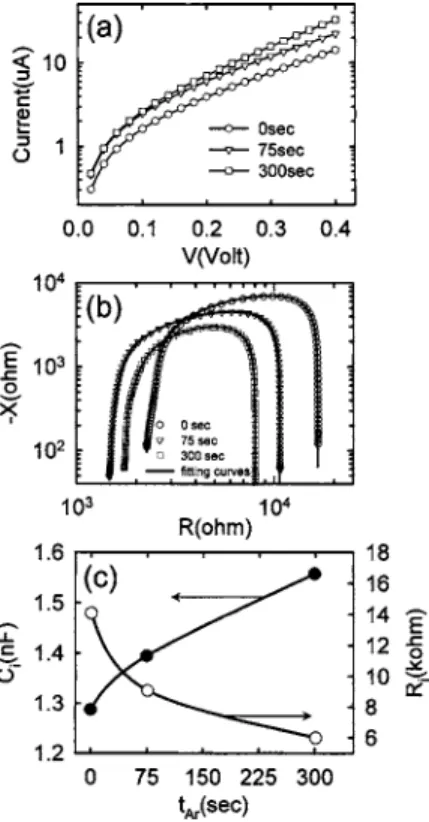
Vdcamplitude is essential to probe the interfacial conditions. The dc four-point-probe 共4p兲 current-voltage 共I-V兲 curves provide useful information for the choice of bias amplitude. Figure 3共a兲 displays the dc 4p I-V curves of 0, 75, and 300 s Ar+-irradiated MTJs. The I-V curves of the 75 and 300 s Ar+-irradiated MTJs almost overlap in low-bias-voltage re-gion, but these two I-V curves become distinguishable when
Vdc exceeds about 100 mV. Therefore, we apply an addi-tional Vdc of 400 mV 关typical for magnetic random access memory共MRAM兲 operation兴 in the measurement of CI spec-tra. Based on the above design, the bias-dependent CI spectra can be used to probe the variation of the top and bottom M-I interfacial conditions perturbed by Ar+irradiation on the bot-tom electrode.
Figure 3共b兲 demonstrates the bias-dependent CI spectra 共at 400 mV dc bias from bottom to top electrodes兲 in type of log-log Nyquist plots. The bias-dependent CI spectra can be analyzed by equivalent circuit method, including the contri-butions for CoFe– AlOx interfaces 共Ri and Ci兲, bulk AlOx
layer共Rband Cb兲, and lead of cross patterns 共Rl兲. The fitting
curves in Fig. 3共b兲 demonstrate great agreement with experi-mental results. Among these parameters, Ri and Ci are the
dominant factors related to the M-I interfacial transport prop-erties discussed below. First, we observe that the interfacial capacitance 共Ci兲 increases with rising tAr, as shown in Fig. 3共c兲. It is noted that Ci can be influenced by the charge
redistribution inside the tunnel barrier near the interface or by variation of interfacial traps.11The former process, similar to the formation of p-n junctions, occurs only at a larger length scale 共⬎100 nm兲, thus, the possibility can be obvi-ated. The latter process enhances the Ciin proportion to the
FIG. 1. 共a兲 The TMR ratio, 共b兲 complex capacitance spectra,共c兲 x-ray reflectivity with symbols for experi-mental data and curves for simulation results, and共d兲 fitting interfacial roughness of top and bottom M-I in-terfaces from x-ray reflectivity for Ar+-irradiated
CoFe– AlOx– CoFe MTJs with irradiation time tAr= 0,
75, and 300 s.
FIG. 2. Normalized TMR falloff curves as a function of Vdcranged from
−400 to 400 mV for Ar+-irradiated CoFe– AlO
x– CoFe MTJs with
irradia-tion time tAr= 0, 75, and 300 s. The inset indicates the patterns of normalized R0− Rsvs Vdc.
103504-2 Huang et al. J. Appl. Phys. 98, 103504共2005兲
trap state density共TSD兲 or the lifetime an electron spends on the trap states near the M-I interface. The enhancement in Ci
likely indicates that the Ar+ irradiation creates more trap states at the M-I interfaces. Second, these trap states are likely formed by the hybridization of conduction carriers and defects at M-I interfaces. When carriers are injected from the bottom ferromagnetic 共FM兲 electrode across the M-I inter-face to the insulating layer, these trap states act as conducting channels. Thus, the increase in TSD with rising tArcauses a decrease in Ri, as shown in Fig. 3共c兲, as a consequence of
increasing conducting channels. Furthermore, the increase in TSD suggests that more defects are created at the M-I inter-face due to increasing of the interfacial roughness by Ar+ irradiation, consistent with the results of x-ray reflectivity. It is here noted that similar results of bias-dependent CI spectra have also been observed when MTJs are biased from the top to the bottom electrodes.
Finally, we attempt to clarify the underlying mechanism for the asymmetric TMR falloff curves. The asymmetric TMR falloff curves of the 75 and 300 s Ar+-irradiated MTJs can be due to the variation of junction resistance 共R0兲, R0 − Rs, or their mixed contributions. We notice that the junction
resistance of all MTJs decrease with increasing Vdc, but these curves 共not shown here兲 are in marked difference with the patterns of Fig. 2. The possibility of junction resistance variation causing the asymmetric properties can be elimi-nated. We also plot the normalized R0− Rsvs Vdc. As shown
in the inset of Fig. 2, the curves are almost the same as the normalized TMR falloff curves. The asymmetric properties hence are due to the spin-dependent contribution as further interpreted in the following. MTJs with increasing top and bottom interfacial roughnesses, shown in Fig. 1共d兲, show in-creasing TSD at bottom and top interfaces. When spin-polarized共SP兲 carriers are injected from the bottom FM elec-trodes 共positive bias region兲, the SP carriers first encounter the bottom interface with a higher TSD. These trap states behave as unpolarized channels, thus, the SP carriers de-crease more dramatically during tunneling through the bot-tom M-I interface. On the contrary, SP carriers injected from top FM electrodes 共negative bias region兲 first encounter the top interface with a relatively lower TSD, i.e., more SP car-riers tunnel through the top M-I interface compared to the reverse bias process. When Vdc increases, the difference of spin-independent currents become apparent and lead to asymmetric TMR falloff curves in the positive and negative regions.
IV. CONCLUSIONS
In summary, asymmetric TMR falloff curves have been observed for Ar+-irradiated MTJs. CI and x-ray reflectivity techniques have been employed to characterize the Ar+-irradiated M-I interfaces. An interpretation, based on the distribution of TSD at M-I interfaces, has been proposed to disclose the underlying mechanism for the asymmetric TMR falloff curves. This work also demonstrates that the control of interfacial roughness can be utilized to modulate the trans-port properties of MTJs.
ACKNOWLEDGMENTS
The authors would like to thank Professor Y. H. Lee for the kind assistance of using the impedance analyzer. This work has been support by the National Science Council of the ROC under Grant No. NSC 94-2112-M-006-003, Taiwan Spin Research Center of the National Chun Cheng Univer-sity under Grant No. 93-EC-17-A-01-S1-026, and National Synchrotron Radiation Research Center under Project No. 2004-3-032-1.
1G. A. Prinz, Science 282, 1660共1998兲.
2S. S. P. Parkin, C. Kaiser, A. Panchula, P. M. Rice, B. Hughes, M. Samant,
and S. H. Yang, Nat. Mater. 3, 862共2004兲.
3S. Zhang, P. M. Levy, A. C. Marley, and S. S. P. Parkin, Phys. Rev. Lett.
79, 3744共1997兲.
4J. Zhang and R. M. White, J. Appl. Phys. 83, 6512共1998兲.
5X. H. Xiang, T. Zhu, J. Du, G. Landry, and J. Q. Xiao, Phys. Rev. B 66,
174407共2002兲.
6L. Le Brizoual, P. Alont, M. Hehn, F. Montaigne, M. Alont, A. Schuhl,
and E. Snoeck, Appl. Phys. Lett. 86, 112505共2005兲.
7J. Schmalhorst, S. Kämmerer, G. Reiss, and A. Hütten, Appl. Phys. Lett.
86, 052501共2005兲.
8S.-J. Ahn, T. Kato, H. Kubota, Y. Ando, and T. Miyazaki, Appl. Phys.
Lett. 86, 102506共2005兲.
9Y. Miyamoto, K. Machida, N. Hayashi, T. Tamaki, and H. Okuda, J. Appl.
Phys. 89, 6647共2001兲.
10J. C. A. Huang and C. Y. Hsu, Appl. Phys. Lett. 85, 5947共2004兲. 11G. Landry, Y. Dong, J. Du, X. Xiang, and J. Q. Xiao, Appl. Phys. Lett. 78,
501共2001兲. FIG. 3.共a兲 The four-point-probe current-voltage curves, 共b兲 bias-dependent
complex capacitance spectra in type of Nyquist plots共symbols兲 in log-log scale and fitting curves共solid curves兲, 共c兲 fitting interfacial capacitance Ci,
and 共d兲 fitting interfacial resistance Ri for CoFe– AlOx– CoFe MTJs with
irradiation time tAr= 0, 75, and 300 s.
103504-3 Huang et al. J. Appl. Phys. 98, 103504共2005兲