Chemistry
Zumdahl, 7th edition
CH6 Thermochemistry
Hot have flowing into the ocean in Hawaii Volcanoes National Park creates clouds of steam.
6.1 The Nature of Energy
6.2 Enthalpy and Calorimetry 6.3 Hess’s Law
6.4 Standard Enthalpies of Formation 6.5 Present Sources of Energy
6.6 New Energy Sources
Contents
Introduction
Energy is the essence of our very existence as individuals and as a society.
The food that we eat furnishes the energy to live, work, and play, just as the coal and oil consumed by
manufacturing and transportation systems power our
modern industrialized civilization.
6.1 The Nature of Energy
energy: the capacity to do work or to produce heat.
One of the most important characteristics of energy is that it is conserved.
The law of conservation of energy. Energy can be converted from one form to another but can be neither created nor destroyed.
That is, the energy of the universe is constant.
Energy can be classified as either potential or kinetic
Potential energy is energy due to position or composition.
The kinetic energy of an object is energy due to the motion of the object and depends on the mass of the object m and its velocity v: KE = ½mv
2.
Energy can be converted from one form to anther.
Consider the two balls in Fig. 6.1(a).
Ball A, because of its higher position initially, has more
potential energy than ball B.
When A is released, it moves down the hill and strikes B.
Eventually, the arrangement shown in Fig. 6.1(b) is achieved.
This transfer of energy is called frictional heating.
The temperature of the hill increases very slightly as
the ball rolls down.
Figure 6.1
(a) In the initial positions, ball A has a higher potential energy than ball B. (b) After A has rolled down the hill, the potential energy lost by A has been converted to random motions of the components of the hill
(frictional heating) and to the increase in the potential
energy of B.
Heat and temperature are decidedly different.
Temperature is a property that reflects the random motions of the particles in a particular substance.
Heat, involves the transfer of energy between two objects due to a temperature difference.
Heat is not a substance contained by an object,
although we often talk of heat as if this were true.
Note that in going from the initial to the final
arrangements in Fig. 6.1, ball B gains potential energy because work was done by ball A on B.
Work is defined as force acting over a distance.
This bring us to a very important concept: the state function or state property.
A state function refers to a property of the system that
depends only on its present state.
A state function (property) does not depend in any way on the system’s past (or future).
A very important characteristic of a state function: A
change in this function (property) in going from one state
to another state is independent of the particular pathway
taken between the two states.
This infrared photo of a house shows where energy leaks occur. The more red the color, the more energy (heat) is leaving the house.
The system is the part of the universe on which we wish to focus attention; the surroundings include
everything else in the universe.
When a reaction results in the evolution of heat, it is
said to be exothermic (exo- is that is, energy flows out of the system.
Reactions that absorb energy from the surroundings are said to be endothermic. When the heat flow is into a
Chemical Energy
The formation of nitric oxide from nitrogen and oxygen is endothermic:
N
2(g) + O
2(g) + energy (heat) 2NO(g)
Total energy is conserved and that energy flows from the system into the surroundings in an exothermic
reaction.
This means that the energy gained by the surroundings
must be equal to the energy lost by the system.
In any exothermic reaction, some of the potential
energy stored in the chemical bonds is being converted to thermal energy (random kinetic energy) via heat.
The energy diagram for the combustion of methane is shown in Fig. 6.2, where Δ(PE) represents the change in potential energy stored in the bonds of the products as
compared with the bonds of the reactants.
Figure 6.2
The combustion of methane releases the quantity of energy Δ(PE) to the surroundings via heat flow. This is an exothermic process.
The net result is that the quantity of energy Δ(PE) is transferred to the surroundings through heat.
For an endothermic reaction, the situation is reversed, as shown in Fig. 6.3.
The study of energy and its interconversions is called thermodynamics.
The law of conservation of energy is often called the
first law of thermodynamics and is stated as follows:
Figure 6.3
The energy diagram for the reaction of nitrogen and oxygen to form nitric oxide. This is an endothermic process: Heat [equal in magnitude to Δ(PE)] flows into the system from the
surroundings.
The internal energy E of a system can be defined most precisely as the sum of the kinetic and potential energy of all the “particles” in the system.
The internal energy of a system can be change by a flow of work, heat, or both. That is,
ΔE = q + w
where ΔE represents the change in the system’s
internal energy, q represents heat, and w represents work.
Thermodynamic quantities always consist of two parts:
a number, giving the magnitude of the change, and a sigh, indicating the direction of the flow.
The sigh reflects the system’s point of view.
The same conventions also apply to the flow of work.
If the system does work on the surroundings (energy flows out of the system), w is negative.
If the surroundings do work on the system (energy flows into the system), w is positive.
ΔE = q + w
The first law of thermodynamics is then written ΔE =
q - w’, where w’ signifies work from the surroundings’
Calculate ΔE for a system undergoing an endothermic process in which 15.6 kJ of heat flows and where 1.4 kJ of work is done on the system.
Sample Exercise 6.1
Internal Energy
A common type of work associated with chemical
processes is work done by a gas (through expansion) or work done to a gas (through compression).
Suppose we have a gas confined to a cylindrical
container with a movable piston as shown in Fig. 6.4, where F is the force acting on a piston of area A.
The pressure of the gas is
P = F
Work is defined as force applied over a distance, so if the piston moves a distance Δh, as shown in Fig. 6.4,
Work = force × distance = F × Δh = P × A × Δh
Figure 6.4
(a) The piston, moving a distance Δh against a pressure P, does work on the surroundings. (b) Since the volume of a cylinder is the area of the base times its height, the change in volume of the gas is given by Δh × A = ΔV.
ΔV = A × Δh
Work = P × A × Δh = PΔV
For an expanding gas, ΔV is a positive quantity because the volume is increasing.
Thus ΔV and w must have opposite signs, which leads to the equation
w = -PΔV
Note that for a gas expanding against an external pressure P, w is a negative quantity as required, since work flows out of the system.
When a gas is compressed, ΔV is a negative quantity (the volume decreases), which makes w a positive
quantity (work flows into the system).
A balloon is being inflated to its full extent by heating the air inside it. In the final stages of this process, the volume of the balloon changes from 4.00 × 10
6L to 4.50 × 10
6L by the addition of 1.3 × 10
8J of energy as heat. Assuming that the balloon expands against a constant pressure of
1.0 atm, calculate ΔE for the process. (To convert between L ・ atm and J, use 1 L ・ atm = 101.3 J.)
Sample Exercise 6.3
Internal Energy, Heat,
and Work
Solution
In this case P = 1.0 atm and
Sample Exercise 6.3
Thus
See Exercises 6.28 through 6.30 Sample Exercise 6.3
6.2 Enthalpy and Calorimetry
enthalpy, H, is defined as
H = E +PV
where E is the internal energy of the system, P is the pressure of the system, and V is the volume of the system.
Since internal energy, pressure, and volume are all state functions, enthalpy is also a state function.
Enthalpy
pressure-volume work (w = -PΔV).
ΔE = q
p+ w
ΔE = q
p- P Δ V q
p= ΔE + P Δ V
where q
pis the heat at constant pressure.
The definition of enthalpy is H = E + PV.
ΔH = ΔE + Δ (PV)
q
p= ΔE + P Δ V
•
at constant pressure
ΔH = q
p•
At constant pressure (where only PV work is allowed),
the change in enthalpy Δ H of the system is equal to the
energy flow as heat.
For a chemical reaction, the enthalpy change is given by the equation
ΔH = H
products- H
reactantsWhen 1 mole of methane (CH
4) is burned at constant pressure, 890 kJ of energy is released as heat. Calculate ΔH for a process in which a 5.8-g sample of methane is burned at constant pressure.
Solution
At constant pressure, 890 kJ of energy per mole of CH
4is produced as heat:
Sample Exercise 6.4
Enthalpy
In this case, a 5.8-g sample of CH
4(molar mass = 16.0 g/mol) is burned.
See Exercises 6.35 through 6.38 Sample Exercise 6.4
The device used experimentally to determine the heat associated with a chemical reaction is called a
calorimetry.
Calorimetry is based on observing the temperature
change when a body absorbs or discharges energy as heat.
The heat capacity C of a substance, is defined as
C =
Calorimetry
heat absorbed
increase in temperature
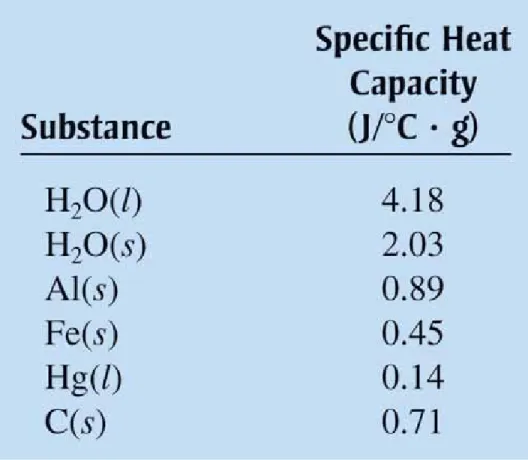
If the heat capacity is given per gram of substance, it is called the specific heat capacity, and its units are J/℃ ・ g or J/K ・ g.
If the heat capacity is given per mole of the substance, it is called the molar heat capacity, and it has the units J/℃ ・ mol or J/K ・ mol.
The specific heat capacities of some common substance
are given in Table 6.1.
TABLE 6.1 The Specific Heat Capacities of
Some Common Substances
This device is called a “coffee-cup calorimeter.”
The measurement of heat using a simple calorimeter
such as that shown in Fig. 6.5 is an example of constant-
pressure calorimetry, since the pressure (atmospheric
pressure) remains constant during the process.
Figure 6.5
A coffee-cup calorimeter
made of two Styrofoam cups.
From these assumptions and definitions, we can calculate the heat (change in enthalpy) for the
neutralization reaction:
Energy released by the reaction
= energy absorbed by the solution
= specific heat capacity × mass of solution × increase in temperature
= s × m × ΔT
Energy released = s × m × ΔT
When 1.00 L of 1.00 M Ba(NO
3)
2solution at 25.0℃ is mixed with 1.00 L of 1.00 M Na
2SO
4solution at 25℃ in a calorimeter, the white solid BaSO
4forms and the
temperature of the mixture increases to 28.1℃. Assuming that the calorimeter absorbs only a negligible quantity of heat, that the specific heat capacity of the solution is 4.18 J/℃ ・ g, and that the density of the final solution is 1.0 g/mL, calculate the enthalpy change per mole of BaSO
4formed.
Sample Exercise 6.5
Constant-Pressure Calorimetry
Solution
Since 1.00 L of each solution is used, the total solution volume is 2.00 L, and
Thus
Sample Exercise 6.5
See Exercises 6.51 through 6.54 Sample Exercise 6.5
Calorimetry experiments also can be performed at constant volume.
To study the energy changes in reactions under
conditions of constant volume, a “bomb calorimeter” (Fig.
6.6) is used.
For a constant-volume process, the change in volume
ΔV is equal to zero, so work (which is -PΔV) is also
equal to zero.
Therefore,
ΔE = q + w = q = q
V (constant volume)Figure 6.6
Figure 6.6
A bomb calorimeter. The reaction is carried out inside a rigid steel “bomb” (photo of actual disassemble “bomb” shown on right), and heat evolved is absorbed by the surrounding water and other calorimeter parts. The quantity of energy produced by the reaction can be calculated from the temperature
increase.
Suppose we wish to measure the energy of combustion of octane (C
8H
18), a component of gasoline.
A 0.5269-g sample of octane is placed in a bomb
calorimeter known to have a heat capacity of 11.3 kJ/℃.
Energy released by the reaction
= temperature increase × energy required to change the temperature by 1℃
= ΔT × heat capacity of calorimeter
= 2.25℃ × 11.3 kJ/℃ = 25.4 J
The number of moles of octane is 4.614 × 10
-3mol octane.
Since 25.4 kJ of energy was released for 4.614 × 10
-3mol octane, the energy released per mole is 5.50 × 10
-3kJ/mol.
Since the reaction is exothermic, ΔE is negative:
ΔE
combustion= -5.50 × 10
-3kJ/mol
Note that since no work is done in this case, ΔE is
6.3 Hess’s Law
Since enthalpy is a state function, the change in
enthalpy in going from some initial state to some final state is independent of the pathway.
In going from a particular set of reactants to a
particular set of products, the change in enthalpy is the same whether the reaction takes place in one step or in a series of steps.
This principle is known as Hess’s law .
The overall reaction can be written in one step, where the enthalpy change is represented by ΔH
1.
N
2(g) + 2O
2(g) 2NO
2(g) ΔH
1= 68 kJ
The principle of Hess’s law is shown schematically in
Fig. 6.7.
Figure 6.7
The principle of Hess’s law. The same change in enthalpy
occurs when nitrogen and oxygen react to form nitrogen dioxide, regardless of whether the reaction occurs in one (red) or two
Two characteristics of ΔH for a reaction:
1. If reaction is reversed, the sign of ΔH is also reversed.
2. The magnitude of ΔH is directly proportional to the quantities of reactants and products in a reaction. If the coefficients in a balanced reaction are multiplied by an integer, the value of ΔH is multiplied by the same integer.
Characteristic of Enthalpy Changes
The first rule can be explained by recalling that the sign of ΔH indicates the direction of the heat flow at constant pressure.
If the direction of the reaction is reversed, the direction of the heat flow also will be reversed.
The second rule comes from the fact that ΔH is an extensive property, depending on the amount of
substances reacting.
Two forms of carbon are graphite, the soft, black,
slippery material used in “lead” pencils and as a lubricant for locks, and diamond, the brilliant, hard gemstone.
Using the enthalpies of combustion for graphite (-394 kJ/mol) and diamond (-396 kJ/mol), calculate ΔH for the conversion of graphite to diamond:
C
graphite(s) C
diamond(s)
Sample Exercise 6.7
Hess’s Law Ⅰ
(left) graphite;
(right) diamond.
Hints for Using Hess’s Law
Calculations involving Hess’s law typically require that several reactions be manipulated and combined to finally give the reaction of interest. In doing this procedure you should
• Work backward from the required reaction, using the reactants and products to decide how to manipulate the other given reactions at you disposal
• Reverse any reactions as needed to give the required reactants and products
• Multiply reactions to give the correct numbers of
This process involves some trial and error, but it can be
very systematic if you always allow the final reaction to
guide you.
6.4 Standard Enthalpies of Formation
For a reaction studied under conditions of constant pressure, we can obtain the enthalpy change using a calorimeter.
An example is the conversion of solid carbon from its grahite form to its diamond form:
C
graphite(s) C
diamond(s)
The value of ΔH for this process cannot be obtained
by direct measurement in a calorimeter because the
The standard enthalpy of formation (ΔH∘) of a compound is defined as the change in enthalpy that
accompanies the formation of one mole of a compound from its elements with all substances in their standard states.
A degree symbol on a thermodynamic function, for
example, ΔH∘, indicates that the corresponding process has been carried out under standard conditions.
The standard state for a substance is a precisely defined reference state.
f
f
Conventional Definitions of Standard States
For a Compound
z The standard state of a gaseous substance is a pressure of exactly 1 atmosphere.
z For a pure substance in a condensed state (liquid or solid), the standard state is the pure liquid or solid.
z For a substance present in a solution, the standard state is a concentration of exactly 1 M.
For an Element
z The standard state of an element is the form in which the element exists under conditions of 1 atmosphere and 25℃. (The standard state for oxygen is O2(g) at a pressure of 1 atmosphere; the
The standard state of carbon is graphite, the standard
states for oxygen and hydrogen are the diatomic gases, and the standard state for methanol is the liquid.
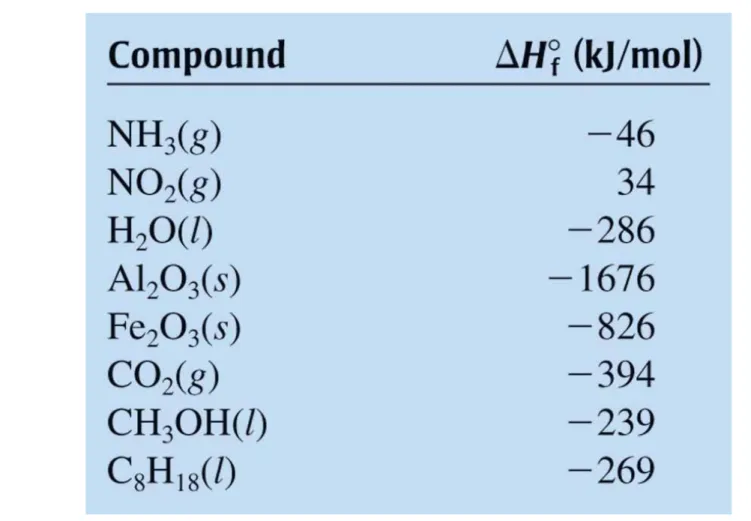
The ΔH∘ values for some common substances are shown in Table 6.2. More values
The importance of the tabulated ΔH∘ values is that
enthalpies for many reactions can be calculated using these numbers.
f
f
Calculate the standard enthalpy change for the combustion of methane:
CH
4(g) + 2O
2(g) CO
2(g) + 2H
2O(l)
Enthalpy is a state function, so we can invoke Hess’s law and choose any convenient pathway from reactants to
products and then sum the enthalpy changes along the
chosen pathway.
TABLE 6.2 Standard Enthalpies of
Formation for Several Compounds at 25 ℃
A convenient pathway, shown in Fig. 6.8, involves
taking the reactants apart to the respective elements in their
standard states in reactions (a) and (b) and then forming the
products from these elements in reactions (c) and (d).
Figure 6.8
In this pathway for the combustion of methane, the reactants are first taken apart in reactions (a) and (b) to form the
constituent elements in their standard states, which are then
This process is diagramed in Fig. 6.9.
Notice that the reactants are taken apart and converted to elements [not necessary for O
2(g)] that are then used to
form products.
Let’s examine carefully the pathway we used in this example.
First, the reactants were broken down into the elements
in their standard states.
This process involved reversing the formation reactions and switching the signs of the enthalpies of formation.
The products were then constructed from these elements.
This involved formation reactions and thus enthalpies of formation.
The products were then constructed from these elements.
This involved formation reactions and thus enthalpies of
formation.
Figure 6.9
A schematic diagram of the energy changes for the reaction
The enthalpy change for a given reaction can be
calculated by subtracting the enthalpies of formation of the reactants from the enthalpies of formation of the products.
Remember to multiply the enthalpies of formation by integers as required by the balanced equation.
This statement can be represented symbolically as
follows:
where the symbol Σ(sigma) means “to take the sum of the terms,” and n
pand n
rrepresent the moles of each
product or reactant, respectively.
Elements are not included in the calculation because
elements require no change in form.
Keep in Mind the Following Key Concepts When Doing Enthalpy Calculations:
z When a reaction is reversed, the magnitude of ΔH remains the same, but its sign changes.
z When the balanced equation for a reaction is multiplied by an integer, the value of ΔH for that reaction must be multiplied by the same integer.
z The change in enthalpy for a given reaction can be calculated from the enthalpies of formation of the reactants and products:
z Elements in their standard states are not included in the ΔHreaction calculations. That is , ΔH∘ for an element in its standard state is zero.
f
Using the standard enthalpies of formation listed in Table 6.2, calculate the standard enthalpy change for the overall reaction that occurs when ammonia is burned in air to
form nitrogen dioxide and water. This is the first step in the manufacture of nitric acid.
Solution
We will use the pathway in which the reactants are
broken down into elements in their standard states, which
Sample Exercise 6.9
Enthalpies from Standard
Enthalpies of Formation Ⅰ
Sample Exercise 6.9
1 Decomposition of NH
3(g) into elements (reaction (a) in Fig. 6.10). The first step is to decompose 4 moles of NH
3into N
2and H
2:
2 Elemental oxygen (reaction (b) in Fig. 6.10). Since
O
2(g) is an element in its standard state, ΔH∘= 0.
(b)Sample Exercise 6.9
3 Synthesis of NO
2(g) from elements (reaction (c) in Fig. 6.10). The overall reaction equation has 4 moles of NO
2. Thus the required reaction is 4 times the formation reaction for NO
2:
Form Table 6.2, ΔH∘ for NO
f 2(g) = 34 kJ/mol and
Sample Exercise 6.9
4 Synthesis of H
2O(l) from elements (reaction (d) in Fig. 6.10). Since the overall equation for the reaction has 6 moles of H
2O(l), the required is 6 times the formation reaction for H
2O(l):
From Table 6.2, ΔH∘ for H
2O(l) = -286 kJ/mol and
To summarize, we have done the following:
f
Sample Exercise 6.9
See Exercises 6.67 and 6.68
Figure 6.10
A pathway for the combustion of ammonla.
Using enthalpies of formation, calculate the standard change in enthalpy for the thermite reaction:
This reaction occurs when a mixture of powdered aluminum and iron (Ⅲ) oxide is ignited with a magnesium fuse.
Sample Exercise 6.10
Enthalpies from Standard
Enthalpies of Formation Ⅱ
Sample Exercise 6.10
See Exercises 6.71 and 6.72 The thermite reaction is one of the
most energetic chemical reactions known.
6.5 Present Sources of Energy
Woody plants, coal, petroleum, and natural gas hold a vast amount of energy that originally came from the sun.
By the process of photosynthesis, plants store energy that can be claimed by burning the plants themselves or the decay products that have been converted over
millions of years to fossil fuels.
Although the United States currently depends heavily
on petroleum for energy, this dependency is a relatively
Figure 6.11
Energy sources used in the United States.
Petroleum is a thick, dark liquid composed mostly of compounds called hydrocarbons that contain carbon and hydrogen.
Table 6.3 gives the formulas and names for several common hydrocarbons.
Natural gas, usually associated with petroleum
deposits, consists mostly of methane, but it also contains significant amounts of ethane, propane, and butane.
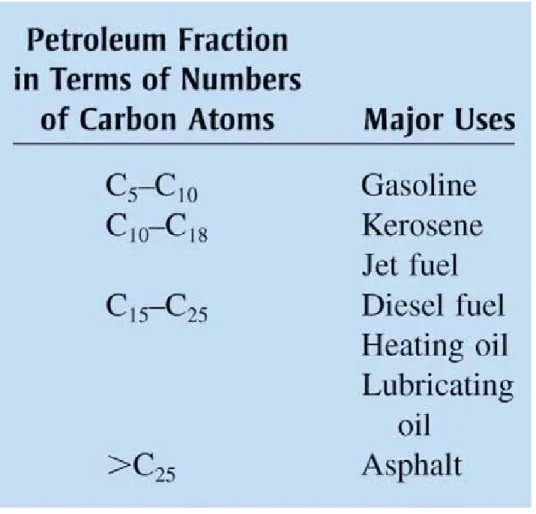
The commercial uses of various petroleum fractions are
Petroleum and Natural Gas
TABLE 6.3 Names and Formulas for
Some Common Hydrocarbons
TABLE 6.4 Uses of the Various
Petroleum Fractions
The petroleum era began when the demand for lamp oil during the Industrial Revolution outstripped the traditional sources: animal fats and whale oil.
In response to this increased demand, Edwin Drake
drilled the first oil well in 1859 at Titusville, Pennsylvania.
The petroleum from this well was refined to produce
kerosene (fraction C
10—C
18), which served as an excellent lamp oil.
Gasoline (fraction C
5—C
10) had limited use and was
often discarded.
As gasoline became more important, new ways were
sought to increase the yield of gasoline obtained from each barrel of petroleum.
William Burton invented a process at Standard Oil of Indiana called pyrolytic (high-temperature) cracking.
In this process, the heavier molecules of the kerosene
fraction are heated to about 700℃, causing them to break
(crack) into the smaller molecules of hydrocarbons in the
gasoline fraction.
The oil rig in Norway is the largest in the world.
Coal was formed from the remains of plants that were buried and subjected to high pressure and heat over long periods of time.
Coal “matures” through four stages: lignite, subbituminous, bituminous, and anthracite.
Each stage has a higher carbon-to-oxygen and carbon- to-hydrogen ratio.
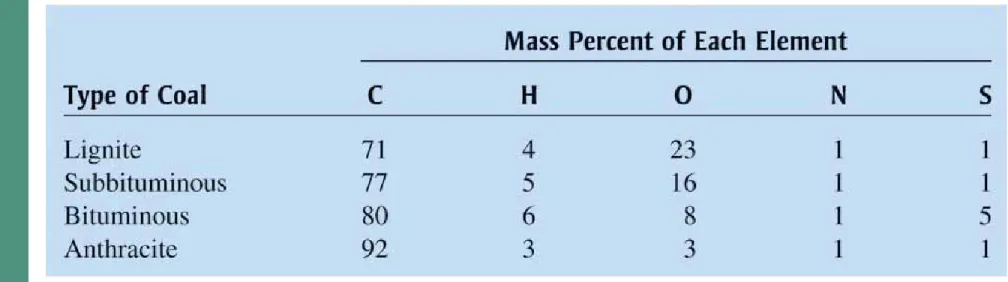
Typical elemental compositions of the various coals are
Coal
The energy available from the combustion of a given mass of coal increase as the carbon content increases.
Anthracite is the most valuable coal, and lignite the least
valuable.
TABLE 6.5 Elemental Composition of
Various Types of Coal
The earth receives a tremendous quantity of radiant energy from the sun, about 30% of which is reflected back into space by the earth’s atmosphere.
The remaining energy passes through the atmosphere to the earth’s surface.
Some of this energy is absorbed by plants for
photosynthesis and some by the oceans to evaporate
water, but most of it is absorbed by soil, rocks, and water, increasing the temperature of the earth’s surface.
Effects of Carbon Dioxide on Climate
This energy is in turn radiated from the heated surface mainly as infrared radiation, often called heat radiation.
The atmosphere, like window glass, is transparent to
visible light but does not allow all the infrared radiation to pass back into space.
As shown in Fig. 6.12, so a net amount of thermal energy
is retained by the earth’s atmosphere, causing the earth to
be much warmer than it would be without its atmosphere.
Figure 6.12
Figure 6.12
The earth’s atmosphere is transparent to visible light from the sun. This visible light strikes the earth, and part of it is changed to infrared radiation. The infrared radiation from the earth’s
surface is strongly absorbed by CO2, H2O, and other molecules present in smaller amounts (for example, CH4 and N2O) in the atmosphere. In effect, the atmosphere traps some of the energy, acting like the glass in a greenhouse and keeping the earth
warmer than it would otherwise be.
Thus the temperature of the earth’s surface is controlled to a significant extent by the carbon dioxide and water
content of the atmosphere.
In fact, the variation in the earth’s average temperature over the past century is somewhat confusing.
In the northern latitudes during the past century, the
average temperature rose by 0.8℃ over a period of 60
years, then cooled by 0.5℃ during the next 25 years, and
finally warmed by 0.2℃ in the succeeding 15 years.
Such fluctuations do not match the steady increase in carbon dioxide.
However, in southern latitudes and near the equator
during the past century, the average temperature shown a steady rise totaling 0.4℃.
This figure is in reasonable agreement with the predicted
effect of the increasing carbon dioxide concentration over
that period.
Sheep grazing on a ranch in Australia.
The increase in the atmospheric concentration of carbon dioxide is quite dramatic (see Fig. 6.13).
Methane is another greenhouse gas that is 21 times more potent than carbon dioxide.
This fact is particularly significant for countries with lots of animals, because methane is produced by methanogenic archae that live in the animals’ rumen.
To reduce this level, Australia has initiated a program to
vaccinate sheep and cattle to lower the number of archae
Figure 6.13
Figure 6.13
The atmospheric CO2 concentration and the average global temperature over the last 250 years. Note the significant increase in CO2 concentration in the last 50 years. (Source:
National Assessment synthesis Team, Climate Change
Impacts on the United States: The Potential Consequences of Climate, Variability and change, Overview, Report for the U.S.
Global Change Research Program, Cambridge University Press, Cambridge, UK, p. 13, 2000.)
6.6 New Energy Sources
There are several potential energy sources: the sun
(solar), nuclear processes (fission and fusion), biomass
(plants), and synthetic fuels.
One alternative energy source involves using a traditional fuel-coal-in new ways.
Substances like coal that contain large molecules have high boiling points and tend to be solids or thick liquids.
To convert coal from a solid to a gas therefore requires reducing the size of the molecules; the coal structure
must be broken down in a process called coal gasification.
The process is represented in Fig. 6.14.
Coal Conversion
Figure 6.14
Figure 6.14
Coal gasification. Reaction of coal with a mixture of steam and air breaks down the large hydrocarbon molecules in the coal to smaller gaseous molecules, which can be used as fuels.
The desired product is a mixture of carbon monoxide and hydrogen called synthetic gas, or syngas, and methane
(CH
4) gas.
In coal gasification, some of the reactions are exothermic:
Other gasification reactions are endothermic,
Although syngas can be used directly as a fuel, it is also important as a raw material to produce other fuels. For
example, syngas can be converted directly to methanol:
CO(g) + 2H
2(g) CH
3OH(l)
Methanol is used in the production of synthetic fibers and plastics and also can be used as a fuel. In addition, it can be converted directly to gasoline.
In addition to coal gasification, the formation of coal
If you have ever seen a lecture demonstration where hydrogen-oxygen mixtures were ignited, you witnessed a demonstration of hydrogen’s potential as a fuel.
The combustion reaction is
There are three main problems: the cost of production, storage, and transport.
Hydrogen as a Fuel
The main engines in the space
First let’s look at the production problem.
Currently, the main source of hydrogen gas is from the treatment of natural gas with steam:
CH
4(g) + 2H
2O(g) 3H
2(g) + CO(g) ΔH° = 206 kJ
Note that this reaction is highly endothermic; treating methane with steam is not an efficient way to obtain
hydrogen for fuel. It would be much more economical to
burn the methane directly.
H
2O(l) H
2(g) + ½C
2(g)
•
Requires 286 kJ of energy per mole of liquid water, and under current circumstances, large-scale production of hydrogen from water is not economically feasible.
•
However, several methods for such production are currently being studied: electrolysis of water, thermal
decomposition of water, thermochemical decomposition of
water, and biological decomposition of water.
Thermal decomposition is another method for producing hydrogen from water.
In the thermochemical decomposition of water, chemical
reactions, as well as heat, are used to “split” water into its
components.
Note that the HI is not consumed in the net reaction.
Note also that maximum temperature required is 825℃, a temperature that is feasible if a nuclear reactor is used as a heat source.
The storage and transportation of hydrogen also present problems.
An additional problem is the relatively small amount of
energy that is available per unit volume of hydrogen gas.
Although the use of hydrogen as a fuel solves some of
the problems associated with fossil fuels, it does present
some potential environmental problems of its own.
Compare the energy available from the combustion of a given volume of methane and the same volume of
hydrogen at the same temperature and pressure.
Solution
In Sample Exercise 6.6 we calculated the heat released for the combustion of methane and hydrogen: 55 kJ/g CH
4and 141 kJ/g H
2. We also know from our study of gases that 1 mol H
2(g) has the same volume as 1 mol CH
4(g) at the same temperature and pressure (assuming ideal
Sample Exercise 6.12
Enthalpies of Combustion
Thus, for molar volumes of both gases under the same conditions of temperature and pressure,
Sample Exercise 6.12
Thus about three times the volume of hydrogen gas is needed to furnish the same energy as a given volume of methane.
See Exercises 6.78 Sample Exercise 6.12
Assuming that the combustion of hydrogen gas provides three times as much energy per gram as gasoline,
calculate the volume of liquid H
2(density = 0.0710 g/mL) required to furnish the energy contained in 80.0 L (about 20 gas) of gasoline (density = 0.740 g/mL). Calculate also the volume that this hydrogen would occupy as a gas at 1.00 atm and 25℃.
Sample Exercise 6.13
Comparing Enthalpies of
Combustion
Thus storage of hydrogen in the individual automobile as a liquid does not seem practical.
A much better alternative seems to be the use of metals that absorb hydrogen to form solid metal hydrides:
H
2(g) + M(s) MH
2(s)
This hydrogen would then be available for combustion in
the engine by release of H
2(g) from the hydride as needed:
The most likely use of hydrogen in automobiles will be to power fuel cells .
Ford, Honda, and Toyota are all experimenting with cars
powered by hydrogen fuel cells.
Many other energy sources are being considered for future use.
The western states, especially Colorado, contain huge deposits of oil shale, which consists of a complex carbon- based material called kerogen contained in porous rock formations.
Ethanol (C
2H
5OH) is another fuel with the potential to supplement, if not replace, gasoline.
Other Energy Alternatives
The most common method of producing ethanol is fermentation, a process in which sugar is changed to alcohol by the action of yeast.
Car engines can burn pure alcohol or gasohol, an
alcohol-gasoline mixture (10% ethanol in gasoline), with little modification. Gasohol is now widely available in the United States.
Methanol (CH
3OH), an alcohol similar to ethanol, which
has been used successfully for many years in race cars, is
now being evaluated as a motor fuel in California.
Another potential source of liquid fuels is oil squeezed from seeds (seed oil).
The main advantage of seed oil as a fuel is that it is
renewable. Ideally, fuel would be grown just like food
crops.
The sugars in corn are fermented and used to produce ethanol, an additive for gasoline.