High piezoelectric properties of cement piezoelectric composites containing kaolin
Huang Hsing Pan*a, Ruei-Hao Yanga, Yu-Chieh Chenga
a Department of Civil Engineering, Kaohsiung University of Applied Sciences, Kaohsiung, Taiwan
ABSTRACT
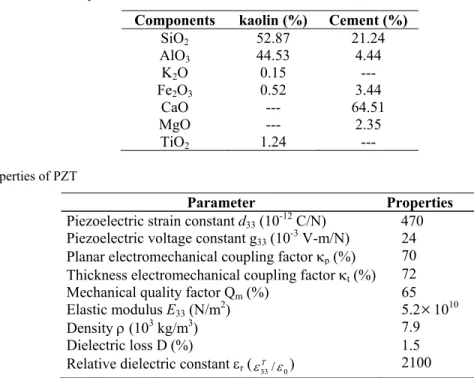
To obtain high piezoelectric properties, PZT/cement composites with kaolin were fabricated and polarized by 1.5kV/mm electric field for 40 min, where lead zirconate titanate (PZT) inclusion with 50% by volume was used. After the polarization, piezoelectric properties of the composite were measured daily till 100 days. Results indicated that relative dielectric constant (εr) and piezoelectric strain constant (d33) increase with aging day, and approach to asymptotic values after 70 days. Temperature treatment to the composite is a dominate factor to enhance piezoelectric properties. The d33
and εr values of PZT/cement composites treated at the ambient temperature (23℃) were 57pC/N and 275 at the 70th aging day respectively, and then reached 106pC/N and 455 in turn with 150℃ treatment. The composite contains 4%
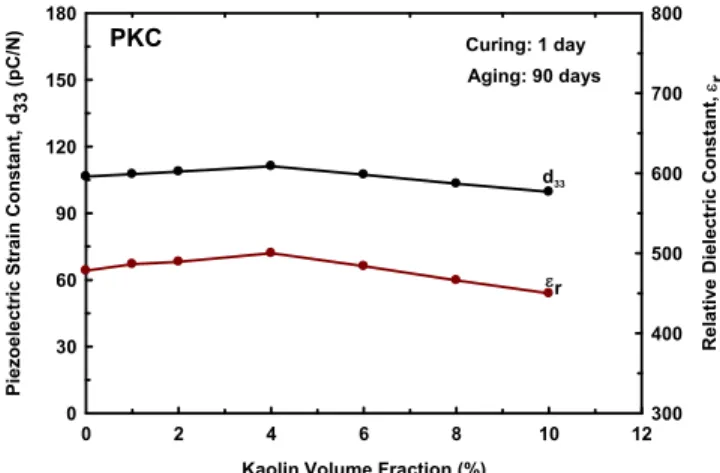
kaolin having the highest value of d33=111pC/N and εr=500 at 90 days because the porosity is the less than the others.
Cement piezoelectric composites containing kaolin own the higher d33 and εr value, compared with the other reported composites with 50% PZT. The porosity, the electromechanical coupling factor and impedance-frequency spectra of the cement piezoelectric composites were also discussed.
Keywords: cement, piezoelectric properties, kaolin, lead zirconate titanate, porosity, sensor
1. INTRODUCTION
Instead of conventional piezoelectric ceramics or polymers, cement-based piezoelectric composites as sensors for structural health monitoring in concrete structures were developed to overcome the matching problem with concrete. The manufactures of cement-based piezoelectric composites having high piezoelectric and dielectric constants are still ongoing. For 0-3 type cement-based piezoelectric composites (PZT/cement composites) with adequate PZT content exhibiting good compatibility with concrete, the piezoelectric properties reported thus far are not high enough for application as cement sensors. The highest values of piezoelectric strain constant d33 and relative dielectric constant εr were near 60 pC/N and 300, respectively, with the exception of Wang et al.[1] who fabricated 60%PZT/cement composites including a silica-based material, yielding d33 = 70 pC/N and 99 pC/N after 38 and 90 days, respectively.
A great deal of effort has been made to improve the dielectric and piezoelectric properties of cement-based piezoelectric ways to enhance ferroelectric behavior. Some admixtures such as carbon[2], carbon black[3-4], carbon nanotubes[5] and pozzolanic materials[6-8] have been selected to use in cement piezoelectric composites, finding that adequate content of admixtures can slightly increase the d33 and εr values of PZT/cement composites. This work focuses on PZT/cement composites consisting of Type I Portland cement as the matrix and randomly oriented PZT particles as the functional inclusion, where kaolin addition was added to the composite.
2. EXPERIMENTAL PROGRAM
PZT particles are uniformly distributed to cement-based binders, so-called 0–3 cement piezoelectric composites. PP composite is a cement piezoelectric composite with 50% PZT and 50% cement by volume, where acoustic impedance (ρv) of PP is 10×10-6 kg-m-2s-1 close to concrete with ρv = 9.0×10⁻⁶ kg-m-2s-1. Kaolin as a partial replacement of cement was added to the composite. There are six replacements of cement by kaolin, 1, 2, 4, 6, 8 and 10 vol.%, in PP composite.
KPC materials represent the PP material containing kaolin. For instance, KPC1 represents 1 vol.% of cement replaced by kaolin in the PP composite.
* [email protected]; Tel: +886 928755863; Fax: +886 7 3831371
Cement is type I Portland cement with the fineness of 349m2/kg and a specific gravity of 3.16. The specific gravity, particle diameter and the fineness of kaolin are 2.63, 1.5μm and 9000~11000m2/kg, respectively. The main chemical components of kaolin and cement are listed in Table 1. PZT particles of 75–150μm were chosen, which have a specific gravity of 7.9, d33 = 470 pC/N, piezoelectric voltage constant g33 = 24×10−3 V-m/N, and εr = 2,100, as listed in Table 2.
Table 1. Main chemical components of kaolin and cement
Components kaolin (%) Cement (%)
SiO2 52.87 21.24
AlO3 44.53 4.44
K2O 0.15 ---
Fe2O3 0.52 3.44
CaO --- 64.51 MgO --- 2.35
TiO2 1.24 ---
Table 2. Properties of PZT
Parameter Properties
Piezoelectric strain constant d33 (10-12 C/N) 470 Piezoelectric voltage constant g33 (10-3 V-m/N) 24 Planar electromechanical coupling factor κp (%) 70 Thickness electromechanical coupling factor κt (%) 72 Mechanical quality factor Qm (%) 65 Elastic modulus E33 (N/m2) 5.2×10¹⁰
Density ρ (103 kg/m3) 7.9
Dielectric loss D (%) 1.5 Relative dielectric constant εr (ε33T /ε0) 2100
To prepare specimens, PZT particles, cement and kaolin were pre-mixed by a solar-planetary mill for 5 min without adding water. The resulting composite (mixture) was uniformly mixed. Then, the mixture was pressed in a 15mm∮ cylindrical steel mold at 80 MPa compression to form a disk-like specimen. Afterwards, specimens were cured for 24 h at 90℃ and 100% relative humidity to produce suitable strength. After curing, the specimens sequentially were polished to a 2mm in thickness, and were monitored by optical microscopy (OM) at 350X magnification to visualize the constituents and the porosity of the composite.
Before the polarization, specimens were coated on both sides with silver paint and then baked in an oven at 150℃ for 30 minutes to form the electrode. After that, specimens were placed at ambient air temperature for one day. Finally, specimens were heated at 150℃ (pretreatment temperature) for 40 min. Here, PP material was treated at 23℃ (PP23
material) used as a reference.
After temperature pretreatment, the specimen was cooled to room temperature, and we immediately measured capacitance (C) and dielectric loss (D) using an impedance phase analyzer (Model 6520A) at 1 kHz. Relative dielectric constant εr was calculated from Ct/ε0A [9], where t is the thickness of specimen (here is 2mm), ε0 is a vacuum dielectric constant(8.854pF/m), and A is the electrode area (15mm).
To create piezoelectric properties, voltage field applying to the composites is required. No piezoelectric properties are found without successful polarization. Poling voltage was applied to the specimen at 1.5kV/mm, in a 150 silicone oil bath for 45 minutes. During the polarization, voltage increase should be carefully applied to prevent from current breakdown of the specimens. The piezoelectric properties were measured and calculated immediately when the specimen was successfully polarized, and then the data were recorded daily up to 100 days. Specimens were tested with an impedance phase analyzer at 1 kHz and a d33 piezometer (Model P/N 90-2030) with a frequency of dynamic force at 110 Hz. Each experimental value shown here represents an average of three specimens tested at 24℃ and 50% relative humidity, and the d33 value was measured at nine positions for each specimen.
fd!i:
., a
f,'.. -f4'41,S ^
:
3. RESULTS AND DISCUSSION
3.1 Porosity
Before the polarization, the specimens were monitored by optical microscopy (OM), and the OM image for PP material with 0% and 4% of kaolin were shown in Figure 1 and 2 respectively, where crimson spots represent the pores inside the specimen. Both figures indicate that no clustering of PZT particles was observed.
Figure 1. OM image of PP material (350X) Figure 2. OM image of PKC4 material (350X)
From the OM image, the porosity was calculated by image analysis software with pixel threshold criteria to obtain an average porosity for the PP material and KCP materials, as listed in Table3. Obviously, the porosity of the composite without kaolin (PP material) has a value of 2.33%, and the values with increasing kaolin (PKC materials) first decrease and then increase. PP material containing 4% kaolin (PKC4) has the lowest porosity, with 1.86%. Adding kaolin can reduce the pores in the composites because the particle of kaolin is smaller than that of cement.
Table 3. Porosity of PP material and PKC materials
Materials PP PKC1 PKC2 PKC4 PKC6 PKC8 PKC10
Porosity (%) 2.33 1.91 1.89 1.86 1.92 1.96 1.99
3.2 Dielectric loss and dielectric constant before the polarization
Cement-based composites do not have piezoelectric properties without a successful polarization. If a specimen has a higher dielectric losses D prior to the polarization, it will be difficult to polarize the specimen and easy to induce current breakdown during the polarization. We measured dielectric loss D and relative dielectric constant εr of the composites prior to the polarization. Thus, a lower D value is expected for PZT/cement composites to obtain efficient poling. As shown in Table 4, the higher pretreatment temperature of the specimen resulted in a lower dielectric loss D, indicating that temperature pretreatment facilitates polarization of the specimen. With 150 ℃ temperature pretreatment, PP materials have the lowest value D = 0.13 and PKC10 has the highest value D = 0.22 as reported in Table 4. Adding kaolin into PP material will increase the D value. The trend affected by temperature and kaolin for relative dielectric constant εr is similar to dielectric loss D.
Table 4. εr and D of PP and PKC materials before the polarization
Materials εr D
23℃ 150℃ 23℃ 150℃
PP 111 41 0.29 0.13
PKC1 123 42 0.31 0.13
PKC2 152 45 0.36 0.14
PKC4 165 47 0.41 0.17
PKC6 182 48 0.49 0.18
PKC8 225 50 0.53 0.20
PKC10 252 53 0.58 0.22
3.3 Piezoelectric strain constants
The values of dielectric loss were pretty low listed in Table 4, indicating PKC materials can be poled in electric field.
After the polarization, the piezoelectric strain constants d33 of cement piezoelectric composites cured for 24 h are shown in Figure 3, where solid lines represent PP150 and PKC materials subjected to a 150℃ temperature treatment and PP23
subjected to a 23℃. Piezoelectric strain constants in Figure 3 with dashed lines representing previous results[1,6,10]. Experiments indicated that the d33 values increase with aging time, and PP specimens pretreated at higher temperatures always exhibit higher d33 values. At the 70th day, the d33 values for PP23 and PP150 are 57 pC/N and 106.3 pC/N, respectively. Meanwhile, the d33 values of PP150 containing 1-6% kaolin are higher than that of PP150 after 90 days, indicating that proper kaolin content can increase the PP material. The d33 value of PP and PKC materials is shown in Table 5. PKC4 has the highest value of d33, with the value of 111.1 pC/N. Compared with the results of Wang et al.[1], higher d33 values of cement piezoelectric composites has been manufactured.
Aging Time (day)
0 20 40 60 80 100 120 140
Piezoelectric Strain Constant, d33 (pC/N) 0 20 40 60 80 100 120 140
PKC1PKC2 PKC4
PKC6 PKC8 PKC10
PP150
PP23
PKC
Wang et al. (2012)
Chaipanich (2007)
Pan et al. (2013) Yang et al. (2013)
Figure 3. Piezoelectric strain constant of cement piezoelectric composites
Table 5. The d33 value of PP and PKC materials (pC/N)
Materials Age after the polarization (day)
0 7 28 56 60 70 90
PP 13.9 32.3 73.8 101.0 101.3 106.3 106.5
PKC1 13.3 33.3 69.6 99.8 100.5 105.6 107.6
PKC2 13.6 30.2 63.9 99.2 99.2 106.0 108.7
PKC4 13.3 33.1 69.4 101.9 102.9 110.6 111.1
PKC6 12.6 26.4 61.5 95.8 95.7 102.8 107.4
PKC8 12.2 25.9 59.2 92.0 92.3 99.5 103.3
PKC10 12.2 23.4 54.4 88.3 88.7 95.2 99.6
3.4 Relative dielectric constant
The relative dielectric constant εr depends on the capacitance, the specimen thickness, the permittivity of the free space constant ε0and the electrode area[11]. In Figure 4, the εr value of the composites continues to develop with age, gradually approaching a steady value after 28 days for 23℃ pretreatment and after 60 days for 150℃. The εr value for PP150 at the age of 56 days was 455, 1.66 times the value for PP23 (εr =274.6). At the 90th day, the εr values for PKC materials (treated by 150℃) were higher than that for PP150 with 478.2, where the value of PKC1, PKC2, PKC4 and PKC6 were 486.3, 489.3, 500 and 483.9 (PKC6) respectively. Similarly to the piezoelectric strain constant d33, the composites subjected to 150℃ temperature pretreatment and proper kaolin content can exhibit an enhanced εr value.
Aging Time (day)
0 20 40 60 80 100 120 140
Relative Dielectric Constant,
ε r
0 100 200 300 400 500 600
PKC1PKC2 PKC4
PKC6 PKC10PKC8 PP150
PP23
PKC
Figure 4. Relative dielectric constant of cement piezoelectric composites
3.5 Electromechanical coupling factor
The thickness electromechanical coupling factor Kt is calculated from the resonance frequency at the minimum impedance fmand at the maximum impedance fn captured in impedance-frequency spectrum[12]. After pretreatment at
150℃ and subjected to a 1.5 kV/mm electric field, Figure 5 was impedance-frequency spectra of PKC4 material relative to the age after the polarization, indicating that aging time had no effect on the resonance frequency at minimumand maximum impedance. The resonance frequency of fmand fn for PKC materials was within the range of 120 kHz–136 kHz, shown in Figure 6. Compared with the PP material with the resonance frequency between 142.2 kHz and 143.2 kHz, adding kaolin into PP material will have the lower resonance frequency.
Higher Kt values represent more efficient conversion between electrical and mechanical energy. Table 6 is the results of electromechanical coupling factor for cement piezoelectric composites calculated from fmand fn. The Kt values exhibit only a 1% reduction as the specimen ages as listed in Table 6, indicating the negligible influence of aging time.
Although the Kt value continues to increase with kaolin content, this effect was minor due to only 8% increase for PKC10.
Frequency (kHz)
0 100 200 300 400 500 600 700 800 900 1000
Impedance (kΩ)
0 10 20 30 40 50 60 70
80 PKC4
100 120 140 160 180 200
15 30 45 60
60 Days 7 Days
28 Days
56 Days 0 Days
70 Days
Kaolin Volume Fraction (%)
0 2 4 6 8 10 12
Frequency (kHz)
110 120 130 140 150
PKC
fm fn
Curing: 1 day Aging: 70 days
Figure 5. Impedance-frequency spectra of PKC4 material Figure 6. Resonance frequency of PKC materials
Table 6. Electromechanical coupling factor of cement piezoelectric composites (%)
Materials Age after the polarization (day)
0 7 28 56 60 70 90
PP 13.3 13.3 13.2 13.2 13.2 13.2 13.1
PKC1 13.4 13.3 13.3 13.2 13.2 13.2 13.2
PKC2 13.5 13.5 13.4 13.2 13.2 13.2 13.4
PKC4 13.5 13.5 13.4 13.4 13.4 13.4 13.4
PKC6 13.7 13.7 13.7 13.6 13.6 13.6 13.6
PKC8 14.0 14.0 13.9 13.9 13.9 13.9 13.9
PKC10 14.3 14.3 14.3 14.2 14.2 14.2 14.2
3.6 Phase angle
To manufacture sensors or actuators made by cement piezoelectric composites, we also need to know the information of phase angle. Phase angle continues to develop with the age, plotted in Figure 7. Figure 8 shows the phase angle at the age of 90 days for PKC materials. The value of phase angle for PP and PKC10 is -62.1o and -72.1o, respectively. Phase angle will increase with kaolin content, except for PKC1 and PKC2. It seems that to establish the connection between the porosity and the phase angle for PKC materials is still difficult at this stage.
Aging Time (day)
0 20 40 60 80 100 120 140
Phase Angle (degree)
-90 -85 -80 -75 -70 -65 -60 -55 -50
PKC1 PKC2 PKC4 PKC6 PKC8 PKC10
PP150 PP23
PKC
Kaolin Volume Fraction (%)
0 2 4 6 8 10 12
Phase Angle (degree)
-90 -80 -70 -60 -50
Porosity, n ( % )
1.0 1.5 2.0 2.5 3.0
PKC Curing: 1 day
Aging: 90 days
n -62.1o
-60.6o-61.6o -63.0o
-68.0o
-71.9o -72.1o
Figure 7. Age effect on phase angle. Figure 8. Phase angle at the age of 90 days for PKC materials
3.7 Kaolin effect
With 150℃ pretreatment, piezoelectric properties at the age of 90 days are listed in Table 7 or shown in Figure 9 and 10 for cement piezoelectric composites subjected to 1.5kV/mm poling voltage. In Table 7, experiment data of the d33 values lie in 99.6 –111.1 pC/N which is greater than d33 = 90 pC/N reported by Wang et al.[1]. To manufacture higher d33 value of cement piezoelectric composites has achieved.
Figure 9 indicates that the composite containing 4% kaolin has the highest value of d33 and εr, with d33 = 111.1 pC/N and εr = 500. Adding kaolin can increase d33 and εr, but its volume content should not be greater than 6%. The electromechanical coupling factor will continue to increase as kaolin increases, shown in Figure 10. The electromechanical coupling factor for PKC10 is 14.2%. The Kt value has 8% increasing if kaolin content increases from 0 to 10%. For the piezoelectric voltage constant g33, however, kaolin has a less effective to the composite. Meanwhile, comparisons between the porosity and piezoelectric properties imply that reducing pores in the composites can increase d33 and εr.
Table 7. Piezoelectric properties at the age of 90 days materials d33
(pC/N)
εr g33
(mV-m/N)
Kt
(%)
Porosity (%)
PP 106.5 478.2 25.2 13.1 2.32
PKC1 107.6 486.3 25.0 13.2 1.91
PKC2 108.7 489.3 25.1 13.4 1.89
PKC4 111.1 500.0 25.1 13.4 1.86
PKC6 107.4 483.9 25.1 13.6 1.92
PKC8 103.3 466.1 25.0 13.9 1.96
PKC10 99.6 449.8 25.0 14.2 1.99
Kaolin Volume Fraction (%)
0 2 4 6 8 10 12
Piezoelectric Strain Constant, d33 (pC/N) 0 30 60 90 120 150 180
Relative Dielectric Constant,
ε r
300 400 500 600 700
PKC 800
d33
εr Curing: 1 day Aging: 90 days
Figure 9. Piezoelectric strain constant and relative dielectric constant at the age of 90 days
Kaolin Volume Fraction (%)
0 2 4 6 8 10 12
Piezoelectric Voltage Constant, g33 (mVm/N) 10 20 30 40
Electromechanical Coupling Factor,
κ t (%)
10 11 12 13 14 15
PKC 16
g33
κt Curing: 1 day Aging: 90 days
Figure 10. Electromechanical coupling factor and piezoelectric voltage constant Phase angle at the age of 90 days
4. CONCLUSIONS
Cement piezoelectric composites containing kaolin have been manufactured and can be successfully poled by 1.5 kV/mm. The main findings from the experiments on piezoelectric properties related to the pore and the temperature are as follows:
• Adding kaolin into PP material can reduce the pores in the composites. The composite contains 4% kaolin (PKC4) has the lowest porosity, with 1.86%.
• Before the polarization, the composites pretreated at 150℃ exhibited a lower dielectric loss D and relative dielectric constant εr. However, PKC materials containing higher kaolin result in a higher value of D and εr.
• Relative dielectric constant and piezoelectric strain constant increase with aging day, and approach to asymptotic values after the age of 70 days.
• The d33 value of PP composites pretreated at 150℃ reaches 106.3 pC/N at aging day 70, while the sample pretreated at 23℃ has a value of 57 pC/N. The d33 values of PP material containing kaolin lie in 99.6 –111.1 pC/N that is higher than d33 = 90 pC/N reported by Wang et al.[1].
• PKC materials exhibit a higher piezoelectric strain constant d33 and the composite with 4% kaolin has the highest d33
(111.1 pC/N). However, kaolin content should not be greater than 6% by volume due to the increase of the porosity.
• Adding kaolin can increase d33 and εr, but its volume content should not be greater than 6%.
• The resonance frequency of the composite continues to decrease with increasing kaolin. For the electromechanical coupling factor Kt, there is 8% increasing if 10% kaolin is added.
•Phase angle continues to develop with the age, and also with kaolin content except for the composite containing 1% and 2% kaolin.
ACKNOWLEDGMENTS
This work was financially supported by the Taiwan National Science Council under MOST 103-2221-E-151-048.
REFERENCES
[1] Wang, F., Wang, H., Song, Y. and Sun, H., “High Piezoelectricity 0-3 Cement-Based Piezoelectric Composites,”
Mater. Lett., 76, 208-210 (2012).
[2] Jaitanong, N., Wongjinda, K., Tammakun, P., Rujijanagul, G. and Chaipanich, A., “Effect of Carbon Addition on Dielectric Properties of 0-3 PZT-Portland Cement Composite,” Adv. Mater. Res., 55-57, 377-380 (2008).
[3] Huang, S., Li, X., Liu, F., Chang, L., Xu, D. and Cheng, X., “Effect of Carbon Black on Properties of 0-3 Piezoelectric Ceramic/Cement Composites,” Curr. Appl. Phys., 9, 1191-1194 (2009).
[4] Gong, H., Li, Z. J., Zhang, Y. and Fan, R., “Piezoelectric and Dielectric Behavior of 0-3 Cement-Based Composites Mixed with Carbon Black,” J. Euro. Ceram. Soc., 29, 2013-2019 (2009).
[5] Gong, H., Zhang, Y., Quan, J. and Che, S., “Preparation and Properties of Cement Based Piezoelectric Composites Modified by CNTs,” Curr. Appl. Phys., 11, 653-656 (2011).
[6] Chaipanich, A., “Dielectric and Piezoelectric Properties of PZT-Silica Fume Cement Composites,” Curr. Appl.
Phys., 7, 532-536 (2007).
[7] Pan, H. H., Chiang, C-K., Yang, R-H. and Lee, N-H., “Piezoelectric Properties of Cement-Based Piezoelectric Composites Containing Fly Ash,” Lect. Notes Elect. Eng., 293, 617-626 (2014).
[8] Pan, H. H. and Chiang, C-K., “Effect of Aged Binder on Piezoelectric Properties of Cement-Based Piezoelectric Composites,” Acta Mech., 225, 1287–1299 (2014).
[9] Huang, S., Ye, Z., Hu, Y., Chang, J., Lu, L. and Cheng, X., “Effect of forming pressures on electric properties of piezoelectric ceramic/sulphoaluminate cement composites,” Comp. Sci. Tech., 67, 135-139 (2007)
[10] Pan H. H., Lin, D-H. and Yeh, R-H., “Influence of pozzolanic materials on 0-3 cement-based piezoelectric composites,” In: Yazdani S, Singh A, editors. New Development Structure Engineering & Construction, 929–934 (2013).
[11] Li, Z. J., Dong, B. and Zhang, D., “Influence of polarization on properties of 0-3 cement-based PZT composites,”
Cem. Concr. Compos., 27, 27–32 (2005).
[12] Xin, C., Huang, S., Jun, C., Ronghua, X., Futian, L. and Lingchao, L., “Piezoelectric and dielectric properties of piezoelectric ceramic–sulphoaluminate cement composites,” J. Euro. Ceram. Soc., 25, 3223–3228 (2005).