• 沒有找到結果。

Framework of the Study

N/A
N/A
Protected

Academic year: 2021

Share "Framework of the Study "

Copied!
14
0
0

加載中.... (立即查看全文)

全文

(1)

CHAPTER III. RESEARCH DESIGN

In this chapter, the research design and methods applied in this study are discussed. The framework of the study is firstly introduced, followed by the research procedure, research methods, research subjects and research instrument. Lastly, the approaches of data collection and data analysis are elaborated and discussed.

Framework of the Study

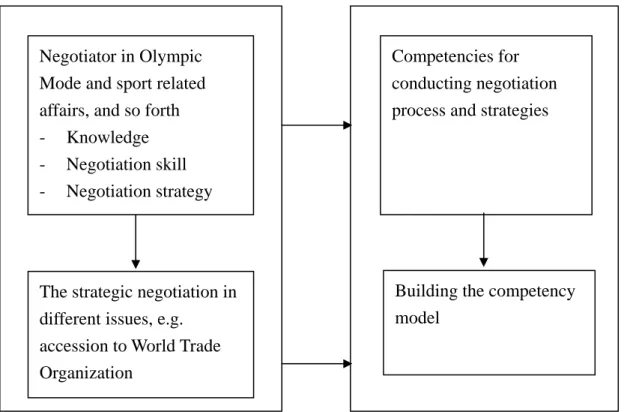
The framework of the study is constructed on basis of research purpose and literature review as indicated in previous chapters. In order to build the competency model for strategic negotiator, it tends to explore and examine the negotiation strategy and process from perspective of the formation of Olympic Mode in international sport community and the negotiations relating in sport affairs within the research framework:

Fig. 3 – 1 Framework of the Study Negotiator in Olympic

Mode and sport related affairs, and so forth - Knowledge - Negotiation skill - Negotiation strategy

The strategic negotiation in different issues, e.g.

accession to World Trade Organization

Competencies for conducting negotiation process and strategies

Building the competency

model

(2)

Research Procedure

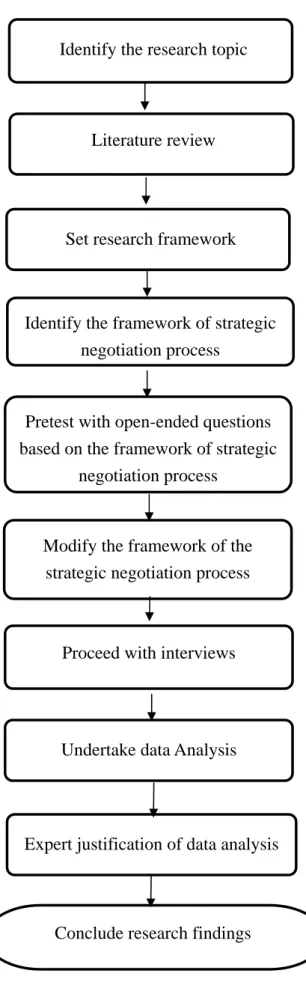
In accordance with the framework of the study, the research procedure encompasses the following steps:

Identify the research topic

Discussed with the thesis advisor, the research topic was defined and focused on the competencies for strategic negotiator in sport affairs from perspective of “Olympic Mode”.

Literature review

With guidance of thesis advisor and based on the purpose of this study, the research conducted literature review on the negotiation process and strategy as well as the competency, and the evolution of two China questions in terms of sport affairs so as to form the framework of the study.

Identify the framework of strategic negotiation process

Based on the literature review and with guidance of thesis advisor, the research identified the necessary procedures and framework of strategic negotiation process.

Pretest with open–ended questions based on the framework of the strategic negotiation process

To ensure the completeness, the framework of the strategic negotiation process

was tested with open-ended questions by interviewing subject A, which is one of the

target samples with abundance of experiences in negotiation. Following the first

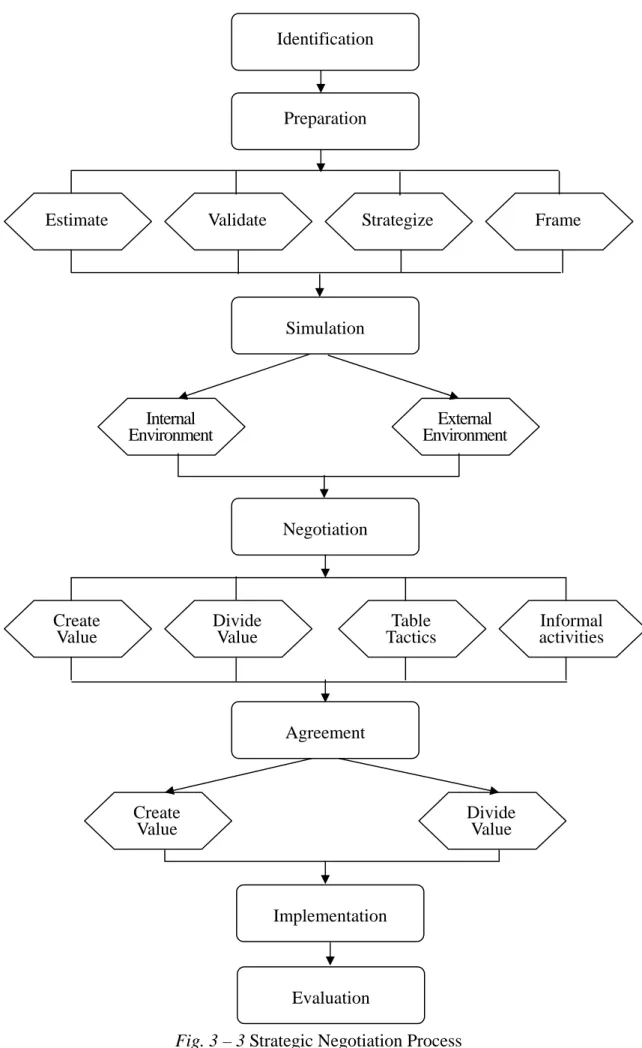
interview, the strategic negotiation process as shown in Fig. 3-3 was modified

according to the advice and comments by subject A.

(3)

Proceed with interview

In Taiwan, not many people in sport sector have experience of involving in negotiation, in particular, the sport affairs, such as the national identity and sport marketing. To this extent, three with negotiation experiences in sport affairs were selected, and three with experiences of negotiation in accession to World Trade Organization (WTO), Asian Pacific Economic Cooperation (APEC) and Organization for Economic Cooperation and Development (OECD), facing the similar situation to that in sport sectors. One of the six samples was asked to receive pretest.

Undertake data analysis

To obtain the results from the interviews, the data collected were analyzed by using coding and statistical techniques.

Expert justification of data analysis

To confirm the coding, expert justification of data analysis was applied. A peer reviewed the coding and results of data analysis and made comments. The modifications of the coding were made accordingly as suggested.

Conclude the research findings

Research findings were drawn from the results of interviews.

In terms of conducting the study, the research flow listed below may apply:

(4)

Fig. 3 – 2 Research Procedure Conclude research findings

Identify the research topic

Literature review

Pretest with open-ended questions based on the framework of strategic

negotiation process

Modify the framework of the strategic negotiation process

Expert justification of data analysis Proceed with interviews

Set research framework

Identify the framework of strategic negotiation process

Undertake data Analysis

(5)

Methods

The study is an exploratory case study. The qualitative interview with open-ended questions were adopted to obtain an overall picture of the strategic negotiation, the negotiators who involve in the strategic negotiation of sports affairs and the accession to WTO, APEC and OECD where the “Olympic Mode” applied are the research subjects to explore the competencies required for a strategic negotiator. As mentioned in previous paragraphs, three with negotiation experiences in sport affairs were selected, and three with experiences of negotiation in accession to WTO, APEC and OECD, facing the similar situation to that in sport sectors. One of the six samples received pretest.

Case study research

Case study research is defined as a research that provides a detailed account and analysis of one or more cases. Case study research can be used to address exploratory, descriptive, and explanatory research questions. (Johnson & Christensen, 2004). Yin (2003) indicated that the case study is the method of choice when the phenomenon under study is not readily distinguishable from its context. For research, the case studies can be exploratory, descriptive or explanatory. According to Stake (2000), there are three different kinds of case studies:

(1) Intrinsic case study: the researcher’s primary interest is in understanding a specific case.

(2) Instrumental case study: the researcher interests in understanding something other than the particular case.

(3) Collective case study: a researcher may jointly study a number of cases in

order to investigate a phenomenon, population, or general condition. The

(6)

collective case study is also called the multiple-case design.

This study is aimed at identifying the competencies required for negotiation within the context through various cases of negotiations in different issues.

Literature review

The general purpose of the literature review is to gain an understanding of the current state of knowledge, and to explain the theoretical underpinnings of the study, to assist in formulation of the research question and selection of the study population, or to stimulate new insights and concepts throughout the study (Johnson & Christensen, 2004). In this study, the literature reviews are conducted to gain an understanding of the negotiation principles and process, the historical background of dealing in “China question” under roof of the Olympic Movement formulating the “Olympic Mode”

through negotiation, and the competencies.

Qualitative interview

Qualitative interviews consist of open-ended questions and provide qualitative data, also called depth interviews due to its use to obtain in-depth information about a research subject’s thoughts, beliefs, knowledge, reasoning, motivations and feelings about a topic. There are three types of qualitative interviews, such as informal conversational interview, the interview guide approach, and the standardized open-ended interview (Johnson & Christensen, 2004).

Instruments

For the purpose of this study, the interview guide approach as the research

instrument that the interviewer enters the interview session with a plan to explore

(7)

specific topics and to ask specific open-ended questions of the interviewees in any order is applied. The open-ended interview with the research subjects is conducted based on the framework of strategic negotiation process as illustrated in Fig. 3 – 3. The open-ended questions somehow consist of the major parts listed below, yet with some discussions during interviews:

(1) How do you prepare for the negotiation?

(2) What negotiation strategies are applied and adopted?

(3) What are the qualifications of a negotiator required?

(4) What do you suggest for the negotiation in the adoption of “Olympic Mode”

in future?

The objective of the interview is to explore the competencies required for a strategic negotiator through the strategic negotiation process. Within the framework and the context of the open-ended questions, the interviewees provide their personal experiences involving in negotiation on the issues of the so-called “Olympic Mode”, the accession to World Trade Organization (WTO), and other international organizations, such as Asia-Pacific Economic Cooperation (APEC).

Reliability

When there has high consistency among different coders about the appropriate

codes, there has intercoder reliability. The intercoder reliability means reliability, or

consistency, between or across coders (Johnson & Christensen, 2004). To ensure the

accuracy of transcript of interviews, the transcribed data were provided to the

interviewees for verification, and the coded responses were justified by other coders.

(8)

Fig. 3 – 3 Strategic Negotiation Process Agreement

Implementation Create

Value Divide

Value

Evaluation Negotiation

Create

Value Divide

Value Table

Tactics Informal

activities Preparation

Estimate Validate Strategize Frame

Identification

Simulation

Internal

Environment External

Environment

(9)

Subjects

In this study, the purposive sampling allows to choose a case illustrating the features or process in which the research interests (Silverman, 2005). This study focuses on the negotiation experiences in negotiation process that the research subjects involved, in particular the negotiation for the Olympic Mode from 1979 to 1981, and consistently in the negotiation with other sport organizations based on the Olympic Mode or sport related issues. Furthermore, the individuals involved in negotiation with other international organizations, for instance, the World Trade Organization (WTO), and Asia-Pacific Economic Cooperation (APEC), are included to diversify the subjects and explore the commonalities of strategic negotiation, whereby identifying the framework of competencies required for negotiator. Based on the framework, the competency model of strategic negotiator will be developed. The purposive sample of individuals involving in negotiation in sport affairs, accession to APEC, WTO and other international organizations were selected for this study.

For the purpose of this study, six samples were selected from the individuals

dealing with the issues of Olympic Mode, sport negotiation, and negotiation on the

accession to World Trade Organization and other international organizations. The six

samples selected have diversified backgrounds and experiences in dealing with the

negotiations with functions either as a negotiator or staffing personnel. In order to

protect the privacy, the six research subjects are anonymously coded with A, B, C, D,

E and F. Hereunder is the profile of the research subjects:

(10)

Table 3-1 Profile of research subjects

Code No. Profile of Interviewees Experiences of Negotiation

A Senior management of Taiwan International Cooperation and Development Fund

International cooperation, and accession to Organization for Economic Cooperation (OECD) B Retired Olympic medalist, former

President of Chinese Taipei Amateur Athletics Association

Negotiation with International Amateur Athletics Federation (IAAF) for membership issue C Retired diplomat, former Secretary

General of National Olympic Committee

Negotiation in membership of National Olympic Committee with the IOC, international affairs and international relations

D Senior management of National Olympic Committee

Negotiation in multisports games protocol, the application of Olympic Mode and sport marketing

E Senior specialist at government departments

Staffing and documenting for negotiation in Asia Pacific Economic Cooperation (APEC) F Retired senior government officer,

Council of Agriculture

Negotiation in accession to World

Trade Organization (WTO) in

agricultural sector

(11)

Data Collection and Analysis

Data Collection

The data were collected through interviews with open-ended questions that encouraged the six subjects elaborated their experiences in conducting either bilateral negotiation or their perspectives on strategic negotiation as staff and supporters.

During the interviews, the interviewees’ consents were obtained to record. Of the six samples interviewed, three of them have experiences in dealing with the negotiation on the issues in sport sector of Taiwan, two have involved in Asia-Pacific Economic Cooperation and World Trade Organization, and one has experience in Organization for Economic Cooperation and Development and negotiation across borders, giving the understanding on the negotiation process that may help to identify and clarify the strategic process measures for negotiation, thereby to explore the core competencies required for a strategic negotiator and to develop the competency model for a strategic negotiator, which may project the competencies required for strategic negotiation under the construct of knowledge, skills and attitudes linked to the negotiation strategy.

Data Analysis

Within the framework of the study, the data were analyzed and explored with

emphasis on the negotiation process and competencies, in particular, the process of

strategic negotiation in different issues, and the competencies that may be required for

a strategic negotiator, encompassing the knowledge, negotiation skills and negotiation

strategy. Based on the system of strategic negotiation process shown in Fig. 3-3, the

interviews are conducted with individuals involving in negotiation in different issues

for comparing in a cross-case analysis to search for the similarities as well as the

differences of competencies required for a strategic negotiator. The data drawn from

the transcripts of interviews were coded and justified by other coders. The coding has

(12)

been slightly modified pursuant to the comments of the coders.

In the study, the negotiation process and competencies required were discussed and explored on basis of the results drawn from the interviews with open-ended questions, focusing on the phases for pre-negotiation preparations and the application and the adoption of negotiation strategy. Besides, some interviewees gave their views on the qualifications required of a negotiator, as well as expressed their opinions and advices on the application of the “Olympic Mode”. As a result of cross-case analysis on the observed data of interviews, the competencies for a strategic negotiator were identified from the context of each question:

Question 1: How do you prepare yourself for negotiation?

In this question, the interviewees gave their experiences and advices either as a negotiator or staff for negotiation to prepare for negotiation in sport affairs or in international cooperation, certain measures and steps are to be undertaken for preparation.

Question 2: What negotiation strategies are applied and adopted?

The interviewees shared their personal experiences in working on the strategies and tactics that were brought to table for negotiation.

Question 3: What are the qualifications of a negotiator required?

This question has been discussed with three of the target samples, while the rest

of interviewees provided with their comments and advices when discussing the

Questions 1 and 2 to pinpoint the qualifications required for a negotiator.

(13)

Question 4: What do you suggest for the negotiation in the application of “Olympic Mode” in future?

Since the so-called “Olympic Mode” has been generally applied in different sectors beyond the sport community where the denominated representation of Taiwan was referred to as “Chinese Taipei”, the issue was discussed with five interviewees.

Through the discussion, the general concepts on negotiation were addressed.

Taking into account the data extracted and inferred from the advices and key elements addressed in the interviews, three out of six samples were selected with their background in sport sector and involving in struggling for protecting the national rights and interests in international sport community. As addressed in each case of negotiation, the interviewees at sport community expressed that to conduct negotiation, the concepts of well-preparedness at pre-negotiation phase, i.e. seeking right information relating to the issue to be negotiated, analyzing the data available, understanding the need of the counter organization and negotiator, being aware of the goal for negotiation and fostering the expertise of the selected negotiator, building team, able to communicate in foreign language, and so forth. The concepts drawn from the data show a great deal of similarity, especially the advices for preparing oneself for negotiation, and were confirmed with the other three samples with negotiation experience in accession to WTO, APEC and OECD, who provided their own experiences in negotiation. For instances, Sample A, E and F mentioned that before entering into negotiation, the negotiators should collect necessary information and identify the goals with a view of protecting the national interests up to maximum, building team, and identifying goals for negotiation.

Similarly, at negotiation stage, the six samples provided same concepts in

(14)

building interpersonal relationships and conducting negotiation with flexibility and adaptability in order to reach consensus at table and achieve the goal set for negotiation. With respect to the post-negotiation phase, two interviewees provided the advices of reviewing the implementation of the agreement that might make the negotiation revolving in case of any defaults of implementation.

Since the study aimed to explore the competencies required for strategic

negotiator, particularly, the strategic negotiator in sport, to verify the validity of the

results, the multiple data sources were used, and the data triangulation on the obtained

data should apply. Considering the significant similarity in the concepts inferred from

the data obtained, the results of data analysis was validated and are utilized for figuring

out the competencies that are required for strategic negotiator.

數據

Fig. 3 – 1 Framework of the Study Negotiator in Olympic
Fig. 3 – 2 Research Procedure Conclude research findings
Fig. 3 – 3 Strategic Negotiation Process Agreement Implementation Create Value  Divide Value EvaluationNegotiation Create Value Divide ValueTable Tactics Informal  activities Preparation

參考文獻

相關文件

The first row shows the eyespot with white inner ring, black middle ring, and yellow outer ring in Bicyclus anynana.. The second row provides the eyespot with black inner ring

You are given the wavelength and total energy of a light pulse and asked to find the number of photons it

好了既然 Z[x] 中的 ideal 不一定是 principle ideal 那麼我們就不能學 Proposition 7.2.11 的方法得到 Z[x] 中的 irreducible element 就是 prime element 了..

volume suppressed mass: (TeV) 2 /M P ∼ 10 −4 eV → mm range can be experimentally tested for any number of extra dimensions - Light U(1) gauge bosons: no derivative couplings. =>

Asymptotic Series and Borel Transforms Revisited Alien Calculus and the Stokes Automorphism Trans–Series and the Bridge Equations Stokes Constants and Asymptotics.. 4 The Airy

For pedagogical purposes, let us start consideration from a simple one-dimensional (1D) system, where electrons are confined to a chain parallel to the x axis. As it is well known

The observed small neutrino masses strongly suggest the presence of super heavy Majorana neutrinos N. Out-of-thermal equilibrium processes may be easily realized around the

incapable to extract any quantities from QCD, nor to tackle the most interesting physics, namely, the spontaneously chiral symmetry breaking and the color confinement.. 