Development of a Shortened Reading
Comprehension Test Using the Rasch
Model
Chang, Lily
Abstract
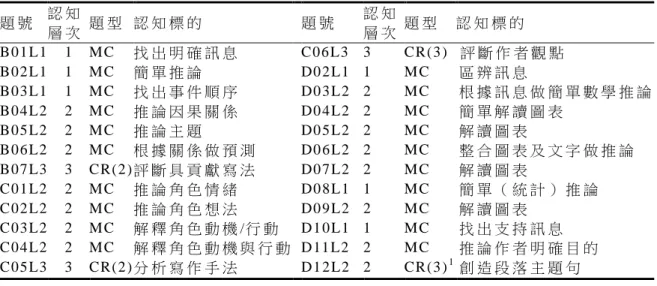
Although recent research in reading comprehension has focused on the processes of reading, only a few such reading comprehension tests are available for primary school children in Taiwan. Of the few available tests, the length of the test further limits the extent to which they actually applied in school settings. Therefore, the present study aims to shorten and validate a reading comprehension test developed, based on the NAEP reading assessment framework for 4th and 5th grade students using the Rasch partial credit model. Two data sets, collected separately by Hwang (2010) and Chang, Chen, Lo, and Lu (2011), consisting of a total sample of 1,191 4th and 5th graders from Kaohsiung and Pingtung areas in Taiwan, were used to develop and evaluate the psychometric properties of the shortened reading comprehension test. The adequacy of the shortened test was assessed with respect to the content coverage of the test (including two types of reading passages and three levels of cognitive processes), item spread and item-person alignment, the dimensionality of the test (including rating scale performance, item fit to the model, item calibration invariance [DIF] across gender, grade and school size), the invariance of ability estimates across forms, and person separation reliability. The results indicate that the shortened version, with a reduction of 41% of the items and half of the administration time, achieves similar or even higher quality of the psychometric properties as compared with that of the original version. Discussions on test reduction using the Rasch model, suggestions for further studies, and applications of the reading comprehension test are also provided.
Key Words: reading comprehension test, test reduction, Rasch model
壹 、 緒 論
閱 讀 是 學 生 學 習 各 學 科 的 重 要 基 礎 , 更 是 形 塑 個 體 終 身 發 展 軌 跡、經 濟 福 祉、主 動 及 積 極 參 與 社 會 的 關 鍵 能 力( Wagemaker, 2011 )。 有 鑑 於 閱 讀 的 重 要 性 , 教 育 部 近 年 來 積 極 推 動 各 項 閱 讀 教 育 , 譬 如 : 2004 年「 焦 點 三 百 --國 小 兒 童 閱 讀 計 畫 」、2006 年 「國 中 小 閱 讀 推 廣 計 畫 」、 2008 年 「 悅 讀 101-教 育 部 國 民 中 小 學 閱 讀 提 升 計 畫 」 等 ( 教 育 部,2009)。提 升 閱 讀 理 解 可 說 是 各 項 閱 讀 教 育 改 革 的 重 要 目 標 之 一 。 閱 讀 的 定 義 及 閱 讀 教 學 強 調 培 養 的 能 力 , 隨 著 閱 讀 理 論 及 研 究 的 蓬 勃 發 展 , 在 不 斷 演 進 中 。 從 早 期 強 調 對 文 本 的 思 考 與 推 理 ( 如 : Thorndike 認 為 閱 讀 即 推 理 ), 到 後 期 受 認 知 心 理 學 基 模 理 論 及 後 設 認 知 理 論 的 影 響 , 閱 讀 者 的 角 色 開 始 重 於 文 本 , 讀 者 被 視 為 建 構 者 與 修 正 者 ( reader as builder and fixer ), 再 至 後 基 模 理 論 時 代 ( moving beyond schema theory) 的 「心 智 模 式 」( mental model ), 除 重 視 建 構 篇 章 意 義 外 , 更 強 調 先 備 知 識 與 文 本 互 動 的 情 境 與 動 態 歷 程 ( Pearson,2009)。閱 讀 理 解 因 此 被 視 為 一 個 涉 及 作 者 意 圖、文 本 內 容、讀 者 能 力、
評 量 架 構 中 不 同 的 認 知 層 次。PISA 界 定「 擷 取 與 檢 索 」、「 統 整 與 解 釋 」
和「 省 思 與 評 鑑 」三 個 層 次( OECD, 2010);PIRLS 界 定「 直 接 提 取 」、
「 直 接 推 論 」、「 詮 釋 、 整 合 觀 點 與 訊 息 」 和 「 檢 驗 、 評 估 內 容 、 語 言 和 文 章 的 元 素 」四 個 層 次( Mullis, Martin, Kennedy, Trong, & Sainsbury,
2009),前 兩 層 次 屬 直 接 理 解 歷 程、後 兩 層 次 屬 解 釋 理 解 歷 程( 柯 華 葳、 詹 益 綾 、 張 建 妤 、 游 婷 雅 , 2008); NAEP 則 界 定「 尋 找 和 回 憶 」、「 整 合 和 解 釋 」 和 「 批 判 和 評 鑑 」 三 個 層 次 ( NAGB, 2008)。 國 內 目 前 依 據 上 述 閱 讀 認 知 歷 程 , 專 門 針 對 一 般 學 童 之 文 本 閱 讀 理 解,而 非 採 短 文 診 斷 或 篩 選 理 解 困 難 學 童 而 編 製 的 測 驗 並 不 多( 如: 林 怡 君、張 麗 麗、陸 怡 琮, 2013;黃 琬 玲 , 2010; 董 宜 俐 , 2003 等 )。 然 為 顧 及 測 驗 涵 蓋 的 廣 度 及 精 確 性 , 這 些 測 驗 的 文 本 數 及 題 數 都 不 會 太 少 、 施 測 時 間 多 超 過 一 節 課 40 分 鐘 , 譬 如 : 董 宜 俐 「國 小 學 童 閱 讀 理 解 測 驗 」( 2003)共 六 篇 文 本 40 題,作 答 時 間 60 分 鐘;黃 琬 玲「 國 小 四 、 五 年 級 閱 讀 理 解 測 驗 」( 2010)共 五 篇 文 本 41 題 , 作 答 時 間 80 分 鐘 ; 林 怡 君 等 「國 小 高 年 級 閱 讀 理 解 測 驗 」( 2013) 含 五 篇 文 本 39 題,作 答 時 間 80 分 鐘。因 測 驗 作 答 時 間 長,限 制 了 測 驗 使 用 的 方 便 性, 進 而 降 低 了 教 學 及 實 務 研 究 者 的 選 擇 及 應 用 。 許 多 研 究 者 因 而 自 行 從 全 測 驗 中 選 取 部 份 文 本 來 縮 減 測 驗 。 然 而 , 使 用 未 經 嚴 謹 信 效 度 考 驗 的 「 簡 化 測 驗 」 將 影 響 測 量 結 果 的 穩 定 性 , 以 及 推 論 學 童 閱 讀 理 解 能 力 、 根 據 推 論 做 出 後 續 各 項 教 與 學 決 定 及 行 動 的 正 確 性 與 適 切 性 。
目 前 國 內 閱 讀 理 解 測 驗 普 遍 以 古 典 測 驗 理 論( classical test theory,
簡 稱 CTT ) 編 製 。 在 此 架 構 下 , 測 驗 的 「 廣 度 - 精 確 度 」
度 呢 ? 電 腦 適 性 測 驗( CAT)是 目 前 可 以 達 到 此 目 標 的 方 法( Embretson
& Reise, 2000 ),但 因 需 建 立 題 庫,並 不 適 用 在 所 有 測 驗 實 務 上。Rasch
模 式 , 基 於 其 具 備 「客 觀 測 量 」的 特 性 , 當 數 據 與 模 式 契 合 時 , 研 究 者 可 以 將 試 題 與 受 試 者 置 於 同 一 向 度 上 , 選 擇 分 布 廣 泛 ( 可 測 得 不 同 能
力 ),且 與 受 試 者 能 力 接 近( 當 試 題 與 受 試 者 位 置 相 同 時,試 題 訊 息 量
三 、 Rasch 部 份 給 分 模 式
因 測 驗 包 含 二 元 及 多 元 計 分 試 題 , 故 採 Rasch 部 份 給 分 模 式 ( partial credit model , PCM)( Master, 1982):
xni 為 受 試 者 n 在 試 題i達 到 等 級 x 的 機 率,n為 受 試 者 能 力、ij為 試 題i第 j個 閾 值 的 難 度( 閾 值 為 相 臨 兩 等 級 機 率 相 等 之 值,又 稱「 階 」[step])。 i m x0,1,..., ( 等 級 數 為 m1)、k 1,2,...,mi( 閾 值 數 相 當 於 等 級 數 減 1),
0 0 0 j n ij 。簡 版 與 原 版 在 難 度 、 向 度 性 、 能 力 估 計 恆 定 性 及 信 度 等 各 項 心 理 計 量 特 性 上 的 差 異 , 來 評 估 簡 版 測 驗 之 適 切 性 。
( 一 ) 難 度
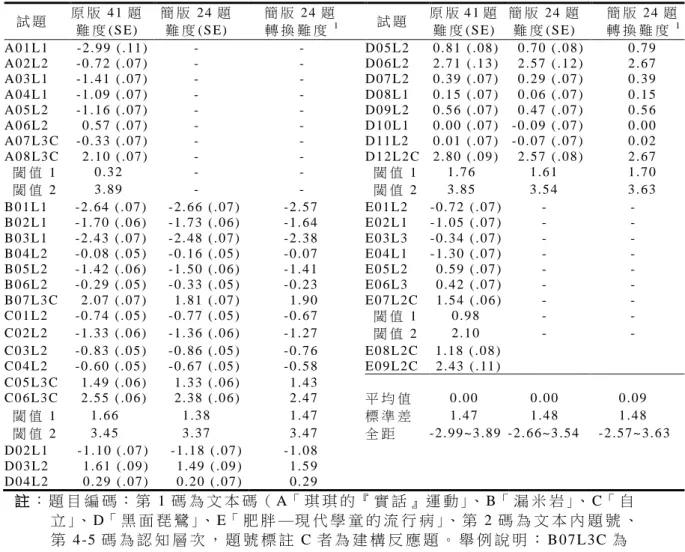
以 Wright 地 圖 比 較 兩 版 本 試 題 的 分 布,以 及 試 題 難 度 與 受 試 者 能 力 的 對 應 情 形 ; 透 過 試 題 等 化 , 來 比 較 兩 版 本 的 難 度 ; 計 算 試 題 難 度 的 相 關 , 來 了 解 試 題 在 兩 版 本 中 相 對 位 置 的 穩 定 性 ; 最 後 , 比 較 不 同 性 質 文 本 及 認 知 層 次 試 題 的 難 度 在 兩 版 本 中 是 否 相 近 。( 二 ) 向 度 性
從 多 元 計 分 等 級 量 表 的 適 切 性 、 試 題 及 測 驗 契 合 度 , 以 及 試 題 所 測 構 念 跨 群 體 的 恆 定 性 ( DIF) 等 檢 視 測 驗 的 向 度 性 。 在 等 級 計 分 量 表 方 面 , 以 閾 值 的 次 序 性 及 間 距 ( 適 切 間 距 應 介 於 1.4 ~ 5.0 logits,Linacre, 2004 )檢 核 及 比 較 兩 版 本 等 級 量 表 之 適 切 性 。 在 試 題 及 測 驗 契 合 度 方 面 。以 outfit MNSQ 及 infit MNSQ 檢 視 個 別 試 題 契 合 度 , 以 殘 差 主 成 份 分 析 的 第 一 個 特 徵 值 檢 核 整 體 測 驗 契 合 度 。 其 中 , MNSQ 值 介 於 0 至 無 限 大 , 期 望 值 為 1, 大 於 1 表 示 試 題 不 契 合 單 向 度 模 式 、 小 於 1 表 示 數 據 與 模 式 過 度 契 合 , 二 元 及 多 元 計 分 試 題 的 合 理 範 圍 分 別 為 0.70 ~ 1.30、0.60 ~ 1.40( Wright & Linacre,1994)。當 數 據 契 合 Rasch 模 式 時,殘 差 應 隨 機 且 獨 立,若 Rasch 因 素 被 解 釋 後 , 我 們 仍 可 從 殘 差 中 抽 取 出 因 素 , 就 表 示 所 測 構 念 可 能 不 只 一 個。研 究 者 先 根 據 Rasch 理 論 模 式 產 生 10 組 模 擬 數 據,再 求 得 各 組 數 據 的 第 一 個 特 徵 值 及 10 個 特 徵 值 的 平 均 值,之 後,比 較 根 據 實 徵 數 據 及 模 擬 數 據 得 到 特 徵 值 的 差 異 , 若 差 異 不 大 , 則 表 示 測 驗 未 違 背 單 向 度 。 在 DIF 檢 定 方 面 , 試 題 所 測 構 念 不 應 因 群 體 不 同 而 有 差 異 , 意 即 具 相 同 能 力 但 來 自 不 同 次 群 體 之 受 試 者 , 其 答 對 試 題 的 機 率 應 無 不 同
( Holland & Thayer, 1988 ),否 則 測 驗 分 數 將 無 法 置 於 同 一 量 尺 上 相 互
殘 差 雙 因 子 變 異 數 分 析 中 ,「 能 力 組 別 」及「 DIF 變 項 」為 主 要 因 子 , 當「 DIF 變 項 」達 顯 著 但「 能 力 組 別 × DIF 變 項 」交 互 作 用 未 達 顯 著 時 , DIF 為 齊 一 性 ( uniform DIF ), 當 「 能 力 組 別 × DIF 變 項 」 達 顯 著 時 , DIF 為 非 齊 一 性 ( non-uniform DIF )( Andrich, Sheridan, & Luo, 2007 )
( 因 每 題 進 行 兩 個 考 驗 , 故 每 個 考 驗 的 第 一 類 錯 誤 率 控 制 在 α =
R asc h 模建置 「國小 四、五 年級閱 讀理解測 驗」簡 版 圖一 原版及簡版 Wright 地圖 註:題目編碼 1-3 碼為文本及編號、4-5 碼為認知層次,題號後註明 C 者為建構反應題,題號句點後數字標示第 k 個閾值。舉例說明:A08L3C.2 為文本 A 第 8 題、認知層次 3、建 構反應題(C)第二個閾值(.2)。文本 A:琪琪的「實話」運動、B:漏米岩、C:自立、D:黑面琵鷺、E:肥胖—現代學童的流行病。
位置(logits) 受試者 試題 [uncentralised thresholds]
文學文本 A 文學文本 B 文學文本 C 訊息文本 D 訊息文本 E 琪琪的「實話」 漏米岩 自立 黑面琵鷺 肥胖—現代學童 運動(文學) (文學) (文學) (訊息) 的流行病(訊息) 4.0 A08L3C.2 D12L2C.2 C06L3C.2 oo 3.0 o D06L2 E09L2 oooooo 2.0 o B07L3C E07L2C.2 o oooooooooooo C06L3C.1 D03L2 D12L2C.1 o C05L3C ooo 1.0 oooooooooooooo E08L2C ooo D05L2 E07L2C.1 ooo
ooooooooooooooooooo A06L2 D09L2 E06L3 E05L2 oooo A08L3C.1 D04L2 D07L2
0.0 ooooooooooooooooooo D11L2 D08L1 ooooooooo B04L2 D10L1
ooooo A07L3C B06L2 E03L3 oooooooooooooooooo
oooo A02L2 C01L2 C04L2 E01L2 -1.0 oooooooooooooooo C03L2
oooo A05L2 A04L1 D02L1 E02L1 ooooooooooooo C02L2 E04L1 ooooooooo A03L1 B05L2 ooooooooo B02L1 -2.0 ooo ooooooo o B03L1 oo B01L1 -3.0 A01L1 o o -4.0 o = 10 Persons ---
位置(logits)受試者 試題 [uncentralised thresholds]
在 整 體 契 合 度 方 面,殘 差 主 成 份 分 析 的 結 果 顯 示,兩 版 本 第 一 個 主 成 份 最 大 特 徵 值 皆 為 1.8; 10 組 模 擬 數 據 之 第 一 個 主 成 份 特 徵 值 的 平 均 值,簡 版 及 原 版 分 別 為 1.32 及 1.42。此 結 果 顯 示,觀 察 數 據 及 模 擬 數 據 得 到 之 特 徵 值 差 異 不 大 , 整 體 測 驗 並 未 違 背 單 向 度 。 綜 合 上 述 , 簡 版 在 個 別 試 題 及 整 體 測 驗 契 合 度 上 皆 與 原 版 接 近 , 雖 然 兩 版 本 均 有 少 數 題 目 outfit MNSQ 契 合 度 略 超 出 範 圍 , 但 仍 屬 可 接 受 範 圍 ( 因 outfit MNSQ 為 非 加 權 指 標 , 極 易 受 少 數 偏 離 模 式 期 望 的 極 端 個 別 反 應 影 響 ),表 示 測 驗 可 由 單 一 閱 讀 理 解 構 念 解 釋。值 得 特 別 注 意 的 是,建 構 反 應 題 的 契 合 度 指 標 普 遍 較 低,呈 現 Guttman 型 態, 表 示 試 題 與 Rasch 模 式 過 度 契 合 , 試 題 鑑 別 度 高 過 模 式 的 預 期 ; 換 句 話 說 , 低 能 力 學 童 的 答 題 機 率 低 過 模 式 預 期 , 而 高 能 力 學 童 的 答 題 機 率 則 高 過 模 式 的 預 期 。 表 六 原 版 與 簡 版 之 個 別 及 整 體 試 題 契 合 度 契 合 度 指 標 原 版 4 1 題 簡 版 2 4 題 個 別 試 題 I nfi t M N S Q 平 均 值 0.9 9 0.9 9 標 準 差 0.1 3 0.11 全 距–選 擇 題 全 距–建 構 反 應 題 0.8 7 ~ 1 .15 0.7 1 ~ 0 .93 0.8 5 ~ 1 .13 0.7 7 ~ 0 .89 O ut fi t M N S Q 平 均 值 0.9 8 0.9 7 標 準 差 0.2 4 0.2 3 全 距–選 擇 題 全 距–建 構 反 應 題 0.6 7 ~ 1 .35 0.6 0 ~ 0 .66 0.6 9 ~ 1 .38 0.5 8 ~ 0 .68 整 體 測 驗 殘 差 主 成 份 分 析 之 第 一 個 特 徵 值 觀 察 數 據 模 擬 數 據( 10 組 ) 平 均 全 距 1.8 1.4 2 1.4 ~ 1. 5 1.8 1.3 2 1.2 ~ 1. 4
( 三 ) D I F
1.殘 差 雙 因 子 變 異 數 DIF 分 析 DIF 分 析 結 果 如 表 七 。 殘 差 雙 因 子 變 異 數 分 析 的 結 果 顯 示 原 版 有 7 題 出 現 DIF( 2 題 性 別 、 3 題 年 級 、 2 題 學 校 規 模 ), 分 屬 三 個 建 構 反學 校 學 童 有 利 。
兩 種 文 本 各 層 次 試 題 的 比 重 。
二 、 後 續 研 究 之 建 議
研 究 發 現 一 般 契 合 度 指 標 , 如 infit 及 outfit MNSQ 對 探 查 試 題 跨 群 體 之 恆 定 性 並 不 敏 感 ( Smith, 1982; Smith & Suh, 2003), 故 目 前 DIF 分 析 已 廣 被 納 入 例 行 性 的 試 題 分 析 中 , 以 確 保 試 題 所 測 構 念 不 會 因 群 體 不 同 而 產 生 差 異 。 由 於 DIF 是 一 個 相 對 性 的 概 念 , 檢 測 結 果 會
受 到 DIF 操 作 性 定 義( 即 探 查 方 法 不 同 )、樣 本 數 大 小、DIF 嚴 重 程 度、
參考文獻
林怡君、張麗麗、陸怡琮( 2013)。Rasch 模式建置國小高年級閱讀理解 測 驗。 教育心理 學報 , 45(1),38-60。 林寶 貴 、錡寶香 ( 2000)。中文閱讀理解測驗之編製。特殊教育研究學 刊 , 19,79-104。 柯華 葳 、詹益綾 、 張建妤 、 游婷雅 ( 2008)。台灣四年 級學生閱讀素養 -PIRLS2006 報 告。2009 年 2 月 25 日,取自 PIRLS2006 國 際 報 告 : http://lrn.ncu.edu.tw/pirls/PIRLS%202006 %20 Report.html 教育部( 2009,10 月)。全方位的國民 中小學閱讀 推動政策。2009 年 10 月 8 日,取自 教育部全球資訊網: http://www.edu.tw/PDA/ news.aspx?news_sn=2798&pages=16&unit_sn=15 黃琬 玲 (2010)。 以 NAEP 架 構建置國小四、五年 級閱讀理解測驗 (未 出 版之 碩士 論文 )。 國立 屏東教 育 大學, 屏東市。 張麗 麗 、陳品華 、 羅素貞 、 陸怡琮 ( 2011)。國小學童 識字與閱讀理解 能力診斷 之研究活動。屏東縣 100 學年度教育處精進教學計畫 報告。 董宜 俐 (2003)。 國小六年級 學童中文閱讀理解測 驗編製研究 (未出版 之 碩士 論文 )。 國立 台中 教 育 大 學,台中 市 。Andrich, D., & Hagquist, C. (2004, Jan.). Detection of differential item functioning
using analysis of variance. Paper presented at the Second International
Conference on Measurement in Health, Education, Psychology and Marketing: Developments with Rasch Models. Perth, Australia: Murdoch University.
Andrich, D., & Hagquist, C. (2012). Real and artificial differential item functioning.
Journal of Educational and Behavioral Statistics, 37(3), 387-416.
Andrich, D., Sheridan, B., & Luo, G. (2007). RUMM2020. Perth, Australia: RUMM Laboratory.
Cheng, Y. Y., Wang, W. C., & Ho, Y. H. (2009). Multidimensional Rasch analysis of a psychological test with multiple subtests: A statistical solution for the bandwidth-fidelity dilemma. Educational and Psychological Measurement,
69(3), 369-388.
Mahwah, NJ: Erlbaum.
Engelhard, G. Jr. (1993). What is the attenuation paradox? Rasch Measurement
Transactions, 6(4), 257.
Ewing, M. T., Salzberger, T., & Sinkovics, R. R. (2005). An alternative approach to assessing cross-cultural measurement equivalence in advertising research.
Journal of Advertising, 34(1), 17-36.
Hayas, C. L., Quintana, J. M., Padierna, J. A., Bilbao, A., & Muñoz, P. (2010). Use of Rasch methodology to develop a short version of the health related quality of life for eating disorders questionnaire: A prospective study. Health and Quality
of Life Outcomes, 8. Retrieved from http://www.hqlo.com/ content/8/1/29
Hogan, J., & Roberts, B. W. (1996). Issues and non-issues in the fidelity-bandwidth trade-off. Journal of Organizational Behavior, 17, 627-637.
Holland, P. W., & Thayer, D. T. (1988). Differential item performance and the Mantel-Haenszel procedure. In H. Wainer & H. I. Braun (Eds.), Test validity (pp. 129-145). Hillsdale, NJ: Erlbaum.
Hsueh, I. P., Wang, W. C., Wang, C. H., Sheu, C. F., Lo, S. K., Lin, J. H., & Hsieh, C. L. (2006). A simplified stroke rehabilitation assessment of movement instrument.
Physical Therapy, 86 (7), 936-943.
Linacre, J. M. (2004). Optimizing rating scale category effectiveness. In E. V. Smith & R. M. Smith (Eds.), Introduction to Rasch measurement: Theory, models and
applications (pp. 258-278). Maple Grove, Minnesota: JAM Press.
Linacre, J. M. (2005). A user’s guide to WINSTEPS: Rasch-model computer programs. Chicago, IL: Winsteps.com.
Master, G. N. (1982). A Rasch model for partial credit scoring. Psychometrika, 47(2), 149-174.
Mullis, I. V. S., Martin, M. O., Kennedy, A. M., Trong, K. L., & Sainsbury, M. (2009). PIRLS 2011 assessment framework. Boston College: TIMSS & PIRLS International Study Center Lynch School of Education.
NAGB (National Assessment Governing Board). (2008). Reading assessment and
item specifications for the 2009 National Assessment of Educational Progress.
OECD (2010). PISA 2009 results: Learning to learn. Retrieved from OECD: http://www.oecd. org
Ones, D. S., & Viswesvaran, C. (1996). Bandwidth-fidelity dilemma in personality measurement for personnel selection. Journal of Organizational Behavior, 17, 609-626.
Paris, S. G., & Hamilton, E. E. (2009). The development of children’s reading comprehension. In S. E. Israel & G. G. Duffy (Eds.), Handbook of research on
reading comprehension (pp. 32-53). New York: Taylor & Francis.
Pearson, P. D. (2009). The roots of reading comprehension instruction. In S. E. Israel & G. G. Duffy (Eds.), Handbook of research on reading comprehension (pp. 3-31). New York: Taylor & Francis.
Rasch, G. (1980). Probabilistic models for some intelligence and attainment tests (revised and expanded ed.). Chicago, IL: University of Chicago Press. (Original work published 1960)
Singh, J. (2004). Tackling measurement problems with item response theory: Principles, characteristics, and assessment, with an illustrative example. Journal
of Business Research, 57, 284-208.
Smith, R. M. (1982). Detecting measurement disturbances within the Rasch model. Unpublished doctoral dissertation, University of Chicago.
Smith, R. M., & Suh, K. K. (2003). Rasch fit statistics as a test of the invariance of item parameter estimates. Journal of Applied Measurement, 4, 153-163.
Smith, E. V. (2005). Effect of item redundancy on Rasch item and person estimates.
Journal of Applied Measurement, 6(2), 147-163.
Tennant, A. (2007). DIF matters. Rasch Measurement Transactions, 20(4), 1082-1084.
Wagemaker, H. (2011). Forward. In I.V. S., Martin, M. O., Foy, P., & Drucker, K. T.
PIRLS 2011 international results in reading. Retrieved August 1, 2013 from
http://www.iea.nl/publications.html
Wang, W-C. (2008). Assessment of differential item functioning. Journal of Applied
Measurement, 9(4), 387-408.
Wright, B. D., & Linacre, J. M. (1994). Reasonable mean-square fit values. Rasch
Wright, B. D., & Panchapakesan, N. (1969). A procedure for sample-free item analysis. Educational and Psychological Measurement, 29, 23-48.