Abstract—As VoIP applications become popular over IEEE 802.11-based Wireless Local Area Networks (WLANs), it is important to
support fast, seamlesss handoff when a mobile station (MS) roams from one access point (APs) to another. Our goal is to reduce the handoff latency so that the impact of lost packets on a voice conversation is unnoticeable. In this paper, we present a fast handoff solution where an MS can stealthily scan channels of the neighboring APs during a VoIP communication without skipping packet receiption/transmission. Using our method, maybe only one packet is lost during a handoff process on our VoIP test-bed.
Index Terms—Fast HandOff (FHO), Stealthy Channel Scan (SCS)
I. INTRODUCTION
With the widespread deployment of IEEE 802.11-based WLANs, Voice over IP (VoIP) is considered one of the most promising services used over the wireless networks. However, the WLANs have inherent problems in supporting VoIP communications. One of the problems is the lack of fast handoff support when a mobile station (MS) roams between access points (APs); the IEEE 802.11 specification doesn’t clearly specify how to perform handoff between APs. Long handoff latency may result in quality degradation of a VoIP communication.
A handoff process on WLANs can be divided into three phases [1]. First, in the detection phase, an MS detects a number of frames received with weak radio signal or a number of frames failed to transmit, and determine it is time to associate with another AP. For QoS concerned MSs, frames received with weak signal may trigger handoff to ensure that no frame lost in this phase. On the other hand, MSs may wait until a certain number of frames fail to transmit to make sure handoff is not triggered by temporary radio fading, but frames are lost in this phase. Second, in the search phase, an MS searches for an AP for handoff. This can be done by passive scan or active scan [2]. Passive scan, in which an MS listens for the periodic beacons sent by APs, is slower but consumes less energy. On the other hand, an MS can broadcast probe requests and listens for probe responses from APs. This active scan is faster, but more energy consuming. Since there are 11 channels for 802.11b, the delay of search phase is determined by the number of probe requests sent and the time to wait for the probe responses. Finally, in the execution phase including the authentication and reassociation procedures, an MS re-associates with a new AP and may need to be authenticated in a secured WLAN. Velayos and Karlsson [1] showed the detection latency varies from 902ms to 1630ms, the searching latency 87ms to
1Chung-Yung Chia is with the Department of Computer Science & Information Engineering, National Chiao Tung University, Hsinchu, and the Telecommunication Laboratory of Chunghwa Telecom, Taoyuan, Taiwan, ROC. Email: [email protected]
2Jung-Tai Lee and 3Ming-Feng Chang are with the Department of Computer Science & Information Engineering, National Chiao Tung University, Hsinchu, Taiwan, ROC. 3Ming-Feng Chang Email: [email protected]
Fast Handoff for Voice over WLANs
Chung-Yung Chia1 , Jung-Tai Lee2 and Ming-Feng Chang3
288ms, and the execution latency is generally short, 1ms to 3ms. These measurements indicate that detection and search phases are the main contributors of the handoff latency.
Several researchers have investigated in speeding up the handoff process of WLANs. Kim, et al. [3] introduced a selective channel scan method in which an MS scans only channels of neighbor APs specified in the neighbor graph (NG) [4], and thus reduced the search phase latency. Their experiment results showed selective scan can reduce the search phase latency to 55ms when there is only one neighbor, and to 145 ms when there are three neighbors, while the original search phase delay is 322ms.
Shin, et al. [5] also suggested scanning channels selectively using the channel mask (the set of channels of neighbor APs), which is learned by the MS from its previous history in associating with the APs, to reduce search phase delay. They reduced the search phase dalay to 130ms from the original search phase delay of 343ms. Park, et al. [6] developed access points (APs) with dual radio frequency (RF) modules, and used a modified neighbor graph to reduce search phase delay to 0 ms, measured from the device driver, but this method needs extra hardware in the APs.
The previous studies show that since an MS is disconnected from the network in search and execution phases, downstream packets are lost in this interval. For VoIP communications, a small percentage of voice packets lost, if evenly distributed, is tolerable, or even unnoticed, to the users. Since the execution latency can be reduced to less than 3 ms [1], the problem is to reduce the search latency, In this paper, we present a technique to reduce the search latency. We merge the detection and searching phases into one phase, and the MS stealthily scan channels of neighbor APs when necessary. From the experiment results on a real-time VoIP test-bed, using the stealthy scan technique maybe only one packet is lost during each handoff.
II. FASTHANDOFFMECHANISM
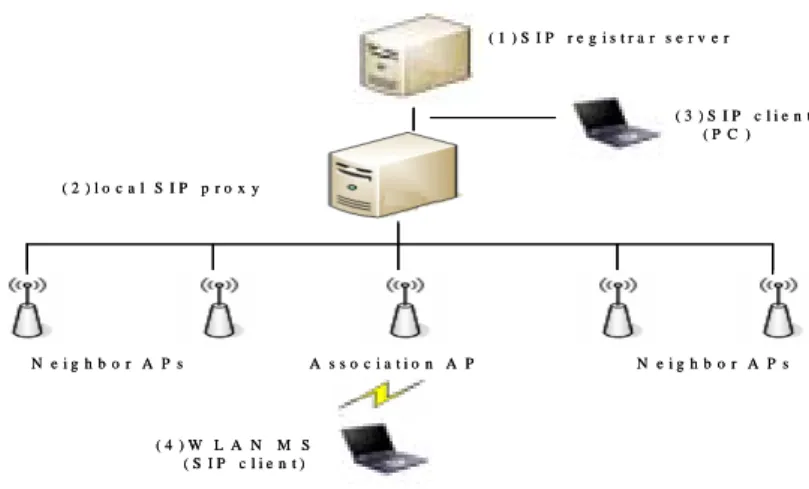
We use SIP to provide VoIP communcations. Fig.1 depicts our system architecture to provide fast handoff mechanism to support VoIP communicaitons on WLANs. On the network side, we have (1) a SIP registrar, (2) a local SIP proxy, and (3) a commercial SIP client in PC. The SIP registrar is a standard SIP registrar responsible for handling SIP REGISTER requests and keeping the information about the MS's location. The local SIP proxy relays packets between the MS and the SIP registrar. On the client side, we have a SIP client (4) with the WLAN driver modified to support our fast handoff mechanism.
To reduce the detection phase delay, we propose a two-phase handoff process for WLANs. First,the FHO detection and search phase, instead of scanning all WLAN channels at a time, the WLAN MS scans only one channel each time chosen from the
pre-configuration channels. The Stealthy Channel Scanning (SCS) process is performed when a certain portion of recently received frames has indicated weak radio signal, and this can be done stealthily without affecting the voice quality of the on-going
VoIP communications. Second,the FHO execution phase, the MS can directly associate with the new AP chosen based on the SCS result of the first phase.
Fig. 1 The system architecture of the FHO mechanism
In the FHO detection and search phase, the MS, which has a VoIP conversation with another VoIP entity, must continuously observe the signal strength of the stream of voice packets received in an observation interval (T) before it decides to perform SCS process. In each observation interval, the signal strength of each received voice packet is measured; if it is lower than -80dbm, the packet is marked with weak signal. At the end of an observation interval, if the percentage of received packets with weak signal is larger than a threshold, P, the MS probes only one channel each time chosen from the pre-configuration channels.
Since only one channel is probed, we expect that no voice packets will be lost, and this will be referred to as SCS (Stealthy Channel Scan). Since the weak signal of received voice packest may be due to temporary radio fading, the handoff decision is not made by one observation interval. Only if three succesive observation intervals indicates weak radio signal and a neighbor AP’s signal strength obtained by the SCS is better than the current AP’s signal strength, the MS performs the FHO execution phase. In the FHO execution phase, the MS directly associates to the target AP selected in the first phase.
III. NUMERICRESULTS
We have implemented the fast handoff design, and conducted experiments to evaluate our implementation. In the experiments, we used a laptop PC labeled as MS1 and a desktop labeled as PC1. The laptop equips with a 1.0 GHz Intel Pentium III, 374 MB of RAM, Mandrake Linux 10.0, and a Compaq HNW-100 PCMCIA wireless NIC. The desktop is an AMD Athlon XP 1700+ with 512 MB RAM running Mandrake Linux 10.0. PC1 used HostAP driver version 0.2.0, an open source driver based on Intersil’s Prism2/2.5/3 802.11b chipset, and KPhone UA version 4.1.0, an open source SIP UA.
( 4 ) W L A N M S ( S I P c l i e n t ) ( 2 ) l o c a l S I P p r o x y
N e i g h b o r A P s A s s o c i a t i o n A P
( 1 ) S I P r e g i s t r a r s e r v e r
N e i g h b o r A P s ( 3 ) S I P c l i e n t
( P C )
( 4 ) W L A N M S ( S I P c l i e n t ) ( 2 ) l o c a l S I P p r o x y
N e i g h b o r A P s A s s o c i a t i o n A P
( 1 ) S I P r e g i s t r a r s e r v e r
N e i g h b o r A P s ( 3 ) S I P c l i e n t
( P C )
A. Experiment Setup
The experiments are conducted in the 802.11b wireless network deployed in the Computer Science building of National Chiao Tung University (NCTU). On the first floor, APs are deployed on the channels 1, 6 and 11 as depicted in Fig.2. In the experiment, a audio stream, using G.711 with packetization interval of 20 ms, is continuously treansfered from PC1 to MS1 while MS1 moves in the L-shaped hallway. We measure the the number of handoff events, the hanoff latency and the number of packet lost and. We also deploy a local SIP proxy to support the FHO mechanism. MS1 also recorded the arrival time of each RTP packet, the sequence number of this RTP packet, and the time when MS1 associates with a new AP.
Fig. 2 The 802.11b wireless network experiment environment
B. Experiment Results
Using the un-enhanced original 802.11b WLAN card, the experiment was repeated 10 times about 10 minutes to obtain the average results. Note that the handoff latency is defined as the interval between the time when the NIC driver notifies an association event and the time the last voice packet is received prior to this notification. The average results indicates there are two handoff events happened and the handoff latency in one handoff event is 232 ms in each experiment. In average, 9.8 voice packets are lost during a handoff event. This disruption of voice packets is detectable by human ears.
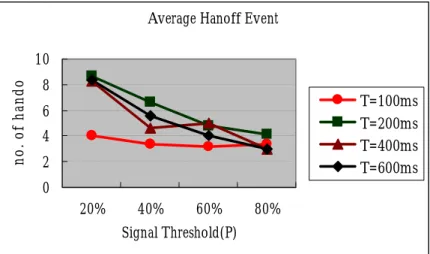
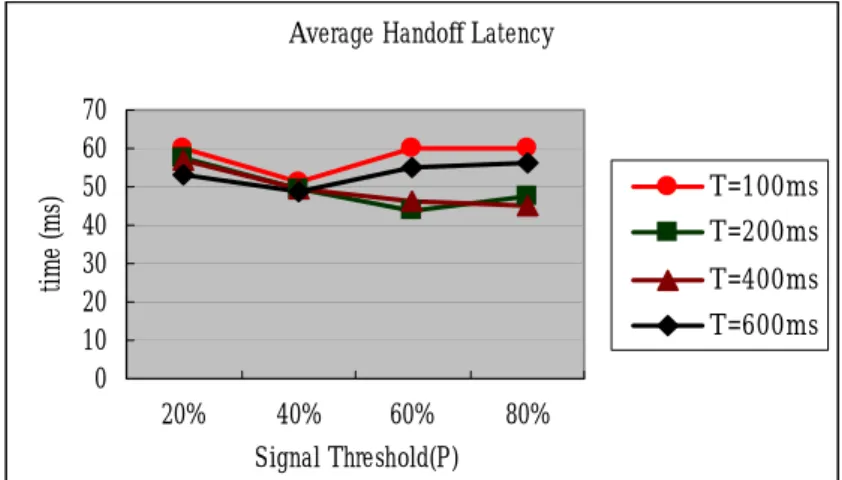
Figs. 3-5 shows the effects of the length of observation interval (T) and the percentage threshold (P) of weak signal packets on the the average handoff event happened , the average handoff latency and the number of packets lost using our FHO mechanism.
The handoff latency of our method is defined between the time when a handoff is issued and the time the first voice packet received after the handoff completes. The packet lost is defined as the number of packets lost when performs handoff process. The handoff event is defined as one handoff happened when performs handoff process. The observation interval T varies in the range of 100~600 ms, and the percentage threshold P varies 20-80 %. Each experiment was repeated 10 times to obtain the average
M S1 M S1
results when using differnet parameters.The results in Fig. 3 indicate that when T is 400-600 ms and P is 80%, the average number of handoff events in an experiment is the smallest, about 3 times. When P decreases, the handoff decision becomes more often and the number of handoff events increases. The results in Fig. 4 indicate that when T is 200-400 ms and P is 60-80%, the average handoff latency can be reduced to below 50 ms. When P is 20%, the decision to handoff may be made prematurely (i.e., handoff to new AP sometimes fails) and the average handoff latency increases. The results in Fig. 5 indicates that when T is 200-400 ms and P is 60-80%, the average packet lost in a handoff event can be reduced nearly to only one packet. When P is 20%, the decision to handoff may be made prematurely and the number of packets lost increases.
No matter different observation intervals (T) and percentage thresholds (P) we choose, the results show that the handoff latency and the number of packets lost are greatly reduced with respect to the results obtained using the un-enhanced original 802.11b WLAN card. This is because scanning target APs is done stealthily in the detection and search phase, and MS can directly associate with the target AP in the execution phase.
IV. CONCLUSION
In this paper, we propose a FHO mechanism using the SCS method to merge the detection phase and search phase of a WLAN handoff process when a mobile station (MS) roams between access points (APs). We evaluate our approach by running VoIP applications on a real WLAN environment using only pre-configured channels 1, 6 and 11. The experiment results indicate that SCS and FHO greatly reduce both the handoff latency and the number of packets lost during the handoff. Furthermore, the handoff latency and the packets lost are unnoticeable to human ears.
Average Hanoff Event
0 2 4 6 8 10
20% 40% 60% 80%
Signal Threshold(P)
no. of hando
T=100ms T=200ms T=400ms T=600ms
Fig. 3 Average number of handoff events for different T and P
Average Handoff Latency
0 10 20 30 40 50 60 70
20% 40% 60% 80%
Signal Threshold(P)
time (ms) T=100ms
T=200ms T=400ms T=600ms
Fig. 4 Average handoff latency (ms) for different T and P
Average Packet Lost
0 0.5 1 1.5 2 2.5
20% 40% 60% 80%
Signal Threshold(P)
no. of packet T=100ms
T-200ms T=400ms T=600ms
Fig. 5 Average number of packets lost for different T and P REFERENCES
[1] Héctor Velayos and Gunnar Karlsson, “Techniques to Reduce IEEE 802.11b MAC Layer Handover Time”, ISRN KTH/IMIT/LCN/R- 03/02 — SE, KTH, Royal Institute of Technology, Stockholm, Sweden, April, 2003.
[2] IEEE Computer Society LAN MAN standards Committee, “IEEE Standard for Information Technology: Part 11: Wireless LAN Medium Access Control (MAC) and Physical Layer (PHY) Specifications”, 1999.
[3] H.S. Kim, S. H. Park, C. S. Park, J.W. Kim, and S. J. Ko, “Selective Channel Scanning for Fast Handoff in Wireless LAN using Neighbor Graph”, International Technical Conference on Circuits/System, Computer and Communications, July 2004.
[4] A. Mishra, M. H. Shin, and W. Arbaugh, “Context Caching using Neighbor Graphs for Fast Handoff in a Wireless Network”, IEEE INFORM 2004.
[5] Sangho Shin et al, “Reducing MAC Layer Handoff Latency in IEEE 802.11 Wireless LANs”. MobiWAC’04, October 1, 2004, USA.
[6] C. S. Park, H. S. Kim and S. H. Park, “Fast Handoff Algorithm Using Access Points with Dual RF Modules”, ECUMN 2004, LNCS 3262, pp.20-28, 2004.