
科技部補助產學合作研究計畫成果精簡報告
以噴霧方式強化甲醇部份氧化產生氫氣之技術開發
計 畫 類 別 : 技術及知識應用型
計 畫 編 號 : MOST 107-2622-E-006-016-CC3 執 行 期 間 : 107年06月01日至108年05月31日
執 行 單 位 : 國立成功大學航空太空工程學系(所)
計 畫 主 持 人 : 陳維新
計畫參與人員: 碩士班研究生-兼任助理:余俊鋒 碩士班研究生-兼任助理:盧貞聿 碩士班研究生-兼任助理:鄭靖霖
處 理 方 式 : 公開方式:立即公開
中 華 民 國 108 年 07 月 07 日
中 文 摘 要 : 本研究主要以噴霧作為進料系統,並搭配雙觸媒床用以進行甲醇部 分氧化(Partial oxidation of methanol ,POM)製造氫氣。本實 驗中,主要使用低Pt和Pd含量(0.2wt%)兩種不同之h-BN-
Pt/Al2O3和h-BN-Pd/Al2O3催化劑,探討不同預熱溫度(100、150、
200、250及300℃),O2與甲醇莫耳(O2 / C)比(0.4-0.8)和Pt / Pd比(0:1, 1:2, 1:4, 1:9)對於甲醇部分氧化反應效能之影響
。研究結果發現,當預熱溫度100℃即可使使Pd催化劑觸發甲醇部分 氧化反應。然而,隨著預熱溫度的增加,對整體反映性能沒有顯著 影響。由於Pt觸媒在甲醇部分氧化反應時的自熱特性,可用於替代 本研究中之預熱系統。本研究將Pt觸媒置於觸媒床上層,用以提供 下層Pd觸媒熱量。在O2/C = 0.6的操作條件下,可觀察到最大之氫 氣產率(1.61 mol (mol methanol)-1)。本研究中亦發現,減少Pt觸 媒之使用,對於POM反應性能影響不大,甲醇轉化率均接近
100%,氫氣產率為1.55-1.57mol(1.61 mol (mol methanol)-1)。
整體而言,POM可以藉由預熱後之h-BN-Pd / Al2O3或雙觸媒床(h- BN-Pd / Al2O3和h-BN-Pt / Al2O3)以冷啟動方式進行反應而產生 氫氣。另外,值得注意的是,在雙觸媒床中以少量(3g)Pt觸媒進 行的POM,可與使用單一Pd觸媒並進行預熱之操作條件達到相同的甲 醇轉化率和氫氣產量。
中 文 關 鍵 詞 : 甲醇部分氧化;噴霧;雙觸媒床;貴金屬觸媒;氫氣製造。
英 文 摘 要 : This study presents the hydrogen production from partial oxidation of methanol (POM) under sprays and dual-bed
catalysts. In the experiment, two different catalysts of h- BN-Pt/Al2O3 and h-BN-Pd/Al2O3 with low Pt and Pd contents (0.2 wt%) are utilized. The effects of different preheating temperatures (100, 150, 200, 250, 300 °C), O2-to-methanol molar (O2/C) ratios (0.4-0.8), and Pt/Pd ratios (0:1, 1:2, 1:4, 1:9) on POM are also examined. The results show that a preheating temperature as low as at 100 °C can lead the Pd catalyst to trigger a POM reaction. Nevertheless, there is no significant effect on performance with increasing
preheating temperature. Because of the autothermal property from the Pt catalyst during POM, it can be used to replace the preheating system in this study. The Pt catalyst is placed as the upper layer to provide heat for the Pd catalyst layer. The maximum H2 yield (1.61 mol (mol methanol)-1) is observed at O2/C=0.6. In this study, reducing the amount of the Pt catalyst does not significantly affect POM performance. The methanol
conversions are close to 100% and H2 yield is from 1.55 to 1.57 mol (mol methanol)-1. Overall, POM can be triggered by preheated h-BN-Pd/Al2O3 or by a dual-bed catalyst (h-BN- Pd/Al2O3 and h-BN-Pt/Al2O3) without preheating to produce hydrogen. It is noteworthy that the POM performed by a duel-bed catalyst together with a small amount (3g) of Pt catalyst can achieve a similar CH3OH conversion and
hydrogen production to that which use a full Pd catalyst with preheating.
英 文 關 鍵 詞 : Partial oxidation of methanol (POM); Sprays; Dual-bed;
Noble-metal catalyst; hydrogen production.
以噴霧方式強化甲醇部份氧化產生氫氣之技術開發
Development of hydrogen production technology from methanol partial oxidation enhanced by sprays
計畫編號:MOST 107-2622-E-006-016-CC3 執行期限:107 年 6 月 1 日至 108 年 5 月 31 日 主持人:陳維新 國立成功大學 航空太空工程學系
Email:[email protected] 中文摘要
本研究主要以噴霧作為進料系統,並搭配雙觸媒床用以進行甲醇部分氧化(Partial oxidation of methanol ,POM)製造氫氣。本實驗中,主要使用低 Pt 和 Pd 含量(0.2wt%)兩種不同之 h-BN-Pt/Al
2
O3
和 h-BN-Pd/Al
2
O3
催化劑,探討不同預熱溫度(100、150、200、250 及 300℃),O2
與甲醇莫耳(O2
/ C)比(0.4-0.8)和 Pt / Pd 比(0:1, 1:2, 1:4, 1:9)對於甲醇部分氧化反應效能之影響。研究結果發現,當預熱溫度≥100℃即可使使 Pd 催化劑觸發甲醇部分氧化反應。然而,隨著預熱溫度的增加,對整體
反映性能沒有顯著影響。由於 Pt 觸媒在甲醇部分氧化反應時的自熱特性,可用於替代本研究中之預熱
系統。本研究將 Pt 觸媒置於觸媒床上層,用以提供下層 Pd 觸媒熱量。在 O
2
/C = 0.6 的操作條件下,可觀察到最大之氫氣產率(1.61 mol (mol methanol)
-1
)。本研究中亦發現,減少 Pt 觸媒之使用,對於 POM 反應性能影響不大,甲醇轉化率均接近 100%,氫氣產率為 1.55-1.57mol(1.61 mol (mol methanol)-1
)。整體而言,POM 可以藉由預熱後之 h-BN-Pd / Al
2
O3
或雙觸媒床(h-BN-Pd / Al2
O3
和 h-BN-Pt / Al2
O3
) 以冷啟動方式進行反應而產生氫氣。另外,值得注意的是,在雙觸媒床中以少量(3g)Pt 觸媒進行的 POM,可與使用單一 Pd 觸媒並進行預熱之操作條件達到相同的甲醇轉化率和氫氣產量。關鍵詞:甲醇部分氧化(POM);噴霧;雙觸媒床;貴金屬觸媒;氫氣製造。
Abstract
This study presents the hydrogen production from partial oxidation of methanol (POM) under sprays and dual-bed catalysts. In the experiment, two different catalysts of h-BN-Pt/Al
2
O3
and h-BN-Pd/Al2
O3
with low Pt and Pd contents (0.2 wt%) are utilized. The effects of different preheating temperatures (100, 150, 200, 250, 300 °C), O2
-to-methanol molar (O2
/C) ratios (0.4-0.8), and Pt/Pd ratios (0:1, 1:2, 1:4, 1:9) on POM are also examined. The results show that a preheating temperature as low as at 100 °C can lead the Pd catalyst to trigger a POM reaction. Nevertheless, there is no significant effect on performance with increasing preheating temperature. Because of the autothermal property from the Pt catalyst during POM, it can be used to replace the preheating system in this study. The Pt catalyst is placed as the upper layer to provide heat for the Pd catalyst layer. The maximum H2
yield (1.61 mol (mol methanol)-1
) is observed at O2
/C=0.6. In this study, reducing the amount of the Pt catalyst does not significantly affect POM performance. The methanolconversions are close to 100% and H
2
yield is from 1.55 to 1.57 mol (mol methanol)-1
. Overall, POM can be triggered by preheated h-BN-Pd/Al2
O3
or by a dual-bed catalyst (h-BN-Pd/Al2
O3
and h-BN-Pt/Al2
O3
) without preheating to produce hydrogen. It is noteworthy that the POM performed by a duel-bed catalyst together with a small amount (3g) of Pt catalyst can achieve a similar CH3
OH conversion and hydrogen production to that which use a full Pd catalyst with preheating.Keywords: Partial oxidation of methanol (POM); Sprays; Dual-bed; Noble-metal catalyst; hydrogen
production.1. Introduction
Nowadays, more and more studies have been focused on clean energy production using renewable resources such as hydrogen, which produces only water vapor when combusted. It is also considered a viable solution to environmental problems with its use in clean fuel cells. In fuel applications, hydrogen has the advantage of having zero greenhouse gas emissions and a high energy content (Abdalla et al., 2018). There are many kinds of feedstock used in the industrial hydrogen production from hydrocarbons such as methane, methanol, propane, butane, petroleum, and diesel (Basile et al., 2015). Methanol is one of the most suitable feedstock options for hydrogen production due to the following benefits: high H/C ratio, low risk, low cost, no sulfur dioxide generation, no carbon bond reduction of carbon deposition rate, and multiple regeneration manufacturing routes. The advantages of the catalyst is characterized by its rapid, low temperature (200-300°C) conversion conditions (Tang et al., 2015).
Thermochemical processes are common methods used to produce hydrogen from methanol, which include direct decomposition (Li et al., 2018), steam reforming (Chen et al., 2017; Lei et al., 2018), partial oxidation (Chen & Guo, 2018; Chen et al., 2015), and autothermal reforming (Chen & Syu, 2011; Ipsakis et al., 2017). Partial oxidation is an exothermic reaction, meaning that the reaction can be triggered without additional heating. The reaction does not require installation of an external heater and steam generator, as is necessary for steam reforming reactions. When the platinum-based (Pt-based) catalysts are used, partial oxidation of methanol can be cold started (Chen & Guo, 2018). Partial oxidation reactions have the advantage of requiring a shorter start-up time for reaction in the reactor.
The partial oxidation of methanol (POM) is expressed as
The POM reactions are often combined with catalysts. Copper supported catalyst is often adapted in POM reactions (Araiza et al., 2017; Gupta et al., 2018). Ag/ZnO was used in Sun et al. (Sun et al., 2018), the result showed high CH
3
OH conversion and low CO selectivity. Li et al. (Demiral & Ayan, 2011) showed that the POM performance via LaMnPd catalysts displayed high reactivity in CO oxidation. The LaMnPt catalysts, however, lead the reaction pathway mainly toward methanol combustion. Pd and ZrO2
promoters couldCH
3
OH + 0.5O2
→ 2H2
+ CO2
, ∆H298 0
= −192.3 kJ mol−1
(1)reduce the activation energy of methanol combustion and steam reforming reactions in POM (Schuyten et al., 2009). Agrell et al. (Agrell et al., 2003) showed that the palladium played a key role in determining product distribution. Previous studies also showed the combination of POM with catalysts under spray reaction systems (Chen & Guo, 2018; Chen & Shen, 2016). In terms of spray reaction systems, when the liquid is ejected from the nozzle, the liquid disintegrates and forms many droplets due to the turbulence in the liquid, cavitation in the nozzle, and aerodynamic interactions with the surrounding air. The system can spray methanol evenly on the reaction bed, and with the uniform and high contact area. The reaction is stable and goes to completion.
A dual-bed set-up was used to enhance the H
2
yield from synthesis gas. Batista et al. (Batista et al., 2006) employed steam reforming (SR) combined with water gas shift reaction (WGSR) by a double bed reactor.The results indicated that CO production was effectively reduced up to around 80% compared to single reactor and the average conversion of ethanol could be achieved up to 90%. Tong et al. (Tong et al., 2005) compared two separate dual catalyst beds (Pt/Ni and Ni/Pt) to a single catalyst bed (Pt or Rh). The results demonstrated that the dual-bed achieved higher CH
4
conversion and H2
yield than the Pt catalyst bed. A dual-bed reactor was also investigated for use in steam gasification by Lv et al. (Lv et al., 2014) . An increase of carbon conversion efficiency of 4.8% was observed, while hydrogen yield achieved a relative growth of 50.5%.From the literature, it is found that both the Pd and Pt catalysts have been applied in POM for hydrogen production. However, the related information about the effects of the preheating and different ratios of Pt/Pd in duel-bed is still not sufficient, especially in a spray system. For that, a comprehensive study of POM with sprays by a h-BN-Pd/Al
2
O3
catalyst and dual-bed catalysts at various operation conditions is investigated.The influence of preheating temperature of the h-BN-Pd/Al
2
O3
catalyst on POM is evaluated. The dual-bed is set up with the addition of h-BN-Pt/Al2
O3
catalyst at the bottom side of h-BN-Pd/Al2
O3
catalyst. The h-BN-Pt/Al2
O3
catalyst, which can trigger POM at room temperature, is employed to provide heat for h-BN-Pd/Al2
O3
catalyst. Therefore, the preheating unit in the system is be replaced by the Pt catalyst.Meanwhile, because of the high cost of Pt compared to Pd, the study also aims to reduce the amount of h-BN-Pt/Al
2
O3
catalyst for economic future applications.2. Experimental 2.1. Reaction system
The overall experimental system was divided into four units: the feeding unit, the reaction unit, the gas treatment unit, and the gas analysis unit. The feeding unit was employed with both N
2
gas and air with a controlled flow rate using electric flow rate controllers (KD-4000). The streams of N2
and air were mixed in a gas mixer. A syringe pump (Chemyx Fusion 200) was used to control the flow rate of methanol. The reaction unit is composed of a quartz tube reactor and a nozzle. In the tube, a K-type thermocouple linked with a thermometer was inserted into the catalyst bed to measure the reaction temperature. A layer of glass beads was placed under the catalyst bed to stabilize it. For preheating, heating tape was installed on the tube.Moreover, the h-BN-Pt/Al
2
O3
catalyst is placed over the h-BN-Pd/Al2
O3
catalyst to form a dual-bed catalystlayer to substitute the heating tape. In the gas treatment unit, a condenser (YIHDER, BL710) and a dryer were used for removing the moisture in the product gas. The gas analysis unit was made up of a gas analyzer (GA, Fuji ZRJF5Y23-AERYR-YKLYYCY-A) and a gas chromatography unit (GC, SRI 8610C) to measure the gas concentrations.
2.2.Experimental procedure
Two commercial catalysts (Green Hydrotech Inc.) of h-BN-Pt/Al
2
O3
and h-BN-Pd/Al2
O3
were utilized to perform the POM. The experiment was divided into three parts, h-BN-Pd/Al2
O3
catalyst preheating, 50%h-BN-Pt/Al
2
O3
,and 50% h-BN-Pd/Al2
O3
, with different ratio of catalysts.The h-BN-Pd/Al2
O3
catalystwas preheated to five different temperatures: 100, 150, 200, 250, and 300 °C. The oxygen-to-methanol molar (O2
/C) ratio was 0.5 for the h-BN-Pd/Al2
O3
catalyst preheating cases. For the case of the dual-bed, however, five different O2
/C ratios of 0.4, 0.5, 0.6, 0.7, and 0.8 were used. The flow rates of oxygen and methanol at different O2
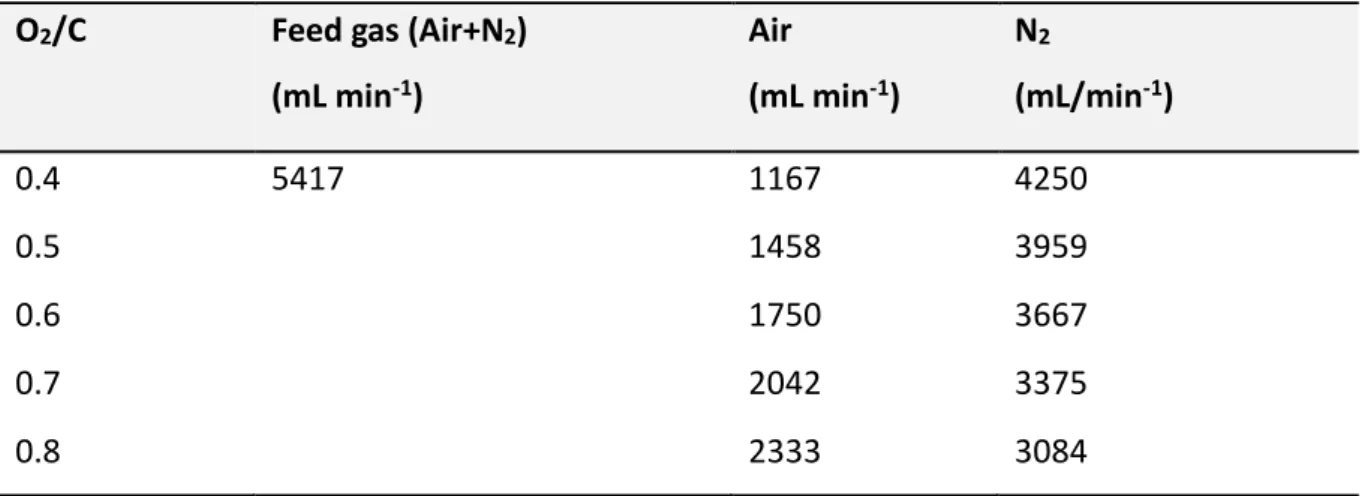
/C ratios are listed in Table 1.Table 1. Volumetric flow rates of feed gas, air, and N 2
(at room temperature)O 2 /C Feed gas (Air+N 2 )
(mL min -1 )
Air
(mL min -1 )
N 2
(mL/min -1 )
0.4 5417 1167 4250
0.5 1458 3959
0.6 1750 3667
0.7 2042 3375
0.8 2333 3084
In this study, the amount of catalyst for POM is fixed at 30 g. Four catalyst ratios (Pt:Pd) 0:1, 1:2, 1:4, 1:9 were considered in the different catalyst ratio cases. In all experiments, a mixture of air and N
2
were used with a total flow rate of 5417 mL min-1
. The methanol flow rate was controlled at 1 mL min-1
(at room temperature) by the syringe pump. Therefore, methanol was nebulized by aerodynamics with the alteration of flow rate as soon as it flowed out from the nozzle. The feedstock (methanol) can be sprayed evenly with a large area on the catalyst bed. The catalyst bed consisted of 30 g of catalyst pellets (length = 5 cm) for each experimental case. The void fraction of the catalyst bed was 0.55. The temperature in the condenser was controlled at 6 °C, while 170 g of silica gel beads were loaded in the dryer to remove moisture in the product gas. The volumetric concentrations of CO, CO2
, and CH4
were continuously analyzed by the GA. In addition, the H2
concentration was measured by the GC using the auto-sampling system at a frequency of 3 min-1
. In each run, the experiment lasted for around 42 min to reach steady state.The flow rate of the product gas was measured by flow rate meter. Based on the flow rate and the concentrations of CO, CO
2
, and CH4
, methanol conversion is calculated by the following equation:CH
3
OH conversion (%)= �𝑛𝑛̇
𝐶𝐶𝑂𝑂 2, 𝑜𝑜𝑜𝑜𝑜𝑜
+ 𝑛𝑛̇𝐶𝐶𝑂𝑂,𝑜𝑜𝑜𝑜𝑜𝑜
+ 𝑛𝑛̇𝐶𝐶𝐻𝐻 4, 𝑜𝑜𝑜𝑜𝑜𝑜
𝑛𝑛̇
𝐶𝐶𝐻𝐻 3 𝑂𝑂𝐻𝐻,𝑖𝑖𝑖𝑖
� × 100 (2)where 𝑛𝑛̇ stands for the molar flow rate (mol min
-1
), and the subscripts in and out designate inflow and outflow, respectively. Meanwhile, the H2
yield from POM is estimated from the molar flow rate of hydrogen (mol min-1
), 𝑛𝑛̇𝐻𝐻 2
, as the following:H
2
yield (mol mol CH⁄3
OH) = � 𝑛𝑛̇𝐻𝐻 2
𝑛𝑛̇
𝐶𝐶𝐻𝐻 3 𝑂𝑂𝐻𝐻
� (3)3. Results and discussion
3.1. POM via h-BN-Pd/Al 2
O3 catalyst 3.1.1. Temperature distributions
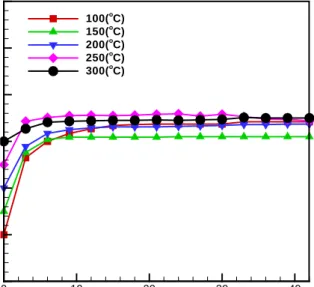
Fig. 1 shows the profiles of temporal distribution of reaction temperature in preheated h-BN-Pd/Al 2
O3
catalyst beds at O
2
/C = 0.5. The reaction temperature increases rapidly in the first 6 min and achieves a steady state after 20 min. The results demonstrate that the h-BN-Pd/Al2
O3
can be triggered by preheating at as low as100 °C. The range of reaction temperature is from 265 °C to 359 °C and the highest reaction temperature (359 °C) can be obtained with a preheating temperature of 250 °C. Even if the Pd catalyst is heated at different preheating temperatures, a similar reaction temperature can be achieved at stable.According to this observation, it is suggested that preheating is required to provide energy for chemical reaction to reach the initial energy required while using Pd catalyst alone. The higher the preheating temperature, the higher the energy is provided to activate POM in the beginning. The reaction time can be reduced from beginning to stabilization of POM. By preheating, the h-BN-Pd/Al
2
O3
can trigger POM favorably (Chen & Guo, 2018).Fig. 1
Profiles of temporal distributions of reaction temperature in h-BN-Pd/Al2
O3
catalyst beds at O2
/C = 0.5 under various preheated temperatures.Time(min) T e m p e ra tu re (
oC )
0 10 20 30 40
0 100 200 300 400 500 600
100(
oC)
150(
oC)
200(
oC)
250(
oC)
300(
oC)
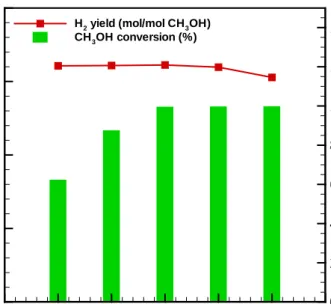
Fig. 2 shows the profiles of H 2
yield at each CH3
OH concentration with different preheating temperatures. The range of H2
yield is from 1.53 to 1.58 mol (mol methanol)-1
. The maximum H2
yield (1.58 mol (mol methanol)-1
) appears at preheating temperature of 200 °C. In the five cases, the lowest CH3
OH concentration was able to reach 86% at a preheating temperature of 150 °C. The reaction temperature is the lowest and therefore the conversion of CH3
OH is at minimum. When the preheating temperature is higher at 300 °C, the methanol drops on the catalyst bed could be directly decomposed. The methanol decomposition reaction is expressed as the following:CH
3
OH ↔ 2H2
+ CO, ∆H298 0
= 90.1 kJ mol−1
(4)The highest CH
3
OH concentration was 94% achieved at the preheating temperature of 300°C. It is noteworthy to mention that when the h-BN-Pd/Al2
O3
catalyst is preheated at 200 °C and 300 °C, the CH3
OH conversion can be achieved at around 95%. Base on the results of H2
yield, the best preheating temperature is at 200 °C.Fig. 2
Profiles of H2
yield and CH3
OH concentration at different preheating temperatures.3.2. POM via dual-bed catalyst
As the experimental results in 3.1, the Pd catalyst is unable to trigger POM under cold start. For that, h-BN-Pt/Al
2
O3
catalyst, which can trigger POM in cold start, was used to displace the preheating system with combination of h-BN-Pd/Al2
O3
as dual-bed reaction layers. In this section, the weight of Pt and Pd catalysts were at 15 g (Pt/ Pb ratio = 1) in each layer. The h-BN-Pt/Al2
O3
was placed as the upper layer to provide heat for the h-BN-Pd/Al2
O3
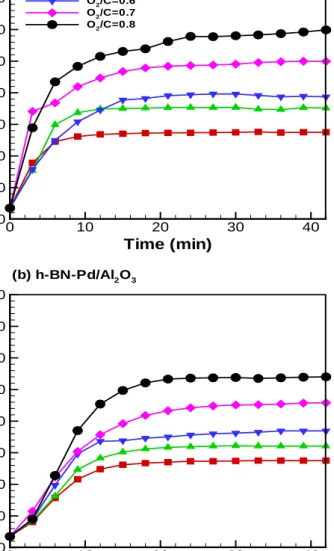
layer.Fig. 3 shows the profiles of reaction temperature with O 2
/C =Preheat temperature ( o C)
H 2 y ie ld (m o l/ m o l C H 3 O H ) C H 3 O H c o n v e rs io n (% )
50 100 150 200 250 300 350
0 0.5 1 1.5 2
0 20 40 60 80 100 120
H
2yield (mol/mol CH
3OH) 140
CH
3OH conversion (%)
0.4-0.8 in dual-bed catalyst. In Fig. 3a, the reaction temperature of h-BN-Pt/Al
2
O3
increased rapidly in the first 6 min and the reaction tends to achieve a steady-state after 20 min. The reaction temperatures of Pt catalyst increased with increasing O2
/C ratios since the higher concentration of oxygen enhances the reaction.The reaction temperature was varied from 275 °C to 599 °C. Shown in Fig. 3b, the heat generation from the Pt catalyst autothermally provides the Pd catalyst with sufficient energy to trigger the POM in the lower layer.
The reaction temperature of Pd catalyst is from 275 °C to 540 °C. Overall, the reaction temperature is higher when the O
2
/C ratio is higher. The temperature of h-BN-Pt/Al2
O3
layer is always higher than h-BN-Pd/Al2
O3
layer. According to this result, the Pt catalyst can replace the preheating tape completely for POM, also reducing the cost and experimental procedure.
Fig. 3
Profiles of reaction temperature in (a) h-BN-Pt/Al2
O3
catalyst bed and (b) h-BN-Pd/Al2
O3
catalyst bed with O2
/C = 0.4-0.8.Fig. 4 shows the profiles of H 2
yield and CH3
OH concentration with O2
/C = 0.4-0.8. The H2
yield is within the range of 1.52 to 1.61 mol (mol methanol)-1
, with the maximum H2
yield (1.61) achieved at O2
/C = 0.6. This H2
yield is greater than the maximum yield obtained by the preheated Pd system (1.58 mol (molTime (min) T e m p e ra tu re ( o C )
0 10 20 30 40
0 100 200 300 400 500 600 700 800
O2/C=0.4 O2/C=0.5 O2/C=0.6 O2/C=0.7 O2/C=0.8
(a) h-BN-Pt/Al
2O
3Time (min) T e m p e ra tu re ( o C )
0 10 20 30 40
0 100 200 300 400 500 600 700 800
(b) h-BN-Pd/Al
2O
3methanol) at O
2
/C = 0.5 and 200 °C. This shows that Pt has a better performance than Pd in POM. Therefore, only 15 g of Pt improves the performance (Ubago-Pérez et al., 2007). As well, the CH3
OH conversion is almost 100% at O2
/C = 0.6-0.8 due to the fact that more oxygen can be supplied toward the partial oxidation at a higher reaction temperature, thus consuming more methanol. As the result, O2
/C = 0.6 is the best condition for POM with Pt and Pd catalysts.Fig. 4
Profiles of H2
yield and CH3
OH conversion at different O2
/C ratios.3.3. Effects of Pt/Pd ratio in duel-bed on POM
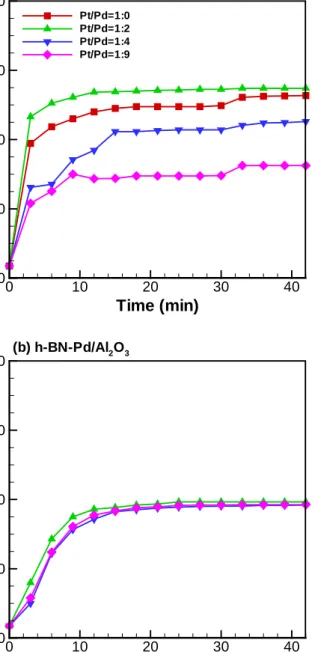
Fig. 5 shows the profiles of reaction temperature in Pt and Pd catalyst beds at different Pt/Pd ratios. In Fig. 5a, the reaction temperature of the Pt
catalyst layer increased in first 6 min and achieve the steady-state at 20 min. The temperature is in the range of 320-548 °C. The highest temperature was achieved with 10 g of Pt and 20 g of Pd. It is notable that the reaction temperature of the Pdcatalyst layer is in the range of 382-393°C; any change in Pt quantity does not have significant effect on the reaction temperature of Pd (Fig. 5b).
Therefore, only 3 g of Pt catalyst can provide enough energy for the activation of POM on 27 g of Pd catalyst.
O 2 /C
H 2 y ie ld (m o l/ m o l C H 3 O H ) C H 3 O H c o n v e rs io n (% )
0.3 0.4 0.5 0.6 0.7 0.8 0.9
0 0.5 1 1.5 2
0 20 40 60 80 100 120
H
2yield (mol/mol CH
3OH) 140
CH
3OH conversion (%)
Fig. 5
Profiles of reaction temperature in (a) h-BN-Pt/Al2
O3
catalyst bed and (b) h-BN-Pd/Al2
O3
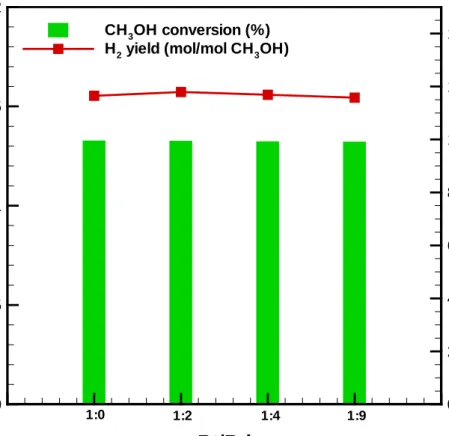
catalyst bed at different Pt/Pd ratios.Fig. 6
shows the profiles of H2
yield and CH3
OH conversion with different Pt/Pd ratios. The H2
yield ranges from 1.55 to 1.57 mol (mol methanol)-1
. The highest H2
yield (1.57 mol (mol methanol)-1
) appears at a Pt/Pd ratio of 1:2. For these four cases, the CH3
OH conversions are almost 100%. This means that the decrease of Pt amount does not affect the performance of POM reaction. Overall, it is feasible to use Pt catalyst instead of heating tape and reduce the amount of Pt to carry out POM reaction when the reduction of Pt does not have significant effect towards the reaction. In other word, using 3 g of Pt catalyst is able to achieve the similar effect as the preheating of 27 g of Pd catalyst. Based on this observation, the amount of Pt catalyst can be reduced with blending Pd catalyst and the performance is almost the same. On the other words, it implies that the cost of catalyst is also reduced.Time (min) T e m p e ra tu re (
oC )
0 10 20 30 40
0 200 400 600 800
Pt/Pd=1:0 Pt/Pd=1:2 Pt/Pd=1:4 Pt/Pd=1:9
(a) h-BN-Pt/Al
2O
3Time (min) T e m p e ra tu re (
oC )
0 10 20 30 40
0 200 400 600 800
(b) h-BN-Pd/Al
2O
3Fig. 6
Profiles of H2
yield and CH3
OH conversion at different Pt/Pd ratios.4. Conclusions
The h-BN-Pd/Al
2
O3
and h-BN-Pt/Al2
O3
catalysts have been employed to trigger POM (partial oxidation of methanol) in this study. The reaction characteristics of POM under the operations of preheating temperature and O2
/C ratio have also been examined. The results indicate that POM can be triggered by a preheated h-BN-Pd/Al2
O3
catalyst or by a Pt/Pd dual-bed catalyst. The POM reaction reaches a steady state after 20 min by the preheated Pd catalyst. The preheated Pd catalyst at 200 °C shows the maximum H2
yield of 1.58 mol (mol methanol)-1
and a CH3
OH conversion up to 94%. In addition, using the h-BN-Pt/Al2
O3
in a dual-bed system with the Pd catalyst is a feasible option to replace the pre-heating system. In this case, the temperature of the h-BN-Pt/Al2
O3
layer was always higher than h-BN-Pd/Al2
O3
. The optimum O2
/C ratio for maximizing CO production develops at 0.6 in that a higher O2
/C ratio (≥0.7) leads to combustion mechanism favored over oxidation. Almost 100% CH3
OH conversion is obtained when O2
/C ratio ≥0.6. Therefore, in comparing the best cases of each the preheating system (200°C) and dual-bed system (O2
/C=0.5), both the H2
yield and CH
3
OH conversion are superior in the dual-bed system. The H2
yield (1.55 to 1.57 mol (mol methanol)-1
) and CH3
OHconversion (close to 100%) are not affected by decreasing the amount of Pt used in the duel-bed. This implies that using a small amount of Pt catalyst (3 g) without preheating can achieve similar results with the full Pt catalyst cases with preheating except for temperature. Based on this observation, the preheating system for POM can be removed with adding only a small amount of Pt catalyst which in turn further reduces the cost of the system setup.Pt/Pd
H 2 y ie ld (m o l/ m o l C H 3 O H ) C H 3 O H c o n v e rs io n (% )
0 0.5 1 1.5 2
0 20 40 60 80 100 120 CH
3OH conversion (%) 140
H
2yield (mol/mol CH
3OH)
1:0 1:2 1:4 1:9
Reference
Abdalla, A.M., Hossain, S., Nisfindy, O.B., Azad, A.T., Dawood, M., Azad, A.K. 2018. Hydrogen production, storage, transportation and key challenges with applications: A review. Energy
Conversion and Management, 165, 602-627.
Agrell, J., Germani, G., Järås, S.G., Boutonnet, M. 2003. Production of hydrogen by partial oxidation of methanol over ZnO-supported palladium catalysts prepared by microemulsion technique. Applied
Catalysis A: General, 242(2), 233-245.
Araiza, D.G., Gómez-Cortés, A., Díaz, G. 2017. Partial oxidation of methanol over copper supported on nanoshaped ceria for hydrogen production. Catalysis Today, 282, 185-194.
Basile, A., Iulianelli, A., Tong, J. 2015. 6 - Membrane reactors for the conversion of methanol and ethanol to hydrogen. in: Membrane Reactors for Energy Applications and Basic Chemical Production, (Eds.) A.
Basile, L. Di Paola, F.l. Hai, V. Piemonte, Woodhead Publishing, pp. 187-208.
Batista, M.S., Assaf, E.M., Assaf, J.M., Ticianelli, E.A. 2006. Double bed reactor for the simultaneous steam reforming of ethanol and water gas shift reactions. International Journal of Hydrogen Energy, 31(9), 1204-1209.
Chen, C.-C., Tseng, H.-H., Lin, Y.-L., Chen, W.-H. 2017. Hydrogen production and carbon dioxide enrichment from ethanol steam reforming followed by water gas shift reaction. Journal of Cleaner
Production, 162, 1430-1441.
Chen, W.-H., Guo, Y.-Z. 2018. Hydrogen production characteristics of methanol partial oxidation under sprays with ultra-low Pt and Pd contents in catalysts. Fuel, 222, 599-609.
Chen, W.-H., Shen, C.-T. 2016. Partial oxidation of methanol over a Pt/Al2O3 catalyst enhanced by sprays.
Energy, 106, 1-12.
Chen, W.-H., Shen, C.-T., Lin, B.-J., Liu, S.-C. 2015. Hydrogen production from methanol partial oxidation over Pt/Al2O3 catalyst with low Pt content. Energy, 88, 399-407.
Chen, W.-H., Syu, Y.-J. 2011. Thermal behavior and hydrogen production of methanol steam reforming and autothermal reforming with spiral preheating. International Journal of Hydrogen Energy, 36(5), 3397-3408.
Demiral, İ., Ayan, E.A. 2011. Pyrolysis of grape bagasse: Effect of pyrolysis conditions on the product yields and characterization of the liquid product. Bioresource Technology, 102(4), 3946-3951.
Gupta, S., Kua, H.W., Low, C.Y. 2018. Use of biochar as carbon sequestering additive in cement mortar.
Cement and Concrete Composites, 87, 110-129.
Ipsakis, D., Ouzounidou, M., Papadopoulou, S., Seferlis, P., Voutetakis, S. 2017. Dynamic modeling and control analysis of a methanol autothermal reforming and PEM fuel cell power system. Applied
Energy, 208, 703-718.
Lei, Y., Luo, Y., Li, X., Lu, J., Mei, Z., Peng, W., Chen, R., Chen, K., Chen, D., He, D. 2018. The role of samarium on Cu/Al2O3 catalyst in the methanol steam reforming for hydrogen production. Catalysis
Today, 307, 162-168.
Li, G., Gu, C., Zhu, W., Wang, X., Yuan, X., Cui, Z., Wang, H., Gao, Z. 2018. Hydrogen production from methanol decomposition using Cu-Al spinel catalysts. Journal of Cleaner Production, 183, 415-423.
Lv, X., Xiao, J., Du, Y., Shen, L., Zhou, Y. 2014. Experimental study on biomass steam gasification for hydrogen-rich gas in double-bed reactor. International Journal of Hydrogen Energy, 39(36),
20968-20978.
Schuyten, S., Guerrero, S., Miller, J.T., Shibata, T., Wolf, E.E. 2009. Characterization and oxidation states of Cu and Pd in Pd–CuO/ZnO/ZrO2 catalysts for hydrogen production by methanol partial oxidation.
Applied Catalysis A: General, 352(1), 133-144.
Sun, Q., Men, Y., Wang, J., Chai, S., Song, Q. 2018. Support effect of Ag/ZnO catalysts for partial oxidation of methanol. Inorganic Chemistry Communications, 92, 51-54.
Tang, H.-Y., Greenwood, J., Erickson, P. 2015. Modeling of a fixed-bed copper-based catalyst for reforming methanol: Steam and autothermal reformation. International Journal of Hydrogen Energy, 40(25), 8034-8050.
Tong, G.C.M., Flynn, J., Leclerc, C.A. 2005. A dual catalyst bed for the autothermal partial oxidation of methane to synthesis gas. Catalysis Letters, 102(3), 131-137.
Ubago-Pérez, R., Carrasco-Marín, F., Moreno-Castilla, C. 2007. Methanol partial oxidation on carbon-supported Pt and Pd catalysts. Catalysis Today, 123(1), 158-163.
107年度專題研究計畫成果彙整表
計畫主持人:陳維新 計畫編號:107-2622-E-006-016-CC3
計畫名稱:以噴霧方式強化甲醇部份氧化產生氫氣之技術開發
成果項目 量化 單位
質化
(說明:各成果項目請附佐證資料或細 項說明,如期刊名稱、年份、卷期、起 訖頁數、證號...等)
國 內
學術性論文
期刊論文 0
研討會論文 2 篇
1. Guo YZ, Chen WH,“Comparison of hydrogen production over Pt and Pd catalysts from methanol partial oxidation using sprays”,第十二屆 全國氫能與燃料電池學術研討會
,2017年10月12-13日,國立東華大學。
2. Chen HH, Chen WH, Guo YZ.
“Hydrogen production from methanol partial oxidation under sprays and dual-bed catalysts”,中華民國第 28屆燃燒與能源學術研討會,2018年4月 27-28日,國立中央大學。
專書 0 本
專書論文 0 章
技術報告 0 篇
其他 0 篇
智慧財產權 及成果
專利權 發明專利 申請中 1
件
陳維新、邱國倫,“噴霧產氫系統
(Hydrogen production system using sprays)” ,中華民國發明專利(Reg.
no. 108123318)。
已獲得 0
新型/設計專利 0
商標權 0
營業秘密 0
積體電路電路布局權 0
著作權 0
品種權 0
其他 0
技術移轉 件數 0 件
收入 0 千元
國
外 學術性論文 期刊論文 1 篇
Chen WH*, Guo YZ. 2018. Hydrogen production performance of methanol partial oxidation under sprays with ultra-low Pt and Pd contents in catalysts. Fuel. Vol. 222, pp.599- 609.
研討會論文 1
Chen WH, Chen KH, Guo YZ. Hydrogen production characteristics from catalytic methanol partial oxidation in sprays. The 14th International Conference on Liquid Atomization and Spray Systems (ICLASS 2018), Chicago, USA, July 22-26, 2018.
專書 0 本
專書論文 0 章
技術報告 0 篇
其他 0 篇
智慧財產權 及成果
專利權 發明專利 申請中 0
件
已獲得 0
新型/設計專利 0
商標權 0
營業秘密 0
積體電路電路布局權 0
著作權 0
品種權 0
其他 0
技術移轉 件數 0 件
收入 0 千元
參 與 計 畫 人 力
本國籍
大專生 0
人次
碩士生 3 余俊鋒、盧貞聿、鄭靖霖,三位皆為碩
士生一年級。
博士生 0
博士後研究員 0
專任助理 0
非本國籍
大專生 0
碩士生 0
博士生 0
博士後研究員 0
專任助理 0
其他成果
(無法以量化表達之成果如辦理學術活動
、獲得獎項、重要國際合作、研究成果國 際影響力及其他協助產業技術發展之具體 效益事項等,請以文字敘述填列。)
2018科技部傑出研究獎
Web of Science (Clarivate Analytics) 2018 Highly Cited Researcher
李國鼎金質獎
2018 Bioresource Technology Award for Highly Cited Review Article
本產學合作計畫研發成果及績效達成情形自評表
成果項目 本產學合作計畫預估研究成果及績效指標
(作為本計畫後續管考之參據) 計畫達成情形
技術移轉 預計技轉授權 1 項 完成技轉授權 0 項
專利
國內 預估 1 件 提出申請 1 件,獲得 0 件
國外 預估 0 件 提出申請 0 件,獲得 0 件
人才培育
博士 0 人,畢業任職於業界 0 人 博士 0 人,畢業任職於業界 0 人
碩士 2 人,畢業任職於業界 0 人 碩士 3 人,畢業任職於業界 0 人
其他 0 人,畢業任職於業界 0 人 其他 0 人,畢業任職於業界 0 人
論文著作
國內
期刊論文 0 件 發表期刊論文 0 件
研討會論文 1 件 發表研討會論文 2 件
SCI論文 0 件 發表SCI論文 0 件
專書 0 件 完成專書 0 件
技術報告 0 件 完成技術報告 0 件
國外
期刊論文 1 件 發表期刊論文 1 件
學術論文 0 件 發表學術論文 1 件
研討會論文 0 件 發表研討會論文 0 件
SCI/SSCI論文 0 件 發表SCI/SSCI論文 0 件
專書 0 件 完成專書 0 件
技術報告 0 件 完成技術報告 0 件
其他協助產業發展
之具體績效 新公司或衍生公司 0 家 設立新公司或衍生公司(名稱):
計畫產出成果簡述
:請以文字敘述計 畫非量化產出之技 術應用具體效益。
(限600字以內)
本研究以噴霧作為進料系統,並搭配雙觸媒床用以進行甲醇部分氧化製造氫氣
,其中雙觸媒床包含h-BN-Pt/Al2O3和h-BN-Pd/Al2O3催化劑。Pt觸媒可進行冷起 動甲醇部分氧化反應,但其成本較高;Pd 觸媒則需預熱才可進行甲醇部分氧化反 應。因此,本計畫進行兩種觸媒組合策略之研究,以降低進行甲醇部分氧化反應 之成本。其中觸媒組合之策略為Pt觸媒置於觸媒床上層,用以提供下層Pd觸媒熱 量。本研究中亦發現,減少Pt觸媒之使用,對於POM反應性能影響不大,甲醇轉化 率均接近100%,氫氣產率為1.55-1.57 mol (mol methanol)-1。整體而言,Pt / Pd比為1:9即可達成組合策略之目標。本研究對於工業以噴霧方式進行甲醇部分氧 化製造氫氣將有所幫助。
請就研究內容與原 計畫相符程度、達 成預期目標情況作 一綜合評估
■達成目標
□未達成目標(請說明,以100字為限)
□實驗失敗 □因故實驗中斷 □其他原因 說明:
本研究具有政策應 用參考價值
■否
□是,建議提供機關
(勾選「是」者,請列舉建議可提供施政參考之業務主管機關)
本研究具影響公共 利益之重大發現
□否
□是
說明:(以150字為限)

![TraditionalMLCalgorithmsmainlytacklethebatchMLCproblem,wheretheinputdataarepresentedinabatch[24,28].Nevertheless,inmanyMLCapplicationssuchase-mailcategorization[22],multi-labelexamplesarriveasastream.Onlineanalysisistherefore dimensionreducermotivatedbyma](data:image/gif;base64,R0lGODlhAQABAIAAAP///wAAACH5BAEAAAAALAAAAAABAAEAAAICRAEAOw==)