尖端量子科技研究—21 世紀奈米技術主題(1/3)
計畫類別: 個別型計畫
計畫編號: NSC92-2212-E-006-086-
執行期間: 92 年 08 月 01 日至 93 年 10 月 31 日 執行單位: 國立成功大學航空太空工程學系(所)
計畫主持人: 邱輝煌
共同主持人: 黃吉川,林三益
計畫參與人員: 林宗憲、林昱昇、林金田、洪子鈞、王士豪、彭裕峰
報告類型: 精簡報告
報告附件: 出席國際會議研究心得報告及發表論文 處理方式: 本計畫可公開查詢
中 華 民 國 93 年 5 月 28 日
Progress and Accomplishments
“Frontier Research in Quantum Science and Technology”- Agenda in Nanotechnology of the 21
stCentury. 2003~2004 NSC92-2212-E006-86
National Cheng Kung University Tainan Taiwan 701
by
H.H. Chiu ( Principal invesitigator) C.C. Hwang ( Co-Principal invsitigator)
S.Y. Lin ( Co-Principal invsitigator) Abstract
The first year research program “Frontier Research in Quantum Science and Technology”- Agenda in Nanotechnology of the 21st Century, supported by NSC focused on the comprehensive studies on the basic, frontier research topics covering three principal subject areas (1) Quantum energetic, structures and stability of quantum systems: hydrogen atoms,
harmonic oscillators, diatomic molecules, and quantum dots,
(2) Quantum fluid dynamic and quantum mechanics: Equivalence principle, single-slit nanojet, quantum channel flow.
(3) Molecular dynamics: simulation of thin liquid film.
In order to disseminate the technical accomplishments, the annual report of the research accomplishments of each sub-project, identified by QSTNSC- is prepared separately in the attached sub sections.
QSTNSC-serial number, listed below, classifies technical accomplishments in three areas,
1. First Year Cycle Program Accomplishments:
Program accomplishments include 1. Technical accomplishments
2. International program accomplishments
Detail descriptions of each accomplishment are described below.
1. Technical accomplishments:
QST1- series: Quantum energetic, structures and stability of quantum systems
QSTNSC-1-1 H.H. Chiu “Quantum fluid dynamical and electronic structure of hydrogen like atom”. (Revised manuscript for the Proceedings of the Royal Society of London) 2004
QSTNSC-1-2 H.H. Chiu and Y.F. Peng “Theory of quantum energetic and structural stability of quantumsystems”. (Accepted for the presentation of ICEE11 2004)
QSTNSC-1-3 H.H. Chiu and Y.C. Wang “ Vibration modal structure and quantum energy of a diatomic molecule” (Submitted for publication 2004)
QSTNSC-1-4 H.H. Chiu, and K.T. Wang “ Quantum emission characteristics of a quantum dot ” (Will be submitted for publication, 2004)
QST-2- series: Quantum fluid dynamics, Principles, and applications
QSTNSC-2-1 H.H. Chiu, “Quantum diffusive fluid dynamics”
(Will be submitted for publication, 2004) QSTNSC-2-2 S.Y. Lin, T.C. Hung, and H.H. Chiu,
“An Analytic Approach for Axially Symmetric Circular Cylinder Quantum Nano Jet”
(Will be submitted for publication, 2004) QST-3- series: Molecular dynamics simulation
QSTNASC-3-1 C. C. Hwang “Molecular dynamic simulation of liquid film”
2.International Program accomplishments
Support from NSC NSC92-2212-E006-86 led to a successful development of research project on Nanojet Technology, funded by USAFOSR/Taiwan Nanoscience Initiative. The nanojet project attracted considerable interest internationally. Professor Nicklaus Dietz at Georgia State University, his colleagues at Georgia Institute of Technology, and Professor Frank, L.
Madarasz at the University of Alabama at Huntsville are interested to have research collaboration with us in the future. It is hoped that a comprehensive research program with these institutions and possibly NASA in the area of nanojet ion prolusion technology.
3. Outlook for the Second Year Cycle Program
The second year program will focus on the subjects listed in the original proposal.
I. Theoretical Programs: Analytical developments of many-particle quantum diffusive fluid dynamics and establishments of basic theorems, and principles of quantum mixture flow.
II. Numerical Program: Application of the many-particle quantum diffusive fluid dynamic theory to the numerical analysis of multi-components quantum fluid flow in channels, tubes and jets.
III. Nanojet Technlogy: ( New addition)
International Collaboration with Georgia State University, Georgia Institute
of Technology, University of Alabama at Huntsville. We are presently negotiating with National Administration of Space and Aeronautics NASA for a prospective collaborative Research and Developments
IV. National Workshop on “Quantum Fluid Dynamics and applications”
The objectives of the national workshop on Quantum Science and Technology fluid dynamics are:
(1) To present the state-of-the-art of the quantum fluid dynamics and related subject areas.
(2) To present the results of the accomplishments of the first and part of the second year research accomplishments.
(3) To enhance the international collaboration in the area of mutual interest in quantum science and technology.
Place and date will be determined later.
Appendix 1. Summary of QSTNSC-sub-projects
QSTNSC-1-1 “Quantum fluid dynamical and electronic structure of hydrogen like atom”. H.H. Chiu ( Condensed from the revised manuscript for the Proceedings of the Royal Society of London)
1 Introduction
Two profound issues, which remain un-addressed or imperfectly understood, are the physical origin of the quantized energy of an atom and the mechanism of the balance of Coulomb potential and the kinetic energy of the vortex induced flow among the quantum potential energy (Bohm & Hiley 1999;
Landau & Lifshitz 1985). An atom emits energy when it is de-excited from a higher energy level to a lower state and absorbs quanta, which are stored in the form of quantum energy in an atom when it is excited by radiative absorption or atomic collision. What is the physical origin of the quantum energy that yields spectra emission, however, has curiously remained unanswered in despite of the successful prediction of the energy levels and the corresponding value of the energy by quantum theory. In addition, the physical mechanism of the balance of the Coulomb field with the quantum potential energy is poorly understood. Finally, the atom at a finite magnetic quantum number exhibits a vortex motion. The question is how the quantum energy serves to drive the vortex motion.
2 Objective
The objectives of this study are to identify the quantum fluid dynamic origin of the quantized energy and to examine the nature of the dynamic balance, which serve to maintain the electron without falling upon the nucleus under the central force. Additionally we assess the vortex induced flow structure and the energy required to drive the vortex motion in a hydrogen-like atom.
3 Literature review
The quantized energy of a hydrogen atom has been calculated as an eigenvalue of the Schrodinger,s equatio however, the physical origin has not been well understood. Review of the literature reveals that the quantized energy has been interpreted as an expectation value of the Hamiltonian. A little research has addressed on the physical origin of quantized energy and the question of the necessary and sufficient condition for the structural stability of an atom. This study, which is the first of its kind, addresses on three issues discussed above.
4. Method of Approach: modal balance analysis
In order to clarify these issues, one may ask how the quantum energy, and how the force opposing Coulomb attractive force, and finally how the energy required for driving the vortex motion can be identified self-consistently within the framework of the theory of quantum fluid dynamics or its variant. We adapting the definitions of quantum diffusion, and express the Bernoulli’s equation as follows,
( )
1 2
e
e e
V E
t m m
φ D
∂ + − =
∂ u ug V Vg
+ +
∇gV . (4.1)The Bernoulli’s equation states the balance of the mechanical energy among various quantum modes including: temporal variation of the velocity potential, kinetic energy due to the mean flow motion, diffusion kinetic energy, Coulomb potential, dilatation energy, and the quantized energy.
Quantum modal balance theory
The Bernoulli’s equation (4.1) for the probability fluid of a hydrogen-like atom in a stationary state is given in the spherical coordinate as follows,
2 2
2 2
2 2
2
2 2 2 2
2 2 2 2 2 2
1
4 sin
1 1
( ) sin
2
1 1 1 1
( ) ( ) ( ) ( )
sin 2 sin
( )
e e
e
ze
m r m r
u r n n
r r r
n n n E
r n r r r m
ρ θ θ θ ρ
θ
ρ ρ ρ
θ ϕ ρ θ θ ϕ
− − + ∂
∂
∂ ∂ ∂
∂ ∂ ∂
∂ ∂ ∂ ∂
+ ∂ + ∂ + ∂ + ∂
=
h l l
l l l
l
(4.2)
Atomic modal balance
The results of the algebraic analysis of the modal balance are summarized below (a) Coulomb modal balance:
R1
M ,
R1
Ω
We select the following two elemental processes
R1
M and
R1
Ω for the Coulomb modal balance,
1 1
2
2 2
2 2
2 (2 2 ) ( 1)
4
nl n
R R R R nl
e nl
d F dF
R l l F
F d d
m
β η η
η η η
+ = + Ω = + + − − +
h l
v v
M M . (5.1)
By the following mathematical manipulation we can show that
( ) ( )
( )
1
2 2
2 2
2 2
2 2
2
2 2
2 2
2 2 2
2
2 4
2 (2 2 ) ( 1)
4
2 2 2 1
4
2
e e
nl nl
R nl
e nl
nl nl
nl
e nl
nl
e nl
R
n Ze
m m r
d F dF
l l F
m F d d
d F dF
l n l F
m F d d
m F nF
β η
β η η
η η η
β η η
η η η
β η
=
− = −
+ Ω + + − − +
− + + − + − −
= − =
h h
h
h M 1
(5.2)
where η β= r, and 2Z β = na .
Thus, we prove that the Coulomb force is balanced by the quantum force derived by
R1
M ,
R1
Ω (b) Vortex modal balance:
θ1
M
The vortex induced flow in the azimuthal direction for a state with a finite valued magnetic quantum number m is driven by the first part of dilatational energy associated with the diffusion velocity in the polar angular direction Mθ1
1
2 2 2 2
2
2 (2 ) 2 2 2 2 2
4 e sin 2 e sin
m h m
m m r
θ β
η θ θ
= h =
M . (5.10)
The right hand side of the above equation is equal to the kinetic energy of the vortex-induced flow.
.
(c) State quantized energy modal balance:
R4
Ω
The elemental process that contributes to the state quantized energy originates in the part of radial diffusion kinetic energy,
R4
Ω , as follows,
( )
4
2 2 2 2 2 4
2 2
2 2 2 2 2
1 2
2 ( )
4 2 2
4 8
R
e e e
Z z e z e
na m an n
m β m
Ω = = = =
h h
h . (5.11)
5 Conclusions
The electronic and fluid dynamic structures, modal balance between the quantum potential and principal modes are examined by the methods of quantum fluid dynamics and modal balance: The quantized energy, En, is identified as the kinetic energy
R4
Ω associated with the radial diffusion of the probability fluid with
R4
ρ density distribution, which corresponds to the asymptotic distribution of the probability fluid.. The Coulomb potential force is balanced by a part of the quantum force due to the dilatation,
R1
M and a part of the energy associated with the diffusion of the fluid in radial direction, ΩR1 respectively, so that the net force vanishes. This dynamic balance serves to maintain the shape of an atom, i.e., an electron does not falls upon the nucleus.
Acknowledgement
The author acknowledges the support by National Science Council, Taiwan, under NSC 92-2212-E-006-086. Helpful discussions with Professor S.H. Lin and Professor C.T. Chen of Academia Sinica are gratefully acknowledged.
QSTNSC-1-2 “Theory of quantum energetic and structural stability of quantum systems”. H.H. Chiu and Y.F. Peng ( Accepted for the presentation at ICCE11 2004)
1 Introduction
Nanosystems, atoms, and molecules possess quantized energy at each state and maintain structural stability, to preserve structural configuration. The questions of basic interest are how quantum energetic and the structural stability of a system are related with the flow properties of the probability fluid, which represents the probability density distribution of a particle in a quantum system. The knowledge offers fundamental understanding of the total energy of a system and provides detailed insights into chemical processes. The structural stability portrays the views of the structural integrity of nano-assemblying of artificial atoms, molecules and nano-machines through the nature of the balance of net forces on the particle in the system.
2 Objective
The objectives of this paper are to show, for the first time, that the quantized energy of a quantum system is equal to the first type of quantum diffusion energy of the probability fluid, and the stability of a system is maintained by the balance of a the forces induced by the second type of quantum diffusion energies with the particle interactive potential force, whereas the kinetic energy of the mean motion of the quantum probability fluid is supplied by the third type of quantum diffusion energy.
Two examples, hydrogen atom and simple harmonic oscillators are presented below. The physical principles, described herein, are applicable for the energetic and stability criteria of nanosystems.
3 Literature review
Present writer, using the modal analysis, has examined quantum energetic and stability of the structure of a hydrogen atom. The results of the analysis are given in terms of the eignfunctions of the Schrodinger’s equation. In order to provide the physical meaning of these terms, such expressions expressed by eignfunctions need to be further expressed in terms of the flow variables of the quantum fluid flow, such as kinetic energy and the dilatation energy induced by specific type of density distribution. Review of the literature reveals that such attempt has not been reported to this date. This article constitutes therefore the first study devoted to these basic issues in hydrogen atom and the harmonic oscillator.
4 Method of Approach;
Application of the quantum fluid dynamics or Bohm’s hidden variables theory to a quantum system [1], [2] reveals that the quantum potential consists of the kinetic energy, Ω = (V .V)/2and dilatation energy M = -D▽. V, where V is the diffusion velocity, that depends on the probability density distributions. The probability density of a quantum system, in general, consists of the product of an asymptotic distribution, denoted by ρA, primary quantized distributions, identified by ρq, and power type distribution, by ρ l. These density distributions of a hydrogen atom and harmonic oscillators are given in standard texts, [3] and will not be reproduced here. Diffusion velocity, corresponding to each density distribution is expressed by VA, Vq, and Vl, , respectively, and is given by the law of quantum diffusion, i.e.,VJ = -D▽ln ρJ, where D = ħ /2m.
4.1. Energetic and stability of a hydrogen atom:
Quantized energy of hydrogen atom: Modal balance theory, developed in our previous study [2], is used to identify the appropriate kinetic energies and dilatation of the diffusion velocities such that their sum is equal to the quantized energy. Detailed analysis, which is not presented here because of the space limitation, reveals that the quantized energy of a hydrogen atom is equal to the kinetic energy of the asymptotic diffusion velocity, as follows:
2 2
2 2 An e
En z 1
= = v
m 2m 2
e
− n a −
where n is the principal quantum number.
Dynamic balance of electron: By a similar modal analysis, we predict that the atom maintain a stable state because the sum of the selected dilatation energies and part of the kinetic energy of diffusion due to asymptotic and primary quantum distributions of the probability fluid maintain balance with the Coulomb potential, such that the net forces, gradient of M and Ω, acting on an electron is zero.
2
2
1 Fn An Fn An Fn Fn An
2 e
ze 1
D v D v v v v v v v v
m r 2
− = − ∇g − ∇g + + + l+ l
Energy required for vortex motion: In an atom with a finite magnetic quantum number, m, a vortex motion present. Modal balance analysis showes that the kinetic energy required for the vortex motion is supplied by the dilatational energies, and kinetic energy associated with diffusion velocities in azimuthal distribution, and the power distribution,
2 2
2 2 2
n , ,m 2 2 2 n n r
e
1 m 1 1
u D v v D v v 2 =2m r sin = − ∇θ θ +2 θ − ∇ +2
θ
l l l
h g g
4.2 Energetic and stability of a simple harmonic oscillator: The density distribution an atom in a harmonic oscillator consists of the product of an asymptotic distribution, function ρA, and the primary distribution function, ρH, in three dimensional coordinates, x, y and z. The modal analysis revels the following energetic structure.
Zero-point energy: The zero-point energy of three dimensional simple harmonic oscillator is equal to the dilatation energy of an asymptotic diffusion velocity, i.e.,
E0 /m = (1/2) ħ (ωx + ωy + ωz)/m = − D▽. VA
where ωx, ωy, and ωzare the frequency of oscillation motion in x,y and z direction.
Sensible quantized energy: The sensible energy, En, defined as the total quantized energy less zero-point energy, is equal to the dilatation energy, kinetic energy of primary distribution function, and the scalar product of the diffusion velocity of the primary diffusion and asymptotic diffusion, as given below.
En /m = ħ (nx ωx + ny ωy + nzωz)/m = − D▽. VHn + (1/2)VHn 2 + VHn .VA
Dynamic balance of simple harmonic motion: The harmonic oscillator maintains dynamic equilibrium between the inter-particle potential and the kinetic energy of asymptotic diffusion velocity, as follows,
2 2 2 2
U 1 1
m=2(ωxx +ωyy +ωzz )= 2VA Acknowledgements
The authors extend their appreciation for the support awarded by the National Science Council of Taiwan under the grant NSC92-2212-E006-086
References [1] Bohm, D. (1952) Phys. Rev. 85, 166.
[2] Chiu, H. H. (2003) “Quantum fluid mechanical and electronic structure of a hydrogen-like atom”
submitted for publication.
[3] Landau L. D. and Lifshitz, EM (1958) Quantum Mechanics, Oxford press.
Dilatation dominated balance
kinetic energy dominated balance
1 1 Ω M R R
n-1 0
10 20 30 40 50
2 4 6 10 20 30 40 50 60
Dilatation dominated balance
kinetic energy dominated balance
1 1 Ω M R R
n-1 0
10 20 30 40 50
2 4 6 10 20 30 40 50 60
Fig. 1 Origin of quantum energy of H-atom
Fig.2 Vortex structure of H-atom
Fig.3 Quantum energetic distribution in H-atom Fig.4 Structure of a H-atom │32 ±2 >
Fig.5 Harmonic oscillator and quantum energetic n = 1, 3,, 5
QSTNSC-1-3 “ Vibrational modal structure and quantum energy of a diatomic molecule” H.H. Chiu and Y.C. Wang ( Submitted for publication)
1 Introduction
The quantum energy of vibrational mode in molecules and atoms constitutes the fundamental entity of a overall system energy, such as chemical bond energy, dissociation energy and ionization energy. A basic quantity in quantum energetic and dynamic structure is the interparticle potential, between atoms.
The empirical relationship between the dissociation energy, or chemical bond energy and the molecular potential has been established for chemical analysis, yet the complete knowledge has been lacking.There is a basic need to establish rigorous analysis, which will addresses on these issue.
2. Objective
The objectives of the study are to identify the origin of the molecular bond energy, quantized energy, zero-point energy and to understand the dynamic balance of the atoms under the influence of the interactive force.
3 Literature review
Although there are semi-analytical and/or, experimental methods developed to measure these energetic quantities, the origin of chemical bond energy, dissociation energy have not been fully understood.
Recently, the modal analysis, has been developed to examine the quantum energetic and stability of the structure of a hydrogen atom. The modal balance method in conjunction with the quantum diffusive fluid dynamics offer the basic analytical tool to determine essential issues related with the physical origin of the quantuized energy and stability of a molecule.
4.Method of Approach
The present study adapts the modal analysis method, previously developed for hydrogen-atom and harmonics oscillator, presented in QSTNSC 1-1, and 1-2. The interactive potential has been assumed to be U = A/r2-B/r, where A and B are empirically constants. The quantum Bernoulli’s equation is used as the basis of the modal balance analysis, under the prescribed interactive potential. The eigenfunction of Schrodinger equation for each steady state is calculated. Subsequently, the density, velocity and the diffusion velocity are calculated for each quantum state, characterized by relaevant quantum number. These data are used to calculate the quantized energy, vortec energy, and the power to drive the vortec motion.
Results : Molecular energetic and structural stability
(1) The molecular interactive potential is balanced by the sum of the dilatation energy and diffusion kinetic energies due to the quantum diffusion in radial direction and azimuthal direction.
(
R3 R3 3) (
R1 R1)
1 2A
A B
m r r
θ
+ Ω + + + Ω = −
M M M
(2) The quantized energy is equal to the kinetic energy of the diffusion velocity induced by an asymptotic density distribution,
2
4 4
1 2 Ω
= Ω =
R
A
E V
m
,1/ 2 2
2 2
2 2
2 8
2 1 (2 1)
A A
B m m A
E p l
−
−
= + + + +
h h
where p is the principal quantum number, l is angular momentum quantum number.
(3) The kinetic energy of the vortex motion is provided by the sum of the dilatation energies in radial and directionand azimuthal direction as well as the corresponding kinetic energies.
(4) Zero-point energy is the energy when the principal quantum number, angular momentum and magnetic quantum number are zero, and is given by,
2 2 2
min 2 2
2 8
1 1
4
A A
B m m A B
D U
A
−
− = + + −
h h
(5) Energetic Structures, i.e., the distribution of the quantum energetic contributing in the quantized energy, dynamic balance, vortex motion, and zero-point energy are shown below.
0 5 10 15 20 25 30
-10 -5 0 5 10
|310>
(6) Dissociation Energy is the difference between the states of dissociation and the zero-point energy as follows.
5 Conclusion
We have successfully predicted the quantized energy, zero-point energy, and the dissociation energy in terms of the sum of the dilatation and kinetic energies of the diffusion of the probability fluids under the non-uniform density distributions: asymptotic, principal quantum and power type distribution functions. When mA/h2 >> 1, the dissociation energy is equal to the potential energy at the point of equilibrium. On the contrary, for mA/h2 << 1, the dissociation energy is smaller than the potential energy.
Acknowledgements
The authors extend their appreciation for the support awarded by the National Science Council of Taiwan under the grant NSC92-2212-E006-086
MR1+ MR3+ Mθ3+ΩR1+ΩR3, MR1+ MR3+ Mθ3, ΩR1+ΩR3
1 3 1 3
R + R + θ3+ Ω + ΩR R
M M M
1 3
R + R + θ3
M M M Ω + ΩR1 R3
QSTNSC-1-4 H.H. Chiu, and K.T. Wang
“Quantum emission characteristics of a quantum dot ” 2004
1. Introduction
Emission characteristics of particles from a source in a spherical configuration in the absence or presence of external potential have been of special interest in nanotechnology. The basic problems of interest are: (1) what is the requirement of the driving potential and the particle emission particle intensity ? (2) what is the operational characteristics of a particle emitter of a given size in a broad range of emission condition at the surface of a an emitter? These problems have not been understood presently.
2. Objective
The present study aims to (1) understand the particle emission characteristics of a quantum dot and to identify the relative importance of the energies including: particle kinetic energy, external potential, quantum diffusion kinetic energy, and quantum dilatation energy, and (2) to establish the scaling law of the system energy with the major parameters to aid in quantum dot design.
3 Literature review
The problem of particle emission from a finite emitter under the external potential falls in the category of quantum mechanic of particle motion in a central force fields.. However, the specific problems concerning the comprehensive emission characteristics under various operation conditions, potential required to drive the particles and the operational limitations have not been studied. We are adapting a unique quantum fluid dynamic approach to treat the problem and to understand the basic emission characteristics.
4. Method of Approach
The emission of particles from the centrally located sources confined in a unit sphere is governed by the quantum Bernoulli’s equation. The equation is solved with boundary conditions. Mathematically, we solve the eigenvalues of the following equation.
% □
2 2 2
2 0
1 1 ln 1 1
2u CP CQ ξ ρ 2 lnρ E 2 CP CQπ
ξ ξ ξ ξ ξ
∂ ∂ ∂
+ − ∂ ∂ + ∂ = = + −
where Cp is the non-dimensional potential energy, CQ is non-dimesional quantum potential energy, ξ is the non-dimensional radiu, π0 is the quantum potential at the emission surface.
The equation is numerically integrated from the unit sphere representing the surface of the source, to large radial distance to determine the distributions of the probability density, quantum potential and quantum dilatation and kinetic energy of diffusion velocity at various emission conditions.
5. Results and Conclusions
Near the particle emission source, or forξ ≤5,we see that the absolute values of quantum diffusion kinetic energy and quantum dilatation energy decrease rapidly, quantum energies here are of significant magnitude. However for ξ > 5, the change in the latter energies are relatively slow. The Comprehensive numerical simulations show no solutions exist for some given C andP C . In other words there are no eigenvalues for the given boundary conditions. Q This is the forbidden band, which appears under large repulsive external potential coefficient..
The appearance of forbidden region, which is a narrow gap inE−CP domain has no apparent physical reason to explain the anomaly. A possible mechanism will require elaborate investigation on the incompatibility of the stationary solution for this range ofCQ.
Acknowledgements
The authors extend their appreciation for the support awarded by the National Science Council of Taiwan under the grant NSC92-2212-E006-086
QSTNSC-2-2. S.Y. Lin, T.C. Hung, and H.H. Chiu.
“An Analytic Approach for Axially Symmetric Circular Cylinder Quantum Nano Jet”
(Will be submitted for publication, 2004)
1. Introduction
Nano-jets of atoms, molecules or charged particles are anticipated to play new roles in the nanoengineering: nano-fabrication, nano-electronics, nano-avionics, molecular assembling, micro-and nano-propulsion systems, atom optics, lithography, interferometery, drug delivery and quantum sensor.
The Quantum nanojet flow phenomenology, including wave interference, complex structures and dynamic behaviors and quantum state transition, exhibit striking parametric dependence on the mass, energy of electrons and slit geometry. Complexities in structures, branching and clustering processes in quantum nanojet provide new physical insights of quantum transition and suggest unique potentials for their applications in interferometer, mass spectrometer, energy sensors, cryptography and nanoelectronics.
2. Objectives
The objectives of the paper are to understand the quantum dynamics and structural characteristics and to establish means to design/control the quantum behaviors of nano-jets to implement quantum jet technology in nanoengineering applications. In this paper, we aim to obtain an analytical solution of Schrodinger equation to describe the behavior of an axially symmetric circular cylinder quantum nano jet.
3. Literature review
In recent years, interest in the quantum mechanics has increased dramatically within the nano technology community [1-4]. Moreover, nanojet structure and dynamics have received attention recently. In our previous study, Chiu and Lin [5], examined the structural and dynamic complexities of a two-slit quantum nanojets. The study reveals two strikingly interesting quantum phenomena in such jets: quantum branching and clustering. The interference fringes were also predicted. The questions of a special interest are: (1) does a single slit jet exhibits quantum clustering? (2) how the structure and dynamic behaviors of single slit jet vary as the particle injection energy? These questions have not been examined.
4. Method of Approach.
The Fourier-Bessel transform method is applied to solve the time-dependent linear Schrodinger equation. In this paper, a simply integral is obtained as the solution of the axisymmetric circular cylinder quantum nano jet. Then the Gaussian numerical integration method is used to integrate the integral. Following this integral, the density probability and momentum are evaluated.
(a) Formulation and Fourier-Bessel transform method
The solution of linear Schrodinger equation is calculated by assuming the wave function in the following form, can be written as
) ,
2 ( z r e iNtφ
ψ = − ,φ =φR +iφI
where N is the quantum Reynolds number defined as the ratio of the inertia force to quantum force. The inlet conditions are described at z=0 for the wave function and its derivative.By the method of Fourier transform, which will not be shown here, we obtain
dk z k N k
J kr J i z
r, ) (1 ) N ( ) ( )cos( )
( 1 2 2
0 0 −
+
= ∫
φ
dk z k N k
N k J kr J
i N 1 sin( )
) ( ) ( ) 1
( 2 2
2 1 2
0 0 −
+ −
−
+ ∫ (1)
dk e
k J kr J
i k N z
N
) ( 1 0
2
) 2
( ) ( ) 1
( + ∫∞ − −
+ Also
dk z k N k
N k J kr J i z
z r
N ( ) ( ) sin( )
) 1 ( ) ,
( 1 2 2 2 2
0 0 − −
+
−
∂ =
∂φ
∫
dk z k N k
J kr J
i) N ( ) ( )cos( ) 1
( 1 2 2
0 0 −
+
−
+ ∫ (2) dk
e N k k J kr J
i k N z
N
) ( 2 2 1
0
2
) 2
( ) ( ) 1
( + ∞ − − −
− ∫
dk z k N k
J kr kJ i z
r r
N ( ) ( )cos( )
) 1 ( ) ,
( 1 2 2
0 1 −
+
−
∂ =
∂φ
∫
dk z k N k
N k J kr kJ
i N 1 sin( )
) ( ) ( )
1
( 2 2
2 1 2
0 1 −
+ −
−
− ∫ (3)
dk e
k J kr J k
i N k z
N
) ( 1 1
2
) 2
( ) ( ) 1
( + ∫∞ − −
−
5. Results and Discussions
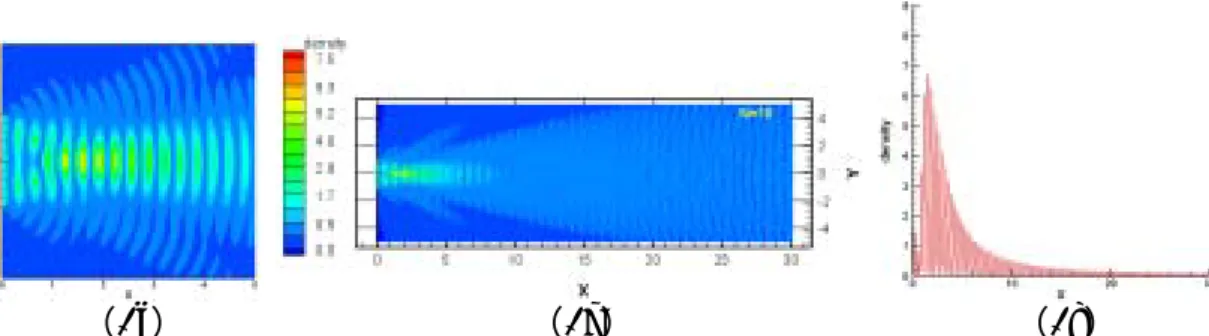
The integrals (4-6) are then evaluated by the three-point Gaussian integration method. At lower Reynolds number, 0 < N < 100, an axially symmetric jet reveals multi-branch configurations. For example, a jet at N = 10, Fig. 1a, exhibits quantum branching, due to the generation of high harmonic waves, which splits the jet issued from the exit into several branches at the downstream. By increasing the Reynolds number above 100 to 1000, a single jet structure is clearer. Fig. 2-4 show the structures of probability density for N = 100, 500, and 900, respectively. Note that the transition Reynolds number is approximately 100.
The interesting phenomena of quantum clustering are found in a board range of Reynolds.
When N = 100, a higher probability density clusters at the center of jet in the range of x = 12 to 22 shown in Fig. 2. The detailed structures of theses clusters vary as function of Reynolds number. The further investigations are underway.
Reference:
1. B. K. Kendrick, A New Method for Solving the Quantum Hydrodynamic Equations of Motion, Journal of Chemical Physics, Vol. 119, No. 12, pp. 5805-5817, 2003.
2. C. L. Gardner, The Quantum Hydrodynamic Model for Semiconductor Devices, SIAM J.
Appl. Math. Vol. 54, No. 2, pp. 409-427, 1994.
3. Z. Chen, A Finite Element Method for the Quantum Hydrodynamic Model for Semiconductor Devices, Computers Math. Appl., Vol. 31, No. 7, pp. 17-26, 1996.
4. C. J. Trahan and R. E. Wyatt, Radial Basis Function Interpolation in the Quantum Trajectory Method: Optimization of the Multi-Quadric Shape Parameter, J. of Computational Physics, Vol. 185, pp. 27-49, 2003
5. H.H. Chiu, C.T. Lin and S.Y. Lin. “Developments of Quantum Nanojet-Based Nanodevices” Accepted for presentation at ICEE 11 2004
(1a) (1b) (1c)
Fig. 1. The distribution of density probability for N = 10: 1a) (0, 5)X(-2.5, 2.5), 1b) (0, 30)X(-5,5), 1c) at the centerline.
(2a) (2b) (2c)
Fig. 2. The distribution of density probability for N = 100: 2a) (0, 5)X(-2.5, 2.5), 2b) (0, 30)X(-5,5), 2c) at the centerline.
(3a) (3b) (3c)
Fig. 3. The distribution of density probability for N = 500: 3a) (0, 5)X(-2.5, 2.5), 3b) (0, 30)X(-5,5), 3c) at the centerline.
(4a) (4b) (4c)
Fig. 4. The distribution of density probability for N = 900: 4a) (0, 5)X(-2.5, 2.5), 4b) (0, 30)X(-5,5), 4c) at the centerline.
Acknowledgements
The authors extend their appreciation for the support awarded by the National Science Council of Taiwan under the grant NSC92-2212-E006-086.
QSTNSC-3-1 C.C. Hwang
“Molecular dynamic simulation of a liquid film”
1. Introduction
Thin film technology has become a key technique in the fabrication of many modern devices such as very large scale integrated (VLSI) circuits optical thin films [1,2] and density increases, the challenges facing in the manufacturing of these devices also increase. Sputter- deposited technique is frequently used for producing thin film on these devices [3].
Sputter-deposited process is accomplished by the removal of atoms from a solid cathode due to the impact of incident ions [4].
2. Objective
In order to understand the relation between the morphologies of growing thin films and different sputtering process parameters is very important for practical film quality control, and for deeper insight into the mechanisms of defect formation.
3. Literature review
Previously utilized experimental methods to observer the produced film surface property including AFM, STM, SEM, stylus measurements, X-ray scattering and optical scattering [5,6]. However, these experimental methods cannot observe the transient morphologies of growing films due to observational difficulties at the small scale encountered in deposition experiments. The thin film growing mechanisms is thus, difficult to fully understand only from experiments. To date, several numerical methods had been developed in aid of the understanding of the growing mechanisms including the continuum-based methods, such as shock tracking algorithm level set method [7], finite element method [8], and particle-based methods; Monte Carlo method [9] and molecular dynamic (MD). The last one method describes the nuclear motion of the constituent particles satisfying the laws of classic mechanics at atomic scale [10]. The superiority of the MD approach apparently emerges as the characteristic size of the system approaches to a rather small scale. Furthermore, the MD simulation is also a powerful tool to explore the new physical phenomenon occurring at nano scale, as a quick and efficient way to the understanding the nonotechnology [11].
4 Method of approach
These simulated approach brief introduce in the below. The other kind of the boundary conditions are used to specify the environmental conditions encountered in practice such as temperature or pressure condition. These conditions usually account for the energy or momentum transfer between the simulation domain and the environment occurring at the boundary. Two types of the technique are usually adopted in the MD simulation, namely the scaling and Langevin techniques. The latter one technique is more general than the former, which also can treat the pressure, temperature specified conditions or either the coupling of pressure and temperature conditions.
Molecular dynamics is used to describe the nuclear motion of the constituent particles satisfying the laws of classic mechanics at atomic scale. The electron cloud effect is not considered individually in MD method and is considered as a whole in the potential function.
The force acting between atoms is not usually directly described in the most of MD method and alternatively, replacing by its potential function. This also means the inter-atomic force can be obtained by taking the negative first derivative of the associated potential, i.e.,
F= −∇Φ, (1)
where F is force acting between atoms andΦis the potential function.
Thus, we can describe more clearly that the potential functions are used to model the inter-atomic force in MD method. This also indicates that the different potential functions may adopted in the simulation according to different material characteristics used in the simulation model. Two categories of the potential function are classified according to its electricity of the atom, these are, neutral atom and ion. Usually, the neutral atom potentials are used to model the substrate atoms and deposition atom interaction and the ion potential is used to model ion interaction in some related ion assisted deposition processes, such as ion assisted deposition (IAD) and ion physical vapor deposition (IPVD).
In addition, this research we utilized the many-body potential of the tight-binding second moment approximation (TB-SMA) model is employed to simulate the interatomic force among atoms. The prediction of some properties by TB-SMA method provides more accurate than that of EAM method. Moreover, the computing algorithm of TB-SMA method is simpler than that of EAM method. This model is introduced by summing the band energy, which is characterized by the second moment of the d-band density of state, and a pairwise potential energy of the Born-Mayer type [12] and is expressed in the following form
1/ 2 2
0 0
exp 2 ij 1 exp ij 1
j j
r r
E q A p
r r
ξ
= − − − + − −
∑
∑
, (2)
where ξ is an effective hopping integral, r is the distance between atom i and j, and ij r 0 is the first-neighbor distance. The parameters A, p, q and ξ are determined by the experimental data of cohesive energy, lattice parameter, bulk modulus and shear elastic constants, respectively.
5 Results and conclusions
Based on above methodology, we have carried out that the simulation condition is incident energy of 10-eV. Figure 1 shows the interface width, which uses to characterize the surface roughness, for different Ar-to-Cu ratio at relatively low incident Ar energy. The interface width drawn from deposited film produced by the usual evaporation deposition, i.e., without the assistance of Ar incident, is also plotted on the figure for comparison. It is noted that the simulation condition of the incident Cu atom form the evaporation deposition is set as 0.1-eV for all the case studies. Figure 2 shows the influence of the Ar incident angle on the produced film surface property for a specific Ar-to-Cu ratio. The results of Fig.1 and Fig.2 indicate that surface roughness of the film produced by IAD is smaller than that produced by the usual evaporation deposition whatever the change of the IAD process parameters.
However, the influence of process parameters of Ar-to-Cu ratio and Ar incident angle is insignificant for the further improvement of the surface roughness for IAD when the Ar incident energy at a relatively low of 10-eV. It is noted that the Ar incident angle is calculated from the surface normal of the substrate. The results are expected and are consistent with the physical explanation that the momentum transfer from Ar to Cu atom is limited when the Ar incident energy is at relatively low level.