Natural Products of Cosmetics: Analysis of Extracts of Plants Endemic to Taiwan for the Presence of
Tyrosinase-inhibitory, Melanin-reducing, and Free Radical Scavenging Activities
Cheun-Bin Jiang1, Man-Jau Chang2, Chi-Luan Wen3, Yi-Pei Lin4, Feng-Lin hsu4 anD Mei-hsien Lee4*
1. Department of Pediatrics, Mackay Memorial Hospital, Taipei City, Taiwan
2. Institute of Chinese Pharmaceutical Science, China Medical University, Taichung
3. Seed Improvement and Propagation Station, Council of Agriculture, Propagation Technology Section, Taichung, Taiwan
4. Graduate Institute of Pharmacognosy, Taipei Medical University, Taipei City, Taiwan (Received: May 3, 2006; Accepted: July 25, 2006)
aBstraCt
Non-toxic natural products useful in the formulation of cosmetics are of considerable interest. Recent efforts have focused on the identification of substances that inhibit tyrosinase activity or suppress formation of reactive oxygen species (ROS) in skin cells. Since tyrosinase is the rate-limiting enzyme in the synthesis of melanin, the pigment responsible for the color of human skin, tyrosinase inhibitors may have skin-whitening effects. Since ROS have been implicated in the aging of human skin, agents that suppress the production of ROS may retard such aging. In the present study, ethanol (95%) extracts of 26 plants endemic to Taiwan were examined for their tyrosinase-inhibitory or melanin-reducing activities in human epidermal melanocytes, as well as in vitro free radical scavenging activity. Among the preparations tested, extracts of Pyracantha koidzumii (M-165) were found to be the least cytotoxic and to possess the highest cellular tyrosinase inhibitory activity (IC50, 54.8 μg/mL). Extracts of Acer albo- purpurascens (M-51), Hygrophila pogonocalyx (M169), Machilus japonica var. kusanoi (M-67), and Eriobotrya deflexa (M-50) exhibited the most potent free radical scavenging activity against hydroxyl, superoxide, and 2,2’-azino-bis(3-ethylbenzothiazo- line-6-sulfonic acid (ABTS) anion radicals. The IC50 values of M-51, M169, M-67, and M-50 were 3.1, 0.8, 6.6, and 1.8 μg/mL for hydroxyl radical; 5.3, 12.8, 12.4, and 6.1 μg/mL for superoxide radical; 2.4, 7.9, 5.7, and 2.9 μg/mL for ABTS anion radical, respec- tively. Nevertheless, the phenolic contents were not all correlated with these activities. These plants thus serve as potential sources of ingredients, which could be combined in cosmetic products. Further investigation of the substances responsible for the observed tyrosinase-inhibitory and free radical scavenging activities is therefore warranted.
Key words: plants endemic to Taiwan, tyrosinase, human skin melanocytes, free radical scavenging activity
introDuCtion
Tyrosinase (EC 1.14.18.1) is a copper-containing monooxygenase that is widely distributed in nature. The enzyme hydroxylates monophenols to o-diphenols and oxidizes o-diphenols to o-quinones. Quinones are highly reactive compounds that, upon further oxidation, could convert to eumelanin polymers through a radical-coupling pathway. Besides, quinones can polymerize spontane- ously, resulting in melanins formation, and can react with amino acids or proteins, thus enhancing the brown color production by the parent compound(1).
Melanin synthesis in melanocytes is accompanied by the generation of hydrogen peroxide, which, if inappro- priately processed, can lead to the formation of hydroxyl radicals and other ROS(2). These highly reactive free radi- cal compounds are potentially damaging to human tissues.
For example, the hydroxyl radical (HO•), the superoxide anion radical (O2•-), hydrogen peroxide (H2O2), and the peroxyl radical (ROO•) all have the capacity to generate metabolic products that could attack DNA or lipids in cell membranes. ROS cause biological damage in exposed tissues via iron-catalyzed oxidative reactions(3). Oxida- tive stress is also involved in the pathogenesis of skin disorders(1), and ROS scavengers or inhibitors, such as antioxidants, reduce hyper-pigmentation(5).
Most of the popular de-pigmenting agents in current use are toxic to melanocytes and have various adverse effects(6-8). Tyrosinase inhibitors involved in the rate- limiting step in the pathway for melanin synthesis, may present safer alternatives to depigmenting compounds.
However the well known tyrosinase inhibitor kojic acid, is highly sensitive to skin, and cases of allergic contact dermatitis due to this drug have been reported(9-11). Thus, searching for non-toxic natural products with proper- ties useful in the formulation of cosmetics is desirable.
* Author for correspondence. Tel: +886-2-27361661 ext. 6151;
E-mail: [email protected]
Recent efforts have been focused on the identification of plant products that are antioxidant(12-16) or whitening agents(1,17-22).
Because they are easy to culture, human epidermal melanocytes (HEMn cells) are powerful in vitro tools for investigating human melanin synthesis and pigmentation.
In culture, these cells continue to express the melanogenic phenotype of the skin from which they were derived.
The present study was undertaken to investigate whether plants indigenous to Taiwan, contain potentially useful substances for cosmetic purposes. Extracts of Taiwanese plants were screened for tyrosinase-inhibitory activities and 2,2’-azino-bis(3-ethylbenzothiazoline-6-sulfonic acid (ABTS)•- and hydroxyl (HO•) radical-scavenging activities using HEMn cells as a model system.
MethoDs anD MateriaLs I. Reagents
2,2’-azobis(2-amidino-propane)-dihydrochloride (AAPH), ABTS, l-3,4-dihydroxyphenylalanine (l-DOPA), luminol, sodium hydroxide (NaOH), 3-(4,5-dimethyl- thiazol-2-yl)-2,5-diphenyl tetrazolium bromide (MTT), ethylenediaminetetraacetic acid (EDTA), Folin-Ciocalteu reagent, and Triton X-100 were purchased from Sigma Chemical Co. (St. Louis, MO). Other chemicals were of the highest grade commercially available.
II. Materials
All plant materials were selected and collected from the Highlands Experiment Farm, National Taiwan Univer- sity, Nantou, Taiwan, and were identified by Mr. Chi-Luan Wen, Seed Improvement and Propagation Station, Council of Agriculture, Taiwan. The specimens were deposited in the Graduate Institute of Pharmacognosy, Taipei Medical University, Taiwan.
III. Preparation of Extracts
Pulverized dried leaves of plants were extracted twice within 7 days with 95% ethanol. Filtrates were combined, and concentrated under reduced pressure. The concen- trates were freeze-dried and stored in a closed container until use. The yields of plant extracts were calculated by the following formula:
Yield (%) = (mass of the extract / mass of the dried raw plant material) × 100.
IV. Cell Culture
Cells, culture medium and supplement were obtained from Cascade Biologics, Inc. (Portland, OR, USA). Prima- ry melanocytes derived from normal neonatal human foreskin (HEMn cells; Cat. No. C-102-5C) were propa-
gated in Medium 154 (Cat. No. M-254-500) enriched with Human Melanocyte Growth Supplement (HMGS, Cat. No.
S-002-5).
V. Assay of Cell Viability
Cells were seeded in 24-well plates (1 × 10⁵ cells/
well). After 24 h culture, test materials were added and incubations were continued for another 24 h. Cell viabil- ity was determined by the MTT method, which measures the mitochondrial dehydrogenase activity involved in the formation of purple formazan. Cell viability (%) was calculated as (Absorbance at 570 nm of the test sample / Absorbance at 570 nm of the control) × 100.
VI. Tyrosinase Activity Analysis by DOPA Staining of SDS-PAGE Gels
Tyrosinase activity was determined by zymography as described(2). Test materials were added to HEMn cells (1
× 105 / well) in 24-well plates, and cultures were incubated at 37ºC with 5% CO2 in a humidified incubator for 1 day.
The protein contents of culture supernatants were deter- mined with a Bio-Rad protein assay kit. Test supernatants containing (40 µg protein) were incubated with a five- fold excess of sample buffer (60 mM Tris-HCl, pH 6.8, 2%
SDS, 10% glycerol) at 37ºC for 30 min, and then subjected to the polyacrylamide gel (10%) electrophoresis. After electrophoresis, gels were washed with 0.1 M PBS (pH 6.8) for 1 h by gentle shaking, and then incubated at 37ºC for 1 h in 0.1 M PBS, pH 6.8, containing 5 mM l-DOPA substrate. The tyrosinase activity was calculated for the intensity value (intensity × area) for each band by Quantity One 1-D Analysis Software (Bio-Rad, UK, Europe), and normalized with the intensity value with control.
VII. Measurement of Melanin Content in Melanocytes.
Melanin contents were measured as described previ- ously(3). Cells were treated with test materials for 24 h.
Cell pellets were suspended with 1 N NaOH and incubated at 37°C overnight. Samples were clarified by centrifugation for 10 min at 10000 g. The optical densities (OD) of super- natants were measured at 450 nm using an ELISA reader.
VIII. Assay for Hydroxyl Radical Scavenging Activity The hydroxyl radical was generated by the Fenton reaction according to a modification of the luminescence method(4). Reaction mixtures included luminol (40 μM), phosphate buffer (4.17 mM, pH 7.4), Fe2+(4.6 μM)-EDTA (2.3 μM), H2O2 (96 mM), and test sample. The chemilu- minescent reaction was performed in a KH2PO4-NaOH (pH 7.5)-buffer at room temperature. The reaction was initiated by adding Fe2+-EDTA, followed by H2O2. Lumi- nescence intensity was monitored over wavelengths rang- ing from 200 to 900 nm.
IX. Superoxide Radical Scavenging Activity
The generation of superoxide radicals by the xanthine/xanthine oxidase system was monitored by the nitro-blue tetrazolium (NBT) procedure with modification as described previously(5). The reaction mixtures includ- ing various concentrations of test samples, 100 μM of xanthine, 15 mU of xanthine oxidase, and 500 μM of NBT were incubated at ambient temperature for 2 min and the reaction was then initiated by adding xanthine oxidase.
The samples were dissolved in 100 mM phosphate buffer (pH 7.4). The absorbance (560 nm) of each sample was measured. The effects of the tested compounds on xanthine oxidase were evaluated by following the forma- tion of uric acid from xanthine at room temperature. The same reaction mixtures, except for NBT, were used in the enzymatic assay for superoxide radical-scavenging activ- ity. The absorbance was measured at 295 nm.
X. Assay for ABTS Radical Anion Scavenging Activity Reaction mixtures contained 1 mM AAPH, 2.5 mM ABTS as the diammonium salt, 100 mM potassium phos- phate buffer (pH 7.4), and 150 mM NaCl. After 15 min of incubation at 68°C, the blue-green ABTS•- containing solution was adjusted to an absorbance of 0.650 at 734 nm.
Samples of interest (20 μL) were added to 180 μL of the ABTS radical solution in 96-well plates. Mixtures were incubated at 37°C for 10 min in the dark, followed imme- diately by measurement of absorbance at 734 nm(6). XI. Determination of Total Phenolics
The total phenolic content of each extract was deter- mined by the Folin-Ciocalteu method(7). The sample solution (50 μL) was mixed with an equal volume of 1 N Folin-Ciocalteu reagent-20% sodium carbonate (Na2CO3).
After 25 min of incubation at room temperature, the reac- tion mixture was clarified by centrifugation at 3500 g for 10 min. The absorbance of the supernatant was measured at 730 nm. The amount of total phenolics was expressed as gallic acid equivalents (GAE) in grams per gram dry plant extract.
XII. Statistical Analysis
Data are presented as the mean ± standard deviation (SD) for measurements conducted in triplicate. Differenc- es between groups were tested for significance by means of the non-parametric Mann-Whitney U-test. A P-value <
0.5 indicated statistical significance.
resuLts anD DisCussion
Whitening cosmetics that contain naturally occur- ring, as opposed to synthetic, substances are currently
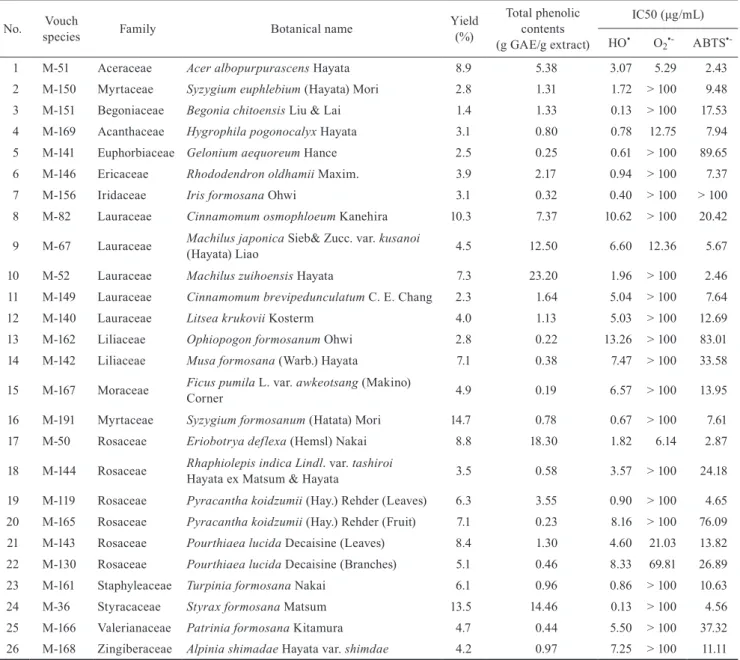
desirable. Twenty-six Taiwanese plants were therefore evaluated as potential sources of skin-whitening and anti- oxidant ingredients. Ethanol extracts of these plants were prepared with yields ranging from 1.4% to 14.7% (Table 1).
Among many factors contribute to the color of mammalian skin, the most important ones are the degree and distribution of melanin pigmentation. Melanin, one of the most widely distributed pigments in animals, is secret- ed by melanocytes distributed in the epidermis. Inhibition of melanin synthesis by tyrosinase inhibitors represents a main strategy for developing new whitening agents.
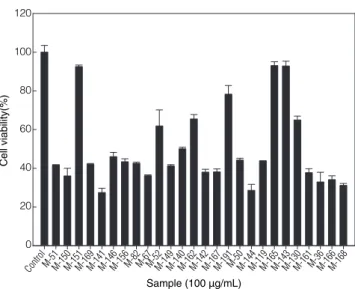
HEMn cells were therefore employed to examine the anti- tyrosinase and melanin-decreasing activities of plant extracts. Since a cosmetic additive must have a low cyto- toxicity, the effect on viability was examined first. Of the 26 extracts investigated, those from B. chitoensis (M-151), P. koidzumii (M-165), and P. lucida (M-143) were least cytotoxic (viability > 80%) after 24 h treatment at concen- tration of 100 μg/mL (Figure 1). Tyrosinase catalyzes two key reactions in the melanin biosynthesis pathway, and substrates for both reactions have been used to assay tyrosinase(8). In the present study, l-DOPA zymography was used to detect tyrosinase inhibition by extracts of B.
chitoensis (M-151), P. koidzumii (M-165), and P. lucida (M-143) in HEMn cells (Figure 2). The effect of extracts on tyrosinase activity was semi-quantified relative to that of medium alone. Tyrosinase inhibition by arbutin (used as a positive control) was dose-dependent between 2 mM and 10 mM. Tyrosinase inhibitory activity was expressed as the intensity value (intensity × area) for each protein band visualized by Image Analysis Software (Quantity One, Bio-Rad) and normalized to the intensity value for control. Of the three extracts tested at concentrations of 20 μg/mL, 40 μg/mL, 80 μg/mL, or 100 μg/mL, only the P. koidzumii (M-165) extract exhibited dose-dependent inhibitory activity. Extracts of B. chitoensis (M-151) and P. lucida (M-143) were minimally inhibitory. Measure- ment of the melanin content of cells exposed to each of the three extracts revealed that P. koidzumii (M-165) extract significantly and dose-dependently reduced melanin content (p < 0.05, Figure 3). The other two plant extracts had almost no effect on melanin content of HEMn cells.
This observation may be due to that melanin biosynthesis in HEMn cells occur via multiple steps. Compounds in these extracts may also affect enzymes besides tyrosinase, such as dopachrome tautomerase or DHICA oxidase(9).
Skin has the largest surface area of any tissue of the human body and is constantly exposed to oxidative stress induced by ROS generated both from endogenous enzymes and external pro-oxidant stimuli. ROS-mediated oxidative damage to skin can be extensive, resulting in modification of DNA, lipid peroxidation, and release of inflammatory cytokines. The hydroxyl radical is one of the most reactive and damaging ROS(10). To deal with harmful effects by such radicals, mammalian skin is equipped with antioxidant scavenging defense mecha- nisms. Some plant extracts can also scavenge hydroxyl
radicals and thereby protect cellular lipids against oxida- tive damage by free radicals(11). The HO• quenching activity of the 26 extracts was determined using the Fenton reaction system in combination with a chemilu- minescence (CL) assay. This approach has been used widely in the fields of biology(12), medicine(13-14), and food science(15). All but the extracts of C. osmophloeum (M-82) and Ophiopogon formosanum (M-162) owned potent scav- enging activity (IC50 > 10 μg/mL).
The superoxide radical was generated by an xanthine/
xanthine oxidase enzymatic system. Xanthine oxidase catalyzes the oxidation of xanthine in the presence of molecular oxygen to yield uric acid and superoxide anion.
This is an important physiological pathway in humans(16). Extracts of A. albopurpurascens (M-51), H. pogonoca- lyx (M169), Machilus japonica var. kusanoi (M-67), E.
deflexa (M-50), P. lucida (M-143), and P. lucida (M-130) showed potent scavenging activity (IC50 < 100 μg/mL) and no inhibitory effect on xanthine oxidase at a concentration of 100 μg/mL (data not shown).
ABTS radical anion has recently become a popular tool for measuring radical-scavenging activity. ABTS- based methods are often employed to screen complex mixtures, such as plant extracts, beverages, and biological fluids, for scavenging activity and for estimating the anti- oxidant activity of lipophilic and water-soluble materials
(6,17). Analytical methods involving ABTS•- may be pref- erable to other methods for evaluating the total antioxidant capacity of various chemicals and food substances(18-21). By using an ABTS-based method, potent scavenging activity (IC50 2.43-9.48 μg/mL) was detected in extracts of A. albopurpurascens (M-51), S. euphlebium (M-150),
table 1. Ethno-botanical data, extract yields, phenolic contents of extracts, and IC50 values for extracts relevant to their free radicals scav- enging activities for 26 selected Taiwanese plants.
No. Vouch
species Family Botanical name Yield
(%)
Total phenolic contents (g GAE/g extract)
IC50 (μg/mL) HO• O2•- ABTS•-
1 M-51 Aceraceae Acer albopurpurascens Hayata 8.9 5.38 3.07 5.29 2.43
2 M-150 Myrtaceae Syzygium euphlebium (Hayata) Mori 2.8 1.31 1.72 > 100 9.48
3 M-151 Begoniaceae Begonia chitoensis Liu & Lai 1.4 1.33 0.13 > 100 17.53
4 M-169 Acanthaceae Hygrophila pogonocalyx Hayata 3.1 0.80 0.78 12.75 7.94
5 M-141 Euphorbiaceae Gelonium aequoreum Hance 2.5 0.25 0.61 > 100 89.65
6 M-146 Ericaceae Rhododendron oldhamii Maxim. 3.9 2.17 0.94 > 100 7.37
7 M-156 Iridaceae Iris formosana Ohwi 3.1 0.32 0.40 > 100 > 100
8 M-82 Lauraceae Cinnamomum osmophloeum Kanehira 10.3 7.37 10.62 > 100 20.42
9 M-67 Lauraceae Machilus japonica Sieb& Zucc. var. kusanoi
(Hayata) Liao 4.5 12.50 6.60 12.36 5.67
10 M-52 Lauraceae Machilus zuihoensis Hayata 7.3 23.20 1.96 > 100 2.46
11 M-149 Lauraceae Cinnamomum brevipedunculatum C. E. Chang 2.3 1.64 5.04 > 100 7.64
12 M-140 Lauraceae Litsea krukovii Kosterm 4.0 1.13 5.03 > 100 12.69
13 M-162 Liliaceae Ophiopogon formosanum Ohwi 2.8 0.22 13.26 > 100 83.01
14 M-142 Liliaceae Musa formosana (Warb.) Hayata 7.1 0.38 7.47 > 100 33.58
15 M-167 Moraceae Ficus pumila L. var. awkeotsang (Makino)
Corner 4.9 0.19 6.57 > 100 13.95
16 M-191 Myrtaceae Syzygium formosanum (Hatata) Mori 14.7 0.78 0.67 > 100 7.61
17 M-50 Rosaceae Eriobotrya deflexa (Hemsl) Nakai 8.8 18.30 1.82 6.14 2.87
18 M-144 Rosaceae Rhaphiolepis indica Lindl. var. tashiroi
Hayata ex Matsum & Hayata 3.5 0.58 3.57 > 100 24.18
19 M-119 Rosaceae Pyracantha koidzumii (Hay.) Rehder (Leaves) 6.3 3.55 0.90 > 100 4.65 20 M-165 Rosaceae Pyracantha koidzumii (Hay.) Rehder (Fruit) 7.1 0.23 8.16 > 100 76.09
21 M-143 Rosaceae Pourthiaea lucida Decaisine (Leaves) 8.4 1.30 4.60 21.03 13.82
22 M-130 Rosaceae Pourthiaea lucida Decaisine (Branches) 5.1 0.46 8.33 69.81 26.89
23 M-161 Staphyleaceae Turpinia formosana Nakai 6.1 0.96 0.86 > 100 10.63
24 M-36 Styracaceae Styrax formosana Matsum 13.5 14.46 0.13 > 100 4.56
25 M-166 Valerianaceae Patrinia formosana Kitamura 4.7 0.44 5.50 > 100 37.32
26 M-168 Zingiberaceae Alpinia shimadae Hayata var. shimdae 4.2 0.97 7.25 > 100 11.11
H. pogonocalyx (M169), R. oldhamii (M146), Machilus japonica var. kusanoi (M-67), M. zuihoensis (M-52), Cinnamomum brevipedunculatum (M-149), S. formosa- num (M-191), E. deflexa (M-50), Pyracantha koidzumii (M-119), and Styrax formosana (M-36).
Plant phenolic compounds have diverse proper- ties including antioxidant(22-24), antiviral(25), antibacte- rial(26-28), and anti-tumor activities(29-32). Total phenolic content may reflect the total antioxidant activity(33). The total phenolic content of extracts is presented in Table 1.
Phenolics were abundant (more than 2 g GAE/g extract) in A. albopurpurascens (M-51), R. oldhamii (M146), Cinna- momum osmophloeum (M-82), M. japonica var. kusanoi (M-67), M. zuihoensis (M-52), E. deflexa (M-50), P. koid- zumii (M-119), and S. formosana (M-36).
Few reports have addressed the commercial value of
plants endemic to Taiwan. The present study found that extracts of P. koidzumii (M-165) were non-toxic and had significant tyrosinase-inhibitory and melanin-reducing activity in HEMn cells. Nevertheless, extracts of this plant were not enriched in phenolics and not effective in scaveng- ing superoxide and ABTS radicals. P. koidzumii (M-165) extracts may therefore contain non-phenolic products that effectively reduce melanin synthesis by unique mecha- nisms. Oxidative stress induces ROS and other free radi- cals and plays a role in the pathogenesis of skin disorders.
Therefore, free radical scavengers or antioxidants are commonly included in skin care formulations. The present study found that extracts of A. albopurpurascens (M-51), H. pogonocalyx (M169), M. japonica var. kusanoi (M-67), and E. deflexa (M-50) exhibited the most potent free radical scavenging activities, including activities against hydroxyl, superoxide, and ABTS anion radicals. Due to their potent free radical scavenging activities, these extracts can be combined in the cosmetic formulation, and because of their cytotoxicity, their concentration needs to be reduced in the formulation. Not all of these activities correlate with phenolic components of the plant extracts. Some activity may be due to other secondary metabolites contained in the active plants. Therefore, compounds from a variety of Taiwanese plants are potentially useful in the formulation of cosmetics.
aCknoWLeDgeMents
This study was sponsored by the Mackay Memorial Hospital (93MMH-TMU-10). The authors also express
Sample (100 µg/mL)
Control M-51M-150M-151M-169M-141M-146M-156M-82M-67M-52M-149M-140M-162M-142M-167M-191M-50M-144M-119M-165M-143M-130M-161M-36M-166M-168
Cell viability(%)
120 100 80 60 40 20 0
Figure 1. The viabilities of human epidermal melanocytes treated with ethanol extracts derived from each of 26 selected Taiwanese plants.
Figure 2. l-DOPA zymography analysis of the inhibition of human epidermal melanocyte tyrosinase by extracts of B. chitoensis (M-151), P. koidzumii (M-165), and P. lucida (M-143). (A) medium only; (B) 2 mM arbutin (Ar), 40 μg/mL test extract; (C) 4 mM arbutin, 60 μg/mL test extract; (D) 6 mM arbutin, 80 μg/mL test extract; (E) 10 mM arbutin, 100 μg/mL test extract.
1.00 0.65 0.45 0.24 0.15 Fold increase
1.00 1.08 1.06 1.04 0.83 Fold increase
1.00 1.03 0.83 0.59 0.32 Fold increase
1.00 0.77 0.63 0.61 0.49 Fold increase
Figure 3. The melanin content of human epidermal melanocytes treated with ethanol extracts of three selected Taiwanese plants.
Differences between control and treatment groups were tested for significance using the non-parametric Mann-Whitney U-test. A P-value < 0.05 indicated statistical significance.
Sample
Melanin content (%)
B. chitoensis
*
*
P. koidzumii
*
**
*
* *
P. lucida Medium
120 100 80 60 40 20 0
Medium 40 µg/mL 60 µg/mL
80 µg/mL 100 µg/mL
thanks for the partial financial support provided by a grant (CCMP94-RD-015) from the Committee on Chinese Medi- cine and Pharmacy, Department of Health, Executive Yuan and the Juridical Person of Yen’s Foundation, Taiwan.
reFerenCes
1. Yamakoshi, J., Otsuka, F., Sano, A., Tokutake, S., Saito, M., Kikuchi, M. and Kubota, Y. 2003. Lightening effect on ultraviolet-induced pigmentation of guinea pig skin by oral administration of a proanthocyanidin-rich extract from grape seeds. Pigm. Cell Res. 16: 629-638.
2. Li, D. Q., Meller, D., Liu, Y. and Tseng, S. C. 2000.
Overexpression of MMP-1 and MMP-3 by cultured conjunctivochalasis fibroblasts. Invest. Ophthalmol. Vis.
Sci. 41: 404-410.
3. Wang, K. H., Lin, R. D., Hsu, F. L., Huang, Y. H., Chang, H. C., Huang, C. Y. and Lee, M. H. 2006.
Cosmetic applications of selected traditional Chinese herbal medicines. J Ethnopharmacol. 106: 353-359.
4. Cheng, Z., Yan, G., Li, Y. and Chang, W. 2003.
Determination of antioxidant activity of phenolic anti- oxidants in a Fenton-type reaction system by chemilu- minescence assay. Anal. Bioanal. Chem. 375: 376-380.
5. Valentao, P.,Fernandes, E.,Carvalho, F.,Andrade, P.
B.,Seabra, R. M. and Bastos, M. L. 2001. Antioxidant activity of Centaurium erythraea infusion evidenced by its superoxide radical scavenging and xanthine oxidase inhibitory activity. J. Agric. Food Chem. 49: 3476-3479.
6. Kim, D. O., Lee, K. W., Lee, H. J. and Lee, C. Y. 2002.
Vitamin C equivalent antioxidant capacity (VCEAC) of phenolic phytochemicals. J. Agric. Food Chem. 50:
3713-3717.
7. Yeh, C. T. and Yen, G. C. 2005. Effect of vegetables on human phenolsulfotransferases in relation to their anti- oxidant activity and total phenolics. Free Radic. Res.
39: 893-904.
8. An, B. J., Kwak, J. H., Park, J. M., Lee, J. Y., Park, T.
S., Lee, J. T., Son, J. H., Jo, C. and Byun, M. W. 2005.
Inhibition of enzyme activities and the antiwrinkle effect of polyphenol isolated from the persimmon leaf (Diospyros kaki folium) on human skin. Dermatol. Surg.
31: 848-854.
9. Lamoreux, M. L.,Wakamatsu, K. and Ito, S. 2001.
Interaction of major coat color gene functions in mice as studied by chemical analysis of eumelanin and phe- omelanin. Pigm. Cell Res. 14: 23-31.
10. Bergamini, C. M., Gambetti, S., Dondi, A. and Cervellati, C. 2004. Oxygen, reactive oxygen species and tissue damage. Curr. Pharm. Design 10: 1611-1626.
11. Reiter, R. J., Acuna-Castroviejo, D., Tan, D. X. and Burkhardt, S. 2001. Free radical-mediated molecular damage. Mechanisms for the protective actions of mela- tonin in the central nervous system. Ann. N.Y. Acad.
Sci. 939: 200-215.
12. Miyazawa, T., Fujimoto, K., Suzuki, T. and Yasuda, K.
1994. Determination of phospholipid hydroperoxides using luminol chemiluminescence--high-performance liquid chromatography. Methods Enzymol. 233: 324- 13. Song, Z. and Wang, L. 2001. Chemiluminescence inves-332.
tigation of detection of rutin in medicine and human urine using controlled-reagent-release technology. J.
Agric. Food Chem. 49: 5697-5701.
14. Parejo, I., Petrakis, C. and Kefalas, P. 2000. A transi- tion metal enhanced luminol chemiluminescence in the presence of a chelator. J. Pharmacol. Toxicol. Methods 43: 183-190.
15. Deshpande, S. S. 2001. Principles and applications of luminescence spectroscopy. Crit. Rev. Food Sci. Nutr.
41: 155-224.
16. Selloum, L.,Reichl, S.,Muller, M.,Sebihi, L. and Arnhold, J. 2001. Effects of flavonols on the generation of superoxide anion radicals by xanthine oxidase and stimulated neutrophils. Arch. Biochem. Biophys. 395:
49-56.
17. Cano, A., Acosta, M. and Arnao, M. B. 2000. A method to measure antioxidant activity in organic media: appli- cation to lipophilic vitamins. Redox Rep. 5: 365-370.
18. Arnao, M. B., Cano, A. and Acosta, M. 1999. Methods to measure the antioxidant activity in plant material. A comparative discussion. Free Radic. Res. 31: S89-96.
19. Re, R., Pellegrini, N., Proteggente, A., Pannala, A., Yang, M. and Rice-Evans, C. 1999. Antioxidant activity applying an improved ABTS radical cation decoloriza- tion assay. Free Radic. Biol. Med. 26: 1231-1237.
20. Kim, D. O. and Lee, C. Y. 2004. Comprehensive study on vitamin C equivalent antioxidant capacity (VCEAC) of various polyphenolics in scavenging a free radical and its structural relationship. Crit. Rev. Food Sci. Nutr.
44: 253-273.
21. Zhu, Y. Z., Huang, S. H., Tan, B. K., Sun, J., Whiteman, M. and Zhu, Y. C. 2004. Antioxidants in Chinese herbal medicines: a biochemical perspective. Nat. Prod. Rep.
21: 478-489.
22. Nishino, H., Murakoshi, M., Mou, X. Y., Wada, S., Masuda, M., Ohsaka, Y., Satomi, Y. and Jinno, K. 2005.
Cancer prevention by phytochemicals. Oncology 69:
S38-40.
23. Vattem, D. A., Ghaedian, R. and Shetty, K. 2005.
Enhancing health benefits of berries through phenolic antioxidant enrichment: focus on cranberry. Asia Pac. J.
Clin. Nutr. 14: 120-130.
24. Ray, A. 2005. Cancer preventive role of selected dietary factors. Indian J. Cancer 42: 15-24.
25. Zenebe, W. and Pechanova, O. 2002. Effects of red wine polyphenolic compounds on the cardiovascular system. Bratisl Lek Listy 103: 159-165.
26. Puupponen-Pimia, R., Nohynek, L., Alakomi, H. L.
and Oksman-Caldentey, K. M. 2005. Bioactive berry compounds-novel tools against human pathogens. Appl.
Microbiol. Biot. 67: 8-18.
27. Newton, S. M., Lau, C., Gurcha, S. S., Besra, G. S.
and Wright, C. W. 2002. The evaluation of forty-three plant species for in vitro antimycobacterial activities;
isolation of active constituents from Psoralea corylifo- lia and Sanguinaria canadensis. J. Ethnopharmacol. 79:
57-67.
28. Eley, B. M. 1999. Antibacterial agents in the control of supragingival plaque--a review. Br. Dent. J. 186: 286- 29. Mori, H., Tanaka, T., Sugie, S., Yoshimi, N., Kawamori, 296.
T., Hirose, Y. and Ohnishi, M. 1997. Chemoprevention by naturally occurring and synthetic agents in oral, liver, and large bowel carcinogenesis. J. Cell Biochem.
27: S35-41.
30. Steele, V. E., Moon, R. C., Lubet, R. A., Grubbs, C.
J., Reddy, B. S., Wargovich, M., McCormick, D. L.,
Pereira, M. A., Crowell, J. A., Bagheri, D. and et al.
1994. Preclinical efficacy evaluation of potential che- mopreventive agents in animal carcinogenesis models:
methods and results from the NCI Chemoprevention Drug Development Program. J. Cell Biochem. 20: S32- 31. Helzlsouer, K. J. and Kensler, T. W. 1993. Cancer che-54.
moprotection by oltipraz: experimental and clinical con- siderations. Prev. Med. 22: 783-795.
32. Xue, W. J. and Li, D. H. 1985. Antitumor mechanism of phenolic compounds. Yao Xue Xue Bao 20: 477-480.
33. Rao, B. 2003. Bioactive phytochemicals in Indian foods and their potential in health promotion and disease pre- vention. Asia Pac. J. Clin. Nutr. 12: 9-22.