國⽴臺灣⼤學社會科學院經濟學系 碩⼠論⽂
Department of Economics College of Social Sciences
National Taiwan University Master Thesis
探討靈⾧類的⾵險態度 台灣獼猴在無知之幕後的⾏為實驗 Risk Attitude of Primates, Experiment Conducting on Formosan
Macaque behind Veil of Ignorance
何宗祐 Tsung-Yu Ho
指導教授 ⿈貞穎
Advisor: Chen-Ying Huang, Ph.D.
中華民國 104 年 12 ⽉ December, 2015
中⽂ 要
在開始介紹理論之前 讓我們先想想以下情境 想像你遇到兩個
⼈ ⼀位是富有的企業家 另⼀位是貧窮的乞丐 當你問他們何為公 平的社會制度 企業家很可能會回答資本主義 因為他相信資本主義 給⼈們相同的⽴⾜點 以個⼈的努⼒追求成就及財富 然⽽ 乞丐則 可能贊成共產主義 希望在共產制度下每個⼈都分配到相同的資源 從這個⼩故事我們可以知道 ⼀個⼈對於公平的偏好很可能受到其社 會地位影響 因此當我們要觀察出⼀個⼈真正的社會偏好 便需要在 不受到給定社會地位的影響之下 觀察此⼈對於公平制度的選擇 此 即無知之幕 (Veil of Ignorance) 的概念 ( John Rawls, 1971)
本⽂是第⼀篇以台灣獼猴為實驗對象的⾏為實驗論⽂ 探討猴⼦在無 知之幕後的⾏為決策 我們將無知之幕後的社會偏好分解成兩個部分 其⼀是⼀般的社會公平偏好 亦即無知之幕前的社會偏好 在不具⾵
險下所做的選擇 另⼀則是⾵險偏好 ⽽無知之幕的環境中 受試者 必須在具有⾵險的情況下決定其對公平與否的社會偏好 因此無知之 幕後的社會偏好受到⼀般的社會偏好和⾵險偏好所影響
我們的實驗主要分作三個部分 第⼀部分 受試者會在不具⾵險的社 會環境下做出公平與否的選擇 在此階段的實驗中 我們可以根據選 擇結果推斷受試者是否注重公平 抑或是具有 利他 或 損他 的 傾向 第⼆部分 受試者在相同的期望報酬且⾮社會的環境下 會⾯
臨具有⾵險的選項或無⾵險選項 透過選擇結果可以推斷其⾵險偏好 第三部分 受試者會在具有⾵險的社會環境下做出社會偏好的選擇 受試者將⾯臨無⾵險的公平選項及具有⾵險的不公平選項 若受試者 選擇無⾵險的公平選項 可能導因於其對於公平的社會偏好或是⾵險 趨避的⾵險偏好 相反的 若受試者選擇具⾵險的不公平選項 則可 能導因於其不具對公平的社會偏好或其為⾵險愛好者 同時 受試者 必須⾯臨⼀半機會成為劣勢者 (即得到的報酬較少) 另⼀半機會成為 優勢者 (即得到的報酬較多) 的⾵險 從以上討論可知 原則上我們能 從第⼀ ⼆部分的實驗結果 推測受試者在第三部分將會做的選擇
關鍵字 ⾏為實驗 靈⾧類 台灣獼猴 無知之幕 ⾵險態度 利 他⾏為 反社會⾏為 階級關係
Abstract
The veil of ignorance (VOI), behind which people allocate resources prior to learning their social positions, was introduced by John Rawls (1971). Pref- erence over distributions may depend on a decision maker’s economic or so- cial position. However, decisions made before learning his role are immune from being affected by his respective social position and hence reflect what truly constitutes a just distribution. These are termed as decisions or pref- erences behind VOI. Moreover, since behind VOI, the decision maker has to determine an institution of the society in which he would afterward live in without knowing his subsequent position, hence his risk preference plays a role too. We study the behavior of non-human primates, Formosan Rock Macaque (Macaca cyclopis), in the face of food decision problems. We con- duct a class of modified dictator games in which a proposer chooses between two food allocations for itself and a companion, and measure the proposer’s preferences, including risk preference, inequality aversion, and preference be- hind VOI. Our data shows that subjects are strongly risk-loving, and they tend to choose equal distribution more frequently when they make the decision be- hind VOI. We therefore apply subjects’ social preference to explain the dif- ference between their risk preference and preference behind VOI.
Key words: behavioral experiment, non-human primates, Formosan Macaque, veil of ignorance, risk attitude, pro-social behavior, anti-social behavior, hi- erarchy
Contents
中⽂ 要 i
Abstract ii
Contents iii
List of Figures v
List of Tables vi
1 Introduction 1
2 Methods 4
2.1 Subject . . . 4
2.2 Device . . . 4
2.3 Process . . . 5
2.3.1 Pretests . . . 7
2.3.2 Pairing behavior observing experiment . . . 8
2.3.3 Decision making experiments . . . 9
3 Results 12 3.1 Pretests . . . 12
3.2 Pairing behavior observing experiment . . . 12
3.3 Decision Making Experiments . . . 13
4 Conclusion 23
Bibliography 25
List of Figures
2.1 Cage and Subject . . . 5
2.2 Device . . . 6
2.3 SOCIAL . . . 10
2.4 RISK . . . 10
3.1 Result of RISK . . . 17
3.2 Result of VOI . . . 19
3.3 Result of revised SOCIAL and CONTROL . . . 22
List of Tables
2.1 Combination of preferences . . . 11
3.1 Result of pretests . . . 12
3.2 Result of SOCIAL and CONTROL . . . 14
3.3 Regression of SOCIAL and CONTROL . . . 15
3.4 Regression of reciprocity problem . . . 16
3.5 Regression of RISK . . . 18
3.6 Regression of RISK and VOI . . . 20
Chapter 1 Introduction
Preferences are typically taken to be given in traditional economic modeling. How- ever, they have biological foundations in that evolution should shape them so that they serve to help optimize survival fitness (Netzer (2009), Rayo and Becker (2007)). Among them, risk preference has strong biological roots and the biological mechanisms are better understood (Benjamin et al. (2012)). In particular, we would like to look into the issue of how important risk preference is in determining choices behind “the veil of ignorance”
(VOI). This may help shed light on the general curiosity of understanding risk preferences.
The veil of ignorance is a concept developed by John Rawls in Rawls (1971). It was argued that a just society could be constructed if people choose a desired society prior to learning their social positions. In the simplest case, imagine in a world of two, a prince and a beggar, an equal distribution yields an even share of resource, say 5 and 5 to them, whereas an unequal distribution gives the prince the majority and leaves little for the beg- gar, such as 9 versus 1. The question is whether one would like to be born to the equal society or the unequal society before he ever knows his role (either the prince or the beg- gar). We decompose preference behind VOI into two parts: the decision maker’s inequal- ity aversion and their risk preference. Since when the decision maker takes the role of the prince, the other necessarily takes the role of the beggar (and vice versa), the decision maker’s inequality aversion towards the other determines ex post how much he likes a distribution. On the other hand, he has to consider the risk of not obtaining his desired role as well, hence his risk preference plays a role too.
In economics, it has been argued that measuring inequality is conceptually similar to measuring risk (Atkinson (1970)). Preferences behind the veil of ignorance may closely relate to risk preferences when the decision maker is completely selfish. For a decision maker who does not care about the well beings of the other person, without learning his position, the unequal society is simply a half-half lottery with outcomes 9 or 1, since he gets 9 as the prince and 1 as the beggar. On the other hand, in the equal society, no matter whether he is born as a prince or a beggar, he definitely gets 5. The equal society could be framed as a riskless lottery with the outcome of 5 for sure. Thus, whether the decision maker prefers the equal or unequal society is determined solely by his preference over the half-half lottery and the riskless lottery. In other words, for a purely selfish agent, his decision behind the veil of ignorance will be perfectly aligned to his risk preferences.
We are curious about how risk preference differs from preference behind the veil of ignorance and the possible role of social preference in this difference if it exists. There are several human experiments trying to illustrate the differences. However, results from these experiments comparing risk preference with preference behind VOI are mostly in- conclusive. For instance, Frignani and Ponti (2012) discovered that risk preferences of subjects are very similar to those behind VOI. On the other hand, Schildberg-Hörisch (2010) found significant difference between these two preferences. In particular, women subjects choose more equal distributions than men. It is not clear whether the preference of considering others is a learned cultural trait (and so is uniquely human) or an evolved characteristic. If the preference is evolved, then similar behaviors should be observed in other species. This is one of the reasons we conduct experiments on monkeys. It is also no- table that previous experiments in primates test social preferences when decision maker’s position is known, i.e., they all test preference more or less along the social environment (Jensen et al. (2007), Bräuer et al. (2009), Brosnan and De Waal (2003), Burkart et al.
(2007), Silk et al. (2005), Jensen et al. (2006)). Notions of a just society where positions are still unknown are never put into test. In other words, our project is the first attempt of testing the preferences behind the veil of ignorance.
Three primary conditions are examined in our experiment. First, in the social condition
(SOCIAL), the proposer chooses between an equal and an unequal distribution for itself and another recipient. Whether the proposer prefers to choose equal or unequal alterna- tive can be verified as its social preference in this condition. Second, in the risk condition (RISK), the proposer makes a choice between risky and riskless bundles with same ex- pected value of rewards. The proposer participates in the experiment alone without social environment. Third, in the VOI condition, the proposer faces the identical alternatives as in RISK but with another recipient. Hence, the only different between RISK and VOI is the existence of the recipient. In VOI, in addition to its risk preference, the proposer has to simultaneously consider its social preference when making a decision. We try to provide evidence from data collected by experiments to support the theoretical decomposition of preferences.
Chapter 2 Methods
2.1 Subject
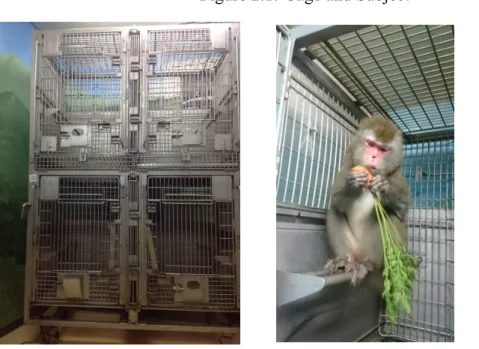
Our experiment includes 7 adult macaques, 3 of them are male (CF, CL, HM) and 4 of them are female (SN, V, B, MC). They live in a pair-house cage which provides a 120 (length) *200 (height) *60 (width) cubic centimeter space for each of two individuals.
A meshed stainless board is inserted in the middle of the cage to keep two individuals apart, they can only see and communicate across the board but can not touch each other.
Average available space for each macaque fills the requirements issued by local animal welfare organizations and laws. They are fed twice per day and they are free to drink water all the time supplied by an automatic system. We apply positive reinforcement methods to train our subjects, and they have never been forced to join the experiments.
2.2 Device
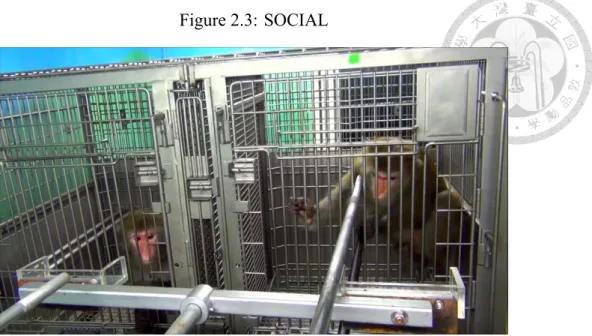
Subjects who join the experiment have two possible roles to play as: the proposer or the recipient. Both of them will be carried from their original cages to the laboratory using a transfer cage, which is identical with the cage they live in. The proposer will always be at the left hand side when facing the experimental device, and when there is a recipient, it will be at the other side instead.
Figure 2.1: Cage and Subject
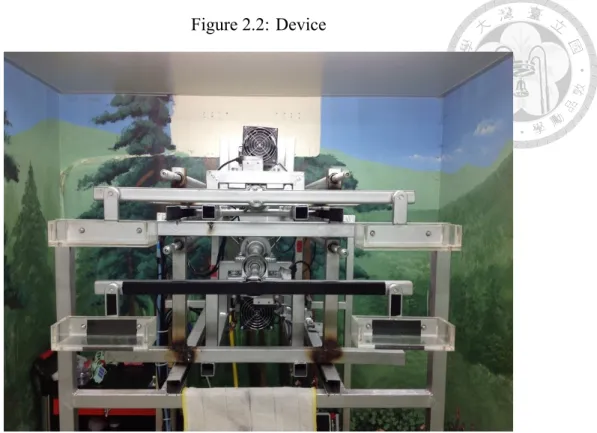
The main experimental device is a costumed mechanical tackle, which is equipped with four food trays, two on the top and the others at the bottom. A pole on the top controls the two trays on the top while the pole at the bottom controls the other two trays. The proposer has to make a decision by pulling one of the pole, for instance, if the proposer chooses the top pole, the two trays on the top will approach the subjects to the distance that they can take the food on the trays. If there is a meshed stainless board in the middle of the cage, the proposer can only take the food from one tray which is closer. Once one of the pole is pulled, the other will be locked automatically so that the proposer can not pull both of the poles in one trial. At the same time, the device is equipped with electronic system, allowing the robotic arm to spin, which causes to the position exchange of the food trays.
The whole experiment process is recorded by two cameras, one takes down the be- haviors of the subjects, the other records the food bundles and the choice the proposer makes.
2.3 Process
Our work includes four pretests, one pairing behavior observing experiment, and three decision making experiments. The order is as follow: pretest1, pretest2, pretest3, pairing behavior observing experiment, first decision making experiment (SOCIAL), pretest4,
Figure 2.2: Device
second decision making experiment (RISK), third decision making experiment (VOI).
*Notation definition: {(a, b), (c, d), (S/NS, R/NR, B/NB)}
(a,b) is the units of food rewards which is closer to the proposer/recipient on the top two trays. (c,d) is then at the bottom trays. S/NS determines whether the food trays will spin randomly or not. R/NR determines whether there is a recipient on the other side of the cage or not. B/NB determines whether there is a meshed stainless board between the middle of the cage or not, if not, the proposer can move unrestrained in the cage and take the food from both side of the trays.
Each unit of food reward is one-eighth of a grape, which will not be fed in the subjects’
daily routine. Grapes are appealing to the subjects because they are sweeter than most of the food they have eaten. Two warm up trials are inserted before every experiments to make sure that subjects have motivations to get rewards. Such amount of rewards will not affect the health situation of the subjects.
2.3.1 Pretests
The main purpose of this treatment is to verify the proposer’s ability of distinguishing the difference between different bundles of rewards. The proposer has to pull the pole which corresponds to the tray which contains more rewards correctly. Each trial will be recorded as fail if the proposer does not pull any of the poles in 30 seconds. It will be recorded as food refuse if the proposer has pulled the pole, but does not eat the rewards in 30 seconds. Otherwise it will be recorded as a typical trial. Each section has 12 trials, the proposer has to answer correctly in at least 8 typical trials to pass the section. To pass the pretest, the proposer has to pass 3 sections continuously or pass at least 3 sections in the total number of 5. (If the proposer makes the choices randomly, the probability of passing the pretest is less than 5% under this threshold.) The proposer participates in at most one section per day to maintain the motivation and concentration.
• Pretest1: {(3,0), (2,0), (NS,NR,NB)} or {(2,0), (3,0), (NW,NR,NB)}
The proposer has to distinguish the amount of rewards on the closer food trays, choose either top or bottom pole which leads to 3 units of rewards to pass the pretest.
• Pretest2: {(0,3), (0,2), (NS,NR,NB)} or {(0,2), (0,3), (NW,NR,NB)}
The proposer has to distinguish the amount of rewards on the farther food trays, choose either top or bottom pole which leads to 3 units of rewards to pass the pretest.
• Pretest3: {(1,1), (1,2), (NS,NR,NB)} or {(1,2), (1,1), (NW,NR,NB)}
or {(2,1), (1,1), (NS,NR,NB)} or {(1,1), (2,1), (NW,NR,NB)}
The proposer has to distinguish the amount of rewards on both sides of the food trays, choose either top or bottom pole which leads to in total 3 units of rewards to pass the pretest.
• Pretest4: {(2,4), (3,1), (S,NR,B)} or {(3,1), (2,4), (S,NR,B)}
The proposer has to recognize that the expected value of the lottery (2,4) is greater than the expected value of the lottery (3,1). Furthermore, the proposer has to refuse the temptation that comparing the closer food trays, 3 rewards are more than 2 while
the most rewards 4 is on the farther tray. Here we use the lotteries containing the expected value 2 and 3 to be consistent with pretests 1, 2 and 3.
2.3.2 Pairing behavior observing experiment
There are two targets in this section. First, through the process step by step, subjects will be more familiar with each other, hence reduce the pressure under social environ- ment, which will help the subsequent experiments go smoothly when the proposer and the recipient are present at the same time. Second, by observing the positive and nega- tive social behaviors performed between subjects, we can verify the hierarchy relationship among the subjects. Each pair (ex: CF/CL, B/SN?? will meet three times. The environ- ment is slightly adjusted each time so that the separations between two subjects decrease gradually, which makes it easier for them to contact with the other and get used to each other. We put a whole black acrylic glass board in the meshed stainless board between two subjects, they can only hear and smell but can not see each other. Second, a meshed black acrylic glass is inserted instead, subjects can see each other through the small holes.
In the end, we put only the meshed stainless board between them, so they can see, smell, and even touch each other with their fingers.
The pairing time of each is 30 minutes, experimenters stand in front of the cage and record subjects’ behaviors in the first 15 minutes, the last 15 minutes is only recorded by the camera. The reason we did so is that the experimenter himself can be a factor effecting the ranking relationships of the monkeys, for instance, the monkey may regard the experimenter as the highest rank individual since he controls all the food resource.
The main content of the records bases on the behavior recording sheet issued by Yerks Regional Primate Research Center (Emory University), which includes behaviors under pressure such as stereotype, floating limb and self-biting. On the other hand, behaviors related to comfort such as grooming, displaying and presenting are also included. Subjects participates in the pairing experiment no more than twice per day.
2.3.3 Decision making experiments
• SOCIAL (and the corresponding CONTROL) : SOCIAL:
{(2,2), (2,3), (NS,R,B)} or {(2,3), (2,2), (NS,R,B)} or {(2,2), (2,1), (NS,R,B)} or {(2,1), (2,2), (NS,R,B)}
CONTROL:
{(2,2), (2,3), (NS,NR,B)} or {(2,3), (2,2), (NS,NR,B)} or {(2,2), (2,1), (NS,NR,B)} or {(2,1), (2,2), (NS,NR,B)}
The main purpose of this section is to verify whether the proposers have prosocial or antisocial preferences or not. The only difference between SOCIAL and CONTROL is that the the recipient does not exist in CONTROL. We conclude the subject is prosocial if it chooses (2,3) between (2,2) and (2,3) more frequently in SOCIAL than in CONTROL, since it is willing to give 3 rewards to others when a recipient is present. Similarly, we conclude the subject is antisocial if it chooses (2,1) more frequently in SOCIAL than in CONTROL. On the contrary, if there is no significant difference between the choices in SOCIAL and in CONTROL, we conclude that the subject does not have prosocial or antisocial tendency. Each section consists of 12 trials, and all pairs finish a section forms a block. We collected in total 3 blocks of data. To avoid the reciprocity problem, we have following 3 principles:
1. There are at least 7-9 other pairs (3days - a week) between the pairs which the identity of the proposer and the recipient is inverse.
2. Once a subject served as a recipient, it can not serve as a proposer within the day.
3. A subject can only serve as a proposer once per day, and it can not participate in more than 2 sections per day.
• RISK:
{(2,2), (1,3), (S,NR,B)} or {(2,2), (3,1), (S,NR,B)} or {(2,2), (2,1), (S,NR,B)} or {(2,1), (2,2), (S,NR,B)}
Figure 2.3: SOCIAL
Figure 2.4: RISK
We measure the subject’s attitude toward risk in this section. The proposer makes a decision between two alternatives with same expected value but different risk with- out a recipient. The food trays spin randomly for 360 or 540 degrees after pulling the pole, thus (1,3) or (3,1) represents the risky lottery which the proposer has a fifty-fifty percent chance to get 1 or 3 rewards. (2,2) represents the riskless bundle which the proposer gets 2 rewards no matter how the trays spin. Each section con- sists of 8 trials, and all subjects finish a section forms a block. We collected in total 4 blocks of data. The proposer participates in at most one section per day.
Table 2.1: Combination of preferences
SOCIAL RISK VOI
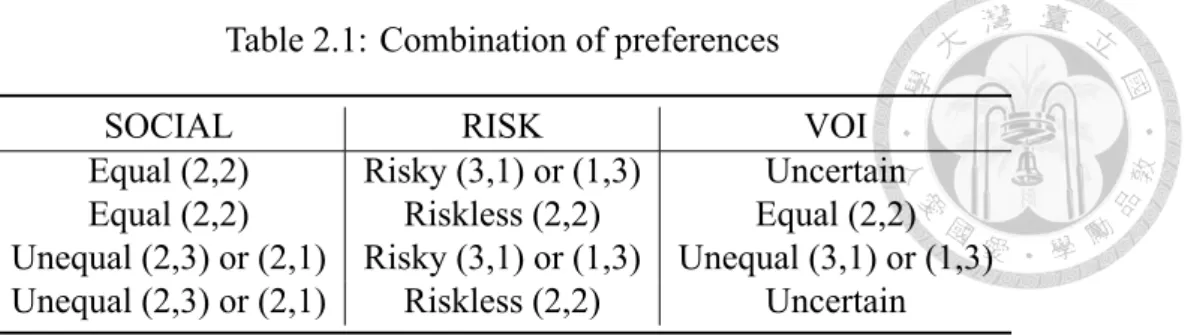
Equal (2,2) Risky (3,1) or (1,3) Uncertain Equal (2,2) Riskless (2,2) Equal (2,2) Unequal (2,3) or (2,1) Risky (3,1) or (1,3) Unequal (3,1) or (1,3) Unequal (2,3) or (2,1) Riskless (2,2) Uncertain
• VOI :
{(2,2), (1,3), (S,R,B)} or {(2,2), (3,1), (S,R,B)} or {(2,2), (2,1), (S,R,B)} or {(2,1), (2,2), (S,R,B)}
The purpose of this section is to observe the subject’s preference behind VOI. The condition is similar to RISK but the recipient is present here, so that the proposer has to consider his social preference and risk preference simultaneously. That is, the proposer has to make an either equal or unequal distribution to itself and the recip- ient under a potentially risky environment. For example, if the proposer prefers the equal outcome in SOCIAL and CONTROL, and it is risk-loving, then in VOI, he has to consider which preference is more powerful. If the proposer prefers the equal (riskless) option in VOI, which is (2,2), we infer that the proposer cares more about inequality aversion than his attitude toward risk. On the contrary, if the proposer prefers the unequal (risky) allocation in VOI, we infer that its risk-loving preference dominates its concern of social resource distribution. The possible combination of preferences is listed in Table 1.
Each section consists of 8 trials, and all pairs finish a section forms a block. We collected in total 4 blocks of data. To avoid the reciprocity problem, we follow the same principles as mentioned in SOCIAL condition.
Chapter 3 Results
3.1 Pretests
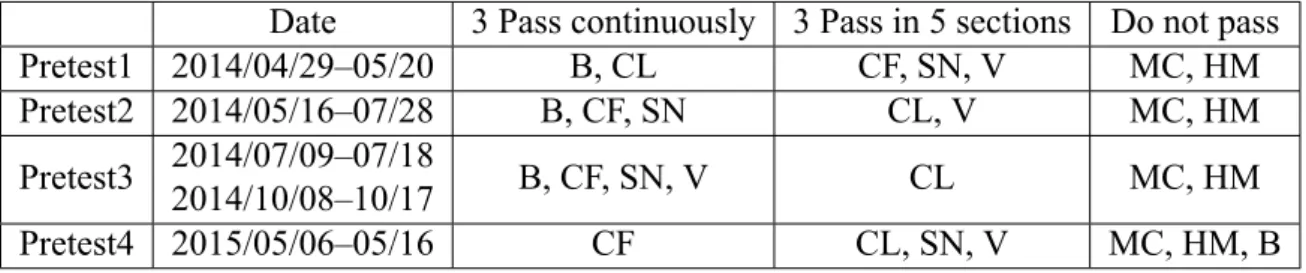
We carried out training before any pretest. In order to prevent from training effect, the reward bundles of pretests never appear in the training process. Subjects have to pass pretests 1-3 to join SOCIAL and CONTROL as a proposer; they have to pass pretest 4 to join RISK and VOI as a proposer. Table 2 shows the status of our subjects. Those who do not pass the pretest can still join the experiment as recipients.
3.2 Pairing behavior observing experiment
We are currently reviewing the videos collected and have not finished yet. Reporting from the experimenters and the administrator of the monkeys, we have a temporary hier- archy relation: CF>HM>CL=B>SN>V>MC.
Table 3.1: Result of pretests
Date 3 Pass continuously 3 Pass in 5 sections Do not pass
Pretest1 2014/04/29–05/20 B, CL CF, SN, V MC, HM
Pretest2 2014/05/16–07/28 B, CF, SN CL, V MC, HM
Pretest3 2014/07/09–07/18
2014/10/08–10/17 B, CF, SN, V CL MC, HM
Pretest4 2015/05/06–05/16 CF CL, SN, V MC, HM, B
3.3 Decision Making Experiments
• SOCIAL and CONTROL
First, we look at the descriptive statistics to overview the results. Since the con- ditions (2,2), (2,3) and (2,2), (2,1) examine the proposer’s social preference in the opposite direction, we analyze them separately. The overall percentages of choos- ing unequal bundle in CONTROL are 55.07% and 48.53% respectively, while they are 54.62% and 52.94% in SOCIAL. The prosocial tendency is absence since the proposer do not choose (2,3) more frequently when the recipient exists. On the other hand, we find that in average, the proportion of choosing (2,1) increases for 4.41%
from SOCIAL to CONTROL. The reason may be that proposers intentionally per- form antisocial behaviors. What’s even more interesting is that when we look into the detail, the hierarchy plays an important role here.
We define “rank low to high” to be the group which the rank of the proposer is lower than the recipient; “rank high to low” to be the group which the rank of the proposer is higher than the recipient. Note that in CONTROL, the recipient is absence, so we do not divide the data into two groups. The result of adopting the division is shown in Table 3. There is a huge difference between the two groups in the (2,2), (2,1) condition. The proportion of choosing (2,1) is 61.15% in the group “rank high to low”, which is much higher than in the other group. That is, when the dominant is making decisions, it prefers to give the subordinate less rewards than itself while the subordinate still chooses (2,2) more frequently when facing the dominant recip- ient. Thus, the increase in the proportion of choosing unequal bundle between from CONTROL to SOCIAL in the (2,2), (2,1) condition is mainly driven by the group
“rank high to low”.
We apply OLS estimation to verify the difference between SOCIAL and CON- TROL. The explained variable is a dummy indicating that the proposer chooses
Table 3.2: Result of SOCIAL and CONTROL
(2,2), (2,3) (2,2), (2,1) (2,2) (2,3) (2,2) (2,1) CONTROL
pool SD/ n
44.93%
(0.5010)
55.07%
69
51.47%
(0.5035)
48.53%
68 SOCIAL
pool SD/ n
45.38%
(0.4986) 54.62%
324 47.06%
(0.4999) 52.94%
323 SOCIAL
rank low to high SD/ n
46.77%
(0.5003) 53.23%
186 53.26%
(0.5003) 46.74%
184 SOCIAL
rank high to low SD/ n
43.48%
(0.4975)
56.52%
138
38.85%
(0.4891)
61.15%
139 Standard deviations are in parentheses, n is the number of obser- vations.
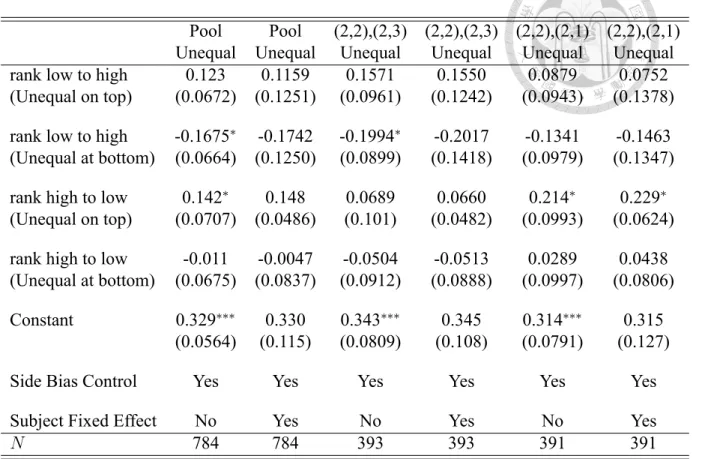
the unequal option, which is (2,3) or (2,1) respectively in each trial. We consider the proportion of choosing unequal option in CONTROL as benchmark and evalu- ate if the proposer shifts its decision when a recipient exists. The first two columns of Table 4 include all data while the third to the sixth column decompose it into the two conditions. In all regressions, we control the subject’s preference of top or bottom pole, which is termed as side bias control in the table. For comparison, we control subjects fixed effect in the second, forth, and sixth regressions. The result shows that the subordinate tends to choose more equal options in the (2,2), (2,3) condition, while the dominant seems to be senseless of falling behind others. On the other hand, the dominant statistically increases the proportion of choosing (2,1) when a subordinate exists to receive 1 unit of reward. That is, the dominant enjoys to exceed or punish the subordinate by choosing the unequal bundle (2,1).
The social preference we found contradict to the result of Horner et al. (2011), which shows that chimpanzees perform prosocial behavior in the trial (1,0), (1,1). Instead, our subjects reveal antisocial tendency when the subordinates serve as the proposers in the (2,2), (2,3) condition and the dominants serve as the proposers in the (2,2),
Table 3.3: Regression of SOCIAL and CONTROL
Pool Pool (2,2),(2,3) (2,2),(2,3) (2,2),(2,1) (2,2),(2,1) Unequal Unequal Unequal Unequal Unequal Unequal rank low to high 0.123 0.1159 0.1571 0.1550 0.0879 0.0752 (Unequal on top) (0.0672) (0.1251) (0.0961) (0.1242) (0.0943) (0.1378) rank low to high -0.1675∗ -0.1742 -0.1994∗ -0.2017 -0.1341 -0.1463 (Unequal at bottom) (0.0664) (0.1250) (0.0899) (0.1418) (0.0979) (0.1347) rank high to low 0.142∗ 0.148 0.0689 0.0660 0.214∗ 0.229∗ (Unequal on top) (0.0707) (0.0486) (0.101) (0.0482) (0.0993) (0.0624) rank high to low -0.011 -0.0047 -0.0504 -0.0513 0.0289 0.0438 (Unequal at bottom) (0.0675) (0.0837) (0.0912) (0.0888) (0.0997) (0.0806) Constant 0.329∗∗∗ 0.330 0.343∗∗∗ 0.345 0.314∗∗∗ 0.315
(0.0564) (0.115) (0.0809) (0.108) (0.0791) (0.127)
Side Bias Control Yes Yes Yes Yes Yes Yes
Subject Fixed Effect No Yes No Yes No Yes
N 784 784 393 393 391 391
Standard errors in parentheses
∗p <0.05,∗∗p <0.01,∗∗∗p <0.001
(2,1) condition.
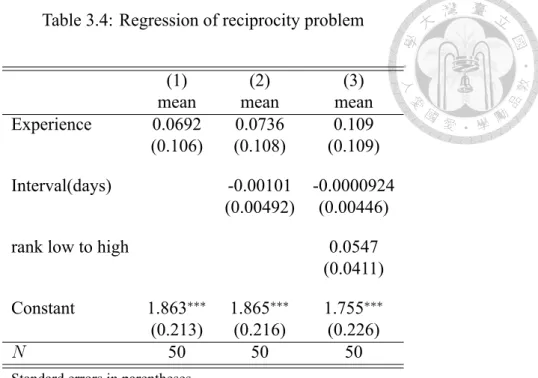
As for the reciprocity problem, we have several constraints (see 2.3.3) when arrang- ing the order of the pairs in each experimental condition to reduce the reciprocal effects. Furthermore, we use regression estimations to confirm that the effect is not statistically significant. The dependent variable is the mean of units of rewards the subject offers the recipient. Experience is the mean of units of rewards the subject obtains when serving as the recipient in the previous section which the position of the proposer and the recipient is inverse. For example, in the pair CL/CF in block1, CL offered y units of rewards in average. Then the independent variable x is the average units of rewards CL obtained in the pair CF/CL in block1. We also put the interval measured by days between the two pairs as a control factor. Since the hier- archy plays a role in SOCIAL condition, we also put it into control using the dummy indicating the ranking relationship. None of the factors statistically increases or de-
Table 3.4: Regression of reciprocity problem
(1) (2) (3)
mean mean mean
Experience 0.0692 0.0736 0.109
(0.106) (0.108) (0.109) Interval(days) -0.00101 -0.0000924
(0.00492) (0.00446)
rank low to high 0.0547
(0.0411) Constant 1.863∗∗∗ 1.865∗∗∗ 1.755∗∗∗
(0.213) (0.216) (0.226)
N 50 50 50
Standard errors in parentheses
∗p <0.05,∗∗p <0.01,∗∗∗p <0.001
creases the average amount of rewards giving to the recipient. We then conclude that the reciprocal behaviors do not appear in our data.
• RISK
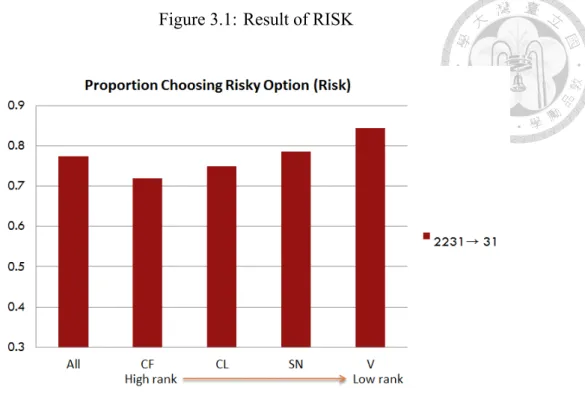
The percentage of choosing the risky lottery ranges from 71.9% to 84.4% across subjects, with the mean of 77.4%. It is significantly different from making a decision randomly (p-value=0.002). We also run the t-test individually and the differences are still significant. We thus conclude that all subjects are risk-loving. Besides, there is a weak tendency that the low rank subject tend to choose the risky lottery more frequently. One possible explanation is that when living in the wild, high rank Formosan Macaque owns the priority of allocating food resource, so there is no need to adopt risky strategies for it comparing with low rank individuals.
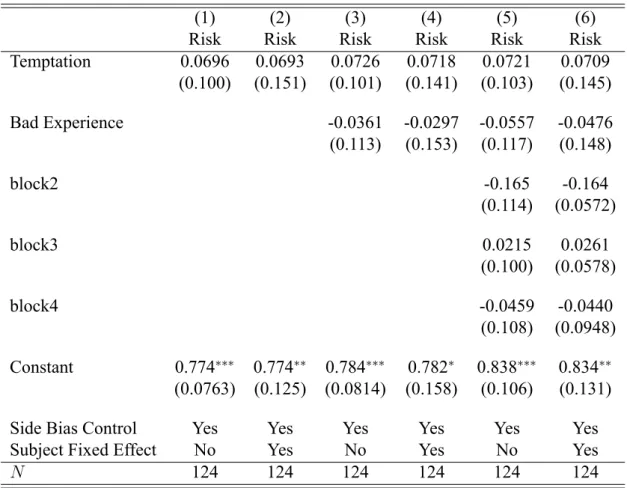
We apply OLS regression to estimate the result of RISK. The dependent variable is a binary variable for whether the proposer chooses the risky bundle (1,3) or (3,1).
We also control the side bias and report the coefficients before and after controlling subjects fixed effect. Temptation is a dummy variable indicating that the food tray containing 3 units of rewards is near the proposer. Bad experience is a dummy in-
Figure 3.1: Result of RISK
dicating that the proposer chose the risky bundle and received 1 unit of reward in the previous trial. Block2-4 are the dummy variables indicating in which block the trials are. The results of the regression show that our subjects do not choose the risky bundle more frequently when the valuable 3 units of rewards is at a closer po- sition. Nevertheless, even though we found that the proposer sometimes performed negative behaviors after having a bad experience, the decisions do not change sig- nificantly. The insignificance of the coefficients Block2-4 indicate that the subjects’
behaviors do not differ between blocks. To sum up, the tendency of risk-loving is robust in our data.
Risk preferences of primates diverge in the past literature. Heilbronner et al. (2008) made a comparison between chimpanzees and bonobos. Their result shows that chimpanzees are risk-loving while bonobos are risk averters. They explain the difference by introducing their food collecting strategies when living in the wild.
Chimpanzees tend to hunt for preys even if there are adequate fruit patches, while bonobos prefer to rely on terrestrial herbaceous vegetation. Diet of Formosan Macaque consists of fruits, tender leaves, buds, grass stems, insects, snails, and bird eggs.
Table 3.5: Regression of RISK
(1) (2) (3) (4) (5) (6)
Risk Risk Risk Risk Risk Risk
Temptation 0.0696 0.0693 0.0726 0.0718 0.0721 0.0709 (0.100) (0.151) (0.101) (0.141) (0.103) (0.145)
Bad Experience -0.0361 -0.0297 -0.0557 -0.0476
(0.113) (0.153) (0.117) (0.148)
block2 -0.165 -0.164
(0.114) (0.0572)
block3 0.0215 0.0261
(0.100) (0.0578)
block4 -0.0459 -0.0440
(0.108) (0.0948) Constant 0.774∗∗∗ 0.774∗∗ 0.784∗∗∗ 0.782∗ 0.838∗∗∗ 0.834∗∗
(0.0763) (0.125) (0.0814) (0.158) (0.106) (0.131)
Side Bias Control Yes Yes Yes Yes Yes Yes
Subject Fixed Effect No Yes No Yes No Yes
N 124 124 124 124 124 124
Standard errors in parentheses
∗p <0.05,∗∗p <0.01,∗∗∗p <0.001
Figure 3.2: Result of VOI
However, individuals from the clusters which live near human habitats tend to steal or rob food from farms or tourists. This might partially explain the risk attitudes we found since most of our subjects came from this kind of clusters.
• VOI
The proportion of choosing unequal option in VOI varies from 56% to 72% between subjects, with the mean of 66.3%. There is still a weak tendency which is similar to the result of RISK, that is, the low rank subject tend to choose the unequal bundle more frequently. However, as the data shows, the average proportion of choosing the bundle (1,3) or (3,1) decreases for 11% when a recipient takes part in the experiment.
Since the existence of the recipient is the only difference between RISK and VOI, we apply the same estimation as used in SOCIAL and CONTROL. As Table 7 shows, subjects fixed effect altered the significance of the regressions. That is, when sub- jects are controlled, the variation within the subject is small. It may be caused by using the hierarchy relationships and subjects as controls at the same time. We then focus on explaining the result by rank but not the subjects fixed effect.
Comparing RISK and VOI, both of the dominant and subordinate tend to reduce
Table 3.6: Regression of RISK and VOI
(1) (2)
Unequal Unequal rank low to high 0.0468 0.0006 (Unequal on top) (0.0567) (0.09) rank low to high -0.2055∗∗ -0.2539 (Unequal at bottom) (0.06832) (0.1156) rank high to low -0.154∗ -0.106 (Unequal on top) (0.0662) (0.146) rank high to low -0.1489∗ -0.0994 (Unequal at bottom) (0.0718) (0.1115) Constant 0.810∗∗∗ 0.815∗∗∗
(0.0497) (0.0453)
Side Bias Control Yes Yes
Subject Fixed Effect No Yes
N 705 705
Standard errors in parentheses
∗p <0.05,∗∗p <0.01,∗∗∗p <0.001
the proportion of choosing unequal bundle when a recipient exists. In other words, they choose the equal bundle (2,2) more frequently in VOI than in RISK. The result is similar to Schildberg-Hörisch (2010), which shows that people tend to allocate more equal distribution when playing a dictator game behind the veil of ignorance.
However, it is worth noting that even though the proportion of choosing equal bundle increased, it is still less than 50%, indicating that monkey subjects still prefer the unequal (risky) bundle (3,1), which is different from most of human beings.
• SOCIAL and CONTROL versus VOI and RISK
Our theoretical decomposition of preferences implies that when subjects tend to consider more about equality from RISK to VOI, it must be driven by their social preference in the direction that they choose the equal bundle more frequently when a recipient exists. However, the dominant seems to become more inequality loving with a subordinate recipient in the (2,2), (2,1) condition. So far, it seems that our data fail to support our theories, but suddenly we found a potential problem and came up with solutions which may help to fix the contradiction.
The main problem is that, in fact, the proposer is facing a decision between whether it prefers to receive the same units of rewards with the recipient or it prefers to exceed or fall behind the recipient for two units of reward with equal probabilities in VOI.
Notwithstanding, the proposer faces the similar decision in SOCIAL but with the difference of one unit of reward. In other words, the proposer have to make a deci- sion between receiving the same reward with the recipient and exceeding one unit of reward in the (2,2), (2,1) condition or falling behind one unit of reward in the (2,2), (2,3) condition. We might naturally assume that the feeling of exceeding/falling behind one unit and two units of rewards to be monotonic and increasing, however, it is not necessary to be true. We then conducted other SOCIAL and CONTROL experiments to find the solutions.
We examined the subjects’ social preference with the bundles (1,1), (1,3) and (3,3), (3,1) this time. We have not yet finished data collecting, but there is still preliminary
Figure 3.3: Result of revised SOCIAL and CONTROL
result which is worth discussing.
The numbers of trials are 222 in the (1,1), (1,3) condition and 60 in the (3,3), (3,1) condition. Only parts of pairs participate in this section, so we are unable to separate the data by hierarchy now. As Figure 8 shows, our subjects seem to view the two conditions differently. When making a choice between (3,3) and (3,1), the proposer performs identically with or without the recipient. On the contrary, the proposer decreases the proportion of choosing unequal option when a recipient exists in the (1,1), (1,3) condition, which is exactly the preference causing the difference between RISK and VOI in our data.
Chapter 4 Conclusion
Preferences of non-human primates diverge in many directions, which may be caused by the difference of species, live styles, hierarchy, and even the frameworks of experimen- tal design. In our experiment, we find that Formosan Macaque possess strong tendency of risk loving, and they alter their decisions to be more equality conscious when they are behind the veil of ignorance. The uncertainty of either exceeding or falling behind the other individual discourage them to choose the unequal as well as risky option. We also find that they respond differently toward the alternatives met in SOCIAL and CONTROL.
To confirm the correctness of our theoretical decomposition of preference behind VOI, we will continue conducting the experiment which contains the bundles (1,1), (1,3) and (3,3), (3,1) in SOCIAL and CONTROL condition.
Besides, our experimental design tried to verify the subjects’ preference by containing various units of rewards, and we made a lot of efforts to confirm their abilities of dis- tinguishing the numbers. However, many other experiments instead adopt the quality of rewards as the difference between choices, for example, using grape as the good and cu- cumber as the bad. In fact, in the training process, we observed that our subjects responded more sensitively to different kinds of reward than the different numbers.The problem is that their tastes vary widely between subjects so it is difficult to find a proper bundle in the experiments including more than one subject.If the problem can be solved, there will be another dimension of evidence supporting our data.
Another implication from our experiment is that the hierarchy seems to be more influ-
ential than we thought before. Note that the hierarchy mentioned here is not the identity as the princess or the beggar, but the ranking priority in the social internet. It is more like the occupation or the socialeconomic status in human society. When conducting similar experiment on human beings as a comparison of our work, which I believe is necessary, this factor is worth considering and should be controlled.
Our work serves as the vanguard of non-human primates behavioral experiments in Taiwan, I hope that the results are able to shed some light on the way better approach the true origins of these preferences, and encourage more scholars and students to devote into the development of relating inquiries.
Bibliography
Atkinson, A. B. (1970): “On the Measurement of Inequality,” Journal of Economic The- ory, 2, 244–263.
Benjamin, D. J., D. Cesarini, C. F. Chabris, E. L. Glaeser, D. I. Laibson, V. Guðnason, T. B. Harris, L. J. Launer, S. Purcell, A. V. Smith, M. Johannesson, P. K. Magnusson, J. P. Beauchamp, N. a. Christakis, C. S. Atwood, B. Hebert, J. Freese, R. M. Hauser, T. S. Hauser, A. Grankvist, C. M. Hultman, and P. Lichtenstein (2012): “The Promises and Pitfalls of Genoeconomics,” Annual Review of Economics, 4, 627–662.
Bräuer, J., J. Call, and M. Tomasello (2009): “Are apes inequity averse? New data on the token-exchange paradigm.” American journal of primatology, 71, 175–81.
Brosnan, S. F. and F. B. M. De Waal (2003): “Monkeys reject unequal pay.” Nature, 425, 297–299.
Burkart, J. M., E. Fehr, C. Efferson, and C. P. van Schaik (2007): “Other-regarding pref- erences in a non-human primate: common marmosets provision food altruistically.”
Proceedings of the National Academy of Sciences of the United States of America, 104, 19762–6.
Frignani, N. and G. Ponti (2012): “Risk versus social preferences under the veil of igno- rance,” Economics Letters, 116, 143–146.
Heilbronner, S. R., A. G. Rosati, J. R. Stevens, B. Hare, and M. D. Hauser (2008): “A fruit in the hand or two in the bush? Divergent risk preferences in chimpanzees and bonobos,” Biology Letters, 4, 246–249.
Horner, V., J. D. Carter, M. Suchak, and F. B. M. de Waal (2011): “Spontaneous prosocial choice by chimpanzees.” Proceedings of the National Academy of Sciences of the United States of America, 108, 13847–13851.
Jensen, K., J. Call, and M. Tomasello (2007): “Chimpanzees are rational maximizers in an ultimatum game.” Science (New York, N.Y.), 318, 107–109.
Jensen, K., B. Hare, J. Call, and M. Tomasello (2006): “What’s in it for me? Self-regard precludes altruism and spite in chimpanzees.” Proceedings. Biological sciences / The Royal Society, 273, 1013–21.
Netzer, N. (2009): “Evolution of Time Preferences and Attitudes toward Risk,” American Economic Review, 99, 937–955.
Rawls, J. (1971): A Theory of Justice, Harvard University Press.
Rayo, L. and G. S. Becker (2007): “Evolutionary efficiency and happiness,” Journal of Political Economy, 115, 302–337.
Schildberg-Hörisch, H. (2010): “Is the veil of ignorance only a concept about risk? An experiment,” Journal of Public Economics, 94, 1062–1066.
Silk, J. B., S. F. Brosnan, J. Vonk, J. Henrich, D. J. Povinelli, A. S. Richardson, S. P.
Lambeth, J. Mascaro, and S. J. Schapiro (2005): “Chimpanzees are indifferent to the welfare of unrelated group members.” Nature, 437, 1357–1359.