Optimal Data Hiding in H.264/AVC Videos for Covert Communication
*Guan-Lin Huang (黃冠霖) and Wen-Hsiang Tsai (蔡文祥)
Dept. of Computer Science, National Chiao Tung University, Hsinchu, Taiwan E-mails: [email protected], [email protected]
ABSTRACT
A method using an optimal data hiding technique for covert communication via H.264/AVC videos is proposed. An H.264/AVC video consists of a series of I and P image frames. We propose proper hiding techniques for macroblocks in I and P frames by utilizing their properties, respectively.
We hide data into the intra-prediction mode of the I macroblock, and into the tree structured motion compensation of the P macroblock. Briefly, we modify the prediction mode and the variable partition size of the tree structured motion compensation to hide data and maintain imperceptibly of the hidden data. In addition, we also use the Lagrange optimization technique to optimize the changes yielded by the data hiding process. Experimental results show the feasibility of the proposed method.
Keywords: Covert communication, data hiding, intra-prediction mode, tree structured motion compensation, H.264/AVC, Lagrange optimization technique.
1. INTRODUCTION
Due to the growth of computer network and audio/video compression technologies, many applications of digital media emerge on the network. The transmission of secret information is one of such applications. Data hiding is a good solution to this kind of covert communication application. It is a technique for use to hide secret messages into certain cover media imperceivably.
Videos are suitable for use as cover media because they are used widely and have large capacities for data embedding. So we try to use a kind of video, namely, H/264/AVC, as the cover media and propose accordingly an optimal data hiding method for covert communication in this study.
A lot of approaches related to hiding data into videos have been proposed [1-3]. Hu et al. [2]
* This work was supported partially by the NSC project Advanced Technologies and Applications for Next Generation Information Networks (II) – Subproject 5:
Network Security, No. 96-2752- E-009-006-PAE and partially by the NSC project No. 96-2422-H-009-001.
proposed a method for hiding data in H.264/AVC videos based on the use of intra-prediction modes which are employed for compressing video data.
Kapotas et al. [3] proposed a method for embedding data in encoded video sequences, in which the technique of modulating the partition size of the blocks in the image frames was employed to hide secret data.
Traditionally, when applying video data hiding techniques for covert communication, the data hiding capacity and the imperceptibility of the hidden data are two major concerns. With the popularity of web applications, people give more and more attention to low bit rate videos.
Therefore, a problem is how to hide data into videos and get optimal results which take data hiding capacity, imperceptibility, and low bit rating into consideration simultaneously.
Two macroblock types are used in the baseline profile of the H.264/AVC standard, namely, I macroblock and P macroblock. We propose optimal data hiding techniques for the two macroblock types, respectively, in this paper.
The method proposed for hiding data into I macroblocks is based on the use of the intra-prediction mode, which is a new coding scheme adopted in the H.264/AVC standard. An encoder selects the best prediction mode for each block by the use of a Lagrangian cost function [4]
which minimizes the rate and the distortion in the H.264/AVC standard simultaneously. The function is formulated as follows:
arg min( ( , ) ( , ))
k k k k k
M
J D S M R S M
τ
λ
= ∈ + (1)
where
(1) τ denotes the set of all the nine prediction modes, i.e., τ = {M1, M2, ..., M9};
(2) λ represents the Lagrange multiplier;
(3) Sk denotes the block being processed;
(4) D is a distortion function whose value is computed as the sum of the squared differences (SSD) between the reconstructed block Sk' and the original one Sk;
(5) R denotes the used bits for encoding the block Sk using the prediction mode Mk.
In our approach, the block Sk is fixed to be 4×4 which yields higher data embedding rates.
Furthermore, we add the hiding capacity as a new parameter to the Lagrangian cost function
described by (1), resulting in:
arg min( ( , ) ( , ) - 1 )
i
i i i
M
J D S M R S M N
τ λ γ
= ∈ + ⋅ (2)
where the new parameter γ1 is a multiplier for the hiding capacity Ni (in unit of bit) in the 4×4 block.
By this function, we can get the best result as a tradeoff among the data hiding capacity, the bit rate, and the resulting distortion.
The idea of hiding data in the P macroblocks proposed in this paper is to modify the variable partition size of the tree structured motion compensation, which is a different feature of the H.264/AVC standard from earlier standards. Tree structured motion compensation is a method of partitioning macroblocks into motion compensated sub-blocks of varying sizes. The encoder selects the best partition size for each macroblock by a Lagrangian cost function described as follows:
arg min( ( , ) ( , ))
k
k k
P
J D S M R S M
ω
λ
= ∈ + (3)
where ω denotes the set of all alternative partition sizes, and Pk denotes the current partition size. Similarly, we add hiding capacity as a new parameter to the Lagrangian cost function, resulting in:
arg min( ( , ) ( , ) -
2)
i
i i i
J
PD S M R S M N
ω
λ γ
=
∈+ ⋅
(4)where the new parameter γ2 is the multiplier for hiding capacity (in unit of bit) in P macroblocks.
By this formula, we can get the best result as a tradeoff among the data hiding capacity, the bit rate, and the resulting distortion.
In the remainder of this paper, the proposed method for hiding secret data into H.264/AVC videos is described in Section 2, and the corresponding data extraction method is stated in Section 3. In Section 4, several experimental results of applying the proposed method will be shown. Finally, some discussions and a summary will be made in the last section.
2. HIDING SECRET DATA INTO H.264/AVC VIDEOS
In this section, the proposed methods of hiding data into different types of macroblocks of H.264/AVC videos will be described.
2.1. Process for Hiding Data Optimally into I Macroblocks Based on Intra-Prediction Mode
We describe how we propose to hide secret data in I macroblocks optimally in a sense mentioned previously, based on the use of the nine prediction modes. Each 4×4 luma prediction mode in the I macroblock can be used to hide zero to four bits of data by this method, without influencing the degree of imperceptibility. In addition, we recode the number of bits so hidden in
the highest-frequency quantized coefficients of the 4×4 block. We also use the user’s secret key to encrypt the secret data to enhance the security. A detailed algorithm of the process is described in the following.
Algorithm 1: optimal data hiding in I macroblocks Input: an I macroblock I in the spatial domain , a
user’s key R, and a secret data file D.
Output: a stego-macroblock I'.
Steps:
1. For each character Di of the secret data D, perform the following steps.
1.1 Compute the remainder R' of dividing R by 256.
1.2 Transform each character Di of the secret data D in the following way to form encrypted data E:
i i
E = D ⊕ R '. (5)
2. For each luma 4×4 block B of I, perform the following operations.
2.1 For each luma 4×4 prediction mode Mi, perform intra-prediction, DCT-based transform, and quantization in the video coding process, and then match four bits of E, E3E2E1E0 with the 4-bit numeral value I0I1I2I3 the index i of Mi to obtain the number of bits Ni which can be hidden in Mi in the following way:
if E3 = I3, set Ni = 1;
if E3 = I3 and E2 = I2, set Ni = 2;
if E3 = I3, E2 = I2 and E1 = I1, set Ni = 3;
if all Ej are equal to ;I;, set Ni = 4;
otherwise, set Ni = 0.
2.2 Replace the highest-frequency quantized coefficients C by a new value according to the following rules:
if 0 then set 0;
if 1 then set 1;
if 2 then set -1;
if 3 then set 2;
if 4, then set -2.
i i i i i
N = , C = N = , C = N = , C = N = , C = N = C =
(6)
3. Select the best prediction mode according to Eq. (2), and decide the number of bits which can be hidden in this block. Take away from E these bits.
4. Repeat the above steps to encode more bits in the remaining portion of E until no more is left.
2.2. Process for Hiding Data Optimally into P Macroblocks Based on Tree Structured Motion Compensation
We hide secret data into P blocks based on variable partition sizes of 16×16 macroblocks.
Each 16×16 P macroblock can be used to hide one or four bits of data by modifying the partition size.
In order to allow better choices of sizes to reduce rate-distortion, we encode hidden data by the partition size with multiple choices for 0 or 1 according to Table 1, in which two groups of sizes are used to encode 0 and 1, respectively. In addition, we use the user’s secret key to encrypt secret data. A detailed algorithm of the process is described in the following.
Algorithm 2: optimal data hiding in P macroblocks Input: a P macroblock P in the spatial domain, a
user’s key R, a secret data file D, and the macroblock partition size K.
Output: a stego-macroblock P'.
Steps:
1. For each character Di of the secret data D, perform the following steps.
1.1 Compute the remainder R' of dividing R by 256.
1.2 Transform each character Di of the secret data D according to Eq. (5) to form encrypted data E.
2. According to Table 3.1, hide one bit e1 or four bits ej of E into the macroblock partition according to the following rules for the macroblock partition size K.
2.1 When the partition size K is 16×16:
1 1
if 0, then perform next partition size;
if 1, then perform Step 3.
e e
=
= (7)
2.2 When the partition size K is 8×16 or 16×8:
1 1
if 0, then perform Step 3;
if 1, then perform the next step.
e e
=
=
(8)
2.3 When the partition size K is 8×8, split P into the four 8×8 sub-macroblocks Pj. For j = 1 to 4,
i. when the partition size is 4×8 or 8×4:
if 0, then perform Step 3;
if 1, then perform the next step
j j
e e
=
= (9)
ii. when the partition size is 8×8 or 4×4:
j j
if 0, then perform the next step;
if 1, then perform Step 3.
e e
=
= (10)
3. According to Eq. (4), compute the best partition size, and decide the number of bits which can be hidden in this block. Take these bits away from E.
4. Repeat the above steps to encode more bits in the remaining portion of E until no more is left.
Table 1 Relations between hidden data and partition sizes.
Partition size Hidden data
16×16 1
8×16 0
16×8 0
8×8 1
4×8 0
8×4 0
4×4 1
3. EXTRACTION OF SECRET DATA FROM H.264/AVC VIDEOS
In this section, the proposed methods for extracting the hidden data from an input H.264/AVC stego-video will be described.
3.1. Process for Extraction of Data from I Macroblocks
The proposed data extraction process retrieves the adopted prediction modes of I macroblocks from the bitstream of the stego-video first. After entropy-decoding the stego-video, the quantized highest-frequency coefficient of each luma 4×4 block of I macroblocks is retrieved.
Then we take these coefficients, the prediction modes and the user’s key as input to the data extraction process for I macroblocks. A detailed algorithm is described in the following.
Algorithm 3: data extraction from I macroblocks Input: a quantized luma 4×4 block I of the I
macroblock in the frequency domain, the prediction mode M, and a user’s key R.
Output: an extracted data file D.
Steps:
1. Obtain the number of bits Ni hidden in the mode M from the highest-frequency coefficient C of I according to the following rules:
if 0 then set 0;
if 1 then set 1;
if -1 then set 2;
if 2 then set 3;
if -2 then set 4.
i i
i i
i
C = , N = C = , N = C = , N = C = , N = C = , N =
(11)
2. Extract the last Ni bit(s) e of M as part of encrypted data E.
3. For every eight bits Ei of E, perform the following steps.
3.1 Compute the remainder R' of dividing R by 256.
3.2 Compute the 8-bit code of each character Di of the secret data D as follows and transform the obtained codes into original characters to get the embedded message:
'
i i
D = E ⊕ R . (12) 3.2. Process for Extraction of Data from P
Macroblocks
The proposed data extraction process retrieves the macroblock partition sizes of the P macroblocks from the stego-video first; if the macroblock partition size is 8×8, we get the sub-macroblock partition size of P macroblocks further, and take the partition size and the user’s key as input to the data extraction process for P macroblocks. A detailed algorithm is described in the following.
Algorithm 4: data extraction from P macroblocks.
Input: a macroblock partition size P (and four sub-macroblock partition size Pj) and a user’s key R.
Output: an extracted data file D.
Steps:
1. Extract a bit e1 or four bits ej as part of the encrypted data E from the P according to the following rules.
1.1 When P is 16×16, 8×16, or 16×8, extract a bit e1 from the macroblock partition size P1 in the following way:
1 1
1 1
if is 16 16, then set 1;
if is 8 16, 16 8 then set 0.
P e
P e
× =
× × = (13)
1.2 When P is 8×8, extract 4 bits ej from four sub-macroblocks partition size Pj in the following way:
for j = 1 to 4:
if is 8 8, 4 4, then set 1;
if is 4 8, 8 4, then set 0.
j j
j j
P e
P e
× × =
× × = (14)
2. For every 8 bits Ei of E, perform the following steps.
2.1 Compute the remainder R' of dividing R by 256.
2.2 Set each character Di of the secret data D according to Equation (3.11).
4. EXPERIMENTAL RESULTS
The proposed optimal data hiding algorithms were integrated into the H.264 reference software JM12.4 [5]. The most important configuration parameters of the JM12.4 are shown in Table 2;
other parameters are kept to retain their default values. Several video sequences, Foreman, Football, Mobile and Tempete, in CIF (352×288 pixels) format were used in our experiments.
Table 2 Configuration parameters.
Profile Baseline
No. of frames to be coded 10
Period of I-pictures 5
RD Optimization High complexity mode
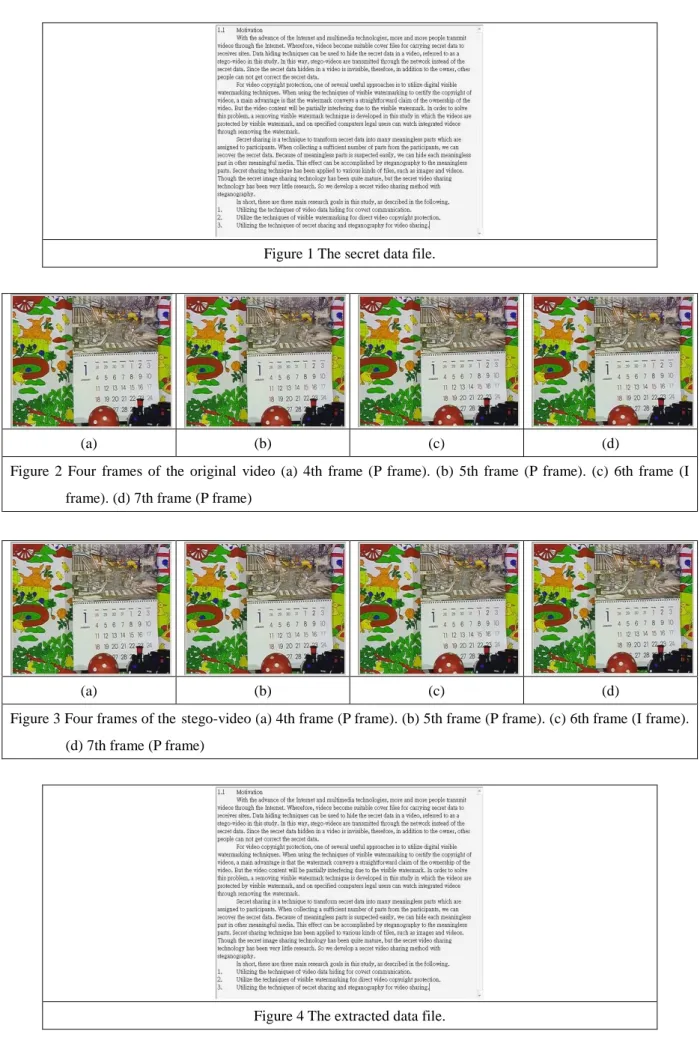
The performance of the optimal data hiding algorithms was evaluated with the number of bits hidden (NBH), the peak-signal-to-noise-ratio increase in the Y color space (PSNRI), the bit rate increase (BRI) and the subjective perception testing by comparing the original video and the stego video frames with hidden secret data. The secret data with the size of 2262 bytes used in the experiments are shown in Figure 1. Four of ten frames of the input video are shown in Figure 2 and four of ten frames of the resulting stego-video are shown in Figure 3. The extracted data are
shown in Figure 4. Finally the NBH, PSNRI and BRI values for several video sequences are shown in Table 3. From the above results and data, it can be observed that the proposed method can embed the secret data into H.264/AVC videos imperceptibly with light bit rate increasing.
Table 3 NBH, PSNRI and BRI values for several video sequences (γi,γp= 250).
Football Foreman Mobile Tempete Average of
PSNRI/NBH in I macroblocks(%)
-0.031761 -0.052796 -0.024492 -0.030125
Average of BRI/NBH in I macroblocks
7.668156 13.382799 4.941370 6.188712
Average of NBH
in I macroblocks 1567 593 3650 2321 Average of
PSNRI/NBH in P macroblocks(%)
-0.189027 -0.162934 -0.235225 -0.250322
Average of BRI/NBH in P macroblocks
27.370086 11.071856 17.341488 13.365207
Average of NBH
in P macroblocks 1043 835 981 868
5. CONCLUSIONS
In this paper, we have proposed an optimal data hiding method that can be used to hide data into I macroblocks and P macroblocks. The optimal data hiding method not only considers hiding capacity of secret data and imperceptibility, but also considers bit rates. Therefore, the method is suitable for covert communication applications, especially when it is necessary to transmit an H.264/AVC video in a low bit rate network.
REFERENCES
[1] M. Yang and N. Bourbakis, “A High Bitrate Information Hiding Algorithm for Digital Video Content under H.264/AVC Compression,”
Proceedings of IEEE International Conference on Image Processing Midwest Symposium on Circuits and Systems, Cincinnati, OH, USA, vol. 2, pp. 935- 938, Aug., 2005.
[2] Y. Hu, et al., “Information hiding based on intra prediction modes for H.264/AVC,” Proceedings of IEEE International Conference on Multimedia and Expo, Beijing, China, pp. 1231-1234, Jul., 2007.
[3] S. K. Kapotas, et al., “Data hiding in H.264 encoded video sequences,” Proceedings of International Workshop on Multimedia Signal Processing, Chania, Crete, Greece, pp. 373-376, Oct., 2007.
[4] T. Wiegand et al., “Rate-constrained coder control and comparison of video coding standards,” IEEE Transactions on Circuits and Systems for Video Technology, vol. 13, no.7, pp. 688- 703, July, 2003.
[5] H.264/AVC JVT reference software JM12.4, http://iphome.hhi.de/suehring/tml/download/
Figure 1 The secret data file.
(a) (b) (c) (d)
Figure 2 Four frames of the original video (a) 4th frame (P frame). (b) 5th frame (P frame). (c) 6th frame (I frame). (d) 7th frame (P frame)
(a) (b) (c) (d)
Figure 3 Four frames of the stego-video (a) 4th frame (P frame). (b) 5th frame (P frame). (c) 6th frame (I frame).
(d) 7th frame (P frame)
Figure 4 The extracted data file.