Planning and delivering Nature-based Solutions in Mediterranean cities
First assessment of the IUCN NbS Global Standard in Mediterranean urban areas
Summary for policy-makers
IUCN Centre for Mediterranean Cooperation
The designation of geographical entities in this report, and the presentation of the material, do not imply the expression of any opinion whatsoever on the part of IUCN concerning the legal status of any country, territory, or area, or of its authorities, or concerning the delimitation of its frontiers or boundaries. The views expressed in this document do not necessarily reflect those of IUCN.
IUCN is pleased to acknowledge the support of its Framework Partners who provide core funding: Ministry of Foreign Affairs of Denmark; Ministry for Foreign Affairs of Finland; Government of France and the French Development Agency (AFD); the Ministry of Environment, Republic of Korea; the Norwegian Agency for Development Cooperation (Norad); the Swedish International Development Cooperation Agency (Sida);
the Swiss Agency for Development and Cooperation (SDC) and the United States Department of State.
This publication has been made possible by funding from Mava Foundation.
Published by: IUCN, Gland, Switzerland.
Produced by: IUCN Centre for Mediterranean Cooperation.
Copyright: © 2021 IUCN, International Union for Conservation of Nature and Natural Resources.
Reproduction of this publication for educational or other non-commercial purposes is authorised without prior written permission from the copyright holder provided the source is fully acknowledged.
Reproduction of this publication for resale or other commercial purposes is prohibited without prior written permission of the copyright holder.
Recommended
citation: IUCN (2021). Planning and delivering Nature-based Solutions in Mediterranean cities. First assessment of the IUCN NbS Global Standard in Mediterranean urban areas. Summary for policy-makers. Málaga, Spain: IUCN. 50 pp.
Cover photo: © Pere Sanz | Dreamstime.com Layout by: Carmen Moreno
Available from: Centre for Mediterranean Cooperation of IUCN Calle Marie Curie 22
29590, Campanillas Málaga, Spain
www.iucn.org/mediterranean www.iucn.org/resources/publications
About IUCN Centre for Mediterranean Cooperation:
IUCN, International Union for Conservation of Nature, is a membership Union composed of both government and civil society organisations. It harnesses the experience, resources and reach of its more than 1,300 Member organisations and the input4of more than 18,000 experts. IUCN is the global authority on the status of the natural world and the measures needed to safeguard it. The IUCN Centre for Mediterranean Cooperation opened in Malaga (Spain) in October 2001 with the core support of the Spanish Ministry of Environment and the regional Government of Junta de Andalucía. The Centre’s mission is to influence, encourage and assist Mediterranean societies to conserve and use sustainably the natural resources of the region and work with IUCN Members and cooperate with all other agencies that share the objectives of IUCN.
This document highlights key findings from the report Planning and delivering Nature- based Solutions in Mediterranean cities. First assessment of the IUCN NbS Global Standard in Mediterranean urban areas, and should be read in conjunction with the full report. References to research and reviews on which this report is based are listed in the full report. The full report can be downloaded at:
https://www.iucn.org/regions/mediterranean/resources/thematic-documents
Planning and delivering Nature-based Solutions in Mediterranean cities
First assessment of the IUCN NbS Global Standard in Mediterranean urban areas
Summary for policy-makers
© ARTBYFRANZI | DREAMSTIME.COM
Table of contents
Acknowledgements
IV
Foreword
V
1. Introduction. Mediterranean urban policy and Nature-based Solutions
1
2. IUCN Standard for Nature-based Solutions
4
3 Assessment of the Standard in Mediterranean cities
7
4. Lessons learned from the assessment
11
5. Spatial features of Mediterranean cities and the need for NbS
13
6. Tackling societal challenges with NbS in the urban context
17
MEDITERRANEAN CASE STUDIES
24
Case study:
Parque del Mar, Alicante (Spain)
25
Case study:
Green infrastructure and biodiversity plan, Barcelona (Spain)
27
Case study:
Gazelle Valley Urban Nature Park, Jerusalem (Israel)
29
Case study:
Coastal trail of Málaga (Spain)
31
Case study:
La Nature au coeur de Nice, Nature at the heart of Nice (France)
33
Case study:
Metropolitan Pavlos Melas Park (Greece)
35
Case study title:
Environmental corridors around Oued Tine Valley area (Tunisia)
37
Case study:
Post-industrial urban regeneration: The living lab at Sesvete, Zagreb (Croatia)
39
Bibliography
41
This report has been prepared in a highly collaborative manner, drawing on the expertise of a variety of people from within and outside of IUCN. We would like to thank everyone who has contributed to this report, especially those who reviewed and provided extensive technical information on the case studies from local governments and other institutions:
– Alberto Ruiz Carmena,
Urban Environment Observatory, Málaga City Council.
– Amanda Lind and Yael Hammerman, The Society for the Protection of Nature, Israel.
– Amira Sansa and Edouard Jean,
Association Les Amis de Capte Tunisie, Tunisia.
– Anne Itziar Velasco and Blanca Marañón,
Environmental Studies Centre, Vitoria-Gasteiz City Council, Spain.
– Iva Bedenko,
Zagreb Council, Croatia.
– Jérôme Sieurin,
Métropole Nice-Côte d’Azur, France.
– Juan Jerez and Juan Antonio Ochando, Port of Alicante, Spain.
– Konstantina Toli,
Global Water Partnership Mediterranean.
– Manuel Sapiano,
Energy & Water Agency, Malta.
– Margarita Pares and Coloma Rull Sabaté,
Directorate of Green Spaces and Biodiversity–Urban Ecology, Barcelona City Council, Spain.
– Maria Mavroudi,
Pavlos Melas Council, Greece.
– Mariló Recio,
Málaga Provincial Council, Spain.
As well as those who have helped with the provision of the illustrations for the report.
This summary was elaborated by the consultancy work of Alex Midlen, and was edited by Lourdes Lázaro and Andrés Alcántara from the IUCN Centre for Mediterranean Cooperation.
Acknowledgements
Natural ecosystems in cities (green spaces and water bodies) provide an essential group of ecosystem services (e.g. water supply, local climate regulation, flood regulation, air purification, recreation) to human populations.
Our knowledge and understanding of these ecosystem services increases year by year, alongside our understanding of the challenges faced by cities and how nature can be used in a positive way to tackle them through the integration of Nature-based Solutions (NbS) in planning and development.
Mediterranean cities and towns share many similar challenges related to climate, geography and culture. Many of these challenges stem from rapid population growth and urban expansion, mainly in coastal areas during the 20th Century.
To add to these pressures, the impacts of climate change, such as changes in temperature and precipitation, are now putting extra stress on urban human well-being. As our understanding of the ecological, public health and economic consequences of this urbanisation grows, the case for ‘greening’ cities –redesigning them with NbS at their heart– becomes ever stronger.
The new global IUCN global NbS Standard, launched on July 2021, responds to the
increasing focus on NbS in development planning and land management. The IUCN Centre for Mediterranean Cooperation (IUCN-Med) along with the IUCN Members in the region and key strategic partners are committing to promote Nature-based Solution (NbS) as approved in Resolution 34 “The implementation of Nature- based Solutions in the Mediterranean Basin” by the IUCN constituency in the framework of the World Conservation Congress 2020.
IUCN-Med is working to build capacity for design and implementation of NbS, with a special focus on Mediterranean cities. In 2020, TECNALIA was commissioned to support the assessment of good practices already identified in the publication “Nature-based Solutions in Mediterranean cities” (2019) against the criteria
Foreword
The result of this exercise allowed the identification of both
the NbS Standard’s potential in Mediterranean cities, and challenges in its use
that must be resolved.
of the IUCN global Standard on NbS in order to make the first practical assessment against real projects and strategies (already implemented or in the design stages) from Mediterranean cities.
The result of this exercise allowed the identification of both the Standard’s potential in Mediterranean cities, and challenges in its use that must be resolved. The overall lessons learned from the assessment point to the need for continuing improvements in practices, especially the systematic evaluation of options, more inclusive public involvement, incorporating adaptive management, and establishing monitoring systems for better reporting on the potential benefits of NbS in urban contexts.
This report contributes to an evidence base on the benefits of NbS to cities in the Mediterranean region. However, we recognise that we are still at the early stages of developing sufficient knowledge to enable the development of city- specific NbS strategies at bigger scales. As an emerging area of policy, cities are therefore currently having to deliver bespoke local research and pilot projects to generate the evidence base they require for local policy development. From IUCN, we believe that a different urbanization –more sustainable and inclusive– is certainly possible, and we hope the IUCN Global Standard on NbS becomes a useful tool to guide urban planners, business and civil society to develop the evidence base of the economic, social and environmental benefits of Nature-based Solutions, and communicate success stories to inspire positive action for nature in urban areas in the Mediterranean and around the world.
The combined effects of long term structural changes (rapid and dispersed urbanisation, demographic change, environmental change) and the Covid-19 pandemic call for significant investment in the coming years to redesign cities - to overcome the negative effects of past deficiencies in planning and development, and to mitigate and adapt to climate change and biodiversity loss. In doing so cities have the opportunity to create new jobs and businesses, adapted to future needs, to reduce social and economic inequalities, and to promote social cohesion and wellbeing. These challenges are captured in the UN Sustainable Development Goals (SDGs), in particular Goal 11 on urban
Introduction. Mediterranean urban policy and Nature-based Solutions
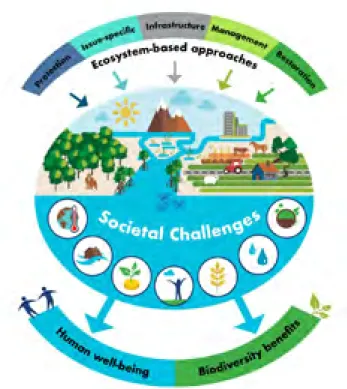
Figure 1: “Nature-based Solutions are actions to protect, sustainably manage and restore natural and modified ecosystems in ways that address societal challenges effectively and adaptively, to provide both human well-being and biodiversity benefits” (IUCN, 2016)
settlements, adopted by all the world’s
governments in 2015. This will require planners, developers and other landowners, and citizens to develop a new perspective on urban planning and development –a greener mindset– that recognises the positive contribution that nature can make to high quality, liveable cities.
Internationally, the concept of Nature-based Solutions (NbS) is taking hold, providing a genuine opportunity for cities to adapt to climate change and to improve sustainability.
The IUCN defines NbS as “actions to protect, sustainably manage and restore natural or modified ecosystems that address societal
1
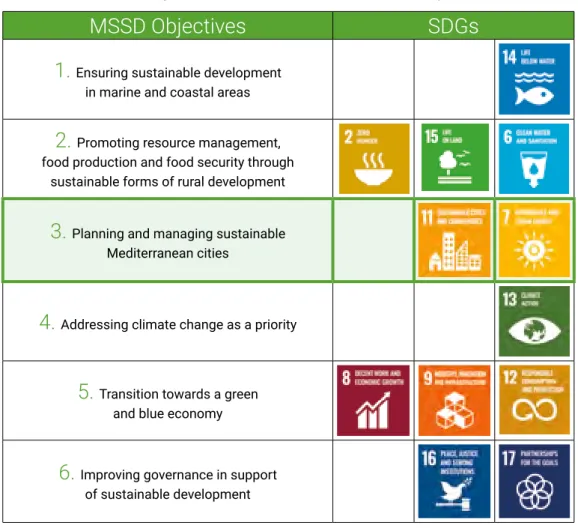
Table 1: The Mediterranean Strategy for Sustainable Development -MSSD- (2016-2025) is structured around six Objectives that feed into the Sustainable Development Goals -SDGs- challenges effectively and adaptively,
simultaneously providing human well-being and biodiversity benefits”. (NbS - see fig 1).
In recent years, this concept is emerging as a central tool in urban planning and development.
For example, the EU’s Horizon 2020 programme has developed a specific research and innovation agenda, funding many projects regarding the effective use of NbS to meet societal challenges in cities.
In parallel, the Mediterranean Strategy for Sustainable Development notes the multiple challenges facing cities in the region (Objective 3, Table 1): excessive land uptake;
rapid degradation of architectural heritage;
aquifer pollution; inefficient waste management;
atmospheric air pollution and noise; and the cumulative effect of all these factors on the environment and on human health.
For those reasons, a new, sustainable and creative approach to planning and managing Mediterranean urban regions is urgently needed.
NbS can play a crucial role in addressing these challenges, providing a multitude of positive environmental and socio-cultural functions:
mitigating environmental pressures, improving aesthetics, reducing the urban heat island effect, mitigating flooding, and providing direct or indirect urban ecosystem services.
In response to this emerging body of policy and practice, IUCN has developed the first-ever Global Standard for Nature-based Solutions (IUCN, 2020) to help users design, implement and verify NbS
MSSD Objectives SDGs
1.
Ensuring sustainable development in marine and coastal areas2.
Promoting resource management, food production and food security throughsustainable forms of rural development
3.
Planning and managing sustainable Mediterranean cities4.
Addressing climate change as a priority5.
Transition towards a green and blue economy6.
Improving governance in support of sustainable developmentactions. This Standard, introduced in July 2020, provides clear parameters for defining NbS and a common framework to help benchmark progress.
This complements the IUCN’s global initiative named IUCN Urban Alliance, which aims to create greener, more liveable cities that will improve the health, well-being and prosperity of people living in urban areas, launched in 2018. This initiative will include development of a City Nature Index, providing a standardised way for cities to measure
the quality of their underlying stock of natural resources, known as ‘natural capital’.
Societal challenges are reflected succinctly in the targets for SDG 11, for urban areas. This complements the more detailed descriptions of the societal challenges for which NbS are an effective response and upon which the IUCN Global NbS Standard focuses.
Make cities and human settlements inclusive, safe resilent and sustainable
Targets for UN Sustainable Development Goal 11 By 2030
Ensure access for all to adequate,
safe and affordable housing
and basic services and upgrade slums.Support least developed countries, including through financial and technical assistance, in building
sustainable and resilient
buildings utilizing local materials.
Provide access to safe, affordable, accessible and sustainable transport systems for all, improving road safety, notably by expanding public transport, with special attention to the needs of those in
vulnerable situations,
women, children, persons with disabilities and older persons.
Enhance inclusive and sustainable urbanization and capacity for
participatory, integrated and sustainable
human settlement planning
and management in all countries.Strengthen efforts to protect and safeguard the
world’s cultural
andnatural heritage
Reduce the adverse per capita
environmental impact of cities, including by paying special attention to air quality and municipal and other waste management.Support positive economic, social and environmental links between
urban, peri-urban and rural areas
by strengthening national and regional development planning.Substantially increase the number of cities and human settlements adopting and implementing integrated policies and plans towards inclusion,
resource efficiency, mitigation and adaptation to climate change, resilience to disasters,
and develop and implement, in line with the Sendai Framework for Disaster Risk Reduction 2015-2030, holistic disaster risk management at all levels.Provide
universal access to safe,
inclusive and accessible, green and public spaces, in particular for women and children, older persons and persons with disabilities.Significantly reduce the number of deaths and the number of people affected and substantially decrease the direct economic losses relative to global gross domestic product caused by disasters,
including
water-related disasters,
with a focus on protecting the poor and people in vulnerable situations.IUCN Standard for Nature-based Solutions
The IUCN Global Standard aims to equip users with a robust framework for designing and verifying NbS that yield the outcomes desired, in solving one or several societal challenges.
Based on the feedback of actual and potential NbS users, it has been developed to be flexible and adaptable, purposefully avoiding a rigid
normative framing with fixed, definitive thresholds of what NbS ought to achieve. Rather the
Standard is designed to support users to apply, learn and continuously strengthen and improve the effectiveness, sustainability and adaptability of their NbS interventions.
2
© IUCN
Figure 2: Illustrating the interconnections between the 8 criteria of the NbS Standard (IUCN, 2020)
© RADIOKAFKA | DREAMSTIME.COM
The Standard consists of 8 criteria and 28 indicators
Summarised in Figure 2 and Table 2, (IUCN, 2020)
CRITERION FOCUS
1.
NbS effectively address societal challengesThe purpose of this Criterion is to ensure that the NbS is designed as a response to a societal challenge(s) that has been identified as a priority by those who are or will be directly affected by the challenge(s). All stakeholders, especially rights holders and beneficiaries of the NbS, must be involved in the decision-making process used for identifying the priority challenge(s) (Criterion 5).
2.
Design of NbS is informed by scaleThe purpose of this Criterion is to encourage NbS designs that recognise the complexity and uncertainty that occur in living dynamic land and seascapes.
Scale applies not only to the biophysical or geographic perspective but also to the influence of economic systems, policy frameworks and the importance of cultural perspectives.
3.
NbS result in a net gain to biodiversity and ecosystem integrityNbS are derived as goods and services from ecosystems, and therefore strongly depend on the health of an ecosystem. Biodiversity loss and ecosystem change can have significant impacts on the functioning and integrity of the system. Therefore, NbS design and implementation must avoid undermining the integrity of the system and instead, proactively seek to enhance the functionality and connectivity of the ecosystem. Doing so can also ensure the long-term resilience and durability of the NbS.
4.
NbS areeconomically viable
The return on investment, the efficiency and effectiveness of the intervention, and equity in the distribution of benefits and costs are key determinants of success for an NbS. This Criterion requires that sufficient consideration is given to the economic viability of he intervention, both at the design stage and through monitoring the implementation.
5.
NbS are based on inclusive, transparent and empowering governance processesThis criterion requires that NbS acknowledge, involve and respond to the concerns of a variety of stakeholders, especially rights holders. Good governance arrangements are proven to not only reduce an intervention’s sustainability risks, but also to enhance its social ‘license to operate’.
Conversely inadequate governance provision for otherwise well-intended actions can adversely affect the legitimacy of benefit and cost sharing arrangements.
6.
NbS equitably balance trade-offs between achievement of their primary goal(s) and the continued provision of multiple benefitsTrade-offs in land and natural resource management is inevitable.
Ecosystems provide a wealth of different benefits and not everyone values each of them in the same way. While tradeoffs cannot be avoided, they can be effectively and equitably managed. This Criterion requires that NbS proponents acknowledge these tradeoffs and follow a fair, transparent and inclusive process to balance and manage them over both time and geographic space. This involves a credible assessment, full disclosure and agreement among the most affected stakeholders on how the trade-offs should be addressed.
7.
NbS are managed adaptively, based on evidenceThis Criterion requires that NbS implementation plans include provisions to enable adaptive management as a response to uncertainty and as an option to effectively harness ecosystem resilience. A degree of uncertainty is inherent when managing most ecosystems due to theircomplex, dynamic and self-organising nature. This also means that ecosystems have greater resilience which confers a wider range of options to respond to unanticipated social, economic or climate events.
8.
NbS are sustainable and mainstreamed within an appropriate jurisdictional contextThis Criterion requires that NbS interventions are designed and managed with a view to long-term sustainability and that they take account of, work with and align with sectoral, national and other policy frameworks.
Table 2: The assessment criteria of the IUCN Standard for NbS (content source: IUCN, 2020)
8 Criteria that make up the IUCN Global Standard
for NbS are all interconnected
This report summarises the results of a first assessment of a selection of practices in Mediterranean Cities against the IUCN Global Standard.
The IUCN Centre for Mediterranean Cooperation commissioned in 2020 TECNALIA to undertake an assessment of how the Standard could be put into practice by analysing 18 cases of Nature- based Solutions in Mediterranean cities.
The purpose of the analysis was to assess to what extent these interventions met the standard, and in this way to identify particular opportunities and challenges for applying the standard in urban areas throughout the Mediterranean region.
It is the first practical assessment of the Standard against real projects and strategies already implemented or in the design stages. It aimed to identify both the Standard’s potential in Mediterranean cities, and challenges in its use that must be resolved.
Assessment of the Standard in Mediterranean cities
The practices were selected considering their even distribution across the Mediterranean geography, their representativeness within the Mediterranean climate region and its idiosyncrasies, climate risks, urban development, planning culture and systems, governance, etc, and at different scales from regional, city and district levels.
The analysis sought to:
Identify good practice examples
in different in Mediterranean cities in terms of the NbS benefits and their contribution to the societal challenges using the criteria and set of indicators suggested by the Standard.
Identify gaps
in practices and explore opportunities for improving and enhancing NbS interventions and the implementation process.Identify lessons learned
for practical application and usability of the standard, and extract messages and elements that can be shared with other practices.
Give value to the adaptive capacity of the Standard
itself and how it could be reviewed and customized.It is worth mentioning that the practices analysed have been assessed as potential
Nature-based Solutions despite the fact that they may not have been designed as such
in the first place.
© ASFERICO | DREAMSTIME.COM
3
BARCELONA
Green Infrastructure
& Biodiversity Plan
VITORIA-GASTEIZ
Urban Green Infrastructure
TIRANA
Boulevard and river
JERUSALEM
Gazelle Valley Park
GRENOBLE
Land use and ecosystem services
PAVLO MELAS
Metropolitan Park
MALTA
Non-conventional water
management
TUNISIA
Environmental corridors IN THE SELECTED CASE, TWO DIFFERENT SPEEDS WERE DETECTED IN THE WAY CITIES ANALYSED WERE IMPLEMENTING NbS IN THE MEDITERRANEAN REGION:
18 practices were selected in the first screening report
MALAGA
Perchel Lagunillas
MALAGA
Coastal Trail
ALICANTE
Park of the Sea
NAPLES
Coastal regeneration in Bagnoli
LJUBLJANA
River and parks connectivity
NIZE
Greening the city
ZAGREB
Sesvete
Living Lab AMMAN
Urban agriculture
THESSALONIKI
Blue spaces and resilience
MARSEILLE
Stormwater retention basins
Type 1:
URBAN REGENERATION IN A GLOBAL CHANGE CONTEXT
Type 2:
CLIMATE CHANGE AND WATER RESILIENCE
Type 3:
COASTAL RESILIENCE UNDER RISING SEAS
Type 4:
MATURE PROJECTS
1- Good practice cases:
Urban regeneration in a global change context Climate change and water resilience
Coastal resilience under rising seas
2- Advanced and mature practices
The key findings of this assessment are:
The results revealed that NbS are currently being used explicitly to meet a wide range of societal challenges, particularly regarding human health and wellbeing. However, there are challenges in applying some of the criteria in the Standard.
What underlies these challenges is the need for the use of tools and processes to measure and value NbS and the benefits they deliver to allow comparison with other approaches so that effective prioritisation can be made.
In particular, prioritisation must take a long-term perspective, especially considering maintenance and renewal (i.e. a ‘whole-life-cost’ approach) and considers the ‘externalities’ inherent in each option so that efficient trade-offs can be made.
NbS MEET a wide range of SOCIETAL CHALLENGES, particularly human health and wellbeing.
NEED FOR THE USE OF TOOLS AND PROCESSES TO MEASURE AND VALUE NbS in comparison with other approaches.
NEED TO IDENTIFY AND DOCUMENT the benefits and costs of NbS.
PRIORITISATION MUST TAKE A LONG-TERM PERSPECTIVE, especially considering maintenance and renewal.
MONITOR is fundamental to improvement in design and management.
In the case of adaptive management, in addition to the use of these decision-making tools must be added the question of how to deal with the uncertainty of environmental change. Basing decision-making on a robust ‘theory of change’ is a helpful tool promoted by the Standard for navigating change over time.
As with any auditing system, having rigorous procedures for measuring and monitoring is essential. This requirement is often seen as an extra burden. However, that is to overlook its strategic value. The ability to measure and monitor is fundamental to improvement in design and
management and ultimately to securing a higher value of benefits for society.
For all these reasons the Standard stresses the importance of identifying and documenting the benefits and costs of NbS (and of other options, especially ‘no change’)
and who receives and who pays them.
For the evaluation a total of 28 indicators were used, grouped in 8 categories and criteria based on the IUCN Standard. The answers obtained varied strongly according to the city and the indicator.
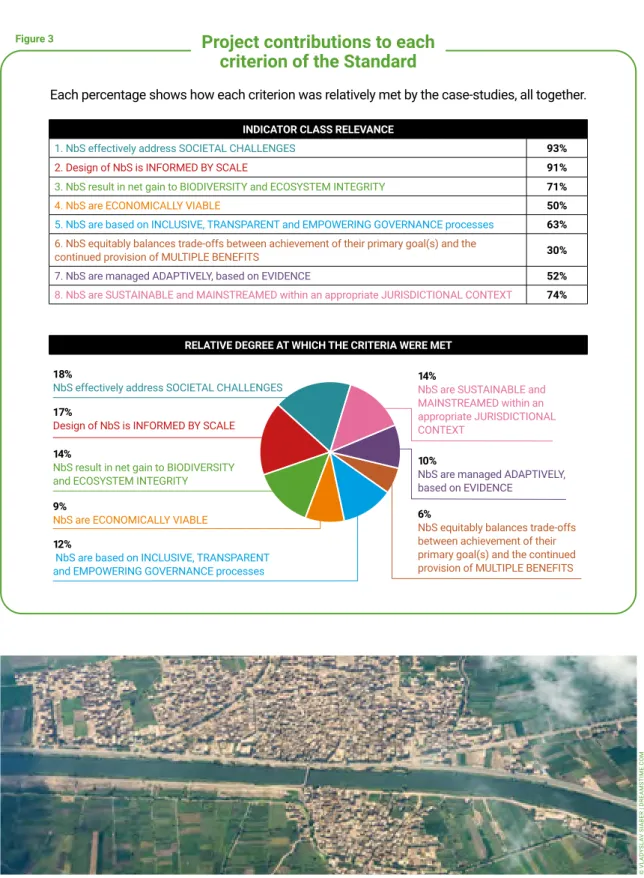
The graphic is a summary of the availability of information for each challenge.
For criterion 1 and 2, sufficient information is available. On the other side, less information was found for challenges 4 and 7, while serious problems were encountered when trying to obtain evidence for challenge 6 (Figure 3).
© VLADYSLAV SIABER | DREAMSTIME.COM
Figure 3
Project contributions to each
criterion of the Standard
Each percentage shows how each criterion was relatively met by the case-studies, all together.
14% NbS are SUSTAINABLE and MAINSTREAMED within an appropriate JURISDICTIONAL CONTEXT
10%
NbS are managed ADAPTIVELY, based on EVIDENCE
6% NbS equitably balances trade-offs between achievement of their primary goal(s) and the continued provision of MULTIPLE BENEFITS 12% NbS are based on INCLUSIVE, TRANSPARENT
and EMPOWERING GOVERNANCE processes 9%
NbS are ECONOMICALLY VIABLE
18% NbS effectively address SOCIETAL CHALLENGES 17% Design of NbS is INFORMED BY SCALE
14% NbS result in net gain to BIODIVERSITY and ECOSYSTEM INTEGRITY
INDICATOR CLASS RELEVANCE
1. NbS effectively address SOCIETAL CHALLENGES 93%
2. Design of NbS is INFORMED BY SCALE 91%
3. NbS result in net gain to BIODIVERSITY and ECOSYSTEM INTEGRITY 71%
4. NbS are ECONOMICALLY VIABLE 50%
5. NbS are based on INCLUSIVE, TRANSPARENT and EMPOWERING GOVERNANCE processes 63%
6. NbS equitably balances trade-offs between achievement of their primary goal(s) and the
continued provision of MULTIPLE BENEFITS 30%
7. NbS are managed ADAPTIVELY, based on EVIDENCE 52%
8. NbS are SUSTAINABLE and MAINSTREAMED within an appropriate JURISDICTIONAL CONTEXT 74%
RELATIVE DEGREE AT WHICH THE CRITERIA WERE MET
Better and more systematic evaluation of options (to allow assessment of TRADE-OFFS AND ECONOMIC FEASIBILITY) including quantitative and qualitative assessments of value (e.g. cost/
benefit analysis, environmental impact assessment, public opinion survey etc).
More inclusive PUBLIC INVOLVEMENT, and the incorporation into every-day practice of multilevel planning through stakeholder partnerships (both internal and external) at different scales.
Incorporating ADAPTIVE MANAGEMENT APPROACHES into strategic and project planning.
Establishing systems for gathering and STORING BASELINE AND MONITORING DATA, and periodic evaluation and reporting regarding interventions at all scales.
What is the UNIT OF ASSESSMENT, e.g. a park, a neighbourhood, a transport network? This must be clearly defined to allow assessment against available data. Having a clear definition will help to identify what indicators will be important for the assessment and to ensure the necessary data is gathered, or that an assessment can be made with the data that is already available.
Regarding ECONOMIC FEASIBILITY ASSESSMENT there is a general lack of:
Monetized evaluation of the benefits of NbS, including both the core benefits (e.g. flood prevention) and additional benefits such as increasing resilience against climate change, improving environmental conditions, contribution to health and well-being etc.
Studies on the economic evaluation of the effectiveness against climate change. In this context, the comparison of the NbS with a traditional solution is considered essential.
Lessons learned from the assessment
OTHER IMPORTANT CONSIDERATIONS REGARDING THE ASSESSMENT AGAINST THE STANDARD ARE:
THE OVERALL LESSONS LEARNED FROM THE ASSESSMENT POINT TO THE NEED FOR CONTINUING IMPROVEMENTS IN THE PRACTICES EMPLOYED IN URBAN PLANNING AND IMPLEMENTATION, IN PARTICULAR:
4
The great opportunities presented by the IUCN Global Standard for Mediterranean cities, in the words of participants in the assessment, are to provide:
© ASSOCIATION LES AMIS DE CAPTE TUNISIE-BIZERTE
“The assessment with the NbS criteria will allow us to implement the new Standard when designing, writing, implementing and monitoring our future projects. We will enrich our database of
monitoring and evaluation measures of ecosystem services generated by our agroforestry projects with this methodology.
We hope to get to know and have more opportunities to collaborate with other projects and members of the civil society involved in the assessment of Standard and also to strengthen our
chances of accessing more funding.”
Association Les Amis de Capte Tunisie-Bizerte (Tunisia)
“It could be very useful, especially if used in the planning phase, which is over for us at the moment. I personally
would like to revisit it from time to time, as it can provide new insight in every phase, but its main strength would be in the initial phases“.
City of Zagreb
“It proposes a very valuable approach for the valuation of biodiversity in urban contexts“. “It can contribute to improving the way of reporting to
citizens and different agents with focus on the relevant involvement of the private sector in the NbS implementation“.
Barcelona City Council
“While the balance between economic variables and biodiversity and sustainability is difficult
to achieve it is also seen as an opportunity to verify the need to consider all dimensions beyond the economic viability towards successful implementation“.
Vitoria-Gasteiz City Council
“It offers the opportunity for strategic view and thinking, although lack of time and resources are always a constraint for those responsible for the practices“.
Barcelona City Council
“It provides a consistent way in which practices can be analysed and reported easing the identification of opportunities and niches for improvement“.
Málaga provincial authority
© XABIER TOVAR | DREAM STIME.COM
© VMEDIA84 | DREAM STIME.COM
© GVICTORIA | DREAMSTIME.CO M © TOMAS1111 | DREAMSTIME.COM
Cities in the Mediterranean region are spatially diverse, ranging in size from small and medium sized towns and cities to megacities. Historically they followed a compact form, largely in response to the Mediterranean climate, with high population density and narrow streets interspersed with open squares. The form of cities is also influenced by landscape, with cities confined to a narrow coastal strip by mountains being a common feature. There are a large number of port cities, having an industrial core.
Many of these areas are now being redeveloped for housing, as new port infrastructure is developed on the urban fringes.
From the 20th century many cities have expanded rapidly in a more dispersed model, comprising lower density development expanding outward along arterial transport corridors. This development is often poorly planned, with little consideration of open space and ‘active’
transport needs (walking and cycling). Coastal resort development represents a different type of urbanisation, often linear with a high density of tourist accommodation on the shoreline but also with large areas of open space adjacent to the sea (e.g. Boulevards, recreational parks etc).
Spatial features of Mediterranean cities and the need for NbS
These modern developments are not adapted to climate in the same way as the historic urban forms, and so require large amounts of energy for cooling, and large proportions of land devoted to transport infrastructure. Their transformation of the landscape has important consequences for water management, especially in the context of climate change. Water shortages and salinisation of coastal aquifers are already issues of concern. Similarly, biodiversity is depleted. Traditional food production systems such as olive and orange groves and small farms, often relatively high in biodiversity, are lost. Overall, ecosystem services once provided by natural and farmed landscapes are not replaced in urban forms of land use. Nature-based Solutions should aim to address these losses.
Cities must respond also to profound economic and social change, in particular in variable population growth rates, migration to urban centres, the need to create jobs for an expanding youth population, provision of affordable and good quality housing, changing lifestyles of a growing middle class, and economic opportunities and threats posed by globalisation. Many of these issues demand spatial responses –redevelopment and regeneration, or new development– providing opportunities to redesign cities to meet these new challenges.
Cities must respond also to profound economic and social change, in particular in variable population
growth rates, migration to urban centres and the need
to create jobs for an expanding youth
population.
© VACCLAV | DREAMSTIME.COM5
Contributing to the Mediterranean policy framework
These are well known challenges for
Mediterranean cities. In 2011 the Union for the Mediterranean called for an Urban Development Strategy for Mediterranean cities – the
resulting guidance framework sets out the main challenges and suggested responses for urban areas of 15-20,000 inhabitants or more.
The Mediterranean Strategy for Sustainable Development (2016-2025) in the framework of the Barcelona Convention recognised the particular challenges represented by cities in the region, especially regarding energy use, waste management, food security, and overall resilience to human-made risks and hazards. The Integrated Coastal Zone Management (ICZM) and Land Based Sources of pollution (LBS) Protocols of the Barcelona Convention call for the protection of natural coastal zones, recognising the continuing impacts of urban areas on the natural environment of the Mediterranean.
Local governments have a strong leadership role to play. Strategic spatial planning and urban development planning are powerful tools for guiding the renewal of Mediterranean urban areas to meet the challenges described. These processes, related stakeholder engagement and public participation, and the programming, monitoring and enforcement of implementation all fall to local governments for leadership.
Networks, such as MedCities, have been established to promote good practices and knowledge sharing amongst urban professionals in local governments around the Mediterranean.
The IUCN global NbS Standard provides a tool to support Mediterranean cities to meet the common challenges identified by the Union for the Mediterranean in its guidance framework for sustainable cities, and the urban objectives set out in the Mediterranean Strategy for Sustainable Development. These challenges are complex and interrelated, arising from profound demographic, environmental and economic change, and must be tackled in an integrated way. This is an approach to which NbS are well suited, delivering multiple benefits, and which the NbS Standard facilitates.
Given the status of NbS as a new approach, its potential must be established through well designed and implemented applications.
The Standard provides a robust framework to do this, based on internationally agreed Principles.
This works at both design and verification stages:
Design: using the standard to help assess the various options available to tackle the particular problem that needs to be solved
Verification: confirming that a design adheres to NbS principles, which may be important for funders, political leaders, or the public.
Design and verification both take place at different scales, compare a city-wide green infrastructure strategy with the design of a public park for example, but nevertheless common standards can be applied to ensure quality and consistency in the planning and implementation of NbS.
The IUCN global NbS Standard provides a tool to support Mediterranean urban
areas to meet the common challenges identified by the Union for the Mediterranean
in its guidance framework
for sustainable cities.
How might the Standard BE USED IN PRACTICE TO ACHIEVE these goals?
The assessment for use of the NbS Standard in Mediterranean cities demonstrates its value as:
A STRATEGIC PLANNING TOOL
The Standard can be used as a ‘quick scan’
diagnostic tool in the early stages of strategic planning, whether for a city-wide spatial strategy or a single neighbourhood or regeneration site, to ensure the multiple benefits of NbS are considered and integrated into policies.
Later in the process the Standard can be used to evaluate the policy, prior to final review, and during implementation.
A PROJECT DESIGN GUIDE
Again, the NbS Standard can be used at different stages in the design of specific interventions, such as the design of a new housing or industrial complex, or the renewal of a transport corridor. A quick scan early in the project ensures NbS are fully considered and integrated into the design. Later evaluations can ensure the final design meets its aims, and that implementation is delivering the desired outcomes.
A VERIFICATION TOOL
At both design stage and following implementation, the NbS Standard provides an evaluation and assessment framework to measure outcomes across the seven societal challenges. In this way the Standard can be embedded as a learning process within urban planning and green infrastructure management.
© JOYFULL | DREAMSTIME.COM
Contributing to the creation of more liveable urban environments, improving public satisfaction with the environment.
Facilitating the embedding of NbS in strategic and operational plans.
Providing a process for co-creation of green infrastructure with stakeholders to better meet their social and economic needs through urban renewal and NbS.
Efficient use of resources through the optimisation of multiple benefits from NbS investments.
Providing more sustainable solutions than hard infrastructures to adapt to and mitigate climate change.
Providing more cost effective surface water management.
Reducing air and noise pollution and improving public health.
Improving resilience to environmental hazards, such as heat stress, flooding and sea level rise.
Diversifying urban economies (e.g.
urban agriculture; green infrastructure construction and maintenance
services) and creating a more attractive environment to revitalise urban centres and promote inward investment.
What BENEFITS does use of the Standard promise FOR LOCAL GOVERNMENTS?
As a systematic design and evaluation tool the NbS Standard provides many benefits, including:
Relevance of NbS Standard for urban authorities
As NbS enter into policy and are adopted by projects on the ground there is a pressing need for greater clarity and precision of what the concept entails and what is required for it to be deployed successfully. Without this, the application of NbS could result in inconsistent and ungrounded applications. The Standard provides a systematic learning framework so that lessons can improve the application of NbS, leading to greater confidence in NbS among decision makers and supporting further innovation. Similarly, in the absence of such a
Standard, NbS may remain a general concept, only marginally contributing to the pressing sustainability needs and not realising its full potential. Consequently, the Standard provides an opportunity to create a global user community that helps guide implementation on the ground, accelerates policy development, and creates a scientific evidence base on NbS. Through the Standard, NbS will be based on a common understanding of its interpretation and a shared vision for a just and sustainable world.
The IUCN Centre for Mediterranean Cooperation is committing to promote the NbS Standard in the Mediterranean, including capacity building in NbS with special focus on Mediterranean cities.
Increasingly a knowledge of societal challenges is used as the basis for prioritisation of
governance and action at all scales. This is reflected in the UN Sustainable Development Goals and in European Union policy, for example.
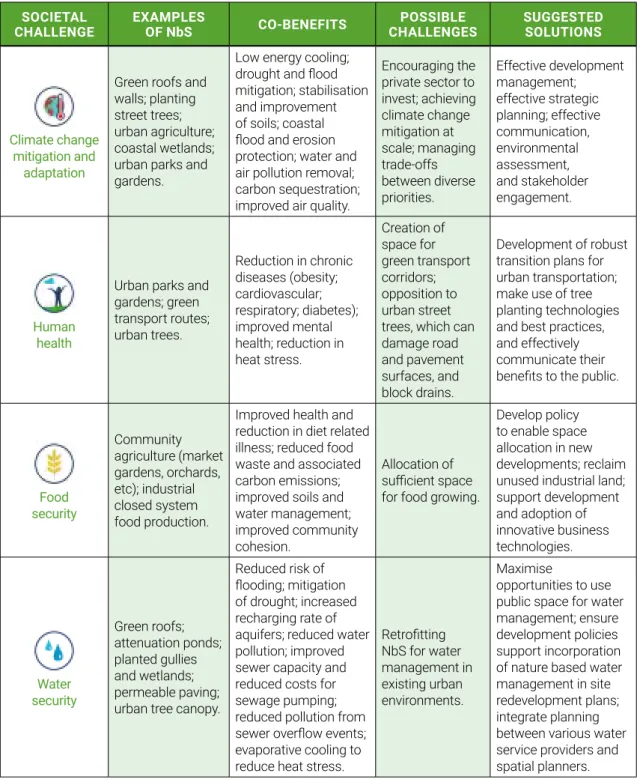
The following paragraphs provide an overview of the contribution that NbS can make to the specific societal challenges addressed by the IUCN Global NbS Standard (see also summary table 3 on page XX). More information can be found in the report ‘Nature-based Solutions to address global societal challenges’. And the IUCN report ‘Nature based Solutions in the Mediterranean Cities’ provides 50 examples from the Mediterranean region.
Climate change mitigation and adaptation
The effects of climate change on urban areas are diverse. Increasing global temperatures will lead to more intense heatwaves and more extreme weather patterns. These effects call for more cooling (and potentially more carbon emissions as a result – the sort of feedbacks to be avoided) to reduce heat stress, and modifications to infrastructure to cope better with heavy rainfall, and storm surges on the coasts. Increased temperatures and sun intensity increase the negative effects of air pollution, especially from traffic. There are NbS to all of these effects. For example:
Low energy cooling - green infrastructure provides shade and evaporative cooling (e.g. green roofs, green walls, trees). Water features also promote evaporative cooling (but the energy consumption of fountains or other pumped systems must be considered carefully).
Tackling societal challenges with NbS in the urban context
Drought and flooding. More extreme weather events require better urban water management. Promoting direct infiltration (e.g. soakaways) or temporary storage and evaporative loss (green roofs) keeps excess rainfall out of drains and recharges groundwater for use during periods of drought. Use of green infrastructure to slow surface water that cannot infiltrate (many options ranging from tree canopy storage, to rain gardens, to temporary storage ponds) is generally cheaper than installing bigger drains, and delivers multiple benefits that below-ground infrastructure cannot.
Stabilisation of soils. Drought and flooding play a part in the destabilisation of land, especially steep slopes, through erosion and waterlogging of soils, producing landslips. Carefully planned planting binds soils with plant root systems, and helps to manage soil moisture content.
Coastal flooding and wave damage.
Coastal dune and beach systems and wetlands (including seagrass beds) provide natural defences against heavy wave action which can cause erosion of the shoreline and damage to property, and flooding by overtopping of sea defences. In parts of the world, securing this type of protection has led to reduced insurance costs for coastal properties such as hotels and other elements of tourist economies.
Urban food production has a part to play in reducing carbon emissions:
shortening supply chains and therefore transport emissions; recycling food waste as compost (also reducing carbon emissions from methane emitted as food decomposes); and helping to protect and enhance soil quality and its capacity to store water.
6
Carbon sequestration is a vital part of our response to climate change. Urban trees can play an important role in capturing and storing carbon for decades, and so removing it from the atmosphere. Urban trees deliver a range of other benefits as well, and the concept of the ‘urban forest’ is gaining increasing attention as a NbS.
Air quality. Higher temperatures and related changes in atmospheric conditions tends to decrease air quality. Plants are proven to be good at removing pollutants and improving air quality, by trapping particulate pollutants, performing as a physical barrier to the dispersal of pollutants (from highways for example) and by absorbing polluting gasses.
Human health
The natural environment, and more specifically ecosystems, the climate and biodiversity, are increasingly recognised as being influential determinants of human health, well-being and social cohesion. A 2016 report published by IUCN points to an established and diverse body of evidence detailing these complex linkages and their underlying mechanisms. The World Health Organisation estimates that 12-18% of all deaths in the WHO Europe region are linked to environmental factors. For example, according to the European Environment Agency, air pollution is the single largest environmental health risk in Europe. A range of chronic diseases (such as obesity, cardio-vascular disease, respiratory disease and diabetes) that place great burdens on health services are linked to environmental quality and access to nature.
© FRANZ1212 | DREAMSTIME.COM
Several studies have focused on how the benefits of green space ‘encounters’ (whether active or passive) can influence health and well-being.
These include improvements in environmental quality, such as heat regulation and noise abatement, the promotion of physical activity and associated Body Mass Index improvements, enhanced social interaction, social cohesion and perceived safety, and opportunities for spiritual wellbeing experiences. The WHO ‘One Health’
initiative promotes integrated decision-making to protect public health from systemic threats - such as infectious pandemics, antibiotic resistance, and food safety - in the mitigation of which NbS can play a part especially in urban environments which house most of the world’s populations.
Urban NbS for positive human health include public parks and gardens, the urban forest in its entirety (street trees, urban woodland etc), community gardens, and planted boulevards and other people- friendly transport corridors (‘green links’).
Food security
Food security is one facet of the large inequalities experienced in most urban communities.
As more of the world’s population live in cities, price and availability of staple foods are increasingly dependent on long supply chains and international commodity markets. Access to a sufficiently varied diet to provide the full range of micronutrients needed for good health is limited by supply and cost - a challenge often leading to both obesity and malnutrition according to the UN Food and Agriculture Organisation.
NbS to urban food security include use of vacant land for food production, rooftop farming, and policies for allocation of land for food production in urban developments (e.g. community gardens).
Food production can also be integrated with food waste management and wastewater management, reducing pollution and increasing the recycling of essential nutrients. These
actions help to discourage soil sealing (e.g.
paving over gardens for other uses), to improve rainwater infiltration and temporary storage so reducing flash flood risk and effects of drought, to limit pollution, waste and associated carbon emissions, to support improvements in health and well-being and community cohesion, and help to reduce inequality.
Water security
Water management in cities has a number of dimensions. Urbanisation typically reduces the infiltration of rainwater into the soil, because so much of the surface is sealed – mostly with concrete and tarmac for example. This has a number of important effects:
Rainfall collects on the surface and rapidly enters gullies, drains and water courses.
During heavy rainfall, which we increasingly experience with climate change, this often causes localised flooding and pollution.
Pollution comes from hydrocarbons and dust washed off surfaces, and from the flooding of foul sewers.
Another important effect of sealed surfaces and the reduced infiltration of rainwater into the soils is the effect this has on the recharging of aquifers. In the past, most towns had little impact on recharge rates. However, with rapid urban expansion the area of cities has grown enormously.
Their effect on aquifer recharge rates is therefore significant. Further, with urban expansion, the demand for water increases. With these two factors, coastal freshwater aquifers are severely depleted in many cases, leading to saltwater intrusion, harming their use for drinking water and food production.
NbS for enhanced water security include: use of porous hard surfaces and green roofs to allow rain water management where it falls rather than relying on its transportation through expensive underground drains; wetlands (permanent or ephemeral) to slow the flow of water, provide storage against drought, and remove pollutants from runoff; planting of urban trees to slow rates of rainfall runoff; and many more.
Increasing attention is being paid in policy to the interlinkages between water, food and energy, and the circular economy, each of which provide different ways of thinking about NbS and what benefits they can deliver in an urban context.
Environmental degradation and biodiversity loss
The implementation of NbS to address the societal challenges above will help to prevent and reverse environmental degradation and biodiversity loss. This is important as research has shown the importance to the urban economy and society of the ecosystem services that are enjoyed as a result of healthy natural capital.
The strategic mechanisms to strengthen this urban natural capital fall broadly into two related categories:
Improved urban planning – to plan strategically for urban re-naturing by creating new green space, connecting green spaces, ensuring new development contains sufficient green space for community health and well-being, protecting the use of green space to optimise ecosystem service flows.
Practical re-naturing green, blue and grey infrastructure – restoring and enhancing the biodiversity and ecosystem functioning of green and blue infrastructure, and replacing or greening the grey infrastructure (roofs, streets and highways, paving, hard flood and erosion defences).
Disaster risk reduction
NbS improve resilience to natural hazards, in particular: flooding from heavy rainfall and over- flowing rivers; sea flooding; coastal erosion;
heat waves; erosion and landslips. The various mechanisms by which NbS provide benefits to disaster reduction are explained in other sections
© YOUSSOUF CADER | DREAMSTIME.COM
Economic and social development
NbS can deliver benefits for economic and social development as well as improving the health of the population and environment. They:
Improve attractiveness of the urban environment, especially the public realm and business districts, to attract inward investment. A high quality environment provides a competitive edge over other enterprise locations.
Support population health and community cohesion by providing places for people to meet and undertake community activities, and provide tranquil spaces that have been demonstrated to improve mental health.
Community gardens and urban farming can improve a range of physical health attributes, linked to a high quality diet.
Provide direct employment and innovation potential (e.g. food system; urban greening products and services such as green roofs, green walls etc; nature-based drainage systems).
Help reduce inequality by supporting individual and community health, wellbeing and prosperity.
New bridge over Guadalhorce river. Part of the Senda Litoral project in the province of Málaga.
Image source: http://www.sendalitoral.es/es/
SOCIETAL
CHALLENGE EXAMPLES
OF NbS CO-BENEFITS POSSIBLE
CHALLENGES SUGGESTED SOLUTIONS
Climate change mitigation and
adaptation
Green roofs and walls; planting street trees;
urban agriculture;
coastal wetlands;
urban parks and gardens.
Low energy cooling;
drought and flood mitigation; stabilisation and improvement of soils; coastal flood and erosion protection; water and air pollution removal;
carbon sequestration;
improved air quality.
Encouraging the private sector to invest; achieving climate change mitigation at scale; managing trade-offs between diverse priorities.
Effective development management;
effective strategic planning; effective communication, environmental assessment, and stakeholder engagement.
Human health
Urban parks and gardens; green transport routes;
urban trees.
Reduction in chronic diseases (obesity;
cardiovascular;
respiratory; diabetes);
improved mental health; reduction in heat stress.
Creation of space for green transport corridors;
opposition to urban street trees, which can damage road and pavement surfaces, and block drains.
Development of robust transition plans for urban transportation;
make use of tree planting technologies and best practices, and effectively communicate their benefits to the public.
Food security
Community agriculture (market gardens, orchards, etc); industrial closed system food production.
Improved health and reduction in diet related illness; reduced food waste and associated carbon emissions;
improved soils and water management;
improved community cohesion.
Allocation of sufficient space for food growing.
Develop policy to enable space allocation in new developments; reclaim unused industrial land;
support development and adoption of innovative business technologies.
Water security
Green roofs;
attenuation ponds;
planted gullies and wetlands;
permeable paving;
urban tree canopy.
Reduced risk of flooding; mitigation of drought; increased recharging rate of aquifers; reduced water pollution; improved sewer capacity and reduced costs for sewage pumping;
reduced pollution from sewer overflow events;
evaporative cooling to reduce heat stress.
Retrofitting NbS for water management in existing urban environments.
Maximise
opportunities to use public space for water management; ensure development policies support incorporation of nature based water management in site redevelopment plans;
integrate planning between various water service providers and spatial planners.
Table 3: A summary of NbS, their benefits, and implementation challenges
in relation to the seven societal challenges recognised by the IUCN global NbS Standard.
SOCIETAL
CHALLENGE EXAMPLES
OF NbS CO-BENEFITS POSSIBLE
CHALLENGES SUGGESTED SOLUTIONS
Environmental degradation and biodiversity loss
Re-naturing urban spaces; creation of wildlife corridors and refugia;
greening of grey infrastructure.
See other societal challenges for a wide range of co-benefits.
Differing perspectives on how urban green space should be managed;
financing new green infrastructure investments.
Initiate a public debate regarding nature- friendly practices to support new operational policies;
measure and take account of the values of ecosystem services;
develop new financial instruments based on the monetisation of benefits from ecosystem services.
Disaster risk reduction
Nature based urban drainage solutions; nature based coastal protection solutions;
nature based soil stabilisation solutions; Nature based urban cooling solutions.
See other societal challenges for a wide range of co-benefits.
Ensuring these systemic issues are addressed at sufficient scale.
Ensure they are effectively addressed in urban spatial plans at a strategic level.
Economic and social development
Planting public and private space to improve the attractiveness of the urban environment;
installation of other Nature based Solutions.
Attracting inward investment; improving footfall and retail turnover in city centres;
improved population health and wellbeing;
promoting innovation and growth in nature based goods and services.
Making the investment case for NbS and green infrastructure.
Quantify and value ecosystem services.
Plan del Verde y de la Biodiversidad de Barcelona 2020.
Image source: https://ajuntament.barcelona.cat/ecologiaurbana/sites/default/files/PlanVerde_2020.pdf
In the following pages are presented eight case studies out of the 18 practices from the assessment of the IUCN Standard against existing NbS in Mediterranean cities. They are necessarily summarised and do not provide the full detail that an assessment against the Standard would produce. For example, each case indicates a pass or fail against the Standard for each of the eight criteria. In reality, the Standard allows for a more nuanced assessment having four outcome categories (strong, adequate, partial and insufficient). For further detail of each assessment, please, review the full report: First screening of the IUCN Global Standard for Nature-based Solutions in Mediterranean Cities.
Mediterranean CASE STUDIES
ALICANTE:
Parque del Mar/ Sea Park
BARCELONA:
Green Infrastructure & Biodiversity Plan
JERUSALEM:
Gazelle Valley Park
MÁLAGA:
Coastal Trail
NICE:
Nature at the heart
PAVLO MELAS:
Integrated regeneration and Metropolitan Park
TUNISIA:
Environmental corridors
ZAGREB:
Sesvete Living Lab
© MOLOTOK007 | DREAMSTIME.COM
Case summary
Parque Del Mar is a public park designed to create a visual and acoustic buffer between the port and the city. The Port Authority of Alicante has built a green, attractive, high quality space, using native tree and bush species adapted to Alicante’s climate, with a low level of maintenance and water consumption.
It is a new space where citizens can spend their leisure time and enjoy cultural activities. Careful thought has gone into the design of the landscape, to provide topographic variety and visual strength and attractiveness through the planting scheme, guided by the principles of the European Landscape Convention. Its contribution to local biodiversity is high.
The park is constructed on port land, which has a high economic cost. However, the strategic benefit is to limit the impact on the city of continued port operations, helping to limit noise, air and visual pollution.
The second Phase of this intervention will include criteria for the selection of protected species (incorporating a nursery of local species) to further enhance biodiversity. Water efficiency in park management is another key concern.
Parque del Mar is designed to act as a buffer between port and city.
Image source: http://www.ingenierospaisajistas.com/parque-del-mar
CASE STUDY:
Sea Park Parque del Mar, Alicante (Spain)
TYPE: 3 SOCIETAL CHALLENGES
Climate
Change Water
Security Human
Health Environmental degradation and biodiversity loss Coastal resilience
under rising seas
STATUS FINALISED