Chapter 8
Linear Algebra:
Matrix Eigenvalue Problems
歐亞書局 P
Contents
8.1 Eigenvalues, Eigenvectors
8.2 Some Applications of Eigenvalue Problems
8.3 Symmetric, Skew-Symmetric, and Orthogonal Matrices
8.4 Eigenbases. Diagonalization. Quadratic Forms
8.5 Complex Matrices and Forms. Optional
Summary of Chapter 8
8.1 Eigenvalues, Eigenvectors
Let A = [ajk] be a given n × n matrix and consider the ve ctor equation(1) Ax = λx.
Here x is an unknown vector and λ an unknown scalar.
Our task is to determine x’s and λ’s that satisfy (1). Ge ometrically, we are looking for vectors x for which the multiplication by A has the same effect as the multiplic ation by a scalar λ; in other words, Ax should be propor tional to x.
continued
歐亞書局 P
Clearly, the zero vector x = 0 is a solution of (1) for any value of λ, because A0 = 0. This is of no interest. A val ue of for which (1) has a solution x ≠ 0 is called an eig envalue or characteristic value (or latent root) of the m atrix A. (“Eigen” is German and means “proper” or “cha racteristic.”) The corresponding solutions x ≠ 0 of (1) ar e called the eigenvectors or characteristic vectors of A corresponding to that eigenvalue λ. The set of all the ei genvalues of A is called the spectrum of A. We shall s ee that the spectrum consists of at least one eigenvalu e and at most of n numerically different eigenvalues. T he largest of the absolute values of the eigenvalues of A is called the spectral radius of A, a name to be motiv ated later.334
How to Find Eigenvalues and Eigenvectors
E X A M P L E 1
Determination of Eigenvalues and Eigenvectors
We illustrate all the steps in terms of the matrix
Solution. (a) Eigenvalues. These must be determined first. Equation (1) iscontinued
歐亞書局 P
Transferring the terms on the right to the left, we get (2*)
This can be written in matrix notation (3*) (A – λI) x = 0
because (1) is Ax – λx = Ax – λIx = (A – λI)x = 0, which gives (3*). We see that this is a homogeneous linear sy stem. By Cramer’s theorem in Sec. 7.7 it has a nontrivial solution x ≠ 0 (an eigenvector of A we are looking for) if and only if its coefficient determinant is zero, that is,
continued
334
(4*)
We call D(λ) the characteristic determinant or, if expa nded, the characteristic polynomial, and D(λ) = 0 the characteristic equation of A. The solutions of this qua dratic equation are λ1 = –1 and λ2 = –6. These are the e igenvalues of A.continued
歐亞書局 P
(b1) Eigenvector of A corresponding to λ1. This vect or is obtained from (2*) with λ = λ1 = –1, that is,A solution is x2 = 2x1, as we see from either of the two equations, so that we need only one of them. This dete rmines an eigenvector corresponding to λ1 = –1 up to a scalar multiple. If we choose x1 = 1, we obtain the eige nvector
continued
335
(b2) Eigenvector of A corresponding to λ2. For λ = λ2= –6, equation (2*) becomes
A solution is x2 = –x1/2 with arbitrary x1. If we choose x1
= 2, we get x2 = –1. Thus an eigenvector of A correspo nding to λ2 = –6 is
歐亞書局 P
This example illustrates the general case as follows. E quation (1) written in components iscontinued
335
Transferring the terms on the right side to the left side, we have(2)
In matrix notation,
(3) (A – λI)x = 0.
continued
歐亞書局 P
By Cramer’s theorem in Sec. 7.7, this homogeneous lin ear system of equations has a nontrivial solution if and only if the corresponding determinant of the coefficients is zero:(4)
continued
336
A – λI is called the characteristic matrix and D(λ) the characteristic determinant of A. Equation (4) is called the characteristic equation of A. By developing D(λ) we obtain a polynomial of nth degree in . This is called the characteristic polynomial of A.歐亞書局 P
Eigenvalues
THEOREM 1
The eigenvalues of a square matrix A are the roots of the characteristic equation (4) of A.
Hence an n × n matrix has at least one eigenvalue and at most n numerically different eigenvalues.
336
The eigenvalues must be determined first. Once the se are known, corresponding eigenvectors are obtaine d from the system (2), for instance, by the Gauss elimin ation, where λ is the eigenvalue for which an eigenvect or is wanted. This is what we did in Example 1 and shal l do again in the examples below.歐亞書局 P
Eigenvectors, Eigenspace
THEOREM 2
If w and x are eigenvectors of a matrix A correspondin g to the same eigenvalue λ, so are w + x (provided x ≠ –w) and kx for any k ≠ 0.
Hence the eigenvectors corresponding to one and the s ame eigenvalue λ of A, together with 0, form a vector s pace (cf. Sec. 7.4), called the eigenspace of A corresp onding to that λ.
336
E X A M P L E 2
Multiple Eigenvalues
Find the eigenvalues and eigenvectors of
Solution. For our matrix, the characteristic determinant gives the characteristic equation–λ3 – λ2 + 21λ + 45 = 0.
continued
歐亞書局 P
The roots (eigenvalues of A) are λ1 = 5, λ2 = λ3 = –3. To find eigenvectors, we apply the Gauss elimination (Sec . 7.3) to the system (A – λI)x = 0, first with λ = 5 and th en with λ = –3. For λ = 5 the characteristic matrix is
Hence it has rank 2. Choosing x3 = –1 we have x2 = 2 fr om –(24/7)x2 – (48/7)x3 = 0 and then x1 = 1 from –7x1 + 2x2 – 3x3 = 0. Hence an eigenvector of A coresponding to λ = 5 is x1 = [1 2 –1]T.
continued
337
For λ = –3 the characteristic matrixHence it has rank 1. From x1 + 2x2 – 3x3 = 0 we have x1
= –2x2 + 3x3. Choosing x2 = 1, x3 = 0 and x2 = 0, x3 = 1, we obtain two linearly independent eigenvectors of A c orresponding to λ = –3 [as they must exist by (5), Sec.
7.5, with rank = 1 and n = 3], and
歐亞書局 P
E X A M P L E 3
Algebraic Multiplicity,Geometric Multiplicity. Positive Defect
The characteristic equation of the matrixHence λ = 0 is an eigenvalue of algebraic multiplicity M
0 = 2. But its geometric multiplicity is only m0 = 1, since eigenvectors result from –0x1 + x2 = 0, hence x2 = 0, in t he form [x1 0]T. Hence for λ = 0 the defect is ∆0 = 1.
continued
338
Similarly, the characteristic equation of the matrixHence λ = 3 is an eigenvalue of algebraic multiplicity M
3 = 2, but its geometric multiplicity is only m3 = 1, since eigenvectors result from 0x1 + 2x2 = 0 in the form [x1 0]T.
歐亞書局 P
E X A M P L E 4
Real Matrices with Complex Eigenvaluesand Eigenvectors
Since real polynomials may have complex roots (which then occur in conjugate pairs), a real matrix may have complex eigenvalues and eigenvectors. For instance, t he characteristic equation of the skew-symmetric matri xIt gives the eigenvalues λ1 = i , λ2 = –i. Eigenvectors are obtained from –ix1 + x2 = 0 and ix1 + x2 = 0, respecti vely, and we can choose x1 = 1 to get
338
Eigenvalues of the Transpose
THEOREM 3
The transpose AT of a square matrix A has the sa me eigenvalues as A.
歐亞書局 P
8.2 Some Applications of Eigenvalue Problems
E X A M P L E 1
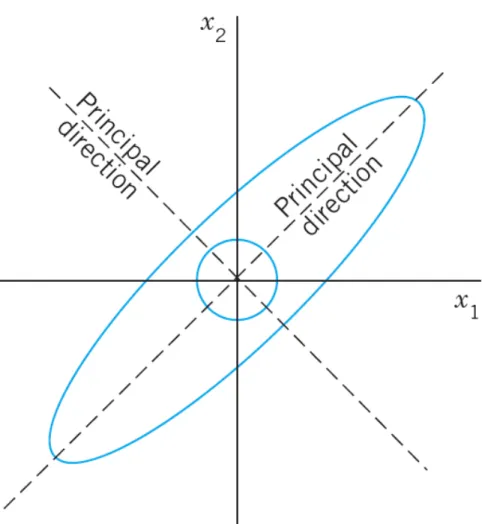
Stretching of an Elastic MembraneAn elastic membrane in the x1x2-plane with boundary circle x12 + x22 = 1 (Fig. 158) is stretched so that a point P:
(x1, x2) goes over into the point Q: (y1, y2) given by (1)
Find the principal directions, that is, the directions of the position vector x of P for which the direction of the position vector y of Q is the same or exactly opposite. What shape does the boundary circle take under this deformation?
continued
340
Fig. 158.
Undeformed and deformed membrane in Example 1歐亞書局 P
Solution. We are looking for vectors x such that y = λx . Since y = Ax, this gives Ax = λx, the equation of an ei genvalue problem. In components, Ax = λx is(2)
The characteristic equation is (3)
continued
340
Its solutions are λ1 = 8 and λ2 = 2. These are the eigen values of our problem. For λ = λ1 = 8, our system (2) be comes
For λ2 = 2, our system (2) becomes
continued
歐亞書局 P
We thus obtain as eigenvectors of A, for instance, [1 1]T corresponding to λ1 and [1 –1]T corresponding to λ2 (or a nonzero scalar multiple of these). These vectors make 45° and 135° angles with the positive x1-direction . They give the principal directions, the answer to our p roblem. The eigenvalues show that in the principal dire ctions the membrane is stretched by factors 8 and 2, re spectively; see Fig. 158.
continued
340
Accordingly, if we choose the principal directions as dir ections of a new Cartesian u1u2-coordinate system, say, with the positive u1-semi-axis in the first quadrant and th e positive u2-semi-axis in the second quadrant of the x1 x2-system, and if we set u1 = r cos φ, u2 = r sin φ, then a boundary point of the unstretched circular membrane h as coordinates cos φ, sin φ. Hence, after the stretch we haveSince cos2 φ + sin2 φ = 1, this shows that the deformed boundary is an ellipse (Fig. 158)
(4)
歐亞書局 P
E X A M P L E 2
Eigenvalue Problems Arising fromMarkov Processes
Markov processes as considered in Example 13 of Sec . 7.2 lead to eigenvalue problems if we ask for the limit state of the process in which the state vector x is repro duced under the multiplication by the stochastic matrix A governing the process, that is, Ax = x. Hence A shou ld have the eigenvalue 1, and x should be a correspon ding eigenvector. This is of practical interest because it shows the long-term tendency of the development mod eled by the process.continued
341
In that example,Hence AT has the eigenvalue 1, and the same is true fo r A by Theorem 3 in Sec. 8.1. An eigenvector x of A for λ = 1 is obtained from
continued
歐亞書局 P
Taking x3 = 1, we get x2 = 6 from – x2 / 30 + x3 / 5 = 0 a nd then x1 = 2 from –3x1 / 10 + x2 / 10 = 0. This gives x= [2 6 1]T. It means that in the long run, the ratio Co mmercial : Industrial : Residential will approach 2 : 6 : 1 , provided that the probabilities given by A remain (abo ut) the same. (We switched to ordinary fractions to avoi d rounding errors.)
341
E X A M P L E 3
Eigenvalue Problems Arising from Population Models. Leslie Model
The Leslie model describes age-specified population gr owth, as follows. Let the oldest age attained by the fem ales in some animal population be 9 years. Divide the p opulation into three age classes of 3 years each. Let th e “Leslie matrix” be(5)
continued
歐亞書局 P
where l1k is the average number of daughters born to a single female during the time she is in age class k, and lj, j-1 ( j = 2, 3) is the fraction of females in age class j – 1 that will survive and pass into class j. (a) What is the nu mber of females in each class after 3, 6, 9 years if each class initially consists of 400 females? (b) For what initi al distribution will the number of females in each class change by the same proportion? What is this rate of ch ange?
continued
341
Solution. (a) Initially, = [400 400 400]. After 3 yea rs,Similarly, after 6 years the number of females in each c lass is given by = (Lx(3))T = [600 648 72], and after 9 years we have = (Lx(6))T = [1519.2 360 194.4].
continued
歐亞書局 P
(b) Proportional change means that we are looking for a distribution vector x such that Lx = λx, where λ is the rate of change (growth if λ > 1, decrease if λ < 1). The characteristic equation is (develop the characteristic de terminant by the first column)A positive root is found to be (for instance, by Newton’s method, Sec. 19.2) λ = 1.2. A corresponding eigenvect or x can be determined from the characteristic matrix
continued
342
where x3 = 0.125 is chosen, x2 = 0.5 then follows from 0.3x2 – 1.2x3 = 0, and x1 = 1 from –1.2x1 + 2.3x2 + 0.4x3
= 0. To get an initial population of 1200 as before, we multiply x by 1200/(1 + 0.5 + 0.125) = 738. Answer: Pro portional growth of the numbers of females in the three classes will occur if the initial values are 738, 369, 92 in classes 1, 2, 3, respectively. The growth rate will be 1.2 per 3 years.
歐亞書局 P
E X A M P L E 4
Vibrating System of Two Masses on TwoSprings
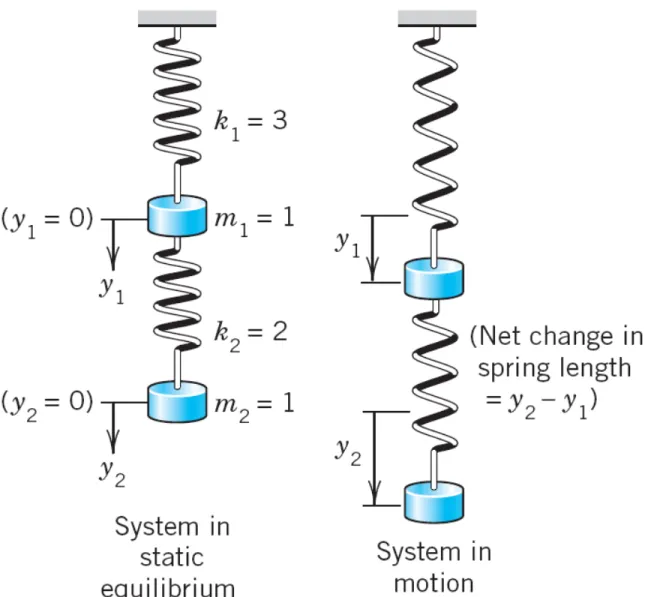
Mass–spring systems involving several masses and sp rings can be treated as eigenvalue problems. For insta nce, the mechanical system in Fig. 159 is governed by the system of ODEs(6)
where y1 and y2 are the displacements of the masses fr om rest, as shown in the figure, and primes denote deri vatives with respect to time t. In vector form, this beco mes
(7)
continued
342
Fig. 159.
Masses on springs in Example 4歐亞書局 P
We try a vector solution of the form (8)This is suggested by a mechanical system of a single m ass on a spring (Sec. 2.4), whose motion is given by ex ponential functions (and sines and cosines). Substitutio n into (7) gives
Dividing by eωt and writing ω2 = λ, we see that our mec hanical system leads to the eigenvalue problem
(9)
continued
343
From Example 1 in Sec. 8.1 we see that A has the eige nvalues λ1 = –1 and λ2 = –6. Consequently, ω = = ±i and = , respectively. Corresponding eigenvectors are(10)
From (8) we thus obtain the four complex solutions [se e (10), Sec. 2.2]
By addition and subtraction (see Sec. 2.2) we get the f our real solutions
continued
歐亞書局 P
A general solution is obtained by taking a linear combination of these,with arbitrary constants a1, b1, a2, b2 (to which values can be assigned by prescribing initial displacement and initial velocity of each of the two masses). By (10), the components of y are
These functions describe harmonic oscillations of the two masses. Physically, this had to be expected because we have neglected damping.343
8.3 Symmetric, Skew-Symmetric, and Orthogonal Matrices
Symmetric, Skew-Symmetric, and Orthogonal Matrices
DEFINITION
A real square matrix A = [ajk] is called
symmetric if transposition leaves it unchanged, (1) AT = A, thus akj = ajk,
skew-symmetric if transposition gives the negative of A ,
(2) AT = –A, thus akj = –ajk,
orthogonal if transposition gives the inverse of A,
歐亞書局 P
E X A M P L E 1
Symmetric, Skew-Symmetric,and Orthogonal Matrices
The matricesare symmetric, skew-symmetric, and orthogonal, respe ctively, as you should verify. Every skew-symmetric ma trix has all main diagonal entries zero. (Can you prove t his?)
345
Any real square matrix A may be written as the sum of a symmetric matrix R and a skew-symmetric matrix S, where(4)
歐亞書局 P
E X A M P L E 2
Illustration of Formula (4)345
Eigenvalues of Symmetric and Skew-Symmetric Matrices
THEOREM 1
(a) The eigenvalues of a symmetric matrix are real.
(b) The eigenvalues of a skew-symmetric matrix are pure imaginary or zero.
歐亞書局 P
E X A M P L E 3
Eigenvalues of Symmetric andSkew-Symmetric Matrices
The matrices in (1) and (7) of Sec. 8.2 are symmetric a nd have real eigenvalues. The skew-symmetric matrix i n Example 1 has the eigenvalues 0, –25i, and 25i. (Veri fy this.) The following matrix has the real eigenvalues 1 and 5 but is not symmetric. Does this contradict Theore m 1?346
Orthogonal Transformations and Orthogonal Matrices
Orthogonal transformations are transformations(5) y = Ax where A is an orthogonal matrix .
With each vector x in Rn such a transformation assigns a vector y in Rn. For instance, the plane rotation throug h an angle θ
(6)
continued
歐亞書局 P
is an orthogonal transformation. It can be shown that a ny orthogonal transformation in the plane or in three-di mensional space is a rotation (possibly combined with a reflection in a straight line or a plane, respectively).
346
Invariance of Inner Product (1)
THEOREM 2
An orthogonal transformation preserves the value of the inner product of vectors a and b in Rn, defin ed by
(7)
That is, for any a and b in Rn, orthogonal n × n mat rix A, and u = Aa, v = Ab we have u • v = a • b.
continued
歐亞書局 P
Invariance of Inner Product (2)
THEOREM 2
Hence the transformation also preserves the lengt h or norm of any vector a in Rn given by
(8)
346
Orthonormality of Column and Row Vectors
THEOREM 3
A real square matrix is orthogonal if and only if its col umn vectors a1, ‥‥, an (and also its row vectors) for m an orthonormal system, that is,
(10)
歐亞書局 P
Determinant of an Orthogonal Matrix
THEOREM 4
The determinant of an orthogonal matrix has the value +1 or –1.
347
E X A M P L E 4
Illustration of Theorems 3 and 4
The last matrix in Example 1 and the matrix in (6) illustr ate Theorems 3 and 4 because their determinants are –1 and +1, as you should verify.歐亞書局 P
Eigenvalues of an Orthogonal Matrix
THEOREM 5
The eigenvalues of an orthogonal matrix A are real o r complex conjugates in pairs and have absolute valu e 1.
348
E X A M P L E 5
Eigenvalues of an Orthogonal Matrix
The orthogonal matrix in Example 1 has the characteris tic equationNow one of the eigenvalues must be real (why?), henc e +1 or –1. Trying, we find –1. Division by λ = 1 gives – (λ2 – 5λ/3 + 1) = 0 and the two eigenvalues and , which have absolute value 1. Verify all of this.
歐亞書局 P
8.4 Eigenbases. Diagonalization.
Quadratic Forms
Eigenvectors of an n × n matrix A may (or may not!) for m a basis for Rn. If we are interested in a transformatio n y = Ax, such an “eigenbasis” (basis of eigenvector s)—if it exists—is of great advantage because then we can represent any x in Rn uniquely as a linear combinat ion of the eigenvectors x1, ‥‥, xn, say,continued
349
And, denoting the corresponding (not necessarily distin ct) eigenvalues of the matrix A by λ1, ‥‥, λn, we have Axj = λjxj, so that we simply obtain
(1)
歐亞書局 P
Basis of Eigenvectors
THEOREM 1
If an n × n matrix A has n distinct eigenvalues, then A has a basis of eigenvectors x1, ‥‥, xn for Rn.
349
E X A M P L E 1
Eigenbasis. Nondistinct Eigenvalues.Nonexistence
The matrix A = has a basis of eigenvectors , corresponding to the eigenvalues λ1 = 8, λ2 = 2. (S ee Example 1 in Sec. 8.2.)
Even if not all n eigenvalues are different, a matrix A m ay still provide an eigenbasis for Rn. See Example 2 in Sec. 8.1, where n = 3.
On the other hand, A may not have enough linearly i ndependent eigenvectors to make up a basis. For in stance, A in Example 3 of Sec. 8.1 is歐亞書局 P
Symmetric Matrices
THEOREM 2
A symmetric matrix has an orthonormal basis of eige nvectors for Rn.
350
E X A M P L E 2
Orthonormal Basis of Eigenvectors
The first matrix in Example 1 is symmetric, and an orth onormal basis of eigenvectors is , .歐亞書局 P
Diagonalization of Matrices
Similar Matrices. Similarity Transformation
DEFINITION
An n × n matrix  is called similar to an n × n matrix A if (4)  = P-1AP
for some (nonsingular!) n × n matrix P. This transformation, which gives  from A, is called a similarity transformation.
350
Eigenvalues and Eigenvectors of Similar Matrices
THEOREM 3
If  is similar to A, then  has the same eigenvalues a s A.
Furthermore, if x is an eigenvector of A, then y = P-1x is an eigenvector of  corresponding to the same eige nvalue.
歐亞書局 P
E X A M P L E 3
Eigenvalues and Vectors of Similar Matrices
LetThen
Here P-1 was obtained from (4*) in Sec. 7.8 with det P
= 1. We see that  has the eigenvalues λ1 = 3, λ2 = 2. T he characteristic equation of A is (6 – λ)(–1 – λ) + 12 = λ2 – 5λ + 6 = 0. It has the roots (the eigenvalues of A) λ
1 = 3, λ2 = 2, confirming the first part of Theorem 3.
continued
351
We confirm the second part. From the first component o f (A – λI)x = 0 we have (6 – λ)x1 – 3x2 = 0. For λ = 3 this gives 3x1 – 3x2 = 0, say, x1 = [1 1]T. For λ = 2 it gives 4 x1 – 3x2 = 0, say, x2 = [3 4]T. In Theorem 3 we thus hav eIndeed, these are eigenvectors of the diagonal matrix  .
Perhaps we see that x1 and x2 are the columns of P. Th is suggests the general method of transforming a matrix A to diagonal form D by using P = X, the matrix with eig envectors as columns:歐亞書局 P
Diagonalization of a Matrix
THEOREM 4
If an n × n matrix A has a basis of eigenvectors, then (5) D = X-1AX
is diagonal, with the eigenvalues of A as the entries on the main diagonal. Here X is the matrix with these eige nvectors as column vectors. Also,
(5*) Dm = X-1AmX (m = 2, 3, ‥‥).
351
E X A M P L E 4
Diagonalization
Diagonalize
Solution. The characteristic determinant gives the char acteristic equation –λ3 – λ2 + 12λ = 0. The roots (eigenv alues of A) are λ1 = 3, λ2 = 4, λ3 = 0. By the Gauss elimi nation applied to (A – λI)x = 0 with λ = λ1, λ2, λ3 we find eigenvectors and then X-1 by the Gauss–Jordan elimina tion (Sec. 7.8, Example 1). The results arecontinued
歐亞書局 P
Calculating AX and multiplying by X-1 from the left, we t hus obtain352
Quadratic Forms. Transformation to Principal Axes
By definition, a quadratic form Q in the components x1, ‥‥, xn of a vector x is a sum of n2 terms, namely,
(7)
continued
歐亞書局 P
A = [ajk] is called the coefficient matrix of the form. W e may assume that A is symmetric, because we can t ake off-diagonal terms together in pairs and write the re sult as a sum of two equal terms; see the following exa mple.353
E X A M P L E 5
Quadratic Form.Symmetric Coefficient Matrix
LetHere 4 + 6 = 10 = 5 + 5. From the corresponding sym metric matrix C = [cjk], where cjk = 1/2 (ajk + akj), thus c11
= 3, c12 = c21 = 5, c22 = 2, we get the same result; indee d,
歐亞書局 P
By Theorem 2 the symmetric coefficient matrix A of (7) has an orthonormal basis of eigenvectors. Hence if we take these as column vectors, we obtain a matrix X that is orthogonal, so that X-1 = XT. From (5) we thus have A= XDX-1 = XDXT. Substitution into (7) gives (8) Q = xTXDXTx.
continued
353
If we set XTx = y, then, since XT = X-1, we get (9) x = Xy.
Furthermore, in (8) we have xTX = (XTx)T = yT and XTx
= y, so that Q becomes simply (10)
歐亞書局 P
Principal Axes Theorem
THEOREM 5
The substitution (9) transforms a quadratic form
to the principal axes form or canonical form (10), whe re λ1, ‥‥, λn are the (not necessarily distinct) eigenva lues of the (symmetric!) matrix A, and X is an orthogon al matrix with corresponding eigenvectors x1, ‥‥, xn, respectively, as column vectors.
354
E X A M P L E 6
Transformation to Principal Axes.Conic Sections
Find out what type of conic section the following quadr atic form represents and transform it to principal axes:Q = 17x12 – 30x1x2 + 17x22 = 128.
Solution. We have Q = xTAx, wherecontinued
歐亞書局 P
This gives the characteristic equation (17 – λ)2 – 152 = 0. It has the roots λ1 = 2, λ2 = 32. Hence (10) becomes Q = 2y12 + 32y22.We see that Q = 128 represents the ellipse 2y12 + 32y22
= 128, that is,
continued
354
If we want to know the direction of the principal axes in the x1x2-coordinates, we have to determine normalized eigenvectors from (A – λI)x = 0 with λ = λ1 = 2 and λ = λ2 = 32 and then use (9). We gethence
This is a 45° rotation. Our results agree with those in S ec. 8.2, Example 1, except for the notations. See also Fig. 158 in that example.歐亞書局 P
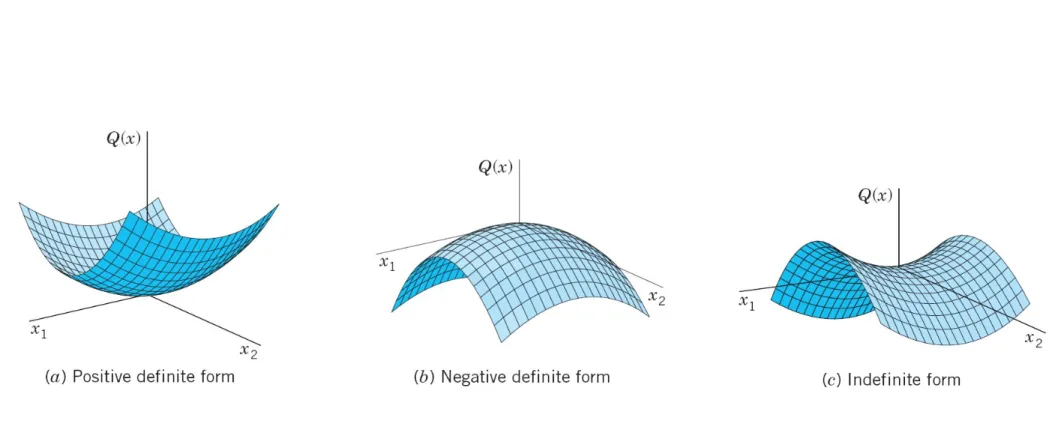
A quadratic form Q(x) = xTAx and its matrix A are calle d (a) positive definite if Q(x) > 0 for all x ≠ 0, (b) nega tive definite if Q(x) < 0 for all x ≠ 0, (c) indefinite if Q (x) takes both positive and negative values. A necessar y and sufficient condition for positive definiteness is tha t all the “principal minors” are positive.continued
356
Fig. 160.
Quadratic forms in two variables歐亞書局 P
8.5 Complex Matrices and Forms. Optional
NotationsĀ = [ājk] is obtained from A = [ajk] by replacing each ent ry ajk = α + iβ (α, β real) with its complex conjugate ājk = α – iβ. Also, ĀT = [ākj] is the transpose of Ā, hence the c onjugate transpose of A.
356
E X A M P L E 1
Notations歐亞書局 P
Hermitian, Skew-Hermitian, and Unitary Matrices
DEFINITION
A square matrix A = [akj] is called
Hermitian if ĀT = A, that is, ākj = ajk skew-Hermitian if ĀT = –A, that is, ākj = –ajk unitary if ĀT = A-1,
357
E X A M P L E 2
Hermitian, Skew-Hermitian, and Unitary Matricesare Hermitian, skew-Hermitian, and unitary matrices, re spectively, as you may verify by using the definitions.
歐亞書局 P
Eigenvalues
Eigenvalues
THEOREM 1
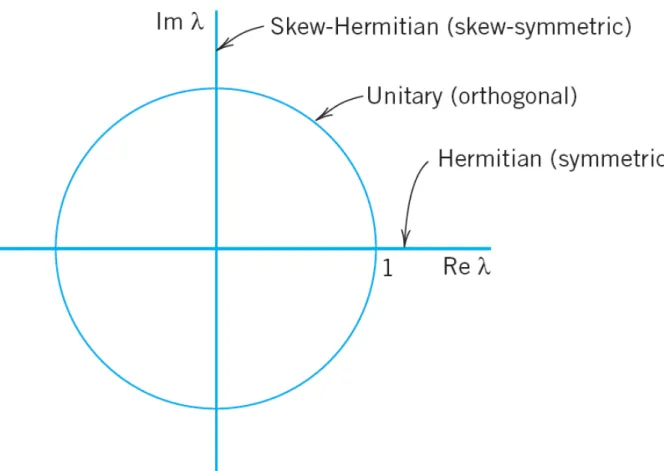
(a) The eigenvalues of a Hermitian matrix (and thus of a symmetric matrix) are real.
(b) The eigenvalues of a skew-Hermitian matrix (an d thus of a skew-symmetric matrix) are pure imaginary or zero.
(c) The eigenvalues of a unitary matrix (and thus of an orthogonal matrix) have absolute value 1.
continued
358
Fig. 161.
Location of the eigenvalues of Hermitian,skew-Hermitian, and unitary matrices in the complex λ-plane
歐亞書局 P
E X A M P L E 3
Illustration of Theorem 1
For the matrices in Example 2 we find by direct calculat ion358
Invariance of Inner Product
THEOREM 2
A unitary transformation, that is, y = Ax with a unitary matrix A, preserves the value of the inner product (4), hence also the norm (5).
歐亞書局 P
Unitary System
DEFINITION
A unitary system is a set of complex vectors satisfying the relationships
(6)
359
Unitary Systems of Column and Row Vectors
THEOREM 3
A complex square matrix is unitary if and only if its column vectors (and also its row vectors) form a unitary system.
歐亞書局 P
Determinant of a Unitary Matrix
THEOREM 4
Let A be a unitary matrix. Then its determinant has ab solute value one, that is, |det A| = 1.
360
E X A M P L E 4
Unitary Matrix Illustrating Theorems 1c and 2–4
For the vectors aT = [2 –i] and bT = [1 + i 4i] we get āT= [2 i]T and āTb = 2(1 + i) – 4 = –2 + 2i and with
as one can readily verify. This gives (Āā)TAb = –2 + 2i, illustrating Theorem 2. The matrix is unitary. Its column s form a unitary system,
continued
歐亞書局 P
and so do its rows. Also, det A = –1. The eigenvalues are 0.6 + 0.8i and –0.6 + 0.8i, with eigenvectors [1 1]T and [1 –1]T, respectively.
360
Basis of Eigenvectors
THEOREM 5
A Hermitian, skew-Hermitian, or unitary matrix has a b asis of eigenvectors for Cn that is a unitary system.
歐亞書局 P
E X A M P L E 5
Unitary Eigenbases
The matrices A, B, C in Example 2 have the following u nitary systems of eigenvectors, as you should verify.360
Hermitian and Skew-Hermitian Forms
E X A M P L E 6
Hermitian Form
For A in Example 2 and, say, x = [1 + i 5i]T we get歐亞書局 P
SUMMARY OF CHAPTER 8
The practical importance of matrix eigenvalue problem s can hardly be overrated. The problems are defined b y the vector equation(1) Ax = λx.
A is a given square matrix. All matrices in this chapter are square. λ is a scalar. To solve the problem (1) mea ns to determine values of λ, called eigenvalues (or ch aracteristic values) of A, such that (1) has a nontrivial solution x (that is, x ≠ 0), called an eigenvector of A co rresponding to that λ. An n × n matrix has at least one and at most n numerically different eigenvalues.
continued
363
These are the solutions of the characteristic equation (Sec. 8.1)
(2)
D(λ) is called the characteristic determinant of A. By expanding it we get the characteristic polynomial of A, which is of degree n in λ. Some typical applications are shown in Sec. 8.2.continued
歐亞書局 P
Section 8.3 is devoted to eigenvalue problems for sym metric (AT = A), skew-symmetric (AT = –A), and orth ogonal matrices (AT = A-1). Section 8.4 concerns the d iagonalization of matrices and the transformation of qu adratic forms to principal axes and its relation to eigenv alues.continued
363