Behavior of intermetallics in liquid Sn–Zn–Ag solder alloys
Jenn Ming Song and Kwang Lung Lin
Department of Materials Science and Engineering, National Cheng Kung University, Tainan 701, Taiwan
(Received 4 April 2003; accepted 2 June 2003)
This study investigated the characteristics of the intermetallics that appear in Sn–Zn–Ag solder alloys, particularly their behavior in molten solder during cooling and remelting. The results indicated that the intermetallics, which deplete the Zn-rich phase, were present in the form of inhomogeneous dendrites and consisted of two intermetallic phases,⑀–AgZn3and␥–Ag5Zn8. These Ag–Zn intermetallics formed as the primary dendrites upon cooling from temperatures slightly below 300 °C. These intermetallics transformed into coarse nodules with a stable, high Ag-content phase when isothermally heated at 250 °C. These massive intermetallic particles tended to settle at the bottom of the melt due to low buoyancy. Isothermal heating at slightly above 300 °C resulted in the rapid melting of these intermetallics. Subsequent
quenching caused numerous fine dendritic intermetallics to form throughout the solder.
I. INTRODUCTION
Sn–Zn eutectic alloy has recently been considered for use as a lead-free solder material because of its low melting point (198 °C), excellent mechanical propert-ies, and low cost.1–3 However, since Zn-containing alloys suffer from easy oxidation and poor wetting,4,5 investigations to develop new Sn–Zn-based alloys continue.
Improvement in wetting ability by Ag doping6 raises the potential application of Sn–Zn alloys as Pb-free sol-ders. Small additions of Ag7,8can also improve the duc-tility of Sn–Zn-based solders, and the presence of Ag–Zn precipitates does not increase the strength of the alloy with high Ag content. Additionally, a study related to vibration properties9revealed that the damping capacity and vibration life under resonant conditions can be sig-nificantly improved by increasing the Ag content of Sn–Zn–Ag alloys. Ag–Zn intermetallics improve the vi-bration fracture resistance.
In view of the effect of Ag–Zn intermetallics on the properties of Sn–Zn solders, it is of interest to investi-gate the formation behavior of the intermetallics. A better understanding of intermetallics formation behav-ior will provide further insight of this alloy for poten-tial applications. The present study investigated the thermal behavior and morphology evolution of Ag–Zn particles in molten Sn–Zn–Ag alloys under both cool-ing and isothermal heatcool-ing conditions. These behav-iors were also correlated to the composition of the intermetallics.
II. EXPERIMENTAL
A near-eutectic Sn–8.55 wt.% Zn (Sn–8.55Zn) alloy and one with a composition of Sn–8.87 wt.% Zn– 1.5 wt.% Ag (Sn–8.87Zn–1.5Ag) were prepared by melting pure tin, zinc, and silver in a high-frequency induction furnace. These prepared alloy ingots were remelted and cast into 8-mm-diameter cylindrical specimens using gypsum mold.
The solidification characteristics of the alloys were investigated using cooling curve and differential scan-ning calorimetery (DSC) analysis. Cooling curves were obtained by inserting a thermocouple into 200 g of mol-ten solder placed in a MgO crucible. The molmol-ten solder was heated up to above 700 °C for cooling curve study. DSC analysis was conducted at a constant cooling rate of 0.5 °C/min, starting from 400 °C.
To investigate the behavior of Ag–Zn intermetallics in molten solders, a 0.2-g specimen was placed in a quartz tube and then soaked in an oil bath at a fixed temperature. After a certain holding time, the tube was quenched in water. The intermetallic particles in the as-cast and heat-treated specimens were examined for morphology, size, and composition.
III. RESULTS
A. Microstructure of the solders
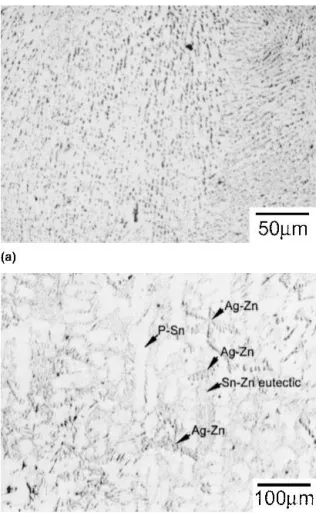
The Sn–8.55Zn specimen exhibited a typical eutectic microstructure [Fig. 1(a)] with fine, oriented Zn needles. Figure 1(b) shows that proeutectic Sn-rich dendrites and
dendritic intermetallics appeared in the Sn–8.87Zn– 1.5Ag specimen. The results of energy dispersive spec-troscopy (EDS) analysis [Fig. 2(a)] indicate that the intermetallics formed between Ag and Zn. X-ray diffrac-tion (XRD) patterns shown in Fig. 2(b) identify these intermetallics as⑀–AgZn3and␥–Ag5Zn8.
The backscattering electron image of the Ag–Zn in-termetallic particles shown in Fig. 3(a) displays a non-uniform dendritic microstructure. It also reveals a pattern of irregular light wavy strata. Composition variation identified by elemental analysis across a Ag–Zn particle [Figs. 3(b) and 3(c)] further indicates the multiphase characteristics of the particles. The Ag content seems to be relatively low in the outer peripheral area; yet the white strip [indicated by the arrows in Figs. 3(b) and 3(c)] contains a slightly higher Ag content than other regions.
B. Thermal behavior of the solders
The cooling curves of the specimens (Fig. 4) indicate that the solidification behavior of Ag-containing and Sn–Zn solders are quite different from each other.
The cooling curve of the Sn–Zn sample shows no inflec-tion point above the eutectic temperature of 198.7 °C. However, the Sn–Zn–Ag solder exhibits off-eutectic features and a plateau starting at about 205.6 °C, believed to have resulted from the formation of proeutectic Sn phase. In addition, an inflection point is observed at a temperature of 285.7 °C for the Sn–8.87Zn– 1.5Ag sample.
Furthermore, an exothermic peak appears at a tem-perature of 286.5 °C in the DSC curve during cooling (Fig. 5). This seems to correspond with the results of the cooling curves. The exothermal behavior is due to the crystallization of the primary Ag–Zn dendrites in the melt at a temperature of slightly below 300 °C.
C. Evolution of Ag–Zn compounds in molten solder
It is of interest to further investigate the physical phenomena corresponding to the thermal behaviors presented in the previous paragraphs. Experiments for FIG. 1. Microstructures of the (a) Sn–8.55Zn and (b) Sn–8.87Zn–
1.5Ag alloys (P-Sn, proeutectic Sn dendrite; Ag–Zn, Ag–Zn intermetallics).
FIG. 2. (a) EDS spectrum from the intermetallics and (b) XRD pattern of the solders.
examining the evolution behavior of the Ag–Zn inter-metallics were conducted at 250 °C (below the crystal-lizing temperature of the intermetallics) and 300 °C (slightly above the crystallizing temperature of the inter-metallics). These two temperatures are above the melting temperatures of proeutectic Sn dendrites and Sn–Zn eu-tectic phase, therefore, the intermetallic particles were soaked in the Sn–Zn melt.
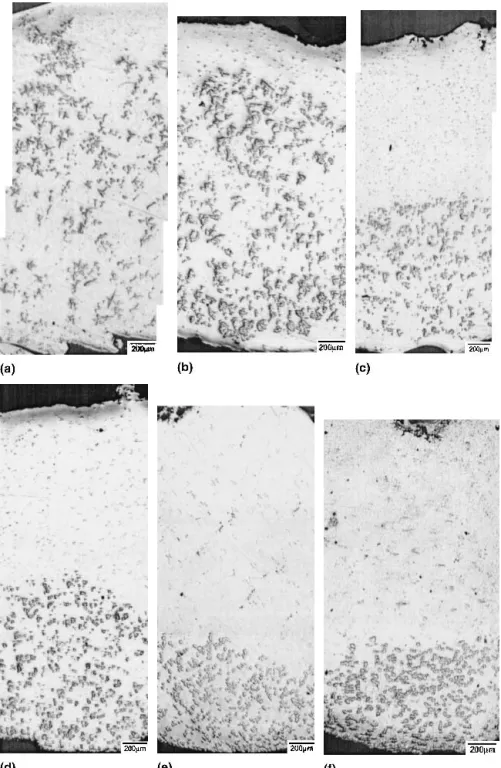
Figures 6(a)–6(f) display the microstructural evolution of the solidified Sn–8.87Zn–1.5Ag samples after isother-mally heating at 250 °C for various periods of time. Figures show that the Ag–Zn dendrites, with an average
FIG. 4. Cooling curves of Sn–8.55Zn and Sn–8.87Zn–1.5Ag samples.
FIG. 5. DSC curve of the Sn–8.87Zn–1.5Ag sample upon cooling. FIG. 3. (a) Backscattering electron image of the Sn–8.87Zn–1.5Ag
sample; (b, c) elemental line scanning for Zn and Ag across an Ag–Zn particle.
primary dendrite length (PDL) of about 67m, were spheroidized. These particles tended to descend and form clusters in the lower region of the sample during the extended holding time. In addition, fine Ag–Zn interme-tallic dendrites were also observed in the upper region of the melt, where no coarse dendrites appear.
A higher magnification of these intermetallic particles (Fig. 7) illustrates that during isothermal aging at 250 °C, the original Ag–Zn dendrites transformed into round
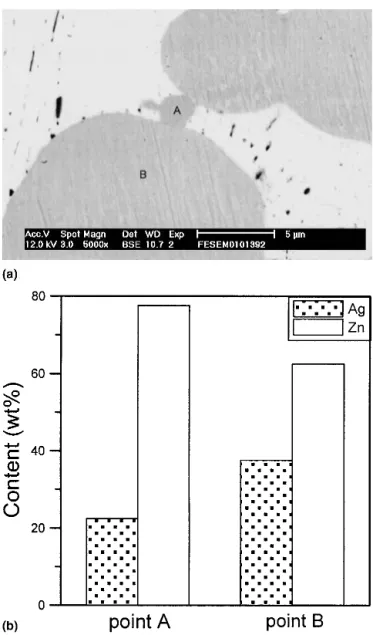
nodules. Both the aspect ratio and the PDL of the com-pounds decreased sharply during the first 20 min of ag-ing, and then the aspect ratio remained roughly constant while the PDL increased slightly afterwards (Fig. 8). This indicates that during the extended aging time the particles remained unchanged in shape but grew larger. It is worthy of notice that the backscattering image (Fig. 9) shows the Ag–Zn particles became quite uniform in ap-pearance after long hold times at high temperature. The FIG. 6. Cross-sectional microstructure of the Sn–8.87Zn–1.5Ag samples after holding at 250 °C for (a) 0 min, (b) 5 min, (c) 10 min, (d) 20 min, (e) 40 min, and (f) 60 min.
neck area linking the nodules, point A of Fig. 9(a), shows depletion in the Ag content compared with that of the massive nodules, point B of Fig. 9(a).
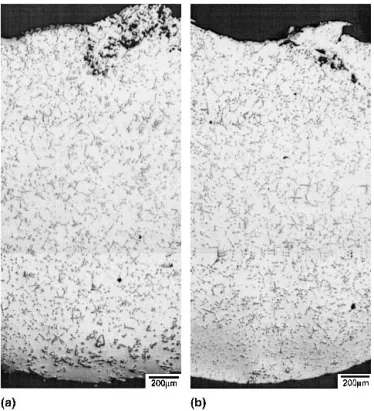
On the other hand, there are only fine dendrites [Figs. 10(a) and 10(b)] uniformly distributed in the sample aged at a high temperature of 300 °C for short durations of 1 min and 3 min. This implies that even after a short period of aging above the crystallization temperature of the intermetallics, original massive dendrites all dis-solved and fine, uniformly dispersed dendrites appear throughout the whole droplet.
IV. DISCUSSION
A. Solidification of Sn–Zn–Ag solder
The eutectic temperatures of Sn–Zn and Sn–Ag are, repectively, 199 and 221 °C. The cooling curves (Fig. 4) show the Sn–Zn eutectic behavior (198.7 and 199.6 °C)
of both solders, while the eutectic behavior of the Sn–Ag system does not appear in either curve. It was anticipated that the crystallization behavior of the Ag–Zn interme-tallics would be seen in the DSC and cooling curves of the Sn–8.55Zn–1.5Ag solder. XRD analysis (Fig. 2) does indicate the formation of the AgZn3 and Ag5Zn8 inter-metallics. It is believed that the exothermic peak at around 286.5 °C resulted from the crystallization of these intermetallics. Yet, the corresponding behavior seems to appear late at 285 °C in the cooling curve. The differ-ences are unresolved at this juncture, and further com-ment will be reserved until additional expericom-ments are completed.
The composition of the solder melt gradually changes upon cooling because of the consumption of Ag and Zn due to the precipitation of Ag–Zn intermetallics. The lowering in Ag content eliminates the possibility of Ag–Sn eutectic phase forming which, as mentioned FIG. 7. Morphologies of Ag–Zn intermetallics isothermally held at 250 °C for (a) 0 min, (b) 5 min, (c) 10 min, (d) 20 min, (e) 40 min, and (f) 60 min.
previously, was not observed.10,11 The depletion in Zn led to the enrichment of Sn in the Sn–Zn melt. Accord-ingly, the proeutectic Sn dendrites formed during the continuing cooling process as depicted by the plateau appearing at 205.6 °C on the cooling curve of the Sn–8.55Zn–1.5Ag solder. Consequently, the composi-tion of the solder liquid approached the eutectic Sn–Zn and gave rise to eutectic phase. Thus the solidification of the Sn–8.55Zn–1.5Ag solder occurred in the sequence of (1) Ag–Zn intermetallics, (2) proeutectic Sn, and (3) eutectic Sn–Zn.
B. Microstructure of Sn–Zn–Ag solder and Ag–Zn intermetallics
The aforementioned solidification sequence gave rise to the proeutectic Sn, eutectic Sn–Zn domain, and Ag–Zn intermetallics observed in the microstructure of the Sn–Zn–Ag solder. The solidification of the proeutectic
Sn dendrites rejected the earlier precipitated Ag–Zn in-termetallics to the residual melt. The residual melt solidified into the eutectic phase during the subsequent cooling. As a result, the Ag–Zn intermetallics were located in the Sn–Zn eutectic region, as observed in Fig. 1(b).
The ␥–Ag5Zn8 and ⑀–AgZn3 intermetallics nucleate and grow in the liquid solder at the expense of nearby Ag and Zn. And,␥–Ag5Zn8is the most stable among all the Ag–Zn intermetallic phases.12 The solder is more Zn-rich in comparison to Ag. It can be predicted that the outskirt peripheral region of the intermetallic dendrites will be deficient in Ag as observed in Fig. 3. It is as-sumed in this study that the inhomogeneity in composi-tion is caused by the peritectic transformacomposi-tion L +␥ → ⑀ during solidification.13
FIG. 8. Quantitative measurement of morphological change as the function of aging time for pre-existing Ag–Zn intermetallics soaking at 250 °C (the aspect ratio was defined as primary dendrite length)/ primary dendrite width).
FIG. 9. (a) Backscattering electron image of the Sn–8.87Zn–1.5Ag sample after aging at 250 °C for 60 min; (b) results of EDS elemental analysis at the neck (point A) and the massive nodule (point B).
C. Characteristics of Ag–Zn intermetallics during high-hold temperature
Continuing aging of the liquid solder at a high tem-perature of 250 °C caused the growth and homogeniza-tion in the composihomogeniza-tion of the intermetallics. The morphological change in Fig. 7 and the composition analysis in Fig. 9 illustrate that the growth of the inter-metallics, influenced by the Gibbs–Thomson effect,14
is proceeding through the speroidization and necking proc-esses. The necking process takes place at the expense of low-Ag phase (point A in Fig. 9) of which Ag dissolves to further react with the Zn of the melt and then merge with the large high-Ag nodule (point B in Fig. 9).
Sedimentation of massive Ag–Zn intermetallic nod-ules in liquid solder at 250 °C is attributed to the differ-ence in density between Sn–Zn melt and Ag–Zn particles. The theoretical densities of ␥–Ag5Zn8 and ⑀–AgZn3 are estimated to be 8.66 and 8.26 g/cm
3 , re-spectively, which are both higher than Sn (7.17 g/cm3) and Zn (7.14 g/cm3). Since the massive particles were suspended in a static melt, there were no fluctuations in flow to affect the motion of particles. Therefore, the mas-sive intermetallics tended to settle in the lower region of the melt due to low buoyancy caused by the above-mentioned difference in density. With an extended aging time, the continuing reaction ⑀–AgZn3 → ␥–Ag5Zn8 probably enhances particle settling.
FIG. 11. Fine Ag–Zn dendrites in the upper region of the sample aging at 250 °C for (a) 40 min and (b) 60 min, and in the sample aging at 300 °C for (c) 1 min and (d) 3 min.
FIG. 10. Cross-sectional microstructure of the Sn–8.87Zn–1.5Ag sample after a short period of aging at 300 °C for (a) 1 min and (b) 3 min.
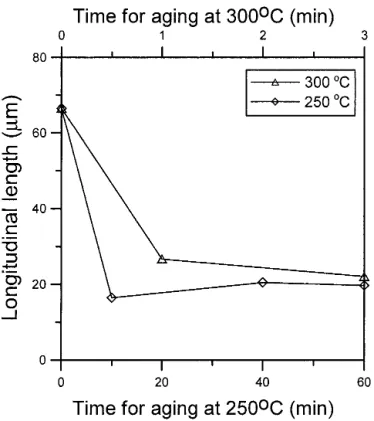
Fine Ag–Zn dendrites were found in the upper region of the Sn–Zn–Ag specimen when held at 250 °C [Figs. 11(a) and 11(b)], while similar dendrites were distributed throughout the whole specimen when aged at 300 °C [Figs. 11(c) and 11(d)]. Given that the solubility of Ag in the Sn–Zn eutectic structure was limited,13the formation of these fine Ag–Zn particles must be closely related to the partial or complete melting of the original Ag–Zn dendrites during high temperature soaking. The released Ag atoms combined with Zn atoms in the melt promoted formation of additional Ag–Zn dendrites during the quench process. Figure 12 indicates that these fine Ag– Zn intermetallic dendrites retain a PDL of about 20m, regardless of the aging time. The fine dendrites quenched from 300 °C possessed a slightly greater particle size than those quenched from 250 °C. This phenomenon was attributed to the quenching period from 300 °C being longer than that from 250 °C.
V. CONCLUSIONS
The addition of Ag into Sn–Zn solder resulted in the formation of ␥–Ag5Zn8 and ⑀–AgZn3 intermetallics in the Sn–Zn eutectic region. The consumption of Zn in the formation of intermetallics gave rise to the appearance of an off-eutectic structure. Ag–Zn intermetallics crystallize at temperatures slightly below 300 °C upon cooling. Aging of the liquid phase Sn–Zn–Ag at 250 °C produced spheroidal Ag–Zn intermetallics that grew and settled in the specimen. Aging at 300 °C resulted in rapid dissolu-tion of pre-existing Ag–Zn intermetallic dendrites.
ACKNOWLEDGMENT
The authors acknowledge the financial support from National Science Council of the Republic of China under Grant No. NSC 91-2216-E-006-054.
REFERENCES
1. W. Yang and R.W. Messler, Jr., J. Electron. Mater. 23, 765 (1994). 2. H. Mavoori, J. Chin, S. Vaynman, B. Moran, L. Keer, and
M.E. Fine, J. Electron. Mater. 41, 1269 (1997).
3. M. McCormack, S. Jin, and G.W. Kammlott, in Proceedings of the 1995 IEEE International Symposium on Electronics and the En-vironment, ISEE, Orlando, FL (The Institute of Electrical and Electronics Engineers, Inc., Piscataway, NJ, 1995), p. 171. 4. F. Hua and J. Glazer, Design & Reliability of Solders and Solder
Interconnections, edited by R.K. Mahidhara, D.R. Frear, S.M.L. Sastry, K.L. Murty, P.K. Liaw, and W.L. Winterbottom (TMS, Warrendale, PA, 1997), p. 65.
5. S. Vaynman and M.E. Fine, Scripta Mater. 41, 1269 (1999). 6. T. Takemoto, T. Funaki, and A. Matsunawa, Welding Research
Abroad 46, 20 (2000).
7. M. McCormack and S. Jin, J. Electron. Mater. 23, 715 (1994). 8. J.M. Song, G.F. Lan, T.S. Lui, and L.H. Chen, Scripta Mater. 48,
1047 (2003).
9. J.M. Song, G.F. Lan, T.S. Lui, and L.H. Chen, in Proc. 4th In-ternational Symposium on Electronic Materials and Packaging, IEEE-CPMT, Dec. 4–6, 2002, Kaohsiung, Taiwan (The Institute of Electrical and Electronics Engineers, Inc., Piscataway, NJ). 10. I. Karakaya and W.T. Thompson, Bull. Alloy Phase Diag. 8, 340 (1987). 11. K. Suganuma, S.H. Huh, K. Kim, H. Nakase, and Y. Nakamura,
Mater. Trans. 42, 286 (2001).
12. O. Kubaschewski and J.A. Catterall, Thermochemical Data of Alloys (Pergamon Press, London, U.K., 1956), p. 69.
13. T.B. Massalski, Binary Alloy Phase Diagrams, (ASM, Metals Park, OH, 1986), Vol. 1.
14. D.A. Porter and K.E. Easterling, Phase Transformations in Metals and Alloys, 2nd ed. (Chapman and Hall, London, U.K., 1992), p. 42.
FIG. 12. Primary dendrite length of the fine Ag–Zn dendrites in the samples after aging at 250 and 300 °C.