Learning Effects of
Preferral-Word-Recognition Intervention
for 1
stGrade Students with Learning
Difficulties
Chiu-Hsia Huang
Abstract
The purpose of this study was to investigate the learning effects of Preferral-Word-Recognition-Intervention (PWRI) for assessing four elementary risky
students with learning difficulties mainly in Chinese word-recognition. This study
was used the percentile (%), Tryon’sC statisticand
2
f scores to analyze all subjects’
learning effects. There were five formal assessments and one informal assessment.
A-B-A' single subject research design consisted of the baseline, PWRI and maintaining phases. The resultsofTryon’sC statistic, z scores and
2
f scores were
indicated that three subjects got good learning effects toward PWRI, but only one
subject didn’tmakea significant learning difference. After withdrawing PRWI, four
subjects maintained learning effects. In addition, the main types of word-recognition
errors were included errors with similar pronunciation-forms, similar pronunciations and different forms.
Keywords: Preferral-Word-Recognition-Intervention, students with leaning difficulties, learning effects
壹 、 緒 論
國 內 對 於 顯 著 學 習 困 難 或 疑 似 學 習 障 礙 學 生,往 往 由 普 通 班 教 師 先 發 覺 後,繼 而 通 知 校 內 輔 導 單 位,蒐 集 相 關 資 料 與 通 報 教 育 局,個 案 皆 得 逐 一 於 繁 瑣、漫 長 與 嚴 謹 的 鑑 定 流 程 而 接 受 審 理。有 時 因 資 料 不 齊 或 其 他 疑 慮,個 案 會 當 場 被 退 件 而 擇 期 再 審;有 時 還 會 於 鑑 定 流 程 而 往 返 好 幾 回,如 此 一 來 可 能 就 會 延 宕 個 案 及 早 發 現 與 及 早 接 受 介 入 的 關 鍵 期。個 案 唯 有 通 過 鑑 定 流 程 的 審 查 後,才 可 能 受 到 關 注 與 接 受 後 續 的 特 教 服 務。本 研 究 者 認 為 如 此 耗 時 與 繁 瑣 的 鑑 定 流 程,會 讓 顯 著 學 習 困 難 的 學 生,特 別 是 低 年 級,錯 失 了 黃 金 補 救 期,但 教 學 介 入 反 應 似 乎 可 能 解 決 上 述 學 習 障 礙 鑑 定 流 程 的 長 期 迷 思 。 本 研 究 旨 在 探 討 轉 介 前 識 字 教 學 介 入 對 四 位 國 小 一 年 級 識 字 困 難 學 童 的 整 體 學 習 效 果 ; 比 較 與 分 析 受 試 者 於 各 階 段 (基 線 期 、 處 理 期 與 追 蹤 期 )的 學 習 效 果 是 否 有 顯 著 的 差 異 ; 以 及 歸 納 受 試 者 於 各 階 段 五 種 識 字 評 量 的 最 常 見 錯 誤 類 型 分 析 。 本 研 究 者 茲 將 分 述 說 明 如 後 。一 、 研 究 背 景
或 被 標 記 等 問 題 衍 生 ; 也 能 滿 足 學 生 的 學 習 需 求 。 由 上 述 可 知 , 繼 RTI 的 概 念 萌 芽 與 盛 行 後 , 或 許 讓 長 期 飽 受 爭 議 的 學 習 障 礙 鑑 定 流 程 , 可 以 帶 來 新 期 待 、 新 希 望 與 新 願 景 。
美 國 特 殊 兒 童 協 會 (Council for Exceptional Children: CEC,2006) 提 及 關 於 RTI 的 願 景 與 冒 險 (the promise and the peril); RTI 是 好 是 壞,實 在 很 難 一 言 以 蔽 之 就 能 說 得 清 楚 的。乍 看 之 下,它 是 一 種 診 斷 學 習 障 礙 的 方 法,扮 演 著 一 個 非 常 重 要 的 角 色,重 要 到 足 以 讓 我 們 轉 變 如 何 教 育 學 生 --所 有 學 生 的 想 法 。 CEC(2007)也 提 及 於 RTI 高 峰 會 議,談 論 許 多 關 於 RTI 的 應 用、現 代 與 未 來 的 議 題。美 國 教 育 署 (U.S. Department of Education)宣 稱 RTI 的 巔 峰 期 始 於 2007 年 12 月 6 至 7 日 , 由 專 家 學 者 摘 述 RTI 主 要 發 表 的 文 章 ; IDEA 也 擬 定 新 條 款 。 由 此 得 知 , RTI 漸 為 當 代 很 重 要 的 教 育 議 題 與 未 來 的 新 趨 勢 。 Coleman(2008)認 為 RTI 似 乎 迫 使 我 們 以 不 同 的 新 思 維 方 式 , 思 考 我 們 如 何 滿 足 學 生 的 學 習 需 求,此 種 新 方 式 的 思 維,卻 停 滯 於 文 字 表 面 的 詮 釋 而 深 陷 困 境 中 。 學 者 專 家 們 對 於 支 持 或 反 對 RTI 應 採 取 何 種 的 執 行 模 式 與 實 施 流 程 等 論 述,直 至 今,仍 眾 說 紛 紜、莫 衷 一 是, 爭 議 從 不 間 斷 。 於 IDEA-2004 法 令 保 護 之 下 , 教 學 介 入 服 務 提 供 給 學 習 困 難 或 高 危 險 學 習 困 難 學 童 等 。 RTI 具 有 兩 種 重 要 目 的 : (1)提 供 早 期 介 入 的 服 務;(2)提 供 診 斷 學 習 障 礙 的 替 代 方 法。Bender 與 Shores(2007); Lerner 與 J ohns(2009)等 提 及 RTI 似 乎 已 被 許 多 學 者 專 家 視 為 是 21 世 紀 特 教 服 務 概 念 的 新 轉 變,不 僅 影 響 美 國 特 殊 教 育 的 未 來 趨 勢,也 影 響 了 其 他 國 家 特 殊 教 育 的 發 展 趨 勢。國 外 RTI 的 相 關 研 究 者,例 如 :
Fuchs 與 Fuchs(20 05) ; Fletcher 與 Vaughn (2007) ; Hoover 與
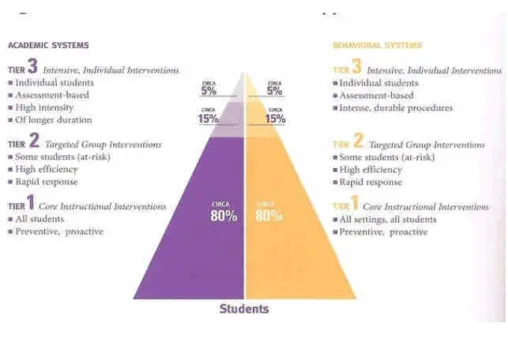
圖 一 三 階 段 的 介 入 模 式 (3 -T iered Interventio n Mo d els)
參考資料:Continue of School-Wide Support. National Research Center on Learning Disabilities. www.ncrid.org. The General Three-Tier RTI Model is illustrated in Figure 1. National Center on Response to Intervention. http://www.rti4success.org and Bradley, Danielson & Doolittle (2007).
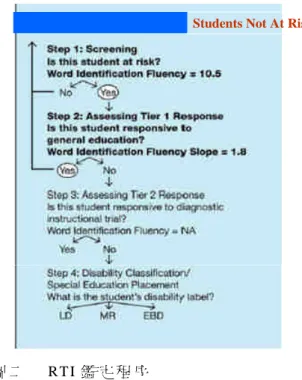
Barn es 與 Harlacher(2008); Gersten, Compton,Connor, Dimino, Santoro, Linan-Tho mpson 與 Till y(200 9)等 提 出 繁 瑣 的 鑑 定 流 程 似 乎 得 先 等 到 學 生 學 習 失 敗 後,教 師 才 會 思 考 補 救 教 學 的 問 題。若 能 於 鑑 定 流 程 之 前 , 對 於 普 通 教 育 無 顯 著 學 習 反 應 或 輔 導 無 效 的 高 風 險 學 生,由 普 通 班 教 師 先 進 行 全 面 的 篩 選,早 期 發 現 學 習 或 行 為 問 題,以 提 供 早 期 的 補 救 服 務。若 於 接 受 一 學 期 或 一 年 補 救 服 務 後,仍 無 顯 著 進 步 的 高 風 險 學 生,教 師 就 將 他 們 學 習 無 反 應 或 學 習 表 現 欠 佳 等 相 關 資 料 送 至 鑑 定 安 置 會 議 進 行 審 理;確 認 後,即 提 供 後 續 的 特 教 服 務 。 RTI 似 乎 可 能 解 決 以 上 鑑 定 學 習 障 礙 流 程 的 迷 思 , Bradley, Danielson 與 Doolittle(2007);Fuchs 與 Fuchs(2005)等 提 及 RTI 三 階 段 的 介 入 模 式 (請 見 圖 一 )、 鑑 定 程 序 (請 見 圖 二 )與 診 斷 學 習 障 礙 的 高 鑑 定 率 。
RTI 鑑定程序
Students Not At Risk
圖 二 R T I 鑑 定 程 序
資料來源:Response-To-Intervention(RTI). As a Method of LD Identification: Four Cases Studies. Fuchs & Fuchs,2005.
本 研 究 者 針 對 RTI 模 式 與 應 用 於 各 學 科 的 實 驗 教 學 研 究 , 分 述 說 明 如 下 :
(一 )RTI 模 式
選 與 實 施 為 期 五 週 監 控 學 生 的 進 步 情 形 的 話,如 此 就 可 早 期 發 現 哪 些 學 生 對 於 普 通 教 育 輔 導 有 學 習 反 應 或 哪 些 無 學 習 反 應 的。若 於 篩 選 時 一 旦 被 發 現 對 於 教 學 無 反 應 的 學 生,就 應 進 入 能 提 供 更 適 切 的 二 階 段 介 入 模 式;由 科 學 資 料 本 位 的 檢 視 後,若 發 現 某 學 生 不 僅 於 學 習 表 現 程 度 與 學 習 表 現 成 長,出 現 了 雙 重 差 距 的 話,此 詮 釋 了:有 教 學 介 入 反 應 與 無 教 學 介 入 反 應 的 最 佳 驗 證 。 由 上 述 得 知,RTI 模 式 的 優 點,包 括:(1)RTI 強 調 於 研 究 有 效 的 教 學 應 用 , 能 立 即 提 供 有 需 求 學 生 的 協 助 , 但 RTI 並 非 是 等 待 失 敗 的 模 式 ; (2)確 認 學 生 的 學 習 問 題 並 非 因 教 學 不 當 而 導 致 的 ; (3)蒐 集 評 量 資 料 的 目 的 是 要 通 知 教 師 與 改 善 教 學 之 用,而 評 量 與 介 入 是 有 密 切 的 聯 結 性 ; 以 及 (4)某 些 RTI 模 式 (如 : Heartland,IA)對 於 教 學 介 入 無 反 應 者 是 不 會 被 標 記 的 。 標 記 只 是 污 名 化 與 歸 類 障 礙 類 別 (例 如 : 學 習 障 礙、情 緒 障 礙、智 能 障 礙 ),標 記 僅 具 有 少 許 的 教 育 意 義 而 已 。 事 實 上,至 今 沒 有 任 何 一 種 診 斷 或 提 供 服 務 是 絕 對 完 美 無 缺 的 ; RTI 到 底 是 不 是 有 效 的 或 如 何 進 行 ? 此 議 題,一 直 以 來 爭 議 不 斷,卻 苦 無 正 解。對 於 RTI 模 式 的 應 用 與 實 施 流 程,RTI 是 否 有 對 學 生 產 生 學 習 反 應 等 問 題 , 學 者 專 家 們 一 直 以 來 都 存 在 著 許 多 不 分 軒 輊 的 論 述。例 如:Kavale 等 人 (2008)對 於 RTI 模 式 抱 持 著 相 當 保 留 存 疑 的 態 度 ; 相 反 地 , 對 於 RTI 模 式 抱 持 著 相 當 支 持 者 , 例 如 : Fuchs 與
Fuchs(2005); Fletcher 與 Vaughn(2 009) ; Fuchs, Fuchs 與
Hollenabeck y(2007)等 。 本 研 究 者 較 贊 同 VanDerHeyd en(2 006)提 出 的 論 述 : 學 校 裡 , 從 事 專 業 工 作 者 , 對 於 RTI 各 持 不 同 的 看 法 , 各 方 看 法 也 只 不 過 是 從 不 同 哲 學 的 角 度 觀 看 RTI。 但 , 各 方 觀 點 對 於 RTI 仍 抱 持 著 不 同 的 期 待,就 各 方 於 此 議 題 爭 議 的 立 場 而 言,身 為 教 學 實 務 者 或 研 究 者 來 說 , 那 是 很 難 說 誰 對 或 誰 錯 ? 本 研 究 者 針 對 RTI 的 相 關 研 究 與 結 果 發 現 , 分 述 說 明 如 下 :
(二 )RTI 的 相 關 研 究
協 助 孩 童 父 母 與 教 師 盡 早 發 現 3 或 4 歲 於 學 校 曾 經 歷 學 習 挫 敗 經 驗 的 高 危 險 學 童 , 被 轉 介 接 受 正 式 評 估 或 被 安 置 與 接 受 特 教 服 務 。 早 期 RTI 的 相 關 研 究 , 主 要 應 用 於 學 前 或 國 小 高 風 險 閱 讀 、 識 字 困 難 、 以 及 行 為 問 題 的 學 生,也 陸 續 被 應 用 於 其 他 年 齡 層 與 不 同 的 學 科 領 域 ; 例 如:國 小 中 高 年 級 閱 讀 與 識 字 困 難 學 生,國 高 中 數 學 困 難 學 生,甚 至 於 高 風 險 行 為 問 題 學 生 的 正 向 行 為 支 持 介 入 等。學 習 障 礙 全 國 研 究 中 心 (2006)指 出 於 長 堤 聯 合 校 區,學 校 支 持 服 務 處 的 副 督 導 提 出 許 多 關 於 校 內 執 行 RTI 的 實 際 問 題 與 成 效 經 驗 分 享。RTI 是 一 種 有 效 鑑 定 高 風 險 學 習 障 礙 學 生 的 模 式 , 全 國 許 多 州 與 校 區 皆 成 功 地 運 用 此 模 式 。 此 外 , VanDerHeyden, Witt 與 Gilbertson(2007)曾 進 行 多 年 評 估 與 驗 證 RTI 模 式 的 影 響 , 結 果 發 現 , 系 統 性 的 RTI 模 式 對 於 診 斷 與 評 估 的 應 用 影 響 非 常 大 的 。 Torgeson(2007)也 提 及 於 佛 州 閱 讀 研 究 中 心 , 應 用 RTI 模 式 教 導 早 期 閱 讀 介 入 與 診 斷 學 習 障 礙 學 生 的 高 鑑 定 率 , 結 果 顯 示 RTI 模 式 對 於 學 習 障 礙 學 生 鑑 定 率 是 有 影 響 的 。 由 許 多 佛 州 大 批 學 校 的 資 料 數 據 與 研 究 結 果 也 顯 示,RTI 具 有 立 即 學 習 的 影 響,早 期 閱 讀 教 學 介 入 確 實 能 有 效 診 斷 於 求 學 階 段 學 習 障 礙 學 生 的 高 鑑 定 率 ; RTI 具 備 了 預 防 與 解 決 問 題 的 功 能。 根 據 上 述 文 獻, 本 研 究 者 彙 整 國 內 外 RTI 應 用 於 各 學 科 的 研 究 結 果 , 分 述 說 明 如 下 : 1.J ustice(2006)與 Ukrainetz(2006)針 對 閱 讀 與 語 言 聽 說 困 難 學 生 進 行
RTI 研 究,結 果 顯 示 學 生 對 於 RTI 產 生 有 效 的 學 習 反 應。Koutsoftas, Harmon 與 Gar y(200 9)的 研 究 發 現 71%的 學 生 對 於 RTI 有 學 習 反 應 且 保 留 效 果。Vaughn, Wanzek, Murry, Scammacca, Linan-Thompson 與 Woodruff (2009) 也 發 現 , 接 受 教 學 介 入 後 , 國 小 低 年 級 學 生 的 閱 讀 理 解 與 認 字 能 力 皆 有 效 的 提 升,但 閱 讀 流 暢 度 卻 沒 有 顯 著 的 效 果 , 其 閱 讀 流 暢 度 仍 需 更 密 集 的 個 別 教 學 介 入 。
2.Duffy(2007)針 對 高 中 學 習 困 難 學 生 進 行 RTI 研 究 , 結 果 顯 示 , RTI 有 效 的 監 控 教 學 品 質 與 學 生 的 學 習 情 形,特 別 於 轉 銜 與 預 防 輟 學 的
監 控 標 的 介 入 是 相 當 有 效 的 。 Sandomierski, Kincaid 與
學 業 與 社 交 困 難 學 生 , 皆 是 有 效 的 學 習 反 應 。
3.Br yant(2005) 針 對 德 州 奧 斯 汀 (Austin) 社 區 的 幼 稚 園 至 國 小 二 年 級 學 生 , 進 行 多 階 段 的 數 學 教 學 介 入 模 式 , 提 供 PowerPoint、 投 影 片 與 其 他 輔 助 資 源 。 Gestern, Beckmann, Clarke, Foegen, Marsh, Star 與 Witzel(2009)透 過 RTI 以 協 助 國 小 與 國 中 數 學 困 難 的 學 生 。 上 述 的 兩 種 研 究 結 果 顯 示,大 多 數 學 生 對 於 數 學 教 學 介 入 皆 呈 現 有 效 的 學 習 反 應 。
響 , 本 研 究 者 猶 如 醍 醐 灌 頂 的 震 撼 , RTI 是 一 種 可 預 防 的 措 施、 可 提 供 早 期 介 入 的 服 務、可 替 代 來 診 斷 學 習 障 礙 的 機 制、也 可 應 用 於 普 通 班 外 加 式 的 教 學 介 入 。 本 研 究 者 根 據 上 述 RTI 相 關 研 究 結 果 , 擬 定 以 下 三 種 研 究 動 機 , 說 明 陳 述 如 後 。
二 、 研 究 動 機
由 於 21 世 紀 特 殊 教 育 服 務 於 概 念 上 的 轉 變 , 從 「 以 障 礙 類 別 進 行 安 置 及 提 供 教 育 措 施 」 思 維 至 「 對 介 入 無 顯 著 有 效 反 應 之 問 題 解 決 」、教 學 介 入 反 應 (RTI)的 解 決 之 道;有 些 專 家 學 者 會 將 RTI 與 PSM 視 為 同 義 異 詞 或 替 代 名 詞 (邱 上 真 , 2005)。 本 研 究 者 發 現 , 國 內 RTI 的 相 關 研 究 佐 證 , 目 前 數 量 仍 顯 得 相 當 不 足 與 匱 乏 的 , 實 需 有 更 多 RTI 實 驗 教 學 的 研 究,提 出 更 多 科 學 化 的 數 據 資 料 與 可 追 蹤 的 臨 床 研 究 , 以 驗 證 RTI 對 於 學 習 困 難 或 高 危 險 的 學 習 困 難 學 童 , 若 能 愈 早 發 現 問 題 與 愈 早 介 入 的 話 是 愈 有 效 的 論 證 。 本 研 究 者 源 自 以 下 重 要 思 維 的 影 響 , 茲 將 說 明 如 下 : (1)邱 上 真 (2002)提 及「 把 每 一 個 孩 子 帶 上 來 」(The No Child Left Behin d, NC LB) 的 理 念;(2)陳 麗 珠 (2007)提 出「 攜 手 計 畫 課 後 扶 助 」的 政 策;以 及 (3) 曾 世 杰 與 簡 淑 真 (2008)提 出 愈 早 鑑 定 愈 早 解 決 學 習 問 題;愈 晚 鑑 定 診 斷 愈 難,兒 童 就 愈 容 易 錯 過 最 好 的 補 救 教 學 時 機。由 於 上 述 重 要 思 維 的 影 響 , 本 研 究 者 擬 透 過 「 轉 介 前 識 字 教 學 介 入 」 以 驗 證 RTI 的 教 育 理 念 與 落 實 RTI 的 推 動 , 此 乃 研 究 動 機 之 一 。 本 研 究 者 亦 深 受 國 外 近 期 重 要 的 特 殊 教 育 法 案 , 例 如 : RTI 、 Universal Design forLearnin g(UDL) 、 Assistive Technology Act(P L108-364 , 2004) 與
受「 轉 介 前 識 字 教 學 介 入 」一 學 期 後,皆 呈 現 有 效 的 學 習 反 應; 僅 受 試 甲 的 學 習 效 果 的 提 升 並 不 是 很 明 顯。由 研 究 結 果 得 知,受 試 甲 疑 似 學 習 障 礙,於 接 受 一 學 期 外 加 式 與 調 整 課 程 的 補 救 教 學 介 入 後,學 習 反 應 仍 然 無 很 顯 著 的 提 升 , 應 繼 續 接 受 第 二 階 段 或 第 三 階 段 介 入 模 式,受 試 甲 所 需 的 是 更 密 集 的 個 別 教 學 介 入 或 延 長 教 學 介 入 時 間 與 頻 率 。 受 試 乙 與 受 試 丁 雖 接 受 第 二 層 級 介 入 模 式 的 小 組 補 救 教 學 介 入 後,目 前 仍 有 某 些 程 度 的 學 習 困 難;可 繼 續 提 供 後 續 密 集 的 小 組 教 學 介 入 模 式。受 試 丙 的 識 字 問 題 並 非 是 主 要 的 問 題,而 是 家 庭 功 能 欠 佳 與 行 為 問 題 所 間 接 影 響 教 學 介 入 的 效 果,他 最 迫 切 需 要 的 是 正 向 行 為 支 持 介 入,而 非 識 字 教 學 介 入。本 研 究 者 認 為 也 許 因 為 整 體 教 學 介 入 的 時 間 並 不 長 與 密 集 性 也 不 頻 繁。所 以,受 試 者 的 立 即 學 習 效 果 會 呈 現 正 向 的 學 習 效 果,但 保 留 維 持 效 果 就 不 見 得 會 如 此 了;若 能 延 長 教 學 介 入 時 間 或 增 加 個 別 化 密 集 的 教 學 介 入,或 許 會 更 有 助 於 受 試 者 長 期 的 保 留 學 習 效 果 。 此 外 , 本 研 究 結 果 , 應 證 了 Duff(2007); Gestern 等 人 (2009); J ustice(2006);Koutsoftas 等 人 (2009);Vaughn 等 人 (2009);曾 世 杰 與 陳 淑 麗 (2007); 曾 世 杰 與 簡 淑 真 (2008); 以 及 曾 世 杰 (2009)等 的 研 究 發 現,教 學 介 入 對 大 多 數 的 學 習 困 難 或 行 為 問 題 學 生 具 有 效 的 學 習 效
果 。 同 時 , 也 驗 證 了 四 位 受 試 者 皆 是 Bradle y,Dani elson 與
教 育 部 國 教 司 。 黃 秀 霜 (2002)。 中 文 年 級 認 字 量 表 。 台 北 : 心 理 出 版 社 。 黃 秀 霜、鄭 美 芝 (2003)。國 小 注 音 符 號 能 力 診 斷 測 驗。台 北:心 理 出 版 社 。 曾 世 杰 、 陳 淑 麗 (2007) 。 注 音 補 救 教 學 對 一 年 級 低 成 就 受 試 者 的 教 學 成 效 實 驗 研 究。國 立 政 治 大 學 教 育 與 心 理 研 究,教 育 與 心 理 研 究 , 30(3), 頁 53-77。 曾 世 杰 、 簡 淑 真 (2008) 。 學 障 可 以 早 鑑 定 出 來 ? 台 東 經 驗 的 分 享 。 台 灣 學 障 學 會( TALD)2008 年 會 員 大 會 手 冊,2008 年 3 月 1 日 , 高 雄 師 範 大 學 行 政 大 樓 六 樓 第 三 會 議 室 。 曾 世 杰 (2009) 。 教 學 研 究 難 為 : 以 轉 介 前 介 入 與 RTI 的 研 究 為 例 。 2009 年 4 月 27 日 , 屏 東 教 育 大 學 特 教 系 碩 士 班 專 題 演 講 資 料 。 教 育 部( 2008)。國 民 中 小 學 九 年 一 貫 課 程 綱 要 語 文 學 習 領 域。國 民 教 育 司 。 康 軒 編 輯 部 (2007) 。 國 民 小 學 國 語 一 下 (第 二 冊 )。 臺 北 : 康 軒 文 教 事 業 股 份 有 限 公 司 。 康 軒 編 輯 部 (2007) 。 國 民 小 學 國 語 教 師 手 冊 一 下 (第 二 冊 )。 臺 北 : 康 軒 文 教 事 業 股 有 限 公 司 。 ㄅ ㄆ ㄇ 動 物 歌 謠 (2004)。 風 車 圖 畫 書 出 版 社 。
American Institutes for Research (2009). RTI state database. In National
Center on Response to Intervention.
Barnes, A. C., & Harlacher, J. E. (2008). Clearing the confusion.
Response-to-intervention as a set of principles. Education and Treatment of
Children, 31(3), 417-431.
Belson, S. (2003). Technology for exceptional learners. Boston:Houghton Mifflin Company.
Bender, W. N., & Shores, C. (2007). Response to intervention: A practical
guide for every teacher. Council for Exceptional Children: Arlington,
VA.
state response to intervention initiatives in Northeast and Islands Region states (Issues & Answers Report, REL 2009–No. 083).
Washington, DC: U.S.
Bradley, R., Danielson, I., & Doolittle, J. (2005). Response to intervention.
Journal of Learning Disabilities, 38(6), 485-486.
Bradley, R., Danielson, L., & Doolittle, J. (2007). Responsiveness to intervention: 1997 to 2007. Teaching Exceptional Children, 30(5), 8-12.
Bryant, D. (2005). An emerging model: Three-tier mathemat ics intervention
model (K-2). Retrieved March, 27, 2010 from
www.k8accesscenter.org/documents/SERP-Math.DCAIRppt.ppt. Coleman, M. R. (2008). Words can shape the destiny of children in the RTI
process. In Council for Exceptional Children.
Coleman, M. R., Buysse, V., & Neitzel, J. (2006). Recognition and response: An early intervening system for young children at risk for learning disabilities—research synthesis and recommendations. In National
Center for Learning Disabilities.
Coleman, M. R., Buysse, V., & Neitzel, J. (2006). Empirical articles on response to intervention. In Recognition and Response.
Council for Exceptional Children (2007). Identifying learning disabilities.
In Council for Exceptional Children.
Danielson, L. (2004). Potential Advantages of RTI Approach. Retrieved June, 25, 2010 from
steinhardt.nyu.edu/scmsAdmin/uploads/000/453/RTIKeynotePMDaniels on.pdf.
Duffy, H. (2007). Meeting the needs of significantly struggling learners in high school: A look at approaches to tiered intervention. In National
High School Center, American Institutes for Research.
Faribanks, S., Sugai, G., Guardiano, D., & Lathrop, M. (2007). Response to intervention: Examining classroom behavior support n second grade.
Exceptional Children, 73(3), 283-310.
Fletcher, J. M., & Vaughn, S. (2007). Response to intervention: Preventing and remediating academic difficulties. Child Development Perspectives,
3, 3-27.
Fletcher, J. M., & Vaughn, S. (2009). Response to intervention: Preventing
and remediating academic difficulties and reading: Response to Intervention and multi-tier intervention. Retrieved March, 10, 2010
from www.bilingualspecialed.com/?m=200907.
Fuchs, D., & Deshler, D. D. (2007). What we need to know about responsiveness to intervention (and shouldn’tbe afraid to ask).
Learning Disabilities Research and Practice, 22(2), 129-136.
Fuchs, D., Fuchs, L. S., Compton, D., Bryant, J., & National Research
Center on Learning Disabilities (2005). Responsiveness-to-Intervention:
A New Method of Identifying Students with Disabilities. Council for
Exceptional Children Annual Convention.
Fuchs, D., & Fuchs, L. S. (2005). Response to intervention as a method of LD identification: Four case studies. In Tennessee Department of
Education.
Fuchs, D., & Fuchs, L. S. (2006). Introduction to response to intervention: What, why, and how valid is it? Reading Research Quarterly, 93-99. Fuchs, L. S., & Fuchs, D. (2006). Identifying learning disabilities with RTI.
Perspective: The International Dyslexia Association, 32(1), 39-40.
Fuchs, L. S., Fuchs, D., & Hollenabeck, K., N. (2007). Extending
responsiveness to intervention to mathematics in first and third grades.
Learning Disabilities Research & Practice, 22(1), 13-25(24).
Disabilities Research and Practice, 18(3), 157-171.
Gersten, R., Beckmann, S., Clarke, B., Foegen, A., Marsh, L., Star, J.R., & Witzel, B. (2009). Assisting students struggling with mathematics:
Response to Intervention (RtI) for elementary and middle schools (NCEE 2009 –4060).
Gersten, R., Compton, D., Connor, C.M., Dimino, J., Santoro, L., Linan-Thompson, S., & Tilly, W.D. (2009). Assisting students
struggles with reading: Response to Intervention and multi-tier intervention for reading in the primary grades. A practice guide
(NCEE 2009-4025). Washington, DC: National Center for Education Evaluation and Regional Assistance, Institute for Education Sciences, U.S.Department of Education. (ERIC Document Reproduction Service No.ED504-264).
Hale, J. B. (2006). Implementing IDEA 2004 With a Three-Tier Model That Includes Response to Intervention and Cognitive Assessment Methods.
School Psychology Forum: Research In Practice, 1(1), 16-27.
Hale, J. B., Kauffman, A. S., Naglieri, J. A., & Kavale, K. A. (2006). Implementation of IDEA: Integrating response to intervention and cognitive assessment methods. Psychology In The Schools, 43(7), 753-770.
Hale, J. B., Flanagan, D. P., & Naglieri, J. A. (2008). Alternative research-based methods for IDEA. Identification of children with specific learning disabilities. Communiqué, 36(8), 1, 14-17.
Hasselbring, T., & Glaser, C. (2000). Use of computer technology to help students with special needs. The Future of Children: Children and
Computer Technology, 10(2), 102-122.
Hoover, J. J., Patton, J. R. (2008). The Role of special education in a multitiered instructional system. Intervention in School and Clinic,
43(3), 195-202.
the prevention of reading difficulties. Language, Speech, and Hearing
Services in Schools, 37, 284–297.
Kavale, K. A., Spaulding, L. S. (2008). Is Response-to-Intervention good policy for specific learning disability? Learning Disabilities Research
& Practice, 23(4), 170-180.
Kavale, K. A., Kauffman, J. M., Bachmeier, R. J., & LeFever, G. B. (2008). Response-to-intervention: Separating the rhetoric of self-congratulation from the reality of specific learning disabilities identification. Learning
Disability Quarterly, 31, 135-150.
Koutsoftas, A.D., Harmon, M. T., & Gary, S. (2009). The effect of tier 2 intervention for phonemic awareness in a response-to-intervention model in low-income preschool classrooms. Language, Speech, and
Hearing Services in School, 40, 116-130.
Lerner, J., & Johns, B. (2009). Learning Disabilities and Related Mild
Disorders—Characteristics, Teaching Strategies and New Directions.
Houghton Mifflin Company.
Linan-Thompson, S., Cirino, P. T., & Vaughn, S. (2007). Determining English islearner’sresponse to intervention:Questionsand some answers. Learning Disabilities Quarterly, 30, 185-195.
Morgan, P. L., Fuchs, D., Compton, D. L., Cordray, D. S., & Fuchs, L. S. (2008).Doesearly reading failure decrease children’sreading motivation? Journal of Learning Disabilities, 41, 387-404.
National Center on Response to Intervention. Retrieved June, 25, 2010 from
http://www.rti4success.org.
National Joint committee on Learning Disabilities (2005). RTI as an
Eligibility Mechanism: Issue Responsiveness to Intervention and Learning Disabilities, pp.7-19, approved as an official paper, 2005.
National Joint committee on Learning Disabilities (2005). Responsiveness to
Intervention and Learning Disabilities, 28, 249-260.
within the specific learning disability determination process. Materials from the National SEA Conference on SLD Determination. In National
Research Center on Learning Disabilities.
National Research Center on Learning Disabilities (2007). Learning disabilities resource kit: Specific learning disabilities determination procedures and responsiveness to intervention. In National Research
Center on Learning Disabilities.
Sandomierski, T; Kincaid, D., & Algozzine, B. (2007). Response to intervention and positive behavior support: Brothers from different mothers or sisters with different misters? Positive Behavioral
Interventions and Supports Newsletter, 4(2), 1-4.
Torgeson, J. K. (2007). Using an RTI model to guide early reading instruction: Effects on identification rates for students with learning disabilities. In Florida Center for Reading Research.
Universal Design for Learning (UDL). Retrieved June, 25, 2010 from
http;//www.cast.org.
Vaughn, S., Wanzek, J., Murry, C.S., Scammacca, N., Linan-Thompson, S., & Woodruff, A. L. (2009). Response to early reading intervention: Examining higher and lower responders. Council for Exceptional
Children, 75(2), 165-183.
VanDerHeyden, A. M. (2006). RTI myths and representations: Looking at data and experience. NASP Communiqué, 34(6).
VanDerHeyden, A. M., Witt, J. C., & Gilbertson, D. (2007). A multi-year evaluation of the effects of a response to intervention: (RTI) model on identification of children for special education. Journal of School
Psychology, 45(2), 225–256.
U.S. Department of Education. (2009). American Recovery and
School Reform and Improvement. In National Center on Response to
Intervention.
Ukrainetz, T. A. (2006). The Implications of RTI and EBP for SLPs:
Commentary on L. M. Justice. Language, Speech, and Hearing Services
in Schools, 37, 298–303.
Zirkel, P. A., & Krohn, N. (2009). RTI after IDEA: A survey of state laws.