St. John’s wort significantly increased the systemic exposure and toxicity of methotrexate in rats
Shih-Ying Yanga, Shin-Hun Juanga,c, Shang-Yuan Tsaib, Pei-Dawn Lee Chaoband Yu-Chi Houb,c*
a Institute of Pharmaceutical Chemistry, China Medical University, Taichung, Taiwan.
b School of Pharmacy, China Medical University, Taichung, Taiwan.
c Department of Medical Research, China Medical University Hospital, Taichung, Taiwan.
Correspondence to:
Yu-Chi Hou, Ph.D.
School of Pharmacy China Medical University Taichung 40402, Taiwan
E-mail: [email protected]
Telephone: +886-4-22053366 ext 5133 Fax: +886-4-22031028
Abstract
St. John’s wort (SJW, Hypericum perforatum) is one of the popular nutraceuticals
for treating depression. Methotrexate (MTX) is an immunosuppressant with narrow therapeutic window. This study investigated the effect of SJW on MTX
pharmacokinetics in rats.
Rats were orally given MTX alone and coadministered with 300, 150 mg/kg of SJW and 25 mg/kg of diclofenac, respectively. Blood was withdrawn at specific time points and serum MTX concentrations were assayed by a specific monoclonal
fluorescence polarization immunoassay method.
The results showed that 300 mg/kg of SJW significantly increased the AUC0-t
and Cmax of MTX by 163% and 60%, respectively, and 150 mg/kg of SJW significantly increased the AUC0-t of MTX by 55 %. In addition, diclofenac enhanced the Cmax of MTX by 110%. The mortality of rats treated with SJW was higher than
that of controls.
In conclusion, coadministration of SJW significantly increased the systemic exposure and toxicity of MTX. The combined use of MTX with SJW would need to be with caution.
Key Words: St. John’s wort, Hypericum perforatum, methotrexate, pharmacokinetics,
Introduction
During the past decades, a speedy increase in the use of nutraceuticals has occurred in certain parts of the world, especially in Europe and North America. St.
John’s wort (SJW, Hypericum perfpratum L.) has been one of the popular nutraceuticals widely used in the treatments of anxiety, hysteria and depression for more than two decades (Bilia, et al. 2002, Volz 1997). However, a multitude of SJW
— drug interactions have been reported and most of these studies demonstrated that SJW significantly decreased the blood levels of a variety of drugs via inducing cytochrome P450 (CYP) and P-glycoprotein (P-gp), an efflux pump of numerous drugs (Izzo 2005, Paulke, et al. 2006, Singh 2005, Tirona and Bailey 2006,
Venkataramanan, et al. 2006).
SJW contains a number of polyphenols, such as hypercin, pseudohypericin, quercetin and rutin etc. (chemical structures shown in Fig. 1) (Erdelmeier 1998). It is now generally recognized that polyphenols are extensively metabolized by conjugation reaction in gut and/or liver (Piskula 2000) and present predominately as sulfates and glucuronides in the circulation (Hou, et al. 2000, Hou, et al. 2001, Hou, et al. 2003, Hsiu, et al. 2002), which exist as anions under pH 7.4 and thus are putative substrates of multi-drug resistance proteins (MRPs) and organic anion transporters (OATs) (Borst, et al. 2006, Endres, et al. 2006, Takeda, et al. 2002).
Methotrexate (MTX, chemical structure shown in Fig. 1), an anticancer agent and immunosuppressant, is a bicarboxylic acid with narrow therapeutic window. MTX has been used in the treatment of acute lymphoblastic leukemia (Evans, et al. 1986), osteosarcoma (Aquerreta, et al. 2004), psoriasis (Grim, et al. 2003) and rheumatic diseases (Burchini and Orsi 2004). The adverse reactions of MTX are nausea, vomiting, mucositis, diarrhea, stomatitis, myelosuppression and hepatotoxicity
(Carneiro-Filho, et al. 2004, Kuijpers and Van Der Kerkhof 2000).
In pharmacokinetic aspect, the unchanged MTX is mainly eliminated via kidney and less than 10% of the MTX is metabolized to 7-hydroxymethotrexate (Seideman, et al. 1993, Sonneveld, et al. 1986). MTX has been reported being a substrate of multi-drug resistance associated protein (MRP) 1, 2, 3, 4 (Chen, et al.
2002, Ito, et al. 2001, Zeng, et al. 2001) and organic anion transporter (OAT) 1, 2, 3, 4 (Kobayashi, et al. 2002, Lash, et al. 2006, Ohtsuki, et al. 2004, Uwai, et al. 1998).
Clinically, there have been lethal interactions reported between MTX and non- steroidal anti-inflammatory drugs (NSAIDs), such as ketoprofen (Thyss, et al. 1986) and naproxen (Ekstrom, et al. 1997). Other toxic NSAIDs — MTX interactions resulted in bone marrow suppression and acute renal failure (Kremer and Hamilton 1995, Tracy, et al. 1992). It has been proposed that hOAT 1, 3, 4 and possibly other transporters were involved in these pharmacokinetic interactions (Takeda, et al. 2002).
Given that glucuronides and sulfates of polyphenols are putative substrates of MRPs and OATs, we hypothesized that the conjugated metabolites of polyphenols in SJW might compete with MTX for renal excretion and resulted in serious toxic interaction as NSAIDs did. Therefore, this study investigated the effect of coadministration of SJW on the pharmacokinetics of MTX in rats. Furthermore, in order to identify the probable mechanism of interaction, MDCK II-MRP 2 cell line was used to evaluate the effects of SJW on MRP 2-mediated transport.
Materials and Methods
Materials
MTX (25 mg/mL) was obtained from Pharmachemia B.V. (Haarlem, the Netherlands). Diclofenac was purchased from Yung Shin Pharmaceutical Ind. Co., Ltd. (Taichung, R.O.C.). The SJW caplet was a commercial product of Vita Health Products Inc. (Winnipeg, Canada). The weight per caplet was 1500 mg with labeled content of 300 mg of SJW extract which has been standardized to contain 0.3%
hypericin. TDx kit of methotrexate was purchased from Abbot Laboratories (Abbot Park, IL, USA). Milli-Q plus water (Millipore, Bedford, MA, USA) was used throughout this study.
Preparation of SJW suspension for oral administration
Twenty caplets were triturated in a mortar to become fine powders and then mixed with 40 mL of Milli-Q plus water to afford a homogeneous suspension immediately before oral administration.
Animals and drug administration
Male Sprague-Dawley rats were furnished from National Laboratory Animal Center (Taipei, Taiwan) and nurtured in the Animal Center of China Medical University (Taichung, Taiwan). The animal study adhered to “The Guidebook for the Care and Use of Laboratory Animals (2002)” published by the Chinese Society of Animal Science, Taiwan. The protocol was approved by the Animal Management
Committee, China Medical University. Before experiments, rats were fasted overnight, but drinking water was allowed ad libitum. Food was supplied 3 h after dosing and every four rats were caged together during the experimental periods. A total of 26 rats weighing 350 - 420 g and aged 8 - 12 wk were used in this study, including 7 rats in the control group given MTX alone, 7 rats in each group receiving combined treatment of MTX with SJW, and 5 rats in the group receiving combined treatment with diclofenac. MTX solution (25 mg/mL) was diluted with Mill-Q plus water to make 2.5 mg/mL. A dose of 5 mg/kg was supplied orally to rats with and without an oral dose of SJW (300 mg/kg and 150 mg/kg of SJW) or diclofenac (25 mg/kg). SJW and diclofenac (as an in vivo positive control) were administered 30 min before MTX via gastric gavage. SJW suspension was freshly prepared every
time immediately before dosing and the suspension was very homogeneous.
Blood collection
Blood samples (0.5 mL) were withdrawn via cardiopuncture before and at 15, 30, 60, 120, 240 and 480 min and 6, 12, 24, 36 and 48 h after MTX dosing and centrifuged at 10,000 g for 15 min twice to obtain the serum which was stored at
-20℃ until analysis.
Determination of MTX concentration in serum
MTX concentration in serum was measured by a specific monoclonal fluorescence polarization immunoassay (Abbott, Abbott Park, IL, USA). The assay was calibrated
for concentrations from 0 to 1.0 μM and validation of the calibration curve was carried out by testing three controls with concentrations of 0.07, 0.4 and 0.8 μM right
before the assay of samples. The lower limit of quantitation was 0.02 μM.
Cell line and culture conditions
Madin-Darby canine kidney type II cells transfected with human MRP2 (MDCK II-MRP 2) were kindly provided by Prof. Dr. Piet Borst (Netherlands Cancer Institute, Amsterdam, Netherlands). Cells were grown in DMEM medium supplemented with 10% FBS, 100 units/mL of penicillin, 100 μg/mL of streptomycin, and 292 μg/mL of glutamine at 37ºC in a humidified incubator containing 5% CO2. The medium was changed every other day and cells were subcultured when 80% to 90% confluency
was reached.
Preparation of serum metabolites of SJW
In order to mimic the molecules interacting with MRP 2 of kidney cells in vivo, the
serum metabolites of St. John’s wort (SJWM) were prepared from rats. SJW suspension was orally administered to rats fasted overnight. Blood was collected at 30 min after dosing. After coagulation, the serum was vortexed with 4-fold methanol.
After centrifuging at 10,000 g for 15 min, the supernatant was concentrated in a rotatory evaporator under vacuum to dryness. To the residue, appropriate volume of water was added to afford a solution with 10-fold serum concentration, which was divided into aliquots and stored at -80℃ for later use. Blank serum was collected
from rats and processed likewise to prepare controls for comparison with
correspondent SJWM.
Effects of SJWM on MRP 2 activity
The transport assay of chloromethylfluorescein diacetate (CMFDA), a precursor of MRP 2 substrate, was modified from a previous method (Jia, et al., 2008). MDCK II-MRP 2 was used as a cell model to evaluate the effect of SJWM on the intracellular accumulation of glutathione-methylfluorescein (GSMF), the hydrolysis product of CMFDA. Briefly, MDCK II-MPR 2 cells (1x10⁵ cells/well) were cultured in a 96-well plate. After overnight incubation, the medium was removed and washed three times with ice-cold PBS buffer. The tested agents (MK571 or SJWM) and CMFDA were added into each well. After 30-min incubation, the supernatants were removed and washed with ice-cold PBS. Subsequently, 100 μL of 0.1 % Triton X-100 was added to lyse the cells. The fluorescence was measured with excitation at 485 nm and emission at 528 nm. To quantitate the content of protein in each well, 10 μL of cell lysate was added to 200 μL of diluted protein assay reagent (Bio-Rad, Hercules, CA, U.S.A.) and the optical density was measured at 570 nm. The relative intracellular accumulation of
GSMF was calculated by comparing with that of control after protein correction.
Data analysis
The peak serum concentration (Cmax) was acquired from perceptible observation.
The pharmacokinetic parameters of MTX were analyzed by noncompartmental model
of the program WINNONLIN (version 1.1 SCI software, Statistical Consulting, Inc., Apex, NC). The area under the serum concentration-time curve (AUC0-t) was calculated using trapezoidal rule to the last point. One-way ANOVA was used for statistical comparison taking p < 0.05 as significant.
Results
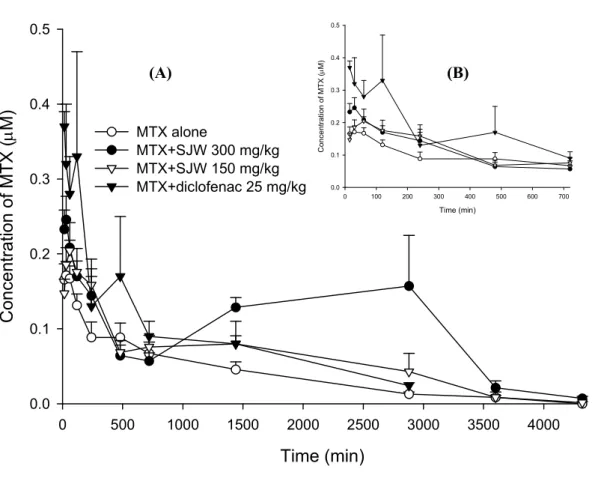
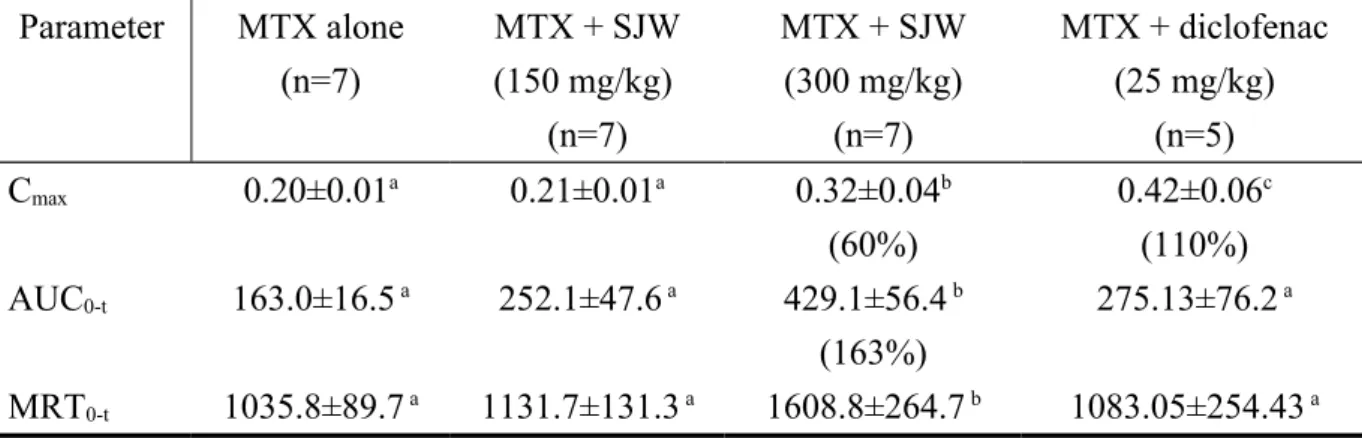
The serum profiles of MTX after oral administration of MTX alone and coadministration with SJW (300 mg/kg and 150 mg/kg) and diclofenac (25 mg/kg) are shown in Fig. 2. MTX was absorbed rapidly and the Tmax appeared within the first hour after dosing. The pharmacokinetic parameters of MTX after various treatments are listed in Table 1. The results showed that coadministration of 300 mg/kg of SJW significantly increased the AUC0-t of MTX by 163%, enhanced the Cmax by 60%.
While 150 mg/kg of SJW was coadministered, the AUC0-t of MTX was significantly increased by 55 %, whereas other parameters were not significantly affected. When diclofenac was coadministered with MTX, the Cmax, of MTX was significantly
enhanced by 110%.
Upon observing the rats throughout the whole experiment, several ones in the treatment groups receiving MTX with SJW were found becoming weaker and weaker with time. At 72 h after MTX dosing, the body weights of rats in the treatment groups reduced by 50-100 g, whereas those in control group reduced only for 30-50 g. Surprisingly, 3/7 and 2/7 of rats died in the groups coadministered with 300 mg/kg and 150 mg/kg of SJW, respectively, during day 6 and day 10. In contrast, the seven rats given MTX alone all survived very well throughout the whole experiment period.
In order to identify the probable involvement of MRP 2 in this pharmacokinetic interaction, MDCK II-MRP 2 cells were used for evaluating the effect of SJWM on the efflux of GSMF, a substrate of MRP 2. The accumulations of GSMF in MDCK II-MRP 2 cells measured after 30-min incubation with tested agents are shown in Figure 3. The positive control MK571 at 10 μM significantly increased the intracellular accumulation of GSMF by 183 %, whereas the solvent DMSO at 0.25 % (v/v) did not show significant effect. SJWM at 1-, 0.5- and 0.25- fold serum concentrations significantly increased the intracellular accumulation of GSMF by 42, 56 and 57 %, respectively.
Discussions
Our results showing that coadministration of 300 mg/kg of SJW significantly increased the Cmax and AUC0-t of MTX indicated that SJW increased the oral bioavailability of MTX. Comparison of the serum profiles of MTX revealed that SJW
conspicuously inhibited the elimination of MTX.
In literature, SJW has been consistently reported reducing the plasma levels of a variety of drugs, such as cyclosporine, digoxin, indinavir, nevirapine, theophylline and warfarin, and leading to diminished efficacy (Bilia, et al. 2002, Dresser, et al.
2003, Dürr, et al. 2000). Subsequently, several mechanism studies have reported that SJW induced CYP 3A4 expression and increased the activities of other CYP enzymes such as CYP1A2, 2D6 and 2C9 (Singh 2005, Tirona and Bailey 2006). In addition, several studies revealed that long-term or short-term administration of SJW led to coordinated increased expression of P-gp and CYP 3A4 (Dresser, et al. 2003, Dürr, et al. 2000). Taken together, the inductive modulation on CYPs and P-gp by SJW can account for the decreased plasma levels of various drugs which are substrates of P-gp and/or CYPs. However, contrary to all previous findings, the present study unearthed that SJW significantly increased the Cmax and AUC of MTX, which was a substrate of MRPs and OATs rather than P-gp.
In regard to the underlying mechanism of this SJW — MTX interaction, the
membrane transporters MRPs and OATs, which are known to be associated with renal excretion of acidic drugs, might play important role (Kusuhara and Sugiyama 2002, Sekine, et al. 2000). Representing a positive control of MRP 2 inhibitor in this study, diclofenac significantly increased the bioavailability of MTX in rats, which was in a similar manner and but in lesser magnitude to that caused by 300 mg/kg of SJW.
Therefore, we speculate that combined use of SJW with MTX might result in toxic
interaction as diclofenac did (Thakrar, et al. 2007).
The polyphenols in SJW have been found extensively metabolized in rats to sulfates and glucuronides (Paulke, et al. 2006), which should exist as anions under physiological pH and thus are putative substrates of MRPs and OATs. Because the majority of MTX was excreted as parent form via urine, the conjugated metabolites of polyphenol in SJW may rival with MTX for urinary excretion mediated by MRPs and OATs, which could explain the decreased elimination of MTX as seen from the serum profiles. The underlying mechanism of SJW—MTX interaction was thus proposed to
be similar to those in NSAIDs—MTX interactions (Nozaki, et al. 2007).
As shown in Figure 3, the serum metabolites of SJW at 0.25-, 0.5- and 1.0-fold serum concentration all demonstrated significant inhibition on the activity of MRP 2, which can account for the decreased elimination of MTX caused by SJW. We speculate that this MRP 2—mediated SJW-MTX interaction in rats might be
extrapolated to humans, because the distributions and functions of MRPs in rats are
similar to those in humans (You 2004).
More importantly, the combined use of SJW with MTX resulted in toxic interaction which was evidenced by the increased mortality of rats. MTX is known to be polyglutamated by folylpoly-γ-glutamate synthetase (FPGS) to yield MTX-glu2-7
derivatives which are not pumped out by MRPs. The higher number of glutamates conjugated, the longer the metabolites remain in cells and result in higher cytotoxicity (Genestier, et al. 2000, Kool, et al. 1999, Saxena and Henderson 1996). A competition between the transport of MTX by MRPs and the conversion into MTX-glu2-7 by FPGS has been reported (Kool, et al. 1999, Zeng, et al. 2001). Nevertheless, MRPs have low affinity to MTX, thus MTX was transformed into MTX-glu2-7 more easily at low concentration. A long exposure of MTX at low concentration was found more toxic than high concentration (Widemann and Adamson 2006). Therefore, the higher mortality of rats receiving SJW with MTX can be accounted for by the longer
exposure of MTX at low serum concentration caused by SJW.
Botanical products are increasingly used as nutraceuticals worldwide in recent decades. However, their safety remains underinvestigated. In this study, SJW, a polyphenol – rich antidepressant nutraceutical, has shown inhibition on the elimination of methotraxate, a critical acid drug (Zeng, et al. 2001). We suggest that
more animal or clinical studies to investigate the interactions of SJW with critical acid
drugs are recommended for drug safety.
In conclusion, coadminstration of SJW notably resulted in higher systemic exposure and toxicity of MTX. We suggest that caution would need to be exercised when SJW is concurrently used with critical acid pharmaceuticals.
Acknowledgement
The work was, in part supported by the National Science Council, R.O.C.
(NSC99-2320-B-039-017-MY3 and NSC99-2320-B-039-005-MY3); and China Medical University, Taichung, Taiwan, R.O.C. (CMU98-S-34).
References
Aquerreta, I., Aldaz, A., Giraldez, J., Sierrasesumaga, L., 2004. Methotrexate pharmacokinetics and survival in osteosarcoma. Pediatr. Blood Cancer. 42, 52-58.
Bilia, A.R., Gallori, S., Vincieri, F.F., 2002. St. John's wort and depression:: Efficacy, safety and tolerability-an update. Life Sci. 70, 3077-3096.
Borst, P., Zelcer, N., Van De Wetering, K., 2006. MRP2 and 3 in health and disease.
Cancer Lett. 234, 51-61.
Burchini, G., Orsi, C., 2004. Rheumatoid arthritis. N. Engl. J. Med. 351, 1360-1;
author reply 1360-1.
Carneiro-Filho, B., Lima, I., Araujo, D., Cavalcante, M., Carvalho, G., Brito, G., Lima, V., Monteiro, S., Santos, F., Ribeiro, R., 2004. Intestinal barrier function and secretion in methotrexate-induced rat intestinal mucositis. Dig. Dis. Sci. 49, 65-72.
Chen, Z.S., Lee, K., Walther, S., Raftogianis, R.B., Kuwano, M., Zeng, H., Kruh, G.D., 2002. Analysis of methotrexate and folate transport by multidrug resistance protein 4 (ABCC4). Cancer Res. 62, 3144.
Dresser, G.K., Schwarz, U.I., Wilkinson, G.R., Kim, R.B., 2003. Coordinate induction of both cytochrome P4503A and MDRI by St John's wort in healthy subjects.
CLINICAL PHARMACOLOGY AND THERAPEUTICS-ST LOUIS- 73, 41-50.
Dürr, D., Stieger, B., Kullak-Ublick, G.A., Rentsch, K.M., Steinert, H.C., Meier, P.J., Fattinger, K., 2000. St John's Wort induces intestinal P-glycoprotein/MDR1 and intestinal and hepatic CYP3A4&ast. Clinical Pharmacology & Therapeutics 68, 598- 604.
Ekstrom, P.O., Giercksky, K.E., Andersen, A., Slordal, L., 1997. Alterations in methotrexate pharmacokinetics by naproxen in the rat as measured by microdialysis.
Life Sci. 60, PL359-PL364.
Endres, C.J., Hsiao, P., Chung, F.S., Unadkat, J.D., 2006. The role of transporters in drug interactions. European journal of pharmaceutical sciences 27, 501-517.
Erdelmeier, C., 1998. Hyperforin, Possible the Major NonNitrogenous Secondary Metabolite of Hypericum perforatum L. Pharmacopsychiatry 31, 2-6.
Evans, W.E., Crom, W.R., Abromowitch, M., Dodge, R., Look, A.T., Bowman, W.P., George, S.L., Pui, C.H., 1986. Clinical pharmacodynamics of high-dose methotrexate in acute lymphocytic leukemia. N. Engl. J. Med. 314, 471-477.
Genestier, L., Paillot, R., Quemeneur, L., Izeradjene, K., Revillard, J.P., 2000.
Mechanisms of action of methotrexate. Immunopharmacology 47, 247.
Grim, J., Chladek, J., Martinkova, J., 2003. Pharmacokinetics and pharmacodynamics of methotrexate in non-neoplastic diseases. Clin. Pharmacokinet. 42, 139-151.
Hou, Y.C., Hsiu, S.L., Huang, T.Y., Yang, C., Tsai, S.Y., Chao, P.D.L., 2001. Effect of honey and sugars on the metabolism and disposition of naringin in rabbits. Planta Med. 67, 538-541.
Hou, Y.C., Hsiu, S.L., Yen, H.F., Chen, C.C., Chao, P.D.L., 2000. Effect of honey on naringin absorption from a decoction of the pericarps of Citrus grandis. Planta Med.
66, 439-443.
Hou, Y., Chao, P., Ho, H., Wen, C., Hsiu, S., 2003. Profound difference in pharmacokinetics between morin and its isomer quercetin in rats. J. Pharm.
Pharmacol. 55, 199-203.
Hsiu, S.L., Huang, T.Y., Hou, Y.C., Chin, D.H., Chao, P.D.L., 2002. Comparison of metabolic pharmacokinetics of naringin and naringenin in rabbits. Life Sci. 70, 1481- 1489.
Ito, K., Oleschuk, C.J., Westlake, C., Vasa, M.Z., Deeley, R.G., Cole, S.P.C., 2001.
Mutation of Trp1254 in the multispecific organic anion transporter, multidrug resistance protein 2 (MRP2)(ABCC2), alters substrate specificity and results in loss of methotrexate transport activity. J. Biol. Chem. 276, 38108.
Izzo, A.A., 2005. Herb–drug interactions: an overview of the clinical evidence.
Fundam. Clin. Pharmacol. 19, 1-16.
Jia, J.X., Wasan, K.M., 2008. Effects of monoglycerides on rhodamine 123 accumulation, estradiol 17 beta-D-glucuronide bidirectional transport and MRP2 protein expression within Caco-2 cells. J. Pharm. Pharm. Sci. 11, 45-62.
Kobayashi, Y., Ohshiro, N., Shibusawa, A., Sasaki, T., Tokuyama, S., Sekine, T., Endou, H., Yamamoto, T., 2002. Isolation, characterization and differential gene expression of multispecific organic anion transporter 2 in mice. Mol. Pharmacol. 62, 7.
Kool, M., Van Der Linden, M., De Haas, M., Scheffer, G.L., De Vree, J.M.L., Smith, A.J., Jansen, G., Peters, G.J., Ponne, N., Scheper, R.J., 1999. MRP3, an organic anion transporter able to transport anti-cancer drugs. Proceedings of the National Academy of Sciences 96, 6914.
Kremer, J., Hamilton, R., 1995. The effects of nonsteroidal antiinflammatory drugs on methotrexate (MTX) pharmacokinetics: impairment of renal clearance of MTX at weekly maintenance doses but not at 7.5 mg. J. Rheumatol. 22, 2072-2077.
Kuijpers, A., Van Der Kerkhof, P., 2000. Risk-benefit assessment of methotrexate in the treatment of severe psoriasis. American Journal of Clinical Dermatology 1, 27-39.
Kusuhara, H., Sugiyama, Y., 2002. Role of transporters in the tissue-selective distribution and elimination of drugs: transporters in the liver, small intestine, brain and kidney. J. Controlled Release 78, 43-54.
Lash, L.H., Putt, D.A., Cai, H., 2006. Membrane transport function in primary cultures of human proximal tubular cells. Toxicology 228, 200-218.
Nozaki, Y., Kusuhara, H., Kondo, T., Iwaki, M., Shiroyanagi, Y., Nakayama, H., Horita, S., Nakazawa, H., Okano, T., Sugiyama, Y., 2007. Species difference in the inhibitory effect of nonsteroidal anti-inflammatory drugs on the uptake of methotrexate by human kidney slices. J. Pharmacol. Exp. Ther. 322, 1162.
Ohtsuki, S., Kikkawa, T., Mori, S., Hori, S., Takanaga, H., Otagiri, M., Terasaki, T., 2004. Mouse reduced in osteosclerosis transporter functions as an organic anion transporter 3 and is localized at abluminal membrane of blood-brain barrier. J.
Pharmacol. Exp. Ther. 309, 1273-1281.
Paulke, A., Schubert-Zsilavecz, M., Wurglics, M., 2006. Determination of St. John's wort flavonoid-metabolites in rat brain through high performance liquid chromatography coupled with fluorescence detection. Journal of Chromatography B 832, 109-113.
Piskula, M.K., 2000. Factors affecting flavonoids absorption. Biofactors 12, 175-180.
Saxena, M., Henderson, G.B., 1996. Identification of efflux systems for large anions and anionic conjugates as the mediators of methotrexate efflux in L1210 cells.
Biochem. Pharmacol. 51, 975-982.
Seideman, P., Beck, O., Eksborg, S., Wennberg, M., 1993. The pharmacokinetics of methotrexate and its 7-hydroxy metabolite in patients with rheumatoid arthritis. Br. J.
Clin. Pharmacol. 35, 409.
Sekine, T., Cha, S.H., Endou, H., 2000. The multispecific organic anion transporter (OAT) family. Pflügers Archiv European Journal of Physiology 440, 337-350.
Singh, Y.N., 2005. Potential for interaction of kava and St. John's wort with drugs. J.
Ethnopharmacol. 100, 108-113.
Sonneveld, P., Schultz, F., Nooter, K., Hählen, K., 1986. Pharmacokinetics of methotrexate and 7-hydroxy-methotrexate in plasma and bone marrow of children receiving low-dose oral methotrexate. Cancer Chemother. Pharmacol. 18, 111-116.
Takeda, M., Khamdang, S., Narikawa, S., Kimura, H., Hosoyamada, M., Cha, S.H., Sekine, T., Endou, H., 2002. Characterization of methotrexate transport and its drug interactions with human organic anion transporters. J. Pharmacol. Exp. Ther. 302, 666.
Thakrar, B.T., Grundschober, S.B., Doessegger, L., 2007. Detecting signals of drug–
drug interactions in a spontaneous reports database. Br. J. Clin. Pharmacol. 64, 489- 495.
Thyss, A., Kubar, J., Milano, G., Namer, M., Schneider, M., 1986. Clinical and pharmacokinetic evidence of a life-threatening interaction between methotrexate and ketoprofen. The Lancet 327, 256-258.
Tirona, R.G., Bailey, D.G., 2006. Herbal product–drug interactions mediated by induction. Br. J. Clin. Pharmacol. 61, 677-681.
Tracy, T., Krohn, K., Jones, D., Bradley, J., Hall, S., Brater, D., 1992. The effects of a salicylate, ibuprofen, and naproxen on the disposition of methotrexate in patients with rheumatoid arthritis. Eur. J. Clin. Pharmacol. 42, 121-125.
Uwai, Y., Okuda, M., Takami, K., Hashimoto, Y., Inui, K., 1998. Functional characterization of the rat multispecific organic anion transporter OAT1 mediating basolateral uptake of anionic drugs in the kidney. FEBS Lett. 438, 321-324.
Venkataramanan, R., Komoroski, B., Strom, S., 2006. In vitro and in vivo assessment of herb drug interactions. Life Sci. 78, 2105-2115.
Volz, H., 1997. Controlled clinical trials of Hypericum extracts in depressed patients- an overview. Pharmacopsychiatry 30, 72-76.
Widemann, B.C., Adamson, P.C., 2006. Understanding and managing methotrexate nephrotoxicity. Oncologist 11, 694-703.
You, G., 2004. (Section A: Molecular, Structural, and Cellular Biology of Drug Transporters) The Role of Organic Ion Transporters in Drug Disposition: An Update.
Curr. Drug Metab. 5, 55-62.
Zeng, H., Chen, Z.S., Belinsky, M.G., Rea, P.A., Kruh, G.D., 2001. Transport of Methotrexate (MTX) and Folates by Multidrug Resistance Protein (MRP) 3 and MRP1. Cancer Res. 61, 7225.
Legends for Figures
Fig. 1 Chemical structures of hypericin (a), pseudohypericin (b), quercetin (c), rutin
(d) and methotrexate (e).
Fig. 2 Mean (±S.E.) serum MTX concentration - time profiles (A) and the early profiles of MTX from 0 to 720 min (B) after administration of MTX alone (5.0 mg/kg) (○) and coadministrations with 300 (●), 150 mg/kg (▲) of SJW and diclofenac
(25 mg/kg) in rats.
Fig. 3. Effects of SJWM (1.0-, 0.5- and 0.25-fold serum concentrations) and MK571 (10 μM) on the intracellular accumulation of GSMF in MDCK II-MRP 2 cells.
Table titles
Table 1 Pharmacokinetic parameters of MTX in rats given oral MTX (5.0 mg/kg)
alone and coadministered with SJW.
Table 2. Time profiling of MTX serum concentration (mol/L) of after oral coadministration of MTX (5 mg/kg) with SJW (150 mg/kg and 300 mg/kg) and dicolfenac (25 mg/kg).
(a) (b)
(c) (d)
N
N N
N
HN
O
OH O
OH O NH2
H2 N
(e) Fig. 1
Fig. 2
Time (min)
0 500 1000 1500 2000 2500 3000 3500 4000
Concentration of MTX (M)
0.0 0.1 0.2 0.3 0.4 0.5
MTX alone
MTX+SJW 300 mg/kg MTX+SJW 150 mg/kg MTX+diclofenac 25 mg/kg
Time (min)
0 100 200 300 400 500 600 700
Concentration of MTX (M)
0.0 0.1 0.2 0.3 0.4 0.5
(A) (B)
C MK571
SJWM 1X
SJWM 0.5X
SJWM 0.25X
GSMF flurorescence intensity (% of ocntrol)
0 50 100 150 200 250 300 350
***
* *** *
Fig. 3
Table 1
Parameter MTX alone (n=7)
MTX + SJW (150 mg/kg)
(n=7)
MTX + SJW (300 mg/kg)
(n=7)
MTX + diclofenac (25 mg/kg)
(n=5)
Cmax 0.20±0.01a 0.21±0.01a 0.32±0.04b
(60%)
0.42±0.06c (110%) AUC0-t 163.0±16.5 a 252.1±47.6 a 429.1±56.4 b
(163%)
275.13±76.2 a MRT0-t 1035.8±89.7 a 1131.7±131.3 a 1608.8±264.7 b 1083.05±254.43 a
Cmax (M): concentration of peak serum level.
AUC0-t (˙min): area under serum concentration - time curve to the last point.
MRT0-t (min):mean residence time.
Means in a given row without a common superscript differ at p < 0.05. A mean with superscript ‘‘a’’ was significantly different from a mean with superscript ‘‘b’’.