Chapter Four Results and Discussion
The results of the tests are presented and subjects’ performance is discussed in detail in this chapter.
4.1 Results
In this section, the data collected from the blank-filling and writing tests are analyzed to examine the research hypotheses, which concern (1) use of simple past and present perfect; (2) acquisition rates of the functions of the present perfect; (3) L1 interference and dependence on the temporal adverbials; and (4) performance in the writing task. The performance difference between the two groups is merged into each hypothesis for comparison.
In the third grader group, all the 68 blank-filling tests were valid, but only 47 valid writings were collected. In the first grader group, 72 blank-filling tests were valid, and 58 writings were regarded valid. Not every subject completed the whole blank-filling test; therefore, the accuracy rate was obtained according to the numbers of items subjects answered in each category. The high- and low-intermediate groups produced respectively 719 and 733 finite clauses in their writings. The 105 writings collected 117 present perfect instances in total, of which 90 were used correctly.
Due to the limited use of the ‘perfect of recent past’, occurrences of such use were not expected in the writings. The other three functions were identified and analyzed.
4.1.1 Use of Simple Past and Present Perfect
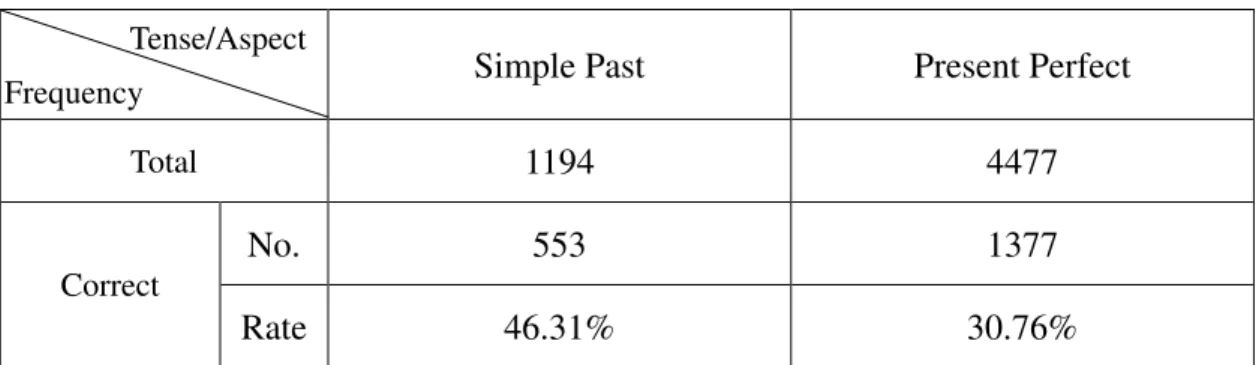
To test the first research hypothesis, which predicts better performance of the simple past over the present perfect, the overall performance of the two forms in the blank-filling test has to be compared. Table 6 presents the total occurrences and accuracy rate of the simple past and the present perfect.
Tense/Aspect
Frequency Simple Past Present Perfect
Total 1194 4477
No. 553 1377
Correct
Rate 46.31% 30.76%
Table 6. Accuracy rates of the simple past and the present perfect
For the simple past, 553 out of 1194 answers were correct, yielding the accuracy rate 46.31%. For the present perfect, 1377 out of 4477 answers were correct, yielding the accuracy rate 30.76%. Independent-sample T-test was run to test the difference, and the result showed the difference reached a significant degree (P=0.000).
Therefore, from the blank-filling test, it is proved that the use of the simple past was better grasped than the present perfect.
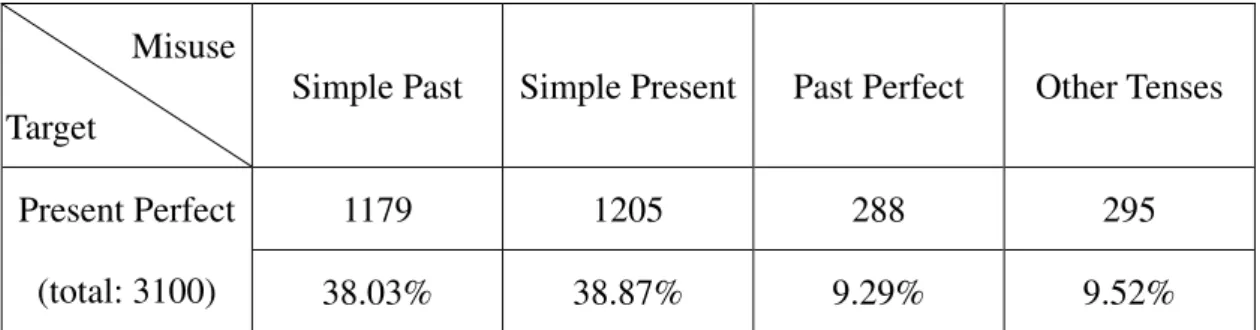
The first hypothesis also predicts that subjects tend to use simple past for the present perfect. To examine this tendency, the tenses that subjects misused for the present perfect were counted and shown in Table 7*:
Misuse Target
Simple Past Simple Present Past Perfect Other Tenses
1179 1205 288 295
Present Perfect
(total: 3100) 38.03% 38.87% 9.29% 9.52%
Table 7. Error distribution in the blank-filling test
* For Items 25 and 46, answers like “have finished” and “have graduated” were regarded incorrect, but they were still coded as present perfect. Consequently, these errors were not included in this table.
In place of 3100 blanks expected to be present perfect, 1179 were answered in the simple past, 1205 in the simple present, 288 in the past perfect, and 295 in other tenses. The percentage of each tense/aspect was: simple past 38.03%, simple present 38.87%, past perfect 9.29%, and other tenses 9.52%. The tense that subjects misused most for the present perfect is the simple present. A further exploration of the contexts which trigger the subjects to use the simple present will be conducted and presented in the discussion part to explain this tendency.
The above analyses reveal the difficulty level of the present perfect. The accuracy rate of the form is lower than that of the simple past, and simple present was used most for the present perfect because they share some similar features with the present perfect but are cognitively much simpler. Also the functional complexity of the present perfect defers learners’ full acquisition. Taiwanese EFL learners often encounter the use of present perfect in isolated occurrences, so they are assumed not
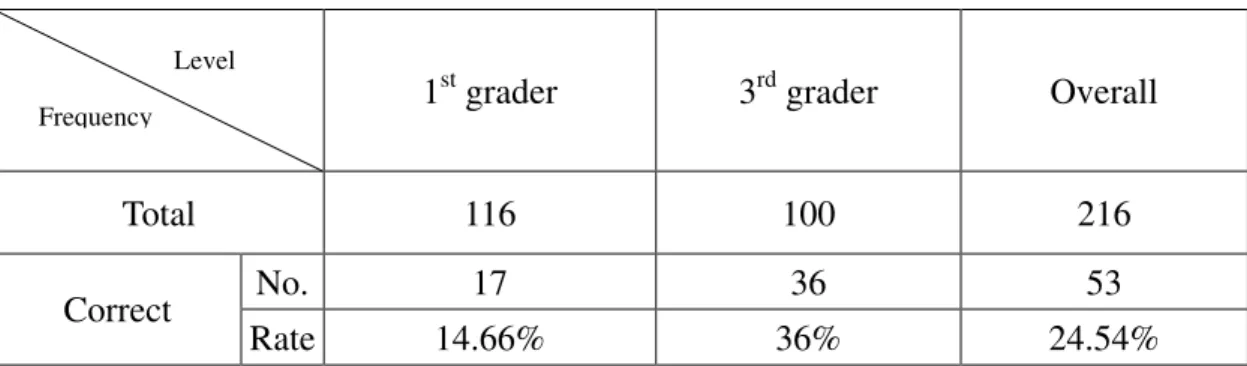
knowing the discourse functions the present perfect serves. Table 8 shows learners’
performance of the discourse functions:
1st grader 3rd grader Overall
Total 116 100 216
No. 17 36 53
Correct
Rate 14.66% 36% 24.54%
Table 8. Performance of discourse function of present perfect
Table 8 shows that the overall performance is relatively low, only 24.54%. Yet a further analysis of the performance of the third and the first graders reveals that the third graders appreciated this particular function more, with the accuracy rates of 36%
to 14.66%. However, the figures do not exclusively indicate that they could perceive the discourse function of the present perfect. Their judgment can be only sentence-level, and can also be mingled with their familiarity with other different functions the present perfect serves. Consequently, the evidence in the blank-filling test is not enough to sustain this hypothesis. In the writing task, due to the restriction of topic and genre, the use of present perfect in the topic sentence was not found.
Thus, learners’ awareness of the discourse function the present perfect serves remains unknown.
The first research hypothesis is thus partly supported. Though learners were
Level Frequency
expected to use mainly simple past for present perfect, they actually used more simple present. The contexts where learners used simple present and simple past will be compared to find out what features the two forms share in common with the present perfect the learners perceived. The explanation is provided in the discussion part.
In addition to the cognitive complexity, the unfamiliar discourse function places extra burden learners in using this form more proficiently. However, their poor performance on the discourse function may result from a more complicated reason, and thus is not substantially supported in the test.
4.1.2 Acquisition Rate of the Functions of the Present Perfect
The second research hypothesis aims to investigate if Chinese learners acquire the different functions of the English present perfect at a different rate. It is reported that Scottish children acquire ‘perfect of recent past’ first, and then ‘experiential perfect’, and then ‘resultative perfect’, and American children acquire ‘experiential perfect’ first (Gathercole, 1986). Different cognitive loads, functional loads and frequency of input of each function together influence learners’ acquisition rate.
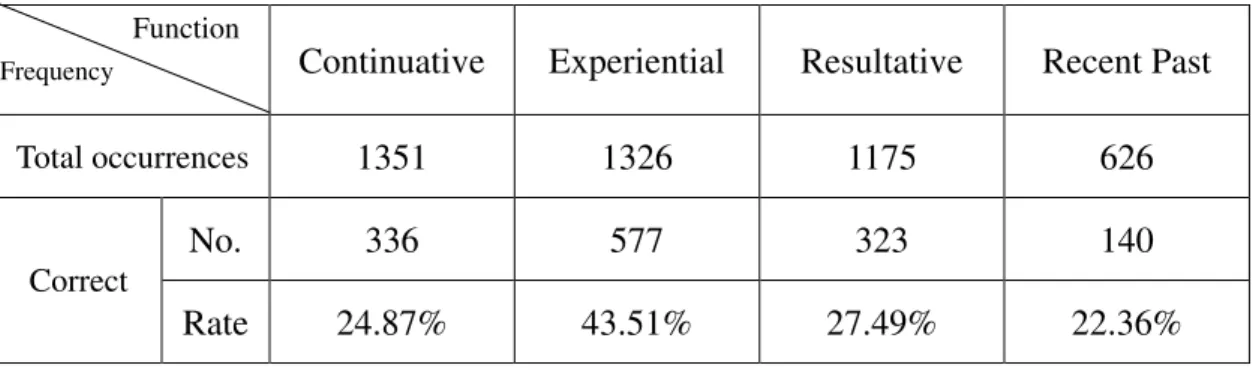
Since each function of the English present perfect poses different degrees of difficulty, Chinese learners may use some functions better than others before they acquire the form completely. To examine this hypothesis, the comparison among the performances of each function of the present perfect was made and shown in Table 9:
Continuative Experiential Resultative Recent Past
Total occurrences 1351 1326 1175 626
No. 336 577 323 140
Correct
Rate 24.87% 43.51% 27.49% 22.36%
Table 9. Accuracy rate of each function
As expected, learners’ performance of ‘experiential perfect’ was better. 577 answers out of 1326 were correct; the accuracy rate is 43.51%. The performance of
‘continuative perfect’ did not meet the expectation; the accuracy rate is just 24.87%, a result from 336 correct answers out of 1351, far behind the ‘experiential perfect’, and even lower than the 27.49% of the ‘resultative perfect’, in which 323 answers were accurate in 1175. The most unfamiliar use to the learners is the ‘perfect of recent past’, the accuracy rate of which is 22.36%, from the correct 140 instances out of 626.
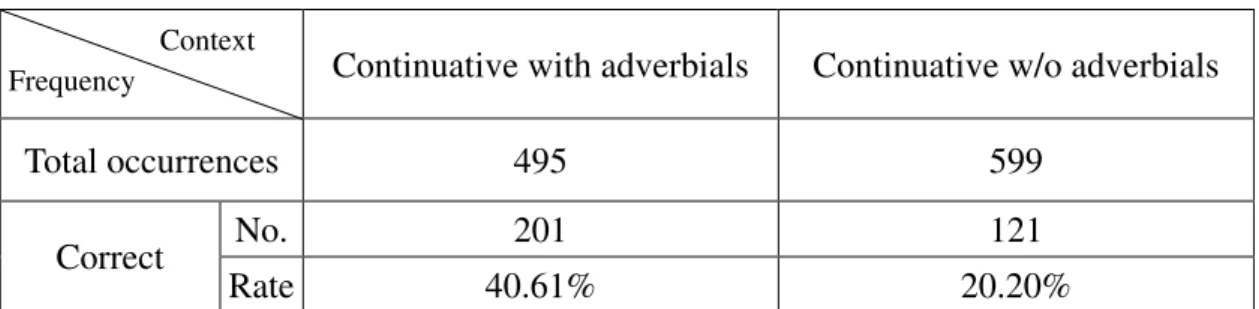
The computation shows that learners use the ‘experiential perfect’ best, and they are not as familiar with the other functions. Since the result contradicted the prediction of learners’ performance of the ‘continuative perfect’, such contexts were reviewed in order to find out the reason of its low accuracy rate. A possible reason is that learners heavily rely on the temporal adverbials when deciding on the tense/aspect. Based on this assumption, ‘continuative perfect’ contexts with temporal adverbials and those without were examined separately. The calculation is presented in Table. 10*:
Function Frequency
Continuative with adverbials Continuative w/o adverbials
Total occurrences 495 599
No. 201 121
Correct
Rate 40.61% 20.20%
Table 10. Influence of adverbials in ‘continuative perfect’ contexts
* Items 25 and 46 fall in this category, and both carry temporal adverbials. However, they were designed to test learners’ perception of the use of instantaneous verbs in perfective aspect with duration, and most learners were unable to notice such a feature. As a result, the accuracy rates of these two items were relatively low. Therefore, they were excluded from this calculation.
From Table 10, it is apparent that learners did much better in the contexts with temporal adverbials. The total answered blanks were 495, out of which 201 were correct; the accuracy rate is 40.61%. When such clues are removed, the accuracy rate drops to 20.20%. The result suggests that learners did not exactly comprehend the meaning of ‘continuative perfect’; their perception was largely enhanced through the use of temporal adverbials.
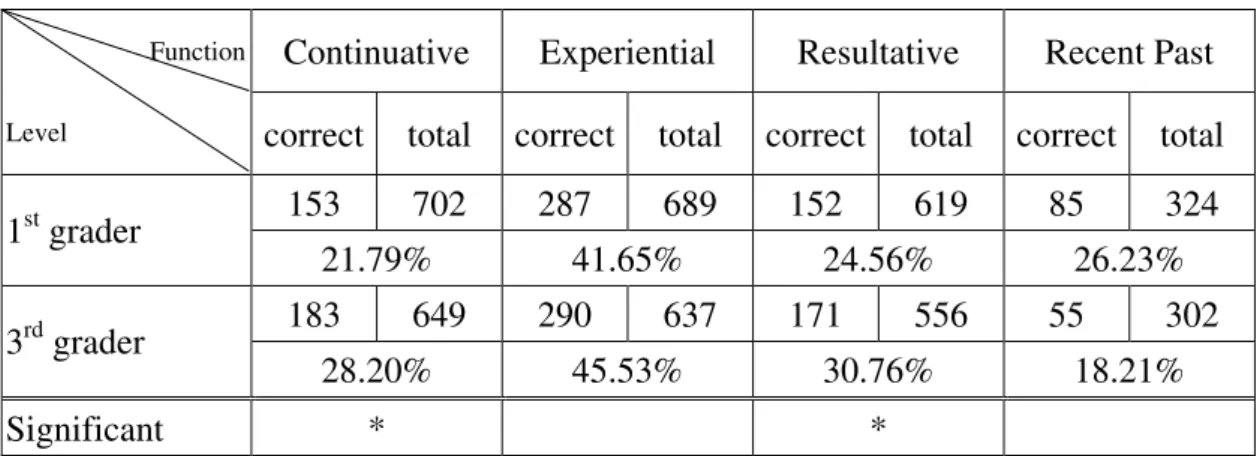
Since the uses of the ‘continuative’ and ‘experiential’ perfect are more salient, and are introduced as prototypical uses in the junior high school textbook, learners are expected to perceive these uses early. Therefore, performance of the two levels is expected to be distinguished only in those less salient uses, i.e. ‘resultative’ and
‘recent past’ uses. Though the overall performance of ‘continuative perfect’ did not fulfill the expectation, the performances of all the functions of the two groups need to
Context Frequency
be scrutinized in order to find out their acquisition rates. Table 11 shows the
individual performance between the two groups:
Continuative Experiential Resultative Recent Past Function
Level correct total correct total correct total correct total
153 702 287 689 152 619 85 324
1st grader
21.79% 41.65% 24.56% 26.23%
183 649 290 637 171 556 55 302
3rd grader
28.20% 45.53% 30.76% 18.21%
Significant * *
Table 11. Performance of each function of two groups
Both groups did best on the ‘experiential perfect’, the accuracy rate being 41.65% for first graders and 45.53% for third graders. Next is the ‘resultative perfect’; first graders got 24.56% accurate and third graders 30.76%. For the first graders, the performance of ‘continuative perfect’ was the worst of all, with an accuracy rate of 21.79%, while the third graders reached 28.20% accuracy. The first graders did better on ‘perfect of recent past’, even better than the third graders, their accuracy rates being 26.23% to 18.21%. The figures seem that the third graders performed better in three out of the four functions, but the T-Test results reveal that they only made progress on the ‘continuative’ and ‘resultative’ perfect. The P values of these two uses are 0.029 and 0.046 respectively (* P<0.05). The learners did not perform differently on ‘experiential perfect’, with a P value of 0.354. Besides, though the
first graders seemed to do a lot better on ‘perfect of recent past’ than the third graders, the T-Test results did not differentiate the performances of the two groups (P = 0.122).
The details of the statistics are illustrated in Table 12.
t-test for Equality of
Means
Sig. t Sig.
(2-tailed)
Mean Difference
Std. Error Difference Equal
variances assumed
.234 -2.201 *.029 -6.7950E-02 3.087E-02 continuative
Equal variances not
assumed
-2.190 .030 -6.7950E-02 3.103E-02
Equal variances
assumed
.533 -.930 *.354 -3.9120E-02 4.205E-02 experiential
Equal variances not
assumed
-.927 .356 -3.9120E-02 4.221E-02
Equal variances
assumed
.023 -2.030 .044 -7.2457E-02 3.570E-02 resultative
Equal variances not
assumed
-2.019 *.046 -7.2457E-02 3.588E-02
Equal variances
assumed
.192 1.557 *.122 6.850E-02 4.400E-02 Recent past
Equal variances not
assumed
1.565 .120 6.850E-02 4.377E-02
Table. 12 Results of difference significance from Independent-sample T-test
As mentioned in the analysis for the first hypothesis, the present perfect with the discourse function must serve one of the four semantic functions simultaneously.
The two question items designed for the discourse function in the blank-filling test also serve the ‘resultative’ function. From Table 11, it is observed that learners did not perform well on this function, either. Furthermore, learners show progress as their exposure to the English present perfect increases, which is spotted in the performance of the discourse function as well. Therefore, the perception of both functions may be intertwined and obscure learners’ real acquisition of the discourse function.
Though learners of higher proficiency showed improvement on the ‘reslutative’
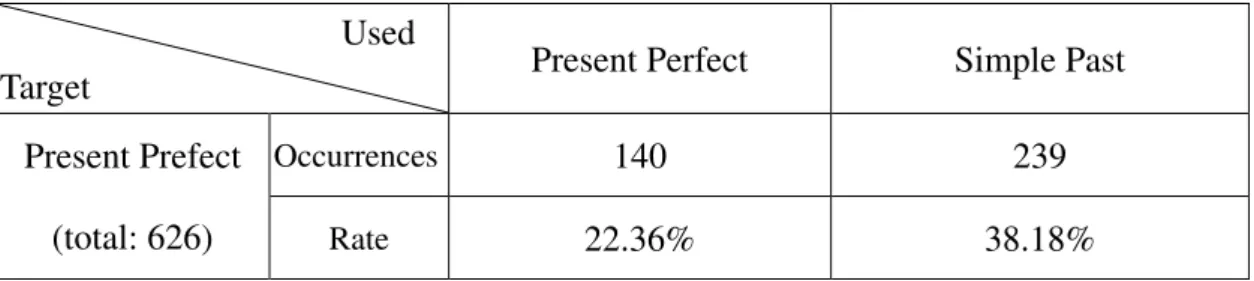
use of the present perfect as predicted, they did not make any progress on the ‘recent past’ use. The lowest accuracy rate of the ‘perfect of recent past’ can be accounted for with the fact that American English the learners have been exposed to also use simple past in the recent past contexts. Therefore, learners would tend to use simple past in place of the present perfect in such context, for simple past is less marked and more familiar to the learners. A closer look was paid to such use and the proportion of learners’ use of the present perfect and simple past is shown in Table. 13:
Used
Target Present Perfect Simple Past
Occurrences 140 239
Present Prefect
(total: 626) Rate 22.36% 38.18%
Table 13. Tenses used in the ‘recent past’ contexts
Learners used more simple past in the ‘recent past’ contexts. The percentage of the use of simple past is 38.18%, while the use of present perfect only takes up 22.36%.
To learners, immediate past is not particularly distinguished from remote past.
Moreover, simple past is easier to use than present perfect in terms of syntactic complexity and cognitive load, as the earlier comparison made in Chapter Two points out. The two considerations result in the high proportion of use of the simple past.
In summary, the data reveal that Chinese learners did acquire the different functions of the English present perfect at different rates. Among the four functions, the ‘experiential perfect’ was the best comprehended and used one. The ‘resultative perfect’ and ‘perfect of recent past’ were acquired late and still got low accuracy rate.
The prediction was not attested about the use of the ‘continuative perfect’. A further examination reveals that learners did well in the contexts with temporal adverbials, but did badly in those without temporal adverbials. Such divergent performance indicates that learners only perceived the meaning of ‘continuative perfect’
significantly better when the duration of time is specified. However, learners perceived the ‘continuative’ and ‘resultative’ uses better after two years of exposure to the English present perfect. Besides, learners’ performance supports the hypothesis that the simple past was used more in the ‘recent past’ contexts. Since Chinese learners have more contact with American English, they are likely to be influenced by its feature that simple past and present perfect are interchangeable in such contexts.
In addition, simple past is more familiar and much simpler to the learners.
Consequently, the prevalence of the simple past in the ‘recent past’ contexts conforms to our prediction.
4.1.3 L1 Interference and Dependence on the Temporal Adverbials
In Chinese, the meanings of ‘continuative’, ‘experiential’, ‘resultative’ and
‘recent past’ perfect are realized in two aspectual markers – le and guo. When acquiring the English present perfect, Chinese learners are likely to apply what they have perceived in Chinese aspects to this new form. Thus the third hypothesis predicts that learners will do better on the functions that le and guo share with the English present perfect. Therefore, if learners transfer their knowledge of le and guo to English present perfect, they will perform best on the ‘recent past’ contexts, since this is the only function that both le and guo apply. However, Table 9 shows that
‘perfect of recent past’ had the lowest accuracy rate among the four functions.
Moreover, the performances of the other three functions were diverse, though all of the functions are covered by either le or guo in Chinese. As a result, Chinese aspectual markers have limited help in acquiring English present perfect.
Hypothesis 3 also predicts a transfer of the dependence on extra temporal markings in Chinese to English present perfect regardless of verb types. In Chinese, any verb type is allowed to go with adverbials indicating duration in a present perfect context. However, in English, instantaneous verbs in present perfect are not allowed to go with durative adverbials, unless the verb actions can be transformed into states.
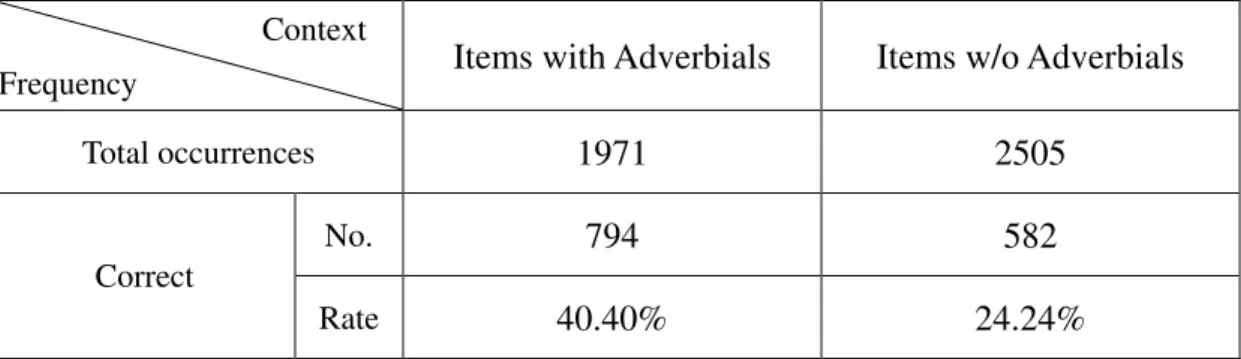
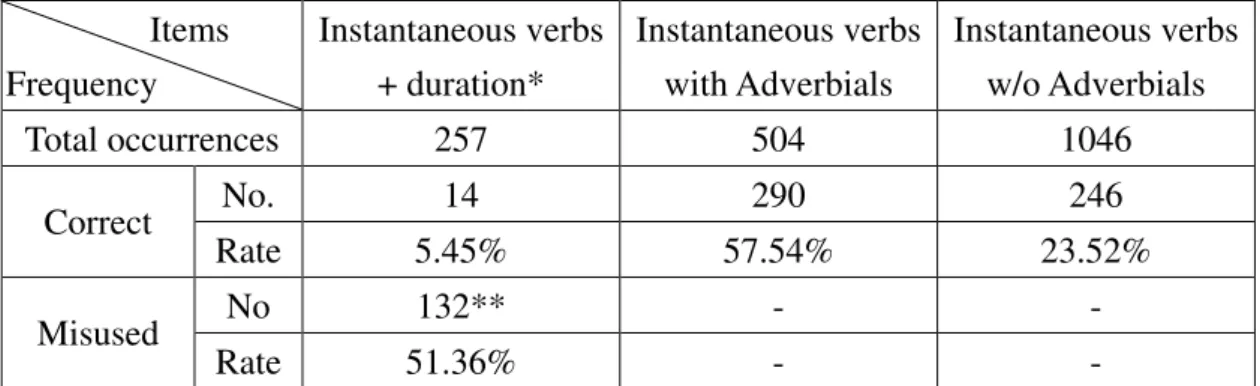
The difference emerges from the ‘change of state’ meaning of Chinese aspectual marker le, which is absent in the English present perfect. If learners are not aware of the verb types in English, they are likely to apply this usage in Chinese to an English present perfect context. Both items with temporal adverbials and items with instantaneous verbs were examined to find out if there was such a tendency. The results are shown in Table 14 and 15*:
Context
Frequency Items with Adverbials Items w/o Adverbials
Total occurrences 1971 2505
No. 794 582
Correct
Rate 40.40% 24.24%
Table 14. Performance of contexts with and without adverbials
Items Frequency
Instantaneous verbs + duration*
Instantaneous verbs with Adverbials
Instantaneous verbs w/o Adverbials
Total occurrences 257 504 1046
No. 14 290 246
Correct
Rate 5.45% 57.54% 23.52%
No 132** - -
Misused
Rate 51.36% - -
Table 15. Performance of items of instantaneous verbs
* The co-occurrence of instantaneous verbs and duration is not allowed in English. This category means to examine learners’ awareness of such incorrect usage.
** For Items 25 and 46, only the uses of “have finished” and “have graduated” were counted as misused and presented in this table. Other answers are not our target here.
First, temporal adverbials did assist learners to make decision on using the present perfect. The accuracy rate of items with adverbials reaches 40.40%, while that of items without adverbials drops to 24.24%. Second, learners did not seem to have the knowledge that instantaneous verbs in present perfect are not allowed to go with duration in English. Items 25 and 46 should be changed into states – “have been finished” and “have been graduated” instead of “have finished” and “have graduated.” The accuracy rate of the two items are extremely low, only 5.45%.
Most learners thought the combination of “have finished” or “have graduated”
together with a period of time was appropriate, and the rate of such answers is as high as 51.36%. Third, learners were not familiar with the limitations of instantaneous verbs in the use of present perfect; they heavily relied on the clues of adverbials. As
a result, items of instantaneous verbs with temporal adverbials enjoy a much higher accuracy rate (57.54%) than those without adverbials (23.52%).
Chinese learners heavily rely on adverbials in present perfect contexts. These adverbials can serve not only as clues for learners to use present perfect, but also as triggers to overuse present perfect. Some question items, requiring simple present and simple past, were designed to test learners’ judgment at seeing the adverbials.
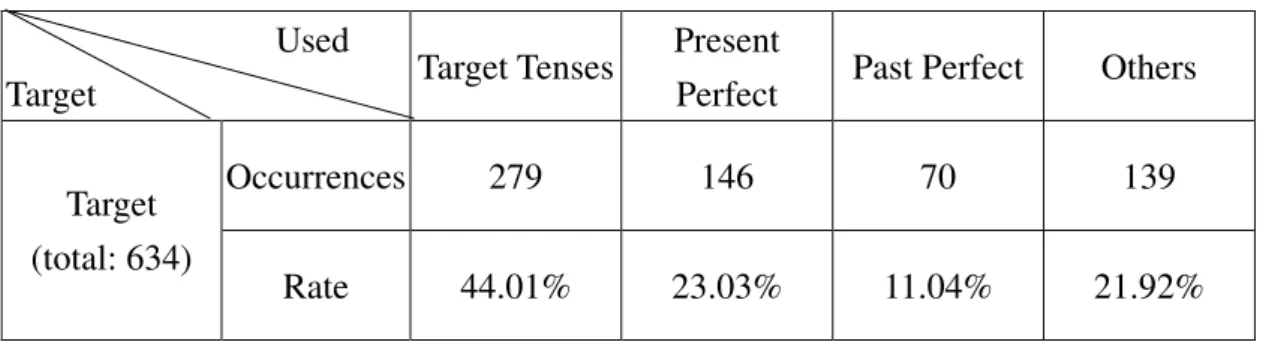
The tenses/aspects used by learners for these items are listed in Table 16:
Used
Target Target Tenses Present
Perfect Past Perfect Others
Occurrences 279 146 70 139
Target (total: 634)
Rate 44.01% 23.03% 11.04% 21.92%
Table 16. Tense distribution in items of other tenses with adverbials
The overall accuracy rate of these question items is 44.01%. Among the errors, present perfect is the most common one, taking up 23.03%. Past perfect has a proportion of 11.04%. Other tense/aspect errors were lumped together and wholly occupy 21.92%. The results show that learners were able to tell the appropriate tense/aspect according to the contexts, yet the adverbials still play a part in the decision-making.
When learners are not proficient in using the present perfect, temporal adverbials
can serve as enhancers. As their proficiency grows, learners are expected to decode the clues from the contexts and thus rely less on these extra enhancers. To test this assumption, the performances of the two groups in the contexts without adverbials
were compared and the result is as listed in Table 17.
Level Frequency
1st grader 3rd grader Significant
Total 1314 1191
No. 268 314
Correct
Rate 20.40% 26.36%
*
Table 17. Performance in contexts without adverbials by 1st and 3rd graders
The third graders answered 26.36% correct, and the first graders got 20.40%
correct. The T-Test result shows that the third graders performed significantly better in such contexts (P = 0.031).
From the analyses, L1 transfer can be found. Learners are used to temporal markings in adverbials in Chinese, therefore, they perceived better the related time in the contexts with temporal adverbials in English. On the other hand, learners did worse when temporal adverbials were not present, which means they excessively depended on such clues. Nevertheless, learners do not associate these adverbials with the present perfect only. They can still make correct judgment based on the
contexts when a simpler tense is required. As expected, with continuous exposure to the present perfect, learners are able to distinguish the features of using this form from the contexts and reduce the dependence on the adverbials. In addition to the influence of adverbials, learners did not sense that only durative verbs or states can fit into a ‘continuative perfect’ context in English. Instead, they applied whatever they use in Chinese to similar contexts in English.
4.1.4 Performance in the Writing Task
Elicitation alone cannot represent learners’ acquisition of the present perfect.
Only when they are able to use the form spontaneously and appropriately have they acquired it. Therefore, learners’ writings need to be analyzed to find out their use of
the present perfect. The details of their writings are listed in Table 18:
Tense Group
Finite Clause
Simple Present
Present Prog.
Present Perfect
Simple Past
Past Prog.
Past Perfect
Future
487 3 59 149 1 5 28
1st graders
733
66.44% 0.41% 8.05% 20.33% 0.14% 0.68% 3.82%
462 3 58 167 1 4 24
3rd graders
719
64.26% 0.42% 8.07% 23.23% 0.14% 0.56% 3.34%
Table 18. Distribution of tenses in writings
The writing task collected totally 733 finite clauses from the first graders and 719
the two groups. First graders used 66.44% of simple present and 20.33% of simple past, and third graders used 64.26% of simple present and 23.23% of simple past.
The occurrences of the present perfect were rare. First graders used only 8.05% of the present perfect, and third graders 8.07%. The low occurrence rate is likely to result from the way learners wrote to the topic. Hence, a further step was taken to investigate if learners misused other tenses/aspects for the present perfect. Table 19 presents the result:
Level
Used Target
Present perfect
Simple past
Simple present
Past perfect
Others
45 27 44 3 -
1st graders
Present
perfect 37.82% 22.69% 36.97% 2.52% -
45 24 32 2 1
3rd graders
Present
perfect 43.27% 23.08% 30.77% 1.92% 0.96%
Table 19. Tenses used in place of present perfect in writings
Learners mainly used simple present and simple past in place of present perfect, similar to the error distribution in the blank-filling test. Such misuse reveals that learners perceive the features of current relevance as well as the indefinite past of the present perfect, but they chose to use the forms they had more confidence in.
It requires a closer look to see if learners did use present perfect better on certain functions but not others in their spontaneous production. A calculation was conducted to reveal learners’ use of each function. Yet due to the features of written text, ‘perfect of recent past’ is not possible to be found in learners’ writings; therefore, this use is left out from the calculation. The distribution of learners’ use of the other three functions are shown in Table 20:
Use
Level Continuative Experiential Resultative Total
1st graders 21 20 4 45
3rd graders 21 21 3 45
Table 20. Distribution of the present perfect in each function
Though learners performed better on the ‘resultative perfect’ in the blank-filling test, they hardly used this function in their writings. On the contrary, they used a lot more
‘continuative perfect’ in the spontaneous production, even though their performance on this function was poor in the elicitation test. Yet with a further examination on the writings, it was found that learners used ‘continuative perfect’ only with adverbials in for and since. The result reflects an earlier analysis that learners used
‘continuative perfect’ more accurately if adverbials were present in the blank-filling test, which implies that learners are familiar with this function only when it is associated with a specified period of time.
In summary, learners used simple present and simple past mainly in their descriptions. Even in the places where present perfect is appropriate, they tended to misuse simple present and simple past the most. This preference of tense use indicates that learners are not confident in using present perfect in the spontaneous production, thus they avoid using this form. When it came to the functions that they were more certain about, they were able to use present perfect, which resulted in the most uses of ‘experiential perfect’ and ‘continuative perfect’ with for and since.
4.1.5 Summary
In this section, the results of the blank-filling test and writings concerning the use of the present perfect are reported.
The experiment aims to investigate how Chinese learners at the senior high school stage perceive the English present perfect. 143 subjects participated in this research, including first graders and third graders in two senior high schools. The experiment consisted of two test types: a blank-filling test and a writing test.
As to the results, first of all, learners’ performance of the simple past was better than that of the present perfect. But in place of the present perfect, they misused more simple present instead of simple past. Unfortunately, the present experiment was not able to prove learners’ perception of the discourse function that present perfect serves. In the design, the two items serving the discourse function also
carried the ‘resultative’ function; therefore, learners’ performance was also affected by their knowledge of the ‘resultative perfect’. Moreover, the writing task in the experiment was not the genre that requires present perfect in the topic position. As a result, this speculation was not verified.
Next, a closer examination into the four functions of the present perfect reveals that learners used ‘experiential perfect’ best, and their performance of the other three functions consistently fell far behind the ‘experiential perfect’. A further investigation into the ‘continuative perfect’ found that learners actually were familiar with such use, as long as adverbials ‘for’ and ‘since’ were present in the contexts.
Without specified period of time, learners were not able to use this function. As for the ‘experiential perfect’, learners of both levels were quite familiar with this use, hence their performances were equally good. Performance difference between the two levels is observed on ‘continuative’ and ‘resultative’ uses. The result indicates that learners gradually comprehend the various uses of the present perfect as they have longer exposure to this form. ‘Perfect of recent past’ remains difficult to them, thus their performances were not significantly different. Learners tend to use simple past instead of the present perfect in such contexts.
Next, it was attested that Chinese does influence its speakers in the use of the English present perfect. Chinese speakers are accustomed to the use of additional
temporal adverbials to locate time, thus they did better in the contexts where there were extra adverbials. In contexts without such adverbials, their judgment was weakened. Yet learners are able to make correct decisions when a simpler tense like simple past is required. They do not overuse present perfect as expected in contexts with adverbials. Besides, with the growth of proficiency, learners rely less on the adverbials; the third graders got higher accuracy rate on items without adverbials.
Under the influence of Chinese aspectual marker le, learners carried the customary use of instantaneous verbs with duration in Chinese over to the English present perfect. A review of all the items using instantaneous verbs disclosed that learners were unaware of such verb feature; their judgment of using the appropriate tense/aspect mainly depended on the adverbials. In spite of these L1 transfers, Chinese aspectual markers le and guo did not show apparent influence in assisting learners’ comprehension of the English present perfect.
The final analysis explores learners’ spontaneous production of the present perfect in way of a writing task. It was found that learners tended to use simple present and simple past in their descriptions. The occurrences of the present perfect were sporadic. Learners only used some fixed sentence patterns in the present perfect, and they tried to paraphrase their ideas in simple present and simple past if any present perfect was needed but beyond these fixed patterns. The distribution of
learners’ uses of the present perfect were also examined, which revealed that learners used ‘continuative perfect’ and ‘experiential perfect’ the most. Though they performed ‘continuative perfect’ and ‘resultative perfect’ equally well in the blank-filling test, they rarely used ‘resultative perfect’ in the writings. The third graders did not use more present perfect than the first graders in their production.
4.2 Discussion
The results of the present study are discussed in this section in relation to the research hypotheses. Yet before we go into the detailed discussion under each category, a main finding from the results should be mentioned first to provide a basis for the later explanation. First of all, in both the blank-filling test and the writing task, the simple present prevails, either as misused tense or as spontaneously produced one. This tendency suggests that learners observed current relevance of the events, however, they were only able to use simple present under such circumstances.
Second, learners used a large amount of simple past as well. They regarded the events as beginning or being completed in the past, yet they did not see their relation to the present. These tendencies lead to the assumption that learners actually observe the features of current relevance and anteriority, but they are unable to integrate both meanings and use present perfect. Thus, they treat the features individually and use the more appropriate simple present or past. This suggests that
learners do not have complete understanding of the present perfect. Based on this knowledge, learners’ performance in each aspect is discussed below.
4.2.1 Use of Simple Past and Present Perfect
In the current study, the simple past obtained higher accuracy rate (46.31%) than the present perfect (30.76%) as shown in Table 6, suggesting that learners are more familiar with simple past. There are some reasons to account for learners’
performance. First, simple past is cognitively and functionally simpler. It is used to locate an event prior to and independent of the speech time and does not take the speaker’s viewpoint. But present perfect requires a connection between the event and the speech moment, as well as the speaker’s pragmatic perspective. Thus, present perfect is quite complicated to ESL learners. Moreover, present perfect plays more than such roles in a discourse. However, the uses of the present perfect learners encounter usually occur in isolated occurrences. As a consequence, learners rarely have the opportunity to learn the discourse function of this form. The design of the blank-filling test, regrettably, cannot reveal learners’ real knowledge about this function. Because the present perfect in the topic position must carry both the discourse function and any of the four functions at the same time, it is hard to distinguish whether their poor performance simply comes from their inadequate knowledge of the discourse function. The two items testing learners’ perception of
the discourse function are both ‘resultative perfect’, and this use happens to be one that learners are not good at. Since their performances on the discourse function and the ‘resultative perfect’ are poor, the degrees of the acquisition of the two functions may interfere each other. Their knowledge of the discourse function is unable to attest in the writing task, either. Restricted to the writing genre and the topic, it is not likely to find present perfect in the topic sentence. The only support to the hypothesis is that learners indeed have little encounter with present perfect serving the discourse function, and undergoing a tense shift in the body paragraphs.
In addition to the cognitive and functional complexity, frequency of input may also play a role in the performance discrepancy of the two forms. Taiwanese learners start to learn simple past early and receive much more input of this form.
Take the junior high school English textbooks by the National Institute of Compilation and Translation for example, simple past is first introduced in the second last lesson in Book II. In the following textbooks, simple past occupies nine lessons and co-occurs with other tenses in another twelve lessons. Present perfect is introduced in the first lesson in Book V, and occurs only in isolated sentences in the following lessons. There are 23 occurrences of the present perfect other than Lesson 1. The disproportion of the frequency of the two forms predicts learners’
different degrees of familiarity with them.
Though present perfect and simple past share many features, Taiwanese learners do not misuse mostly simple past for present perfect. Instead, as reported in previous studies (Walker, 1967; Deng, 1987; Bardovi-Harlig, 2001), learners sometimes confuse present perfect with a present tense and sometimes with a past.
Both simple present and simple past take up the main part of errors in place of the present perfect, 38.87% and 38.03% respectively (Table 7). The contexts in which simple present is misused most and those in which simple past is misused most need to be reviewed to find out what features of the present perfect may cause possible confusion for learners. The top three contexts that learners used simple present for the present perfect are listed below:
(42) Camille: Hey, Sam! It’s been a while since we last met!
Sam: Oh, my! It’s Camille! How are things?
Camille: Fine. Well, Sam, I hope you (14) _____________ <forgive( )>
me now about that day.
Sam: What day? What was it?
Camille: Well, you know, that day I said I would never go out with such a short guy like you…… about six years ago. I am really sorry about that!
Sam: Ha! Ha! My dear Camille, I forgot it long time ago! Don’t keep that in mind.
(43) Wendy: Do you think we can make it this summer to go rafting( )?
Andrew: I don’t think so. We (32) _____________ <not, have> much rain this year. The river may be too thin for rafting.
(44) Interviewer: I have never been to any of those countries. I (36) ____________
<always, want> to travel to those places. I went to Hong Kong
three years ago, but I have not been anywhere since then.
Some common elements can be found in these contexts: now, this year, and always.
Learners usually encounter and use these adverbials with simple present, and thus they neglected other parts of the contexts and reacted only to these adverbials.
Disregarding the ‘recent past’ contexts, the top three contexts that learners used simple past for the present perfect are as follows:
(45) Student A: (15) _____________ <you, take> any English test recently?
Student B: Yes, last Saturday.
Student A: How did you do on it?
(46) Husband: Oh… hi, Marty! Long time no see! You look great!
Sister-in-law: Yeah, you too, Chris. I am on a diet, and guess what! I (29) _____________ <lose> 2 kilos in one week! Everyone says I am in a perfect shape.
(47) Tommy said:
I think the beard suits him because he (45) _____________ <lose> a lot of hair in the past few years. Now his face looks balanced.
These three contexts refer to past events. If learners fail to see their connection with the present time, then they tend to treat these events simply as complete actions and thus use simple past.
The investigation into the contexts shows that Taiwanese learners primarily base on sentence-level clues to judge the use of appropriate tense/aspect. If there are
The clues provided in the contexts across the sentence boundary are ignored.
Therefore, learners are still not able to relate present perfect to its most important features ‘anteriority’ and ‘current relevance’. Furthermore, with their attention focusing on single sentences, learners cannot perceive the function of the present perfect in a discourse.
4.2.2 Acquisition Rates of the Functions of the Present Perfect
When Taiwanese learners get to know the English present perfect, which is the first semester in the third year of the junior high school to the subjects of the present study, they encounter mostly the ‘continuative’, ‘experiential’, and ‘resultative’
functions. In order to get some idea of learners’ exposure to the present perfect, the junior and senior high school textbooks are reviewed here. The following introductions are taken from Lesson 1, Book V of Taiwanese junior high school textbooks, compiled by the National Institute of Compilation and Translation.
The first use introduced in the grammar focus is the ‘experiential perfect’.
Examples from the textbook are:
(48) Have you ever been to a baseball game?
(49) He has never written a letter in English. (p 10) The second use is the “continuative perfect”:
(50) Have you studied English for two years?
(51) He has waited for a long time. (p 11) The third use is the “resultative perfect”:
(52) Have you finished the homework?
(53) He has written the letter. (p 13)
The use of “perfect of recent past” is not listed in the grammar focus, but occurs once in the follow-up reading text within the same lesson, “A Letter to Susan” (p 3):
(54) Summer vacation has just ended, and I’m now in my third year of junior high.
However, this single occurrence may go without attention. In the following lessons, students encounter 23 occurrences of the present perfect, 6 in the ‘continuative’
function, 5 in the ‘experiential’ function, 11 in the ‘resultative’ function, and only 1 in the ‘recent past’ function.
The continuous exposure to this form has to be put off to senior high school stage. Take Far East, one of the high school textbook versions, as sample, the frequency of the present perfect is counted. Table 21 shows the occurrences of the form in six textbooks of 3 years:
Function Book I Book II Book III Book IV Book V Book VI total
Continuative 0 8 4 6 8 15 41
Experiential 13 1 10 5 6 18 53
Resultative 7 1 9 14 20 18 69
Recent past 2 2 1 0 2 3 10
total 22 12 24 25 36 54 173
Table 21. Occurrences of the present perfect in Far East Textbooks
Table 21 shows that students are exposed mostly to the ‘resultative perfect’ and
‘experiential perfect’. Contrary to Gathercole’s observation (1986), ‘perfect of recent past’ has the least frequency in the input. If frequency of input plays an influential role in the acquisition, students will be more familiar with the use of
‘resultative perfect’ and ‘experiential perfect’, then ‘continuative perfect’, and least
‘perfect of recent past.’
The results of present study show that, learners performed best on the
‘experiential perfect’, with an accuracy rate of 43.51% (Table 9, p 61). Though they are exposed to ‘resultative perfect’ most, as calculated in Table 21, their performance on this function did not meet the expectation. The accuracy rate is 27.49%, not
exactly different from the 24.87% of the ‘continuative’ function. Therefore, the frequency of input alone may not be responsible for Taiwanese learners’ acquisition.
It was assumed that, since ‘continuative’ function was introduced as the second use of the present perfect in the textbook, and it carries high saliency, learners would be familiar with this use. However, their performance did not show this familiarity.
A review of the introduction of the ‘continuative perfect’ in the junior high school textbook reveals that the use often comes with adverbials, e.g.:
(55) It’s been a long time since you left Taiwan. (p 3)
(56) So far I’ve worked hard and done well on all the tests. (p 4) (57) You’ve studied Chinese for two years now. (p 4)
The use with adverbials also appeared in the grammar focus (Ex. 50, 51); therefore, it is very likely that learners strongly associate the ‘continuative perfect’ with adverbials.
A further analysis of the contexts of ‘continuative perfect’ in the blank-filling test verified this assumption. The accuracy rate of this use with adverbials is 40.61%, while without adverbials the accuracy rate is just 20.20% (Table 10, p 62). That is to say, the ‘continuative’ use is familiar to learners only when it comes with adverbials;
otherwise, it appears difficult to the learners.
The analysis of learners’ performance has shown that learners are most familiar with the ‘experiential perfect’, and this is the only use that both first and third graders
seem to have grasped. The third graders do make progress in some other uses of the present perfect. They make significant advances on the ‘continuative perfect’ and
‘resultative perfect’. This suggests that learners are able to appreciate the different uses of the present perfect when their proficiency grows. However, this is not the tendency in their spontaneous production. Learners’ performance of the blank-filling test shows that they have not grasped the meaning of ‘continuative perfect’, yet this is the function they used most in the writings in both groups.
Moreover, learners performed slightly better on the ‘resultative perfect’ than the
‘continuative perfect’, but they barely used any ‘resultative’ function in the writings.
A closer look into their writings reveals that, the ‘continuative perfect’ used by the learners was with “for (a period of time)” or “since (when)”. Beyond these structures, they were not able to produce any ‘continuative perfect’. In the case of the blank-filling test, learners encountered uses like “I have always wanted…”, “…
has changed greatly”, and “… people have asked about …”, which are not within the pattern they are familiar with. Therefore, their performance was poor. In other words, learners have only acquired the typical use of the ‘continuative perfect’ with temporal adverbials, the one the junior high school textbook introduces.
Learners’ use of the ‘resultative perfect’ is different from their acquisition of the
‘continuative perfect’. In the ‘resultative’ function, the actions that caused the
results may not directly relate to the present time, thus the connection between the actions and the current results is an abstract idea. In the elicitation test, learners could rely on the adverbials like already, yet, and lately, but in the spontaneous production, they could not see the relation of a past happening and the current moment. Consequently, the use of the ‘resultative perfect’ is rare. Only the learners who have acquired this use were able to use it, and their uses were perfectly correct. In addition, the occurrences of this function do not reflect learners’ progress.
There are four instances in the first grader group while there are only three in the third grader group.
Though the occurrences of ‘perfect of recent past’ are parsimonious in the textbooks, it remains a basic function of the present perfect. The low accuracy rate (22.36%, Table 9, p 61) indicates that Taiwanese learners are not familiar with this use.
According to Gathercole (1986), American children acquire this use late because present perfect and simple past are exchangeable in the recent past contexts in American English. As a result, children do not need to acquaint themselves with this function of the present perfect. Since the EFL environment in Taiwan has more contact with American English, it is possible that learners prefer to use simple past for a recent past situation because simple past is easier to them. The calculation of the present perfect and simple past in ‘recent past’ contexts proves that learners used
simple past more often; the percentage is 38.18% to the 22.36% of the present perfect (Table 13, p 66). It is also explicable that learners see the events in the recent past contexts as past happenings, no matter they happened in the immediate past or remote past. As a consequence, they fail to relate the recency of the events with the ‘current relevance’ feature of the present perfect. The most troublesome use is the ‘perfect of recent past’, which is an apparent challenge to the third graders. Though the first graders performed better on this use, the performance difference is not significant.
In other words, maybe some of the learners know better about such function, but learners in general do not get the meaning of it.
4.2.3 L1 Interference and Dependence on Temporal Adverbials
When learners contact a new language, they often resort to their first language for some applicable similarities. The traits of the English present perfect can be found in the Chinese aspectual markers le and guo. As shown in Table 4, le and guo together share all the four uses of the present perfect. If Chinese learners turn to the two aspectual markers for understanding better the English present perfect, they should be able to use the four functions equally well. At least they should use
‘perfect of recent past’ best, since both le and guo serve this function. However, the results of the experiment do not show this phenomenon. Learners’ performances of the four functions were not equal, and they did worst on the use of ‘recent past’.
Therefore, Chinese learners do not apply their knowledge of le and guo to the use of English present perfect.
What Chinese learners carry over to the use of present perfect is the dependence on the extra aspectual markings. Because time is not coded in morphological inflections but in additional temporal adverbials in Chinese, Chinese speakers are used to looking for adverbials in the contexts as clues. As the results show, on the items with adverbials, learners’ performance was better; the accuracy rate is 40.40%
(Table 14, p 68). When those adverbials were absent, the accuracy rate drops to 24.24%. Therefore, in the aspect of reliance on extra aspectual markings, the influence of first language is observed.
In addition to the L1 transfer, the reliance on adverbials can also be the instructional effect. Learners are instructed to use present perfect at seeing certain adverbials if they do not have confidence in the judgment. To prove this speculation, a few domestic grammar books were reviewed to see how present perfect is instructed in Taiwan. A general presentation of the English present perfect is as the following in these materials, the detailed sketches are enclosed in Appendix Two:
(58) Present Perfect
1. A very recently completed action. Often co-occurring with already, just, today, etc.
Ex. I have just finished my homework.
2. An experience up to the present. Often co-occurring with ever, never, once, etc.
Ex. He has told the same joke so many times that I am tired of it.
3. An action or state that continues to the present. Often co-occurring with for, since.
Ex. I have collected coins for many years.
4. A result of a past action that lasts till now.
Ex. He has eaten nothing today.
From the review, it is clear that instruction also heavily associates adverbials with the uses of the present perfect either in the explanation or in the examples.
Also, because the examples or even the test questions provided are single sentences, all the clues about time must be given through adverbials. Hence, learners are familiar with the uses of the present perfect only when they co-occur with the adverbials. They are not equipped with the ability to look for clues in the contexts, and thus have limited knowledge of the present perfect.
Besides, it is possible that learners would associate these adverbials only with the present perfect, and overuse this form. Nonetheless, the computation of the items of other tenses with such adverbials discloses that learners are still clear that other tenses are likely to co-occur with these adverbials. They obtained an accuracy rate of 44.01% (Table 16, p 70), which suggests that in fact they have the ability to judge
appropriate use from the contexts. In fact, learners comprehend better the use of simple present and simple past; therefore they do not rely solely on the adverbials.
However, they do not understand present perfect so well that they depend on the adverbials as enhancers to use this form, which explains that the use of the present perfect takes up nearly half of the error frequency in such contexts (23.03%).
Fortunately, the degrees of reliance decreases as learners have continuous exposure to the English present perfect. The third graders made a significant progress on the items without adverbials (Table 17, p71). This suggests that their reliance on these extra clues reduces gradually, and they are able to decide the appropriate tense/aspect based on the context itself. Nonetheless, the accuracy rate still remains low (26.36%), which reveals the relatively heavy dependence on the temporal adverbials rather than contexts.
In addition to the reliance on the temporal adverbials, the L1 transfer can also be spotted on the customary usage of certain types of verbs in the present perfect. In English, only durative verbs or static verbs are compatible with the ‘continuative’ use of the present perfect. Instantaneous verbs, unless transformed into a state, are not allowed in such contexts. However, in Chinese, instantaneous verbs in a perfective sense are compatible with a period of time. It results from a meaning that le carries:
change of state. Yet this sense is not covered by the English present perfect.
Therefore, it was predicted that Chinese learners would apply this usage to the English present perfect contexts. As supposed, most learners used “… have finished for a long time” and “… have graduated for ten years” for Items 25 and 46; the rate strikes high as 51.36% (Table 15, p 69). They obligatorily use present perfect when
“for (a period of time)” is there, not considering the verb features. At a second thought, learners may not be aware of verb features at all. An investigation into the performance on the same verb type was conducted (Items 1, 14, 16, 17, 20, 27, 28, 29, 38, 41, 45, 54, 57), and the outcome attested learners’ sole dependence on the adverbials. Their accuracy rate is as high as 57.54% in the contexts of instantaneous verbs with adverbials (Items 1, 17, 27, 57), but the rate reduces to 23.52% if the adverbials were absent (Items 14, 16, 20, 28, 29, 38, 41, 45, 54). It is very likely that Chinese learners do not have the knowledge of various verb types and the limitation of their co-occurrence with certain structures in English. They simply rely on the trigger of adverbials and use whatever tense/aspect that is appropriate.
On the other hand, the low accuracy rate of the correct use (5.45%) may not be only bound to the unawareness of verb features. It requires certain proficiency of learners to be able to transform active actions into passive states in such contexts.
Moreover, not every instantaneous verb can be used in states; thus a single rule cannot furnish learners with the ability of how to use present perfect correctly under such
circumstances. Therefore, learners need explicit instruction in order to acquire this use of the present perfect.
4.2.4 Performance in the Writing Task
In the writing task, first graders produced a total of 733 finite clauses, and third grader 719. But in whole each group produced the same number of correct present perfect instances (45 instances). Compared to the total number of finite verbs, the use of the present perfect is sporadic. The tenses used in the writing data were mainly simple present and simple past. In place of the present perfect, learners misused simple present most. Among the four functions of the present perfect, learners used ‘continuative’ and ‘experiential’ ones the most. But due to the restriction of the written type, ‘perfect of recent past’ is not expected in the writings and thus excluded from our analysis. In what follows, subjects’ writings will be analyzed in the aspects of tense uses, tense misuses, and function distribution.
Examples taken from the writings will also be presented. Last, a comparison between learners’ performances of blank-filling and writing tests will be made to reveal their active use of the present perfect.
4.2.4.1 Tense Uses in Writings
Basically, learners tended to use simple present and simple past most in the writings. Since the topic was about someone they admire, their descriptions were
primarily divided into a fact part and a past event part. Learners often used simple present when they thought what they described was a fact:
(59) I always love David Tao’s songs.
(60) I see him on TV every time.
(61) This conviction always inspires me when I am in a low spirit.
To the learners, this admiration is something that holds true at present. Therefore, they would generally use simple present to describe these facts. On the other hand, for events that happened before, they used simple past:
(62) As J.J. published his CD, Second Heaven, last year, I bought and enjoyed it.
(63) I began adore him crazily is the time he acted as a gay in the film “Crystal Boy.”
(64) I saw every movie he played even the movies he just played a little role in.
Learners tended to treat these experiences as single events in the past, not to relate them to the present time. As a result, there were more uses of simple past than present perfect.
The preference of using simple present and past can also be found in learners’
adoption of them for present perfect if the intended structures were beyond the ones they were familiar with. This adoption is proposed by Larsen-Freeman and Long (1997: 61) as avoidance strategies: in a spontaneous language production task, testees
often use language aspects they have the most confidence in and avoid troublesome aspects. The parsimonious uses of the present perfect were almost fixed patterns, which suggests that learners are conservative in using this form freely:
(65) I have been her fan for eight years, since I heard a famous song “My Hear Will Go On.”
(66) I have never met him face to face.
These structures are the basics and most familiar to the learners; therefore, their occurrences were common in the writings but not other structures.
4.2.4.2 Tense Misuses
The errors were mostly simple present, and then simple past in place of the present perfect. The contexts where learners used simple present for present perfect were mainly what they regarded as facts:
(67) I am Jacky Chan’s fan for a long time.
(68) It really affect my motive of learning English.
(69) I never see her and never join her activity.
(70) Because his influence, I often contribute money and old clothes to poor people.
Though the events started sometime earlier and lasted till the speech moment, learners did not see the point to use the present perfect. They saw the events as truth at the
speech moment, thus thought it reasonable to use simple present. That is to say, learners are aware of the current relevance in these contexts, however, their knowledge is limited to the use of simple present. They are still not able to perceive the use of present perfect in these situations. Moreover, they probably treated never, often and always as frequency adverbials, and they were instructed to associate frequency adverbials with simple present.
Simple past is also used to describe a person’s experiences in English, and this form was what the learners chose to use in their writings. They saw such events as single occurrences in the past and did not relate them to the present, nor did they think these actions might repeat or happen again. For instance,
(71) By the story of his experience, he taught me to see clearly the black side in this society.
(72) They made a lot of beautiful and brisk songs in Chinese, Taiwanese, and also in English.
(73) I saw him only on the TV and never joined his activity.
Learners failed to consider the repeatability of the actions or the results on the present time; in other words, they did not sense the current relevance under such circumstances. Therefore, they used simple past for situations like these.
Though the first graders used 59 present perfect instances, and the third graders
58, only 45 of them were correctly used in each group. Learners put present perfect in the patterns they were familiar with, but were not aware of other limits in the contexts. For example, a learner wrote:
(74) I have seen him when I was second grade in junior high school.
He talked about his experience of contact with his idol so far, which is a typical use of the ‘experiential perfect’. However, he added a specified time; such specification contradicts the ‘indefinite past’ feature of the present perfect, thus the use is inappropriate here. This suggests that learners do not have a clear picture of how time is viewed in the use of present perfect. They learned about its function, but not the restrictions of time use. Some of their inappropriate uses are:
(75) He has been old enough.
(76) Not until I saw his novels have I been his fan.
(77) He have got the M.V.P. at 2004 stars game.
These errors reflect that learners’ knowledge about the present perfect is not yet complete. They know the occasions where present perfect can fit in, but not the restrictions which make the use inaccurate.
4.2.4.3 Distribution of Functions of Present Perfect
Learners used ‘continuative’ and ‘experiential’ perfect the most (42 instances and 41 instances respectively, out of 90 occurrences in total). As mentioned above, they
only used certain fixed patterns which they were most familiar with. Other than these typical uses, they hardly ever tried to use present perfect. Some examples are listed below:
Continuative perfect
(78) I have adored Allen Iverson since I was a junior high student.
(79) For eighteen years, he has always been the first player who get to the court.
Experiential perfect
(80) I haven’t join any his activitys before.
(81) She has came to Taiwan only one times.
The use of ‘resultative perfect’ is scarce, but it was correctly used in these rare instances:
(82) I have forgot the reason why I like him.
(83) I have been fascinated with her creativity of magic matters.
(84) I think he has improved a lot from film to film.
4.2.4.4 Comparison between Test Types
The findings of the spontaneous production conforms that of the blank-filling test in some ways. Learners largely used simple present in the contexts where they regarded the events relevant at the present moment. The next most frequently used tense was the simple past. Learners perceived more the anteriority sense in these
contexts and used simple past spontaneously. Rarely did learners perceive both features of current relevance and anteriority. This suggests learners do not fully discover the messages about time underlying in the contexts. Their judgment of time still remains sentence-level.
The writing task has also elicited a contradictory result to the blank-filling test.
Learners used ‘continuative perfect’ extensively in the writing, while they did not appear proficient in this use in the blank-filling test. They performed the ‘resultative perfect’ equally well with the ‘continuative perfect’ in the blank-filling test, yet they hardly ever used ‘resultative perfect’ in the spontaneous production. A further exploration reveals that learners are only able to use the prototypical structures of the present perfect in their production. There are not any fixed patterns in the
‘resultative’ use; therefore, learners do not know how to use this form if without the trigger of adverbials. Their performance in the writing indicates that they do not grasp the semantic meanings of the present perfect completely, not to mention the pragmatic meaning.
4.2.5 Summary
In this section, the findings of the present study are discussed in relation to each research hypothesis. First, simple past obtained a higher accuracy rate than the present perfect. The better performance of the simple past is argued to have partly