行政院國家科學委員會補助專題研究計畫成果 報告
※※※※※※※※※※※※※※※※※※※※※※※
(計畫名稱) 金屬矯正支架之抗腐蝕處理與其生物相容性之研究 (1/3)
※※※※※※※※※※※※※※※※※※※※※※※
計畫類別:*個別型計畫 □整合型計畫 計畫編號:91-2314-B-040-010-;
執行期間:91 年 8 月 1 日至 92 年 7 月 31 日 執行單位:中山醫學大學口腔醫學研究所
計畫主持人:高嘉澤
共同主持人:丁信智 黃翠賢
中 華 民 國 92 年 05 月 1 日
(計畫名稱)
金屬矯正支架之抗腐蝕處理與其生物相容性之研究(1/3)
計畫編號:91-2314-B-040-010-;
執行期間:91 年 8 月 1 日至 92 年 7 月 31 日 執行單位:中山醫學大學口腔醫學研究所
計畫主持人:高嘉澤 共同主持人:丁信智 黃翠賢
中英文摘要口腔是一個複雜的環境,原 本口內的酸鹼值是接近中性的環 境。但因飲用酸性的飲料、食物 或食物被微生物分解等都會產生 酸,而使口腔變為酸性的環境,
加上冷熱飲食,潮濕的環境以及 黏稠食物不易去除口內氯離子的 存在,微生物代謝出來的硫化物 等不利因素影響,使得放置於口 腔內的金屬托架更易受到侵蝕。
金屬表面以 TiN 或 CrN 鍍膜可增 加其抗腐蝕性。本研究之目的乃 研究金屬矯正支架以氮化鈦處理 後表面腐蝕性之變化。研究方法 乃將四種不同之金屬矯正支架以 氮化鈦處理後,經電化學腐蝕反 應,以原子吸收光譜儀比較其金 屬離子之釋出及以電子顯微鏡觀 察其表面之變化。結果發現金屬 矯正支架經氮化鈦處理後溶液中 仍有 Ni, Cr, Fe, Mn 等金屬離子 釋出,電子顯微鏡觀,金屬矯正 支架其表面金屬亦有腐蝕反應發 生。電化學腐蝕反應發現其氧化 電 位 與 無 鍍 膜間 亦 有 差 異 。 關鍵字: 氮化鈦 腐蝕性 人工唾 液
The orthodontic metal bracket is made by st ainless st eel. It is proved that is easily to corrode in
t h e a c i d a n d c h l o r i d e r i c h environment. The purposes of the
current study were to investigating the titanium nitride (TiN) ion plated s t a in le s s s t e e l me t a lb r a c k e t anticorrosion ability. Material and methods: The fo u r t yp e s o f stainless steel brackets were used to test in acidic artificial saliva. The T iN p la t e d me t a l br a ck e t w as performed by the titanium nitride (TiN) ion plating method. The TiN plating result was proved success on the bracket surface by the EDX a n a l y s i s . T h e a mo u n t o f t h e metallic ion release was analyzed with its immersion so lut ions by
atomic absorption
spectrophotometer. Result: Both TiN and without TiN plated bracket can release detectable ions, such as nickel, chro miu m, ma nga ne se, copper and ferric et, al., into the solution. The TiN plated metal bracket surface existed corrosion pattern in SEM observation. The o xidat ive po t ent ial is d iffere nt bet wee n w it h and w it ho ut TiN plated brackets.
K ey words: T it a n iu m n it r id e , corrosion, artificial saliva
計畫緣由與目的
The t ypes o f st ainless st eel mo st commonly used in bracket manufacture include AISI types 303, 304, 304L, 316, 316L and 317.
1
Stainless steel alloys containing 8 to 12% nickel and 17 to - 22% chromium are generally used for t he me t a ll i c p a r t s o f o r t ho do nt ic appliances.2
When producing stainless steel, the more chromium, nickel and molybdenum incorporated, and the lesss u l f u r a nd c a r bo n, t he be t t e r t he corrosion resistance of the final product.
Appro ximat e ly 10% o f t he genera l populat ion exhibits a hypersensit ive reaction to nickel. Peltonen
3
reportedt h a t w o me n w e r e 1 0 t i me s mo r e sensit ive to nickel than men. Moffa
4
found that 31.9% of women and 20.7%of men in a population of 403 showed a positive reaction in a similar patch test with nickel sulfate.
In our previous study found that metal bracket will corrode in acidic solution and released undesired metal ion.
6
It is important to find a way to i m p r o v i n g t h e b r a c k e t c o r r o s io n resistance. S inc e t it aniu m is u sua ll y selected for the fixtures and abutments of dental implant systems, development of attachments coated with a titanium compound to reduce corrosion would be beneficial for metal bracket.The purposes of the current study were to investigating the titanium nitride (TiN) ion plated stainless steel metal bracket anticorrosion ability.
結果與討論
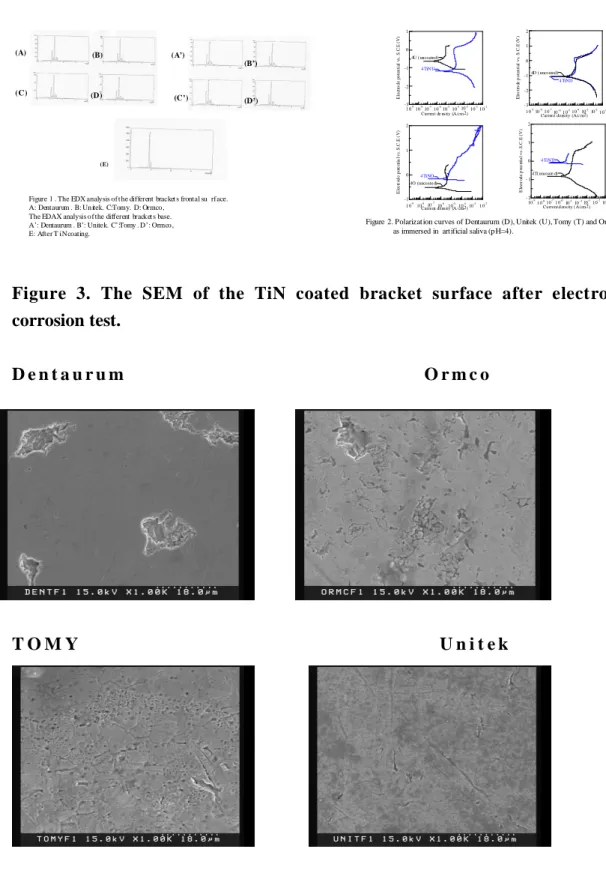
After energ y d isp ers ive -ray X (EDX) analyzer detecting, the non TiN plated bracket EDX graph showed the cont ent o f t he bracket were nickel, chromiu m, fe r r ic , ma ng a ne s e , a nd copper (Fig 1.A-G). The TiN plated bracket EDX graph showed only the Ti peak was found on the surface of the bracket (Fig 1.H). The TiN plating on the bracket surface was success. The electrochemical corrosion test showed on figure 2. The SEM observation of the
metal brack ets sho wed so me o f t he bracket surface existed corrosion. Fig 3.
T he a mo unt o f met a l io ns ( nicke l, chromium, ferric, manganese, copper and cobalt ions) release from the TiN plated and without TiN plated brackets were shown in the table III.
The results indicate that the TiN film can be effectively plated onto the
b r a c k e t s u r f a c e , t h e E D X d a t a demonstrating that the bracket’s external
surface was completely covered by the t it a n iu m. Fr o m t he r e s u lt s o f t he corrosio n t e s t , h o w e v e r , b o t h t h e TiN-p l a t e d b r a c k e t a n d t h e n o n TiN-plated bracket were found to release
met al io ns int o t he art ificial saliva solution, suggesting that, under such condit ions, both brackets will suffer some degree of corrosion. Fro m the SEM observation the TiN plated bracket
su r fa ce w e r e mo r e e ve n t ha n t ha t w it ho ut T iN p lat ed bracket . T here existed corrode surface might be from surface incomplete plating.
Mo st o f t he T iN-plated bracket groups revealed a greater degree of metal ion release than was the case for the non T iN-plated group, suggesting that the anti-corrosion properties of the TiN-plated brackets were not well. Such a result appears to be contrary to the 1992 study by Ono et, al.
7
, in which the authors indicate that TiN plating is an excellent anti-corrosion procedure for stainless steel orthodontic appliances.7
The low anti-corrosion ability of the TiN plated bracket was inferred as follows.This would appear to be related to the o bservat io n t hat t he hig her e nerg y non–physical vapour deposition (PVD) t e c hn iq u e o f p la t ing , s u c h a s io n implantation, cannot uniformly coat the
substrate, although the resulting bond between the bracket and the substrate is quite strong. The irregular shape of the bracket could be another inference that could be formed uneven plating effects.
The third factor might be caused by the
galvanic corrosion between the TiN coating and the metal bracket.
8
Park and Shearer indicated in 1983 that in a 0.05% sodium chloride (NaCl) solution, the average release of metal was 40 micrograms nickel and 36 micrograms chromium per day for a full mouth appliance.
9
The dietary intake of nickel has been reported to be 300 to 500 micro grams per day, while t he average chromium intake varies from five micro grams to mor e t ha n 1 0 0 micrograms per day.10
Our study has indicated that the level of nickel ions re lea sed int o t he t est so lut io n wa s se ve r a l t ime s g r e at e r t ha n t ha t o f chromium ions released, for all groups apart from the Tomy group, although for both ions, the level of their release into the oral cavity was lower than the level of their respective dietary intake,10
the result appearing to be compatible with a relatively “safe” release of such ions to the body.計畫成果自評
The TiN plating is a naro coating technique on the subject surface. The plating on polymorphism is not so easy.
The present study we have demonstrated t ha t T iN c o a t e d br a ck e t s a r e less corroded in electrochemical analysis.
The amount of metal ions from the TiN plated bracket is lower than that amount of body tolerance. It is still needed to demonstrate the bio logic effects of released ions in future research.
REFERENCES
1. Matasa CG. Attachment corrosion a n d it s t e s t i n g . J C l i n O r t h o d 1995;29:16-23.
2. Ke r o s u o H , Mo be G , Ar ne H P . Salivar y nickel and chro mium in subjects with different types of fixed orthodontic appliances. Am J Orthod Dentofac Orthop 1997;111:595-598.
3. Peltonen L. Nickel sensitivity in the
g e n e r a l p o p u l a t i o n . C o n t a c t Dermatitis 1979;5:27-29.
4. Moffa JP. Biological effects of nickel-containing dental alloys.
Council on Dental Materials, Instruments, and Equipment. J Am Dent Asso 1982; 104:501-505.
5. M a i j e r e R , S m i t h D C . Biodegradation of the orthodontic
b r a c k e t s y s t e m. A m J O r t h o d Dentofac Orthop 1986;99:195-198.
6. H u a n g T H , Y e n C C , K a o C T . C o mp a r i s o n o f io n s r e l e a s e d between new and recycled brackets.
A m J O rt ho D e nt o Fa c O rt ho p ; 2001,120:68-75.
7. O no S , Ku ma g a i M, H o a sh i K.
Corrosion of TiN coating in high t emperat ure deminer ized wat er.
C o r r o s i o n E n g i n e e r 1 9 9 2 ; 41;385-392.
8. Franco CV, Fontana LC, Bechi D, Mart ine lli AE, Muzart JLR. An electrochemical study of magnetron sputtered Ti coated and TiN coated
s t e e l . C o r r o s i o n S c i e n c e 1998;40:103-112.
9. P a r k H Y . S he ar e r T R. I n v it r o release of nickel and chromium from simulated orthodontic appliances.
Am J Orthod 1983; 84:156-9.
10. Schroeder HA, Balassa JJ, Tipton IH.
Abnormal trace metals in man-nickel.
J Chronic Disease 1962; 15:51-62.
Table I. Details of the metal brackets
Company Bracket type Position Slot Order No.
Tomy Co. (Tokyo, Japan)
Micro-LOC Bracket Standard edgewise
upper bicuspid
.018’ 920-45 Ormco Co. (Orange,
Ca, USA)
Diamond Bracket Standard edgewise
upper bicuspid
.018’ 340-0604 Unitek 3M. Co.
(Monrovia, Ca, USA)
Twin Torq ue bracket Andrew
upper bicuspid
.018’ 018-203
Dentaurum Co.
(Pforzheim, Germany)
Discovery Direct Bond Bracket System Ricketts Universal
upper bicuspid
.018’ 790-136-0 0
Table II. The content of the artificial saliva.
Company Sinphar Pharm Co.LTD. Ta ipei, Taiwan Content Sali Lube (Saliva substitute)
So ld iu m C hlo r ide 0.844 mg Pot assiu m Chlo r ide 1.2 mg Calcium Chloride Anhydrous 0.146 mg Magnesium Chloride 6 H2O 0.052 mg Potassium Phosphate dibasic 0.34 mg Sorbitol Solution 70% 6 0 m g M e t h yl P a r a be n 2 mg Hydroxyethyl Cellulo se 3.5 mg
Table III. The amount of metal ion(Mean ± standard deviation,μg/ml) release from immersion metal brackets in pH 4 artificial saliva.
Control Dentaurum Tomy Unitek Ormco
TiN Non-TiN TiN Non-TiN TiN Non-TiN TiN Non-TiN
Ni 8.07±0.88 162.28±14.28 125.70±4.84 20.79±2.06 13.98±5.00 558.7±2.55 586.52±11.95 460.13±10.37 253.90±23.58
Cr 9.31±0.81 78.07±4.45 49.72±2.64 19.38±1.36 12.02±0.35 17.91±0.51 12.8±0.42 59.84±7.96 22.58±13.01
Fe 51.43±1.11 142.24±2.93 124.06±1.77 79.11±2.27 68.73±1.15 81.13±2.24 67.25±2.89 196.00±7.92 115.20±34.36
Mn 1.08±0.02 22.11±1.97 15.11±2.11 6.36±1.20 8.49±1.36 8.52±0.34 5.60±0.49 14.54±3.00 5.39±3.88
Cu 2.40±0.33 526.04±21.08 628.26±20.77 31.97±16.15 39.52±16.79 7.94±2.38 10.26±2.64 10.19±4.46 14.00±2.03
Co 0.05±0.05 2.78±0.48 1.14±0.14 0.45±0.12 0.15±0.13 1.16±0.18 0.49±0.06 3.02±0.37 0.72±0.36
Figure 3. The SEM of the TiN coated bracket surface after electrochemical corrosion test.
D e n t a u r u m O r m c o
T O M Y U n i t e k
Curren t de nsity (A/cm2) -3
-2 -1 0 1
Electrode potential vs. S.C.E (V)
4U ( uncoated) 4 TiN U
1 0- 910-810-710-610-510-410-310- 21 0- 1
Current d ensity ( A/cm2) - 2
- 1 0 1 2
Electrode potential vs. S.C.E (V)
4 TiNT 4T( uncoate d)
10-91 0- 810-71 0-610-510- 410-310- 210- 1 Current density (A/ cm2)
-1 0 1 2
Electrode potential vs. S.C.E (V)
4 TiNO 4O (uncoated)
1 0- 910- 810- 710-610-510-410-31 0- 2
Curren t density (A/c m2) -3
-2 -1 0 1 2
Electrode potential vs. S.C.E (V)
4D ( uncoated) 4 TiND
1 0- 910-81 0-710-61 0-510-410-310-21 0- 1
Figure 2. Polarization curves of Dentaurum (D), Unitek (U), Tomy (T) and Ormco (O) as immersed in artificial saliva (pH=4).
(A) (B)
(C) (D)
Figure 1 . The EDX analysis of t he different bracket s frontal su rface.
A: Dentaurum . B: Unitek. C:Tomy. D: Ormco, The EDAX analysis of the different bracket s base.
A’: Dentaurum . B’: Unitek. C’:Tomy . D’: Ormco, E: After T iNcoating.
(A’)
(C’)
(B’)
(D’)
(E)