Nancy Bryan, Robert Feinberg, Michael Ferrantino, Alan Fox, William Powers, and Edward Wilson Office of Tariff Affairs and Trade Agreements.
CONTENTS–Continued
Appendixes
Free Trade Agreement with Central America and the Dominican Republic CAWG California Association of Winegrape Growers. ACTPN Advisory Committee for Trade Policy and Negotiations APAC Agricultural Policy Advisory Committee for Trade ATAC Agricultural Technical Advisory Committee IGPAC Intergovernmental Policy Advisory Committee ITAC Industry Trade Advisory Committee.
Executive Summary
Overview
Therefore, the decline in production or employment for textiles and clothing and the broader auto and passenger parts sector would be negligible (less than 1 percent). For example, a safer and more stable investment environment and enhanced enforcement of intellectual property rights are likely to increase trade and investment in a wide range of goods and services.
Summary of Findings
Introduction
Scope and Approach of the Report
- S.-Korea FTA Overview
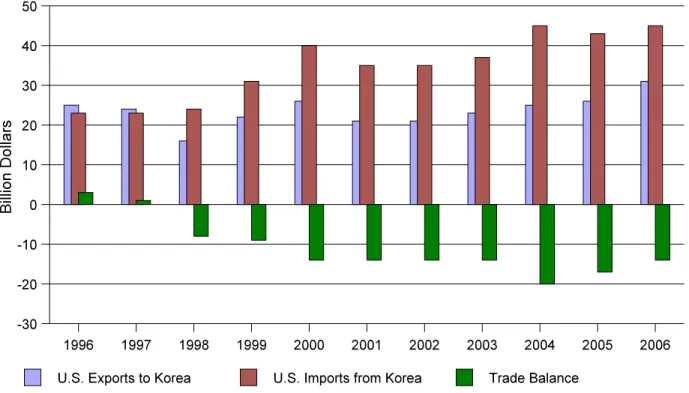
- S.-Korea Trade Overview
- S. Merchandise Exports
- S. Merchandise Imports
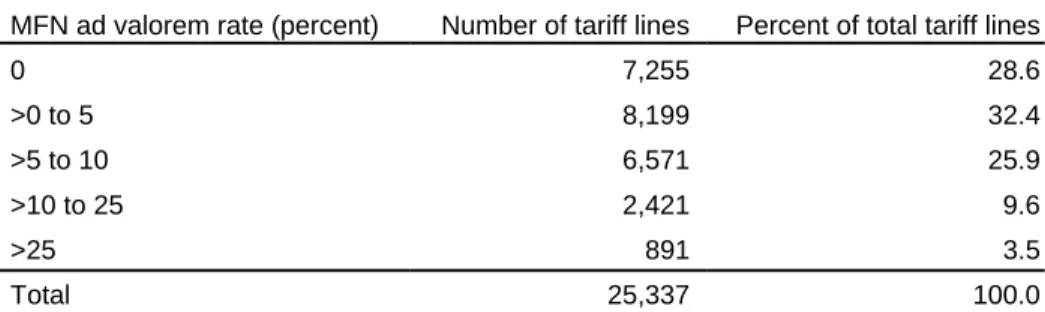
9 Information on the tariff commitments of the United States and Korea is available in the chapter. Source: Compiled from US official statistics 1-6 Table 1.2 Korean tariff rates on imports from the United States MFN ad valorem rate. percentage) Number of tariff lines Share of total tariff lines (percentage).
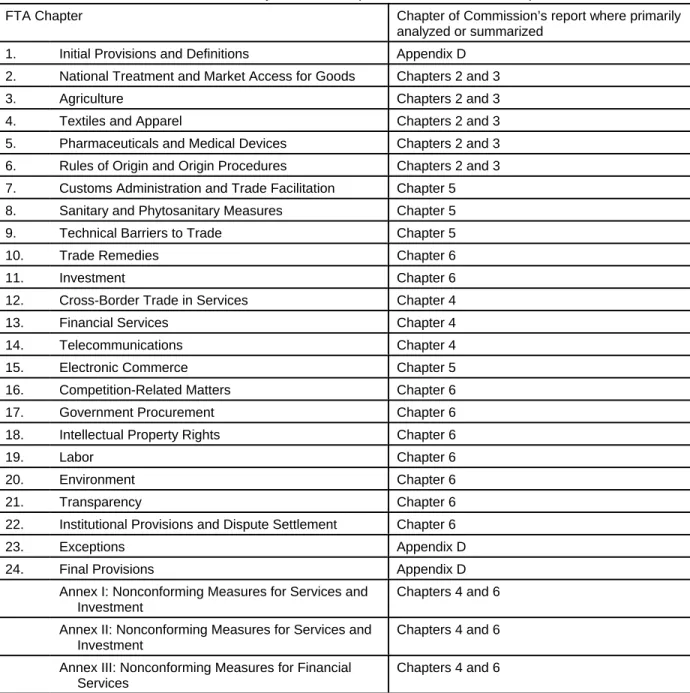
FTA Tariff Commitments
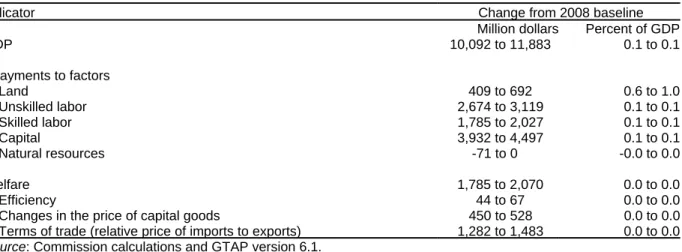
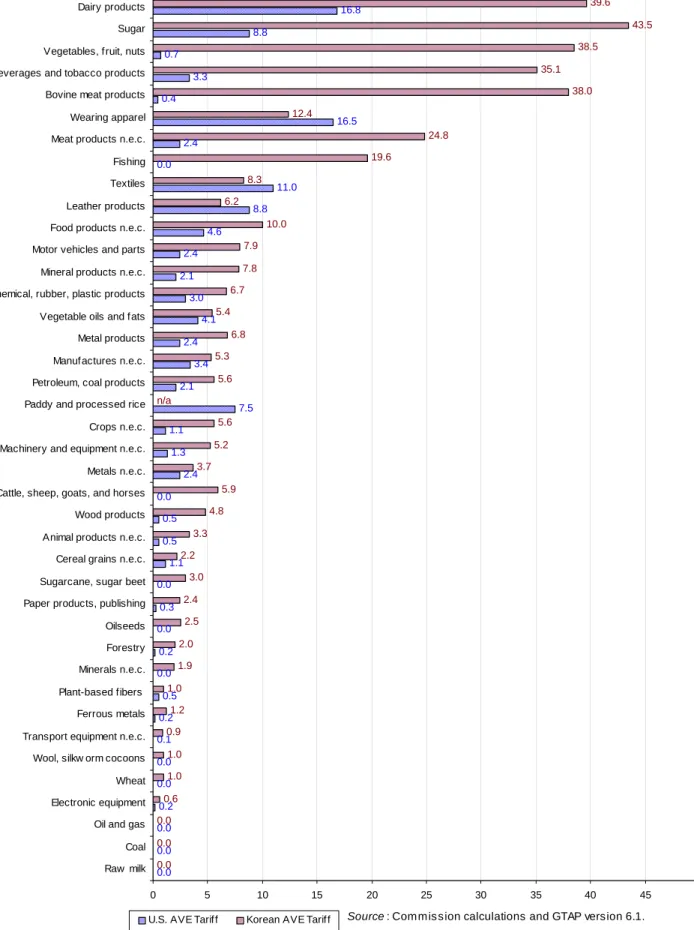
2 The version of the model used in this report is similar to that used by other researchers who also use the GTAP model to estimate the impact of the US-Korea FTA on the US. This chapter provides an assessment of the measurable impact of a fully implemented US agreement. -Korea Free Trade Agreement with the US
Analytical Framework
A detailed discussion of the changes in trade in services that can be expected from the provisions of the FTA is presented in chapter 4 of this report. Therefore, a qualitative assessment of these chapters of the FTA is provided in chapters 5 and 6 of this report.
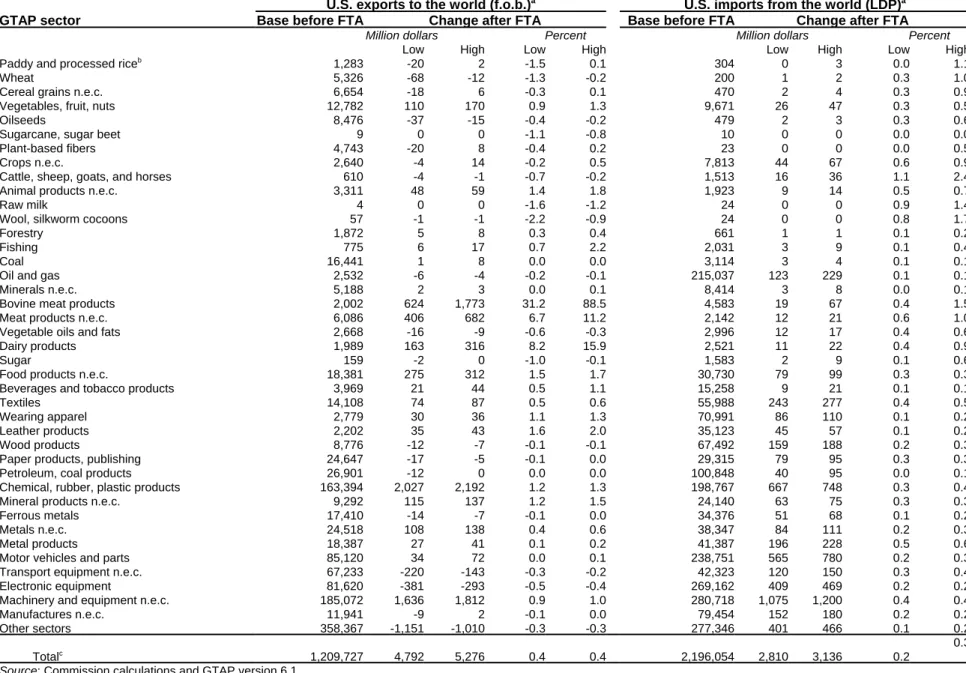
Simulation Results 15
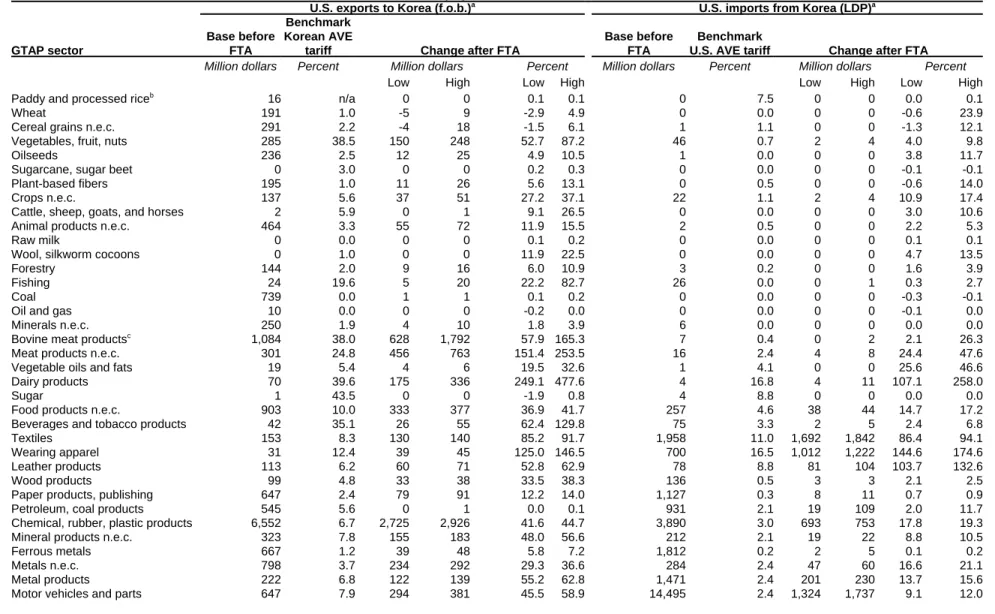
S. Gross Output and Employment Effects
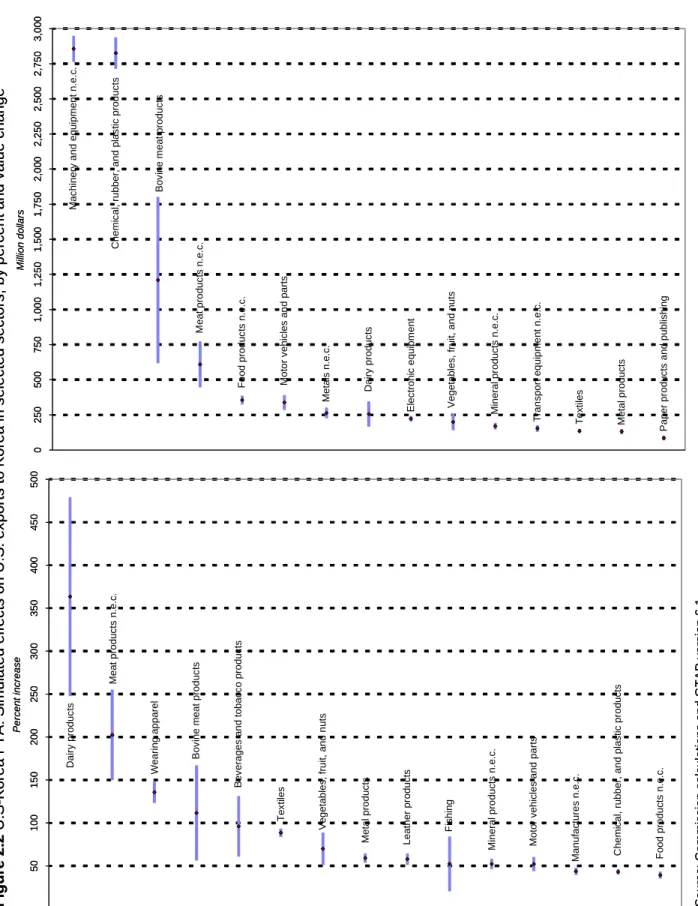
Under the terms of the US-Korea Free Trade Agreement, the phase-in period for liberalization ranges from immediate duty-free access to 15 years or more, with some products subject to temporary or permanent growth contracts. These increases are a reflection of the percentage of each sector subject to immediate liberalization: about 70 percent for machinery and equipment n.e.c.;.
Sector-specific Assessments
5 Includes Harmonized Tariff Schedule of the United States (HTS) headings 1001 through 1008, except rice (HTS subheading 1006). 2 of this report for additional information on the economy-wide general equilibrium analysis of tariff and TRQ liberalizations under the FTA.
Grain (Wheat, Corn, and Other Feed Grains) 5
7 Given that the model assumes a fixed amount of resources, it is possible that exports will decline despite the reduction in Korean tariffs as a result of the reallocation of resources in the United States to other more liberalized sectors. They wrote that "zero duty under this free trade agreement, coupled with strong economic growth in Korea, will help the U.S.
Oilseed Products (Soybeans and Soybean Oil) 20
In the marketing year, the percentage of Korean soybean imports was broken down into soybean oil and meal; most of the remaining 30 percent was consumed directly in food use (tofu, miso, soy paste, cabbage, and soy seasoning). The United States supplied 5 percent of Korea's 265,000 mt soybean oil imports in the marketing year Argentina (with a 91 percent share) dominated Korean soybean oil imports and Brazil followed with the remaining 4 percent.

Animal Feeds 40
The immediate elimination of the 5 percent tariff on DDGS as a result of the implementation of the FTA would further increase the competitiveness of the United States against China, the other major supplier. The American Soybean Association (ASA)56 and the National Oilseed Processors Association (NOPA)57 have expressed support for the US-Korea FTA because of the immediate duty-free access provided to the US.

Citrus Fruit 73
Orange exports are expected to increase, but not as quickly, as much of the U.S. 86 Barnes, Richardson and Colburn (attorney), written submission to the Trade Policy Staff Committee, Office of the USTR on behalf of Florida Citrus Mutual, Florida Citrus Packers, Gulf Citrus Growers Assoc. and Indian River Citrus League, March 24, 2006.
Noncitrus Fruit 87
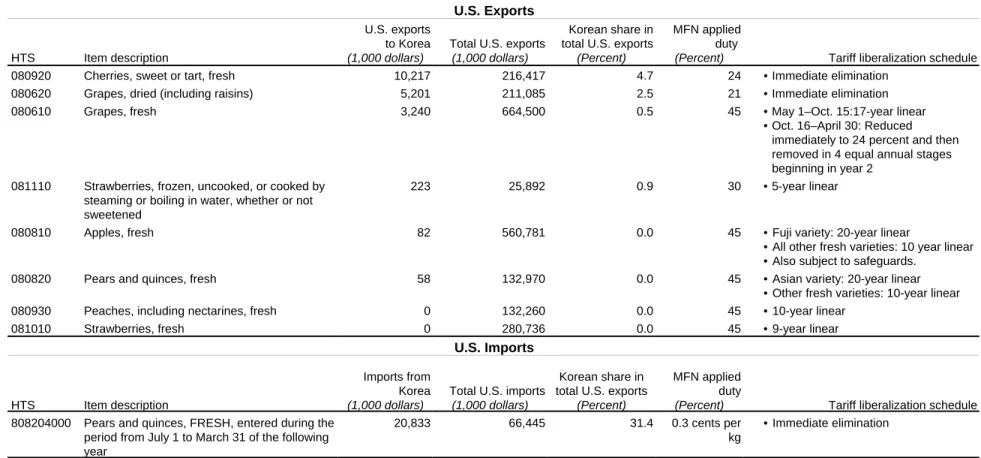
Raisin exports would likely benefit from the immediate removal of Korea's 21% tariff upon implementation of the agreement. Upon entry into force of the free trade agreement, fresh strawberries would benefit from a 9-year linear reduction in the current 45% tariff.
Potato Products 122
The abolition of the 20% duty on chips, granules and other potato preparations would occur in three annual installments and would be abolished on January 1 of the 3rd year. A report by the Agricultural Policy Advisory Committee (APAC) on trade indicated that a majority of its members believe the US-Korea Free Trade Agreement will benefit the US.
Other Vegetables 162
Exports of canned tomatoes and tomato products (ie, processed tomato products) would likely increase, especially in the near future.175 Processed tomato products were among the top ten in the US. tariff rate quota increases a quota that would be phased in over 10 or more years and accompanied by very large above-quota duties.180 In the Korean fresh vegetable market sector, the United States has maintained a 5 percent market share in recent years. 181 Due to increasing demand, the US
Tree Nuts (Pistachios, Almonds, and Walnuts) 204
Globally, individual country tolerance limits for aflatoxin in tree nuts are in the range of 10–20 parts per billion (ppb). The two countries' products tend to compete in similar markets, although in recent years Iran's quality problems linked to high levels of aflatoxin have caused it to lose half of its market share in the EU.207 Iran's problems exporting pistachios to the EU have contributed to increased competition for pistachios in other countries. global markets such as Korea.
Dairy Products 215
The Advisory Committee on Trade in Fruits and Vegetables expressed support for the US-Korea Free Trade Agreement in its report on the Free Trade Agreement in view of the increased opportunities that duty-free treatment offers to the United States. All tariff quotas except the tariff quota for milk powder and evaporated milk are eventually eliminated in accordance with the agreement, and at.

Meat (Beef, Pork, and Poultry) 229
Beef short ribs have been one of the core beef products exported by the United States to Korea and represent a high-value product in the Korean market vis-a-vis its U.S. 252 NCBA, "United States-Republic of Korea Free Trade Agreement, Testimony of the National Cattlemen's Beef Association," written submission to the USITC, June 20, 2007.

Seafood 255
The Commission's economy-wide analysis of the long-term effects of tariff and TRQ liberalization estimates that the FTA could result in an increase in the US. It noted that an increase in low-cost imports has led to the decline in the US.
Selected Processed Foods 265
Implementation of the TBT provisions of the FTA is likely to be critical to fully realizing these gains in market access. 276 California Tomato Growers Assoc., "Public Comments," written submission to the Trade Policy Staff Committee, Office of the USTR, n.d.

Nonalcoholic Beverage Products 277
International Trade Commission,” a written submission to the USITC on behalf of the Wine Institute and Assoc. Welch Foods Inc., a Cooperative (Welch's), in a written submission to the Commission, expressed support for the grape juice provisions of the FTA.
Textiles and Apparel 288
S. Imports
The expected increase in RVP and polyester filament imports from Korea is likely to displace domestic production in the US. The "2015 Vision Plan" presented by the Korean Ministry of Trade, Industry and Energy in November 2005 includes the development of advanced industrial textiles.
S. Exports
The NCTO expressed concern that the FTA would grant Korea immediate duty-free access to the U.S. AMTAC suggested that the FTA phase-out plan was likely to undermine the US-China bilateral textile agreement and create increased potential for illegal transshipments in the region.
Leather Goods and Footwear 336
361 Cooper (attorney), written submission to USITC on behalf of Rubber and Plastic Footwear Manufacturers Assoc., May 23, 2007. Cooper (attorney), written submission to USITC on behalf of Rubber and Plastic Footwear Manufacturers Assoc., May 23, 2007 .
Pharmaceuticals 363
The Medicaid program in the United States is expressly recognized as a regional health care program, not a health care program of the central government level. Separate assessments of the medical goods sector and certain passenger vehicles are contained later in the chapter.
Machinery, Electronics, and Transportation Equipment 399
Industry groups, such as the International Intellectual Property Alliance (IIPA), state that the FTA's intellectual property provisions would have. The Commission's economic analysis of the long-term effects of tariff and TRQ liberalization under the FTA for this sector estimates that the U.S.

Passenger Vehicles 433
S. Exports 434
A contributing factor to the potential effect of the FTA is the dispute settlement mechanism. Hyundai added that the FTA will create further opportunities for Hyundai to expand its market presence in the United States, to the benefit of the US.

Medical Devices 506
513 For further information on a summary of the Pharmaceuticals and Medical Devices chapter of the FTA, see ch. It is intended that the Pharmaceuticals and Medical Devices and TBT chapters of the FTA will address some of these NTMs (see Chapter 5 of this report for additional information on TBT provisions and Appendix D for a summary of the FTA chapter on Pharmaceuticals and Medical Devices).
Impact of Market Access Provisions for Services
The term is intended to distinguish these modes of delivery from delivery by affiliated companies located in the country of the consumer. The Commission therefore uses Korea's GATS commitments as a baseline to measure the benefits of the FTA.
FTA Chapter 12—Cross-Border Trade in Services
3 It is not possible to establish an overall quantitative measure of the effect of the US-Korea FTA on trade in services due to the unavailability of necessary data. Note: Due to the calculation routines used by the IMF, there may be rounding differences between a total and the sum of its components.
FTA Chapter 13—Financial Services
FTAs, cross-border trade will be limited to certain segments of the financial services industry, as set out in Schedule 13-A. For banking and securities, FTA coverage of cross-border trade will be limited to the provision and transfer of financial information and financial data processing, advisory and other ancillary financial services as defined in the text of the chapter.
FTA Chapter 14—Telecommunications
In 2005, Korea's broadband penetration rate was approximately 25 percent, one of the highest in the world. 68 Annex 1 of the FTA states that foreign ownership cannot exceed 49 percent of the total voting shares of facilities-based public telecommunications suppliers located in Korea.
Professional Services 75
The European Union Chamber of Commerce in Korea stated that Korea is the last economy in Northeast Asia (including North Korea) and one of the last in the world to partially open its legal services market to foreign participation. About 400 foreign lawyers are employed in Korea as consultants by Korean law firms, in addition to Korean-licensed practitioners.
Audiovisual Services 93
The Korean television broadcast and cable market is one of the largest and most technologically advanced1 in the Asia-Pacific region. The provisions directly addressing audiovisual services are found in the NCMs for services and investment in Annexes I and II and also in two annexes under chapter 18 (intellectual property rights) of the FTA.
Impact of Trade Facilitation Provisions
2 For example, the Korea Customs Service (KCS) uses the UNI-PASS system, which is a one-stop electronic customs clearance service. 4 According to the US-Korea Business Council, Korea's complicated and time-consuming Customs procedures impose costs on U.S.
FTA Chapter 7—Customs Administration and Trade Facilitation
Submission on the United States—Korea Free Trade Agreement,” written submission to the Trade Policy Staff Committee, Office of the USTR, March 24, 2006. 15 The implementation language of the US-Korea Free Trade Agreement is stronger than that of recent agreements, in recognition of the greater capacity of Korean Customs.
FTA Chapter 8—Sanitary and Phytosanitary Measures
In its report on the agreement, the Agricultural Policy Advisory Committee (APAC) expressed the view that the US-Korea FTA will benefit the US. The National Pork Producers Council (NPPC) has expressed its support for the FTA in a written submission to the Commission.
FTA Chapter 9–Technical Barriers to Trade
The committee expressed concern that the benefits of the FTA from the tariff side could be negated by continued TBTs in the form of SPS measures not addressed in the FTA, specifically food additives banned by Korea but approved by the United States. United States, B2B transactions make up 93 percent of the country's total e-commerce transactions.
FTA Chapter 15–Electronic Commerce
97 KIEC, Republic of Korea, “Korea e-Commerce: Overview”; and American Univ., "Management of Global Information Technology, Information Technology Landscape in Korea". In general, the US-Korea FTA will (1) allow for non-discriminatory and duty-free treatment of all digital products, whether delivered electronically or in physical form; (2) contain commitments by both parties to facilitate the use of electronic authentication in their respective markets; and (3) include principles that ensure reasonable consumer access to the Internet to conduct electronic commerce.
Impact of Regulatory Provisions
FTA Chapter 10–Trade Remedies
A Party could not apply a bilateral safeguard measure to the same good more than once, and the measure could not be applied after a transition period, except with the consent of the other Party. First, ITAC 11 said that the safeguard provisions should allow safeguard measures to be extended beyond the transition period even without the consent of the other Party.
FTA Chapter 11—Investment
3 ITI, "ITI Submission on the United States-Korea Free Trade Agreement," written submission to the Trade Policy Staff Committee, Office of the USTR, March 24, 2006. This section of the chapter also deals with NCMs, and special formalities and information requirements.