
複合式品牌延伸之研究—語言學觀點 - 政大學術集成
154
0
0
全文
(2) 謝辭 事實上,在放榜的那一刻之前,我從來沒有想過自己會讀博士班,又一直到 準備離校的這一刻之前,我也從來沒有想過這輩子會讀這麼久的書。我的人生道 路轉了幾個彎,雖然一路上許多遭遇看似福禍未知,但是我很慶幸總有許多貴人 提攜,也因此能擁有許多千金難換的回憶。 首先要感謝兩位辛苦的指導教授樓永堅老師以及別蓮蒂老師。跟兩位老師的 緣分從碩士班就開始了,雖然當時不同校,但是幸運的我卻有樓老師指導碩論,. 政 治 大. 別老師擔任口試委員。後來進入政大企研博士班後,再次有機會在兩位老師門下. 立. 學習,從決定了論文主題之後,彷彿就是一場長期抗戰,無止盡的實驗設計、收. ‧ 國. 學. 資料、檢討再設計、再收資料…,雖然過程漫長又充滿挑戰,然而現在回想起來, 設計那些實驗內容其實還滿有趣的。謝謝兩位老師,不管擔任什麼辛苦的行政. ‧. 職,無論我在國內外,總是當我的最佳戰友,跟我一起燃燒腦細胞。如果問我再. y. Nat. sit. 有一次機會重新決定研究主題,會不會換一個方向?我想我會大口的深呼吸,然. n. al. er. io. 後再次選擇這場長期抗戰。. i n U. v. 再來要大大的感謝政大語言學研究所的何萬順老師,三年前面臨困境的我帶. Ch. engchi. 著作到一半的研究,向素昧平生的何老師求援,從那之後,何老師的研究室就像 是我的彈藥庫,不管是理論或是實驗設計面臨瓶頸,只要去敲他的門就不會空手 而回。謝謝何老師為我指出一條跨領域的蹊徑,又答應擔任我的口試委員,在口 試現場您旁徵博引又深入淺出的發言,總讓我感覺是在聽一場精彩的演講,忘了 自己才是報告人。 在此也要深深的感謝另外五位口試委員:林建煌老師、張卿卿老師、廖淑伶 老師、練乃華老師、蔡東峻老師。謝謝幾位老師不吝給我許多意見,鼓勵我尋找 跨領域的理論,協助我改善實驗設計,提昇研究的貢獻,還多次花時間閱讀我的 中文或英文版本論文。我何其有幸擁有龐大又堅強的論文指導委員會,這麼多經 i.
(3) 驗豐富的老師齊聚一堂,幫助我完成論文研究,絕對是我人生中難能可貴的經驗。 謝謝同師門的學長姐及同學們,總在討論研究時一起燃燒,收集資料時互相 幫忙;感謝父母容許我總走在陌生又充滿不確定性的道路上,讓我有機會看到不 同樣貌的世界;謝謝許多師長朋友一路上的鼓勵,讓我擁有好長好長又多采多姿 的學生生涯。 At last, I would like to thank you, Dr. Kent B. Monroe. Thank you for letting me stay with you when I was in the States, helping me finish my research, and showing me how to be a great researcher. I do appreciate your generosity and patience.. 政 治 大 definitely could not get this research done without your help. Thank you very much. 立. You encourage me to ask questions, to think deeply, and to challenge theories. I. ‧ 國. 學. 再次謝謝大家!. ‧. n. er. io. sit. y. Nat. al. Ch. n U engchi. ii. iv. 蔡孟君. 謹上. Oct. 14, 2011.
(4) 中文摘要 複合式品牌延伸是近年來推出新產品時常用的策略,指的是兩個品牌共同推 出一個新產品,而這個新產品是兩者過去從未碰觸的產品類別,且新產品的名稱 中包含了兩個品牌原有的品牌名。當一個品牌聯盟形成並研發出新產品之後,在 包裝或是廣告中的產品名稱,便成為傳達新產品概念最直接的方式。 Park, Jun, and Shocker (1996)提出一個模式,描述消費者形成對於複合式品 牌延伸概念認知的過程。根據這個模式,如果消費者看到「Slim-Fast chocolate. 政 治 大 「Slim-Fast」這個品牌結合起來,在心中先形成一個新的概念,然後再把這個新 立. cakemix by Godiva」這個產品名稱,他們會先把產品「chocolate cakemix」及. ‧ 國. 學. 的概念跟「Godiva」這個品牌結合起來,形成這個複合式品牌延伸產品的最終概 念。由於 Slim-Fast 在這個新產品概念的形成過程中,先跟該產品結合,因此消. ‧. 費者會認為,這個產品與 Slim-Fast 的關聯性比跟 Godiva 來得強,也比較可能屬 於 Slim-Fast 的產品之一。然而,在上述這個複合式品牌產品名稱中,Slim-Fast. y. Nat. io. sit. 也位在整個品牌名稱短句的句首,一個合理的懷疑是,該產品與 Slim-Fast 相對. n. al. er. 強烈的關聯性,也有可能來自於其位於短句句首的位置導致。. i n U. v. 對於上述複合式品牌延伸產品與其中一個品牌較強的關聯性,本研究參考不. Ch. engchi. 同的語言學理論,提出另外一個可能的解釋:位於品牌名稱短句句首的品牌,對 於這個複合式品牌延伸產品的影響力,會比另一個品牌來得強烈。本研究分別於 台灣與美國進行五個實驗,實驗中共使用了數個不同的複合式品牌延伸產品名稱 以及品牌產品組合,來測試研究假說。 與過去文獻不同的是,在本研究所使用的多數複合式品牌延伸產品名稱中, 消費者的確認為位於短句句首的品牌與該產品關聯性較另一品牌強,且對於該產 品的推出負較大的責任,故倘若複合式品牌的其中一個品牌,想要在消費者心中 創造一個相對較投入的形象,最有效的方式就是設法讓自己的品牌呈現在新產品 名稱的句首位置,除此之外,本研究亦發現,消費者心目中複合式品牌延伸產品 的責任歸屬,也會受到兩個品牌相對的強度或行銷能力所影響。 iii.
(5) Abstract Composite brand extensions, in which two brands ally themselves to create a composite brand name and enter a different product category, have become a common way for firms to introduce a new product. An important managerial issue after the alliance has been formed and the new product developed is how to communicate the composite brand to consumers with an expression in advertising and on packaging. Park, Jun, and Shocker (1996) propose a model to describe how consumers form their perceptions of a composite brand extension concept. According to this model, if. 政 治 大 they first combine the product chocolate cakemix and the brand Slim-Fast to form a 立. consumers are exposed to the expression “Slim-Fast chocolate cakemix by Godiva,”. new concept in their minds and then combine this new concept with Godiva to create. ‧ 國. 學. the final composite brand product concept. Thus, consumers perceive the product as more closely associated with and more likely belonging to Slim-Fast than Godiva.. ‧. However, Slim-Fast is also located in the initial position in this expression. Potentially,. sit. y. Nat. the stronger association between the product and Slim-Fast may also come from the. io. er. word order of the composite brand expression.. Considering other linguistic theories, the author proposes an alternative. n. al. Ch. i n U. v. explanation for the strong association between one brand and the extension product in. engchi. a composite brand expression. That is, the brand in the initial position of the expression will exhibit more strength than its partner. Five studies including several expressions and composite brand alliances were conducted in Taiwan and the United States to test the hypotheses. In contrast with the findings of previous research, the results show that the brand in the initial position of most composite brand expressions is perceived as more closely associated with and more responsible for the extension product than the other brand in the alliance. To show its involvement and association with the co-branded product, standing in the initial position of the expression is a sufficient way for one brand to create a more involved image. The perceived responsibility is also influenced by the relative brand strength or marketing ability of both brands. iv.
(6) TABLE OF CONTENTS. 謝辭................................................................................................................................. i 中文摘要....................................................................................................................... iii Abstract ......................................................................................................................... iv LIST OF TABLES ...................................................................................................... viii LIST OF FIGURES ...................................................................................................... ix CHAPTER 1. 政 治 大 Brand Extension立 ............................................................................................ 5. CHAPTER 2 2.1. INTRODUCTION ................................................................................ 1 LITERATURE REVIEW AND CONCEPTUAL DEVELOPMENT .. 5. Brand Alliance .............................................................................................. 8. 2.3. The Composite Concept .............................................................................. 12. 2.4. Proximity Iconicity ..................................................................................... 17. 2.5. Initial Position ............................................................................................. 19. 2.6. The Use of Hyphen ..................................................................................... 22. ‧ 國. ‧. al. er. io. sit. y. Nat. v. STUDIES IN TAIWAN ...................................................................... 24. n. CHAPTER 3 3.1. 學. 2.2. Ch. engchi. i n U. Study 1: The Association Between Each Brand and the Extension Product. .............................................................................................................................. 24. 3.2. 3.1.1. Stimuli Creation and Procedure ....................................................... 24. 3.1.2. Results and Analyses........................................................................ 28. 3.1.3. Conclusion and Discussion .............................................................. 31. Studies 2A, 2B, and 2C: Perceived Responsibility and Feedback Effect ... 34 3.2.1. Stimuli Creation and Procedure ....................................................... 34. 3.2.2. Results and Analyses........................................................................ 40. 3.2.3. Integrating Across the Results ......................................................... 49. v.
(7) 3.2.4 CHAPTER 4. 4.2. Stimuli Creation and Procedure .................................................................. 62 4.1.1. Pretests ............................................................................................. 62. 4.1.2. Experimental Design of Study 3 ...................................................... 63. Results and Analyses................................................................................... 65 4.2.1. The Language Structure ................................................................... 65. 4.2.2. Association between Each Brand and the Extension Product ......... 67. 4.2.3. Perceived Responsibility.................................................................. 70. 4.2.4 4.3. STUDY 3 IN THE UNITED STATES ............................................... 60. 政 治 大 Feedback Effects .............................................................................. 74 立. Conclusion and Discussion ......................................................................... 78. 學. CHAPTER 5. ‧ 國. 4.1. Conclusion and Discussion .............................................................. 57. GENERAL DISCUSSIONS, CONTRIBUTIONS, AND FUTURE. y. The Effect of the Initial Brand ......................................................... 82. 5.1.2. The Influence of Relative Brand Strengths ...................................... 84. 5.2.1. Separating the effect of the Head Brand from the Initial Position ... 86. 5.2.2. The Assignment of the Head Brand ................................................. 86. 5.2.3. Clarifying the Confusion between Composite and Ingredient. er. sit. 5.1.1. io. al. v i n C h........................................................................... Theoretical Contributions 86 engchi U n. 5.2. General Discussions .................................................................................... 81. Nat. 5.1. ‧. RESEARCH DIRECTIONS ........................................................................................ 81. Branding Strategies ...................................................................................... 88 5.3. Managerial Implications ............................................................................. 90. 5.4. Research Limitations and Future Research Directions ............................... 92. REFERENCES ............................................................................................................ 96 APPENDIX 1. RELEVANT RESEARCH LITERATURE ON BRAND. ALLIANCES ............................................................................................................. 102 vi.
(8) APPENDIX 2. THE TRANSLATION OF THE EXPRESSIONS .......................... 104. APPENDIX 4. THE QUESTIONNAIRE OF STUDY 2A...................................... 113. APPENDIX 5. THE QUESTIONNAIRE OF STUDY 2B ...................................... 120. APPENDIX 6. THE QUESTIONNAIRE OF STUDY 2C ...................................... 128. APPENDIX 7. THE QUESTIONNAIRE OF STUDY 3 ........................................ 136. 立. 政 治 大. ‧. ‧ 國. 學. n. er. io. sit. y. Nat. al. Ch. engchi. vii. i n U. v.
(9) LIST OF TABLES. Table 1. Results of the Pretest for Study 1 ............................................................... 25. Table 2. Sample Sizes of the Studies in Taiwan ....................................................... 26. Table 3. The Initial Brand and the Head Brand in Every Expression ...................... 27. Table 4. The T Test Results of the Absolute Association ......................................... 29. Table 5. Manipulation Checks for Studies 1, 2A, 2B, and 2C.................................. 33. Table 6. Experimental Design of All Studies ........................................................... 39. Table 7. The Pause Point in the Expressions of Study 2A, 2B, and 2C ................... 41. Table 8. 政 治 大 Results of Analyses 立 for Absolute Responsibility........................................44. Results of Analyses for Relative Responsibility......................................... 46. Table 10. Feedback Effects in Study 2A, 2B, and 2C .............................................. 48. Table 11. Meta-Analyses of Studies 2A, 2B, and 2C ............................................... 50. Table 12. Results of the Pretest for Study 3 ............................................................. 62. Table 13. Sample Size of Study 3 ............................................................................. 63. Table 14. Manipulation Checks for Study 3 ............................................................. 65. Table 15. The Pause Point in the Expressions of Study 3 ........................................ 66. Table 16. The Association and Ownership between Each Brand and the Product ... 69. Table 17. Results of Analyses for Absolute and Relative Responsibility................. 72. Table 18. Feedback Effects in Study 3 ..................................................................... 77. ‧. ‧ 國. 學. Table 9. n. er. io. sit. y. Nat. al. Ch. engchi. viii. i n U. v.
(10) LIST OF FIGURES. Figure 1. An Example of the Linguistics Syntax Tree ............................................. 12. Figure 2. The Structure of a Composite Brand Expression ...................................... 14. Figure 3. The Structure of the Possessive Expression .............................................. 42. Figure 4. The Structure of the Simple Expression.................................................... 43. 立. 政 治 大. ‧. ‧ 國. 學. n. er. io. sit. y. Nat. al. Ch. engchi. ix. i n U. v.
(11) CHAPTER 1. INTRODUCTION. Brand alliance strategies involving the short- or long-term association or combination of two or more brands, products, or other proprietary assets (Rao and Ruekert 1994) have become common. Consumers’ impressions of the brands in an alliance may be transferred to the co-branded product, while characteristics of the individual brands may carry over to the product or service of the alliance (e.g., Park, Jun, and Shocker 1996; Simonin and Ruth 1998). Brands in the alliance may also benefit from the cooperation (e.g., Simonin and Ruth 1998; Washburn Till, and. 政 治 大 Composite branding strategy, 立 a specific form of brand alliance, refers to the. Priluck 2004).. ‧ 國. 學. combination of two existing brand names to create a composite brand name for a new product (Park et al. 1996). Many firms have adopted a composite branding strategy to. ‧. develop or promote new products by integrating the expertise inherent in both brands.. sit. y. Nat. Most brand alliance strategy researchers have emphasized that the selection of the. n. al. er. io. best partner can enhance consumers’ evaluations of the co-branded product or the. i n U. v. brands themselves (e.g., Voss and Gammoh 2004; Walchi 2007).. Ch. engchi. However, an important marketing issue once the alliance has been formed and the new product has been developed is how to communicate the composite brand to consumers with an expression in advertising and packaging. “Covergirl and Olay simply ageless foundation,” “Kellogg’s Cinnabon pancakes,” “Giorgio Armani-Samsung mobile phone,” and “Prada phone by LG” are recent examples of composite brand alliance expressions. These composite brand expressions are a way the two companies in the alliance can communicate with consumers. Consumers may interpret the expressions in their own way and form perceptions about how the brands in the alliances have cooperated with each other, or which brand has more. 1.
(12) responsibility for developing and marketing the new product. Composite brand extension is a specific situation in which the composite brand product is in a product category that neither brand in the alliance has ever been in. Using the expression “Slim-Fast chocolate cakemix by Godiva 1” as an exemplar, a model was proposed by Park et al. (1996) to describe how consumers form the concept of a composite brand extension in their minds. Accordingly, it was suggested that consumers would first combine the product chocolate cakemix and the brand Slim-Fast to form a new concept in their minds. This new concept would then be. 政 治 大 process, consumers would be more likely to associate Slim-Fast closely with the 立. combined with Godiva to create the final composite brand product concept. In this. product, and consequently, its attributes would be more salient than Godiva’s for. ‧ 國. 學. understanding the composite brand product. Moreover, after consumers are exposed. sit. y. Nat. become more favorable than Godiva in this case.. ‧. to the information of composite brand extension, their attitudes toward Slim-Fast will. io. er. However, Slim-Fast is also located in the initial position of the above expression. Potentially, the stronger association between the product and Slim-Fast may also. al. n. v i n come from the word order of theCcomposite brand expression. h e n g c h i U If the expression “Slim-Fast chocolate cakemix by Godiva” is changed to “Godiva’s Slim-Fast. chocolate cakemix,” will the result be the same? According to the model in previous research, the product chocolate cakemix will be perceived to be more closely associated with Slim-Fast than Godiva in both expressions. But in the second expression, Godiva is now located in the initial position instead of Slim-Fast. Will consumers still perceive the product to be more associated with Slim-Fast than. 1. In the original article, cake mix was spelled as in the expression above. This original expression and. spelling will be adopted when developing the conceptual argument.. 2.
(13) Godiva? In the first expression, Slim-Fast is in the initial position of the expression and also combined with the product first. Thus, it could not be concluded definitely that which theory could explain the effect showed in previous research. In the second expression, Slim-Fast will still be connected with the product first, but it no longer stands in the initial position of the expression. Consequently, the two brands will show their strengths and compete with each other. Drawing on linguistic theories, the purpose of this research is to establish a conceptual framework for the investigation of composite brand extension expressions and to clarify the definitions and. 政 治 大 examines whether the composite concept formation process as originally proposed, or 立 manipulations of some important concepts. Base on the clarification, this research. the word order as suggested here, has more influence on consumers’ interpretation of. ‧ 國. 學. the composite brand extension.. ‧. There are a few researchers explored the branding issue from a linguistic. sit. y. Nat. perspective. For example, some researchers found that some semantic factors, such as. io. er. paronomasia, unusual spelling, and word frequency, tend to improve consumers’ likability or memory toward the brand (Ang 1996; Klink 2001; Lowrey, Shrum and. al. n. v i n C hPark, Lawson andUMilberg 1989). Besides the Dubitsky 2003; Meyers-Levy 1989; engchi semantic meaning, brand name’s shape, including case, color, and size fonts, can. influence consumers’ memory accuracy of the brand name (Gontijo, Rayman, Zhang and Zaidel 2002; Gontijo and Zhang 2007). The other linguistic dimension of brand naming is phonetics. Brand names with some specific sounds are more easily recalled than others that do not start with a plosive (Argo, Popa and Smith 2010; Bergh, Collins, Schultz and Adler 1984; Lowrey et al. 2003; Klink 2001). In comparison to a single brand name, when two brands are involved in a co-branded product name, the structure of the expression can be more vital to both brands and the product. Both of the brand owners are concerned about the performances of the co-branded product as 3.
(14) well as their own existing products and brand equity. The locations of the two brands in the composite brand expression may be an important determinant of those concerns. The linguistic theories used in the current research are universal. The rules are adopted by people using different languages from different countries. Therefore, to conduct studies in both Taiwan and the United States using Chinese and English languages respectively can not only verify the universality of the theories, but also enhance the generalizability of the findings. Moreover, brand managers may not only. 政 治 大 but also how the two original brands will be influenced by the alliance which they are 立. be interested in how consumers associate their own brand with the co-branded product,. involved in. Thus, several dependent variables, such as association, perceived. ‧ 國. 學. responsibility, and feedback effect, were examined in the present research to provide a. ‧. thorough perspective on this issue. Two sets of competing hypotheses were proposed. sit. y. Nat. and tested based on different linguistic theories to explain how consumers form the. io. er. new concept including two existing brands and one co-branded extension product in their minds. Furthermore, not only the expression in the previous research was. al. n. v i n C h were also created adopted, but several different expressions in the current research. In engchi U most of those new expressions, the brand which would be combined initially with the product to form a new concept no longer stands in the initial position. Using these new expressions, the relative strengths of the two brands in an alliance could be purified. Chapter 2 begins by reviewing previous research on brand extension, brand alliance, and composite brand extension. Then the competing hypotheses will be proposed with the support of linguistic theories. Chapter 3 and Chapter 4 present four studies in Taiwan and one study in the United States respectively. Then the contributions, implications, and limitations of the findings conclude the dissertation. 4.
(15) CHAPTER 2 LITERATURE REVIEW AND CONCEPTUAL DEVELOPMENT. This chapter starts with a brief review of brand extension and brand alliance literatures, followed by the introduction of composite brand extension. Then the author presents several linguistic theories to illustrate how consumers form the. 政 治 大. composite brand product concept. Based on these theories, the competing hypotheses will be proposed.. 立. ‧ 國. 學. 2.1 Brand Extension. ‧. Brand extension strategy means to enter a completely different product class by. sit. y. Nat. using the current brand name. Many companies adopt brand extension strategy to. io. er. lower the cost of new product awareness establishment, to reduce the risks the company may face, and to increase the efficiency of marketing the new product. al. n. v i n C h established brand (Aaker and Keller 1990). The original may transfer its attributes and engchi U characteristics to the extension product (the “spillover effect”) (Cohen and Basu 1987; Herr, Farquhar and Fazio 1996; Meyers-Levy and Tybout 1989; Sujan 1985). The performance of the extension product will also influence the original brand (the “feedback effect”) (Ahluwalia and Gürhan-Canli 2000; John, Loken and Joiner 1998; Keller and Aaker 1992; Loken and John 1993). Many researchers have explored the factors that affect consumers’ evaluations of the extension product. Fit between the original brand and the extension product is the most important one that mentioned frequently in the literature. The concept of fit, which comes from categorization theory, means the similarity (Aaker and Keller 1990; 5.
(16) Boush and Loken 1991; Herr et al. 1996; Park, Milberg, and Lawson 1991) or typicality (John et al. 1998; Loken and John 1993) of product categories or brand concepts. Consumers will evaluate the fit of product categories between the existing product classes and the new product. If the existing and the new products fit together, consumers’ attitudes and associations toward the existing products will transfer to the extension one (Cohen and Basu 1987; Herr et al. 1996; Meyers-Levy and Tybout 1989; Sujan 1985) and cause a more positive attitude toward the extension product (Grime, Diamantopoulos, and Smith 2002). However, an unfit extension product may change. 政 治 大 Researchers have different perspectives toward the concept of fit. Aaker and 立. the brand’s personality (Diamantopoulos, Smith, and Grime 2005).. Keller (1990) proposed that the dimensions of fit between the original and extension. ‧ 國. 學. product classes include perceived complement, substitute, and transferability. The. ‧. original and extension products are viewed fit together if those products will be. sit. y. Nat. consumed jointly to satisfy a particular need, or one of them can replace the other to. io. er. satisfy the same need, or the perceived abilities to produce those products are considered similar. Keller (1998) also mentioned that fit depends on the amount of the. al. n. v i n C original common associations between the product classes in h e n gandcextension hi U. consumers’ minds. Most researchers agreed with the perspective that fit represents the common attributes, characteristics, or similar usage context between the original and extension products. However, Park et al. (1991) argued that fit reveals not only the product-to-product relation, but also brand-to-product consistency (i.e., brand concept congruency) based on the abstract brand concept instead of the similarity between the original and new products (Thorbjornsen 2005). If the extension product and the brand concept match, consumers will consider the brand and the extension product fit together. The perceived quality of a brand’s current products will also influence 6.
(17) consumers’ favorability and attitude toward the extension product (Aaker and Keller 1990; Dacin and Smith 1994; Keller and Aaker 1992). Consumers will more likely favor an extension by a brand that has perceived high-quality products in comparison to a brand with perceived medium or low quality products. Besides the perceived quality of the original products, the variation among the current products of the brand is also an important determinant of spillover effect (Boush and Loken 1991; Dacin and Smith 1994). Consumers will have more confidence toward the extension product launched by a broad brand with a variety of product classes than a narrow brand.. 政 治 大 consumers’ attitudes to the original brand might be changed due to the extension. 立. Brand extension may also cause feedback effect to the original brand. That is,. Some researchers found that consumers’ attitudes to the original brand will be better. ‧ 國. 學. after they learned the fact that this brand has launched an extension product (John et al.. ‧. 1998; Keller and Aaker 1992; Loken and John 1993). Nevertheless, does the original. sit. y. Nat. brand always benefit from the brand extension strategy? The answer is still doubtful.. io. er. Although some researchers found that the original brand does not consequentially affected by a failed extension (Keller and Lehmann 2006; Keller and Aaker 1992), the. al. n. v i n C inh some situations. U original brand will still be harmed Ahluwalia and Gürhan-Canli engchi. (2000) and John et al. (1998) demonstrated that the original brand will be damaged by the failure of an extension product if the fit between the original brand and the extension product is high. Furthermore, a dilution effect will also occur when the attributes of the extension product are inconsistent with the original brand’s concept (Loken and John 1993). In addition to the brand concept, the current products will also be harmed seriously when they and the extension product belong to the same product category (John et al. 1998).. 7.
(18) 2.2 Brand Alliance A brand alliance is a general term to describe the cooperation between brands. It is a common way to promote the new products and avoid the risks of failure other than brand extension. A reputable partner can be a signal of good quality and thus help the other brand in the alliance to launch a new product to the marketplace (Rao, Qu, and Ruekert 1999). When new product is launched, brand alliance strategy can not only improve consumers’ evaluation of the product and both brands, it may also protect each partner brand against future counterextensions by other brands from the. 政 治 大 The cooperation of existing brands can transfer consumers’ favorable impression 立. new product category back into its own parent category (Kumar 2005).. of both brands to the alliance, and the characteristics of individual brands can also be. ‧ 國. 學. brought into the product or service of the alliance (Park et al. 1996; Simonin and Ruth. ‧. 1998; Voss and Gammoh 2004). Many researchers also found that brand alliance is a. sit. y. Nat. win-win strategy, and all the brands in the alliance can benefit from the cooperation. io. er. (Geylani, Inman, and Hofstede 2008; Leuthesser, Kohli, and Suri 2003; Rodrigue and Biswas 2004; Simonin and Ruth 1998; Washburn, Till, and Priluck 2000; Washburn et. n. al. al. 2004).. Ch. engchi. i n U. v. The strength of spillover and feedback effects of a brand alliance depends on the relative status, such as brand awareness, image, or brand equity, of the individual brands in the alliance (Hadjicharalambous 2010; Simonin and Ruth 1998; Washburn et al. 2000; Washburn et al. 2004), though the findings in these previous studies were still mixed. Some researchers concluded that a brand with high equity or familiarity will not be harmed if it allies with a brand with low equity or familiarity, but the product of the latter brand will benefit much more through allying with the former brand (Simonin and Ruth 1998; Voss and Gammoh 2004; Washburn et al. 2000). Nonetheless, Hadjicharalambous (2010) found that when a prestigious brand launches 8.
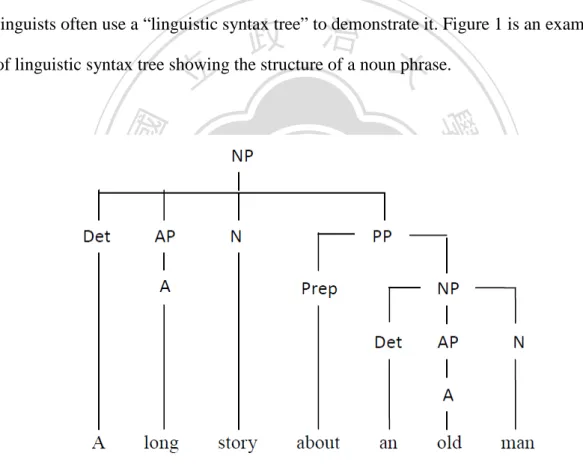
(19) an extension product with a less prestigious brand, consumers may react negatively to the prestigious brand. Helmig, Huber, and Leeflang (2007), James (2006), and Walchi (2007) adapted the concept of fit to brand alliance field. They suggested that the fit between partners (i.e., partner congruity), which means the similarity of brand characteristics or benefits between two brands, would influence consumers’ attitudes of the co-branded product. Moderate incongruity composition is more favorable than high incongruity or congruity. In high incongruity situation, consumers need so much effort to process the. 政 治 大 In highly congruity situation, consumers’ evaluation of the co-branded product would 立. brand alliance information that their preference of the product would not be improved.. not be changed because they process the information almost without any efforts. ‧ 國. 學. (Walchi, 2007). James, Lyman, and Foreman (2006) broadened the meaning of partner. ‧. congruity to the fit of brand personality. Consumers’ attitudes of the brand alliance. sit. y. Nat. will be more positive if the personality of the two partners in an alliance is matched in. io. er. comparison to the two partners with unmatched personalities.. Although brand alliance has been a popular and promising issue practically and. al. n. v i n C hconcept is still ambiguous academically, the boundary of this due to the absent of a engchi U. strict definition. There are many types of alliances that differ in the purpose of allying or the way to communicate the alliance concept either to customers or to readers of branding research literature. Lebar et al. (2005) classified the types of brand alliance into five categories: promotions, sponsorship, licensed product, new-product extensions, and website. Base on the classification above, the purpose of an alliance can be generalized more simply into three categories: promotion, production, and sponsorship. The brands cooperating with each other for product or service promotion focus on the sales improvement of each individual brand after the alliance (e.g., Samu, Krishnan, and Smith 1999). The studies of this type of alliance often appear in the 9.
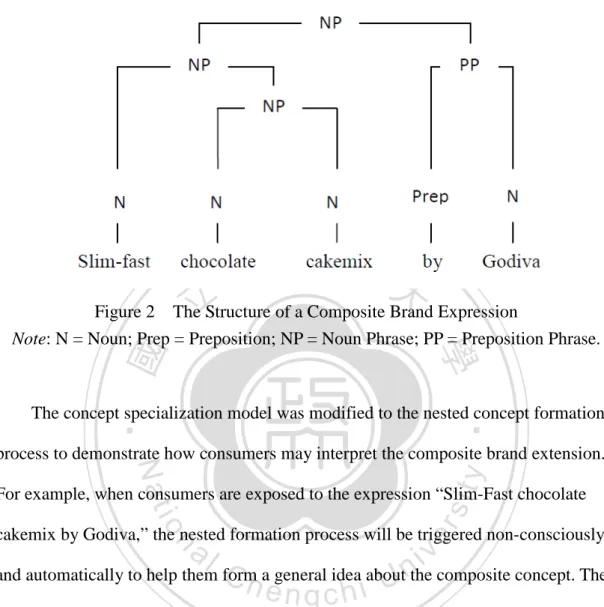
(20) promotion strategy literatures. The studies emphasizing the sponsorship type of alliance usually investigate the benefits to the sponsors after they contribute some resources to nonprofit organization or sports activities (e.g., Carrillat, Harris, and Lafferty 2010; Ruth and Simonin 2003). Some of these cooperation are also called “cause-brand alliances” when non-profit organizations were involved (e.g., Lafferty and Goldsmith 2005; Lafferty, Goldsmith, and Hult 2004), The relationship between partners in a promotion or sponsorship type of alliance is often loose and short-term. But if two or more brands cooperate for product. 政 治 大 time. Researchers have adopted different forms of brand alliances when investigating 立. development or marketing, the relationship will be closer and maintained for a longer. However, not everyone has defined the context explicitly.. 學. ‧ 國. the situation of two brands involving in a new product development (see Appendix 1).. ‧. As shown in Appendix 1, in one third of those studies, the participants were. sit. y. Nat. presented with information about two brands launching a new product, yet they were. io. er. not informed how those two brands worked together (e.g., Rao, Qu, and Ruekert 1999; Voss and Gammoh 2004). In one-half of the remaining studies, the participants were. al. n. v i n told that one brand served as anC ingredient in the otherU h e n g c h i brand’s product, an ingredient brand alliance (e.g., Desai and Keller 2002; Simonin and Ruth 1998). In the other studies, the participants were not only informed that two brands introduced a new product together, but were also exposed to a composite brand name, an expression describing two brands and one product (e.g., Geylani et al. 2008; Park et al. 1996). From consumers’ perspectives, the relationship between those brands in a composite brand alliance is most close because all the individual brand names are presented in the combined name of the co-brand product. Consequently, the reciprocal influences between these brands and the composite brand product should be strongest among all types of brand alliance. 10.
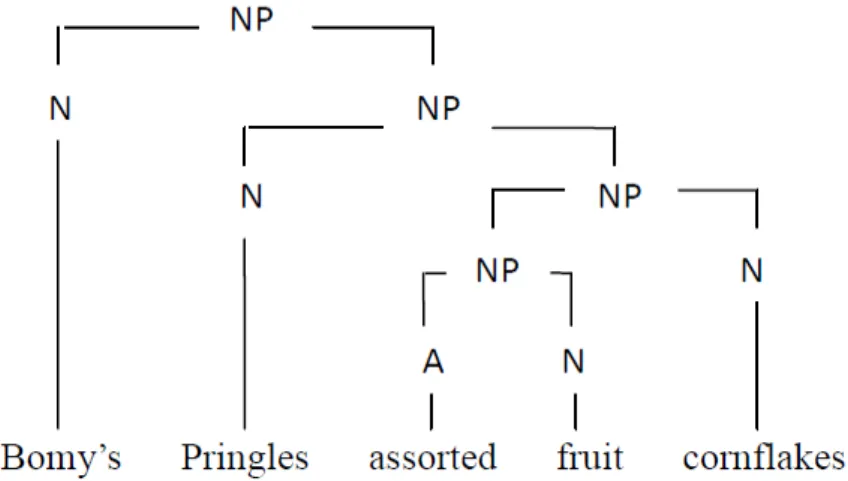
(21) Consumers’ first impression of the composite brand product comes from the expression of the co-branded product name on the package or in advertising. How consumers process the expression to form the alliance concept in their minds may depend on the language structure of the expression, which is similar to the way people communicate with others (Carnie 2002). Therefore, linguistics theories are applicable to illuminate the process of how consumers form the composite brand concept in their minds.. 立. 政 治 大. ‧. ‧ 國. 學. n. er. io. sit. y. Nat. al. Ch. engchi. 11. i n U. v.
(22) 2.3 The Composite Concept People use words and sentences to communicate with others. To understand the relation between the words in a phrase or a sentence, they will take the words which are more related to each other as a unit, and then combine units into a greater unit. At last, a hierarchical structure of the phrase or sentence is formed after multiple combinations (Carnie 2002). Consumers spend less cognitive effort when they adopt this nested concept formation process than when they combine all the concepts at one time. To analyze the structure of a phrase or a sentence in a syntax perspective,. 政 治 大 of linguistic syntax tree showing the structure of a noun phrase. 立. linguists often use a “linguistic syntax tree” to demonstrate it. Figure 1 is an example. ‧. ‧ 國. 學. n. er. io. sit. y. Nat. al. Ch. engchi. i n U. v. Figure 1 An Example of the Linguistics Syntax Tree Note 1: A = Adjective; Det = Determiner; N = Noun; Prep = Preposition; AP = Adjective Phrase; NP = Noun Phrase; PP = Preposition Phrase. Note 2: From Syntax: A Linguistic Introduction to Sentence Structure (p. 85), by Keith Brown and Jim Miller, 1991, London: Routledge.. A composite concept refers to a combination of two or more concepts to create a new meaning (Murphy 1988). One of these concepts is called the “head”, which is 12.
(23) often a noun or pronoun. The head would be modified by the other concepts referred to as the “modifiers.” Normally, in a noun phrase the modifiers can be located before or after the head (Carnie 2002; Sweet 1903). Take the noun phrase in Figure 1 for example, “a long story about an old man” is a composite concept. The noun “story” is the head of this concept; whereas the adjective “long” and the preposition phrase “about an old man” are the modifiers modifying the head. The preposition phrase “about an old man” is composed by a preposition, an adjective and a noun, and these elements will be combined to form an unit before they are connected with the head. 政 治 大 Murphy (1988) summarized three models to interpret the process how people 立. “story”.. form a composite concept: the extensional model, the concept specialization model,. ‧ 國. 學. and the selective modification model. The extensional model (Osherson and Smith. ‧. 1981; Zadeh 1965) is used to represent a composite concept as the intersection of the. sit. y. Nat. sets corresponding to two or more independent concepts (e.g., pet fish). The concept. io. er. specialization model (Brachman 1979; Finin 1980) was developed to explain noun-noun conjunctions that are formed by a head and a modifier. In this model the. al. n. v i n meaning of the head is specifiedC by the modifier (e.g.,U h e n g c h i apartment dog). The selective. modification model proposed by Smith, Osherson, Rips, and Keane (1988) illustrates adjective-noun conjunctions. The adjective is used to specify a single feature of the noun (e.g., red apple). The components of a composite brand product typically include two brands and one product. Each component can be taken as an independent concept respectively. Therefore, the expression for a composite brand product can be viewed as a composite concept or a noun-noun conjunction, though it is composed of at least three components. The linguistic syntax tree can be used to illustrate the structure of a composite brand expression. The language structure of a composite brand expression 13.
(24) in previous research is shown as Figure 2.. 立. 政 治 大. ‧ 國. 學. Figure 2 The Structure of a Composite Brand Expression Note: N = Noun; Prep = Preposition; NP = Noun Phrase; PP = Preposition Phrase.. ‧. The concept specialization model was modified to the nested concept formation. sit. y. Nat. process to demonstrate how consumers may interpret the composite brand extension.. io. er. For example, when consumers are exposed to the expression “Slim-Fast chocolate cakemix by Godiva,” the nested formation process will be triggered non-consciously. al. n. v i n C h a general idea about and automatically to help them form the composite concept. They engchi U will combine chocolate and cakemix to a single unit first, and then connect this new concept with Slim-Fast to form a greater unit. Finally, the new concept and the preposition phrase “by Godiva” will be linked to create a whole new meaning. In the current research, the author adopts this nested process. However, other linguistic theories should be considered as well. To be consistent with the theories, this research uses the terms, the “head brand” and the “modifier brand”, instead of the “header” and the “modifier” used by previous researchers. In the example above, Godiva was considered the modifier brand, and Slim-Fast was considered the head brand. Park et al. (1996) found the extension product was perceived to be more 14.
(25) closely associated with the head brand than the modifier brand. And the participants’ perceptions of the product also exhibited a stronger influence of the head brand’s attributes than the modifier brand’s characteristics. It should be noted that the definition of the head brand and the modifier brand is ambiguous within previous research. Park et al. (1996) in a pretest asked the participants to answer two questions: (1) which brand did they perceive to have ownership of the composite brand extension product? and (2) what was the perceived degree of association of the product with each of the two brands in the alliance? In. 政 治 大 cakemix by Slim-Fast” used in their study, the brand appearing before the product was 立 both expressions “Slim-Fast chocolate cakemix by Godiva” and “Godiva chocolate. perceived to be associated more with the product. As a result the researchers assigned. ‧ 國. 學. the first brand in the expression to be the head brand. This same empirical process to. ‧. identify the head brand was adopted by Jones (2004). However, he found that. sit. y. Nat. consumers perceived the extension product to be more associated with Slim-Fast in. io. er. both cases. Thus, he concluded that Slim-Fast was the head brand no matter whether it appeared before or after the product.. al. n. v i n Cthe This procedure to determine brand in a composite brand expression h ehead ngchi U. raises some concerns. First, if the assignment of the head brand and the modifier brand is based on the empirical results, it may violate the linguistic theory, from which those terms come from. Second, the perceived association between each. constituent brand and the extension product may also be influenced by relative brand familiarity, likability, or perceived extendibility. Using empirical results to identify the head brand and the modifier brand conceivably could be inconsistent with the underlying linguistic interpretation. To clarify this situation, this research will base the conclusion on linguistic theory and assign the head brand and the modifier brand by their respective locations in a composite brand expression. In so doing, there will be 15.
(26) an opportunity to clarify the effect of the head brand, and to investigate the interaction of syntax and other marketing factors. These confusions not only happened in the assignment of the head brand and the modifier brand, but also appeared in the context that previous experiments were conducted. Both Jones (2004) and Uggla (2004) used the concept “modifier brand” to demonstrate consumers’ interpretation of an ingredient brand (e.g., ECCO shoes with GORE-TEX fabric). However, it seems less appropriate to adopt this concept in the ingredient branding context because consumers likely know that the host brand, which. 政 治 大 in production or marketing. Further, the role of the ingredient brand in such an 立. produces the end product, should assume the responsibility for the co-branded product. alliance is to provide one component of the product. Thus, it is reasonable that most. ‧ 國. 學. consumers will perceive the host brand to be more associated with the product. And. ‧. the syntax structure here would play a minor role in consumers’ perceptions toward. sit. y. Nat. the ingredient branding alliance.. io. er. In Park et al. (1996), the head brand received stronger feedback effect from the composite brand extension only in the condition of “Slim-Fast chocolate cakemix by. al. n. v i n Godiva.” There is no significantC feedback effect in another h e n g c h i U condition “Godiva. chocolate cakemix by Slim-Fast,” in which the two brands’ positions were exchanged.. They explained that the participants might perceive Godiva’s chocolate as an ingredient of the co-branded product. Hence the feedback effect of the host brand Slim-Fast was enhanced when it was the head brand. On the other hand, when the ingredient brand Godiva was the head brand, it remained a secondary component of the co-branded product in consumers’ perception. That might be the reason that the stronger feedback effect on the head brand Godiva did not appear in the latter case, though it was still perceived to be associated closer with the extension product in their pretest. 16.
(27) 2.4 Proximity Iconicity Although the hierarchical structure of language mentioned above can be analyzed through the process of composite concept formation, the lineal structure, or the word order, is also essential for people to express themselves or understand others’ thoughts. When there are more than two modifiers in a noun phrase, the word order depends on the relation between the head and those modifiers (Valois 2006). The most objective and explicit modifier, which exhibits the intrinsic characteristics of the head without comparison with other things, will be located near the head. On the other. 政 治 大 comparing the head and other things, will be placed away from the head (Hetzron 立 hand, the most subjective and implicit modifier, which has to be clarified by. 1978; Sproat and Shi 1988; Zhang 1998). This phenomenon, proximity iconicity, is. ‧ 國. 學. common in Chinese, English, and other languages. For example, most people will use. ‧. “the big red apple” instead of “the red big apple” when they describe the attributes of. sit. y. Nat. an apple. The apple can be defined as red color without comparing with other objects.. io. er. But people need to compare it with other things to judge its relative size. People often take linguistic expressions as spaces. The distance of words in a. al. n. v i n Cofhthe concepts that are sentence symbolizes the distance represented by the words. engchi U. The closer the words are in a sentence, the stronger is the relation between them. That is “closeness is strength of effect” (Lakoff and Johnson 1980; Wang 2002). For example, if A influences B, the effect will be greater when A and B are closer in a sentence. No matter how to interpret the expression for a composite brand extension using the concept formation process or the proximity iconicity, the same pattern should appear in consumers’ perceptions of the composite brand expressions. The head brand is located close to the extension product, so consumers will connect it with the product before the modifier brand is linked with the product. Consequently, the 17.
(28) extension product will be perceived to be more closely associated with the head brand than the modifier brand. Consumers will tend to consider the extension product as the head brand’s product. As a result, the head brand will be perceived to be more responsible for the extension product than the modifier brand due to the perceived product ownership. The performance of the co-branded extension product will also show a greater influence on the head brand than the modifier brand. That is, consumers’ attitude of the head brand will be more positive/negative when the extension product succeeds/fails. In comparison to the modifier brand, the head brand. 政 治 大 damaged more seriously when the product does not perform well. Thus, a set of 立. will benefit more from a favorable co-branded product. On the other hand, it will be. hypotheses are proposed:. ‧ 國. 學 ‧. H1a: When consumers are exposed to the expression of a composite brand extension,. io. er. in comparison to the modifier brand.. sit. y. Nat. they will perceive the product to be more closely associated with the head brand. H1b: Consumers will perceive the head brand in the expression of a composite brand. al. n. v i n C h for the extension extension has more responsibility product in comparison to the engchi U modifier brand.. H1c: In comparison to the modifier brand, the head brand of a composite brand extension expression will receive a stronger feedback effect from the performance of the extension product.. 18.
(29) 2.5 Initial Position In the expression “Slim-Fast chocolate cakemix by Godiva,” the head brand was also located in the initial position. A reasonable question may be raised: does the effect come from the head brand or the fact that this brand is also in the initial position? The word order not only represents syntax rules and expresses semantic meaning; it also conveys the interest, involvement and focus of speakers (Osgood 1980; Sweet 1903; Tai 2002). English speakers often put the words they want to emphasize in the. 政 治 大 that people already know is usually provided in the initial position of a sentence, and 立 beginning of a sentence (Osgood 1980). Connolly (1991) indicated that information. new information will appear later. The meaning of the words or the phrase in the. ‧ 國. 學. initial position also reveals the theme of the sentence (Fries 1995; Grimes 1986) or the. ‧. scope of the latter words (Crompton 2006). Compared with English, Chinese is a. sit. y. Nat. topic-prominent language. The theme is always in the initial position of a sentence.. io. er. And speakers often assume that listeners know the information appearing first (Chao 1968; Her 1991; Li and Thompson 1981).. al. n. v i n Cthe According to this rule about position, consumers may raise some h einitial ngchi U. thoughts toward the initial brand – the brand in the initial position of a composite brand expression. For example, in the expression “Slim-Fast chocolate cakemix by Godiva,” consumers may consider that Slim-Fast is more important than Godiva in this alliance because of its position in this phrase. Slim-Fast may be perceived as the leader or initiator, and Godiva was invited to take part in this alliance. Since consumers may take the initial brand as the main producer of the co-branded product, the product may be perceived as one member of Slim-Fast’s product line. The association between the product and Slim-Fast will be perceived to be closer than the product and Godiva. Consumers will also consider Slim-Fast to have more 19.
(30) responsibility for the product and for its marketing than Godiva because Slim-fast seems to play a major part in the alliance. Consequently, the initial brand Slim-Fast will receive a stronger feedback effect due to the performance of the co-branded extension product. That is, consumers tend to attribute the success or failure of the product to Slim-Fast instead of Godiva. Contrarily, when the two brands switch their locations in the expression with each other, Godiva becomes the initial brand. Now Godiva, instead of Slim-Fast, will be perceived to be more associated with and have more responsibility for the product. Also, Godiva will receive a stronger feedback. 政 治 大. effect. Based on the argument of the initial position, a set of competing hypotheses are proposed:. 立. ‧ 國. 學. H2a: When consumers are exposed to the expression of a composite brand extension,. ‧. they will perceive the product to be more closely associated with the initial. sit. y. Nat. brand in comparison to the other brand in the alliance.. io. er. H2b: Consumers will perceive the initial brand of a composite brand extension expression has more responsibility for the extension product in comparison to. n. al. Ch. the other brand in the alliance.. engchi. i n U. v. H2c: In comparison to the other brand in the alliance, the initial brand of a composite brand extension expression will receive a stronger feedback effect from the performance of the extension product in comparison to the other brand in the alliance.. These two sets of hypotheses come from different linguistic theories. The head and modifier brand hypotheses, H1a, H1b, and H1c, are based on the model of composite concept formation process related to the relative positions of both brands and the product in a composite brand expression. However, the initial brand 20.
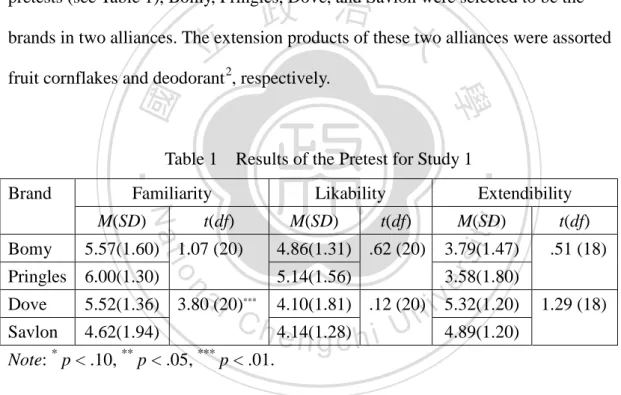
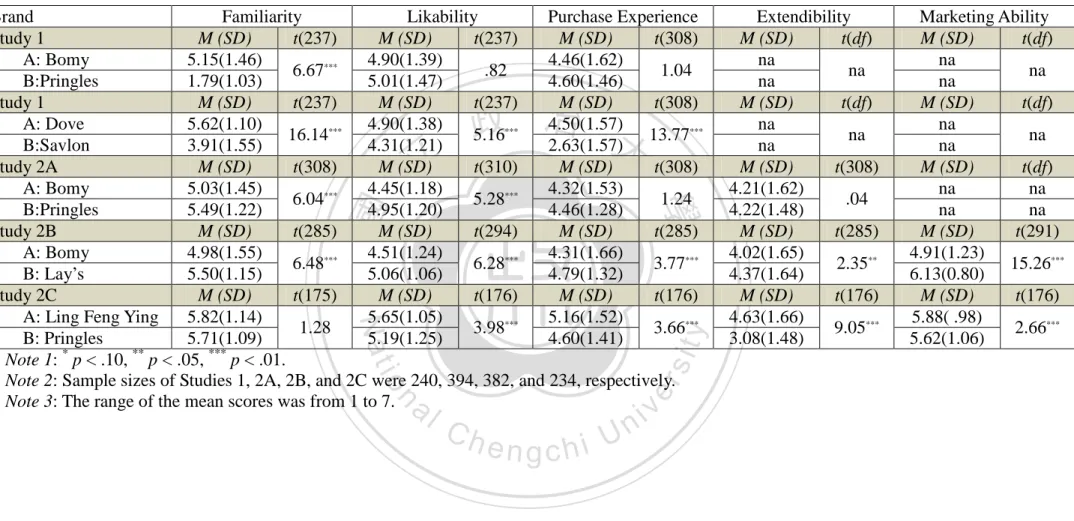
(31) hypotheses, H2a, H2b, and H2c, are proposed according to the absolute position of one brand in the composite brand expression. These competing hypotheses are not necessarily related to each other. For example, in the expression “Slim-Fast chocolate cakemix by Godiva,” Godiva is the modifier brand, while Slim-Fast is both the head brand and the initial brand. Nevertheless, in the expression “Godiva’s Slim-Fast chocolate cakemix,” Slim-Fast remains the head brand, but now the modifier brand Godiva stands in the initial position.. 立. 政 治 大. ‧. ‧ 國. 學. n. er. io. sit. y. Nat. al. Ch. engchi. 21. i n U. v.
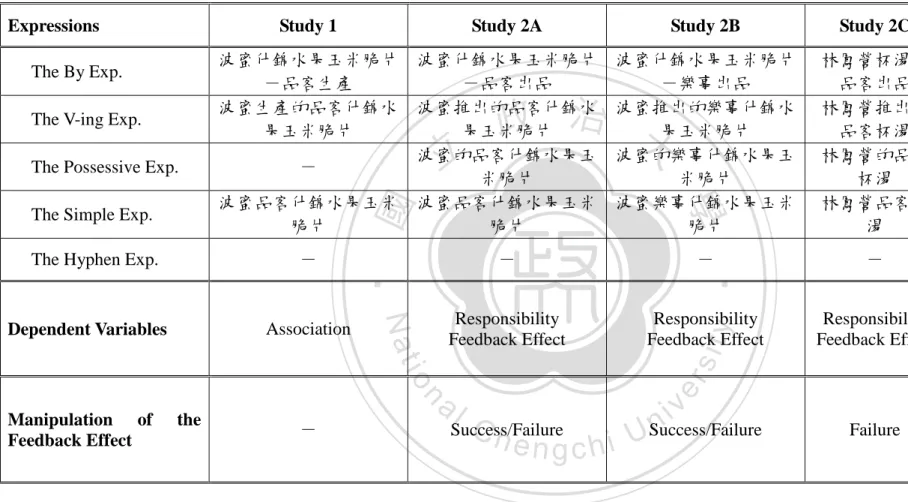
(32) 2.6 The Use of Hyphen It is very common to create a new composite brand by connecting two brands with a hyphen, such as BenQ-Siemens or Warner-EMI, in the real world. In English, the hyphen is usually used to connect two or more words to form a new composite concept (Perkins 1990). The most common composition is to connect two adjectives to modify a noun (e.g., a well-dressed woman). A hyphen is also used to connect nouns to form a new composite concept (e.g., a diplomatic tug-of-war). Sometimes, the hyphen represents an equal relationship among those words that are connected by. 政 治 大 Consumers’ interpretation toward a composite brand expression may be 立. the hyphen (Chen 1989). However, the hyphen does not exist in the Chinese language.. affected by the appearance of a hyphen. Thus, their perception toward “Slim-Fast. ‧ 國. 學. Godiva chocolate cakemix” and “Slim-Fast-Godiva chocolate cakemix” may be. ‧. different. In the latter expression, consumers would likely take the two brands as one. sit. y. Nat. new concept because of the hyphen, and then combine this new concept composed by. io. er. the two brands with the product to form the final composite concept. In this case, there is no head brand and modifier brand in consumers’ minds. Although the initial. al. n. v i n brand may still be perceived theC leader in the alliance,U h e n g c h i consumers may consider the. position of both brands in the alliance more equal in this expression than the similar expression without a hyphen between the two brands. Thus, those effects in the two sets of competing hypotheses proposed above will be weaker when the two brands in a composite brand extension expression are connected by a hyphen than without a hyphen. That is, in the first set of hypotheses, the effects of the head brand in a composite brand extension expression with a hyphen between two brands will be weaker than in another expression without a hyphen. On the other hand, if the second set of hypotheses is supported (i.e., the initial brand exhibits a greater influence), the effects of the initial brand in an expression with a hyphen between two brands will be 22.
(33) weaker than in another expression without a hyphen. Two hypotheses are proposed as the following:. H1d: When the two brands in an expression of a composite brand extension are connected by a hyphen, consumers will perceive (a) the association between the extension product and the latter brand, (b) the responsibility of the latter brand, and (c) the feedback effect of the latter brand. 政 治 大 H2d: When the two brands in an expression of a composite brand extension are 立 weaker than when the two brands are not connected by a hyphen.. connected by a hyphen, consumers will perceive. ‧ 國. 學. (a) the association between the initial brand and the extension product,. ‧. (b) the responsibility of the initial brand for the extension product, and. sit. y. Nat. (c) the feedback effect of the initial brand. io. n. al. er. weaker than when the two brands are not connected by a hyphen.. Ch. engchi. 23. i n U. v.
(34) CHAPTER 3. STUDIES IN TAIWAN. To test the competing hypotheses H1a-c and H2a-c, four experiments in Chinese language were conducted in Taiwan. The participants in the experiments, students from a university in Taiwan, were invited to participate in one of the experiments with an incentive of a lucky draw equivalent to 200 NT dollars.. 3.1 Study 1: The Association Between Each Brand and the Extension. 政 治 大 The purpose of Study 立 1 is to test the competing hypotheses H1a and H2a.. Product. ‧ 國. 學. Hypothesis 1a predicts a stronger association between the head brand and the extension product, whereas H2a argues that the initial brand will be perceived to be. ‧. more closely associated with the extension product.. sit. y. Nat. al. n. Pretests. er. Stimuli Creation and Procedure. io. 3.1.1. Ch. engchi. i n U. v. Pretests were conducted to choose two brands with the same perceived familiarity and likability, and one extension product with the same perceived extendibility from both brands. The concept “perceived extendibility” in Park et al. (1996) is similar to the concept “fit” between the extension product and the original brand in brand extension literature (e.g., Aaker and Keller 1990; Keller 1998) referring to the similarity between the new product and the current product category. It is reasonable that if consumers perceive the co-branded product to be more similar to one brand’s current products than another brand’s products in the alliance, the former will have a stronger association with the co-branded product than the latter. In. 24.
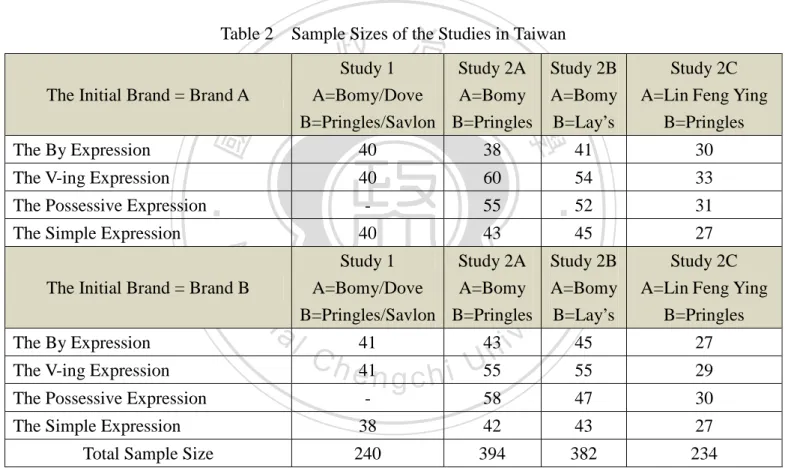
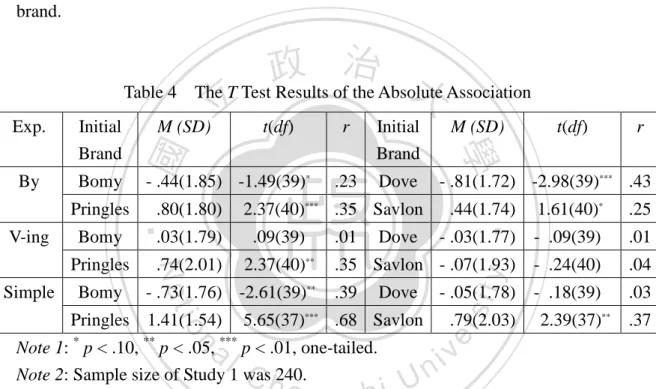
(35) the most extreme case, when the co-branded product is a member of one brand’s current product line, the other brand serves as an ingredient brand. In this case the locations of the two brands in a composite brand expression will only play a minor role when consumers form their perception of this composite brand product concept. It is therefore necessary to control the extendibility of two brands in an alliance. Several fictitious composite brand extensions with real brands were created for the pretests. Using seven-point scales, the respondents rated the familiarity, likability, and extendibility to the extension product of each brand. Based on the results of these. 政 治 大 brands in two alliances. The extension products of these two alliances were assorted 立 pretests (see Table 1), Bomy, Pringles, Dove, and Savlon were selected to be the. fruit cornflakes and deodorant 2, respectively.. t(df). M(SD). 5.57(1.60) 1.07 (20). Pringles. 6.00(1.30). Dove. 5.52(1.36) *. 4.62(1.94). 4.86(1.31) .62 (20) 5.14(1.56). M(SD) 3.79(1.47). t(df) .51 (18). 3.58(1.80). al 3.80 (20) 4.10(1.81) .12 (20) i v5.32(1.20) C h 4.14(1.28) U n 4.89(1.20) engchi n. Savlon. io. Bomy. t(df). Extendibility. y. Nat. M(SD). Likability. sit. Familiarity. er. Brand. Results of the Pretest for Study 1. ‧. ‧ 國. 學. Table 1. ***. 1.29 (18). Note: p < .10, ** p < .05, *** p < .01.. Experimental Design of Study 1 There were three expressions and two brand orders used in Study 1 (see Table 2). The participants were randomly assigned to one of the six groups. Every participant was exposed to both the Bomy/Pringles and the Dove/Savlon alliances. To test the hypotheses, the expression used in Park et al. (1996) was translated into Chinese:. 2. Dove had not introduced deodorant in Taiwan when this experiment was conducted.. 25.
(36) “Bomy assorted fruit cornflakes by Pringles” (named “the by expression”: 波蜜什錦 水果玉米脆片—品客生產). To separate the effects of the head brand and the initial brand, another two Chinese expressions were created: “Bomy manufacturing, Pringles assorted fruit cornflakes 3” (named “the V-ing expression”: 波蜜生產的品客什錦水 果玉米脆片) and “Bomy Pringles assorted fruit cornflakes” (named “the simple expression”: 波蜜品客什錦水果玉米脆片). (Please see Appendix 2 for the details of the expression translation.). Table 2. The Possessive Expression. io. al. n. The V-ing Expression The Possessive Expression The Simple Expression Total Sample Size. 3. 60. -. 55. 40. 43. 30. 54. 33. 52. 31. 45. 27 Study 2C A=Lin Feng Ying B=Pringles. Study 1 Study 2A Study 2B A=Bomy/Dove A=Bomy A=Bomy B=Pringles/Savlon B=Pringles B=Lay’s. sit. Nat. The Initial Brand = Brand B The By Expression. 40. 41. er. The Simple Expression. 38. ‧. ‧ 國. The V-ing Expression. 40. Ch. 41. i n U 43. v. Study 2C A=Lin Feng Ying B=Pringles. y. 立. 學. Study 2B A=Bomy/Dove A=Bomy A=Bomy B=Pringles/Savlon B=Pringles B=Lay’s. The Initial Brand = Brand A The By Expression. 治 政 Study 1 Study 大2A. Sample Sizes of the Studies in Taiwan. 45. 27. 55. 55. 29. -. 58. 47. 30. 38. 42. 43. 27. 240. 394. 382. 234. e41n g c h i. The Chinese version of the V-ing expression does not include a comma. However, this is the best way. to translate the meaning in English as it keeps this expression a noun phrase instead of a sentence. Furthermore, the relative locations of the two brands and the product in the English translation of the V-ing expression were kept the same with that in the original Chinese expression, though the English translation is grammatically incorrect. (Please see Appendix 2 for the details of the expression translations.). 26.
(37) Although it is necessary to use the expression with a similar structure as that in previous research, the Chinese translation of the by expression was unusual. The modifier is rarely located behind the head in Chinese. In order to keep the structure consistent with previous research, the by expression was adjusted to make it more comprehensible by adding a “—.“ The V-ing and the simple expressions differ from the by expression used in previous research. As pointed out before, in the by expression the head brand also stands in the initial position. In these two new expressions “Bomy manufacturing, Pringles assorted fruit cornflakes” and “Bomy. 政 治 大 head brand. When the order of the two brands in each expression was reversed, 立. Pringles assorted fruit cornflakes,” Bomy was the initial brand, and Pringles was the. Pringles was the initial brand and Bomy was the head brand (see Table 3). The. ‧ 國. 學. strength of the head brand and the initial brand can be separated, and the effect of the. y. n. al. The Initial Brand. er. Brand Order 1. sit. The Initial Brand and the Head Brand in Every Expression. io. Expressions. Nat. Table 3. ‧. head brand relative to the initial brand can be clarified using these two expressions.. v. The Head Brand. The Possessive Exp.. i n C Brand A manufacturing, B Product h e nBrand gchi U Brand A’s Brand B Product. A. B. The Simple Exp.. Brand A Brand B Product. A. B. The Initial Brand. The Head Brand. The By Exp.. Brand A Product by Brand B. The V-ing Exp.. Expressions. Brand Order 2. A. A. A. B. The By Exp.. Brand A Product by Brand B. B. B. The V-ing Exp.. Brand B manufacturing, Brand A Product. B. A. The Possessive Exp.. Brand B’s Brand A Product. B. A. The Simple Exp.. Brand B Brand A Product. B. A. Initially, the 240 participants (79 males and 161 females; average age 20.46 years) were told they would be asked some questions about their attitudes towards several brands. They were shown one of the composite brand extension expressions and 27.
(38) informed that two brands are going to introduce a new product together. Then, usingseven-point scales, they rated: (1) the association between brands and product (-3 = associated more with Bomy/Dove, 3 = associated more with Pringles/Savlon), and (2) ownership of the extension product (-3 = belongs to Bomy/Dove, 3 = belongs to Pringles/Savlon). Finally, they rated their familiarity (1 = never heard of it, 7 = very familiar), likability (1 = extremely dislike, 7 = extremely like), and previous purchase experience (1 = never bought it, 7 = purchased often) of the two brands. After answering the questions about one alliance, they were shown another composite brand. 政 治 大 evaluation of this alliance. (Please see Appendix 2 for the complete questionnaire.) 立. extension expression and were asked to answer the above questions according to their. The sequence of the two alliances in the questionnaire was randomly rotated to. ‧ 國. 學. prevent the order effect.. ‧. Results and Analyses. sit. y. Nat. 3.1.2. io. er. Due to the high correlation between the association and ownership scores (Bomy/Pringles: r = .60, p < .01; Dove/Savlon: r = .58, p < .01), these two items were. al. n. v i n C h There was noUorder effect between two averaged into one score for the analyses. engchi. sequences of composite brand alliances in the questionnaire (Bomy/Pringles: t(238) = .30, p = .76; Dove/Savlon: t(238) = 1.18, p = .24). Hypotheses 1a and 2a are competing predictions about the relative perceived association between the extension product and the head brand or the initial brand in a composite brand expression. If the association score is negative, the more closely the product was perceived to be associated with Bomy/Dove. On the other hand, when the score is positive, the more closely the product was perceived to be associated with Pringles/Savlon. Table 4 presents the results of t tests against zero for the absolute association. In the Bomy/Pringles alliance, when the initial brand was Bomy, the average association 28.
(39) score was significantly negative in the by and the simple expressions. However, in the V-ing expression the score was positive, but not significant. On the other hand, when the initial brand was Pringles, the association scores of all three expressions were significantly higher than zero. Most of the results support H2a. Furthermore, the average effect size r of the five homogeneous results (χ2 (4) = 7.32, excluding the heterogeneous result of the expression “Bomy manufacturing, Pringles assorted fruit cornflakes,” was .41. It would take 66 null results to mitigate this effect of the initial brand.. V-ing. Bomy. Simple. Bomy. .09(39). .74(2.01). 2.37(40). al. 1.61(40)*. .25. - .03(1.77). - .09(39). .01. .35 Savlon - .07(1.93). - .24(40). .04. .39. - .18(39). .03. Dove Dove. 5.65(37)*** .68 Savlon. ***. n. **. io. *. - .81(1.72) -2.98(39)*** .43 .44(1.74). .01 **. - .73(1.76) -2.61(39)**. Pringles 1.41(1.54). Dove. 2.37(40)*** .35 Savlon. .03(1.79). Nat. Pringles. .80(1.80). .23. r. ‧. Pringles. - .44(1.85) -1.49(39)*. y. Bomy. Brand. - .05(1.78). sit. By. t(df). 學. Brand. .79(2.03). er. Exp.. ‧ 國. 政 治 大 Table 4 The T Test Results of the Absolute Association 立 t(df) r Initial M (SD) Initial M (SD). 2.39(37)**. .37. v. Note 1: p < .10, p < .05, p < .01, one-tailed. Note 2: Sample size of Study 1 was 240. Note 3: The range of the mean score was from -3 to 3. The lower the score was, the more closely the product was perceived to be associated with Bomy/Dove. The higher the score was, the more closely the product was perceived to be associated with Pringles/Savlon.. Ch. engchi. i n U. Further t tests were conducted to compare the scores between two brand orders (i.e., relative association). If the scores of two brand orders are significantly different, it means the perceived association scores shift when Bomy and Pringles exchange their positions in the expression. The results of the three expressions indicate that when Pringles was the initial brand (Pringles was also the head brand in the by. 29.
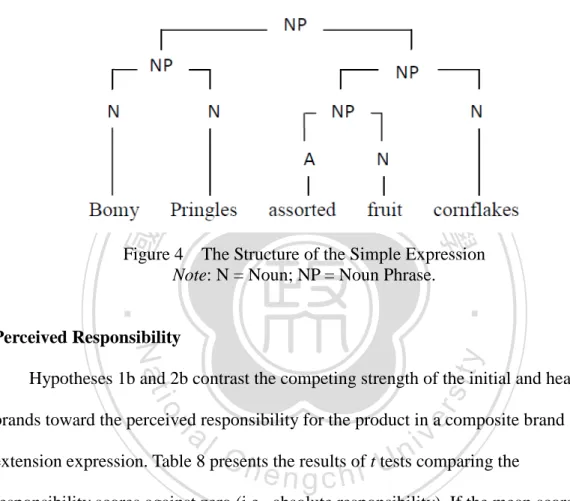
(40) expression, and Bomy was the head brand in the V-ing and the simple expressions), the association score was significantly higher than when Bomy was the initial brand (Bomy was the head brand in the by expression, and Pringles was the head brand in the V-ing and the simple expressions) (the by expression: t(79) = 3.06, p < .01, r = .33; the V-ing expression: t(79) = 1.70, p = .05, r = .19; the simple expression: t(76) = 5.69, p < .01, r = .55). That is, participants perceived that one brand was more closely associated with and own the co-branded product when it is the initial brand. Although in the by expression the head brand in the initial position showed a. 政 治 大 was moved away from the initial position in other two expressions. Thus, H2a was 立. greater association with the product, the effect of the head brand disappeared when it. supported in that the initial brand exhibited more strength than the head brand in a. ‧ 國. 學. composite brand extension expression for the Bomy/Pringles alliance.. ‧. In the Dove/Savlon alliance, when the initial brand was Dove, the average. sit. y. Nat. association score was significantly negative in the by expression. In the V-ing and the. io. er. simple expressions the scores were negative, but not significant. On the other hand, when the initial brand was Savlon, the scores of the by and simple expressions were. al. n. v i n C hthe association score significantly positive. Nonetheless, of the V-ing expression was engchi U. slightly lower than zero, but not significant (see Table 4). The average effect size r of these six homogeneous results (χ2 (5) = 8.37) was .18. It would take an additional 12. studies filed away to change the combined significant results to just significant at p = .05. Although the effect of the initial brand in the Dove/Savlon alliance is not as strong as in the Bomy/Pringles alliance, the extension product was still perceived to be more closely associated with the initial brand than the other brand. Again, further t tests were conducted to compare the scores between two brand orders. If the scores of two brand orders are significantly different, it means the perceived association scores shift when Dove and Savlon exchange their positions in 30.
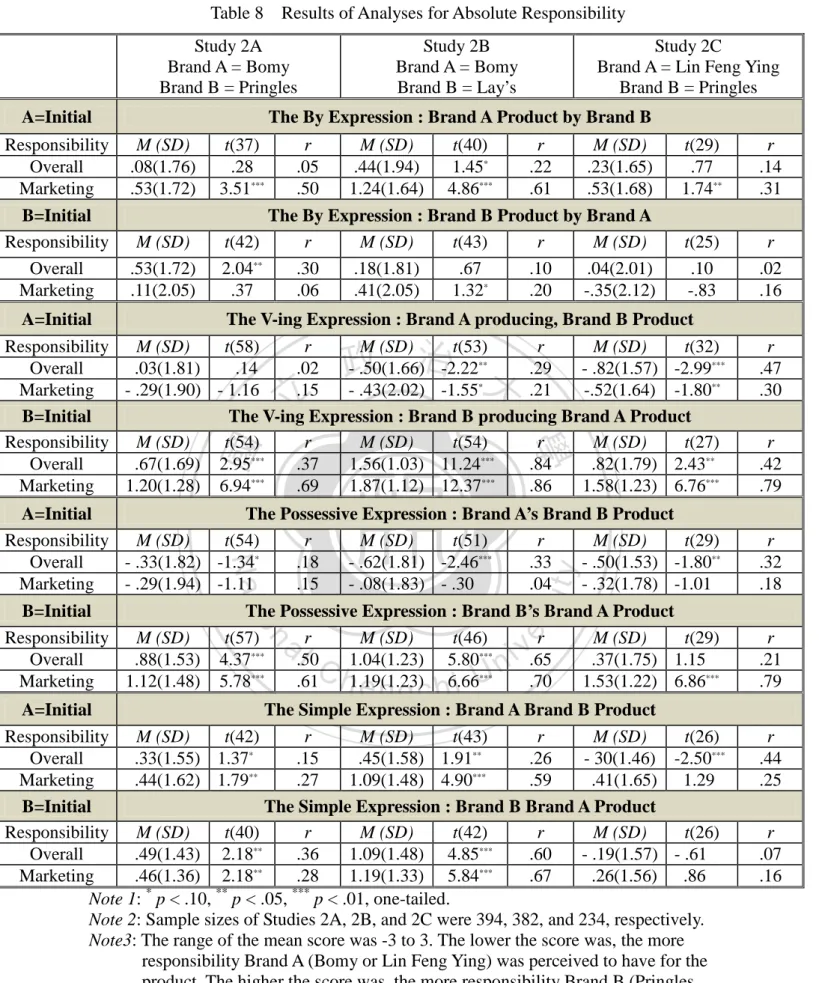
(41) the expression. The results of the by and the simple expressions indicate that when Savlon was the initial brand, the association score was significantly higher than when Dove was the initial brand (the by expression: t(79) = 3.25, p < .01, r = .34; the simple expression: t(76) = 1.94, p = .06, r = .22). That means one brand was perceived to be more closely associated with the product when it was the initial brand than when it was not in the initial position of these two expressions. However, no significant difference was found in the V-ing expression (t(79) = .12, p = .91, r = .01). Combining the three homogeneous results (χ2 (2) = 4.70), the average effect size r was .20. It. 政 治 大 results to just significant at p = .05. 立. would take an additional 7 studies filed away to change the combined significant. ‧ 國. 學. 3.1.3. Conclusion and Discussion. ‧. In Study 1, not only the by expression that used in previous research was adopted,. sit. y. Nat. but two new expressions (the V-ing and simple expressions) were also created. By. io. er. doing so, the strength of the initial brand and the head brand could be separated and tested, especially through the simple expression “Bomy Pringles assorted fruit. al. n. v i n cornflakes” because there is notC any unnecessary meaning h e n g c h i U provided in this expression. Among all expressions in the Bomy/Pringles alliance, the results show a strong. association between the composite brand extension product and the initial brand. It confirms the suspicion mentioned in the first two chapters that the strength of the head brand in the 1996 research was also due to the fact that the head brand was located in the initial position. As for the Dove/Savlon alliance, the same effect of the initial brand was found in the by and simple expressions, though the V-ing expression did not exhibit the same pattern. Moreover, the association score was biased by the relative strength of the two brands in both alliances. The manipulation check (see Table 5) showed that the 31.
(42) participants’ familiarity of Pringles was significantly higher than Bomy. The familiarity, likability and purchase frequency of Dove were also significantly higher than Savlon. The mean scores of all groups in Table 4 did not equally shift to both sides of the scale in two brand orders. The scores slightly favored Pringles in the Bomy/Pringles alliance, and slanted to Dove in the Dove/Savlon alliance, respectively. However, the results also show that the association score shifted when the brand order exchanged even if they were biased by the unequal brand strengths of the two constituent brands. One brand was still perceived to be more closely associated with. 政 治 大 The word “生產的” in the V-ing expression in Chinese might indicate that the 立. the extension product when it was moved to the initial position.. initial brand was only the manufacturer, thereby decreasing the association between. ‧ 國. 學. the initial brand and the extension product. On the other hand, the same word in the. ‧. by expression accompanied the modifier brand at the end of this expression decreased. sit. y. Nat. the association scores between the modifier brand and the product for the same reason,. io. er. hence the head brand was perceived more closely associated with the product relatively. Also, the “—“ in the by expression might indicate that the words after this. al. n. v i n C hnote to the previous punctuation were only an additional words in the expression. engchi U. Therefore, the effect of the head brand in the initial position might be strengthened. To rule out this possibility, in the following studies the wording will be slightly modified. Also, a new expression, the possessive expression, containing fewer Chinese words and simpler in semantic meaning will be added.. 32.
數據
+7
相關文件
• The ArrayList class is an example of a collection class. • Starting with version 5.0, Java has added a new kind of for loop called a for each
We would like to point out that unlike the pure potential case considered in [RW19], here, in order to guarantee the bulk decay of ˜u, we also need the boundary decay of ∇u due to
We conclude this section with the following theorem concerning the relation between Galois extension, normal extension and splitting fields..
• One technique for determining empirical formulas in the laboratory is combustion analysis, commonly used for compounds containing principally carbon and
Students are asked to collect information (including materials from books, pamphlet from Environmental Protection Department...etc.) of the possible effects of pollution on our
A subgroup N which is open in the norm topology by Theorem 3.1.3 is a group of norms N L/K L ∗ of a finite abelian extension L/K.. Then N is open in the norm topology if and only if
We explicitly saw the dimensional reason for the occurrence of the magnetic catalysis on the basis of the scaling argument. However, the precise form of gap depends
We will give a quasi-spectral characterization of a connected bipartite weighted 2-punctually distance-regular graph whose halved graphs are distance-regular.. In the case the
