Catalytic Isomerization of Quadricyclane Using Fourier Transform Near-Infrared
Absorption Spectroscopy: Diffusion, Conversion, and Temperature Effect
Hsiu-Fang Fan,†Chia-Yu Chang,†Thou-Long Chin,† Tong-Ing Ho,†and King-Chuen Lin*,†,‡ Department of Chemistry, National Taiwan UniVersity, Taipei 106, Taiwan, and Institute of Atomic and Molecular Sciences, Academia Sinica, Taipei 106, Taiwan
ReceiVed: August 24, 2005
By using Fourier transform near-infrared (NIR) absorption spectroscopy, the kinetic behaviors of quadricyclane isomerization, as catalyzed by anhydrous CuSO4 in chloroform mixture with and without agitation, are presented. Given the acquired NIR spectra, the concentration decay of quadricyclane with the reaction time is determined with the aid of partial least-squares analysis. When the mixture is not agitated, the diffusion coefficients in chloroform are evaluated to be (3.8 ( 0.1)× 10-5cm2s-1at 27°C and (4.4 ( 0.1)× 10-5 cm2s-1 at 39 °C. In the size-dependent experiments of the catalyst, the one-site and two-site coordinated conversion rate constants are further determined to be (8.5 ( 5.9)× 10-6s-1A-1and (2.2 ( 0.8)× 10-8s-1 A-2, respectively, at 27°C and (1.3 ( 0.8)× 10-5s-1A-1and (1.92 ( 0.01)× 10-6s-1A-2, respectively, at 39°C. A denotes the total catalyst surface area per unit effective volume of solvent. Accordingly, the activation energies for one-site and two-site coordination are evaluated to be 24.8 and 286.2 kJ mol-1, respectively. The reaction is dominated by one-site coordination (1:1 complex) between the reactant and the catalyst. Unless temperature increases, the two-site coordinated reaction may be ignored. In contrast, when analogous experiments are performed in the stirred solution, the diffusion factor is ignored but the conversion rate constants rise due to the increase of collision frequency. For instance, the one-site and two-site coordinated rate constants are increased to (1.7 ( 1.4)× 10-5s-1A-1and (1.27 ( 0.06)× 10-5s-1A-2at 39°C. The two-site coordinated reaction rate is enhanced by a factor of 10. Thus, isomerization may proceed via both 1:1 and 1:2 coordination between the reactant and the catalyst. The Arrhenius plot yields the corresponding activation energies to be 24 ( 3 and 275 ( 3 kJ mol-1. The activation energies remain constant, no matter whether the solution is agitated or not.
I. Introduction
Interconversion of quadricyclane and norbornadiene has attracted considerable attention because of its potential for use in solar energy storage,1,2 molecular switches,3,4 optical waveguides,5and photochromic chemsensors.6In the application of solar energy storage, energy can be stored when norborna-diene is photochemically converted to quadricyclane and then released when quadricyclane is catalytically converted to norbornadiene. The quadricyclane-norbornadiene system is advantageous in several aspects. The conversion enthalpy is as large as 89 kJ mol-1, showing more energy that may be stored than most other candidates. Quadricyclane with an activation energy of 141 kJ mol-1 may last up to 140 h at 100°C,7-9 thereby the energy can be saved for a long period. Nevertheless, norbornadiene cannot absorb solar light >300 nm; the conver-sion efficiency becomes as low as∼0.05 without the use of a photosensitizer.10,11 For this reason, its derivatives have been developed in the hope of efficiently absorbing the light waves longer than 300 nm and achieving better conversion efficiency without the aid of a photosensitizer. Thus far, such investigation has not yet been successful. Although the absorption wavelength has been made to red shift, the energy storage efficiency turns out to be worse than in the original system.
Among those potential catalysts adopted in heterogeneous complex reactions,12-20the Sn(II) and Cu(II) salts are frequently used for investigating the kinetics of the conversion of quad-ricyclane to norbornadiene. In the catalytic conversion reaction, Moore and co-workers determined the quadricyclane and norbornadiene concentrations by gas chromatography.13Their procedure requires the removal and analysis of aliquots of the reaction mixture at intervals during the reaction. To develop an in situ monitoring of the concentration variation for both substances, Vickers and co-workers demonstrated with fiber-optic Raman spectroscopy the potential for automated, nonde-structive, and continuous probing of the isomerization.14 Nev-ertheless, the suspended solids increased the sample opacity. As an alternative method, we developed Fourier transform near-infrared (NIR) absorption spectroscopy to investigate the catalytic reactions.15,16The reaction mixture was not agitated so as to avoid the effect of sample heterogeneity. Given the NIR absorption spectra acquired, the concentrations of reactant and product can be simultaneously determined with the analysis of partial least-squares (PLS).21-23
Moore and co-workers suggested that both one-site and two-site coordination of quadricyclane, with rate constants 2.9× 10⁻² min-1 g-1 and 7.3× 10⁻² min-1 g-2, respectively, for the CuSO4catalyst in benzene, may lead to the production of norbornadiene.13In our previous work,16if a one-site coordi-nated reaction was assumed to dominate, then our result of 2.7 × 10⁻²min-1g-1was consistent with that obtained above in a * To whom correspondence should be addressed. Fax: 886-2-23621483.
E-mail: [email protected].
†National Taiwan University. ‡Academia Sinica.
10.1021/jp054773r CCC: $33.50 © 2006 American Chemical Society Published on Web 02/16/2006
Downloaded by NATIONAL TAIWAN UNIV on September 8, 2009 | http://pubs.acs.org
look into the reaction mechanism.14Apparently, the kinetics of such catalysis has not been well understood yet, including whether a two-site coordinated complex may play a significant role in the surface-mediated reaction, how temperature affects the reaction, how the catalyst reduces the activation energy, and whether the stirring motion may change the kinetic behavior or the mechanism. This work attempts to clarify these problems. Herein, the kinetic behaviors of quadricyclane isomerization are investigated simultaneously under the conditions of either a still or stirred mixture. When the mixture stands still, the kinetic event becomes more complicated. The additional dif-fusion phenomena have to be taken into account. Fourier transform NIR absorption spectroscopy is used to measure the CuSO4-catalyzed isomerization of quadricyclane in the super-natant chloroform solution. With the aid of a rate model, diffusion and isomerization of quadricyclane may be well characterized. The isomerization rate constants thus obtained will be compared with those acquired in a stirred mixture. Then, the temperature dependence of the catalytic reaction is analyzed for these two cases. The activation energies for one-site and two-site coordination may be determined accordingly.
II. Experimental Section
A step-scan Fourier transform spectrometer (FTS, IFS-66v/ s, Bruker) equipped with a tungsten lamp as the NIR radiation source and a Si diode detector suitable for the wavelength range from 6000 to 25 000 cm-1. The FTS can be operated in either step-scan or rapid-scan mode with time resolutions on the order of nanoseconds and milliseconds, respectively.15,16,24-26 The rapid-scan mode is selected for the rate determination of the current catalytic isomerization. The interferogram of each scan, completed within milliseconds, was Fourier transformed and displayed.
The catalytic reactions were conducted either in a still or in a stirred mixture. The procedures for the former experiments have been described previously.16 In brief, about 7 g of the catalyst CuSO4(Merck) was added in a cuboid cell (1 cm× 5
cm × 4.8 cm), followed by slow addition of the chloroform
solvent. After the suspended salts had settled in the cell, the light beam restricted to a cross section of 2 mm in diameter was guided to propagate through the solvent layer∼0-1 mm above the solid surface. The NIR spectrum of the solvent background was acquired and averaged for 30 scans. Then, aliquots of chloroform drawn from the solvent layer were well mixed with 15-30 µL quadricyclane or norbornadiene and
carefully returned to the sample cell. NIR spectra were recorded at 30-s intervals over a period of 4 h. Each spectrum was an average of 10 measurements. For the experiment of temperature effect, a homemade minithermostat was applied to keep the cuboid cell at either 27 or 39°C during the reaction.
In the alternative experiments, a glass bottle, filled with 10 mL of chloroform solvent and a small amount of catalyst, was stirred in a thermostat with a magnet bar. The reaction was initiated by addition of 70µL of quadricyclane to the mixture.
After different reaction periods from 5 up to 45 min, the solution layer was filtered to a sample cell, followed by acquisition of NIR spectra with FTS. The filtrates without the catalyst left inside may not cause any further reaction. The procedures were
which overlap with the solvent spectra. Fortunately, when the solvent background spectrum is subtracted, only the band at 8700 cm-1leaves minor noise in the baseline.16The change of the absorption bands during the reaction is large enough to allow for determination of the individual concentrations of quadricy-clane and norbornadiene with the aid of the PLS method.21-23 In this work, 480 sets of the NIR absorption spectra for each catalytic reaction system were acquired, while 56 calibration sets of various concentration combinations of quadricyclane and norbornadiene each in the range 0.005-0.100 M (mol/L) were prepared. The fit between the predicted and actual concentra-tions, which is characterized by a straight line having a slope of 1.00 and a regression coefficient >0.98, gives rise to the quadricyclane or norbornadiene concentrations in the reaction mixture.
For the measurements of the temperature effect in a still solution, the PLS analyses at different temperatures of 27 or 39 °C were applied to find the concentrations of the related substances during the reaction. In contrast, the filtrates collected from the stirred solution were cooled to 27°C before the NIR spectra were acquired. Thus, the PLS analysis only at 27°C was performed for the reactions at varied temperatures.
The reactant quadricyclane (quadricyclo[2.2.1.0.0] heptane) was photosynthesized from norbornadiene (bicyclo[2.2.1] hepta-2,5-diene) with acetonitrile as a photosensitizer. The light at 365 nm was irradiated for about 8 h/day for 4 weeks. Its purity
>98% was examined by1H NMR spectroscopy. Norbornadiene
(99%, Aldrich) was used without further purification. The catalyst CuSO4was heated at 140°C for 12 h before use. The particle sizes were distributed into five groups of 38-44, 53-63, 74-88, 106-125, and 149-177 µm through various
standard mesh frames. CHCl3was dried over molecular sieves with a 4-Å pore size.
III. Kinetic Model
When the mixture is not agitated, quadricyclane must rely on diffusion onto the solid surface to result in norbornadiene. The kinetic rate equation including the contribution of diffusion and conversion is thus expressed as15
where C is the concentration of quadricyclane, D, its diffusion coefficient, and x, the depth measured from the top of the solution, defined as zero, to the bottom of the cell.
As reported previously,16eq 1 can be solved numerically by a one-dimensional method using a program based on Matlab 6.5 in which input data such as boundary conditions, the height of solvent above the catalyst surface, and the effective depth of the catalyst stacks are required. The effective depth of the catalyst can be evaluated by measuring the additional height of the solvent layer when a given weight of catalyst is deposited in the cell. It reflects the solvent amount in the interstices of the solid stacks. Two parameters related to the diffusivity are required in the simulation. One represents the diffusion coef-ficient of quadricyclane in the solvent layer, which is fitted when x is less than the solvent height, and the other one represents
dC dt ) D
d2C
dx2- kC (1)
Downloaded by NATIONAL TAIWAN UNIV on September 8, 2009 | http://pubs.acs.org
the diffusion coefficient in the solid stacks, which is fitted when x is larger than the solvent height.
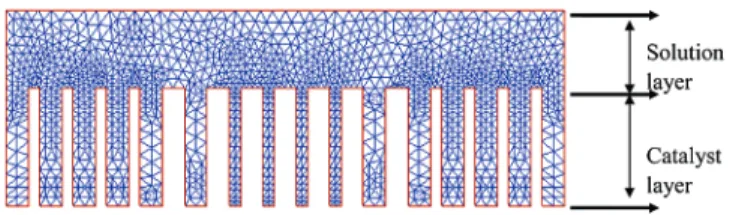
In this work, eq 1 with diffusion alone can be solved technically with a two-dimensional method. The solvent amount in the interstices of the solid stacks is distributed into numerous branches, as depicted in Figure 1. The ratio of the volumes occupied between the solvent and the solid particles in the entire branch region is subject to the experimental conditions. The numerical analysis of eq 1 is performed by a finite element method. That is, the whole system in Figure 1 is broken up into many tiny triangular unit cells, which may be spatially characterized with a two-dimensional coordinate. Given the boundary conditions, dC/dx ) 0, valid for all the edges of the model cell, the height of the solvent above the catalyst surface, and the volume ratio in the branch region, the concentrations of quadricyclane in all the triangular unit cells may be solved as functions of time and space, according to a written program based on the Matlab 6.5 environment. To compare with the experimental observation of the reactant decay, each time- and space-dependent simulated curve is integrated within the zone where the NIR probe beam propagates through the solution. Note that the diffusion coefficient of quadricyclane in the solvent is the only parameter to fit the obtained decay curve. The quality of simulation can be improved by increasing the number of branches, but it will not be improved further when the number exceeds eight. The optimized value remains a constant, irrespec-tive of the size change of the catalyst.
Despite the improved accuracy of the diffusion coefficient evaluation, the developed two-dimensional method cannot handle the complicated event to determine conversion and diffusion simultaneously. Therefore, in this work, we first apply the two-dimensional method to find out the diffusion coefficient of quadricyclane in the solvent. Given this parameter, a one-dimensional method is adopted to fit the geometry factor related to the solid phase. For one-dimensional diffusion, the diffusion of quadricyclane may be hindered while moving through the catalyst stacks along the x direction, and thus, the fitted geometry factor is smaller than unity. In this manner, the diffusion coefficient of quadricyclane inside the solid stacks is evaluated by multiplication of the diffusion coefficient in the solvent and the geometry factor. After both the diffusion coefficients are obtained, the conversion rate constant is analogously fitted with the one-dimensional method.16
IV. Results and Discussion
A. Determination of Kinetic Constants in Solution without Agitation. Since the norbornadiene product has a similar structure and properties as quadricyclane, it is used as a substitute to determine the diffusion coefficients for quadricy-clane in the catalytic system. Its concentration as a function of time is evaluated by PLS analysis, as described in the Experimental Section. The measured concentration change of
norbornadiene due to diffusion is plotted in Figure 2. The observed data are simulated with either one-dimensional or two-dimensional methods to determine the diffusivity. The resultant diffusion coefficients in the solvent are consistent. We alter-natively use NaCl salt to replace CuSO4, since the former salt cannot catalyze quadricyclane. The determined diffusion coef-ficient of quadricyclane in CHCl3also agrees with those found using norbornadiene as a substitute. The determined diffusion coefficients remain consistent, irrespective of variation of the solution volume. As the particle size of CuSO4 is changed following the distributions of 38-44, 53-63, 74-88, 106-125, and 149-177µm, the fits of the diffusion coefficients are
similarly carried out. The results are listed in Table 1. The diffusion coefficients in the solvent layer are determined to be (3.8 ( 0.1)× 10-5cm2s-1at 27°C, while the one inside the CuSO4 catalyst decreases normally with a decrease in the particle size. The diffusion tends to be slower, since the catalyst stack becomes more tightly packed as a result of the decreased size. With the one-dimensional method, the size effect can be characterized by a geometry factor, which becomes smaller when the solid pack is tighter. For instance, it is found to be 0.34 and 0.38 for CuSO4with the size distributions of 74-88 and 149-177µm, respectively. In contrast, in terms of the
two-dimensional method with the branch model, a single parameter of diffusivity can be fitted to all the concentration decay curves acquired with different particle sizes. The obtained diffusion coefficients, which remain independent of the size variation, Figure 1. Model cell in which the solvent amount inside the solid
layer is divided into numerous branches. The entire system is broken up into many tiny triangular unit cells. The concentrations of quadri-cyclane in all the triangular unit cells are solved as functions of time and space.
Figure 2. Time-dependent concentration of norbornadiene caused by diffusion in chloroform in the presence of CuSO4. The measurements with the b symbol are conducted at the solution height of 0.45 cm and the catalyst weight of 7 g. The corresponding fit with the one-dimensional method yields 3.8× 10⁻⁵and 1.29× 10⁻⁵cm2s-1for the diffusion coefficients in the solvent and inside the solid phase, respectively. The fit with the two-dimensional method yields 3.8× 10⁻⁵cm2s-1for the diffusion coefficient. The catalyst particle size is 38-44µm.
TABLE 1: Particle-Size Dependence of Diffusion
Coefficients in Solvent/Solid Phases and Pseudo-First-Order Conversion Rate Constants at 27°C
catalyst size (µm) D1a (×105cm2s-1) D2 b (×106cm2s-1) kI c (×103s-1) 149-177 3.8 1.43 2.2 106-125 3.8 1.33 3.4 74-88 3.8 1.29 5.0 53-63 3.8 1.22 8.2 38-44 3.8 1.29 14.5 aThe term D
1denotes the diffusion coefficient in chloroform.bThe term D2denotes the diffusion coefficient in the catalyst.cThe term kI denotes the pseudo-first-order catalytic rate constant.
Downloaded by NATIONAL TAIWAN UNIV on September 8, 2009 | http://pubs.acs.org
are in agreement with the one in the solvent phase using the one-dimensional method.
Because of hindrance of the flow along the vertical direction, the diffusion inside the solid stacks is found to be slower as simulated with the one-dimensional method. In contrast, for the two-dimensional method, the flow along horizontal and vertical directions are both taken into account such that the diffusion does not make any significant difference between the solvent and solid phases, if the interstices of the solid stacks are large enough like CuSO4. Furthermore, the branch model has removed the steric hindrance caused by particle shape and stacking. Unless the ratio of the volumes occupied by the solvent to the solid stacks is too small, a single parameter of diffusivity is appropriate enough to fit the observed concentration decay.
Given the diffusion coefficients in the two phases, the isomerization rate constant of quadricyclane catalyzed by CuSO4 can be evaluated by simulating the concentration decay. When the solvent amounts are varied, the obtained rate constants are consistent in the simulation. An example for the fit with the size distribution 149-177µm under the conditions of different
solvent amounts is shown in Figure 3, in which the reaction rate constant is the only parameter to adjust. The conversion rate constants are analogously evaluated as functions of the particle size of the catalyst. The results are summarized in Table 1. The catalytic conversion becomes faster with decreasing the particle size, since the total surfaces contacted by the reactant may increase. For instance, the pseudo-first-order conversion rate constants are found to be (1.5 ( 0.1)× 10-2and (3.4 ( 0.1)× 10-3s-1with the size distributions of 38-44 and 106-125µm, respectively.
The obtained pseudo-first-order rate constant, ktot, may be expressed as a sum of the one-site and two-site coordinated depletion rate constants,16
where∆A is the total surface area of the solid, ∆Ve, the effective volume of solvent squeezed in the catalyst stacks, W, the weight of catalyst, d, the density of catalyst, and a, the average diameter of the spherical particles. The effective volume of solvent inside
the catalyst stacks is readily evaluated from the bottom-side area of the cell multiplied by the additional height of the solvent layer when the catalyst is added. Given the evaluated effective solvent volume, the weight of catalyst, and the density 3.6 g/cm3 of anhydrous CuSO4, as shown in Figure 4, the plot of ktotversus 6W/da∆Ve yields one-site and two-site coordinated rate con-stants, k1and k2, to be (8.5 ( 5.9)× 10-6s-1A-1and (2.2 ( 0.8)× 10-8s-1A-2, respectively, at 27°C. A denotes the total catalyst surface area per unit effective volume of solvent. The rate k1is slightly smaller than the previous value 1.3× 10⁻⁵ s-1A-1as calculated with a single average diameter, but the value thus obtained in this work is more reliable. The rate k2is found to be 2 orders of magnitude smaller than k1, suggesting that the two-site coordinated reaction should be negligible at the low temperature of 27°C.
In a similar experiment, Moore and co-workers have obtained the one-site and two-site coordinated rate constants to be 4.8× 10⁻⁴s-1g-1and 1.2× 10⁻³s-1g-2, respectively, for the CuSO4 catalyst in benzene by detection with GC-MS. Given, in eq 2, the particle diameter of 3.3× 10⁻³cm and a total volume of 10 mL in a stirred solution to substitute for the effective solvent volume,13then their conditions may lead to the corresponding values of 9.6 × 10⁻⁶ s-1 A-1 and 4.7 × 10⁻⁷ s-1 A-2, in comparison with our results (8.5 ( 5.9) × 10-6 s-1A-1 and (2.2 ( 0.8)× 10-8s-1A-2at 27°C. The one-site rate constants are consistent with each other, but the two-site rate constants differ by 20 times.
B. Temperature Dependence in Still Solution. To evaluate how the activation energy of 141 kJ mol-1is reduced with the added CuSO4 catalyst,8,9 we move further to find out the diffusion and conversion of quadricyclane at the temperature of 39°C. The PLS analysis is again applied at this temperature to give rise to the concentration decay of quadricyclane during the reaction. All the experimental processes are otherwise identical to those conducted at 27 °C. Figure 5 shows an example for observation and simulation of the concentration decay catalyzed with the size distribution 74-88µm of CuSO4. The diffusivity and conversion rate constants are analogously evaluated as functions of the particle size of the catalyst. The results are summarized in Table 2. The diffusion coefficient in chloroform increases to (4.4 ( 0.1)× 10-5cm2s-1at 39°C. It is reasonable to find an increase of diffusivity with temper-ature. According to Stokes-Einstein equation, the diffusion Figure 3. Reaction-time dependence of the concentration of
quadri-cyclane catalyzed by 7 g of CuSO4in chloroform at 27°C with solution
heights of (a) 0.4, (b) 0.55, (c) 0.45, and (d) 0.35 cm. The solid lines indicate the corresponding simulated curves with the diffusion coef-ficients fixed at 3.8× 10⁻⁵and 1.43× 10⁻⁵cm2s-1in the solution layer and the solid stacks, respectively. The fit yields the depletion rate constant of quadricyclane.
ktot) k1∆A ∆Ve + k2
(
∆A ∆Ve)
2 ) k1 6W da∆Ve + k2(
6W da∆Ve)
2 (2)Figure 4. Particle-size dependence of the pseudo-first-order rate constant, ktot, to yield one-site and two-site coordinated rate constants at 27°C (denoted by b) and 39°C (denoted by 9). The catalyst weight,
W, and the density, d, are fixed at 7 g and 3.6 g cm-3, but the effective volume,∆Ve, is subject to the particle size and measured for each data point.
Downloaded by NATIONAL TAIWAN UNIV on September 8, 2009 | http://pubs.acs.org
coefficient in solution is proportional to the term T/η; T and η
denote the absolute temperature and viscosity, respectively. The termη can be replaced by exp(Ea/RT), where Eais the activation energy for quadricyclane motion in the chloroform solvent and R is the gas constant. Given the values Ea)10 kJ mol-1 and
D1) 3.8 × 10⁻⁵cm2s-1at 27°C, D1in chloroform at 39°C
may be estimated to be 4.6× 10⁻⁵cm2s-1, consistent with the obtained value.
At high temperatures, the diffusivity inside the solid stacks is found to be almost independent of the particle size, showing different behavior from those observed at low temperatures (Tables 1 and 2). The difference of the steric effect due to the size distribution might be overlooked by the increase of thermal motion at high temperatures. But a detailed interpretation has not been known yet. Again, the one-site and two-site coordinated rate constants are determined from the plot of ktotversus 6W/ da∆Ve, as shown in Figure 4, yielding k1and k2to be (1.3 ( 0.8)× 10-5s-1A-1and (1.92 ( 0.01)× 10-6s-1A-2. As the temperature increases, k1is enhanced by less than a factor of 2 but k2is remarkably enhanced by 2 orders of magnitude. Given the rate constants obtained at different temperatures, an Arrhe-nius equation is adopted to determine the one-site and two-site Figure 5. (a) Time-dependent concentration of norbornadiene caused
by diffusion in chloroform in the presence of 7 g of CuSO4at 39°C
with solution heights of (a) 0.41 and (b) 0.35 cm. The solid lines indicate the corresponding simulated curves to yield the diffusion coefficients. (b) Reaction-time dependence of the concentration of quadricyclane catalyzed by 7 g of CuSO4in chloroform at 39°C with solution heights
of (a) 0.36 and (b) 0.32 cm. The solid lines indicate the corresponding simulated curves with the diffusion coefficients fixed at 4.4× 10⁻⁵ and 1.77× 10⁻⁵cm2 s-1in the solution layer and the solid stacks, respectively. The fit yields the depletion rate constant of quadricyclane.
TABLE 2: Particle-Size Dependence of Diffusion
Coefficients in Solvent/Solid Phases and Pseudo-First-Order Conversion Rate Constants at 39°C
catalyst size (µm) D1a (×105cm2s-1) D2b (×106cm2s-1) kIc (×103s-1) 149-177 4.4 1.77 0.0365 106-125 4.4 1.77 0.076 74-88 4.4 1.77 0.166 53-63 4.4 1.77 0.419 38-44 4.4 1.77 0.75 aThe term D
1denotes the diffusion coefficient in chloroform.bThe
term D2denotes the diffusion coefficient in the catalyst.cThe term kI
denotes the pseudo-first-order catalytic rate constant.
Figure 6. Concentration decay of quadricyclane, catalyzed by CuSO4 in the stirred chloroform mixture, as a function of the catalyst amounts at temperatures of (a) 30°C (A 0.2; B 0.4; C 0.5; D 0.6; E 0.8 g) and (b) 39°C (A 0.2; B 0.3; C 0.4; D 0.6; E 0.8 g). The decay curves are fitted using an exponential function to yield the corresponding conversion rate constants.
TABLE 3: One-Site and Two-Site Coordinated Conversion Rate Constants in the Stirred Mixture at Different
Temperatures k1(×105s-1A-1) k2(×106s-1A-2) 30°C 1.2 ( 0.5 0.5 ( 1.5 35°C 1.4 ( 1.0 2.3 ( 0.3 39°C 1.7 ( 1.4 12.7 ( 0.6 44°C 2.0 ( 1.5 89.5 ( 6.7
Downloaded by NATIONAL TAIWAN UNIV on September 8, 2009 | http://pubs.acs.org
coordinated activation energies to be 24.8 and 286.2 kJ mol-1, respectively.
It is now possible, for the first time, to yield the activation energy for the quadricyclane isomerization catalyzed by CuSO4. This catalyst may facilitate the reaction by reducing markedly the activation energy. For the still solution, the reaction is primarily controlled via a 1:1 coordination between the reactant and the catalyst. The two-site coordinated reaction gives no appreciable contribution at low temperatures, such as 27°C, but cannot be neglected as temperature increases.
C. Kinetic Rate Constants in Stirred Solution. In the experiments of stirred solution, the diffusion factor is ignored. We fixed the particle size of the catalyst at 38-44 µm
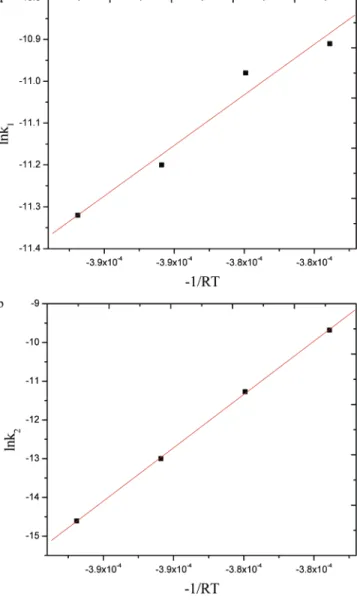
throughout the experiments. The concentrations of quadricyclane left in the filtrates as a function of the reaction time are analogously determined by the PLS analysis. As shown in Figure 6, the concentration of quadricyclane decreases with the reaction time. The decay rate increases as a result of the increased amount of catalyst. Each decay curve may be fitted with an exponential function, as derived from eq 1 without the diffusion term involved. The conversion rate constants as a function of the catalyst amount may thus be evaluated. Similar experiments are carried out at varied temperatures of 30, 35, 39, and 44°C. In
this manner, the pseudo-first-order rate constants, ktot, at different temperatures may be evaluated. According to eq 2, the plot of ktotversus 6W/da∆Veyields one-site and two-site coordinated rate constants, k1and k2. The results are listed in Table 3. The examples of the fit at 30 and 39°C are shown in Figure 7. Herein, the effective solvent volume,∆Ve, in eq 2 is replaced by the total solvent volume, as fixed at 10 mL throughout the experiments. Given the kinetic data, k1and k2, in Table 3, as shown in Figure 8, the Arrhenius plot yields the corresponding activation energy to be 24 ( 3 and 275 ( 3 kJ/mol.
The obtained activation energies for one-site and two-site coordinated reactions are consistent with those obtained in a still solution. According to the Arrhenius equation, the activation energy should remain constant, no matter whether the solution is agitated. Nevertheless, the collision frequency is enhanced under the stirred condition. While inspecting the kinetic data at 39°C, we find that k1and k2are (1.3 ( 0.8)× 10-5s-1A-1 and (1.92 ( 0.01) × 10-6 s-1 A-2, respectively, in the still solution, but the values increase to (1.7 ( 1.4)× 10-5s-1A-1 and (1.27 ( 0.06)× 10-5s-1A-2 in the stirred solution. The isomerization rate constants become larger in the stirred solution, since the collision frequencies increase. This trend is consistent with the report by Moore and co-workers.13Especially for the Figure 7. Plot of pseudo-first-order conversion rate constants as
functions of 6W/da∆Veto yield one-site and two-site coordinated rate constants in the stirred mixtures at temperatures of (a) 30 and (b) 39
°C. W, d, and a denote the weight, density, and particle diameter of the catalyst, respectively, and ∆Ve is the effective volume of the solution, which is replaced by a total volume of solution fixed at 10 mL.
Figure 8. Arrhenius plots of one-site and two-site coordinated conversion rate constants, k1and k2, against the reciprocal of temperature on the logarithmic scale. The slopes yield the corresponding activation energies.
Downloaded by NATIONAL TAIWAN UNIV on September 8, 2009 | http://pubs.acs.org
two-site coordinated reaction, agitation enhances the collision probabilities for a 1:2 coordination and provides additional kinetic energy to overcome the activation barrier. Thus, the k2 value is enhanced by 1 order of magnitude in the temperature rage from 27 to 39°C studied.
V. Conclusion
We have investigated the kinetics of heterogeneous catalysis in either a still or a stirred mixture. By using Fourier transform NIR absorption spectroscopy combined with a simulation model, the kinetic parameters including the diffusion coefficients in the liquid/solid phases, conversion rate constants, and activation energies are evaluated for isomerization of quadricyclane catalyzed by anhydrous CuSO4. The acquired NIR spectra are analyzed with the PLS method to resolve quadricyclane and norbornadiene concentrations during the reaction. When the heterogeneous mixture is not agitated, the further experiments of particle size dependence yield the one-site and two-site coordinated rate constants. The one-site coordinated conversion rate constants are close to those obtained in the stirred solution, but the two-site coordinated rate constants are smaller by 1 order of magnitude. This fact rises from an enhancement of the collision frequency in the stirred solution. If the solution is not agitated, the isomerization is dominated by 1:1 coordination between quadricyclane and the catalyst and the contribution of two-site coordination may be ignored at room temperature. In contrast, when the solution is stirred, the mechanism of a 1:2 coordination may take part in the reaction. The measurements of temperature dependence yield the activation energies, which remain constant, no matter whether the solution is agitated or not. The activation energy for the two-site coordination is found to be more difficult to surmount by a factor of 10.
Acknowledgment. This work is supported by the National Science Council of the Republic of China under Contract No. NSC 93-2113-M-002-028.
References and Notes
(1) Bren, V. A.; Dubonosov, A. D.; Minkin, V. I.; Chernoivanov, V. A. Russ. Chem. ReV. 1991, 60, 451.
(2) Bren, V. A.; Dubonosov, A. D.; Minkin, V. I.; Chernoivanov, V. A. Russ. Chem. ReV. 2002, 71, 917.
(3) Bonfantini, E. E.; Officer D. L. J. Chem. Soc., Chem. Commun. 1994, 12, 1445
(4) Winkler, T.; Dix, I.; Jones, P. G., Herges, R. Angew. Chem., Int. Ed. 2003, 42, 3541.
(5) Watanabe, T.; Magaya, Y.; Yamashita, T.; Horie, K.; Nishikubo, T.; Morino, S. J. Photopolym. Sci. Technol. 1994, 7, 121.
(6) Herges, R.; Reif, W. Liebigs Ann. 1996, 5, 761. (7) An, X.; Xie, Y. Thermochim. Acta 1993, 220, 17. (8) Li, Z.; Scott, L. A. J. Phys. Chem. A 1998, 102, 9202.
(9) Hammond, G. S.; Turro, N J.; Fischer, A. J. Am. Chem. Soc. 1961, 83, 4674.
(10) Dilling, W. L. Chem. Lett. 1966, 66, 373.
(11) Miki, S.; Asako, Y.; Yoshida, Z. Tetrahedron Lett. 1988, 29, 2211. (12) Hautala, R. R.; King, R. B.; Kutal, C. Solar Energy: Chemical ConVersion and Storage; Humana Press: Clifton, NJ, 1979.
(13) Fife, D. J.; Morse, K. W.; Moore, W. M. J. Am. Chem. Soc. 1983, 105, 7404.
(14) Ford, J. F.; Mann, C. K.; Vickers, T. J. Appl. Spectrosc. 1994, 48, 592.
(15) Chuang, E. C. C.; Lin, K. C. J. Phys. Chem. B 2002, 106, 132. (16) Fan, H. S.; Chin, T. L.; Lin, K. C. J. Phys. Chem. B 2004, 108, 9364.
(17) Patrick, T. B.; Bechtold, D. S. J. Org. Chem. 1984, 49, 1935. (18) Noyori, R.; Umeda, I.; Kawauchi, H.; Takaya, H. J. Am. Chem. Soc. 1975, 97, 812.
(19) Taylor, R. B.; Jennings, P. W. Inorg. Chem. 1981, 20, 3997. (20) Sen, A.; Thomas, R. R. Organometallics 1982, 1, 1251. (21) Lindberg, W.; Persson, J.-A. Anal. Chem. 1983, 55, 643. (22) Phelan, M. K.; Barlow, C. H.; Kelly, J. J.; Jinguji, T. M.; Callis, J. B. Anal. Chem. 1989, 61, 1419.
(23) Schrieve, G. D.; Ullman, A. H. Appl. Spectrosc. 1991, 45, 713. (24) Wang, C. C.; Chin, T. L.; Lin, K. C. J. Chem. Phys. 1997, 107, 10348.
(25) Chin, T. L.; Lin, K. C. Appl. Spectrosc. 1999, 53, 22.
(26) Wang, C. C.; Chen Y. P.; Chin, T. L.; Lin, K. C. J. Chem. Phys. 2000, 112, 10204.
Downloaded by NATIONAL TAIWAN UNIV on September 8, 2009 | http://pubs.acs.org