610 IEEE PHOTONICS TECHNOLOGY LETTERS, VOL. 19, NO. 8, APRIL 15, 2007
Hybrid Optical Access Network Integrating
Fiber-to-the-Home and Radio-Over-Fiber Systems
Chun-Ting Lin, Jason (Jyehong) Chen, Peng-Chun Peng, Cheng-Feng Peng, Wei-Ren Peng, Bi-Shiou Chiou, and
Sien Chi
Abstract—Hybrid optical access networks, integrating fiber-to-the-home (FTTH) and radio-over-fiber (RoF) systems that share a single distributed infrastructure, are promising for future multi-service access networks. The primary concern is to enable RoF and FTTH systems to transmit both radio-frequency (RF) and base-band (BB) signals on a single wavelength over a single fiber. This study experimentally demonstrates simultaneous generation and transmission of a wired-line BB signal and a wireless RF signal on a single wavelength, using one external modulator. The hybrid sig-nals transmitted over standard single-mode fiber (SSMF) do not suffer from periodic performance fading due to fiber dispersion. Following transmission over 50-km SSMF, the power penalties of both RF and BB signals are less than 0.2 dB.
Index Terms—Fiber-to-the-home (FTTH), hybrid access network, Mach–Zehnder modulator (MZM), radio-over-fiber (RoF).
I. INTRODUCTION
T
HE HIGH data rate and broadband demands of wireless and wired-line networks have rapidly increased in recent years. Radio-over-fiber (RoF) and fiber-to-the-home (FTTH) systems are promising candidates in wireless and wired-line access networks, respectively. The high cost of separated wire-less and wired-line access networks necessitates integration of the two distributed networks into a single shared infrastructure. The primary concern is to transmit both radio-frequency (RF) and baseband (BB) signals on a single wavelength over a single fiber in a cost-effective way with acceptable performance. Recently, the simultaneous modulation and transmission of an RF signal and a BB signal has been demonstrated [1]–[4]. However, the generated hybrid BB and RF signals suffer from a performance fading problem caused by fiber dispersion [1], [2].Manuscript received November 20, 2006; revised January 17, 2007. This work was supported by the National Science Council of R.O.C. under tract NSC 95-2752-E-009-009-PAE, Contract NSC 95-2221-E-009-085, tract NSC 95-2221-E-155-072, Contract NSC 95-2221-E-155-059, and Con-tract NSC 95-2112-M-260-001-MY2.
C.-T. Lin, J. Chen, C.-F. Peng, and W.-R. Peng are with the Department of Photonics and Institute of Electro-Optical Engineering, National Chiao-Tung University, Hsinchu, Taiwan 300, R.O.C. (e-mail: [email protected]).
P.-C. Peng is with the Department of Applied Materials and Optoelectronic Engineering, National Chi Nan University, Taiwan 545, R.O.C.
B.-S. Chiou is with the Department of Electronics Engineering and Institute of Electronics, Innovative Packaging Research Center, National Chiao-Tung Uni-versity, Hsinchu, Taiwan 300, R.O.C.
S. Chi is with the Department of Photonics and Institute of Electro-Optical Engineering, National Chiao-Tung University, Hsinchu, Taiwan 300, R.O.C. He is also with the Department of Electrical Engineering, Yuan-Ze University, Chung Li, Taiwan 320, R.O.C.
Color versions of one or more of the figures in this letter are available online at http://ieeexplore.ieee.org.
Digital Object Identifier 10.1109/LPT.2007.894326
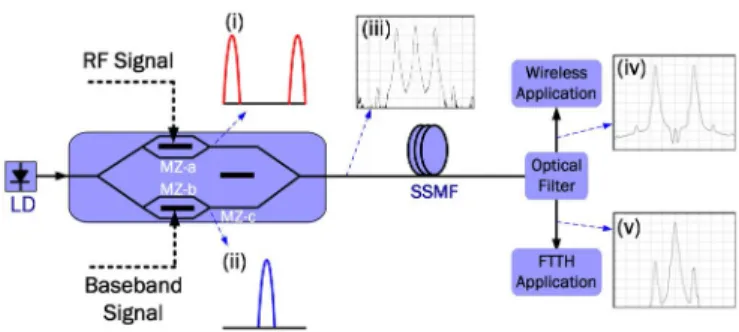
Fig. 1. Schematic diagram of the hybrid optical access network. The resolution of the optical spectrum is 0.01 nm.
Therefore, a dispersion-shifting fiber is employed to transmit the hybrid signals. This negative effect limits implementation to green-field application only, rather than the most common application with already installed standard single-mode fiber (SSMF). Furthermore, only one signal is modulated on the optical subcarrier such that the BB and RF signals are identical after square-law photodetector (PD) detection [3], [4]. Hence, a simple and cost-effective modulation and transmission of the independent BB and RF signals without periodical performance fading due to fiber dispersion are required.
This work proposes the simultaneous modulation and trans-mission of a 1.25-Gb/sON–OFF-keying (OOK) BB signal and a 20-GHz 622-Mb/s OOK RF signal using one external inte-grated modulator. The BB and RF signals are independently modulated and transmitted at the optical carrier and subcarrier, respectively. In the proposed system, the RF signal does not suffer periodic performance fading when it is transmitted over an SSMF. The power penalties of both BB and RF signals are less than 0.2 dB after transmission over 50-km SSMF, revealing the feasibility of the system.
II. HYBRIDOPTICALACCESSNETWORK
Fig. 1 schematically depicts the hybrid optical access net-work system. A BB signal is modulated on the optical carrier and an RF signal on the optical double sideband. An external integrated modulator using x-cut LiNbO [5], [6], consisting of three single-electrode Mach–Zehnder modulators (MZMs), is the key to generating RF and BB signals simultaneously. Two sub-MZMs (MZ-a and MZ-b) are embedded in each arm of the main modulator (MZ-c). The RF signal is generated at MZ-a biased at the minimum transmission point, using double-side-band with an optical carrier suppression (DSBCS) modulation scheme. The optical spectrum of RF signals is shown in inset (i) in Fig. 1. Compared with double-sideband and single-sideband modulation schemes, the DSBCS modulation scheme provides the best receiver sensitivity, the lowest spectral occupancy, the
LIN et al.: HYBRID OPTICAL ACCESS NETWORK INTEGRATING FTTH AND RoF SYSTEMS 611
Fig. 2. Experimental setup for RF and BB signal generation and transmission using one external integrated modulator.
lowest bandwidth requirement for an RF signal, electrical am-plifier, and optical modulator, and the smallest power penalty of the receiver sensitivity after a long transmission distance [4], [7]. Moreover, the BB signal can be modulated at the optical car-rier, as shown in inset (ii) in Fig. 1. The optical BB signal is gen-erated at MZ-b. The optical RF signal and BB signal are com-bined at MZ-c biased at the maximum transmission point. Inset (iii) in Fig. 1 shows the optical spectrum of the hybrid signal. At a remote node, a fiber grating is utilized to separate these two signals, as shown in insets (iv) and (v) in Fig. 1, and each signal is transmitted to the corresponding application.
III. EXPERIMENTALSETUP
Fig. 2 shows the experimental setup for hybrid signal gen-eration and transmission using one external integrated modu-lator. The continuous-wave laser is generated by a tunable laser, and the lasing wavelength is 1554.94 nm. The RF signal is a 622-Mb/s pseudorandom bit sequence (PRBS) signal with a word length of and up-converted with the 10-GHz clock as shown in inset (i) in Fig. 2. The up-converted RF signal is am-plified to a maximum peak-to-peak voltage of 7 V, lim-ited by the RF amplifier. The optical RF signal is generated via MZ-a with a half-wave voltage of 5.8 V. MZ-a is biased at the minimum transmission point to realize DSBCS modulation. The repetition frequency of the generated optical microwave is 20 GHz. The generated optical microwave is shown in inset (ii) in Fig. 2. The BB signal is a 1.25-Gb/s PRBS signal with a word length of ; it is sent into MZ-b with a of 5.6 V. The eye diagram of the generated optical BB signal is shown in inset (iii) in Fig. 2. The optical RF and BB signals are combined in MZ-c with a of 6.9 V. The hybrid optical signals are ampli-fied by an erbium-doped fiber amplifier (EDFA) to compensate for the loss of the external modulator, yielding a power of 0 dBm before transmission over 50-km SSMF. Following transmission over 50-km SSMF, the hybrid signals are preamplified by EDFA and then filtered by a tunable optical filter with a bandwidth of 0.4 nm. At the remote node, the fiber grating with a 3-dB band-width of 4 GHz is used to separate these two signals, as shown in insets (iv) and (v) in Fig. 2, and each signal is sent to the corresponding application. Both optical signals are individually detected by a PIN PD. For FTTH applications, the electrical BB
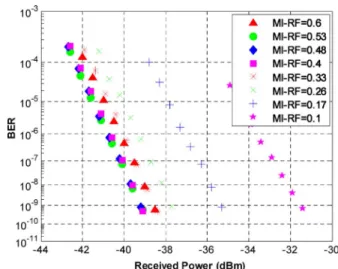
Fig. 3. BER curves of RF signals for MI-RF from 0.6 to 0.1.
signal is filtered by an electrical filter with a 3-dB bandwidth of 1.25 GHz. For wireless applications, the electrical RF signal is down-converted by a mixer with a 20-GHz clock before passing through a low-pass filter with a 3-dB bandwidth of 622 MHz. The eye diagrams of BB and RF signals are shown in insets (vi) and (vii) in Fig. 2, respectively. Both RF and BB signals are tested by a bit-error-rate (BER) tester and the receiver sen-sitivities are measured before EDFA preamplification. The fiber length is set to 25 and 50 km.
IV. EXPERIMENTALRESULTS ANDDISCUSSION
The RF signal performance is closely related to MZM non-linearity. To optimize the RF signal performance, the modula-tion index (MI-RF, MI-RF ) for driving MZ-a de-creases form 0.6 to 0.1 and no BB signals are sent to MZ-b bi-ased at the minimum transmission point. Fig. 3 shows the vari-ation of the receiver sensitivity of the RF signal with different MI-RF. The RF receiver sensitivity initially improves and then declines as the MI-RF decreases from 0.6 to 0.1 When MI-RF is 0.48, the RF signals exhibit the best sensitivity. The optimal MI-RF originates from the tradeoff between the MZM nonlin-earity and the optical carrier suppression ratio (OCSR) for the RF receiver sensitivity when MI-RF is decreased. As MI-RF de-creases, the MZM nonlinearity decreases. Hence, the RF sensi-tivity will improve with MI-RF. However, the OCSR decreases as MI-RF decreases. Low OCSR means that the optical power of the subcarrier is relatively low and that of the optical carrier is relatively high. This incurs a worse receiver sensitivity of the RF signal. Therefore, there is a tradeoff for the receiver sensi-tivity of the RF signal between the MZM nonlinearity and the OCSR when we decrease MI.
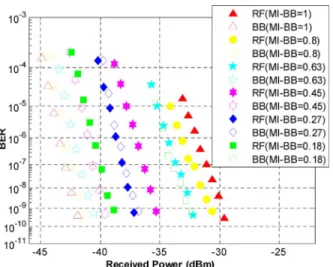
In order to optimize modulation index for BB signals (MI-BB, MI-BB ), the optimal MI-RF for driving MZ-a is fixed at 0.48, and then the BB signal is sent to MZ-b. The MI-BB for driving MZ-b decreases from 1 to 0.18 to yield the same sensitivities of the BB and RF signals. The bias point of MZ-b is adjusted to maximize the extinction ratio of the BB signal as MI-BB varies from 1 to 0.18. Unlike in other works [1], [2], the RF and BB signals are generated at the different sub-MZMs. Various MI-BBs for driving MZ-b cannot influence the RF signal performance when MI-RF for driving MZ-a is maintained at 0.48. As MI-BB decreases, the optical
612 IEEE PHOTONICS TECHNOLOGY LETTERS, VOL. 19, NO. 8, APRIL 15, 2007
Fig. 4. BER curves of BB and RF signals for MI-BB from 1 to 0.18. MI-RF is fixed at 0.48.
Fig. 5. (a) BER curves and (b) power penalty of both RF and BB signals fol-lowing transmission over 25- and 50-km SSMF. The optimal MI-RF and MI-BB for driving MZ-a and MZ-b are 0.48 and 0.27, respectively.
power ratios of the RF and BB signals to the hybrid signals increase and decrease, respectively. Hence, the BB sensitivity increases and the RF sensitivity decreases as MI-BB ranges from 1 to 0.18, as shown in Fig. 4. When the MI-BB is 0.27, the
same sensitivities of the RF and BB signals can be achieved. Under optimal conditions for driving MZ-a and MZ-b, the receiver sensitivities of the RF and BB signals are 37.2 and 36.8 dBm at BER of , respectively. Then the optical hybrid signals at an optical power of 0 dBm are transmitted over 25- and 50-km SSMF. Fig. 5(a) plots the BER curves of the RF and BB signals. The power penalties of both signals at a BER of are less than 0.2 dB, as shown in Fig. 5(b).
Although the RF signal using DSBCS modulation overcomes the RF fading and has the best receiver sensitivity [4], there is a limitation for the RF signals in our proposed system. The RF signals are restricted to amplitude-shifted keying signals due to elimination of the optical carrier. However, if we transmit the RF clock instead of OOK RF signals, phase-shifted keying or quadrature-amplitude-modulation RF signals can be generated at the base station. Besides, there is the other limitation among the RF frequency, the RF signal bandwidth, and the BB signal bandwidth. The main lob bandwidth of the nonreturn-to-zero signal occupies 2-D (D: the data rate of the signal) in the optical domain [8]. Therefore, to avoid the interference between RF and BB signals after fiber grating, the total data rate of the hybrid signals should be less than the RF frequency.
V. CONCLUSION
This study experimentally demonstrates the simultaneous modulation and transmission of FTTH BB and RoF RF signals using one external integrated modulator. The generated hybrid signals do not suffer from periodic performance fading problem caused by fiber dispersion. The receiver sensitivity penalties of both RF and BB signals are less than 0.2 dB after transmis-sion over 50-km SSMF. The results reveal that the proposed system has great potential for use in future multiservice access networks.
REFERENCES
[1] T. Kamisaka, T. Kuri, and K. Kitayama, “Simultaneous modulation and fiber-optic transmission of 10 Gb/s baseband and 60 GHz band radio signals on a single wavelength,” IEEE Trans. Microw. Theory Tech., vol. 49, no. 10, pt. 2, pp. 2013–2017, Oct. 2001.
[2] K. Ikeda, T. Kuri, and K. Kitayama, “Simultaneous three band modu-lation and fiber-optic transmission of 2.5 Gb/s baseband, microwave-, and 60 GHz band signals on a single wavelength,” J. Lightw. Technol., vol. 21, no. 12, pp. 3194–3202, Dec. 2003.
[3] A. Martinez, V. Polo, and J. Marti, “Simultaneous baseband and RF optical modulation scheme for feeding wireless and wireline heteroge-neous access network,” IEEE Trans. Microw. Theory Technol., vol. 49, no. 10, pt. 2, pp. 2018–2024, Oct. 2001.
[4] J. Yu, Z. Jia, L. Yi, G. K. Chang, and T. Wang, “Optical mil-limeter-wave generation or up-conversion using external modulator,”
IEEE Photon. Technol. Lett., vol. 18, no. 1, pp. 265–267, Jan. 1, 2006.
[5] T. Kawanishi, K. Higuma, T. Fujita, S. Mori, S. Oikawa, J. Ichikawa, T. Sakamoto, and M. Izutsu, “40 Gbit/s versatile LiNbO lightwave mod-ulator,” presented at the Eur. Conf. Optical Communication (ECOC 2005), Glasgow, Scotland, 2005, Paper Th 2.2.5.
[6] T. Sakamoto, T. Kawanishi, and M. Izutsu, “Continuous-phase fre-quency-shift keying with external modulation,” IEEE J. Sel. Topics
Quantum Electron., vol. 12, no. 4, pp. 589–595, Jul./Aug. 2006.
[7] C. Lim, C. Lin, M. Attygalle, A. Nirmalathas, D. Novak, and R. Wa-terhouse, “Analysis of optical carrier-to-sideband ratio for improving transmission performance in fiber-radio links,” J. Lightw. Technol., vol. 54, no. 5, pp. 2181–2187, May 2006.
[8] Y. Miyamoto, A. Hirano, S. Kuwahara, M. Tomizawa, and Y. Tada, “Novel modulation and detection for bandwidth-reduced RZ formats using duobinary-mode splitting in wideband PSK/ASK conversion,” J.