行政院國家科學委員會專題研究計畫 成果報告
不對稱資訊下寡占廠商的策略性管理授權
研究成果報告(精簡版)
計 畫 類 別 : 個別型 計 畫 編 號 : NSC 95-2415-H-002-017- 執 行 期 間 : 95 年 08 月 01 日至 96 年 07 月 31 日 執 行 單 位 : 國立臺灣大學會計學系暨研究所 計 畫 主 持 人 : 廖珮真 計畫參與人員: 此計畫無參與人員:無 報 告 附 件 : 出席國際會議研究心得報告及發表論文 處 理 方 式 : 本計畫可公開查詢中 華 民 國 96 年 10 月 08 日
研究計畫中文摘要:
關鍵詞:差別訂價, 策略性授權, 經理人獎酬計畫差別訂價與策略性授權
摘要
本文研究上游獨占供應商差別訂價對下游雙占廠商經理人獎酬計畫決策之影 響。結果發現,不論下游雙占廠商為數量或價格競爭,相較於上游供應商採單一 訂價政策,當上游供應商採差別訂價政策時,下游雙占廠商的所有權人總是會始 使其經理人較為利潤導向(即生產較少數量)。當上游供應商採差別訂價政策時, 有授權經理人的廠商其利潤總是高過於無授權經理人的廠商(即利潤極大化廠 商);相反地,當上游供應商採單一訂價政策時,在價格競爭下,授權經理人的 廠商其利潤高過於利潤極大化廠商,而在數量競爭下,授權經理人的廠商其利潤 低於利潤極大化廠商。研究計畫英文摘要:
Keywords: discriminatory input pricing, strategic delegation, managerial incentive
scheme
Discriminatory Input Pricing and Strategic Delegation
Abstract
This paper examines how discriminatory input pricing by an upstream monopolist affects the incentives that owners of downstream duopolists offer their managers. Regardless of the mode of competition (quantity or price), owners of downstream firms aim to make their managers more profit-oriented and behave less aggressively when the monopolist price-discriminates than when he charges a uniform input price. If the monopolist price-discriminates, the managerial downstream firms always earn more than the purely profit-maximizing firms. However, if the monopolist charges a uniform price, the managerial downstream firms earn more than the profit-maximizing counterparts under price competition and less under quantity competition.
I. Introduction
This paper investigates how discriminatory input pricing by a monopoly supplier affects the managerial incentive schemes that owners of downstream firms offer their managers. It combines the literature on strategic delegation and input-market price discrimination in an analysis of how the profits of the upstream monopolist and downstream duopolists are affected by the input pricing policy and the delegation decision.
This paper extends Fershtman and Judd (1987), Sklivas (1987), and Park (2002) to a vertically related industry by examining how discriminatory input pricing by a monopoly supplier affects the incentive schemes that owners of downstream firms offer their managers. In Park (2002), the monopoly supplier charges both downstream firms the same input price. By contrast, in the present model, we consider the possibility of different input prices charged by the supplier to different downstream firms, thus enabling a comparison of the equilibria under uniform and discriminatory upstream pricing policies. In the present model, the owners of the downstream firms first design managerial incentive schemes (a weighted sum of profits and sales), and then the supplier determines the per-unit input prices (uniform or discriminatory) that he charges the downstream firms. Finally, the managers of the downstream firms choose quantities (prices) under Cournot (Bertrand) competition. The present model assumes that whether or not the supplier will implement a uniform price policy is a common knowledge at the time that the choice of incentive schemes is made. It can be justified on the grounds that the pricing policy of the supplier has been a customary practice in the past.1 Moreover, the assumption that the supplier chooses the input prices after the choice of incentive schemes reflects the fact that the
incentive scheme is something more permanent than the pricing policy of the upstream supplier, and the contracts of the managers are costly to modify.
Another key difference between Park (2002) and this paper is that Park (2002) assumes that the production cost incurred by each downstream firm is only the input price paid to the supplier. Under such a certain assumption, Park (2002) shows that owners of downstream firms obtain the simple Nash equilibrium outcome (i.e., the same output and market price achieved as the profit-maximizers) irrespective of whether quantity or price competition is present. By contrast, in the present model, we assume that each downstream firm incurs an additional marginal cost of production besides the input price, and we show that the simple Nash equilibrium outcome cannot be achieved. Going beyond Park (2002), we show that the profit ranking between the managerial and profit-maximizing firms depends on the mode of competition (quantity or price) and the upstream pricing policy (uniform or discriminatory).
II. Literature Review
The literature on strategic delegation mainly shows that owners can benefit from delegating decisions to managers because the compensation scheme is a commitment device used by owners to precommit managers to certain later actions, which in turn alter the actions taken by rival managers. The strategic delegation model developed according to Vickers (1985), Fershtman and Judd (1987), and Sklivas (1987) usually consists of two stages. In the first stage, owners choose the managerial incentive scheme, which is a weighted sum of profits and sales. In the second stage, managers compete with each other in a Cournot or Bertrand fashion. Fershtman and Judd (1987) and Sklivas (1987), hereafter referred to as the FJS model, show that owners positively weight sales in the incentive scheme, which commits managers to
aggressive behavior in quantity competition. However, under price competition, owners negatively weight sales in the incentive scheme; that is, overcompensating for profits by penalizing sales.
Many papers have extended the FJS model in different contexts. Barros (1995) considers the use of incentive schemes as strategic variables in a mixed duopoly with a public and a private firm; Basu (1995) endogenizes the decision of hiring a manager; Hwang and Mai (1995) consider a general conjectural variation model to examine oligopolistic incentives for managers; Goering (1996) analyzes managerial styles and their impact on the strategic use of managerial incentives; Zhang and Zhang (1997) combine cost-reducing R&D investment with strategic delegation;2 Das (1997) deals with trade policy and strategic delegation; Lambertini (2000) examines how firms choose the type of competition (Cournot or Bertrand), the timing of move (simultaneous or sequential), and internal organization (managerial or entrepreneurial); Ishibashi (2001) examines strategic incentive schemes in a model where firms compete in both price and quality; Barros and Grilo (2002) analyze the effect of delegation on product quality when the delegation decision is endogenous. All of the above papers primarily focus on the horizontal aspects of market structure. An implicit assumption in these models is that firms are vertically integrated. There has been little analysis on the impact of vertical industry relationship on strategic delegation. Park (2002) examines the effects of the upstream monopoly on the incentive schemes for the managers of downstream firms.
On the other hand, the literature on input-market price discrimination mainly analyzes the profit and welfare effects of third-degree price discrimination and the comparison between discriminatory pricing and uniform pricing (e.g., Katz (1987),
2The paper of Zhang and Zhang (1997) is an important contribution to consider the effects of combining R&D spillovers and strategic delegation, even though some of their results are found to be incorrect by Kopel and Riegler (2006).
DeGraba (1990), Yoshida (2000), and Valletti (2003)); the welfare effects of access price discrimination under different regulatory setting (Valletti, 1998); the supplier’s choice between three-degree price discrimination and two-part tariff and the welfare effects (Colangelo, 2006).
III. The Model
The model is the FJS model extended to a vertical industry structure. We consider a three-stage, three-firm model, in which a monopoly supplier sells an input to two competing downstream firms that use the input to produce a homogeneous final product. It is assumed that one unit of the input is required to produce one unit of the final product. In order to examine how discriminatory pricing by the monopoly supplier affects the results of the FJS model, the monopoly supplier is assumed to be a profit-maximizer. The downstream market is modeled as in the FJS model, in that each downstream firm has one owner and one manager, and production decisions are delegated to the manager. The managerial incentive scheme is given by
(1 ) ,
i i i i i
M =α π + −α R where πi and R are the profits and sales of firm i, i
respectively (i=1, 2).3 In the first stage, owners 1 and 2 simultaneously select α1 and α2, respectively, so as to maximize their profits.4 If αi = firm i is an 1, entrepreneurial profit-maximizing firm; if αi < owner i directs manager i away 1, from profit maximization towards sales; and if αi > owner i overcompensates 1, manager i for profits by penalizing sales. In the second stage, the monopoly supplier
3There are some papers considering relative performance incentive scheme, which is a weighted sum of the firm’s own profit and its rival’s profit, for example, Donaldson and Neary (1984), Salas-Fumas (1992), Lundgren (1996), and Miller and Pazgal (2001, 2002, 2005). Jansen et al. (2007) consider the managerial incentive scheme which is a weighted sum of profits and market share. Since this paper is the extension of the FJS model and Park (2002), we follow the FJS model and use the managerial incentive scheme which is a weighted sum of profits and sales.
4As shown in Fershtman and Judd (1987), the real reward for manager i is of the form
i i i
A +B M for constants Ai and Bi,with Bi >0. Owner i chooses Ai and Bi such that Ai+B Mi i equals the
charges firm i a per-unit price k for the input. For simplicity, it is assumed that the i
supplier produces the input at zero marginal cost, because this will not affect the equilibrium of the game. In the third stage, manager i determines the quantity (price) that maximizes M in a Cournot (Bertrand) fashion.i 5 The per-unit cost for the output of firm i is ki+ , where cci i is an additional marginal cost of production, and
0
i
c > .6
To make our analysis interesting, we assume that the downstream market is big enough so that the output levels, the downstream market prices, and the upstream input prices are all nonnegative. The game is solved by backward induction. The cases of quantity competition and price competition are analyzed separately.
IV. Main Results
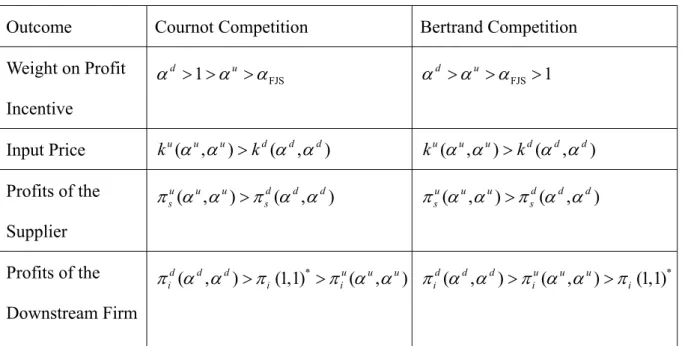
The major finding of this paper is that, regardless of the mode of competition, owners of downstream firms choose a higher weight on profit incentive to make managers behave less aggressively when the supplier price-discriminates than when he charges a uniform price. The supplier obtains higher profits under uniform pricing than under discriminatory pricing, while those of the downstream firms are lower under uniform pricing than under discriminatory pricing. Our result suggests that the supplier can benefit from a precommitment to uniform pricing because under uniform pricing the owners of downstream firms hire more aggressive and sales-oriented managers, leading to larger outputs and thus benefiting the supplier. Moreover, if the supplier price-discriminates, the managerial downstream firms always earn more than firms that do not delegate and are purely profit-maximizing. This contrasts with the
5Managers are assumed to be risk-neutral, so maximizing
i i i A +B M is equivalent to maximizing . i M 6 0 i
c = in the model of Park (2002). In the following analysis, we show that ci does affect
situation where the supplier charges a uniform price, under which the managerial downstream firms earn more than the profit-maximizing counterparts under price competition and less under quantity competition.
Table 1 summarizes the symmetric equilibrium outcomes under Cournot competition and Bertrand competition.
Table 1 The symmetric equilibrium outcomes under Cournot and Bertrand competition Outcome Cournot Competition Bertrand Competition
Weight on Profit Incentive FJS 1 d u α > >α >α αd >αu >αFJS> 1 Input Price ku(α αu, u)>kd(α αd, d) ku(α αu, u)>kd(α αd, d) Profits of the Supplier ( , ) ( , ) u u u d d d s s π α α >π α α u( u, u) d( d, d) s s π α α >π α α Profits of the Downstream Firm * ( , ) (1,1) ( , ) d d d u u u i i i π α α >π >π α α d( d, d) u( u, u) (1,1)* i i i π α α >π α α >π
* Note: πi(1,1) is the profits of the downstream firm when both the downstream firms acting as pure profit- maximizers.
V. Self-Evaluation
(計畫成果自評)
The main contribution of the paper is to combine the literature on strategic delegation with the literature on input-market price discrimination. The paper extends the models Fershtman and Judd (1987), Sklivas (1987) and Park (2002) to analyze how discriminatory input pricing by a monopoly upstream supplier affects the incentive scheme that owners of downstream firms offer their managers. In a previous paper, Park (2002) analyzed how downstream firms design managerial incentives schemes when the upstream supplier establishes a uniform price. This paper extents his model by allowing for input-market price discrimination.
The following points can be considered to further improve the paper:
1. The motivation of the paper can improve considerably if some example of an upstream monopolist that is allowed to price discriminate can be provided.
2. The assumption about the timing of the game should be further justified. The robustness of the results to a change in the timing of the game should be analyzed.
This paper was presented at 2006 APEA (Asia-Pacific Economic Association) International Conference held in Seattle, USA. It was submitted to Managerial and
References
Barros, F. (1995). ‘Incentive schemes as strategic variables: An application to a mixed duopoly’, Internal Journal of Industrial Organization, Vol. 13, pp. 373-386.
Barros, F. and Grilo, I. (2002). ‘Delegation in a vertically differentiated duopoly’,
Manchester School, Vol. 70, pp. 164-184.
Basu, K. (1995). ‘Stackelberg equilibrium in oligopoly: An explanation based on managerial incentives’, Economics Letters, Vol. 49, pp. 459-464.
Colangelo, G. (2006). ‘Wholesale pricing when buyers are asymmetric Cournot competitors’, Manchester School, Vol. 74, pp. 156-169.
Das, S. P. (1997). ‘Strategic managerial delegation and trade policy’, Journal of
International Economics, Vol. 43, pp. 173-188.
DeGraba, P. (1990). ‘Input market price discrimination and the choice of technology’,
American Economic Review, Vol. 80, pp. 1246-1253.
Donaldson, D. and Neary, H. (1984). ‘Decentralized control of a socialist industry’,
Canadian Journal of Economics XVII, pp. 99-110.
Fershtman, C. and Judd, K. L. (1987). ‘Equilibrium incentive in oligopoly’, American
Economic Review, Vol. 77, pp. 927-940.
Goering, G. E. (1996). ‘Managerial style and the strategic choice of executive incentives’, Managerial and Decision Economics, Vol. 17, pp. 71-82.
Hwang, H. and Mai, C. (1995). ‘Strategic management under duopoly’, Managerial
and Decision Economics, Vol. 16, pp. 239-247.
Ishibashi, K. (2001). ‘Strategic delegation under quality competition’, Journal of
Economics, Vol. 73, pp. 25-56.
Jansen, T., Lier, A., Witteloostuijn, A. (2007). ‘A note on strategic delegation: The market share case’, International Journal of Industrial Organization, Vol. 25, pp.
531-539.
Katz M. (1987). ‘The welfare effects of third-degree price discrimination in intermediate good markets’, American Economic Review, Vol. 77, pp. 154-167. Kopel, M., Riegler, C. (2006). ‘R&D in a strategic delegation game revisited: A note’,
Managerial and Decision Economics, Vol. 27, pp. 605-612.
Lundgren, C., (1996). ‘Using relative profit incentives to prevent collusion’, Review
of Industrial Organization. Vol. 11, pp. 533-550.
Lambertini, L. (2000). ‘Strategic delegation and the shape of market competition’,
Scottish Journal of Political Economy, Vol. 47, pp. 550-570.
Miller, N. H. and Pazgal, A. I. (2001). ‘The equivalence of price and quality competition with delegation’, RAND Journal of Economics, Vol. 32, pp. 284-301. Miller, N. H. and Pazgal, A. I. (2002). ‘Relative performance as a strategic
commitment mechanism’, Managerial and Decision Economics, Vol. 23, pp. 51-68.
Miller, N. H. and Pazgal, A. I. (2005). ‘Strategic trade and delegated competition’,
Journal of International Economics, Vol. 66, pp. 215-31.
Park, E. S. (2002). ‘Vertical externality and strategic delegation’, Managerial and
Decision Economics, Vol. 23, pp. 137-141.
Salas-Fumas, V. (1992). ‘Relative performance evaluation of management: the effects on industrial competition and risk sharing’, International Journal of Industrial
Organization, Vol. 10, pp. 473-89.
Sklivas, S. D. (1987). ‘The strategic choice of managerial incentives’, RAND Journal
of Economics, Vol. 18, pp. 452-458.
Valletti, T. M. (1998). ‘Two-part access pricing and imperfect competition’,
Information Economics and Policy, Vol. 10, pp. 305-323.
competitors’, International Journal of Industrial Organization, Vol. 21, pp. 969-988.
Vickers, J. (1985). ‘Delegation and the theory of the firm’, Economic Journal
(Supplement), Vol. 95, pp. 139-147.
Yoshida, Y. (2000). ‘Third-degree price discrimination in input markets: output and welfare’, American Economic Review, Vol. 90, pp. 240-246.
Zhang, J. and Zhang, Z. (1997). ‘R&D in strategic delegation game’, Managerial and
行政院國家科學委員會補助國內專家學者出席國際學術會議報告
96 年 10 月 08 日 報告人姓名 廖珮真 服務機構 及職稱 國立台灣大學會計學系助理教授 時間 2007 年 6 月 29 日〜7 月 3 日 會議 地點 美國西雅圖 本會核定 補助文號 NSC95-2415-H-002-017 會議名稱 (英文) 82th Annual Conference, Western Economic Association 發表論
文題目 (英文) Discriminatory Input Pricing and Downstream R&D Rivalry with Spillovers 一、參加會議經過
6 月 29 日晚上與昔日在美國華盛頓大學的學弟周炳宏、學妹黃俞寧同行,搭乘長榮班機
前往美國西雅圖,於當地時間6 月 29 日傍晚抵達。6 月 30〜7 月 3 日參與論文研討,並
於 7 月 1 日上午發表“Discriminatory Input Pricing and Downstream R&D Rivalry with Spillovers” 一文。7 月 1 日晚間並與美國華盛頓大學經濟系博士班校友 與經濟系教授們餐聚,進行學術之交流。
二、與會心得
此次會議的參與者,包含許多國際上在各個經濟研究領域中相當傑出的學者,亦包括了 昔日在美國華盛頓大學的前後期校友。與我同一研討小組的包含主席黃智聰教授(政大 財政系),鄭義暉教授(高雄大學應用經濟學系),Professor Sungkyu Kwak (Washburn
University),Professor Rosemary Walker(Washburn University),Professor Wei-Choun Yu (Winona State University)等。其中黃智聰教授建議將本文的研究方法應用到公司管理
議題上,將實務應用與本文理論模型做聯結,而Professor Sungkyu Kwak 則建議加強說
明賽局各階段先後順序的合理性。另外,聽完鄭義暉教授的演說“Delegation Game with R&D Spillovers in Market Share Competition” 後受益良多,因為其研究主題和我的極為
接近,有了相互學習的機會。另外,也很榮幸與國際知名學者Professor Jack W. Hou
(California State University)有交談的機會。總之,參加此一研討會,不論在學術研究上 或未來研究的規劃上皆有相當的幫助。並且,在會中與多位在此一領域中學有專精的國 際學者認識,對提昇自己的研究能力很有幫助。
三、感謝