Properties and structure of vapor-deposited polyimide
upon electron-beam irradiation
F.-Y. Tsaia兲 and Y.-H. Kuo
Department of Materials Science and Engineering, National Taiwan University, Taipei 10617, Taiwan
D. R. Harding
Laboratory for Laser Energetics, University of Rochester, Rochester, New York 14623
共Received 10 October 2005; accepted 8 February 2006; published online 28 March 2006兲 Vapor-deposited polyimide capsules from pyromellitic dianhydride and 4 , 4
⬘
-oxydianiline were irradiated with an electron beam that mimicked the-radiation emitted by tritium, a fuel that the capsules are to contain during the inertial confinement fusion process. The mechanical properties and gas permeability of the irradiated capsules were measured to examine their radiation resistance. Upon electron-beam irradiation at an energy of 8 keV and a dose of 120 MGy, the capsules showed 15% and 56% decrease in tensile strength and elongation at break, respectively, without significant change in gas permeability and Young’s modulus. Analyses using x-ray photoelectron spectroscopy and Fourier transform infrared spectroscopy indicated that the chain cleavage and carbonization occurred but were confined in a thin layer at the top surface of the capsules. The shallow penetration of the low-energy electron beam used, as well as the existence of cross-linking in the vapor-deposited polyimide, may have led to the smaller magnitude of property degradation in the capsules compared to that reported for solution-cast polyimide. © 2006 American Institute of Physics.关DOI:10.1063/1.2186030兴I. INTRODUCTION
Aromatic polyimides, with their excellent mechanical properties and thermal stability, have been proposed as a promising material for the inertial confinement fusion共ICF兲 target, a millimeter-sized spherical capsule holding hydrogen isotopes to be placed at the focal point of fusion-triggering laser beams.1,2Previous efforts have made possible the fab-rication of aromatic polyimide capsules from pyromellitic dianhydride 共PMDA兲 and 4,4
⬘
-oxydianiline共ODA兲 by em-ploying a technique based upon vapor-phase polymer-ization,3–5or by an emulsion technique,6and the properties of the capsules critical to the ICF application were assessed.7–10It was verified that the PMDA-ODA polyimide capsules, prepared via the vapor-deposition technique, pos-sessed comparable yet distinct properties from the commer-cial PMDA-ODA polyimide共Kapton兲, produced by solution-based methods. Prior works have yet to examine one attribute of the capsules vital to the ICF application: their resistance to radiation emitted by tritium, a main compo-nent of the fuel mixture currently used in ICF. A polyimide capsule may absorb 60– 120 M Gy of  radiation from tri-tium while being prepared as an ICF target,11 which may significantly impact its performance. It is therefore important to determine the effects ofradiation on the polyimide cap-sules’ ICF-related properties, i.e., gas permeability and me-chanical properties.Effects of electron-beam radiation on the mechanical properties of commercially available aromatic polyimides such as Kapton have been studied.12 It was reported that upon irradiation by an electron beam 共energy=2 MeV兲 to a
dose of 120 M Gy, Kapton exhibited ⬃8% increase in Young’s modulus, ⬃30% decrease in tensile strength, and ⬃80% decrease in elongation at break. Gas permeability of electron-beam-irradiated PMDA-ODA polyimide has not been studied; however, Kita et al. reported reduced gas per-meability through benzophenone-containing polyimide that was irradiated with an electron beam, and attributed the de-crease in permeability to radiation-induced cross-linking.13 As to the structural changes brought about by  radiation, Tahara et al. conducted x-ray photoelectron spectroscopy 共XPS兲 on E-beam 共20–30 keV兲 irradiated PMDA-ODA polyimide to observe rupture of the imide linkage.14
 radiation emitted by tritium is of lower energy than that of the E-beams used in previous study; i.e., its energy is distributed between 0 and 16 keV, averaging at 8 keV. This study sought to examine the properties of vapor-deposited polyimide capsules irradiated with an E-beam mimicking  radiation emitted by tritium, in the meantime investigating some of the previously unexplored topics: 共1兲 -radiation resistance of vapor-deposited polyimide, 共2兲 effects of low-energy E-beam radiation on the properties of polyimide upon extended exposure, and 共3兲 gas permeability of E-beam-irradiated PMDA-ODA polyimide. XPS and infrared absorp-tion spectroscopy analyses were carried out on irradiated samples to determine the induced structural changes.
II. EXPERIMENT A. Sample preparation
Polyimide capsules were prepared via a vapor-deposition technique, which involved two steps: 共1兲 the monomers, PMDA and ODA, were coevaporated in high vacuum onto spherical capsules made of poly-␣-methylstyrene共PAMS兲 to a兲Electronic mail: [email protected]
JOURNAL OF APPLIED PHYSICS 99, 064910共2006兲
0021-8979/2006/99共6兲/064910/4/$23.00 99, 064910-1 © 2006 American Institute of Physics
form a layer of poly共amic acid兲, 共2兲 the coated poly共amic acid兲 was converted into polyimide by thermal curing, where the PAMS capsules depolymerized into gaseous products that escaped by permeation, leaving behind the freestanding polyimide capsules. Detailed descriptions of the sample preparation process were reported previously.15 PMDA and ODA were purchased from Sigma-Aldrich and used as re-ceived. PAMS capsules were purchased from General Atom-ics and used as received. The dimensions of the capsules were: outer diameter= 950– 1200m; wall thickness = 3 – 7m. The capsules were screened for a minimum sphe-ricity of 99.8% before testing.
B. Electron-beam irradiation
Polyimide capsules were irradiated with an electron beam in a Leica Cambridge S360 scanning electron micro-scope共SEM兲. The capsules were contained in a piezoelectric holder, which constantly agitated the capsules to achieve uni-form irradiation. The electron beam was defocused to cover the whole area of the capsule holder共1 cm in diameter兲. The energy of the electron beam was 8 keV. The capsule holder was wired to an ammeter to monitor the incoming electron current, with which the total irradiation dose absorbed by the capsules was calculated. The electron current density was 7 mA/ cm2. With the assumption that electrons impinging on a capsule are completely absorbed, which is generally the case for polymeric materials, the absorbed radiation dose共in gray兲 was calculated by multiplying the electron current den-sity with cross-sectional area of the capsule and the total irradiation time. The doses of E-beam radiation were se-lected to match the doses absorbed by a polyimide capsule during ICF target preparation, i.e., 60– 120 M Gy.
C. Measurement of properties
The Young’s modulus of the polyimide capsules was de-termined in a buckle test, where the maximum pressure dif-ferential a capsule could withstand before buckling was mea-sured, which is known to be proportional to the Young’s modulus. The tensile strength and elongation at break were determined in a burst test, where the maximum pressure dif-ferential共proportional to tensile strength兲 and maximum in-flation 共proportional to elongation at break兲 that a capsule could withstand before bursting were measured. Measure-ment of the gas permeability involved:共1兲 fill a capsule with a gas by permeation to a desired pressure;共2兲 transport the filled capsule to an evacuated chamber;共3兲 monitor the rate of pressurization in the chamber; and 共4兲 calculate the per-meability value from the measured pressurization rate. All measurements were done at room temperatures. For the de-tailed descriptions of the buckle test, burst test, and perme-ability measurement, the readers are referred to the previous publication.15
D. Surface analysis
Polyimide samples before and after irradiation were ana-lyzed by the Fourier transform infrared spectroscopy共FTIR兲 共Bio-Rad FTS-3500兲 and XPS 共VG Scientific Theta-Probe兲. FTIR spectra were taken in the transmission mode and the
attenuated total reflection共ATR兲 mode. In the ATR measure-ments, a germanium prism was used, and the incident angle of the beam was set to 45°, resulting in a probing depth of 0.35m.16 In the XPS measurements, monochromatized Al K␣ 共1486.6 eV兲 x-ray was used, and charging effects were minimized by using an electron flood gun.
III. RESULTS AND DISCUSSIONS
Mechanical properties of the polyimide capsules irradi-ated with 0, 60, and 120 M Gy are shown in Fig. 1 through Fig. 3. Gas permeability as a function of E-beam radiation dose is shown in Fig. 4. It can be seen from Figs. 1–4 that the Young’s modulus and gas permeability did not change significantly upon 120 M Gy of radiation, while the tensile strength and the elongation at break were reduced by 15% and 56%, respectively. The degradations in tensile strength and elongation at break were much smaller than those re-ported for solution-cast commercial Kapton under the same radiation dose 共30% and 80%, respectively, as described in the Introduction section兲. This difference may be attributed to the lower radiation energy used in this study, which ef-fected the shallower penetration of the energetic electrons and thus more contained damage. The difference may also be due in part to the observation that vapor-deposited polyimide possesses certain degree of cross-linking, while solution-cast
FIG. 1. Young’s modulus of polyimide capsules as a function of E-beam irradiation dose.
FIG. 2. Tensile strength of polyimide capsules as a function of E-beam irradiation dose.
064910-2 Tsai, Kuo, and Harding J. Appl. Phys. 99, 064910共2006兲
polyimide is not cross-linked.15 Cross-linking in a polymer increases its resistance to radiation-induced chain cleavage, thereby reducing the extent to which its tensile strength and elongation at break deteriorate.
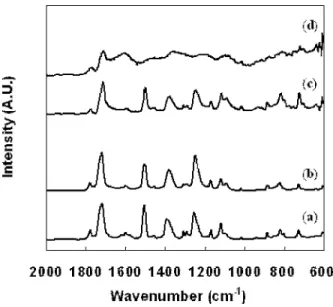
FTIR spectra taken in the transmission mode, as shown in Fig. 5, show no discernable difference between the unir-radiated and the irunir-radiated共dose=120 M Gy兲 samples. In the ATR mode, on the other hand, the two samples gave rise to distinctively different spectra. The spectra of the unirradiated sample are identical in the transmission and ATR mode; however, the ATR spectrum of the irradiated sample show greatly diminished intensity at the polyimide characteristic peaks共1790, 1720, 1380 cm−1, etc.兲 and a broad absorption band at 500– 1000 cm−1. These two features in the ATR spectrum suggest that the irradiated sample decomposed and experienced carbonization to a certain extent. The observa-tion that the irradiated sample showed the altered FTIR spec-trum only in the ATR mode but not in the transmission mode indicates that the radiation penetrated, and caused spectro-scopically detectable changes in, only a small portion of the overall thickness of the sample. The 0.35m probing depth of FTIR employed in this study indicated that the radiation-induced changes were prominent in at least the 0.35-m-thick layer at the top surface of the samples.
Figure 6 shows XPS C1s spectra of the unirradiated and
irradiated 共dose=120 M Gy兲 samples, taken at the top sur-face; the atomic percentages of the fitting components are listed in Table I. The atomic percentages of C1s, N1s, O1s, and Si2p integrated from the XPS spectra are summarized in Table II. The silicon content came from contamination in the irradiation apparatus and the XPS system. Consistent with the FTIR observations, the irradiated sample showed reduced intensity in the imide linkage 共CON兲, indicative of
decom-FIG. 3. Elongation at break of polyimide capsules as a function of E-beam irradiation dose.
FIG. 4. Helium gas permeability of polyimide capsules as a function of E-beam irradiation dose.
FIG. 5. FTIR spectra of unirradiated and irradiated共120 M Gy兲 polyimide samples: 共a兲 unirradiated, transmission mode; 共b兲 irradiated, transmission mode;共c兲 unirradiated, ATR mode; and 共d兲 irradiated, ATR mode.
FIG. 6. XPS C1s spectra of共a兲 unirradiated, 共b兲 irradiated 共120 M Gy兲, samples. Note that C1corresponds to C–C sp2bonds and C2corresponds to
CvO and C–N bonds.
064910-3 Tsai, Kuo, and Harding J. Appl. Phys. 99, 064910共2006兲
position, and an additional peak at 283.2 eV that is attribut-able to amorphous carbon bonded with silicon 共from contamination兲,17
indicative of carbonization. These changes are reflected in the atomic contents where C had increased percentage while N and O contents decreased. The C–C sp2 bonding共labeled as C1兲 on the phenyl rings did not show an observable change, suggesting that the phenyl rings were largely intact. The increase in C–O–C content may be attrib-uted to oxidation followed by the rupture of the imide link-age.
The FTIR and XPS analyses provide further insight on the mechanism of property changes in the polyimide cap-sules caused by E-beam irradiation. The properties that de-graded detectably, tensile strength and elongation at break, are those associated with failure of a sample, while the un-affected gas permeability and Young’s modulus are other-wise. The E-beam-inflicted damage was shown by FTIR to be confined in a thin layer near the top surface of the samples. The damaged top layer became brittle, enabling crack initiation at lower strain 共elongation兲 and stress than does a pristine sample. Once initiated, the cracks in the top layer propagated through the bulk of the sample without sus-taining much further strain and stress, thereby lowering the tensile strength and elongation at break. The Young’s modu-lus and gas permeability, on the other hand, were still deter-mined by the bulk material and therefore were largely unaf-fected.
IV. CONCLUSION
Upon being irradiated with an electron beam of 8 keV energy to a dose of 120 M Gy, vapor-deposited polyimide capsules showed the unaffected Young’s modulus and gas permeability, and 15% and 56% reduction in the tensile strength and elongation at break, respectively. FTIR in the transmission mode and ATR mode indicated that the E-beam-inflicted damage was confined to a thin layer at the surface of the samples, which underwent chain cleavage and carbonization. This observation was consistent with the XPS results. The smaller magnitude of property degradation of the vapor-deposited polyimide compared to that reported for solution-cast polyimide may be attributed to共1兲 cross-linking in the vapor-deposited polyimide, and共2兲 the lower E-beam energy used in this study, which effected the shallower pen-etration through the samples and thus more confined damage. The findings of this study will be useful in the design and handling of polyimide targets for the inertial confinement fusion experiments.
ACKNOWLEDGMENTS
This work was supported by the National Science Coun-cil of Taiwan through Grant No. 94-2215-E-002-013, the U. S. Department of Energy Office of Inertial Confinement
Fu-sion under Cooperative Agreement No.
DEFC03-92SF19460, the University of Rochester, and the New York State Energy Research and Development Authority. The sup-port of DOE does not constitute an endorsement by DOE of the views expressed in this article.
1K. R. Schultz, J. L. Haae, W. J. Miller, D. A. Steinman, and R. B.
Stephens, Fusion Eng. Des. 44, 441共1999兲.
2J. J. Sanchez and S. A. Letts, Fusion Technol. 31, 491共1997兲. 3S. A. Letts, E. M. Fearon, S. R. Buckley, M. D. Saculla, L. M. Allison,
and R. Cook, Fusion Technol. 28, 1797共1995兲.
4E. L. Alfonso, F.-Y. Tsai, S.-H. Chen, R. Q. Gram, and D. R. Harding,
Fusion Technol. 35, 131共1999兲.
5F.-Y. Tsai, D. R. Harding, and S. H. Chen, Polymer 44, 995共2003兲. 6K. Nagai, T. Takaki, T. Norimatsu, and T. Yamanaka, Macromol. Rapid
Commun. 22, 1344共2001兲.
7F.-Y. Tsai, E. L. Alfonso, S. H. Chen, and D. R. Harding, Fusion Technol. 38, 83共2000兲.
8F.-Y. Tsai, D. R. Harding, S. H. Chen, T. N. Blanton, and E. L. Alfonso,
Fusion Sci. Technol. 41, 178共2002兲.
9F.-Y. Tsai, D. R. Harding, S. H. Chen, and T. N. Blanton, J. Appl. Phys. 93, 3760共2003兲.
10S. A. Letts, M. Anthamatten, S. R. Buckley, E. Fearon, A. E. H. Nissen,
and R. C. Cook, Fusion Sci. Technol. 45, 180共2004兲.
11F. Y. Tsai, Ph.D. dissertation, University of Rochester, 2002.
12T. Sasuga, N. Hayakawa, K. Yoshida, and M. Hagiwara, Polymer 26,
1039共1985兲.
13H. Kita, T. Inada, K. Tanaka, and K. Okamoto, J. Membr. Sci. 87, 139
共1994兲.
14H. Tahara, T. Kawabata, L. L. Zhang, T. Yasui, and T. Yoshikawa, Nucl.
Instrum. Methods Phys. Res. B 121, 446共1997兲.
15F.-Y. Tsai, E. L. Alfonso, D. R. Harding, and S. H. Chen, J. Phys. D 34,
3011共2001兲.
16J. Chen and J. A. Gardella, Appl. Spectrosc. 52, 361共1998兲.
17E. E. Ortelli, F. Geiger, T. Lippert, and A. Wokaun, Appl. Spectrosc. 55,
412共2001兲. TABLE I. XPS C1s fitting components for pristine共unirradiated兲 and
irra-diated samples共120 M Gy兲, where C1corresponds to C–C sp2bonds and C2
corresponds to C = O and C–N bonds.
Peak Centre B.E.
At. % Unirradiated Irradiated a-C – Si 283.2 0 14.6 C1 284.6 36.7 36.6 C2 285.4 23.3 12.0 C–O–C 286.3 5.0 6.5 CON 288.5 7.4 4.4
TABLE II. Integrated percentages of C1s, O1s, N1s, and Si2p for pristine 共unirradiated兲 and irradiated samples 共120 M Gy兲.
Bonding At. % Unirradiated Irradiated C1s 72.5 74.0 N1s 4.9 3.9 O1s 17.2 16.9 Si2p 5.5 5.2
064910-4 Tsai, Kuo, and Harding J. Appl. Phys. 99, 064910共2006兲