Analysis of Additives in Polyethylene with Desorption
Chemical Ionization/Tandem Mass Spectrometry
S. W. C H E N and G. R. H E R *
Department of Chemistry, National Taiwan University, Taipei, Taiwan R. O. C
Desorption chemical ionization with ammonia as the reagent gas in combination with tandem mass spectrometry is described for the analysis of additives in polyethylene. The additives were extracted with toluene and then analyzed directly by desorption chemical ionization and tandem mass spectrometry. With ammonia as the reagent gas, mass spectra of additives were found to contain intense pseudomolecular ions with very little fragmentation. In addition, low-molecular-weight polyethylene molecules extracted with the additives were barely detectable, and thus there was less likelihood of interference. Collision-induced dissociation of the pseudomolecular ions provided great confidence in the assignment of additives.
Index Heading: Analysis of polymer additives by tandem mass spec- trometry.
I N T R O D U C T I O N
Various c o m p o u n d s are a d d e d to c o m m e r c i a l p o l y m e r s to prolong p o l y m e r lifetimes a n d e n h a n c e p h y s i c o c h e m - ical p r o p e r t i e s . T h e s e p o l y m e r additives include anti- oxidants, u l t r a v i o l e t stabilizers, lubricants, anti-static agents, t h e r m a l stabilizers, etc. I n d i r e c t analytical m e t h - ods involving solvent e x t r a c t i o n or supercritical fluid ex- t r a c t i o n of t h e additives f r o m a p o l y m e r m a t r i x followed b y off- or on-line c h r o m a t o g r a p h i c s e p a r a t i o n and spec- troscopic d e t e c t i o n have been successfully d e v e l o p e d and widely used. 1-s T h e s e m e t h o d s are generally time con- s u m i n g a n d limited in specificity. In r e c e n t years, mass s p e c t r o m e t r y (MS), a highly sensitive a n d highly specific t e c h n i q u e , has received considerable a t t e n t i o n as an al- t e r n a t i v e t e c h n i q u e for t h e analysis of p o l y m e r addi- tives. 9-2° Earlier M S works focus on the use of EI, CI, a n d G C / M S in t h e analysis of additives. T h e m a j o r draw- back to these m e t h o d s is t h a t t h e y are limited to t h e r - m a l l y stable a n d r e l a t i v e l y volatile c o m p o u n d s a n d t h e r e - fore are n o t s u i t a b l e for m a n y high-molecular-weight p o l y m e r additives. T h i s - p r o b l e m has now been largely o v e r c o m e b y t h e d e v e l o p m e n t of a series of soft ionization t e c h n i q u e s , such as fast a t o m b o m b a r d m e n t (FAB), field d e s o r p t i o n (FD), laser d e s o r p t i o n (LD), etc. FAB, 1°-13 FD, 14 LD, ~2,1~,16 a n d s e c o n d a r y ion m a s s s p e c t r o m e t r y 17 all have shown t h e i r p o t e n t i a l in the analysis of additives f r o m solvent e x t r a c t a n d / o r f r o m bulk p o l y m e r i c m a t e - rial. A l t h o u g h F A B has a r e p u t a t i o n as t h e m o s t often used soft ionization m e t h o d , Wilkins a n d co-workers ~2 have shown t h a t L D is superior to FAB in t h e analysis of p o l y m e r additives, m a i n l y because p o l y m e r additives f r a g m e n t extensively u n d e r FAB conditions. A n o t h e r soft ionization t e c h n i q u e , d e s o r p t i o n chemical ionization (DCI), has also d e m o n s t r a t e d its p o t e n t i a l in t h e analysis
Received 27 November 1992.
* Author to whom correspondence should be sent.
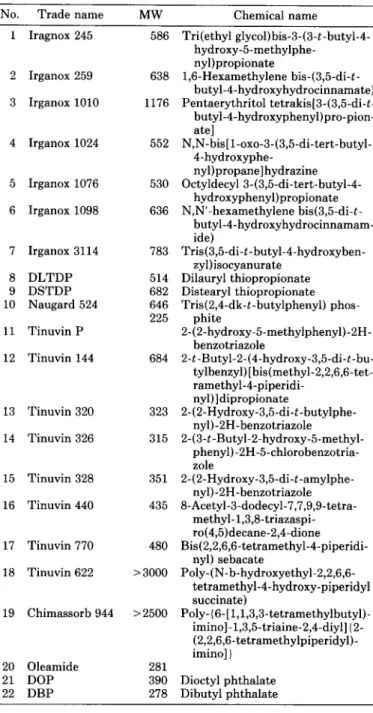
TABLE 1. Trade name, molecular weight, and chemical name of poly- mer additives.
No. Trade name MW Chemical name
1 Iragnox 245 586 Tri(ethyl glycol)bis-3-(3-t-butyl-4-
hydroxy-5-methylphe- nyl)propionate
2 Irganox 259 638 1,6-Hexamethylene bis-(3,5-di-t-
butyl-4-hydroxyhydrocinnamate)
3 Irganox 1010 1176 Pentaerythritol tetrakis[3-(3,5-di-t-
butyl-4-hydroxyphenyl)pro-pion- ate]
4 Irganox 1024 552 N,N-bis[1-oxo-3-(3,5-di-tert-butyl-
4-hydroxyphe- nyl) propane] hydrazine
5 Irganox 1076 530 Octyldecyl 3-(3,5-di-tert-butyl-4-
hydroxyphenyl) propionate
6 Irganox 1098 636 N,N'-hexamethylene bis(3,5-di-t-
butyl-4-hydroxyhydrocinnamam- ide) 7 Irganox 3114 783 Tris(3,5-di-t-butyl-4-hydroxyben- zyl)isocyanurate 8 DLTDP 514 Dilauryl thiopropionate 9 DSTDP 682 Distearyl thiopropionate
10 Naugard 524 646 Tris(2,4-dk-t-butylphenyl) phos-
225 phite 11 Tinuvin P 2-(2-hydroxy-5-methylphenyl)-2H- benzotriazole 12 Tinuvin 144 684 2-t-Butyl-2-(4-hydroxy-3,5-di-t-bu- tylbenzyl) [bis(methyl-2,2,6,6-tet- ramethyl-4-piperidi- nyl) ] dipropionate 13 Tinuvin 320 323 2-(2-Hydroxy-3,5-di-t-butylphe- nyl)-2H-benzotriazole 14 Tinuvin 326 315 2-(3-t-Butyl-2-hydroxy-5-methyl- phenyl)-2H-5-chlorobenzotria- zole 15 Tinuvin 328 351 2-(2-Hydroxy-3,5-di-t-amylphe- nyl) -2H -benzotriazole 16 Tinuvin 440 435 8-Acetyl-3-dodecyl-7,7,9,9-tetra- methyl-l,3,8-triazaspi- ro(4,5)decane-2,4-dione 17 Tinuvin 770 480 Bis(2,2,6,6-tetramethyl-4-piperidi- nyl) sebacate 18 Tinuvin 622 >3000 Poly-(N-b-hydroxyethyl-2,2,6,6- tetramethyl-4-hydroxy-piperidyl succinate) 19 Chimassorb 944 >2500 Poly-{6-[1,1,3,3-tetramethylbutyl)- imino]-l,3,5-triaine-2,4-diyl]{2- (2,2,6,6-tetramethylpiperidyl)- imino] } 20 Oleamide 281
21 DOP 390 Dioctyl phthalate
22 DBP 278 Dibutyl phthalate
of t h e r m a l l y labile a n d nonvolatile molecules. 1s,19 T h e t e c h n i q u e involves r a p i d sample h e a t i n g followed b y t h e r m a l d e s o r p t i o n a n d ionization u n d e r CI conditions. Considering the overall ease of D C I o p e r a t i o n , t h e ca- p a b i l i t y of analyzing nonvolatile c o m p o u n d s , a n d t h e selectivity p r o v i d e d by choosing d i f f e r e n t r e a g e n t gases,
844 Volume 47, Number 6, 1993 0oo3-7028/93/4706-o84452.oo/0 APPLIED SPECTROSCOPY
1 0 0 . 0 50.0 M/Z a
57
. . . . i " ' ' ' ' 100 + 2 H - ( i s o b u t e n e ) 2 = 167 1 4 9 / f - - - i s o b u t e n e = 149 1 6 7H,C,,.Z-E-CH,-CH, ~ O H
/
+NH4+=548 / 4 1 9 +H+=531 / 5 3 1 - ( i s o b u t e n e ) n I 475 =475, 419 tt
5 4 8 [ , . . . . , . . . . , . . . . , . . . . , . . . . . . . . ~ . . . . i . . . . l, . . . . I . . . . 2 0 0 3 8 0 4 0 0 5 0 0 6 g o 5 e . g - 2 1 9b
o
- - 2 1 9 C O - C - C H = - H 8 9 9 - ( i s o b u t e n e ) n - J 731 =843, 787, 731, 675, 619, 563 +NH4+=1194 5 6 3 787 i i i ! i | Jl " ' " : ' 1 ' ' ~ I ' ' , i ' ' ' I M/Z2ge
4gg
6eg
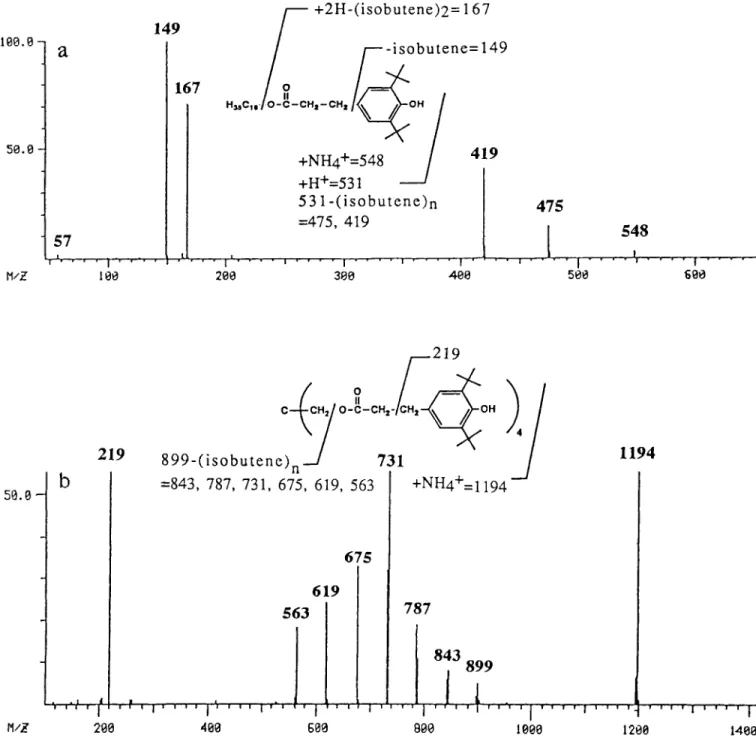
FIG. 1.
CIDmass spectrum of (a) (M + NH~) + ion
(m/z548)
1 1 9 4 675 6 1 9 8 i 3 8 9 9 I . . . . i . . . . [ . . . . i . . . v ' i I i | I I i 1 I 8 0 0 I g e e 1200 1 4 0 8
of Irganox 1076; (b) (M + NH4) + ion (m/z 1194) of Irganox 1010.
it is somewhat surprising that DCI has not been exten- sively used in the analysis of polymer additives.
Concurrent with the development of soft ionization techniques has been the development of tandem mass spectrometry (MS/MS). One of the major applications of MS/MS lies in the coupling with collision-induced dissociation (CID) in mixture analysis. In order to in- crease the sensitivity and also to facilitate the selection of a parent ion, a major criterion in the use of MS/MS in mixture analysis is that, upon ionization, each com- pound should produce as few ions as possible. Therefore, soft ionizations are often chosen in combination with tandem mass spectrometry in the analysis of mixtures. In this paper, we explore the potential of using ammonia DCI as the soft ionization technique along with tandem
mass spectrometry in the analysis of additives from poly- ethylene extracts.
EXPERIMENTAL
C h e m i c a l s . Oleamide was purchased from TCI (Tokyo, Japan); all other additive standards were kindly provided by Ciba-Geigy, Ltd. (Taiwan). The trade names, molec- ular weights, and chemical names of the additive stan- dards are listed in Table I. Oxidized Nugard 524 was prepared by the oxidation of Nugard 524 with hydrogen peroxide. The polyethylene samples were obtained from local stores.
P o l y m e r Extracts. Approximately one gram of polymer
sample was placed in a 250-mL round-bottom bottle and
226 1o~.o 5e. M,"Z a . I 1 ' I ' 50 I 107 120
f t
107 CH= +2H=120 ,, / HO / +H+=226 - ~ I "~ ' ' I t"l, 150 200 I • I 250 100.0 5 0 . e M/Z 1 1 0b
loo
58.5 , ,~;~ .,'. 50 leo Fro. 2. 321 o-,
o+o/
U
°"""/
+ H + - 4 3 6 - - - ' 321 l~ I : , ,~ . , . . 150 200 250 300 436 . i , i 1 i . i , | . i . i f j , i , ~ . i . i .l " | . . .I . I I 350 488 450CID mass spectrum of (a) (M + H) ÷ ion (m/z 226) of Tinuvin P; (b) (M + H) ÷ ion (m/z 436) of Tinuvin 440.
refluxed with 100 mL of toluene for 3 hours. After cooling, 20 mL of methanol was added to precipitate low-molec- ular-weight polymer. The liquid was filtered and dried. The residue was redissolved in methylene chloride and stored for subsequent analysis.
Mass Spectrometry. DCI/MS and DCI/MS/MS exper- iments were performed on a Finnigan TSQ-46C triple- quadrupole mass spectrometer (Finnigan MAT, CA). Methane (from Matheson Co., NJ) and ammonia (from San-Fu Co., Hsinchu, Taiwan) were used as the reagent gas. The sample was air-dried on a platinum or rhenium emitter; the emitter was heated by a separated power supply at a heating rate of 10 mA per second or 20 mA per second until the maximum current of 1.3 A was reached. Argon was used as the collision gas.
846 Volume 47, Number 6, 1993
R E S U L T S AND D I S C U S S I O N
The selection of a suitable ionization method is im- portant to the success of mixture analysis by MS/MS. Ideally, in order to minimize the interference in the se- lection of parent ions, only molecular ions should be produced for each of the compounds in the mixture. For this reason, the "softest" ionization technique is often the best choice in the analysis of mixtures with MS/MS. In addition to "softness," selectivity is also an important factor in the selection of the ionization technique. It is better to choose an ionization technique which responds preferentially to the analytes over the matrix because the polymer extract often consists of additives as well as a low-molecular-weight polymer "matrix."
6 8 0 to~.e 5 8 . 8 a 3 5 5 3 3 8 2 9 9 548 391 ~ _ ~ J t . . . L k ~ A J ~ - t ..n . . . [ . L L I - - J '~ i , i - " ~ T ~ . - - | _ I t . . . . ' r ' " ' I . . . . ' . . . . I . . . ' ' I ' ' ' ' ~ " ' ' ' [ ' ' r ~ ' ' ' ' I ' ' ' ' ~ ' ' ' I ' ~ ' ' - ' ' J '
M/E 200 3ee 400 5ee see 7co 800
6 6 3
1_]
495 l e e . e - b 5e. e, +NH4+=680 / 551 +H+=663 6 6 3 - ( i s o b u t e n e ) n 4 3 9 607 6 6 3 = 6 0 7 , 5 5 1 , 4 9 5 , 4 3 9 , 3 8 3 [ t l 57 383 1 . • • i * . . . . I . . . . r . . . . I . . . . i . . . . I ' " ' - " ( ' ' ' x ' I . . . . , . . . I . . . . -~ . . . .M/Z lee 200 3co 400 see see
Fro. 3. (a) Ammonia DCI mass spectrum of a low-density polyethylene extract; (b) CID mass spectrum of the (M + NH4) + ion (m/z 663) of
oxidized Nugard 524.
When methane was chosen as the DCI reagent gas in the analysis of additive standards, pseudomolecular ion(s) as well as many fragment ions were observed. The spectra became more complicated when polyethylene extracts were analyzed directly by methane DCI. In addition to the molecular ions and many fragment ions from the additives, there were series of ions with a 14-amu interval corresponding to low-molecular-weight polyethylene molecules. These matrix ions may obscure ions from ad- ditives and make the assignment and the selection of precursor ions for M S / M S difficult.
Because of its high proton affinity, ammonia frequent- ly gives very simple CI mass spectra consisting of pseu- domolecular ions with very little fragmentation. Except for Tinuvin 622 and Chimassorb 944, with molecular
weights beyond the mass range of the instrument used (1800 amu), the ammonia DCI mass spectra of all the polymer additives investigated were very simple. The mass spectra were characterized with (M + H) ÷ and/or (M + N H J + ions and with very little fragmentation. Most likely because of the difference in proton affinity, the intensity of the (M + N H J + adduct ion was higher than the (M + H) + ion for most phenolic antioxidants, whereas the intensity of the (M + H) + was significantly higher than the (M + N H J + ion for Tinuvin light sta- bilizer. In addition to being "soft," ammonia is also con- sidered a selective ionization technique. This property can be an advantage if the additives can be ionized pref- erentially over the matrix. 2° The high proton affinity of ammonia makes the low-proton-affinity polyethylene
100.0 - 50.0 M/Z a
l_ ]dll
20O 338 282 391 99 3 5 5 6 8 0 5 4 8 408 663, 400 600 800 1 1 9 4 1067 1084 leO0 1200 100.0 - 5 0 3 . B N/Zb
, , i , I , , i ' , , , , i ' , , , , i " , " , , , ' 1 . . . . l " , ' , , 2eeo i-c> >i
_ /
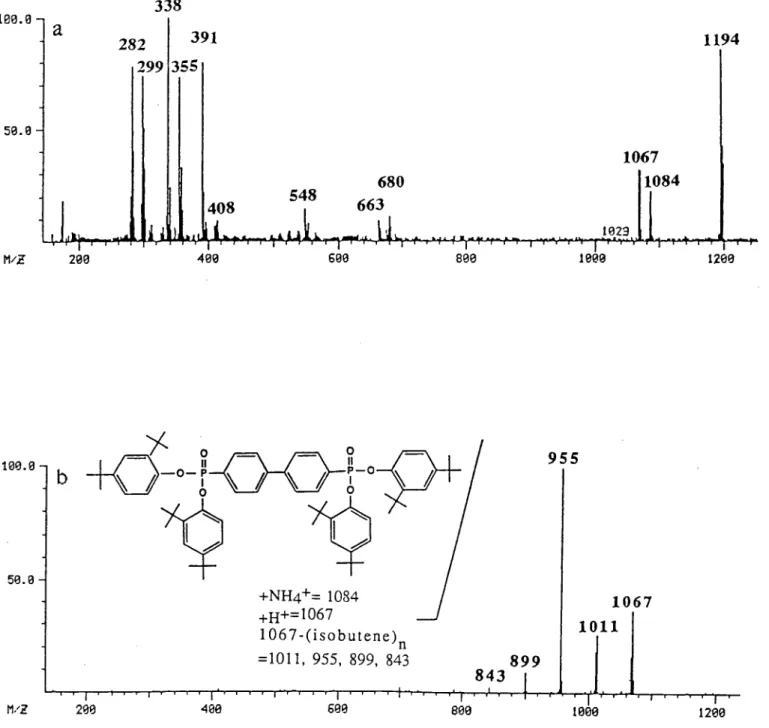
1 0 6 7 - ( i s o b u t e n e ) n =1011, 955, 899, 843 8 9 9 8 4 3 , 1 400 600 800 9 5 5 1 0 6 7 , "1' ,' ,'~ , j , , .. ,, ,| , tO00 1200FIG. 4. (a) Ammonia DCI mass spectrum of a second low-density polyethylene extract; (b) CID mass spectrum of the m/z 1067 ion.
matrix barely detectable, and thus there is less likelihood of interference in the analysis of additives. The low- molecular-weight polyethylene ions, which were quite intense under the conditions of methane DCI, disap- peared almost completely in ammonia DCI.
The ratio of the (M + H) + and (M + NH4) ÷ ions provides some indication of the proton affinity of the analyte. Therefore, if reference compounds are available, it is possible to identify additives on the basis of the molecular weights and their (M + H)÷/(M + NH4) ÷ ratios. Much greater specificity, however, can be obtained with the use of tandem mass spectrometry; the product (daughter) ion mass spectrum obtained with a tandem mass spectrometer provides many structurally charac- teristic fragment ions and thus much greater confidence in the assignment. The structures and the CID mass
8 4 8 V o l u m e 47, N u m b e r 6, 1 9 9 3
spectra of several common polymer additives are shown in Figs. 1 and 2. It is noticed t h a t one of the common fragmentation pathways observed in the CID spectra of antioxidant is the loss of alkene(s) from the parent ions.
For example, the fragments at m/z 475 and 419 in Fig.
l a were produced because of the loss of one or two iso-
butenes from the ammoniated molecular ion (m/z 548)
of Irganox 1076. A similar phenomenon was observed for Irganox 1010; a sequential loss of six isobutenes was re- corded (Fig. lb). Unlike the case for other UV stabilizers, the major fragment of Tinuvin 440 was produced due to the two-bond ring cleavage (double cleavage) reaction (Fig. 2b).
In an effort to evaluate the utility of ammonia DCI/ MS/MS for detecting polymer additives in polyethylene, several commercial polyethylene products were extract-
lOO.e-
~ . o a 548 4 7 5 . 4 [ Jlsee 4oe see
647 663 ;80 . . . . I ' ' ` ' ~ " ' 1 . . . . ~ . . . . I . . . . H,,'Z 2 8 8 G 0 0 ~ 0 88e
5,0
2 . 5 ' 6 4 7 +H+=647 6 4 7 - i s o b u t e n e = 5 9 1 4 4 1 3 4 75 9 1
2~
I
aa54 a
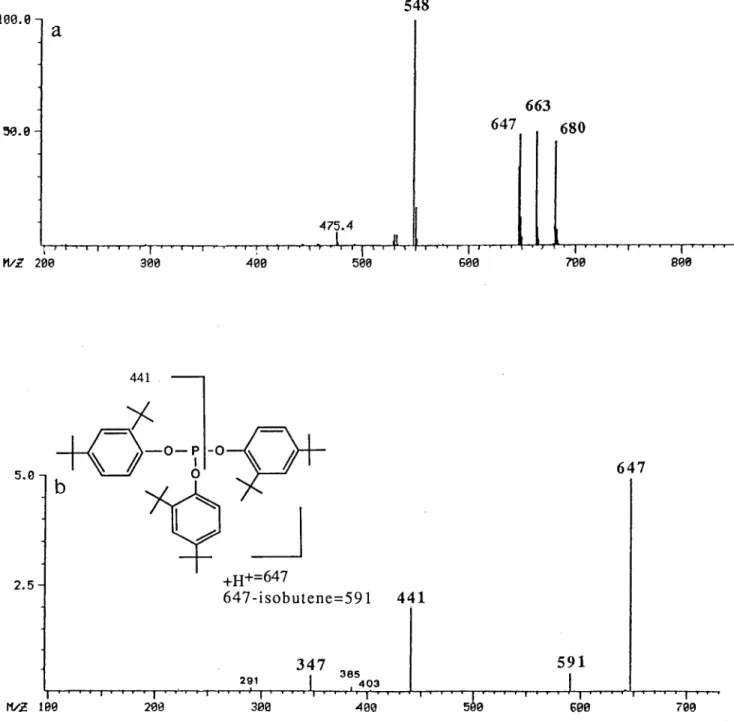
J 2 0 0 3 0 Q 4 0 e 6 ~ 0 .... | • ~ , t~/Z 1oe 700FIG. 5. (a) Ammonia DCI mass spectrum of a high-density polyethylene extract; (b) CID mass spectrum of the
m/z
647 ion.ed with toluene and then analyzed directly by DCI/MS and DCI/MS/MS. T h e results of two low-density and two high-density polyethylene samples are presented. T h e ammonia DCI mass spectrum of a tarp sample which is used locally as a disposable raincoat is shown in Fig. 3a. Pseudomolecular ions for several additives are clearly distinguishable. T h e (M + H ) + / ( M + NH4) + ion pairs
at
m/z
282/299, 338/355, and 663/680 correspond to ad-ditives with molecular weights of 281, 337, and 662, re- spectively. T h e CID mass spectra of the 282/299 and 338/ 355 ion pairs suggested t h a t they were amide waxes oleamide and erucamide, respectively. T h e CID spec- trum of the 663 ion is shown in Fig. 3b. This spectrum is very similar to not the intact form, but the oxidation form, of the phosphite triester secondary antioxidant,
Naugard 524 (MW = 646). T h e ion at
m/z
548 was ob-served in many samples. This ion is either the (M + H) ÷
ion for an additive with molecular weight of 547 or the (M + NH4) + ion for an additive with molecular weight of 530. It is assigned as the (M + NH4) + ion of the antioxidant Irganox 1076 because the CID spectrum is very similar to the spectrum of Fig. la. On the basis of
the product ions
(m/z
149, 167, 279), them/z
391 ionwas assigned as the (M + H) + ion of the additive dioctyl phthalate (DOP). This compound has been used as a plasticizer in polyvinyl chloride or as a lubricant in low- density polyethylene. 21 Because DOP is a common con- t a m i n a n t in samples t h a t have been in touch with plastic or rubber materials, a blank test is used to eliminate the possibility of contamination.
More additives were detected for a disposable raincoat from another manufacturer. T h e DCI mass spectrum of this second tarp extract is shown in Fig. 4a. In addition to the additives identified in the first tarp extract, two
180.8 - 58.8 M/z a 1 4 0 w n f - 140 729 HN--C(CH=]=CH=C(CH=)=
770.1
9 9 4 1 0 5 8 I i ~ .,- ~ -,. t -.-.- -,~( ~ . . . ~,1. i l , " 1 ' ~ - ' . . . . - I " " ' ' I ' " ' ' ' . . . . I ' " ~ • , . . . . I .... 200 .480 G88 880 1000 1280 1 0 0 . 0 - 58.0 H/g FIG. 6.b
1 4 0 5 4 8 994 J 6 0 0 729 855 GO1 7 5 6 J , ~ . . . ~ _ _ _ t . . . . , . . . . [ L .I. ! . . . . . . . I . . . . ~ ' ' ' ' I . . . . ~ . . . t . . . . I . . . . I . . . . 288 488 680 888 1 0 5 8 / 1800 1200(a) Ammonia DCI mass spectrum of Chimassorb 944; (b) ammonia DCI mass spectrum of a high-density polyethylene extract. more additives with molecular weights of over 1000 amu
were detected and identified. The ions at
m/z
1067 and1084 correspond to a compound with a molecular weight
of 1066. Because the fragmentation pattern of the
m/z
1067 ion was similar to the oxidized Nugard 524 with sequential loss of isobutene from the parent ion (Fig. 4b), this ion was tentatively assigned as the (M + H) ÷ ion of the compound resulting from the oxidation of the phosphite triester secondary antioxidant, Santostab
P E P Q (MW=1034). The ion at
m/z
1194 was assignedas the (M + NH4) + ion of another common antioxidant,
Irganox 1010, because the CID spectrum of the
m/z
1194ion was very similar to the spectrum in Fig. lb.
Phosphite antioxidant Nugard 524 was also detected in a high-density sample (Fig. 5a). In addition to the
pseudomolecular ions
(m/z
663, 680) corresponding tothe oxidized Nugard 524, intact Nugard 524
(m/z
647)was also observed. It is interesting to see that an intact molecule has higher proton affinity than its oxidation product [the protonated molecular ion (M + H) + is the major pseudomolecular ion for Nugard 524, whereas (M + H) + and (M + NH4) ÷ have similar intensity for oxi- dized Nugard 524]. The difference in proton affinity is more likely due to the electron withdrawing effect of the oxygen atom. The CID spectra of the intact Nugard 524 (Fig. 5b) and oxidized Nugard 524 (Fig. 3b) show that oxidation also affects the fragmentation pattern signif-
icantly. The ion at
m/z
548 is the ammoniated molecularion of the antioxidant Irganox 1076.
In recent years, there has been a tendency to use sta- bilizer with higher molecular weight (>2000 amu) to prevent loss under severe conditions of applications. 8 5 0 V o l u m e 4 7 , N u m b e r 6 , 1 9 9 3
W h e n h i n d e r e d a m i n e light stabilizer C h i m a s s o r b 944 was s t u d i e d by a m m o n i a DCI, the molecular ion was n o t detected, p r o b a b l y because of the limited mass range of the mass s p e c t r o m e t e r . However, m a n y characteristic f r a g m e n t s were observed (Fig. 6a). T h e s e ions are very useful in t h e identification of additives. I n t h e analysis of the e x t r a c t f r o m a h i g h - d e n s i t y sample (beer crate), w h e n t h e t e m p e r a t u r e of the D C I p r o b e a p p r o a c h e d its m a x i m u m value, m a n y high mass f r a g m e n t s were de- t e c t e d (Fig. 6b). C h i m a s s o r b 944 is believed to be p r e s e n t in this sample because (1) the f r a g m e n t s at m/z 600, 729, 994, a n d 1058 are t h e major f r a g m e n t s of C h i m a s s o r b 944; (2) the m/z 600 ion c o r r e s p o n d s to the molecular weight of m o n o m e r ; a n d (3) the m/z 140 ion, observed in t h e C I D of the m/z 600, is a s t r u c t u r a l l y characteristic cyclic amine f r a g m e n t ion. I n a d d i t i o n to t h e U V ab- sorber, a n t i o x i d a n t I r g a n o x 1076 was also d e t e c t e d in this sample (m/z 548 ion in Fig. 6b).
C O N C L U S I O N
T h e results show t h a t a m m o n i a D C I / t a n d e m mass s p e c t r o m e t r y is a c o n v e n i e n t m e t h o d for the d e t e c t i o n of additives in p o l y e t h y l e n e samples. T h e softness a n d selectivity p r o v i d e d b y a m m o n i a D C I in c o m b i n a t i o n with t h e specificity p r o v i d e d b y collision-induced dis- sociation d e m o n s t r a t e its great p o t e n t i a l for identifica- tion of additives directly from p o l y e t h y l e n e extracts. K n o w i n g the a m o u n t of additives is at least as i m p o r t a n t as identifying the additives in the p o l y m e r sample; fur- t h e r s t u d y will explore t h e utility of D C I in the q u a n - titative analysis of additives in polyethylene.
ACKNOWLEDGMENT
This work was supported by the National Research Council of the Republic of China.
1. J. F. Schabron and L. E. Fenska, Anal. Chem. 52, 1411 (1980). 2. R. B. Walter and J. F. Johnson, J. Polym. Sci. 1S, 29 (1980). 3. D. Munteanu, A. Isfan, C. Isfan, and I. Tincul, Chromatographia
23, 7 (1987).
4. M. W. Raynor, K. D. Bartle, I. L. Davies, A. Williams, and A. A. Clifford, Anal. Chem. 60, 427 (1988).
5. C. Grosset, D. Cantin, A. Villet, andJ. Alary, Talanta 37, 301 (1990). 6. R. C. Wieboldt, K. D. Kempfert, and D. L. Dalrymple, Appl. Spec-
trosc. 44, 1028 (1990).
7. M. Ashraf-Khorassani and J. M. Levy, J. High Resol. Chromatogr. 13, 742 (1990).
8. B. Marcato, C. Fantazzini, and F. Sevini, J. Chromatogr. 553, 415 (1991).
9. R.P. Lattimer and R. E. Harris, Mass Spectrom. Rev. 4, 369 (1985). 10. J. O. Lay, Jr., and B. J. Miller, Anal. Chem. 59, 1323A (1987). 11. H. S. Freeman, Z. Hao, J. Sokolowska-Gajda, R. B. van Breeman,
and J. C. Le, Dyes and Pigments 16, 317 (1991).
12. C. L. Johlman, C. L. Wilkins, J. D. Hogan, T. L. Donovan, D. A. Laudel Jr., and M. J. Youssefi, Anal. Chem. 62, 1167 (1990). 13. T. L. Riley, T. J. Prater, J. L. Gerlock, J. E. de Vries, and
D. Schuetzle, Anal. Chem. 56, 2145 (1984).
14. R. P. Lattimer, R. E. Harris, D. B. Ross, and H. E. Diem, Rubber Chem. Technol. 57, 1013 (1984).
15. A. T. Hsu and A. G. Marshall, Anal. Chem. 60, 932 (1988). 16. B. Asamoto, J. R. Young, and R. J. Citerin, Anal. Chem. 62, 61
(1990).
17. M. P. Mawn, R. W. Linton, S. R. Bryan, B. Hagenhoff, U. Jurgens, and A. Benninghoven, J. Vac. Sci. Technol. A 93, 1307 (1991). 18. R. J. Cotter, Anal. Chem. 52, 1589A (1980).
19. M. Vincenti, E. Pelizzetti, A. Guarini, and S. Costanzi, Anal Chem. 64, 1879 (1992).
20. P. Rudewicz and B. Munson, Anal. Chem. 58, 358 (1986). 21. R. F. Grossman, "Lubricants," in Thermoplastic Polymer Addi-
tives, J. T. Lutz, Jr., Ed. (Marcel Dekker, New York, 1989), Chap. 7, p. 282.