H-MAC: A Channel-Hopping Based Multi-Channel
MAC Protocol for 802.11 Wireless LANs
Chih-Yung Chang, Lain-Jinn Hwang, Yun-Jung Lu, Yu-Chieh Chen *Dept. Computer Science and Information Engineering, Tamkang University
{cychang, micro}@mail.tku.edu.tw, {yjlu, ycchen}@wireless.cs.tku.edu.tw
Abstract—IEEE 802.11 provides a contention-based MAC protocol for single channel wireless environment. Extending IEEE 802.11 to a multi-channel environment not only exploits the bandwidth utilization but also reduces the degree of contentions. However, each station is only equipped with a single antenna, resulting in the situation that station pairs staying on data channels can not maintain the channel usage information which only can be obtained from the control channel. The unavailability of channel utilization can further raise the channel collision problem. This study proposes an efficient 802.11 Multi-Channel MAC protocol, called H-MAC, aiming at maximizing the bandwidth utilization. The proposed protocol adopts the channel hopping sequence (CHS) mechanism to resolve the channel collision problem and reduce the message exchange overhead for switching channels. The proposed H-MAC also exploits the opportunities of spatial reuse, maintains the fairness, and possesses several characteristics including low cache overhead, fewer control packets and collision avoidance. Simulation study shows that the proposed H-MAC protocol largely improve the bandwidth utilization, delay time and throughput while maintaining fairness.
Keywords- IEEE 802.11; Medium Access Control (MAC);
Multi-channel; Mobile Ad hoc NETworks (MANETs); communication protocol.
I. INTRODUCTION
IEEE 802.11 defines a contention-based MAC protocol that adopts techniques including CSMA, RTS/CTS and Random Backoff to avoid transmission collision, maintain fairness among wireless stations, and efficiently use bandwidth resources. However, 802.11 MAC protocol [1] was originally designed for single channel environment. Extending 802.11 MAC to the multi-channel environment can not only improve the channel utilization but also distribute stations that compete for channel access over several channels, reducing the overhead raised from collisions and data retransmissions. Moreover, a multi-channel communication environment, which allows multiple communicating pairs to transmit data simultaneously can improve the throughput and fairness.
In literature, a number of MAC protocols [2][3][4][5][6][7][8] have been proposed for a multi-channel environment under the assumption that each station is
equipped with two antennas. In general, the bandwidth is divided into one control channel and one or more data channels. In these studies, one antenna is used for communication on the control channel and the other one is used for maintaining channel usage information. In [3], an on-demand channel assignment protocol is proposed for a multi-channel environment. It flexibly adapts to host mobility without the requirement of clock synchronization. Some other studies [4][5] considered one control and one data channels. They used the busy tone technique to cope with the hidden terminal and exposed terminal problems, enhancing the channel utilization. When a station intends to use one antenna for transmitting packet on data channel, the other antenna should transmit a busy tone on the control channel to notify the other stations that the data channel has been occupied. In [6], a multi-channel CSMA protocol was proposed for dynamically selecting channels and employing a “soft” channel reservation which gives preference to the channel that was used for the last successful transmission. Studies [7][8] emphasized that multi-channel can be easier than single channel to satisfy the QoS requirements.
Though most aforementioned studies efficiently improved the throughput and maintained the fairness in a multi-channel environment, however, they assumed that each station is equipped with two antennas, which increase the hardware cost. Most 802.11 commercial products are equipped with only single antenna. Since each station is only equipped with a single antenna, communication pairs that stay on the data channels can not maintain the channel usage information which can only be obtained from the control channel, raising the channel collision problem.
MMAC[2] considered a single antenna system in a multi-channel environment. A communicating pair used ATIM/ATIM-ACK/ATIM-RES negotiation to inform their neighbors about the chosen data channel. Multiple communicating pairs located at the nearby locations can thus use different channels for communication without interference. However, all stations need to stay on the same channel in their ATIM window in order to learn the information of channel usage. All the other channels will be idle at every ATIM window, which leads to low channel utilization.
This paper assumes that each station with single antenna and considers the collision problems in a multi-channel environment. An efficient multi-channel MAC protocol based on channel hopping sequence is proposed to improve the
channel utilization, decrease the communication latency, keep the fairness between stations and enhance the network throughput.
II. EFFICIENT MULTI-CHANNEL MACPROTOCOL This section describes the detailed operations of the proposed H-MAC. The proposed protocol operates in a multi-channel environment. Assume that the bandwidth resource is divided into one control channel and n−1 data channels. Each station is equipped with single antenna. The proposed H-MAC tries to exploit the resource utilization in time and space domains and maintain the transmission fairness in the network. Initially, all stations stay on control channel. In the H-MAC protocol, stations intending to communicate with other stations should firstly compete for RTS/CTS negotiation on the control channel according to CSMA and Random Backoff schemes similar to rules defined in the 802.11 DCF MAC protocol. Then, the pair of stations, which obtains the opportunity of RTS/CTS negotiation, derives a Channel Hopping Sequence (CHS) based on the 48-bit MAC addresses of the sender and receiver, and switches to a data channel according to the CHS. 2.1 Definition and Priority
This subsection defines some terms used in the protocol description.
Definition:Pair(si, ri)
Two stations si and ri, intending to communicate with each other, are denoted as Pair(si, ri), where stations si and ri
respectively denote the sender and receiver. Definition:N-Pair
Negotiation Pair: Stations si and ri that intend to exchange RTS/CTS packets on control or data channels is called N-Pair. Definition:C-Pair
Communication Pair: The stations si and ri that complete the RTS/CTS exchanges on both control and data channel and intend to exchange DATA/ACK packets on the data channel is called C-Pair.
In the H-MAC protocol, the sender and receiver first exchange RTS and CTS on the control channel. The RTS/CTS negotiation has several purposes. First, the RTS and CTS packets contain the 48-bit MAC addresses of the sender and receiver, respectively. This information can be used by the sender and receiver to derive the data channel hopping sequence independently.
Although the overhearing of RTS/CTS on control channel can largely reduce the hidden terminal problem occurred in the data channel, however, some stations, denoted here by pair (sj,
rj), may exchange data on a data channel and miss the
RTS/CTS information announced by pair (si, ri) on the control channel. Pair (sj, rj) may intend to continue their communication for another data packet, but may select a data channel currently used by pair (si, ri), causing two pairs communicating on the same data channel. To maintain the fairness, a communicating pair that earlier switches to a data channel should have the right to stay on that channel. All other communicating pairs change the selected channel according to their data channel hopping sequence. Therefore, communication between sender and receiver on data channel is
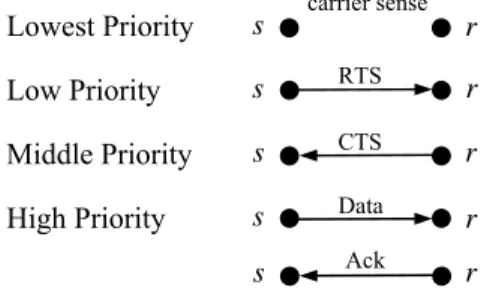
arranged in priority order to allow the communicating pair with higher priority to have the access right of the data channel. The priority of each type of communication is shown in Fig. 1.
Figure 1: The priority of each type of communication.
2.2 The Protocol
This subsection describes the details of H-MAC protocol. The protocol mainly consists of three phases: the Negotiation,
Communication, and Channel Switching phases.
A. Negotiation Phase
In the Negotiation Phase, stations intending to communicate with other stations should stay on the control channel, trying to exchange RTS/CTS packets in a contention-based manner. The competition rules for the sender to send an RTS packet is similar to those rules defined in 802.11 DCF. However, the duration defined in the RTS packet should be modified to the number of slots required for RTS/CTS negotiation. Since the Data packet is transmitted on the data channel, the time for data transmission is not considered in the duration field of RTS.
Upon receiving the RTS packet, the receiver extracts the Sender’s MAC address from the RTS packet and waits for an SIFS duration. If the medium keeps idle during this duration, the receiver then replies with a CTS packet on the control channel to prevent the hidden terminal problem. Notice that the duration field of the CTS packet is set by a null value. Finally, the sender and receiver will derive a common CHS based on their MAC addresses, as a reference for the selection of data channels. The sender and receiver will derive the same CHS since the CHS is generated by their MAC addresses. The CHSs of different communicating pairs are likely different since their MAC addresses are different. This implies that different communicating pairs will select different data channels and hence avoid collision problem which will be only occurred on the same data channel. When an RTS/CTS negotiation is completed, the other senders can compete for the next RTS/CTS negotiation on the control channel.
After the RTS/CTS negotiation on control channel, an additional RTS/CTS negotiation on the data channel is needed in the Negotiation Phase. Although the using of CHS for channel hopping has significantly reduced the probability of collision from different communicating pairs, however, preventing any possible interference during data transmission is required. Therefore, another RTS/CTS negotiation is required on the data channel. When the sender and receiver switch to a specific data channel, they wait for a DIFS duration to check if the medium is idle. If it is the case, the sender
Lowest Priority Low Priority Middle Priority High Priority s s s s r r r r s r RTS CTS Data Ack carrier sense
N-Pair Switching Rule 1: An N-Pair should switch to another channel based on its CHS if any station of the pair detects a busy medium on a data channel.
transmits an RTS packet to the receiver and the receiver replies with a CTS packet. On the contrary, if any or both of the sender and receiver detect that the medium is busy, they will block the RTS and CTS and switch to another data channel according to their CHS. For example, if the sender detects a busy medium, it will switch to another data channel. When the receiver waits for a DIFS period and did not receive any RTS packet from the sender, the receiver will also switch to another data channel according to their common CHS. The sender and receiver will wait for a DIFS period and try to exchange RTS/CTS on the new data channel. The Negotiation Phase will be completed if the sender and receiver complete a successful RTS/CTS exchange on a data channel. Then both sender and receiver change to the Communication Phase.
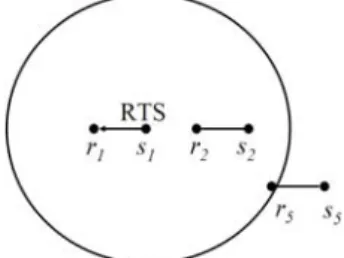
Figure 2 illustrates the operations of the Negotiation Phase on the control channel. As shown in Fig. 2, sender s1 intends to communicate with receiver r1 and then sends an RTS packet to r1 on the control channel. Upon receiving the RTS packet from s1, r1 replies with a CTS packet to s1. Because stations s2, r2, and r3 can overhear RTS packet transmitted from s1, they will block for a duration which is defined in the duration field of the RTS packet. When s1 and r1 finish RTS/CTS negotiation on the control channel, they independently derive a CHS according to their MAC addresses and switch to the selected channel based on the CHS. Afterward, station s2 also intends to communicate with receiver r2 and then transmits to r2 the RTS packet which cannot be overheard by r1 because that r1 has switched to data channel at that moment.
Figure 2: An example for describing the Negotiation Phase on control channel.
Figure 3: An example for describing the switching channel steps of Negotiation Phase.
B. Communication Phase
The communicating pair that completes the Negotiation Phase obtains the opportunity of data transmission on the data channel. Thus, the sender and receiver can exchange Data/ACK on the selected data channel.
There are several reasons for raising packet collisions in the communication phase. For example, an RTS/CTS exchange can be collided to another RTS/CTS exchange. Further, the mobility might raise the collision between two pairs that are exchanging Data/ACK messages. Even though collisions might be occurred in the Communication Phase, however, the proposed protocol arranges the transmissions on the data channel with different priorities to maintain the fairness. Herein, the first-come-stay policy is applied. More specifically, the communicating pair that switches to the data channel earlier can stay on the same data channel if a collision occurs. On the contrary, the late-switching communicating pair should switch to another channel according to their channel hopping sequence. Priority is assigned according to the order of packet types transmitting on the data channel. As shown in Fig. 1, the priority values of the “carrier sense”, “transmitting RTS packet”, ”transmitting CTS packet”, “transmitting Data or ACK packet” communication states, is ‘lowest’, ‘low’, ‘middle’, and ‘high’, respectively. When a collision occurs in a data channel, pairs with lower priority should switch to other data channels and then again compete for the opportunity for channel access if no pair with higher priority on that channel. Figure 3 gives another example for depicting the detail of
Negotiation Phase. In Fig. 3, station s1 and r1 derive their own CHS1 through the exchange of RTS/CTS packets on the control channel. We assume that the CHS1 is [1, 3, 5]. After, pair (s1, r1) switches to the data channel 1 and executes the handshaking procedure. The Data/ACK can be exchanged between stations s1 and r1. Similarly, pair (s2, r2) can derive their CHS2=[1, 4, 6] through the exchange of RTS/CTS on the control channel. After, pair (s2, r2) also switches to data channel 1 according to their CHS2. Since pair (s1, r1) is transmitting the data on the data channel 1, pair (s2, r2) will detect that the channel is busy and decide to switch channel again. The next channel of CHS2 is data channel 4. In this case, pair (s2, r2) will successfully exchange RTS
In general, the collisions can be categorized into three types:
N-Pair interfering with N-Pair, N-Pair interfering with C-Pair
and C-Pair interfering with C-Pair. In the following, the protocol designed to cope with these collision types is presented.
/CTS and
ge RTS/CTS packet on both control channel and data channel.
Data/ACK on channel 4.
(a) N-Pair interfering N-Pair
Below, two rules applied in H-MAC are proposed.
General Rule: An N-Pair can obtain the access right of a data channel only if the pair successfully exchan
The RTS/CTS transmissions of two N-Pairs might be collide with each other on a data channel. A possible scenario is that two N-Pairs switch to the same data channel and try to exchange RTS/CTS. Another scenario is that two N-Pairs are
successful in the exchanges of RTS/CTS on the control channel but their RTS/CTS exchanges on the data channel are failure due to mobility. The proposed H-MAC will maintain the fairness that earlier communication pair has the right to access the data channel.
(a)The scenario that an N-Pair interfering another N-Pair on the Data Channel.
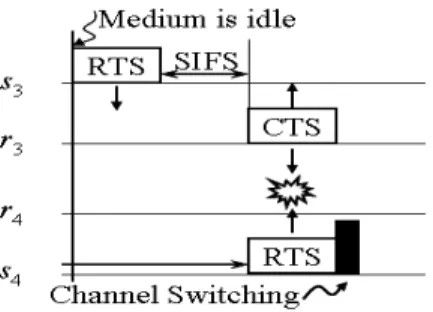
(b)The situation of the medium access on the Data Channel Figure 4: An example of an N-Pair interfering with an N-Pair on the Data Channel.
Figure 4 depicts a possible collision between two pairs that are exchanging RTS/CTS messages. We assume that pair (s3, r3) earlier stay on a specific data channel than pair (s4, r4). The CTS packet sent by r3 will collide with the RTS packet sent by s4. This type of interference is called Pair interfering with N-Pair. In this case, the transmission of pair (s3, r3) is successful while the transmission of pair (s4, r4) is failure. Consequently, pair (s4, r4) will switch to another data channel based on their CHS. Oppositely pair (s3, r3) stays on the original data channel to exchange DATA/ACK messages. The RTS/CTS negotiation on the data channel can significantly reduce the phenomenon of collision between two Data transmissions. We notice that the medium will be idle for a period of SIFS during the transmission of Data/ACK. The RTS can be started only if the medium keeps idle for a period of DIFS which is larger than SIFS. This implies that the RTS has lower priority for channel access than DATA/ACK. Therefore, the transmission of RTS/CTS by an N-pair will be blocked by the transmission of DATA/ACK which is executed by a C-Pair. This also makes the N-pair automatically switch to another channel and therefore prevent two C-Pairs from collision occurrence.
(b) N-Pair interfering C-Pair
Similar to the collision occurred between two N-Pairs, a collision also might be occurred between an N-Pair and a C-Pair. For example, when the Data/ACK exchange of a C-Pair on a specific channel, an N-Pair may switch to the same channel and try to exchange RTS/CTS at the same time. This results in a collision between an N-Pair and a C-Pair. To
maintain the fairness, the proposed H-MAC protocol will naturally reserve the right for channel access of the C-Pair. That is, the N-Pair which later switches to the data channel will switch to another channel when a C-Pair which has a higher priority than N-Pair stays on the same channel.
(a)The scenario that an N-Pair interfering with a C-Pair.
(b)The medium access on multiple data channels.
Figure 5: An example of N-Pair interfering C-Pair on the Data Channel.
Figure 5 gives an example that an N-Pair interferes with a C-Pair. We assume that a C-Pair (s3, r3) is executing the Data Communication Phase. At this moment, an N-Pair (s4, r4) switch to the same channel. The data packet sent by s3 collides with the CTS packet sent by r4. To guarantee the fairness between all communicating pairs, H-MAC will reserve the access right of a data channel to the pair with higher priority. However, station r4 is not aware that its CTS caused a failure transmission of an existing C-Pair. When the C-Pair (s3, r3) is failure in exchanging Data/ACK, station r3 which is interfered by the other station will send a WARNING packet after a certain period time which is an SIFS plus a duration of Random Backoff time. Two cases will be further discussed below depending on whether or not r4 can successfully receive the WARNING packet. If it is the case, r4 will automatically switch to another data channel according to its CHS. After, the
s4 will also switch to the same channel since it is failure to receive the control packet from r4. As a result, the C-Pair (s3, r3) can stay on the original data channel and continuously access the data channel without any interference. On the contrary, if r4 did not receive the WARNING packet due to another collision, it will switch to another channel according to its CHS. After, s4 can not receive an ACK packet from r4 and therefore it also switch to another data channel following its CHS. By this way, pair (s3, r3) can stay on the original data channel to continue its DATA transmission. Here, we notice
that data transmission of s3 and the WARNING packet transmission of r3 are executing simultaneously. Hence s3 is not aware that its data transmission has been failure. To notify the s3 to retransmit the same data, r3 should send an NACK packet to s3 to request for data retransmission after an SIFS period. We summarize the detail for handling the problem of
N-Pair interfering C-Pair below.
N-Pair switching rule 2: If a C-Pair(s, r) can not successfully complete the exchange of DATA/ACK on a data channel, the station which is interfered by other station will wait a duration for an SIFS plus a random backoff(0, 1) time and then use low transmission rate to send a WARNING packet. Upon receiving a WARNING packet, the N-Pair should switch to another channel based on their own CHS.
(c) C-Pair interfering C-Pair
Two C-Pairs can collide with each other due to mobility. Initially, the two C-Pairs might exchange their Data/ACK safely because the sender of a C-Pair and the receiver of the other C-Pair have a distance larger than the communication range. However, the two stations might be closed to each other due to mobility and hence results in a collision between them.
(a)The scenario that a C-Pair interfering a C-Pair.
(b)The medium access on the data channels when two C-Pairs collide with each other.
Figure 6: An example that H-MAC copes with the problem of C-Pair interfering C-Pair.
Figure 6 shows an example that Pair(s3, r3) and Pair(s5, r5) are executing the Data Communication Phase and they are moving closer. The transmission of data packet from s3 to r3 interferes the communication of pair(s5, r5), resulting a collision occurred between two C-Pairs. As mentioned before, the receiver that fails to receive an expected message will
transmit a WARNING packet after waiting for a period of SIFS plus a Random Backoff time. Here, the Random Backoff time is either zero or one slot which is determined randomly. If the Random Backoff time of s3 and the s5 are zero and one, respectively, r3 will send WARNING packet after SIFS time. After, s5 and r5 will switch to another channel according to their common CHS.
In the Communication Phase, the proposed protocol enables the pairs with higher priority staying on the original channel for packet transmission so as to maintain the transmission fairness. The Pair which firstly switches to the data channel is likely to win the right for channel access even though they suffer interference from the other pairs which also intend to communicate on the same data channel but with lower priority.
III. PERFORMANCE STUDY
This section compares the proposed H-MAC protocol, M-MAC and IEEE 802.11 in term of channel utilization and average packet delay. The size of network was set by 100m × 100m, while the radio transmission range of a station was set at a constant of 250m and the bandwidth of each channel was set by 2Mbps. The size of each packet was 512 bytes, and the memory buffer in each station held up to 50 packets. The communication pairs are randomly selected from the deployed neighboring stations. Performance was evaluated in a multi-channel environment which contains one control multi-channel and a number of data channels. The number of data channels varies from 3 to 6 while the number of communication pairs varies from 5 to 20. In the multi-channel environment, stations applying the IEEE 802.11 protocol will randomly select a data channel for communication. In case that there are more than one neighboring pairs selecting a common data channel, they compete for channel access on that channel according to the IEEE 802.11 DCF protocol.
Figure 7: The comparison of H-MAC, M-MAC and IEEE 802.11 in terms of channel utilization.
Figure 7 compares the proposed H-MAC, M-MAC and IEEE 802.11 in terms of channel utilization whose value is normalized between 0 to 1. The channel utilization is measured by the ratio of idle time and the total experimental time. When the number of channels is set by three, the channel
utilizations of M-MAC and H-MAC increase with the number of pairs in case the number of pairs smaller than 15. However, the channel utilization of M-MAC and H-MAC get worse when the number of pairs is increased to from 15 to 20. This is because that too many pairs compete for only three data channels, resulting in collision and contention in both control and data channels easier. However, the channel utilizations of M-MAC and H-MAC are increases with the number of pairs when the number of channels is six or nine since the total bandwidth is increases and therefore the phenomenon of contention and collision is reduced. The channel utilization of IEEE 802.11 decreased with the number of communication pairs when the number of channels is set by three or six due to significant contention and collision occurred in each data channels. However, the channel utilization of IEEE 802.11 increased with the number of pairs very slow when the number of channel is set at nine.
In general, the proposed H-MAC outperforms M-MAC in terms of channel utilization in all cases because that M-MAC asks all stations switching to the same channel in each window and all the other channels are idle during the ATIM-window, resulting in lower channel utilization than H-MAC. The IEEE 802.11 is mainly designed for single channel and no policy is proposed for a multi-channel environment. As a result, H-MAC and M-MAC which are proposed for a multi-channel environment outperform the IEEE 802.11 in terms of channel utilization.
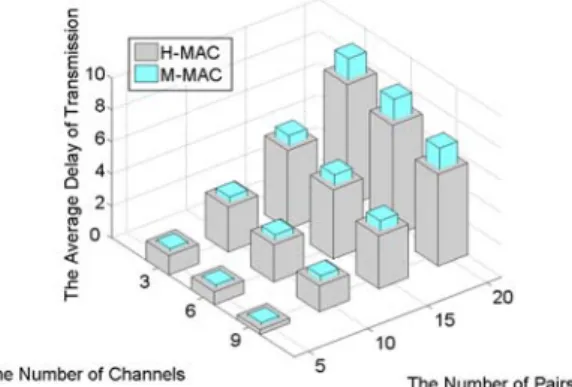
Figure 8: The comparison of H-MAC and M-MAC in terms of average transmission delay with different numbers of communication pairs and channels.
Figure 8 compares H-MAC and M-MAC in terms of average transmission delay by varying the number of channels from 3 to 9 and by varying the number of communication pairs from 5 to 20. When the number of channel is fixed, the average transmission delays of both H-MAC and M-MAC are increased with the number of pairs due to the increased contentions and collisions. However, when the number of pairs is fixed, a broader bandwidth can reduce the average transmission delay. Therefore, the average transmission delays of both H-MAC and M-MAC decreased with the number of channels. In general, the H-MAC uses channel hopping sequence to distribute all communication pairs onto the data
channels and hence reduce the number of contentions and collisions. Although the M-MAC arrange the communication pairs to different data channels, however, the delay for negotiation in the ATIM-Window and the collision and contentions in data channel results in larger average transmission delay than H-MAC.
IV. CONCLUSION
In a wireless LAN with multi-channel environment, bandwidth utilization determines the network throughput and packet transmission delay. In literature, most existing studies assume that each station equipped with two antennas so that one antenna is used for communication on a data channel and the other antenna can stay on the control channel to maintain the channel usage information. This paper assumes that each station equipped with only single antenna and proposes a novel mechanism to improve the channel utilization and reduce the packet transmission delay without maintaining the channel usage information. Based on the channel hopping sequence, a communication pair exchanges RTS/CTS on the selected data channel and hops to another data channel if this pair detects a busy medium on the selected channel. A general rule and two channel switching rules are proposed to prevent the data collisions occurred between two N-pairs, two C-Pairs as well as one N-Pair and one C-Pair. Performance study reveals that the proposed H-MAC outperforms M-MAC in terms of channel utilization and packet transmission delay.
REFERENCES
[1] S. Department, “Wireless LAN medium access control (MAC) and physical layer (PHY) specifications,” IEEE standard 802.11-1997, 1997.
[2] Jungmin So and Nitin H. Vaidya, “A multi-channel MAC protocol for ad hoc wireless networks,” Technical Report, Department of Computer Science University of Illinois at Urbana-Champaign, Jan. 2003.
[3] S.-L. Wu, C.-Y. Lin, Y.-C. Tseng, and J.-P. Sheu, “A new multi-channel MAC protocol with on-demand multi-channel assignment for mobile ad hoc networks,” Int'l Symp. on Parallel Architectures, Algorithms and Networks(I-SPAN), 2000.
[4] S.-L. Wu, Y.-C. Tseng, and J.-P. Sheu, “Intelligent medium access for mobile ad hoc networks with busy tones and power control,” IEEE Journal on Selected Areas in Communication, 18(9):1647-1657, 2000.
[5] Zygmunt J. Haas and Jing Deng, “Dual busy tone multiple access (DBTMA): A multiple access control scheme for ad hoc networks,” IEEE Transactions on Communications, Vol. 50, Issue: 6, pp. 975 –985, 2002.
[6] A. Nasipuri, J. Zhuang, and S. R. Das, “A multichannel CSMA MAC protocol for multihop wireless networks,” Proc. Of IEEE Wireless Communications and Networking Conference (WCNC ’99), Sep. 1999.
[7] C. R. Lin and J.-S. Liu, “Qos routing in ad hoc wireless
networks,” IEEE Journal on Selected Areas in
Communications, 17(8):1426-1438, Aug. 1999.
[8] M. Ajmone-Marsan and D. Roffinella, “Multichannel local area networks protocols,” IEEE Journal on Selected Areas in Communications, 1:885-897, 1983.