Chemoselective synthesis, antiproliferative activities and
SAR study of 1H-pyrazol-5-yl-N,N-dimethylformamidines
and pyrazolyl-2-azadienes
Kau-Shan Wen,a Hui-Yi Lin,b,d Yu-Ying Huang,a Kimiyoshi Kaneko,c Hiroyuki Takayama,c Masayuki Kimura,c Shin-Hun Juang,****,a Fung Fuh Wong****,a
a
Graduate Institute of Pharmaceutical Chemistry, China Medical University, No. 91 Hsueh-Shih Rd. Taichung, Taiwan 40402, R.O.C.
bSchool of Pharmacy, China Medical University, No. Hsueh- 91, Shih Rd. Taichung,
Taiwan 40402, R.O.C.
c
Department of Medico Pharmaceutical Science, Nihon Pharmaceutical University, 10281, Komuro, Inamachi, Kita-Adachigun, Saitama, Japan
d
the contribution equal to first author
*Corresponding author. Tel.: +886 4 2205 3366 ext. 5603; Fax: +886 4 2207 8083. E-mail address: [email protected], [email protected] (F. F. Wong).
Key words: Amidination; Pyrazoles; Antiproliferative activity; Microwave-assisted reaction; Methnimidamide
Abstract
Chemoselective microwave-assisted amidination was successfully developed to synthesize 1H-pyrazol-5-yl-N,N-dimethylformamidines and pyrazolyl-2-azadienes. All of the starting materials and resulting products were tested against NCI-H226, NPC-TW01, and Jurkat cancer cells to evaluate their antiproliferative activities. 1H-Pyrazol-5-yl-N,N-dimethylformamidines 2b, 2c and 2d were most potent with IC50 values in low micromolar range. The formyl group at C-4 position and the
grafted amidinyl group in the main core of pyrazolic molecule were necessary for the inhibitory activity.
Introduction
Pyrazoles attract attentions due to their wide range of pharmacological properties (Haddad et al., 2004; Ramesh Kakarla et al. 2007). The bioactivities of functionalized N-arylpyrazoles are extensively studied (Elguero et al., 1984, 1996; Huang et al., 2000; Kost et al., 1966; Lee et al., 2003) and the C-5 substituted pyrazoles are also explored in the design of pharmaceuticals and agrochemical agents (Sakya et al., 2003).As a result, we focus to develop the new methodology for the synthesis a series of N-arylpyrzoles containing aminidyl group derivatives by microwave irradiation. These compounds have represented an attractive target in view of versatile biological activity (Cheng et al., 2010).
Amidinyl groups are intensively studied since they contribute to the activities of many biologically important compounds (Bielawska et al., 2004; Collins et al., 1998; Fastier et al., 1962; Grout R. J., 1975; Kreutzberger A, 1968; Panico et al., 2002; Sielecki et al., 2001; Sienkiewich et al., 2005). Except for acting as valuable pharmacophore, amidines are also important building blocks for the preparation of various heterocyclic compounds (Boyd G. V. 1991; Croce et al., 1997; Mason et al., 2001; Palacios et al., 2006, 2009), protecting groups for primary amines (Pocha et al., 1986; Rudyk et al., 2003), support linkers in solid phase synthesis (Furth et al.,1997), and auxiliaries in asymmetric synthesis (Matulenko et al., 1996; Meyers et al.,1991, 1992, 1993, 1996). The introduction of an amidinyl group into a known biological molecule is consequently of interest in the field of medicinal chemistry and demonstrates good results in several models (Lund et al., 1972; Oszczapowicz et al., 1997). Herein, we reported a new chemoselective microwave-assisted amidination method to synthesize 1H-pyrazol-5-yl-N,N-dimethylformamidines and pyrazolyl-2-azadienes by using the suitable amount of basic pyridine as the basic catalyst. The reactivity and bioactivity for the different skeletal of methnimidamides
and starting material 5-amino-1,3-disubstituted pyrazole were also explored. Result and Discussion
Chemistry
Scheme 1 illustrates a newly developed chemoselective microwave-assisted amidination (Oszczapowicz et al., 1997) of 5-amino-1,3-disubstituted pyrazoles 1 to give the corresponding 1H-pyrazol-5-yl-N,N-dimethylformamidines 2 and pyrazolyl-2-azadienes 3. A series of 1H-pyrazol-5-yl-N,N-dimethylformamidines 2b–2e were designed based on our previous study (Oszczapowicz et al., 1997) with enhanced antiproliferative activity. A model procedure involved the treatment of 5-amino-1,3-disubstituted pyrazoles 1a–1e with POCl3 (~1.2 equivalent) in DMF at
30–40 °C with 100 W of microwave energy within 15–20 min. After work-up and purification by column chromatography on silica gel, the corresponding 1H-pyrazol-5-yl-N,N-dimethylformamidines 2a–2e were readily obtained in 77–97% yields (see Table 1 and Scheme 1). In addition to grafting the amidinyl group on the main core of 5-amino pyrazole, the formyl group was also introduced at the C-4 position of pyrazolic ring (Besan et al., 1980). Compounds 2a–2e were fully characterized by spectroscopic methods.
N N N NMe2 CHO N N N NMe2 2a-2e 3a-3e POCl3, MW N N 1a-1e POCl3, MW H H DMF with pyridine DMF without pyridine Y Y Y X X X 1b. 2b. 3b. 4b. X = m-Cl, Y = Me, 1c. 2c. 3c. 4c. X = m-Cl, Y = Cl 1d. 2d. 3d. 4d. X = p-Br, Y = Me, 1e. 2e. 3e. 4e. X = p-Br, Y = Cl 1a. 2a. 3a. 4a. X = H, Y = H
NH2 N N NH2 4a-4e Y X CHO NaOH MeOH Scheme 1
Table 1. The results of synthesis of methnimidamides 2a–2e and 5-amino-4-formylpyrazoles 4a–4e 5-Amino-1,3-N,N-disubstituted pyrazoles Methnimidamide (2a–2e) 5-Amino-4-formylpyrazoles (4a–4e)
S.M. (1a–1e) X Y Products Yields (%) Products Yields (%)
1a H H 2a 94 4a 92
1b m-Cl Me 2b 82 4b 85
1c m-Cl Cl 2c 81 4c 87
1d p-Br Me 2d 90 4d 83
1e p-Br Cl 2e 92 4e 96
For the investigation of the effecy of formyl group on activity, we evaluated the chemoselective microwave-assisted amidination methodology to prepare a series of pyrazolyl-2-azadienes 3a–3e without introducing a formyl group at C-4 position on pyrazolic ring as the comparing model. Initially, we chose 5-amino-1-3-diphenylpyrazole 1a as modeling case and treated 1a with different inorganic or organic basic agents to quench the excess amount of active imineniun species or neutralize hydrochloride for diminishing the formation of the formylated methnimidamide product 2. The bases included sodium hydroxide (NaOH), potassium carbonate (K2CO3), cesium carbonate (CsCO3), triethylamine (NEt3),
dimethylaminopyrium (DMAP), and pyridine. Firstly, the amidination reaction was performed on 5-amino-1-3-diphenylpyrazole 1a without basic catalytic agent as the blank study. The reaction only provided the formylated methnimidamide 2a in 94% yield. When the reaction was treated with 2.0 equivalent of inorganic base including sodium hydroxide (NaOH), potassium carbonate (K2CO3), and cesium carbonate
(CsCO3), the methnimidamide product 3a without the formyl group was provided in
cesium carbonate, the methnimidamide product 3a was obtained in 71% isolated yield with the recovery of a small amount of the starting materials 1a. On the other hand, the starting materials 1a and the small amount of the formylated methnimidamide compound 2a were simultaneously obtained in NaOH as basic catalytic agent.
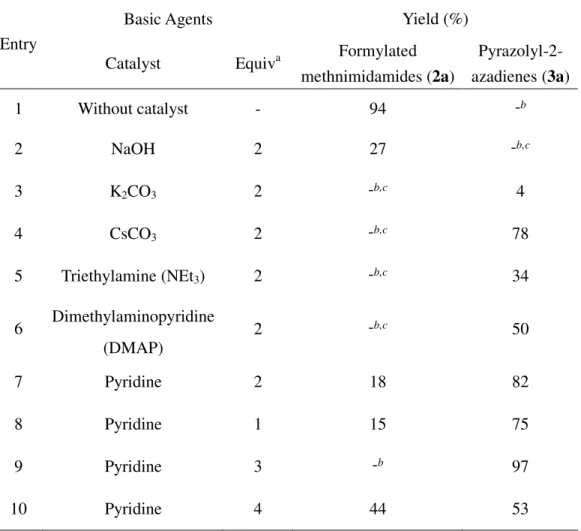
Table 2. The basic catalyzed study for preparation of pyrazolyl-2-azadienes 3a without formyl group in the chemoselective microwave-assisted amidination
Basic Agents Yield (%)
Entry
Catalyst Equiva Formylated
methnimidamides (2a) Pyrazolyl-2- azadienes (3a) 1 Without catalyst - 94 -b 2 NaOH 2 27 -b,c 3 K2CO3 2 -b,c 4 4 CsCO3 2 -b,c 78 5 Triethylamine (NEt3) 2 -b,c 34 6 Dimethylaminopyridine (DMAP) 2 -b,c 50 7 Pyridine 2 18 82 8 Pyridine 1 15 75 9 Pyridine 3 -b 97 10 Pyridine 4 44 53 a
based on the weight of 5-amino-1-3-diphenylpyrazole (1a).
bnot detectable. c
Starting material 1a was recovery.
When the same condition was applied to the commercially available organic bases including triethylamine (NEt3), dimethylaminopyrium (DMAP), or pyridine, the
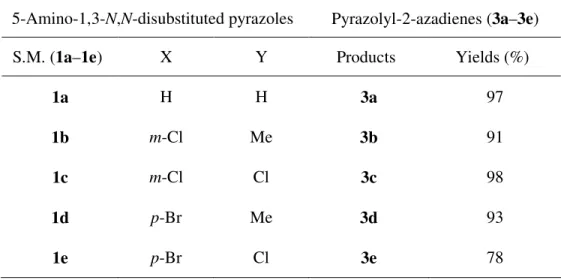
the major product (see entries 5–7 of Table 2). Particularly, the best chemoselective result was achieved by using pyridine as the basic catalyst. The use of various equivalent of pyridine was also studied from 1.0 equiv to 4.0 equiv. We found that the use 3.0 equivalent of pyridine can give pyrazolyl-2-azadiene product 3a in the best yield (97% yield, see entry 9 of Table 2). Furthermore, the newly chemoselective methodology can be applicable to compounds 1a–1e to provide the corresponding pyrazolyl-2-azadiene products 3a–3e without formyl group in 78–98% yields (see Table 3). The reliable chemoseletive procedure involved the treatment of 5-amino-1,3-disubstituted pyrazoles 1a–1e with ~1.2 equivalent of POCl3 and 3.0
equivalent of pyridine in DMF at 30–40 °C with 100 W of microwave energy within 15–20 min. After work-up and purification were performed, the desired pyrazolyl-2-azadiene products 3a–3e without formyl group were obtained in 78–98% isolated yields (see Table 3). Following the aforementioned studies, the chemoseletive amidination reaction seemed determinate to the suitable amount of pyridine basic agent.
Table 3. The results of chemoseletive amidination reaction for preparation of pyrazolyl-2-azadiene products 3a–3e
5-Amino-1,3-N,N-disubstituted pyrazoles Pyrazolyl-2-azadienes (3a–3e)
S.M. (1a–1e) X Y Products Yields (%)
1a H H 3a 97
1b m-Cl Me 3b 91
1c m-Cl Cl 3c 98
1d p-Br Me 3d 93
To identify the essentiality of amidinyl group for the inhibitory activity study, a series of de-amidination compounds 4a–4e were sequentially prepared as the comparison model for the further structure activity relationship study. When we searched the previous reported literature about de-amidinaion, only one method was found by using HCl aqueous solution (Mason et al., 2001). However, the purification procedure was troublesome, especially in neutralization procedure. Consequently we investigated a newly basic condition by using NaOH in MeOH solution. The reliable procedure involved the treatment of methnimidamide 2a–2e with two equivalent of NaOH at reflux in MeOH solution within 2–3 h. After the extraction work-up and simple purification through the short column chromatography on silica gel, the corresponding de-amidination 5-amino-4-formylpyrazole products 4a–4e were obtained in 83–96% yields (see Table 1 and Scheme 1).
Biological evaluations
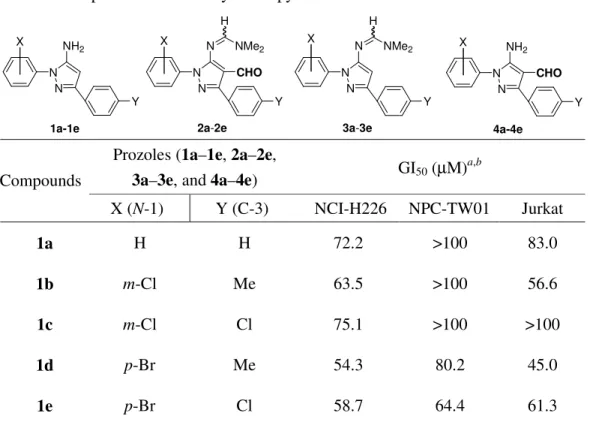
The growth inhibitory activity of all amidine compounds is evaluated against a panel of human cancer cell lines, including lung carcinoma (NCI-H226), nasopharyngeal (NPC-TW01), and T-cell leukemia (Jurkat) cells. The GI50 value is the concentration
that results in a 50% decrease in the cell growth relative to an untreated control. All of starting materials 1a–1e were selected and used as the comparison model for the inhibitory activity study. Among of starting substrates, only compound 1d possessed the negligible inhibitory activity against three cell lines [the GI50 values of 1d are 54.3
µM (NCI-H226), 80.2 µM (NPC-TW01), and 45.0 µM (Jurkat), see Table 4].
Formylated methnimidamide 2a was also used as the comparison model for other analogs 2b–2e against the cancer cell lines. Compounds 2b and 2c containing the same m-Cl-Ph substituted group on N-1 position and either p-Cl-Ph or p-Me-Ph
groups on C-3 position in pyrazolic ring displayed the better inhibitory activity against the three cancer cell lines with GI50 values between 7.2 µM and 9.2 µM (see
Table 4). The results also showed that they were more active against NPC-TW01 and Jurkat than NCI-H226. For compounds 2d and 2e with p-Br-Ph on N-1 position and either p-Cl-Ph or p-Me-Ph groups at C-3 position on pyrazolic ring, compound 2d showed the better inhibitory activity against the three cancer cell lines with GI50
values between 6.0 µM and 8.2 µM. Due to the bulky p-Br-Ph group and p-Cl-Ph groups on the N-1 and C-3 position of pyrazole not favoring to reach the blocking side, the poor result of bioactivity was observed in compound 2e. Following the structure activity relationship study results, compounds 2b–2d possessed the better activity than 2a and 2e. On the other hand, the antiproliferative activity data was consistent with our design approach and compound 2b–2d can be considered as the potency lead drugs.
Table 4. Antiproliferative activity of the pyrazole derivatives
N N 1a-1e X N N N NMe2 3a-3e H Y X N N N NMe2 CHO 2a-2e H Y X Y NH2 N N 4a-4e X Y NH2 CHO
Prozoles (1a–1e, 2a–2e,
3a–3e, and 4a–4e) GI50 (µM)
a,b Compounds X (N-1) Y (C-3) NCI-H226 NPC-TW01 Jurkat 1a H H 72.2 >100 83.0 1b m-Cl Me 63.5 >100 56.6 1c m-Cl Cl 75.1 >100 >100 1d p-Br Me 54.3 80.2 45.0 1e p-Br Cl 58.7 64.4 61.3
2a H H 31.4 9.3 23.5 2b m-Cl Me 8.9 7.2 7.8 2c m-Cl Cl 9.2 7.4 7.7 2d p-Br Me 8.2 6.0 6.7 2e p-Br Cl 62.9 >100 38.9 3a H H >100 >100 >100 3b m-Cl Me 80.9 >100 >100 3c m-Cl Cl 75.6 92.7 74.5 3d p-Br Me 73.9 >100 >100 3e p-Br Cl 59.8 60.7 84.9 4a H H >100 >100 87.3 4b m-Cl Me 71.8 >100 86.3 4c m-Cl Cl 79.7 >100 78.9 4d p-Br Me 8.5 28.2 34.4 4e p-Br Cl 49.1 59.7 90.7 a
NCI-H226: human lung carcinoma; NPC-TW01: human nasopharyngeal carcinoma; Jurkat: human T-cell leukemia
b
All tested compounds were dissolved in 100% DMSO at a concentration of 20 mM as the stock solution. Cells were cultured without or in the presence of the methnimidamide derivatives at different concentrations for 72 h. Cell survival was determined by MTT assay. Drug molar concentration causing 50% cell growth inhibition (GI50) was calculated. Each value represents the mean ± SD of three
independent experiments.
For the further the structure–activity relationship investigation, pyrapzolyl-2-azadienes 3a–3e and de-amidination compounds 4a–4e were evaluated against three cancer cell lines as the comparison study. Following the antiproliferative activity result, the data indicated that compounds 3a–3e [GI50: > 59.8 µM
(NCI-H226), > 60.7 µM (NPC-TW01), and > 74.5 µM (Jurkat)] and 4a–4e [GI50: >
8.5 µM (NCI-H226), > 28.2 µM (NPC-TW01), and > 34.4 µM (Jurkat)] were less potent than compounds 2a–2d. The experimental result in Table 4 demonstrated the formyl group at C-4 position and grating the amidinyl group toward amino moiety at C-5 in pyrazolic ring are essential for the promotion of inhibitory activity. Furthermore, the data indicated that tendency for sensitivity is nasopharyngeal (NPC-TW01) > T-cell leukemia (Jurkat) cell > lung carcinoma (NCI-H266) for methnimidamide compounds 2a–2e.
Conclusion
We have successfully developed a new chemoselective microwave-assisted amidination method to prepare 1H-pyrazol-5-yl-N,N-dimethylformamidines 2a–2e with the formyl group and pyrazolyl-2-azadienes 3a–3e without formylation by using pyridine as the basic agent. Furthermore, we have also evaluated the new de-amidination methodology to prepare the 5-amino-4-formylpyrazoles 4a–4e as the compared study. Following the structure activity relationship study, we have demonstrated that introducing formyl group at C-4 position and grafting amidinyl group in the pyrazole core molecule are necessary for the improved bioactivity. Based on the growth inhibitory activity data, compounds 2b, 2c, and 2d with m-Cl-Ph and p-Br-Ph groups at N-1 position and p-Me-Ph and p-Cl-Ph groups at C-3 position in pyrazolic ring possessed the most potent activity.
Experimental
Chemistry
All chemicals were reagent grade and use as purchased. All reactions were carried out under argon or nitrogen atmosphere and monitored by TLC. Flash column
chromatography was carried out on silica gel (230–400 mesh). Ethyl acetate and hexanes, purchased from Mallinckrodt Chemical Co., were dried and distilled from CaH2. Toluene (reagent grade, from Merck Chemical Co.) was dried by distillation
from CaH2 under nitrogen. 4-Methylbenzoylacetonitrile, phenylhydrazine was
purchased from Acros Chemical Co. 4-Bromophenylhydrazine hydrochloride, 4-chlorobenzoylacetonitrile, 3-chlorophenylhydrazine hydrochloride was purchased from Alfa Aesar Chemical Company. Benzoylacetonitrile were purchased from TCI. N,N-Dimethylformamide, pyridine were purchased from Scharlau Chemical Co. Phosphorylchloride were purchased from FERAK Chemical Co.
Analytical thin-layer chromatography (TLC) was performed on precoated plates (silica gel 60 F-254) purchased from Merck Inc. Mixtures of ethyl acetate and hexanes were used as eluants. Infrared (IR) spectra were measured on a Bomem Michelson Series FT-IR spectrometer. The wavenumbers reported are referenced to the polystyrene absorption at 1601 cm–1. Absorption intensities are recorded by the following abbreviations: s, strong; m, medium; w, weak. Proton NMR spectra were obtained on a Bruker (200 MHz or 400 MHz) spectrometer by use of CDCl3 as
solvent. Carbon-13 NMR spectra were obtained on a Bruker (75 MHz or 100 MHz) spectrometer by used of CDCl3 as solvent. Carbon-13 chemical shifts are referenced
to the center of the CDCl3 triplet (δ 77.0 ppm). Multiplicities are recorded by the
following abbreviations: s, singlet; d, doublet; t, triplet; q, quartet; m, multiplet; J, coupling constant (Hz). Microwave irradiation instrument was purchased from CEM Discover. The microwave irradiation condition was set in 100 W at 30–40 °C within 10–20 min. ESI-MS spectra were obtained from an Applied Biosystems API 300 mass spectrometer. High-resolution mass spectra were obtained by means of a JEOL JMS-HX110 mass spectrometer. Elemental analyses were carried out on a Heraeus CHN–O RAPID element analyzer.
Standard Procedure for the Synthesis of Methnimidamide Compounds (2a–2e)
A solution of pyrazol-5-amine derivatives (1a–1e, 1.0 equiv) and POCl3 (1.2 equiv) in
DMF solution (3 mL) at 30–40 °C was treated with 100 W of microwave energy within 10–20 min. When the reaction was completed, the reaction mixture was concentrated, added to water (10 mL) and extracted with CH2Cl2 (4 × 20 mL). The
organic extracts were washed with saturated NaHCO3, dried over MgSO4, filtered,
and concentrated under reduced pressure. The residue solution was purified by column chromatography on silica gel to give the corresponding methnimidamide products (2a–2e) in 81–94% yields.
N'-[4-Formyl-1,3-diphenyl-1H-pyrazol-5-yl-N,N-dimethyl-methanimidamide (2a)
mp (purified by column chromatography on silica gel) 120–122 °C; 1H NMR (CDCl3,
200 MHz) δ 3.01 (s, 3 H, CH3), 3.12 (s, 3 H, CH3), 7.26–7.47 (m, 6 H, ArH), 7.65–7.70 (m, 2 H, ArH), 7.84–7.89 (m, 2 H, ArH), 8.68 (s, 1H, N=C–H), 9.68 (s, 1H, aldehyde); 13C NMR (50MHz, CDCl3) δ 34.3 (CH3), 40.7 (CH3), 108.4, 124.3 (2 × CH), 126.8, 128.4 (2 × CH), 128.5 (2 × CH), 128.8, 129.4 (2 × CH), 132.3, 139.2, 154.1, 155.8, 159.0, 185.2; IR (KBr) 3059 (m), 2920 (m), 2800 (w), 2742 (w), 1670 (s), 1597 (m), 1508 (m), 1381 (m), 1257 (m), 1134 (m), 1095 (m), 975 (m), 767 (m), 694 (m) cm–1; EIMS m/z (relative intensity) 318 (100), 317 (M+, 42), 303 (17), 289 (9), 274 (19), 248 (8), 186 (14), 159 (7), 77 (24), 51 (5); Anal. Calcd for C19H18N4O;
C: 71.68; H: 5.70; N: 17.60, Found: C: 71.72; H: 5.71; N: 17.58.
N'-[1-(2-chlorophenyl)-4-formyl-3-(4-methylphenyl)-1H-pyrazol-5-yl]-N,N-dimethyl-methanimidamide (2b)
mp (purified by column chromatography on silica gel) 166–168 °C; 1H NMR (CDCl3,
4 H, ArH), 7.51–7.55 (m, 2 H, ArH), 7.51–7.55 (m, 2 H, ArH), 7.79–7.85 (m, 2 H, ArH), 8.01–8.03 (m, 2 H, ArH), 8.69 (s, 1 H, N=C–H), 9.64 (s, 1H, aldehyde); 13C NMR (50 MHz, CDCl3) δ 21.4 (CH3), 34.4 (CH3), 40.8 (CH3), 108.5, 122.0, 124.2,
126.5, 129.2 (6 × CH), 133.9, 138.9, 140.3, 154.2, 156.1, 159.1, 185.2; IR (KBr) 2920 (m), 1666 (s), 1627 (m), 1589 (m), 1489 (m), 1384 (m), 1261 (m), 1134 (m), 1099 (m), 1072 (m), 987 (m), 825 (m), 825 (m), 781 (m), 740 (m) , 682 (m) cm–1; EIMS m/z (relative intensity) 366 (100), 365 (M+, 20), 337 (8), 322 (14), 220 (11), 185 (7), 111 (11), 91 (7), 83 (7), 75 (4); Anal. Calcd for C20H19ClN4O; C: 65.48; H: 5.22; N: 15.27,
Found: C: 65.50; H: 5.19; N: 15.23.
N'-[4-formyl-1-(2-chlorophenyl)-3-(4-chlorophenyl)-1H-pyrazol-5-yl]-N,N-dimethyl-methanimidamide (2c)
mp (purified by column chromatography on silica gel) 162–164 °C; 1H NMR (CDCl3,
200 MHz) δ 3.03 (s, 3 H, CH3), 3.13 (s, 3 H, CH3), 7.23–7.43 (m, 4 H, ArH),
7.58–7.64 (m, 2 H, ArH), 7.77–7.82 (m, 1 H, ArH), 7.99–8.01 (m, 1 H, ArH), 8.63 (s , 1 H, N=C–H), 9.60 (s, 1 H, aldehyde); 13C NMR (50 MHz, CDCl3) δ 34.5 (CH3), 40.8
(CH3), 108.5, 121.9, 124.1, 126.6, 128.7 (2 × CH), 129.4, 130.5 (3 × CH), 134.0,
135.0, 140.1, 154.5, 154.5, 158.9, 184.4; IR (KBr) 2924 (m), 2360 (m), 1666 (s), 1624 (m), 1585 (m), 1481 (m), 1384 (m), 1095 (m), 837 (m), 783 (m), 736 (m) cm–1; EIMS m/z (relative intensity) 386 (100), 385 (M+, 19), 371 (16), 357 (9), 342 (14), 330 (9), 316 (8), 220 (16), 111 (18), 83 (9); Anal. Calcd for C19H16ClN4O; C: 58.93; H:
4.16; N: 14.47, Found: C: 58.89; H: 4.17; N: 14.46.
N'-[1-(4-bromophenyl)-4-formyl-3-(4-methylphenyl)-1H-pyrazol-5-yl]-N,N-dimethyl-methanimidamide (2d)
200 MHz) δ 2.36 (s, 3 H, CH3), 2.98 (s, 3 H, CH3), 3.09 (s, 3 H, CH3), 7.21–7.23 (m,
2 H, ArH), 7.47–7.55 (m, 4 H, ArH), 7.77–7.81 (m, 2 H, ArH), 8.68 (s , 1 H, N=C–H), 9.64 (s, 1 H, aldehyde); 13C NMR (50 MHz, CDCl3) δ 21.4 (CH3), 34.4 (CH3), 40.7
(CH3), 108.5, 120.1, 125.6 (2 × CH), 129.21 (5 × CH), 131.4 (2 × CH), 128.3, 138.9,
154.1, 156.0, 159.1, 185.1; IR (KBr) 2920 (m), 1662 (s), 1624 (m), 1489 (s), 1381 (m), 1265 (m), 1134 (m), 1091 (m), ‘1010 (m), 975(m), 829 (m), 740 (m), 501 (m) cm–1; EIMS m/z (relative intensity) 410 (100), 409 (M+, 26), 395 (12), 366 (15), 266 (10), 185 (10), 155 (6), 83 (7), 58 (5); Anal. Calcd for C20H19BrN4O; C: 58.40; H: 4.66; N:
13.62, Found: C: 58.44; H: 4.69; N: 13.58.
N'-[1-(4-bromophenyl)-4-formyl-3-(4-chlorophenyl)-1H-pyrazol-5-yl]-N,N-dimethyl-methanimidamide (2e)
mp (purified by column chromatography on silica gel) 195–197 °C; 1H NMR (CDCl3,
200 MHz) δ 3.01 (s, 3 H, CH3), 3.13 (s, 3H, CH3), 7.38–7.63 (m, 6 H, ArH), 7.73–7.79 (m, 2 H, ArH), 8.63 (s , 1 H, N=C–H), 9.61 (s, 1 H, aldehyde); 13C NMR (50 MHz, CDCl3) δ 34.5 (CH3), 40.8 (CH3), 108.5 (2 × CH), 120.3, 125.6 (2 × CH), 128.7 (2 × CH), 130.5 (2 × CH), 131.5 (2 × CH), 135.0, 138.1, 154.5 (2 × CH), 158.9, 184.4; IR (KBr) 2364 (m), 2333 (m), 1666 (m), 1624 (m), 1516 (m), 1485 (m), 1381 (m), 1261 (m), 1138 (m), 1076 (m), 1010 (m), 813 (m), 740 (m), 578 (m), 547 (m), 505 (m) cm–1; EIMS m/z (relative intensity) 430 (73), 429 (M+, 20), 388 (13), 374 (8), 266 (14), 232 (8), 205 (9), 155 (11), 111 (4), 83 (10); Anal. Calcd for C19H16ClN4O; C:
52.86; H: 3.74; N: 12.98, Found: C: 52.88; H: 3.71; N: 13.01.
Standard Procedure for the Synthesis of Pyrazolyl-2-azadiene Compounds (3a–3e)
A solution of pyrazol-5-amine derivatives (1a–1b, 1.0 equiv), POCl3 (1.2 equiv) and
microwave energy within 10–20 min. When the reaction was completed, the reaction mixture was concentrated, added to water (10 mL) and extracted with CH2Cl2 (4 × 20
mL). The organic extracts were washed with saturated NaHCO3, dried over MgSO4,
filtered, and concentrated under reduced pressure. The residue solution was purified by column chromatography on silica gel to give the corresponding methnimidamide products (3a–3e) in 78–98% yields.
N'-(4-formyl-1,3-diphenyl-1H-pyrazol-5-yl)-N,N-dimethyl-methanimidamid-e (3a)
mp (purified by column chromatography on silica gel) 113–115 °C; 1H NMR (CDCl3,
200 MHz) δ 2.29 (s, 3 H, CH3), 3.01 (s, 3 H, CH3), 6.15 (s, 1 H), 7.17–7.43 (m, 6 H,
ArH), 7.78 (s, 1 H), 7.83–7.97 (m, 3 H, ArH); 13C NMR (50MHz, CDCl3) δ 34.5
(CH3), 40.2 (CH3), 88.4, 123.5 (2 × CH), 125.5, 127.6, 128.3 (2 × CH), 128.5 (3 ×
CH), 134.0, 140.3, 150.8, 152.6, 154.4; IR (KBr) 3059 (m), 2920 (m), 1635 (s), 1593 (m), 1543 (m), 1496 (m), 1392 (m), 1361 (m), 1257 (m), 1103 (m), 948 (m), 759 (m), 694 (m) cm–1; EIMS m/z (relative intensity) 290 (100), 298 (M+, 10), 246 (29), 219 (7), 198 (8), 186 (14), 171 (15), 145 (10), 83 (9), 77 (20); Anal. Calcd for C19H19ClN4;
C: 67.35; H: 5.65; N: 16.54, Found: C: 74.43; H: 6.28; N: 19.27
N'-[1-(2-chlorophenyl)-4-formyl-3-(4-methylphenyl)-1H-pyrazol-5-yl]-N,N-dimethyl-methanimidamide (3b)
mp (purified by column chromatography on silica gel) 109–115 °C; 1H NMR (CDCl3,
200 MHz) δ 2.38 (s, 3 H, CH3), 2.94 (s, 3 H, CH3), 2.95 (s, 3 H, CH3), 6.10 (s, 1 H),
7.15–7.35 (m, 5 H, ArH), 7.70 (s 1 H, ArH), 7.75–7.80 (m, 2 H, ArH), 7.94–8.00 (m, 1 H, ArH), 8.18–8.20 (m, 1 H, ArH); 13C NMR (50 MHz, CDCl3) δ 21.1 (CH3), 34.3
(CH3), 40.0 (CH3), 88.2, 120.6, 122.3, 124.9, 125.3 (2 × CH), 129.0 (2 × CH), 130.8,
1647 (s), 1585 (m), 1546 (m), 1523 (m), 1489 (m), 1388 (m), 1354 (m), 1261 (m), 1149 (m), 1103 (s), 1072 (m), 1037 (m), 948 (m), 875 (m), 825 (s), 783 (m), 756 (m), 678 (m), 513 (m) cm–1; EIMS m/z (relative intensity) 338 (100), 317 (M+, 10), 294 (15), 279 (6), 220 (10), 185 (18), 151 (3), 111 (7), 91 (4), 83 (9); Anal. Calcd for C19H19ClN4; C: 67.35; H: 5.65; N: 16.54, Found: C: 67.36; H: 5.62; N:16.51.
N'-[4-formyl-1-(2-chlorophenyl)-3-(4-chlorophenyl)-1H-pyrazol-5-yl]-N,N-dimethyl-methanimidamide (3c)
mp (purified by column chromatography on silica gel) 108–110 °C; 1H NMR (CDCl3,
200 MHz) δ 2.93 (s, 3 H, CH3), 3.02 (s, 3 H, CH3), 6.03 (s, 1 H), 7.18–7.35 (m, 3 H,
ArH), 7.65 (s, 1 H), 7.73–7.78 (m, 2 H, ArH), 7.77–7.82 (m, 1 H, ArH), 7.90–7.95 (m, 1 H, ArH), 8.13–8.15 (m, 1 H, ArH); 13C NMR (50 MHz, CDCl3) δ 34.5 (CH3), 40.2
(CH3), 88.3, 120.8, 122.9, 125.3, 126.8 (2 × CH), 128.6 (2 × CH), 129.3, 132.3, 133.3,
133.8, 141.3, 149.9, 153.1, 154.4; IR (KBr) 2920 (m), 1643 (s), 1585 (m), 1543 (m), 1504 (m), 1485 (m), 1354 (m), 1261 (m), 1153 (m), 1107 (m), 1014 (m), 948 (m), 879 (m), 837 (s), 783 (m), 756 (m), 678 (m) cm–1; EIMS m/z (relative intensity) 358 (100), 357 (M+, 7), 316 (15), 299 (6), 220 (12), 205 (13), 179 (7), 111 (12), 96 (2), 83 (10); Anal. Calcd for C18H16Cl2N4; C: 60.18; H: 4.49; N: 15.60, Found: C: 60.21; H: 4.53;
N: 15.57.
N'-[1-(4-bromophenyl)-4-formyl-3-(4-methylphenyl)-1H-pyrazol-5-yl]-N,N-dimethyl-methanimidamide (3d)
mp (purified by column chromatography on silica gel) 115–117 °C; 1H NMR (CDCl3,
200 MHz) δ 2.35 (s, 3 H, CH3), 2.97 (s, 3 H, CH3), 3.00 (s, 3 H, CH3), 6.11 (s, 1 H),
7.16–7.20 (m, 2 H, ArH), 7.71–7.75 (m, 3 H, ArH), 7.85–7.92 (m, 2 H, ArH); 13C NMR (50 MHz, CDCl3) δ 21.3 (CH3), 34.5 (CH3), 40.3 (CH3), 88.3, 118.7, 124.7 (2 ×
CH), 125.4 (2 × CH), 129.2 (2 × CH), 130.9, 131.3 (2 × CH), 137.5, 139.4, 151.2, 152.7, 154.5; IR (KBr) 2920 (m), 1631 (s), 1489(m), 1388 (m), 1103 (m), 829 (m), 759 (m), 497 (m) cm–1; EIMS m/z (relative intensity) 382 (99), 381 (M+, 5), 340 (17), 326 (5), 259 (10), 185 (21), 155 (4), 115 (7), 91 (4), 83 (7); Anal. Calcd for C18H19BrN4; C: 59.54; H: 5.00; N: 14.62, Found: C: 59.57; H: 5.02; N: 14.58.
N'-[1-(4-bromophenyl)-4-formyl-3-(4-chlorophenyl)-1H-pyrazol-5-yl]-N,N-dimethyl-methanimidamide (3e)
mp (purified by column chromatography on silica gel) 152–154 °C; 1H NMR (CDCl3,
200 MHz) δ 2.86 (s, 3 H, CH3), 2.92 (s, 3H, CH3), 6.04 (s, 1 H), 7.30–7.34 (m, 2 H,
ArH), 7.45–7.53 (m, 2 H, ArH), 7.64 (s , 1 H), 7.72–7.77 (m, 2 H, ArH), 7.85–7.92 (m, 2 H, ArH); 13C NMR (50 MHz, CDCl3) δ 34.5 (CH3), 40.3 (CH3), 88.3, 118.9,
124.6 (2 × CH), 126.8 (2 × CH), 128.6 (2 × CH), 131.3 (2 × CH), 132.4, 133.3, 139.4, 149.9, 153.0, 154.5; IR (KBr) 2920 (m), 1635 (s), 1539 (m), 1489 (m), 1357 (m), 1099 (m), 1010 (m), 948 (m), 829 (m), 759 (m), 497 (m) cm–1; EIMS m/z (relative intensity) 402 (89), 401 (M+, 4), 360 (18), 279 (9), 266 (11), 205 (15), 155 (7), 115 (4), 83 (9), 57 (4); Anal. Calcd for C18H16BrClN4; C: 53.55; H: 3.99; N: 13.88, Found: C:
53.51; H: 4.02; N: 13.91.
Standard Procedure for the Synthesis of 5-Amino-4-formylpyrazoles (4a–4e)
A solution of methnimidamide derivatives (2a–2e, 1.0 equiv) and NaOH (2.0 equiv) in MeOH solution (15 mL) at reflux within 2–3 h. When the reaction was completed, the reaction mixture was concentrated to remove solvent, added to water (10 mL) and extracted with CH2Cl2 (3 × 20 mL). The organic extracts were washed with saturated
NaHCO3, dried over MgSO4, filtered, and concentrated under reduced pressure. The
the corresponding 5-amino-4-formylpyrazole products (4a–4e) in 83–96% yields.
5-Amino-1,3-diphenyl-1H-pyrazole-4-carbaldehyde (4a)
mp (purified by column chromatography on silica gel) 154–155 °C; 1H NMR (CDCl3,
200 MHz) δ 6.13 (s, 2 H, NH2), 7.39–7.72 (m, 10 H, ArH), 9.81 (s, 1 H, CHO); 13C
NMR (50MHz, CDCl3) δ 104, 124.0 (2 × CH), 128.4, 128.6 (2 × CH), 128.8 (2 × CH),
129.2, 129.9 (2 × CH), 131.6, 136.9, 150.1, 153.4, 185.4 (CHO); IR (KBr) 3425 (m), 3309 (m), 2827 (m), 2353 (m), 1647 (s), 1508 (m), 1253 (m), 1165 (m), 979 (m), 914 (m), 844 (m), 755 (m) cm–1; EIMS m/z (relative intensity) 263 (M+, 100); Anal. Calcd for C16H13N3O; C: 72.99; H: 4.98; N: 15.96, Found: C: 73.02; H: 5.01; N: 15.93
5-Amino-1-(2-chlorophenyl)-3-(4-methylphenyl)-1H-pyrazole-4-carbaldehyd-e (4b)
mp (purified by column chromatography on silica gel) 147–148 °C; 1H NMR (CDCl3,
200 MHz) δ 2.40 (s, 3 H, CH3), 6.01 (s, 2 H, NH2), 7.25–7.27 (m, 2 H, ArH),
7.37–7.39 (m, 1 H, ArH), 7.43–7.48 (m, 2 H, ArH), 7.57–7.58 (m, 2 H, ArH), 7.64 (s, 1 H, ArH), 9.84 (s, 1 H, CHO); 13C NMR (50 MHz, CDCl3) δ 21.4 (CH3), 104.9,
121.6, 124.2, 128.5, 129.5 (4 × CH), 130.9 (2 × CH), 135.8, 138.1, 139.3, 150.0, 153.9, 185.7 (CHO); IR (KBr) 3406 (m), 3298 (m), 2368 (m), 1624 (s), 1512 (m), 1226 (m), 1168 (m), 1087 (m), 1033 (m), 829 (m), 744 (m) cm–1; EIMS m/z (relative intensity) 313 (M + 2, 32), 311 (M+, 100); Anal. Calcd for C17H14ClN3O; C: 65.49; H:
4.53; N: 13.48, Found: C: 45.47; H: 4.56; N:13.47.
5-Amino-1-(4-chlorophenyl)-3-(4-chlorophenyl)-1H-pyrazole-4-carbaldehyde (4c)
mp (purified by column chromatography on silica gel) 144–145 °C; 1H NMR (CDCl3,
200 MHz) δ 6.06 (s, 2 H, NH2), 7.37–7.48 (m, 5 H, ArH), 7.61–7.62 (m, 3 H, ArH),
9.80 (s, 1 H, CHO); 13C NMR (50 MHz, CDCl3) δ 104.7, 121.6, 124.2 128.6, 129.0 (2
IR (KBr) 3406 (m), 3298 (m), 2924 (m), 2850 (m), 2368 (m), 1624 (s), 1512 (m), 1359 (m), 1222 (m), 1168 (m), 1095 (m), 829 (m), 744 (m) cm–1; EIMS m/z (relative intensity) 333 (M + 2, 64), 331 (M+, 100); Anal. Calcd for C16H11Cl2N3O; C: 57.85; H:
3.34; N: 12.65, Found: C: 57.88; H: 3.32; N: 12.69.
5-Amino-1-(4-bromophenyl)-3-(4-methylphenyl)-1H-pyrazole-4-carbaldehyde (4d)
mp (purified by column chromatography on silica gel) 87–88 °C; 1H NMR (CDCl3,
200 MHz) δ6.10 (s, 2 H, NH2), 7.24–7.25 (m, 2 H, ArH), 7.41–7.42 (m, 2 H, ArH),
7.53–7.57 (m, 4 H, ArH), 9.75 (s, 1 H, CHO); 13C NMR (50 MHz, CDCl3) δ 21.2
(CH3), 104.7, 121.7, 125.1 (2 × CH), 128.3 (3 × CH), 129.4 (2 × CH), 132.8 (2 × CH),
135.9, 139.1, 149.9, 153.6, 185.3 (CHO); IR (KBr) 3290 (m), 2924 (m), 2850 (m), 2368 (m), 1643 (s), 1519 (m), 1373 (m), 1249 (m), 1165 (m), 1072 (m), 983 (m), 825 (m), 740 (m) cm–1; EIMS m/z (relative intensity) 357 (M + 2, 98), 355 (M+, 100); Anal. Calcd for C17H14BrN3O; C: 57.32; H: 3.96; N: 11.80, Found: C: 57.28; H: 3.94;
N: 11.81.
5-Amino-1-(4-bromophenyl)-3-(4-chlorophenyl)-1H-pyrazole-4-carbaldehyde (4e)
mp (purified by column chromatography on silica gel) 191–192 °C; 1H NMR (CDCl3,
200 MHz) δ 5.97 (s, 2 H, NH2), 7.42–7.47 (m, 4 H, ArH), 7.61–7.66 (m, 4 H, ArH),
9.82 (s, 1 H, CHO); 13C NMR (50 MHz, CDCl3) δ 104.8, 122.3, 125.4 (2 × CH),
129.1 (2 × CH), 128.7 (2 × CH), 129.9, 133.2 (2 × CH), 135.4, 135.8, 150.0, 152.5, 185.0 (CHO); IR (KBr) 3302 (m), 2920 (m), 2850 (m), 2368 (m), 1639 (m), 1492 (m), 1261 (m), 1153 (m), 1010 (m), 829 (m), 736 (m), 578 (m) cm–1; EIMS m/z (relative intensity) 356 (M + 1, 32), 375 (M+, 100); Anal. Calcd for C16H11BrClN3O; C: 51.02;
H: 2.94; N: 11.16, Found: C: 51.03; H: 2.91; N: 11.12.
Cell lines
Human non-small cell lung carcinoma (NCI-H226) was purchased from American Type Culture Collection (ATCC; Rockville, MD). T-cell leukemia (MT-2) was obtained from Japanese Collection of Research Bioresources (JCRB) and nasopharyngeal carcinoma (NPC-TW01) was purchased from Bioresource Collection and Research Center (BCRC, Taiwan). All the tumor cell lines were maintained in either RPMI-1640 or Modified essential medium (MEM) supplied with 10% fetal bovine serum at 37 °C in a humidified atmosphere of 5% CO2/95% air in the present
of penicillin and streptomycin.
Growth inhibition assay
Logarithmic phase cells were seeded in a 96-well plate and incubated overnight prior to addition of the designated compounds. After incubation with different concentrations of the tested compounds for 72 h, cells were incubated with MEM containing 0.4 mg/mL MTT for 2 h. The conversion of MTT to formazan by metabolically viable cells was measured by the absorbance at 570 nm in a 96-well microtiter plate reader. The percentage conversion by mock-treated control cells was used to evaluate the effect of the chemicals on cell growth and to determine the concentration that inhibited 50% of growth (GI50).
Acknowledgments We are grateful to the China Medical University (CMU100-S- TS-13) and the National Science Council of Republic of China for financial support (NSC 99-2320-B-039-014-MY3).
References
Besan J, Kulcsar L, Kovacs M, (1980), A newer synthesis of formamidines used as acaricide-insecticides synthesis, 883–884.
Bielawska A, Bielawski K, Muszynska A, (2004), Synthesis and biological evaluation of new cyclic amidine analogs of chlorambucil, Il Farmaco 59:111–117.
Boyd G V, Reactions and Synthetic Uses of Amidines. In The Chemistry of Amidines and Imidates; Patai S., Rappoport Z., Eds.; John Wiley & Sons: New York, 1991; Vol. 2, pp 367.
Cheng K-M, Huang Y-Y, Huang JJ, Kaneko K, Kimura M, Takayama H, Juang S-H, Wong F F, (2010) Synthesis and antiproliferative evaluation of N,N-disubstituted-N′-[1-aryl-1H-pyrazol-5-yl]-methnimidamides, Bioorg Med Chem Lett 20:6781–6784.
Collins J L, Shearer B G, Oplinger J A, Lee S, Garvey E P, Salter M, Dufry C, Burnette T C, Furtine E S, (1998), N-Phenylamidines as Selective Inhibitors of Human Neuronal Nitric Oxide nthase: Structure−Activity Studies and Demonstration of in Vivo Activity, J Med Chem 41:2858–2871.
Croce P D, Ferraccioli R, Rosa C L, (1997), Reactivity of 1-Aryl-4-dimethylamino-2-phenyl-1,3-diaza-1,3-butadienes towards Dienophiles, 1,3-Dipoles, Heterocycles 45:1309–1318.
Elguero J, In Comprehensive Heterocyclic Chemistry; K A. R. atritzky, C. W. Rees, K. T. Potts, Eds.; Pergamon Press: Oxford, 1984; Vol. 5, p 167.
Elguero J, In Comprehensive Heterocyclic Chemistry II; A. R. Katritzky, Rees C. W., Scriven E. F. V., Eds.; Pergamon Press: Oxford, 1996; Vol. 3, p 1.
Furth P S, Reitman M S, Gentles R, Cook A F, (1997), Solid-Phase Synthesis of Novel Amino-Ether Derivatives, Tetrahedron Lett 38:6643–6646.
Furth P S, Reitman M S, Cook A F, (1997), Annovel formamidine linker for use in solid-phase synthesis, Tetrahedron Lett. 38:5403–5406.
Grout R. J., In The Chemistry of Amidines and Imidates, Patai S., ed. Wiley, London, 1975, pp. 255.
Haddad N, Salvango A, Busacca C, (2004) Application of the palladium-catalyzed N-arylation of hydrazones to deactivated heteroaryl halides in the synthesis of pyrazoles Tetrahedron Lett 45:5935–5937.
Huang Y R, Katzenellenbogen J A, (2000) Regioselective Synthesis of 1,3,5-Triaryl-4-alkylpyrazoles: Novel ligands for the estrogen receptor, Org Lett 2:2833–2836.
Kost A N, Grandberg I I, In Advances in Heterocyclic Chemistry; Katritzky A R, Boulton A J, Eds.; Academic Press: New York, 1966; Vol. 6, p 347.
Kreutzberger A., Progress in Drug Research, Jucker J., ed. vol. 2, Birkhäuser, Basel, 1968, pp. 356.
Lee K Y, Kim J M, Kim J N, (2003) Regioselective synthesis of 1,3,4,5-tetrasubstituted pyrazoles from Baylis–Hillman adducts, Tetrahedron Lett 44:6737–6740.
Lund F, Tybring L, (1972), 6ß-Amidinopenicillanic acids– a new group of Antibiotics Nature New Biol 236:135–137.
Mason H. J, Wu X, Schmitt R, Macor J E, Yu G, (2001), Synthesis of fused pyridopyrrolidine dione derivatives using hetero Diels–Alder reactions, Tetrahedron Lett 42:8931–8934.
Mason H J, Wu X, Schmitt R, Macor J E, Yu G, (2001), Synthesis of fused pyridopyrrolidine dione derivatives using hetero Diels–Alder reactions, Tetrahedron Lett. 42:8931–8934.
Matulenko M A, Meyers A I, (1996), Total synthesis of (−)-tetrahydropalmatine via chiral formamidine Carbanion: Unexpected behavior with certain ortho-substituted Electrophiles, J Org Chem 61:573–580.
Meyers A I, Hutchings R, (1996), Asymmetric dialkylation of chiral 2-benzazepine formamidines, Heterocycles 42:475–478.
Meyers A I, Hutchings R H, (1993), The asymmetric synthesis of
1-alkyl-2,3,4,5-tetrahydro-benzazepines and
benzo[β]-1-azabicyclo[5,3,1]decanes, Tetrahedron 49:1807–1820.
Meyers A I, Elworthy T R, (1992), Chiral formamidines. The total asymmetric synthesis of (-)-8-azaestrone and related (-)-8-aza-12-oxo-17-desoxoestrone, J Org Chem 57:4732–4740.
Meyers A I, (1992), Recent progress using chiral formamidines in asymmetric syntheses, Tetrahedron 48:2589–2612.
Meyers A I, Gonzalez M A, Struzka V, Akahane A, Guiles J, Warmus J S, (1991), Chiral formamidines. Asymmetric synthesis of 1,1-disubstituted tetrahydroisoquinolines, Tetrahedron Lett 32:5501–5504.
Oszczapowicz I, Grodner J, Radzikowski C, Glazman-Kuśnierczyk H, Opolski A, (1997), Polish patent appl., No P 22756.
Palacios F., Alonso C., Rubiales G., Villegas M., (2009), Regioselective synthesis of pyrrolin-3-ones and 2,3,4,5-tetrahydro[1,3]-oxazines from N-vinylic amidines, Tetrahedron 65:1119–1124.
Palacios F, Alonso C, Legido M, Rubiales G, Villegas M, (2006), Synthesis and subsequent reactivity of 1-amino-2-aza-1,3-butadienes derived from β-amino esters, Tetrahedron Lett 47:7815–7818.
Panico A, Vicini P, Incert M, Cardile V, Gentile B, Ronsisvalle G, (2002), Amidinobenzisothiazole derivatives with antidegenerative activity on cartilage, Il Farmaco 57:671–675.
Pocha F, (1986), Acces aux alkyl (ou aryl)-4 diamino-3,6 pyrazolo [3,4-b] : Pyridines substituees en 5 par un groupe Sr ou Cl, Tetrahedron 16:4461–4469.
Ramesh Kakarla G L, Gerritz S W, (2007) A fast and efficient bromination of isoxazoles and pyrazoles by microwave irradiation Tetrahedron Lett
48:4595–4599.
Rudyk H, Knaggs M H, Vasiljevic S, Hope J, Birkett C, Gilbert I H, (2003), Synthesis and evaluation of analogues of congo red as potential compounds against transmissible spongiform encephalopathies, Eur J Med Chem 38:567–579. Sakya S M, Rast B, (2003) efficient synthesis of 5-alkyl amino and thioether
substituted pyrazoles, Tetrahedron Lett 44:7629–7632.
Sielecki T M, Liu J, Mousa S A, Racanelli A L, Hausner E A, Wexler R R, Olson R E, (2001), Synthesis and pharmacology of modified amidine isoxazoline glycoprotein IIb/IIIa receptor antagonists, Bioorg Med Chem Lett 11:2201–2204.
Sienkiewich P, Bielawski K, Bielawska A, Palka J, (2005), Inhibition of collagen and DNA biosynthesis by a novel amidine analogue of chlorambucil is accompanied by deregulation of β1-integrin and IGF-I receptor signaling in MDA-MB 231
cells, Environ Toxicol Pharmacol 20, 118–124.
Stephens C E, Tanious E, Kim S, Wilson D W, Schell W A, Perfect J R, Franzblau S G, Boykin D W, (2001), Diguanidino and “Reversed” diamidino 2,5-diarylfurans as antimicrobial agents, J Med Chem 44:1741–1748.
Kau-Shan Wen, Hui-Yi Lin, Yu-Ying Huang, Kimiyoshi Kaneko, Hiroyuki Takayama, Masayuki Kimura, Shin-Hun Juang,**** Fung Fuh Wong****
Chemoselective synthesis, antiproliferative activities and SAR study of
1H-pyrazol-5-yl-N,N-dimethylformamidines and pyrazolyl-2-azadienes
N N
N NMe2
H
CHO
GI50 (µM) for Antiproliferative activity
8.9 8.2 X Z Me Cl Br Me NCI-H266 Jurkat NPC-TW01 9.2 7.2 6.0 7.4 7.8 6.7 7.7 Z Y X Y Cl Cl H H H