The role of carriers in spin current and magnetic coupling for ZnO:Co
diluted magnetic oxides
H. Chou,1,a兲C. P. Lin,1H. S. Hsu,2and S. J. Sun3
1Department of Physics and Center for Nanoscience and Nanotechnology, National Sun Yat-Sen University, Kaohsiung 804, Taiwan
2Department of Applied Physics, National Pintung University of Education, Pintung 900, Taiwan 3Department of Applied Physics, National University of Kaohsiung, Kaohsiung 811, Taiwan
共Received 29 September 2009; accepted 28 December 2009; published online 1 March 2010兲 The role of carriers in the electric conduction and magnetic coupling of diluted magnetic oxides is essential to the spin current formation. This study elucidates the conduction of electrons originating from oxygen vacancies and the magnetic coupling between major doped transition ions. The findings indicate that electrons may conduct in the conduction band or by hopping within discrete localized states. Furthermore, because d-orbital of doped transition ions overlap with these localized states, only hopping electrons contribute to magnetic coupling and spin current formation. Those electrons in the conduction band have no observable effect on magnetic coupling. © 2010 American
Institute of Physics.关doi:10.1063/1.3309588兴
The discovery of diluted magnetic semiconductors 共DMSs兲 and diluted magnetic oxides 共DMOs兲 unlocks an exciting dimension of spintronics by realizing spin control in these materials. DMOs, especially, seem more promising for spintronic applications,1because they exhibit a Tcfar above room temperature. However, the relatively weak ferromag-netic ordering and low ratio of spin current in such materials have up to now limited their applications.2,3 The magnetic coupling in III-V DMSs 共Ref. 4兲 is attributable to
carrier-mediated Ruderman–Kieeel–Kasuya–Yosida共RKKY兲 model via high density carriers in the conduction band.5 In near insulated DMO materials, the bounded magnetic polaron 共BMP兲 model adequately describes the magnetic coupling between low density magnetic ions.6–8Interestingly, neither model adequately explains the magnetic coupling in these materials with moderate carrier density. Furthermore, in ZnO with magnetic cation concentrations of only a few percent, magnetic ions are separated by a span of several lattices, too far for anions to bridge the magnetic coupling. A carrier with coherent spin is needed as a medium for long distance mag-netic coupling. Those carriers behave like electrons in the RKKY model and localized carriers in the BMP model sug-gests that their role depends on their current state and sur-roundings. Therefore, an essential question is which channels of electrons are involved in the magnetic coupling and which channels of conduction can be considered as a spin current. This study uses a series of Co-doped ZnO thin films to in-vestigate the role of electron carriers in magnetic coupling and electric conduction. The findings indicate that electron carriers in the present samples, which apparently have origi-nated from oxygen vacancies or zinc interstitials,9may con-duct in the concon-duction band or by hopping within localized sites. Only electrons hopping within localized sites can me-diate the magnetic coupling between doped magnetic ions and act as spin current.
The ZnO:Co films were prepared at room temperature by a multilayer ␦-doping technique on a ␣-Al2O3共0001兲 sub-strate with Co concentration of about 3.5%.10Examination of
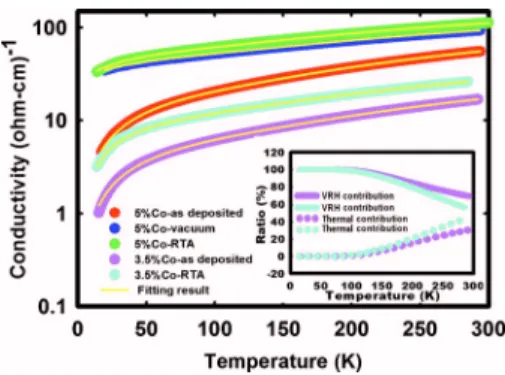
the as grown films by x-ray, TEM, and x-ray absorption spectrum indicated that they were intrinsic films with no detectable precipitation of Co cluster or Co oxides. The electric transport of samples, patterned with a Hall bar geometry, was tested using a standard four-point measure-ment technique. As Fig.1共a兲shows, the longitudinal conduc-tivities共兲 of these films decrease at lower temperatures. The best understanding of these conductivities can be achieved by the combination of the thermal excitation model,
th⬃exp共−Ed/kT兲, which describes those carriers that have been thermally excited from localized states to the conduc-tion band, as well as the variable range hopping 共VRH兲 model, VRH⬃exp关−共C/T兲1/4兴,11 which describes those car-riers hopping within localized states. The total conductivity can be expressed as
共T兲 = A exp关− 共C/T兲1/4兴 + B exp共− E
d/kT兲, 共1兲
where A and B are constants, Ed is the activation energy, which is the energy gap between the localized states and the lowest point of the conduction band, and C is the constant associated with the localized radius and the hopping radius of carriers around localized states. Figure 1 shows that, de-spite the varying carrier concentration, all curves can be well
a兲Electronic mail: [email protected].
FIG. 1. 共Color online兲 Conductivity curves as a function of temperature for ZnO:Co DMO with various carrier concentrations. The yellow lines repre-sent the best fit of the combinational model described in Eq.共1兲. Inset is Qualitative contribution ratio of the thermal excitation model and the VRH model as a function of temperature.
APPLIED PHYSICS LETTERS 96, 092503共2010兲
0003-6951/2010/96共9兲/092503/3/$30.00 96, 092503-1 © 2010 American Institute of Physics
described by the combinational model Eq. 共1兲 at almost all temperature ranges, which indicates that this model can be regarded as an empirical model for further study of the con-duction mechanism.
The thermal excitation term of Eq.共1兲mainly describes how the carriers under the assistance of thermal energy can overcome the energy barriers, which are equal to the activa-tion energy共Ed兲; the carriers are then excited from localized states to become conductive in the conduction band. The scattering factor during conduction has been represented as a part of constant B in Eq.共1兲. As TableIshows, the activation energies are smaller than or equal to 60 meV. This small activation energy indicates that the localized states resemble shallow donors. As temperature increases, more localized electrons are thermally excited to the conduction band. A postvacuum annealing introduces excess oxygen vacancies into the films and results in an increase in carrier concentra-tions and a decrease in activation energies. Furthermore, lo-calized carriers can also contribute to electric conduction via the hopping mechanism. Equation 共1兲 and the fitting results prove that electric conduction occurs in two channels: the conduction in the conduction band and the VRH within lo-calized states. Their relative contribution can be qualitatively represented by ratios A/共A+B兲 and B/共A+B兲 in Eq.共1兲, as shown in the inset of Fig. 1. The lower the temperature, the more the carriers that remain in localized states rather than become thermally excited into the conduction band. The con-tribution of thermal excitation decreases and eventually van-ishes as temperature falls below ⬃100 K, where only the VRH dominates electric conduction. Despite these data, it is still unclear which channels of electrons are involved in the magnetic coupling and which channels of conduction can be regarded as spin current.
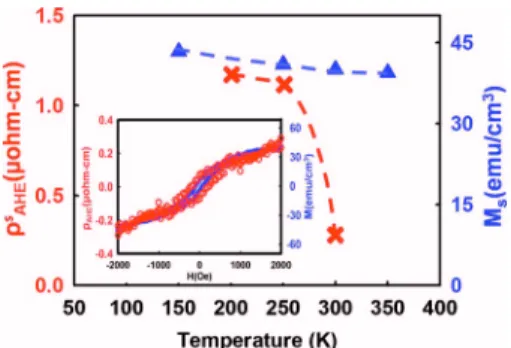
Similar to RKKY and BMP mechanisms, the magnetic coupling in the present samples with such low concentration of Co dopants must also be mediated by electrons. According to normal Hall measurement, the estimated average carrier concentration is around 1018− 1019 cm−3. This average car-rier concentration is far below the threshold of an effective RKKY magnetic coupling. Therefore, the magnetization coupling between doped Co ions cannot be due to RKKY coupling. In Fig. 2, saturated magnetization 共Ms兲 of ZnO:Co共3.5%兲 as deposited sample is plotted as a function of temperature. The Msincreases slowly with a decrease in temperature, which indicates that the Tc of the present sample is far above room temperature. The very high Tcand nearly constant Ms imply that other magnetic coupling mechanisms are responsible. The injection of carriers by the electric field effect indicates that the modified BMP
mechanism12 can be qualitatively responsible for the mag-netic coupling. As long as there are sufficient numbers of percolated modified BMP spheres, a ferromagnetic coupling above room temperature and a nearly constant Ms below room temperature occur, as in the present case. At tempera-tures below 100 K, the effect of thermal excitation disap-pears and the saturated magnetization signals remain con-stant, which suggests that the magnetic coupling is mediated by the localized carriers.
To test this theory and to know whether the hopping conduction between localized states is the spin current, we analyze the physical property directly linking the magnetic coupling and the spin current to the localized carriers. Since the spin current may contribute to the anomalous Hall effect 共AHE兲 by undergoing transverse Lorenz effect,13
as Toyosaki suggests, and the Berry phase effect,14AHE should coincide quantitatively with the magnetic hysteresis in magnitude and follow the 1.6 scaling law.15,16Therefore, AHE is the appro-priate physical quality for testing this idea. As the inset of Fig. 2 shows, the AHE-H curves quantitatively match the M-H curves. If VRH is the main cause of magnetic coupling and spin current, the saturated AHE 共AHE
s 兲 as a function of temperature of the samples should exhibit a tendency similar to the Ms-T curve. Clearly,AHEs increases sharply when tem-perature is reduced from 300 to 200 K, as Fig. 2 shows. These data are direct evidence that this sharply increasing AHE is mainly attributable to increased VRH. That is, carri-ers in localized states are responsible for the magnetic cou-pling that leads to the ferromagnetic property of our samples and forms spin currents. Those carriers in the conduction band have no discernable effect on magnetic coupling, and they exhibit normal current with no spin coherence.
In summary, measurements of electrical properties reveal the dual conduction mechanisms of DMO; the conduction in the conduction band and the VRH within localized states. Quantitative matches between AHE-H curves and M-H curves confirmed the existence of spin current in our samples. The AHE measurements at various temperatures also indicate that carriers in localized states are primarily responsible for the magnetic coupling that governs ferromag-netic properties and spin currents.
The authors would like to acknowledge the great help from Professor J. C. A. Huang and Professor M.-H Tsai. This project is supported by the National Science Council in Tai-wan under Grant No. NSC-95-2112-M-110-011-MY3. TABLE I. Carrier concentration, estimated by the normal Hall
measure-ment, and activation energies of the shallow donor originating from oxygen vacancies for ZnO: Co DMOs at room temperature.
Samples Carrier concentration共n兲 共cm−3兲 Activation energy共Ed兲 共meV兲 ZnO:Co共3.5%兲 as deposited 2.2⫻10+19 59.5
ZnO:Co共3.5%兲 RTA annealed 3.6⫻10+19 50.3
ZnO:Co共5%兲 as deposited 9.8⫻10+19 55
ZnO:Co共5%兲 RTA annealed 1.4⫻10+20 45.9
ZnO:Co共5%兲 vacuum annealed 1.5⫻10+20 45.6
FIG. 2. 共Color online兲 The saturated magnetization 共blue triangles 䉱兲 and the saturated anomalous Hall resistivity共red cross ⫻兲 of the ZnO:Co共3.5%兲 as deposited sample at various temperatures. The blue and red dashed lines are drawn for guidance. The AHE quantitatively coincides with the magnetic hysteresis.
092503-2 Chou et al. Appl. Phys. Lett. 96, 092503共2010兲
1Y. Matsumoto, M. Murakami, T. Shono, T. Hasegawa, T. Fukumura, M.
Kawasaki, P. Ahmet, T. Chikyow, S. Koshihara, and H. Koinuma,Science
291, 854共2001兲.
2A. J. Behan, A. Mokhtari, H. J. Blythe, D. Score, X.-H. Xu, J. R. Neal, A.
M. Fox, and G. A. Gehring,Phys. Rev. Lett. 100, 047206共2008兲. 3Q. Xu, L. Hartmann, S. Zhou, A. Mcklich, M. Helm, G. Biehne, H.
Hoch-muth, M. Lorenz, M. Grundmann, and H. Schmidt,Phys. Rev. Lett. 101,
076601共2008兲.
4H. Ohno,Science 281, 951共1998兲.
5T. Dietl, H. Ohno, F. Matsukura, J. Cibert, and D. Ferrand,Science 287,
1019共2000兲.
6J. M. D. Coey, M. Venkatesan, and C. B. Fitzgerald,Nature Mater.4, 173
共2005兲.
7K. R. Kittilstved, D. A. Schwartz, A. C. Tuan, S. M. Heald, S. A.
Cham-bers, and D. R. Gamelin,Phys. Rev. Lett. 97, 037203共2006兲.
8K. A. Griffin, A. B. Pakhomov, C. M. Wang, S. M. Heald, and K. M.
Krishnan,Phys. Rev. Lett. 94, 157204共2005兲.
9A. Janotti and C. G. Van de Walle,Phys. Rev. B 76, 165202共2007兲. 10J. C. A. Huang, H. S. Hsu, Y. M. Hu, C. H. Lee, Y. H. Huang, and M. Z.
Lin,Appl. Phys. Lett. 85, 3815共2004兲.
11N. F. Mott and E. A. Davies, Electronic Processes in Noncrystalline Sol-ids, 2nd ed.共Oxford University, New York, 1979兲.
12H. Chou, C. P. Lin, J. C. A. Huang, and H. S. Hsu,Phys. Rev. B 77,
245210共2008兲.
13H. Toyosaki, T. Fukumura, Y. Yamada, K. Nakajima, T. Chikyow, T.
Ha-segawa, H. Koinuma, and M. Kawasaki,Nature Mater. 3, 221共2004兲. 14S. Onoda, N. Sugimoto, and N. Nagaosa,Phys. Rev. B77, 165103共2008兲. 15K. Ueno, T. Fukumura, H. Toyosaki, M. Nakano, and M. Kawasaki,Appl.
Phys. Lett. 90, 072103共2007兲.
16T. Fukumura, H. Toyosaki, K. Ueno, M. Nakano, T. Yamasaki, and M.
Kawasaki,Jpn. J. Appl. Phys., Part 2 46, L642共2007兲.
092503-3 Chou et al. Appl. Phys. Lett. 96, 092503共2010兲