(318 ) 要 摘
文
中 師大學報 由質子撞擊鞠質之資料羿估各元素之平均激發能 第二十四期 許榮富〉 本論文旨在提供一牢經驗理論模式以評估各元素之平均擻發能數值,此模式之計算 式是得自運用豪特卡羅近似值計算投巧及各元素之最低游離能,可以簡化成右式表示之:Iz+1 , s=Iz , S+i
Z
+1
.S
,此處 I 接指元素之平均激發能· 1 保指該元素之最低游離能. z 及 s 分別表示該元素於週期表上之原子序及適期位序。 本文所評估之元素平均歡聲能數值亦分別興得自分析其他六大振理論家所提理論值 及另十四實驗家所得之實驗平均值作一比較,結果發現:本文所評估之數值,於極大多 數之先素中,均較其他理論值更能與實驗平均值吻合。另一方面,本文亦同時對一些其 他理論模式及實驗均未曾作過之元素的平均激發能作一預估、 (鉤理系
Fí ,'f. 已。 1';l.PE •! I i 'lY. Z
(320)
l= 凸
l' 吋 t' , ':I ~l0E (I/L) 采恥 p~:; S f. :'~ rr 可 RY , υ 戶可「‘ Irs
t, ") ι , aQFV 『 Lly--ATFhJhu?ecu--a4 、 JGtd 瓜、 7MLCV 內 ul1ζ lTlai--峙,, •• a •• ι-A' ••• AY 旭、 49ιJ 已勻 43 ,‘兩 4343ι 、, hzd3414J 245 丘,, LFHU' 。 --34 瓜,仁、 72 、 VRLult3422 句 SAUFaonvqlz34SAM Udho---744334 人可也可 GL 司令句句,旬,句 5555 頁, 777777778auesass 拿 UF uva 結 晶, MFFL M1* M* Anμ" 內 υ rUA 川~ -*辱 AA A 內 μr 口 /I 、氏 、 iu ccru nu nu 曳, 1 ι ‘ σ ν*A "几 ι* s a 弋 L! il,
The m~aning of each symJol:
C: Chu and Powers
M: Mukherji
D: Dehmer, Inokuti and Saxon B: 6ell, Bish and Gill
*: T~e Proposed Model A: AVérao:-:.e experimental value
一一----一--一一一一一一一一一一一一一一一一一一一一一一一一一一一一一---_.._---一 亭 ‘ *φ 會 -L 「叮 hA ‘ ,, M 吭 rd 司 J 」 、 ι A CA C ,\、* c :;. AC 才 A* A '但 A C A ι 且 C 會 C 略 t *巳 命 C
^ •
C 、* ζ* ι* FLU ru LFLrurwCE **ACACC A 州 -e**A-44RAA" ,L AH 月 AH-R* 牟平 A 川 MF M司 *f AC • C A • C ~ A* C • C * c A .ι A* C ~ *巳 C * c .A C • C *c 罩'C *c(322 ) ',‘ γ no t-z nu nc nR HU hb I Et l . ', 1 、
'
!N:H OF ilALU• (11 REPPESE~TED BY CNr' , ιAlf
,;
5 5 P J 1 、ρ{t~ 、,'j ---嚕---~-~---一一--一-一一一一一一 ---司自----
--- --- ---白.---A - ^ -R A 川 Aι fv*M 們 4TFiuuwv '、‘ AT AD 幸的口。 FM 、 υ AH aHP 叫 TAU 月 AM 伺 QU * AHfuD AM*runu AHAUF 門U 、 nu ----司---司個 4R3AU7 , CUGZ 川u •• ‘歹』丸 d' 句先 dIlli--The. meaning 0 竺 each syrnbol: C: C1U and Powers
h799clz3ι1567890lz345b789012345 £ 7EqElz3423 句 FLC7eqLI23456 Ill-222222222233 主 31JlJ333 主的 44444t 甸甸甸甸 45555577777777uaJA 包 M 司 r:* CA C* MI\ C>!'< C 九 c ﹒ 先 c ιA A " t(牛, M; Mukherji
D: De~mer , Inokuti and Saxon
R: Bell, Bish and Gill
女Th e Proposed Model
A: A,erage experimental value
Fι 看? 「 w fur-L F * “* ' ,.uAuH 罔 a “" " &&停 *AM UT aa 划川 c FL E* UL* *A 』電 4「 au ι* c* c 司, A* A C *c 車 C Þ* *^ c A* C *A C 側重,只 C • c • r *ι ^. r. A t,.... r. 一一一一一一一一一一一一一一一一一一一-"'.一一一一一一一一一一一戶---﹒一回一一一一一--一一---"._---一-C A 令 E M E ‘紅 r C " A 意 r * E 字 f * (
TABLE 2 - Cotinued Average Error in Average Value Sixth Period Burkig31 & Crawford28- Muckenzie Dalton19 & Tumer Barkas18
& Berger Ishiwari33 Andersen35 Average
Element 們 UNKF) 封 .5 :t 7.8 士10 .1 :t13.8 :t 8.6 :t 7.8 :t 9.7 :t13.7 :t 9.5 揖‘i插〉←雷 577.6 686.4 706.3 706.2 736.1 769.4 798.2 701 875 草書 m+!1 適當 577.6:t3.5 695.4:t2.1 775 ,9封 .1 787 :t4.7 846 :1:6.8 7 日士2.9 748封 .0 739:t3.2 645:t12.3 667:t12.7 682:t13.0 699:t13.3 721 士13.7 771:t14.7 704:t13.4 840 692:t13.8 704:t14.1 730:t14.6 711:t14.2 760:t15.2 767:t15.3 698:t14.0 856:t17.2 923.0主4.6 787.0封 .9 797.0:!:4.0 826.0:!:4.1 748.0幻 .7 計 II
“
hWKRMmmU A 『 ZdA 『勻,。 OQJ 弓 LEhU 勻, B ro 司 F 呵,司 J 司',『 IoonynyE會晦難..tJ:令I N-糊油恥õf:司當﹒章糊N-回~慵闢+J崎 E ,
>l'
(MNU) TABLE 2 -Continued Average Error in Average VaIue Fifth Period ', au i& 國 ebm umA 別 rL-a
h間 M Dalton &19 Tumer Barkas18& Berger Ishiwari33 Andersen3S Average
Element -inynu' 、 dnynynU 句3ny 弓,也 封封封封封封昂昂封封 373.4 406.2 420.4 436.1 454.4 475.3 460.5 478.4 496.7 517.5 373.4::t1.l 496.4::t2.0 425::t1.7 462::tl.8 507勾 .0 405::t7.7 414士7.9 432::t8.2 453::t8.6 459::t8.7 476::t9.0 477::t9.1 407::t8.1 422::t8.4 440::t8.8 456::t9.1 466::t9.3 462::t9.2 481::t9.6 486::t9.7 480::t9.6 487.0::t2.4 516.0:t2.6 555.。主2.8 hM
蜘
mm 句“ hhh o125678904 4444444455T ABLE 2 - Continued Fourtb Period
Barkas 18
Average Da1ton &19 Burkig &31 Error in Element & Berger Tumer Crawford 28 Mackenzie Ishiwari33 Andersen3S Swint38 Average Average Va1ue
20 Ca 18713.7 1920113.6 185.8:tO.6 188.3 主2.6 21 Sc 205.2曲.6 205.2 曲 .6 22 Ti 224:t4.5 227.8:t4.3 233:tO.9 217.0:to.7 225.5 :t2.6 23 V 250:t5.0 244.9主持 .7 226.5 曲 .7 240.5 13.5 24 Cr 244.2曲 .7 244.2 主ü.7 25 Mn 258.5 劫 .8 258.5 曲 .8 26 l'e 273.0:t1.4 277:t5.5 300.9 291 :t5.5 280:tl.l 275.4:tO.8 279 士2.9 27 Co 290:t5.8 281.4:tO.8 286 13.3 28 Ni 304.0:t1.5 312:t6.2 310 :t5.9 299:tl.2 288.0:tO.9 306 封.1 29 Cu 314.0:t1.5 316:t6.3 313.8 319 士6.1 323:t13 317.1 劫.9 316 封 3 30 Zn 319:t6.4 323 :t6.1 307 .1士0.9 321 主斗.5 36 Kr 381.0:t1.9 350:t7.0 356.7劫 .9 362.6 13.3 (MNAF) 廿 II 譯音回十! I 論 書~蟬〉卡雷
音書陶器 S 令I N-糊觀恥古午 1對~ :'tt:m時 N 鷗~慵闢+J峙 B >• lt (凶 N 吋) Table 2 - Continued I 'hird.Period Average
Barkas18 Dalton &19 Burkin &31 Error in
&Berger Turner Crawford28 Mackenzie Ishiwari33 Andersen35 Swirit38 Average Average Value
:!:1.7 :!:2.7 臼 5 封 3 163.4 172.3 176 198.0 162.4:!:O.6 166:!:O.6 163 主:3 .1 163.0 172.3 163:!:3.3 163.0:tO.8 Element 195.1:!:4.9 176封.5 189:!:3.8 21O.0:!:1.1 13 Al 14 Si 17 Cl 18 Ar
T ABLE 2 - Continued bond Period Average Errorin Average Value Barkig &31 Mackenzie Dalton19 & Tumer Barkas18
& Berger Crawford28 Swint38 Average
Element (凶 M ∞) 劫.7 劫 .9 11.0 12.0 勾 .3 立.1 揖幅〉←萄 37.4 61.1 79.1 89.3 101.5 126.8 盡量 rn+ll 掛 88.5 88.5 立 .2 103.412.6 117.312.9 66.811.3 53.34 72.14 37.410.7 61.711.2 81.211.6 89.611.8 10112.0 132勾 .6 60.0旬.3 78.0劫.4 13110.7 開 II 3 U 4 Be 6 C 7 N 8 0 10 Ne
E會姆彈Jð: ~N 糊翱恥古字輸﹒~~掛 N 回~慵國咐峙岳
rn
11 AUMM 油) 2 TABLEA verage value of I (恤 eV) Obtained from Experimental Data
Average Error 姐, Average Value Zrelov & Stoletov First Period Brolley & Robe Barkas18
& Berger Derrick39
Bakker
& Segre Avèrage
1 H2.moluclar 1 H-saturated 1 H-unsaturated 2He :tO.1 土的 士0.6 主:0 .6 18.8 18.1 15.7 43.0 42.7曲.6.. 13.6 Thompson 21.9 18.6 15.7 20.0 44.3 曲 .9 17.5 18.7:tO.1 42.0油2 Element
TABLE 1 一包且也盟!! Average Experimental Value Crawford28 Model
s
b:th Period ChU&23 Powers Mukhe司i26 Element 706.2:t13.8 736.l:t8.6 769.4:t7.8 686.4:t7.8 706.3:t8.9 798.219.7 707 715 726 734 742 751 760 769 779 786 793 800 808 818 829 618.9 673.0 705.7 743.04:t18.6 7S2.63:t18.8 762.20:t19.l 773.2S:t19.3 784.32:t19.6 796. 18:t19 .9 317.44拉0.4 830.29垃0.8 832.00:t27.5 829.斜拉7 .4 838.86:t27.7 834.lS:t27.5 838.32:t27.7 844.05 :t2守 9 849.的垃8.0 旺 afestug--biom HTWROKPAHTPBPR 勻,租司 JA 峙,‘ Jro 『 I 。 onynu'i 呵, -43A 峙,、 dro 呵,司 r 『 F 呵,呵,呵,﹒呵,呵 I 。。。。。 ooooo 。 ooo (M 凶。) 揖 4幢〉←萄 盡量自 +ll 適當 l i l-llll E替自器彈JlF ~N 灘酒恥詐司盟﹒:誰)j- N'回~慵鷗喇回 E r、 \Ñ TABLE 1 一臼凶nued
-
\Ñ 、J Fifth Period Be姐 22 AverageαlU &23 Bish& Crawford28 Expe由nental
Element Powers Mukhe司i26 Gill Model Value
37 Rb 391.83封 .9 392.0 38 Sr 388.36封 .9 396.2 39 Y 395.07:t4.0 401.0 40 Zr 404.00土4.0 408.3 373.4:t1.l 41 Nb 421.89:t4.2 415.2 406.2支7.9 42 Mo 433.02士的 422.0 420.4:1:6.。 43 Tc 436.45:t4.4 429.3 44 Ru 458.04揖 .6 436.6 45 Rh 471.60:t4.7 444.1 436.1 揖 .5 46 Pd 497.72:t5 .0 452.4 454.4:t8.9 47 Ag 500.08:t5.0 349.3 460.0 475.3 封 9 48 Cd 503.52:t12.6 469.0 460.5i9.0 49 In 502.25:t12.6 474.8 478.4卸3 50 Sn 505.50:t12.6 377.2 482.1 496.7封 .9 51 Sb 510.00:t12.8 490.8 52 Te 519.48:t13.0 499.8 一 53 1 523.11:t13.1 510.2 54 Xe 530.28:t13.3 的0.1 i9 .0 522.4 517.5:1:6.2
TABLE 1 -Con組nued Average Experimental Valt1e Crawford28 Model Fourth Peri,叫 n& 吼恤到 RHBUG αlU &23 Powers (凶凶 N) Mukhe司i26 K 臼 &muVG
恤
tm 臼 MωhAUaM 齡趾 LN 901234567890123456 12222222222 、 3333333 188.3拉 .6 205.2:tO.6 225 .5血 .6 240.5 封 .5 244.2曲.7 258.5 胡.8 282.9均 .9 285.7封 .3 302.6封 .1 317.2封 3 316.51:4.5 362.61:3.3 謝 4個〉←君 242.$ 248.6 255.2 262.0 268.7 275.5 282.9 290.8 . 298.6 306.3 314.0 323.4 329.4 337.2 347.1 356.8 368.6 382.6 _~æ+ll 艙 330.5166 238.3 255.0 197.22也 ~O 196.00也 .0 207.48~.1 221.10:t2.2 235.52也A 260.64立 .6 266.75 也 .7 283.04~.8 30 1.3 2封 .0 319.48封 .2 350.611:3.5 358.20封 .6 359.29:1:3.6 365.44封 .7 373.561:3.7 382.84封 .80 393 .40封 .9 404.28:t4.0 l l l ElementE書時曾姆拉令l N-糊酒恥、音司出﹒~~自 N 輔~慵儡喇岫哥
Oll
(尸凶凶叫田〉 TABLE 1 - Continued Average Experimental Value Crawford28 Model Bell,2 2 Bish& Gill I 'hird Period Dehmer27 Inokuti & sacon ChU&23 mukherji 26 Element powers 163.4:t1.7 172.3I2.7 176封 .5 198封.3 149.4 157.0 163.0 171.2 181.6 192.0 205.0 220.8 174.1 封 5 123.6:t6.2 124.3:t6.2 131.5:t6.6 164.0:t8.2 177.4:t8.9 152.4 160.3 189.0 148.61:t1.5 149.40:t1.5 150.93:tL5 158.34:t1.6 168.45:t1.7 180.16:t1.8 193.46:t1.9 207.90I2.1 站崗。 blL-I NMAqapsα 品 , 17uquA 峙,、 drO 『',。 0,
A •••••• 且, itA2 且,.壘, AT ABLE 1 - Continued
Second Period
Dehmer,27 BelI.22 Average
'
ChU&23 Inokuti & Bish& Crawford28 Experimental
Element Powers Mukhe司i26 Saxon Gill Model Value
3 U 38.85:1:0.4 43.32 34.021:1.7 45.7 37 .4主fJ .7 4 Be 45.72油5 56.75 38.621:1.9 55.0 61.1:1:0.9 5 B 56.85:1:0.6 49.00也.5 63.2 6 C 72.24劫.7 83.49 62.01 封 .1 74.8 79.11:1.0 7 N 90.65曲9 95.45 76.91 封 .8 89.3 89.31:2.0 8 0 111.601:1.1 106.5 93.50:t4.7 102.9 10 1. 5 坦.3 9 F 135.091:1.4 111.81: 5.6 120.3 10 Ne 160.091:1.6 126.5 131.31: 6.6 122.0坦 .4 141.9 126.8:t2.1 (uuhpv 仕 l 盡量 rn+ll 抽謝咖〉←嵩
~~萬難.tr-sJN-糊酒恥古午 1對﹒輩出自N-崎$慵關‘N 回 E
>1
(尸 ωω 山) TABLE 1Values of 1 (in eV) Calculatedfrom Thωretical Model
Average Experimental Value Crawford28 Bell,22 Besh& Gill First Period ﹒且 句 A &﹒時 ρuvnu
na
鹽、 u huqa 冒 iwpiv RM Dehmer,27 Inokuti & Saxon Kamikawai,26 Watmanabe & Amemiya 。lU&23 Powers Element 1 H atomic 1 H molecular 2 He 15.6主0.6 18.5:tO.3 43.0:tO.6 Model 13.6 14.0~I~15.2 18.2 38.1 39.7劫 .8 41.1 ~I~43.5 38.82:t2.0 49.08:t0.5(336 ) R. Ishiwari, N. Shiomi, S. Shirai, T. Ohata, and Y. Uemura. Bul1 Inst.αlem.
34.
師大學報
Res., Kyot9 Univ., 49,390 (1971).
H. H. Andersen, C. C. Hanke, H. Simonsen, H. &þrens凹, and P. Vaj缸, Phys.
Rev. 175,389 (1968). 35.
第二十四期
H. H. Andersen, H. Simonsen, H.
S4>
rensen, and P. Vajda, Phys. Rev. 186,372 (1969).
H.
S4>
rensen and H. H. Andersen, Phys. Rev. 跑, 1854 (1973). 36.37.
J. B. Sw詛t,R. M. Prior and J. J. Ramirez, Nucl. Instru. and Meth. 80, 134
(1970).
M.De質ick,T. Fields, L. G. Hym阻, G. Keyes, J. Fetkovick, J. Mckenzie, and
1. T. Wang, Phys. Rev. 2A, 7 (1970). 38.
39.
W. H. Barkas and M. J. Berger, Nat1. Acad. Sci. NatL Res.Counci1Pub., 1133,
103 (1964). 40.
Handbook ofChem.and Phys. CRC Press Inc.
,
58th Ed.(1977-1978). 41.G.
W. Crawford,
Private Communication. 42.G. W. Crawford and R. F. Hsu
,“
Joint Meeting, τexas Section of The Am eri-43.can of Physics Teachers弋 Nov.4, 1977.
List of Tables
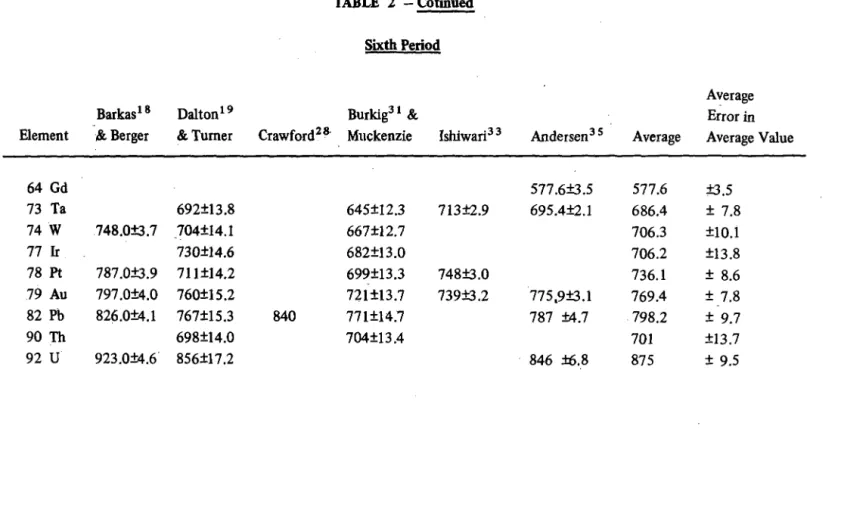
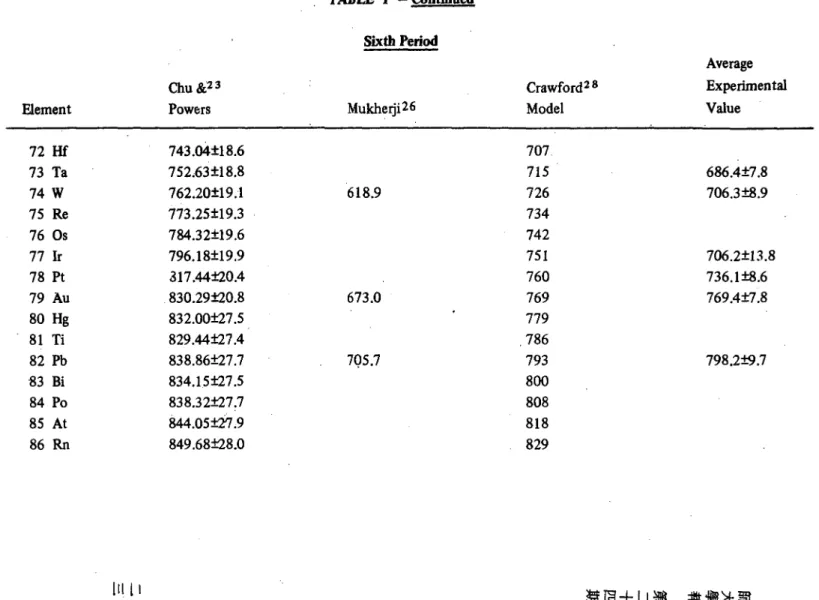
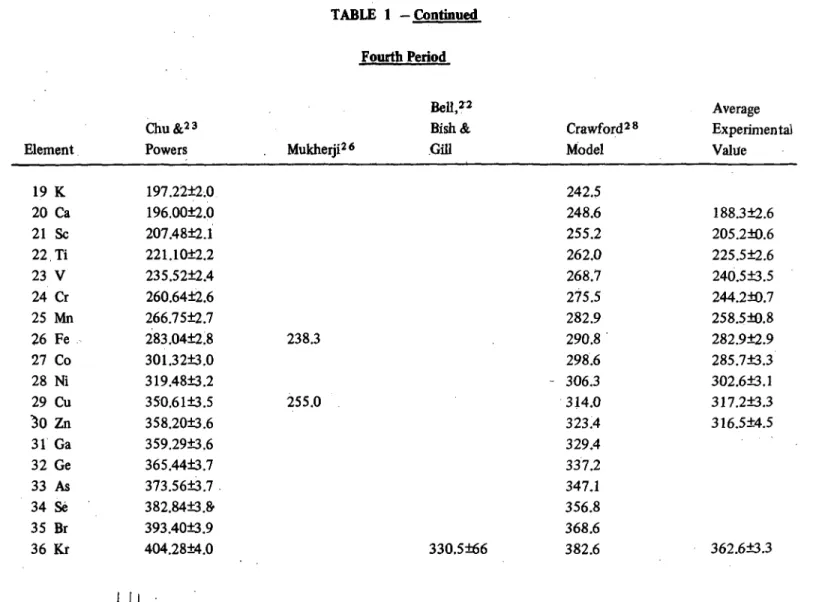
Values of 1 (in eV) Ca1culated from Theoretical Mode1.
Table 1
Average Value of 1 (ineV) Obtained from Experimental Data,
Table 2
Suggested Values for 1 (in eV). Table 3 一七 List of Figures Figure of 1 by Z. Figure of I/Z by Z. Fig.l Fig.2
由賀子撞擊物質之資料,評估各原素之平‘均激發能 29. -;且\a 30. 31. 32. 33. (337 )
14. H. .Bichsel,“High.er Shell Corrections in Stopping Power," Technical Report No. 3; 1961.
15. D. C. Sachs and J. R. Richardson, Phys. Rev. 肘, 834 (1 951); 紗, 1163 (1953); 94
,
79 (1954).16. D. R. Dixon
,
Stopping Power Measurements of 185 MeV Protons in Various}4etals, M. S,訂閱sis , SMU (1967).
17. R. M. Stemheimer, Phys. Rev. 88, 85 (1952); 91, 256 (1953);93, 351
(1954).
18. . L. Fano.
,
Appendix A of Nucleai' Science Series Report,A.19.. F. Bloch, Z. Phip. 81", 363 (1933).
20. W. H. Barkas and M. J.Berger, NASA, SP-3013(1964).
21. Ryotaro Kamikawai, Tsutomu Watanabe, and Ayao Amemiya, Phys~- Rev. 184 (1969).
22. R. P. Futrelle and D. A. McQu訂rie ,J. Phys.
il
, Ser. 2, Vo1. 2,640 (1969). 23. R. J. Bell, DRB Bish, and P. E. Gi1l, J. Phys. B, 5,476 (1972).24. W. K.αlU and D. Powers, Phys. Lett. Vo1. 40A, No. 1, 23 (1972), and private communication.
25. J. Lindhard and M. Schar缸, Math. Acad. Sci. -Natl. Res. Counci1, Publ.
752, Sec. 11-1 (1960).
26. F. Herman and S. Skillman, in Atomic Structure Calculations (Prentice-Hall,
Englewood-Cliffs
,
N. J.) (1963).27. Shankan Mukhe耐, Phys. Rev. B, Vol. 12, No. 9,3530 (1975).
28. J. L. Dehmer, Mitio Inokuti, and. R. P. Saxon, Phys.Rev. A, Vo1. 12,No. 1,
102 (1975).
G. W. Crawford, NASA-CR-108385-N70-26853, (Aug., 1968).
American Institute of Physics Haridbook 3rd Ed. (1972), (McGraw-Hi11,
Inc.) 8-148-153.
G. W. Crawford, NASA-NsG 708, (March, 1970).
V. C. Burkig and K. R. Mackenzie, Phys. Rev. 106,848 (1957).
R. Ishiwari, N. Shiomi, S. Shirai and Y. Uemu間,Bull 1st.αlem. Res., Kyóto Univ. 52 No. 1 (1974).
(338 )
Therefore ourmodel might be useful in experimental data seems to be reliable.
constructing a better theoretical description for theproton penetration pheno- 師大學報 mlenon.
第二十四期
Acknowledgments
The au也or"wishes to thank professor George W. Crawford for his advice.
The new Monte Carlo Approach PROTOS 111 program developed by him is vital to the success of this work. Thanks 訂ealso due to professor Salaita ofthe Nuclear Physics Laboratory of SMU for his help in analyzing the initial data. Finally
,
the author would like to thank Mr. T. C. Shih and Mr. R. H. αlang for their help in contacting with 出eαlU晦.-San Technology in Science for operating the CDC computer.REFERENCES
K. C. Shane and G. G. Seaman
,
Phys. Rev. B 8,
86 (1973). M. D. Brown and C. D. Moak,
Phys. Rev. B 6,
90 (1972). L.Bridwell and A. L. Wa1ters, Phys. Rev. B 3, 2149(1971).2.
J.
G. Kelley, B. Sell帥, and F. A. Hanser, Phys. Rev. B 8, 103 (1973). P. Dalton and J. E. Tumer,
ORNL-1777 (1967).3.
4.
一五
Technical
R. F. Hsl且, Mean Excitation Energies Calculated from Stopping Power and
Range Data, 1978 , Thes函, SMU.
N. Bohr
,
Philos. Mag. 25,
10 (1913).H. A. Bethe
,
Ann. Phys. (Leipz.) 5,
325 (1930).M.-S. Livingstonand H. A. Bethe
,
Revs. Mod. Phys. 9,
245 (1973).H. A. Bethe and J. Ashkin 詛 Segre (ed.)
,
Experimental Nuclear Physics(John Wiley and'Sons, New York, 1953), Vol. 1, P. 166. M. C. Walske, Phys, Rev. 88, 1283 (1952).
M. C. Walske
,
Phys. iRev. 101,
940 (1956).H.可 Bich時1,“Passage of αlarged Particles Through Matter
,"
Report No. 2,
1961. 一 5. 8. 11. 13. 12.9.
10. 6. 7.由質子撞擊物質之資料,評估各原素之平均激發能
四
(339 )
Al-163.0eV, Si-172.3eV, Fe-300.9 eV, Cu-313.97eV, and Pb-743.95eV.
With the aid of CDC computer in Chung-San Technology in Science, the 1-. values for all elements can be obtained from eq1-. (9)1-. The results ofthis calculation
arelisted in Table 3. C. Results
1. Individual Corrected I-va1ues:
Figure 1 shows that the mean excitation energy, 1, plotted against the atomic number, Z. The noted “*" mark represents the I-value obtained from the model proposed in this paper. The average experimental 1 values and the
I~values from different theoretica1 models are also shown. in Fiqure 1 for comparison. The I-va1ueS obtained from our model are also listed in Table 3. From Figure 1 we se( that the I-values obtained from our semiempirical model fit the experimental average I-values very well except 19~Z~ 27. 2. Suggested I/Z Average Value:
Figu.re. 2 shows I/Z plotted against Z, and we see that I/Z values fit the experimental data very well except 19 建立 Z ~ 27. The discrepancy may be caused by such as Fano1 8 stated that the interpolation should be dependable to a few per cent of the va1ue of 1 in this region or by the well known fact of specially strong magnetic dipole moment in 3d-shell effect. It may also be improved in the 4-th period simply by changing the key element.
V. Conclusions
An examination of Figurel shows that the new calculated values of 1 are genera11y in better agreement with experimental averaged I-values than the other theoretical I-value models, except in the case of 19 ~ Z ~ 27. In the case of the lighter elements, the calculated I-va1ues are also in fair agreement with the corre-spot1ding values by Mukherji2 7; For t1 ) heavier elements, the calculated I-values
appear to be rather in excellent agreement with the experimental I-values.
In view of the fact that our I-values are rather in good agreement with the so far available experimental data, the predicted I-values for those elements without
(340 )
If the mean value, 1, involves both with equal weight then 1 would be equal to v2 (24.48
+
54.40)=
39.44 eV.The sum of the two ionization potentialis 18.88 eV. 54.40 eV .
師大學都
The experimental values of 15.7 :t 0.6 for H and 43.0 土 0.6
eV for He are listed on Table 2, as compared to those of 13.60 and 38.08 for our model.
第二十四期
The problem become!? more cori1plicated in stepping form the first period to the second period. . To compute the I-values for the second period, we first choose carbon as the key element. From eq. (2) with the value for the stopping power obtained bý Crawford eta14 2 , we obtain 1
=
72.34 e V for. carbon. The I-values for the rest of the elements in the second period are obtained by adding in tum the lowest ioniztion potential of each element.As explained before, in. our model we assume that within a given period the Class 1 ionization potential represents the difference in the mean excitation po-tential, 1, between any two adjacent elements and that the cnrrect value for 1 is known for at least one element in the period. Thus we choòse aluminum as the
Its I-value can also be obtained from eq. (2)
key element for the third period.
With the I-value for A1 we can then compute the 1-IA1
=
163.0 eVand we have
va1ues for the rest of the elements in this period according to the semimpirica1
Similari1y
,
the I-va1ues for the fouth p er iod are obtained by choos-formu1a (9).ing Cu as the key element with lcu
=
313.97 eV. The results are listed in Tab1e 3. Note that in our computation we neg1ect the density correction, since the proton energy is.1ower than 200 MeV. Therefore we use eq. (2) instead of eq. (3).The stopping power for incident protons in the energy range from 8 to 186 MeV of seven e1ements had been remeasured by Crawford 's group 1977. The B. Ca1culation Procedure
一 一「
I-values of these seven elements are then computed by using the new Monte The
合 Carlo Approach PROTOS 111 computer program with shel1 corrections. details of the computerprogram was given in
“
Joint Meeting, Texas Section of百le American AS80ciation of Physics Teachers" by Crawford and the author4 3.
Be-53.34eV, C-72.34 eV,
( 341 )
the most significant transitìons of the c1osedshel1 electrons, one may identify the mean excitation energy 1 with the mean ionization potential in the first appro'!.:Ì-Keeping this idea in mind, one may consider that ,的 faras the I-value Îs mation.
concerned, fortwo adjacent elements in the same period only the lowest ionizatÏGn This is due to the fact that they have the same core potentials áre different.
electrons.
Basedon this core electron theory
,
one can find a semiempirical model to evaluate the I-values for all elements rather than merely find a mathematical equation which fits the analyzied experimental I-values obtained in section III. Assume that the lowest ionization potential is of the magnituide of the difference of the mean excitation energy between two adjacent elements. Then the proposed semiempirical formula can be used to determine the correct I-value by making'use of both tht Monte Carlo calculation technique for ca1culating the I-value for one of the elements in each period and the lowest (Class 1) ionization potential re-ported in the Handbook of Chemistry and Physics41 . The expression for the semiempirical model is then由質子撞擊鈞質之資料,評估各原素之平均激發能
(9)
Iz±1,s=IZJ±iz±1,s,
where I is the mean excitation energy and i is the lowest ionization poteritial; and the subscripts Z and S refers to the atomic number, the order of the period of the element respectively. For example, for the first period elements, S
=
1, 1 苟言 Z~2;for the second period elements, S = 2, 3 ~ Z ~ 8, etc. S = 8, and 99~Z~104 (the maximum Z is 104, so far).
For the hydrogen atom, only one electron can be involved in a collisioIl.
maximum period Forthe
The lowest ionization potential value of 13.60 eV and the x-ray K edge ionization Thus the mean ionization potential is potential of 14 eV are in close agreement.
really one electron and should be the same with 1
=
13.6 eV.Helium with two electrons has a lowest ionization potential of 24.48 eV and an x-ray K edge ionization potential of 25 eV. Using the semiempirical model, (9),
Both electrons would be involved in the
The Class 2 ionization potential of he1ium is we obtain 1
=
38.08 eV forhe1ium.師大學報
(342 ) or copper. Thus it is necessary to know the I-value and the correct sheU
cφrrections for aluminum or copper. In some cases, improved shelI
correction values permit the reanalysis of an experiment.守Thus the recalculated I-values reported' in Table 2 takes
norma1ization of the relative stopping power measurements to 1
=
163扭to account both a aluminum or 1
=
314 e V for copper and the effect of the neweVfor 第二十四期
The average experimental I-values based on the work shell corrections.
of many investigators can then be analyzied. B. Analysis of Experiments
Before 1967
,
nine selected key experiments had been analyzied for calcula-Since 1968, fourteen keyexperiments are essential in deciding the experimental l-value, which are: Crawford凹, 31;Burkigand Mackenzie32 ; Ishiwari, Shiomi, Shirai, and Vemura3 3,34; Andersen, .Simon-sen, Sorensen, and Vajda3S,36,37; Swint Prior, and Ramirp'z38; De~, Fields,
Hyman, Keyes, FetkoviCh, Mckenzie, and Wang39 .
experimental I-values based on the Range and Stopping-Power Table by Barkas &
The analysis of these key ting I-vålue by Dalton and TumerS.
The result of the average experimental Berger4 0 was carried out by the before6.
I-values and the experimental errors for all elements are given in Table 2.
IV. Evaluation of the Mean Excitation Energy for a1l Elements A. Semiempirical Model
The ionization potential is defmed as the work (expressed in electron volts) required to remove a given electron from its atomic orbit and place it at rest at an
前le mean excitation p缸ameter, 1, is defmed to be the mean infinite distance.
value of the minimum energy transfer in a proton-atomic electron co1Iision which All of the atomic electrons are considered to part-porduces an ionization event.
. icipate in the co1Iision process. According to Mukherji's theory2 7 , if one neglects the minor coupling effect between the electronic bindings, one may attribute the probabilities of the individual atomic elèctrons. Further, since the total osci1lator strength for each electron is close to unity for
the transition osci1lators to
(343 )
Measurements of Range
3.
The range of monoenergetic heayy particles with kinetic energy E is wel1
The quantity related to range R(E) which can be calculated from stopping power theory is the theoretical mean range Rt (E) in 'the continuous
dE
(- dE/dS) slowing-down approximation C3DA:
d
Rt (E)
=
(7)
A smal1 difference between R(E) and Rt(E) is caused by the use of Because the stopping power formula does not CSDA approximation.
hold at very low particle velocities, equation (5) cannot be used directly This CSDA range to calculate the mean excitation potential values.
dE,
r:
EOequation must be rewritten as R
=
Ro (Eo) +defmed only when the particle losses energy without scattering.
晶質子撞擊樹質之資料,評估各原素之平均激發能
(~)
where Ro (Eo) is the measured range of particles with some low energy ( - dE/dS)
Eo..
The straight ahead model or linear method of determining 1 from a range measurement is to estimate the probable I-value of the absorber and then to numerical1y intergrates the reciprocal of the stopping power formula A measured value of Ro (Eo) is added to the result of the numerical integration to obtain the total Ümge R. over the energy interval Eo to E.
The value of 1 is adjusted until it matches the experimental1y measured range.
O
The determination of the relative stopping power involves the measure-ments of the energy losses in terms of the path lengths of an ionizing particle in a test absorber and a referenceabsorber. The reference absor-ber used in measuring relative stopping powers is made of either aluminum
( 344 ) Z2 ( Z )0 A 。。 nu-司 J 一門地 r AUELLF 弓
3-..
nu-師大學報 )0 ]. 一主」z
ln ID-(?
[ f (戶) -第二十四期 (5)The subscripts
“
D" is referred to the standard absorber,
and ß2 and f(ß)can be fmd in Table 8小 loftheAmerican Institute ofPhysics Handbook3 0
The ratio of the thickness of a test absorber (The Third Edition) 1972.
to that of the reference absorber for the same incident particle at a given energy with the same energy loss is defined as the relative stopping
The stopping power of the test absorber is given by equation (5) power.
with the subscript
“
D"replaced by“
R", and the relative stopping power,
S,
is therefore given by( - dE/dS )R (一 dE/dS)D 一 S
=
ZD Z 一切 』', .• ',', ii c-CIz--21
'-Arat ---R-D V.A-Y 圓且 h-n "l ---、 -Y-、..
JP-p
rt-rsU C 且 -rI [ D-R A-A R-DZ-z
(6)where s is measured quantity.
The mean excitation potential, IR, can becalculated from equation (6)if the shell correct~ons,于 CïlZ, are known for both the reference (stand-ard) and the test elements. Also ID must be known for the standard absorber.
Measurements of Absolute Stopping Power 2;
九
The absolute stopping power of an absorber is obtained by a direct determinatión of the energy lost by charged particles in the absorber. potential, 1, of the absorbing material can be calculated from the absolute stopping power dirèct1y by using equation
(5).
excitation mean
(345 )
the path of the partickj~ the shortest distance from entrance to exit in a medium By making use of the Monte Carlo tech-can be torrected 凶 a number of ways.
nique Crawford includect the multiple scattering cOrrection in his calculations. The resu1t are also listed in Table 1.
The theoretical I-value modèls discussed above are based on different physical These inc1ude theoretical oscil1ator strength distribution (QSD)22,
semiempirical OSD23, moment theory2 8, variation-perturbation theory21 , and
loca1 plasma model of Lindhard and Scharff2 4. None of the models considered here represents a comprehensive model for determining the I-value for al1 elements. A further development in theoretical study is required. Before a better theoretical model is available, it seems to be useful to search for a semiempirical model for
1-values which might lead to a better understanting of the experimental resu1ts.
111. Analysis of the Experimental I-values
The experiments which yield the information about the mean excitation
由質子撞擊鞠質之資料,評估各原素之平均激發能
assumptions.
stopping power relative to a reference absorber, absolute stoppimg power. or range. Thus, what we need to do before analyzing the experimental lvaluesis is~o normalize the
measured: energy can be classified according to the parame ter
initial data of different experiments to the same scale or to the same stopping We first introduce the fórmula relating the relative stopping power,
materials.
Then the fourteen key experiments can be The details of the absolute stopping power and range.
art..lyzied to obtain the I-valuès based on {he same scale.
alanyzing procedure has been p
,
esented in the previous paper by the author6 .The resu1ts of the analyzied experiI11ental I-values are listed in Table 2. A. Description of the Origina1 Experimenta1 Data
Measurements of Relative Stopping Power
八
Equation (2) for the stopping power formular can be rewritten Sn
= -:
[一坐~
]D(346 ) chemical binding on valence electrons in diatomic molecules Ìs neglected.
The ca1culated 1 values for all elements are listed on Table 1.
師大學特
In 1974 MukheIji27 ca1culated the 1 value of an element of atomic number Z )n the basis that the velocity distribution among the orbital electrons of an atom
第二十四期
Îs given by n(us) = f (Z) us/vo, where n(us) is the number of obital electrons with velocity less than 恥, vo is given by e2位-1 , and f((Z) assumes the vah~郎 0.28Z2/3 for Z~5.5 and Zl/3 for Z占45.5.The calculated values for the caseof elements with Z<13 are in fair agreement with the corresponding experimental‘values of the
mean excitation energies
,
but for the heavier elements these are appreciably lower than the experimental values. The model may be described by13.6 ] + _2_ ln (13.6Z2), Z )2X 2 Z-Z-2 一一~ ln [( Z In 1
=
2.717 f(Z) Where f (Z) = z1/3 förZ ~45.5 f (Z) = 0.28 Z2/3 for Zζ45.5and Saxon28 used.the stoppingpower depending
In 1975 Dehmer, Inokuti,
calculate a comprehensive set of partial dipole osci11ator strengths and the related moments for the atoms of the first two rows of the periodic table.
oscillator-strength distribution to moment, of the dipole
the on
They derived the moments S(μ) and L(的 =d 凹的/μfor -6~~1 from the comprehensive Hartree-Slater oscillator distributions for He through Ar. The stopping power depends ön
L (0) for fast charged particles and therefore the mean excitation energy 1 canbe
L (0) Z L 盟L S (0) In
(去)
defmed by七
The I-values for Z=2 through Z= 18 obtained by these authors are Iisted in Table 1.
u
山se叫d the 1旭at記es仗t for口rm質m of the “、s“t衍ra羽ig偵ht-叫.
Crawford29
equation as part of a Monte Carlo Nucleon transport program without shell The
“
straight-ahead" model assumption that corrections to evaluate the I-value.(347 )
In the case of smal1 number of variational paramete間, this method can easily be applied. The second oneis the procedure by expressing 1 in terms of matrix power series. The matrices, which are independent offrequency parameter,
lization.
can easily be calculated using a vector funetion. These methods, as wel1 as the direct calculation, involving integration- over ω , are applied to the hydrogen
molecular. They obtain 18.2 eV for the I-values ofthe hydrogen molecuIar.
used linear programming method to calcúlate rigorous upper and lower boui1ds to quantum-mec年anicalproperties and have illustrated it by calculating the upper and the lower bound to the mean excitation energy of hydrogen, helium, neon, argon and krypton. (In this method The sum rules
He, 14.1~I(eV)~43.5; Ar, 64~I (e V)~295; H, 14.0~ I(e V)~15.2 Ne, 90~I (e V)~181; Kr,.88~I (e V)~476. 由質子撞擊鈞賞之資料,評估各原素之平均激發能
1969
,
Futrel1e and McQuarrie22h
the knowledge of certain osci11ator strength sum rules were used.
themselveS have been calculated in most cases in an approximate way so that inaccuracies in the sum rules will be reflected in their otherwise rigorous bounds.
The bounds they obtained for 1 are:
In 1972, Bel1, Bi~h, and Gi111'3 usedboth the Hartree-Fock wavefunctions to
evaluate atomic expection values and the reli.ability of the interpolation with separate atomic subshel1 contribution scheme to obtain the 1 value of He, Ne, Ar,
Helium, 2.92 Rydberg; Neon, 8.97
The êalculated results are: Kr, Xe, and Rn.
Rydberg; Argon, 12.8 Rydberg; Krypton, 24.3及ydberg;andXeron, 33.1 Rydberg,
where 1 Rydberg is equivalent to'13;59994 eV.
In 1972 Chu and Powers24 used Lindhard and Scharff's25 theory with a
Hartree-Fock-Slater26 charge distribution to calculate th~ I-value in the stopping
power. The calculation were based on:
' -j \
it is at the high-velocity limit and therefore the 1 value is independent of velocìty.
the Hartree-Fock-Slater wave functions for an isolated atom, instead of the wave functions for the valence electrons inmetals are used, and the effect of
、‘', F , '
..
f •• ‘、 、 (2)(348 ) from the experimentally derived values of 1 for some known media. It is known that the values of K thus obtained differ for different media and that for media of
師大學報
low atomic numbers, .these va1ues are unexpectedly high. Further, in the absence of any definite trend in the varialion of'Kwith Z, it is difficu1t to make
interpol-第二十四期
ations or extrapolatioIis on the basis of the avaiable data to obtain the value of 1 for an unknown medium with any degee of certainty. Five differentsemiempirical equations models have been proposed before 1967:
Bloch19 (1933)
I 三 KZ, whe
:r
e K is about 15 eV for low Z absorbers,
K is about 10 e V for hígh Z absorbers. Barkas and Berger20 (1964), based on H, Be, At
ladj~ 163 eV 12 + ~7_ Z
--ladj Z2.
Stemheimer17 (private commurtication to Barkas and Berger), based on Al,
3.
, ladj>163eV=
9.76 + 58.8jz1.19 ladjz
Cu,
Pb.Dixon16 (1967), based on Al, Si, Fe, Pb.
_1_ =9.81+35.5jZ Z
4.
五 Da1ton and Tbmer5 (1967) 1=
(10.2 :t 2.07) + (11.8 :t 0.55) Z, for Z ~.13 1=
(56.1::t吐76)+
(8.61 士 0 .3 7)Z,
for Z>135.
In 1968, Kamikawai, Watanabe, and Amemiya2 1 used the variatiôna1 method without integration over a frequency parameter to ca1culate the mean excitation The first one is the procedure involving a matrix diagona-energy 1 in two ways.
(349 )
Hence, the tota1 average energy loss by ionization per unit path length per density of the absorber medium is
~C [ln 2mv2
句
_ ß2 _ _i --.:._一主- ], (3) 1( 1- 戶2) Z 2 NZ 4宵2z2e4 2 mvBelow about 200 MeV, ð is negligible incomparison to the experimental errors. I-values may beobtained using equation(3) from experimental va1ues of range or stopping power
,
provided the shell corections are known.B. Theoretica1 I-value Models
The mean excitation potential, 1, is defined in the stopping power equation to be the mean value of the energy transfer in a charged partic1e - atomic el-ectron collision which produces and excitation event. All of the atomic elel-ectrons
Fano18 defined the mean
are considered to participate in the _collision process.
~n fn ln En , 一 一 I n TA excitation potential as 由質子撞擊物質之資料,評估各原葉之平均激發能 (4)
where fn and En are the dipole oscillator strength and the excitation energy of the transition from its ground state to the excited state n respectively. The summation is extended to the various virtual oscillators of strength fn and excitation frequency
En 用. In principle 1 could be obtained from equation (4). However
,
the deter-mination of 1 from this definition presents serious difficulties since the oscil1ator strengths are not generally well known in the desired energy range. Most elements have excitation energies (En) in the range 10 e V to 1000 e V, and in this range the oscillator strengths (fn ) are poorly known.B1och19 made ageneralization on the basis of the Thomas-Fermi statistical 四
approach and showed that the mean excitation potential 1 of an atom should be proportiona1 to the atomic number Z,
1
=
KZ.(350)
師大學報
A. Stopping Power Formula
The basic theöretical groundwork of the stopping power fonnula was laid down by Bohr7 in 1913. But the first quantum mechanical solution was obtained
by Bethe8, 9, 10 using the Bom approzimation. Bethe's theory expresses the
energy loss per unit path length for a completely stripped heavy ion of atomic
第二十四期 、 F •• EA Ja 、 ß2 2mv2 1 (1于 ß) n r.-L NZ
number z and velocity v as
4πz2e4 mv2
--dE dS
where m artd e are the electron mass and charge, N is th~umber of atoms per unit volume, Z is the atomic number of stopping material and
'ß
=
v肉,the velocity of the incident partic1e relative to the velocity of light.lf the velocity of the incident partic1es v is not large compared to the Bohr-orbit velocity of the atomic electrons Ve in the stopping material, Equation (l)
predicts too high a value for the energy loss. The inner electrons in intennediate and high atomic number elements have velocities such that the condition v ~ Ve
Also, the requirement may not be met when low cannot always be satisfied.
For these reasons shell correction tenns are inc1uded in the stopping power fonnula.. Walske11, 12 has
suggested a theoretical corrections for electrons in the K - and L- shells, and Bichse}l3, 14 has extended the theory to inc1ude the M-shell. Sachs and
Richard-energy incident partic1es slow down in low Z materials.
Dixon 1 6 also son15 have proposed a theoretical correction to inc1ude a11 shells.
By used Bischsel and Walske's derivation to obtain the a11 she11 corrections.
(2)
making use of the shell correction
,
equation (1) is then to be weitten as1:
C
月 NZ [ln _ _ L.mv'"'_ _ ß2 _-Ll一1. 1 (1- ß2) Z 一 4宵z2e4 位w2 dE dSwhere Ci is the shell correction of the i-th shell.
Due to polorization of the medium, the reduction in the energy loss of charged partic1es mtist also be considered. Stemheimer17 summarized the theory
(351 )
ing power or range with partic1e energy are often used to detennine energies and But to calculate the stopping masses in nuc1ear cross-section measurements.
power we have to know the. mean excitationenergy and the corresponding shell corrections ofthe absorber1 , 2, 3, 4.
Dalton and Turner5 analyzied the nine key experiments before 1966 for the absolute sfopping power, relative stopping power, and range of most elements and After 1967, many attempts have obtained the I-values with shell corrections.
been made to construct sufficiently accurate theoretical I-value models as well as to obtain more precise experimental measurements. But there are still discrepenc.
Fur-ies. between thetheoretical estimates and the experimental measurements. thennore, so far there are no systematic I-values for all elements available both
Therefore an analysis of the I-values from the theoretically and experimentally.
recent experimental measurements and the different theoretical models .seems to
It will also be useful to search for a semiempirical model for' I-values which might lead to a better understanding of the experimental results.
In section 11, we brief1y discuss the existing theoretical models for I-values. As a theoretical background we also review the stopping power fonnula in this be useful.
由質子撞擊鞠質之資料,評估各原素之平均激發能
The average experimental I-values obtained from analyzing the fourteen section.
key experiments are given in section 111. Based on the core electron theory for the interaction between the incident charged partic1es and atoms and by making use of 'the Monte Carlo. technigue qne can construct a semiempirical model for the mean excitaiton énergy, 1, for all elements. The details of this model is given
In sectión V we discuss in somewhat detail the comparism of our in sectionIV.
model with others.
11. Analysis of the Theoretical I-values
Then we summerize the existing theoretical I-value models. The details for obtaining the I-values from each model'have been presented in the previous paper by the author6 .
from a brieÌ review of the stopping power fonnula. We start
(352 )
of the Elements
Mean
Exc
itatÎ01n
En
ergy
師大學特
in
Ma
tter
for
Penetration
Proton
第二十四期by
Rong~Fu of PhysicsNormal Uni vers i ty
Hsu
De
partment National TaiwanABSTRACT
In this paper we propose a semiemperica1 model for the mean excitation energy, 1,
for a1l elements. By making use of the Mqnte Carlo technigue and.the lowest (c1ass 1) ionization potentia1s of the elements, we fmd that the mean excitation energy, 1, c甜 be expressed by Iz:t1,s = Iz,8 +"l.z訓,swhere I is the lowest ionization potential and the
subsαipts Z and S are respectively refered to the atomic number and the periodic order of the element.
叮le I-va1ues from our model are compw;ed with those obtained from six other theoretica1 models as well as the average experimenta1 va1ues. lt is found that our I-va1ues are in good agreement with the experimenta1 data for most elements and our model ~s over a1l much better than the olhers.
1. Introduction
The knowledge of the mean excitation energy (l-value) of an element is necessary for computing the stoppong power or the range of a charged particle in The energy deposited per unit absorber mass, i.e., the absorb-ed dose. from chargabsorb-ed partic1es, is proportional to the stopping power of the the given element.
A1so, the amount of ene喀y deposited in an ionization chamber or shielding material depends upon stopping power. Data on the variation of stopp.