行政院國家科學委員會專題研究計畫 成果報告
新社會運動與非選舉的利益代表
研究成果報告(精簡版)
計 畫 類 別 : 個別型 計 畫 編 號 : NSC 95-2414-H-002-030- 執 行 期 間 : 95 年 08 月 01 日至 96 年 07 月 31 日 執 行 單 位 : 國立臺灣大學政治學系暨研究所 計 畫 主 持 人 : 黃長玲 計畫參與人員: 此計畫無參與人員:無 處 理 方 式 : 本計畫可公開查詢中 華 民 國 96 年 12 月 07 日
Beyond Elections: Democracy and Taiwan s Feminist Movement
Chang-Ling Huang Department of Political Science
National Taiwan University
I. Introduction
Taiwan s democratization has been presented as an election-driven process.
Many have argued that local elections that began in the 1950s successfully help to
stabilize the rule of the KMT in Taiwan and the democratic forces took advantage of
this institutional mechanism and eventually brought about Taiwan s democracy
(Rigger 1999; Chao and Myers 2001; Schafferer 2003). Elections indeed have been
the most visible feature of Taiwan s democracy. The country holds elections almost
every year. For each Taiwanese citizen, he or she would cast votes for four types of
executives and three types of legislative representatives. For the executives, there are
elections for the heads of villages or city subdistricts (li), the heads of townships, the
county magistrates or city mayors, and the President. For the representatives, there are
elections for the councils of townships, the councils of counties or cities, and the
parliament. Twenty years after the country began democratization, when vote-rigging
no longer exist and vote-buying no longer a rampant practice, any observer would
agree that elected interest representation has been fully developed in Taiwan.
repeatedly show that democracy should not be reduced to electoral democracy.
Equally important are the establishment of the rule of law, the organization and
articulation of social interests, and citizen s participation and involvement in the
decision-making process. In other words, interest representation through elections
consist only one aspect of democratic practice. For the state to better respond to the
society s demands and needs, interest representation through non-electoral institution
has also been an important democratic feature. However important the legislatures are
in a democracy, they have yet to be proved as effective and sufficient institutions in
representing the interests of the underprivileged. The representation of certain social
interests therefore depends not only on fair elections but also on institutional
arrangements that allow the state to better interact with the society.
Using feminist movement as an example, I explore in this paper the institutional
development of the non-electoral interest representation. Such development has
become a very important part of Taiwan s democratic development. The strength, the
limitation, and the controversies about the institutional arrangement that enhances the
non-electoral interest representation will be discussed. The paper has five sections.
Except for the introduction, section two is an outline of arguments regarding
state-society relation. In section three, I discuss the formation and dissolution of state
commissions綨the institutions under which actors of the state and civil society
interacted綨are discussed. The paper is concluded with the emphasis on the
importance of non-electoral interest representation in democracy.
II. Modern State and Civil Society
As a major organizational form for the political lives of human beings, modern
state emerged relatively late. This form was originated from Western Europe and
expanded into non-Western countries in the past two centuries, during which the
modern state has also become the basic unit of international political system. Along
with the modern state, the concept of the civil society emerged. Modern political
thinkers imagined that, except for the political relation between the rulers and the
ruled, there exist social relations among all the ruled.1 Such social relations are
manifested by various voluntary associations.
Arguments on the relation between modern state and civil society changed with
historical circumstances. The main concern of early liberal thinkers was how
individuals could resist the oppression from the dictator. Their arguments focused on
the distinction between the state and civil society. Unless absolutely necessary, the
state should remain outside of the realms of people s personal lives. Social
1
organizations and interactions among individuals were not business of the states. In
the 19th century, however, the expansion of the capitalist mode of production resulted
in different perspectives. The main concern of socialist thinkers was the ruthlessness
of the market forces and its oppression on the laboring class. The state was designated
as a tentative or transitional means to check the influence of the market forces. The
protection of individual rights no longer depended on the distance between the state
and society. The state was actually required to play an active role in the civil society
so workers did not have to face the risks of labor market alone.
The international competition after the mid-19th century was intensified, and
military competition was coupled with economic competition to the extent that the
causal relation between the two could be unclear. Under the pressure of competition,
many states faced the challenges of internal control and mobilization. Leaders of
many states demanded the corporation of its people, and forced social interests to be
organized in such a way that allowed the states to mobilize social forces easily. While
the 20th century witnessed the violent struggles between the left and the right, it also
witnessed how socialists and fascists states, authoritarian or totalitarian in nature,
organized, mobilized, penetrated, and repressed civil societies. The major difference
between socialist and fascists was only in the degree of their acceptance of market
However repressive or strong-handed was the state, its will or goal was
sometimes resisted, ignored, subverted, or transformed by civil society (Sprut 1994,
2002). This was well documented in the literature on development experience.
Modernization theory implicitly equated the spread of modernity with the realization
of the will of a modern state. Modernization was supposed to spread from the modern
sector to the traditional sector, from the core sector to the periphery sector. The
peripheral and traditional society might resist modernity, but the resistance would be
futile. Eventually all in the society would be absorbed into the compelling
modernization process through which the traditional values, behaviors, or institutions
would also be transformed (Lerner 1958; Shils 1975). Empirical researches, however,
show that modernization or the spread of modernity was a process that never
completed. Some traditional sectors in many countries never disappear but co-exist
well with modern sectors (Berger and Piore 1980). Most importantly, modern states
and traditional societies seemed to transform each other in the process of
modernization. As the spread of modernity was never complete, the state s intention to
impose its will on civil society was never fully successful either.
The idea that the transformer was usually transformed has been presented in a
different way by Migdal. Migdal (1988, 2001) challenged the dualist view on the
Different social organizations compete against each other over the conflicts of
interests and values. In showing its wills and realizing its goals, the state is just like
the society that needs to overcome internal conflicts and inconsistencies. In other
words, the state is not completely distinctive from the society because the state is not
apart from the society but a part of the society. The state and the society actually
constitute each other. Though the image of the states seems to be singular in the
international system, the practice of the state is not. Just like the society has its
multiplicity and diversity, so is the state to a great extent. Different ministries or
departments usually are in conflicts with each other. Since neither the state nor the
society is singular, how does the state connect to the civil society become the core
issue of the state-society relation.
Institutionally speaking, corporatism best demonstrates the connectedness
between state and society. Works on corporatism tend to focus on the difference
between state corporatism and societal corporatism. The former relies on the state s
authoritarian nature and its attempt to monopolize social representation. The latter is
based on democratic bargaining and negotiations. We have learned that the difference
between these two types of corporatism results from different historical process. State
corporatism was initiated from the top, while societal corporatism was initiated by the
and effects are quite different. Whether it is authoritarian monopoly or democratic
bargaining, the most important characteristic of corporatism is its specific way of
organizing and representing social interests. The organization and representation of
the social interests is not based on electoral mechanism. Union leaders might need to
win union elections to be a party of the tripartite bargaining, but they need not to be
elected by the citizens. There, of course, still exists the important difference between
democratic and authoritarian corporatism. For democratic countries, corporatism
means the mutual penetration of the state and the society. It is a system of
non-electoral interest representation because elections are insufficient in protecting
the interests of the weak. For authoritarian countries, corporatism means the state s
penetration of the civil society. It is a system of non-electoral interest representation
because elections are either not held or not an important mechanism for interest
representation anyway.
For a newly democratized country like Taiwan, the development of non-electoral
interest representation has been an important issue. On the one hand, the revitalized
civil society has great expectations on the state and social activists demanded a
greater degree of political participation and policy involvement. On the other hand,
state corporatism was the dominant institution of interest organization during
societal corporatism is an intriguing question intellectually and politically.
III. Feminist Movement and the Formation and Dissolution of State Corporatism
State corporatism in post-war Taiwan was based on the corporatist institutions
developed by the KMT government while in China. In 1945, the KMT government
promulgated The Provisional Act for Private Organizations. The law stipulated that
social organizations of the same nature should be limited one per county. Such forced
monopoly of social representation is one of the usual characteristics of state
corporatism. The Taiwan Association of Women, established in January 1945, was the
first women s organization in Taiwan. Judging from its name and mission statement,
the association aimed to become a national organization for women (Hsu 2000: 22).
Several months later, however, when the KMT-cultivated women s organization, the
Taiwan Provincial Association of Women, was established, the Taiwan Association of
Women was forced to dissolve because of the law (Hsu 2000: 23). Between 1946 and
1949, except for the Taiwan Provincial Association of Women, the Committee on
Women s M ovement was also established within the K M T (Hsu 2000: 24).
After the KMT moved to Taiwan, in 1950 Madame Chiang Kai-Shek established
the National Women s L eague. M embers of the Women s League include wives of
government executives, female political representatives, spouses of civil servants, and
it soon expanded and developed branches and working teams all over the country. The
league had branches in the government at all levels, in universities and colleges, and it
even had overseas branches. Around the same time, the KMT also carried out party
reforms and organizing social interests was an important part of the reform. Between
1952 and 1956, there were womens associations established in 22 counties and 364
towns (Fan 1990: 43). The establishment of women s associations in the counties and
towns was similar to the organization of unions in all the public and major private
enterprises at that time. It was an important part of the corporatization process led by
the KMT.2 When women s associations were established in counties and towns, the
KMT also founded the Central Directive Committee for Works on Women within the
party and Madame Chiang Kai-Shek was the director of the committee. Since
Madame Chiang Kai-Shek was the leader and decision-maker of both the women s
league and the directive committee, women s organizations under the K M T rule since
then followed the pattern of directed by the league and committee, executed by the
associations. (Chang 1999: 66)
The KMT in the 1950s undoubtedly created a corporatist structure for women s
organizations. The state penetrated and mobilized the society.3 The three systems of
2
For a more detailed discussion on the corporatisation of the unions, see Huang (2000).
3
Women was mobilized to provide unpaid labor service such as sewing military clothes. Since the league existed almost everywhere, the spouses of civil servants, female employees of the government, and female students were all mobilized. There actually had been complaints about such mobilization. (Hsu 1997: 86-93; Hong 2003: 64-65)
women s organizations, the Women s L eague, the Party Committees for Women, and the Women s A ssociations, largely covered women of all sectors. The league covered
the military and its main activities were paying visits to the military, sewing military
clothes, and creating schools and care facilities for children of servicemen, especially
for those who died in battles and wars. The party committees were party organizations.
Their main task was to organize and mobilize female party members. The associations
were affiliated with the governments at all levels. Members of the associations were
local women who were spouses of political figures or locally active women. The
party-state of the KMT allowed the league and the committees to penetrate
government branches. Therefore the three systems of women s organizations were not
mutually exclusive. Some degree of ethnic segregation between members of the
league and the committees on the one hand and members of the associations on the
other, however, did exist (Chang 1998: 54-57).
The state corporatist structure of women s organizations predictably resulted in
the pre-emption of autonomous women s organizations. This effect was clear when
experienced rapid social changes in the 1960s and genuine efforts from the civil
society to organize and mobilize women began to emerge. In July 1972, Annette Lu,
now Taiwan s vice-president, founded the Association for Women of the Time with 31
Taipei City. Before the founding of the association, Lu already published a series of
social commentaries on major newspapers and she also lectured and talked on various
public forums to challenge Taiwan s patriarchal system and practice. The founding of
the association therefore was an effort on organizing women, instead of just
presenting ideas. Nine months after she submitted the application, Lu formally
received the reply from the Bureau of Social Affairs and the application was rejected.
The reason stated in the reply was the mission of the proposed organization was
similar to the mission of [existing] women s associations, so applicants could join the
[existing] women s associations and needed not to organize a separate association.
(Lu 1995: cited from Chang 1999: 93) Though the government restricted the
establishment of autonomous womens organizations, it allowed branches of
international women s organizations to exist. Therefore, organizations such as the
YWCA and ZONTA all had branches in Taiwan. After Lu failed to have her
application approved by the government, she participated in the founding of the Taipei
branch of the International Federation of Business and Professional Women. She left
that organization later because she and the organization did not fit each other well (Lu
1995: cited from Chang 1999: 93).4
4
Under the social and political circumstances at that time, how come these international organizations did not become the breeding ground for Taiwan s feminist movement is an interesting topic for study. Compared to the restrictions imposed on the labor unions, women s organizations at that time enjoyed a greater political space. Under the Union Law, unions that had membership in international federations were a part of the corporatist organizations. Branches of the international women s organizations, however, were not corporatized. The most straightforward answer might be that women, unlike the
Though autonomous women s organizations were difficult to emerge, some
development in the 1970s showed that the interaction between state and civil society
was not consistent. L u s book New Feminism was first published in 1974 by the
Young L ion s Publication, a publishing house affiliated with the China Youth Corp.
However, a review in a newspaper published by the Ministry of Defense, severely
criticized that book and forced the China Youth Corp to put a stop on publishing and
marketing that book. In 1977, the book was published by the Trailblazer, a publishing
company founded by Lu and her friends. After the book was published, the company
submitted application for the copy right but the application was rejected. The
committee that was in charge of granting copy rights made the rejection because the
book was extreme in the views presented, [the author] made oblique accusations, and
many wordings were inappropriate . L u petitioned to both M inistry of Interior and
the Administrative Court, but both rejected her petitions too. The reply from the
Administrative Court stated that the judgment was based on consultation to
concerned agencies and it even quoted the opinion from the Garrison Headquarter,
Taiwan s equivalent of the K GB during the authoritarian time. According to the
Garrison Headquarter, L u s book vilified the traditional culture, so no copy right
should be granted (Chang 1999: 95-96). In this case, what needs to be noted is that the
labors potential ability to disrupt production order, did not pose any threat to the social order at that time.
book was originally published by the publishing house of the China Youth Corp, the
corporatist youth organization under the authoritarian rule. In other words, the China
Youth Corp, the periphery of the authoritarian regime, had a different judgment on the
book than that of the Garrison Headquarter, the core of the authoritarian regime. From
the perspective of the state-society relation, the curvy path the book New Feminism
experienced illustrated that different segment of the state connected to the civil
society with different degrees. While the Garrison Headquarter had the power to
override the decision made by the China Youth Corp, the latter s initial judgment
showed the relaxation of the authoritarian state.
By the late 1980s, the pre-emptive effect of the state corporatism reached its
limit because, when democratization began, autonomous social organizations
mushroomed. In 1982, Taiwan s first feminist magazine Awakening was published,
and it also brought about Taiwan s first feminist organization. The founder of the
magazine, Lee Yuan-Chen, met Annette Lu when she was publishing the Trailblazer.
In 1979 when Lu was imprisoned for the Formosa Incident, Lee wanted to make sure
that the nascent feminist movement would continue so she gathered a small group of
friends that shared feminist values to found the Awakening.5 As a feminist voice, the
Awakening was not only a magazine, but also a gathering of post-war Taiwan s
5
In two documentary films, Lee mentioned the background of her founding the magazine. See Recollections of the Path We Have Been (DPP 1997) and The 20th Anniversary of the Awakening (Awakening Foundation 2002).
feminist pioneers. They held series of lectures and forums on issues regarding
women s rights, advocated the idea of gender equality, and participated in legal
reforms.6 In 1987 when the decades long martial law was lifted, the Awakening was
reorganized from a magazine publisher to a foundation and formally declared itself as
a feminist movement organization.
There is no doubt that democratization created political space for feminist as well
as other social movements. By the time many autonomous women s organizations
emerged, the above-mentioned women s league, committees, and associations either
lost their influence or just faded away.7Newly emerged women s organizations
completely bypassed the corporatist structure. None of these organizations came out
of the three previously mentioned systems of women s organizations. State
corporatism, at least for women, was dissolved by the democratic waves. In the
meantime, these newly emerged women s organizations became more and more
differentiated and each tended to specialize in a specific issue area. Many took
advantage of the political opportunities afforded by democratization and got involved
in policy advocacy and legal reforms. By the mid-1990s most of the women s
6
Before democratization began in 1987, Taiwanese social organizations in general had little political space in lobbying. The most important legal achievement that women s organizations garnered was the enactment of the Eugenics Law. To make sure that women could have the reproductive rights, the discourse that women s organizations used at that time was relatively conservative so it was easier to win political support (Hsieh 2000: 56-57).
7
For example, in the local election of 1989, when the DPP won seven county magistrates and city mayors, many women s associations were affected. Branches of women s league no longer has access to the local state resources (Fan 1990: 73).
organizations more or less experienced conflicts with the state and challenged the
state policies. When Chen Shui-Bian became the Taipei City Major in 1994, however,
the relation between the state and society in Taiwan entered a new stage. The mutual
penetration between the state and society began and a new type of non-electoral
interest representation gradually emerged as a dominant pattern of the state-society
relation in Taiwan.
IV. The Prevalence of the Commissions
Tripartite Commission is a standard institutional feature of corporatism. Since
the mid-1990s, a different type of tripartite commission was getting more and more
prevalent in Taiwan. Such commissions usually consist of three types of members:
bureaucrats, representatives from civic organizations, and scholars and experts. The
interaction between the feminist movement and the state best illustrates this trend. In
1994 when Chen Shui-Bian became the Taipei City mayor, he greatly increased
women s political participation in the city government s decision-making process. The
most important institutional change was the establishment of the Commission on the
Promotion of Women s Rights (CPWR). Under the suggestion by feminist activists,
the commission consisted of representative of women s organizations, bureaucrats
experts. The chairperson of the CPWR was the mayor himself. In addition to the
CPWR, similar commissions such as the Commission on Gender Equality Education
and Commission on Women s Health were established under the Department of
Education and Department of Health. In terms of the state-society relation, the Taipei
City CPWR was the first commission that brought the state into feminist movement
and feminist movement into the state.
In 1996 Peng Wan-Ru, the Director of the Department of Womens Affairs of the
Democratic Progressive Party, was killed.8 Womens organizations protested against
the state s inability to create a safe environment and demanded the central government,
still under the rule of the KMT, to be more responsive toward women s needs. The
central government eventually established similar commissions like the ones in the
Taipei City government. The Executive Yuan CPWR was established at the cabinet
level and the Commission on the Gender Equality Education was established under
the Ministry of Education. All these commissions have been the institutional interface
between the state and the civil society. Though commission members held other
full-time jobs in addition to the commission works, many were actively involved and
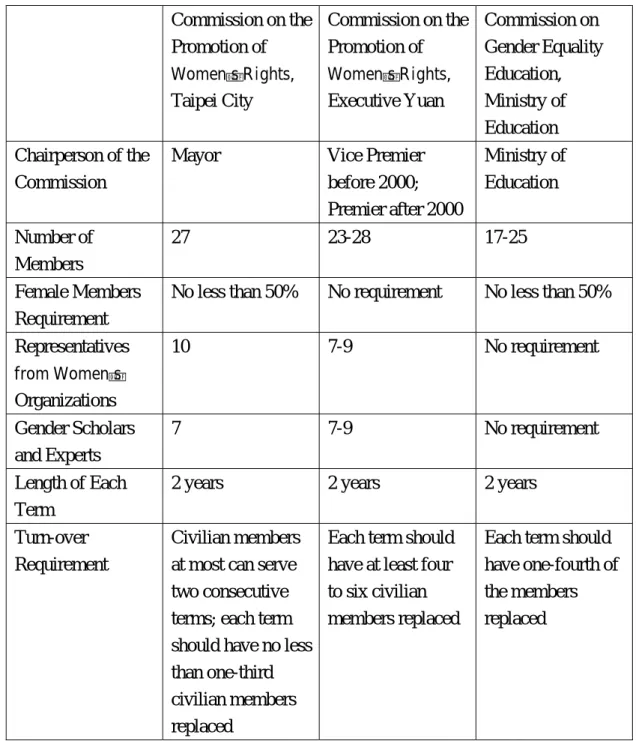
very dedicated because of their activist background and mentality. Table 1 shows the
comparison of three similar commissions. We can see from the table that there is a
8
The killing was believed to be a random crime at night and not politically-motivated. The killer, however, is still at large.
turn-over requirement for the civilian members of the commissions. Such requirement
signifies the state s intention to make the commissions as representative as possible.
Also, if one examines the list of the commission members, it is not hard to find that
civilian members invited as gender scholars or experts usually have backgrounds in
the feminist movement organizations.9
9
For example, for the Fourth Executive Yuan CPWR, four out of the seven scholars and experts had participated in feminist organizations.
Table 1. Comparison of Three Commissions Commission on the Promotion of Women s Rights, Taipei City Commission on the Promotion of Women s Rights, Executive Yuan Commission on Gender Equality Education, Ministry of Education Chairperson of the Commission
Mayor Vice Premier
before 2000; Premier after 2000 Ministry of Education Number of Members 27 23-28 17-25 Female Members Requirement
No less than 50% No requirement No less than 50%
Representatives from Women s Organizations 10 7-9 No requirement Gender Scholars and Experts 7 7-9 No requirement Length of Each Term
2 years 2 years 2 years
Turn-over Requirement
Civilian members at most can serve two consecutive terms; each term should have no less than one-third civilian members replaced
Each term should have at least four to six civilian members replaced
Each term should have one-fourth of the members replaced
Sources: author compiled from the information published by the websites of the commissions
http://www.taipeiwomen.tcg.gov.tw/women_group http://cwrp.moi.gov.tw/index.asp
The CPWR model was expand into other cities and counties after 2002. In 2001,
the National Union of Taiwanese Womens Associations (NUTWA) was established.
The founding president of the union was a prominent feminist activist Yu Mei-Nu. Yu
is a lawyer and a long-term member of the Awakening Foundation. She was also
members of the Executive Yuan CPWR and the Commission on Gender Equality
Education in the Ministry of Education. The Ministry of Interior commissioned the
newly established NUTWA to evaluate the local governments performance on
enhancing women s welfare. The evaluation included all 23 cities and counties
nationwide. The director of the Department of Policy Research in NUTWA, Tseng
Chao-Yuan, was in charge of coordinating the evaluation team, which included
representatives from various social organizations as well as welfare scholars. Tseng
was a feminist activist since her college years and took advantage of this opportunity
to expand the CPWR model into local governments. Her method was simple: she
persuaded the evaluation team to include an item on the evaluation form, and that
item was whether the local government established a commission on promoting
women s rights. A ccording to Tseng, when they did the evaluation, they found out that
county and city governments welfare policies usually lacked interdepartmental
coordination and the participation from local women s organizations was also rare.
the Executive Yuan to establish a CPWR to better coordinate and implement gender
policies. Since 2002, the establishment of the city or county CPWR became an item
for evaluation, and within two years, almost all cities and counties established the
CPWR.
The prevalence of commissions illustrated the process of how the state and the
civil society shape and constitute each other. At the beginning, the feminist activists
initiated the idea, persuade or even pressured the state to open up the opportunities for
them to participate in the decision-making process. This was a process in which the
civil society re-shaped the state. When the local governments established the
commissions, however, the pressure was not from the local society, but from the
central government that was already re-shaped by the civil society.
The establishment of the Taipei City CPWR in many ways marked the change of
the institutional terrain under which the state and civil society interacted and engaged
with each other. Since the Democratic Progressive Party took over the government in
2000, at the cabinet level there were other commissions established such as the
Commission on Social Welfare, the Commission on Sustainable Development, and
the Commission on Human Rights etc. In fact, when the KMT government was in
power, it had a long-term practice of having various advisory committees at the
however, were different from commissions like the Taipei City CPWR because the
former usually include scholars or experts only but not representatives from social
organizations. Moreover, the latter was regarded by many social activists as not only
an opportunity to participate in decision-making, but also an important mechanism for
power-sharing between the state and the civil society.
V. The Strength and Limitation of the Commissions
There were many examples that could illustrate the effectiveness of the CPWR in
promoting gender equality. The best example was probably the efforts made by the
Executive Yuan CPWR on promoting gender mainstreaming. Since the World
Congress for Women in Beijing in 1995, gender mainstreaming has been a global
strategy of feminist movement. The Executive Yuan CPWR since 2003 demanded the
government to follow the basic principles of gender mainstreaming in making policies.
Not only bureaucrats at all levels had to attend training sessions on gender
mainstreaming, the basic tools such as gender statistics, gender budgets, and
evaluations of gender impacts were also established. In addition to that, by the end of
2006, there was a gender focal point and a CPWR established in every ministry. Such
kind of development was impressive, given the fact that the Executive Yuan CPWR
While the strength of the CPWRs was regarded by many feminist activists as an
achievement of the feminist movement, questions were raised regarding the limitation
of the commissions and potential problems of the deep engagement between the
feminist movement and the state. The most severe criticism came from Kaweibo
(2001), a social critique and philosophy professor.10 He argued that Taiwan s feminist
movement followed two different routes: some pursued women s rights and others
pursued sexual rights. The former wanted full citizenship for women while the latter
pursued librations for sexual minorities. According to Kaweibo, the strategy of
feminists that pursed women s rights unavoidably led those feminists to cooperate
with political parties. When political parties tried to win the maximum number of the
votes, feminists that pursued sexual rights would have little space their views were
usually unbecoming of the mainstream society. He argued that the problem of the
women s rights activists was that their strategy would soon be appropriated by
non-feminist women s organizations as well as political parties. Under such
circumstances, competitions among political parties would bring out a conservative
social consensus and a moral majority.11
Though Kaweibo did not illustrate how non-feminist women s organizations and
political parties could appropriate the strategies of feminist movement to form a moral
10
Kaweibo is a pen-name.
11
Kaweibo s criticism is related to the movement strategy of state feminism. For state feminism, see representative works such as Stetson and Mazur (1995), Eisenstein (1996) and Banaszak (2003).
majority, his criticism worth to be carefully considered. The real picture of the
interaction between the feminist movement and the state is more complicated. Few
social organizations in Taiwan had enough resources to be completely free from the
state resources. Since democratization, the state no longer subsidizes social
organization as it did during authoritarian time. It still gives out grants for activities
held by social organizations. Sex rights feminists, in fact, also rely on the state s
resources to advocate their ideas. For example, some sex rights feminists were
commissioned by the Ministry of Education to hold workshops on gender equality
education for elementary and middle-school teachers. A famous organization on the
protection of sex workers rights also received grants from the central as well as
Taipei city government to hold international festivals on prostitution culture. These
examples showed that the state was not necessarily more conservative than the society.
Except relying on grants from the state, some sex rights feminists also accepted the
invitation to be members of the Taipei City CPWR or served on other commissions. In
other words, from the perspective of interest representation, the way sex rights
feminists interacted and engaged with the state has not been too different from the
women s rights feminists.
While Kaweibo s criticism might not be on the target, the limitation of the
society to participate in the decision-making process, they could not determine which
social organizations would be invited to send representatives to the commissions. The
best example to illustrate this point is the current controversy over women s
reproductive rights. When the Eugenics L aw was enacted in 1984, women s
reproductive rights were protected so abortion for women was not particularly
difficult in Taiwan. The religious organizations were never happy about the law, but
there was not much they could do politically since Christian population in Taiwan
only consisted 3% of the religious population. In 2003, when the new minister of the
Ministry of Health was appointed, political opportunities emerged for the religious
organizations. The new minister Chen Chien-Jen was a Catholic and he not only
established a Commission on the Health and Reproduction, but also appointed a
catholic priest and other three experts who had catholic backgrounds to be members
of the commission. Exactly like the feminists who treated those CPWRs as arenas to
promote gender equality, Catholics also treated the commission within the Ministry of
Health as an important arena to promote the pro-life agenda. Within two years, the
commission drafted a revised version of the Eugenics Law and renamed the law as the
Reproduction and Health Law. The draft of the new law required a six-day waiting
period and consultation session for any woman who wants to have an abortion.
strongly opposed the waiting period and consultation requirement and claimed that
such regulation was a violation of women s reproductive rights. For about a year and
half, a see-saw war between religious activists and feminist activists was fought at the
Executive Yuan CPWR and the Commission on the Reproduction and Health in the
Ministry of Health. The Executive Yuan CPWR argued that laws drafted by the
Ministry of the Health should not violate the basic principles set by the Executive
Yuan CPWR, since the Ministry is a subordinate unit of the Executive Yuan. Members
of the Commission on the Reproduction and Health as well as some bureaucrats of the
Ministry, however, thought the decisions made by the Commission on the
Reproduction and Health should also be respected.
The difference between these two commissions became the difference between
two segments of the civil society. All bureaucratic members of these two commissions
did not express any strong opinions over this issue. The draft of the revised law was
supposed to be submitted to the cabinet meeting, but blocked for six months to one
year by the CPWR members at the CPWR meeting. The CPWR members made it
clear to the premier, the chair of the CPWR, that women s organizations in no way
would accept the draft. In the meantime, religious activists have successfully
mobilized Buddhist organizations to support the pro-life cause. Unlike Catholic
great number of believers. Eventually the Ministry of Health changed the six-day
waiting period to a three-day waiting period and submitted the draft to the cabinet
meeting and it was approved by the cabinet. Three CPWR members resigned on the
second day to protest against the decision of the cabinet. The result basically meant
that the feminists lost the battle of commissions and had to fight the religious
organizations in the parliament.
The case on the reproductive rights showed the limitation of the commission as
an institution and the complexity of the non-electoral interest representation. It also
showed that the conflicts between commissions made the state final arbitrator of the
disputes. The conflicts or inconsistencies sometimes could exist within the same
department or ministry. The Commission on Gender Equality Education in the
Ministry of Education drafted a law on gender equality education between 2001 and
2003. The Gender Equality Education Law was passed in 2004 and it demanded that
students鎜 sexual orientations be respected by school teachers and administrators. It is
against the law if a student is discriminated because of his or her sexual orientation.
However, when the Commission on the Human Rights Education, a commission that
was also under the Ministry of Education, held Human Rights Weddings as a form of
meaning and importance of heterosexual marriage.12
VI. Conclusion: The Increasing Importance of Non-electoral Interest
Representation
Though the limitation of the commissions is shown, such institutional
arrangement is now widely adopted in various ministries of the Taiwanese
government. The boundary between the state and society is blurred in the
commissions and the commissions have become an integral part of Taiwan s
democratic institutions. Civilian members of commissions are the interface between
state and civil society. They have the dual identity of being a part of both. When they
face the civil society, they are part of the decision-making bodies of the state, yet
when they face the state, they are members of the civil society.
The prevalence of commissions illustrates the development of non-electoral
interest representation. Such development also resulted in questions about
accountability and representation, classic issues for democratic institutions. These
questions had been raised not just in Taiwan but also at the international level. Under
the trend of globalization, a global civil society seems to be in the process of
12
The content of the Item 5 of the wedding vows was the following: 磮We regard the monogamy of wife and husband as the bedrock of social stability. It is the warm bed for kids to grow. We like and respect this system and we will use our practice and action to maintain its dignity.牐 In 2006, urged by some members of the Commission on the Human Rights Education, the wordings of the first part were changed as we regard marriage and family as the bedrock of social stability.牐
formation. International political elites notice that the influence of the civic
organizations on international affairs has been increasing. Large international
non-government organizations have become more and more influential in global
affairs. Along with the influence came the questions. Major international media such
as Economist openly questioned the representation and accountability of international
non-government organizations (Economist 2000/9/23: 129). Staffs from Ford
Foundation even published a book to discuss these issues (Edwards 1999). At the
international level, activists from advanced industrial democracies are questioned for
their qualifications to speak for the interests of the third world. Similarly in Taiwan,
activists of the middle class and metropolitan background are questioned for their
qualifications to speak for the interests of the unorganized and the silenced. While
these questions are important questions, those who raise the issues tend to justify their
questions by the fact that these activists are not elected.
Would election the only institutional solution that could resolve issues of
accountability and representation? Would election necessarily result in more
accountability and better representation? Have we not witnessed the fact that poor and
under-privileged people hardly get elected? Have we not seen many democratically
elected politicians NOT held accountable for their actions? I believe these questions
issues of accountability and representation, it is a compensation for the insufficiency
of the universally accepted elected interest representation. Current studies on
non-majoritarian institutions, quangos, and public governance all point to the
importance of non-electoral political institutions. For any democracy, the greatest
challenge and the greatest hope are the multiplicity, the diversity, and the
voluntariness of the civil society, which could seldom be fully captured through
elections. Taiwan s democratization thus continues with the institutionalization of
References
Banaszak, Lee Ann, Karen Beckwith, and Dieter Rucht. "When Power Relocates: Interactive Changes in Women's Movements and States." In Women's Movements Facing the Reconfigured State, edited by Lee Ann Banaszak, Karen Beckwith and Dieter Rucht. Cambridge: Cambridge University Press, 2003.
Chang, Ching-Lun. Through the Bumpy Road: A Study on Taiwanese Women, Feminist Movement and State. Taipei: Master Thesis, Department of Sociology, National Taiwan University, 1999
Chao, Linda, and Ramon Myers. "How Elections Promoted Democracy under Martial Law." In Elections and Democracy in Greater China, edited by Larry Diamond and Ramon Myers. New York: Oxford University Press, 2001.
Clawson, Dan. The Next Upsurge: Labor and the New Social Movement. Ithaca: Cornell University Press, 2003.
Edwards, Michael. Future Positive: International Co-Operation in the 21st Century. London: Earthscan, 1999.
Eisenstein, Hester. Inside Agitators: Australian Femocrats and the State. Philadelphia: Temple University Press, 1996.
Evans, Peter B. Embedded Autonomy: States and Industrial Transformation. Princeton: Princeton University Press, 1995.
Fan, Bih-Ling. An Analysis of Womens Organizations. Taipei: Master Thesis, Department of Anthopology, Tsing Hua University, 1990
Hsu, Fang-Ting. A Study on Post-War Taiwan s Feminist Movement and Discourse. Taipei: Master Thesis, Department of History, Tung Hai University, 2000
Jackson, Rober H., and Alan James, eds. States in a Changing World: A Contemporary Analysis. Oxford: Clarendon Press, 1993.
Kaweibo. Women s Rights and Sex Rights: Two Routes of Feminist Movement in Taiwan. Cultural Studies Monthly, No. 5, 2001
Migdal, Joel. Strong Societies and Weak States: State-Society Relations and State Capabilities in the Third World. Princeton: Princeton University Press, 1998.
Migdal, Joel S. State in Society: Studying How States and Societies Transform and Constitute One Another. Cambridge: Cambridge University Press, 2001.
Piven, Francis, and Richard Cloward. Pooer People's Movements: Why They Succeed, How They Fail. New York: Random House, 1978.
Rigger, Shelley. Politics in Taiwan: Voting for Democracy. New York: Routledge, 1999.
Schafferer, Christian. The Power of the Ballot Box: Political Development and Election Campaiging in Taiwan. Landham, MD: Lexington Books, 2003.
Smith, Mark. "Social Movements in Europe: The Rise of Environmental
Governance." In Governing European Diversity, edited by Montserrat Guibernau. London: Open University, 2001.
Spruyt, Hendrik. "The Origins, Development, and Possible Decline of the Modern State." Annual Review of Political Science 2002 5 (2002): 127-49.
Spruyt, Henrik. The Sovereign State and Its Competitors: An Analysis of System Change. Princeton: Princeton University Press, 1994.
Stetson, Dorothy McBride, and Amy Mazur. Comparative State Feminism. Thousand Oaks: Sage Publications, 1995.