
J . CHEM. SOC. DALTON TRANS.
1993
2929
Luminescent Gold(i) Acetylide Complexes. Photophysical
and
Photoredox Properties and Crystal Structure of
[ { A u ( C ~ C P ~ ) } , ( ~ - P ~ , P C H , C H , P P ~ ~ ) ]
t
Dan Li,a Xiao Hang,= Chi-Ming Che,"eLb Wei-Chung Lob and Shie-Ming Pengb
a Department of Chemistry, The University of Hong Kong, Pokfulam Road, Hong Kong
Department of Chemistry, National Taiwan University, Taipei, Taiwan
The spectroscopic and photophysical properties of three gold( 1)-acetylide complexes [N (PPh,),] - [Au(CzCPh),], [Au(PPh,)(C-CPh)] and [{Au(C-CPh)},(p-dppe)] [dppe = 1,2-bis(diphenyI-
phosphino)ethane] are described. X- Ray crystal analysis of the latter showed a weak metal-metal interaction in the solid state with the shortest Au
-
Au separation being 3.1 53(2)A.
The gold(1)- acetylide complexes have long-lived and emissive ,(n,n*) excited states in solutions at room temperature. The photoreaction of [Au( PPh,) (C-CPh)] with methyl viologen has been investigated by Stern-Volmer quenching and flash-photolysis experiments.The photophysics and photochemistry of d' metal complexes have received considerable attention in our laboratory,
'
mainly because such complexes usually possess long-lived and emissive electronic excited states. We have recently found that the phosphorescence of certain organic molecules would be enhanced through co-ordination to the strongly aurating reagent A u ( P P ~ , ) + . ~ This finding prompts us to construct new co-ordinatively unsaturated gold(1) complexes for photo- chemical studies.Herein we show that gold(1)-acetylide complexes belong to a new class of luminophores with interesting photophysical and photochemical properties. Photochemical studies on these complexes are also of interest in the context of developing linear donor- acceptor systems (via Scheme 1) for photoinduced electron- and energy-transfer processes. The crystal structure of [ ( Au(C-CPh)),(p-dppe)] [dppe = 172-bis(diphenylphos- ph in o )e t h ane] has also been determined.
Experimental
A4uteriuls.-The salt KCAuCl,] (Johnson Matthey Chem- icals), 2,2'-thiodiethanol (Strem Chemicals), phenylacetylene, sodium acetate and dppe (all Aldrich) were used as received. Solvents for emission studies and lifetime measurements were of spectroscopic grade. The complexes [(Au(C=CPh)) ca],3 [Au(PPh,)(C-CPh)] and [N(PPh,),][Au(C=CPh),] were prepared by literature methods.
Synthesis of
[(Au(C=CPh)),(p-dppe)].-A
suspension of [(Au(CzCPh)),I
(0.1 g, 0.33 mmol) and an excess of dppe (0.1 g, 0.25 mmol) in dichloromethane (20 cm3) was stirred at room temperature until a clear solution was obtained. This usually took less than 20 min. The volume of the solution was reduced to 5 cm3. Pale yellow crystals were obtained by diffusion of diethyl ether into the solution. The IR and UV/VIS spectral data are given in Table 3.Instrumentation.-The UV/VIS absorption spectra were recorded on a Milton Roy Spectronic 3000 diode-array spectrophotometer and steady-state emission spectra on a SPEX Fluorolog-2 spectrofluorometer. Lifetime measurements
t
Supplementary data available: see Instructions for Authors, J. Chem. SOC., Dalton Trans., 1993, Issue 1, pp. xxiii-xxviii.Ph Ph Ph Ph m P
+
AU(C=CPh)- m - A U - C Z C P h/
/
Donor o;acceptor Donor or acceptor
I
hvP h
m P - ( A u - C =CPh)*
w
e- or energy Scheme 1were performed with a Quanta Ray DCR-3 Nd-YAG laser (pulse output 355 nm, 8 ns). Transient difference absorption spectra were measured with a 100 W tungsten lamp as the monitoring light source. The absolute emission quantum yield was measured by the method of Demas and Crosby' using quinine sulfate in 0.05 mol dm-3 sulfuric acid as standard. Solutions for photochemical experiments were degassed by at least four freeze-pumpthaw cycles.
X-Ray Crystallography for
[(Au(C=CPh)},(~-dppe)].-
X-Ray diffraction data were collected on a Nonius CAD 4 diffractometer using the 8-28 scan mode [28,,, = 44.9", scan speed (1 6.48/2)-(16.48/7)' min-'1 at National Taiwan Univer- sity. The unit-cell dimensions were obtained from 25 reflections in the range 18.48 < 28 -c 24.14".
Crystal data. (C42H34A~2P2)2, A4 = 1028.22, Triclinic, space group
PT,
a = 12.654(4), b = 12.850(4), c = 13.97(3)A,
a = 67.31(2), = 68.78(2), y = 69.52(3)", U = 1894.5(9)A3,
0.30 x 0.25 x 0.30 mm, p(Mo-Ka) = 39.8 cm-', F(OO0) =948.
The last least-squares cycle was calculated with 80 atoms, 385 parameters and 3265 reflections (IIJ > 20(10() out of 4936 unique reflections. The residuals are as follows: for the significant reflections, R = 0.058, R' = 0.057 and goodness of fit = 3.97. The weighting scheme used was
w1
= 02(r;3. All thedata reduction and structural refinement was performed using the NRCC-SDP-VAX packages.6
2930
J. CHEM. SOC. DALTON TRANS.1993
Table 1 Atomic coordinates for non-hydrogen atoms of [{Au(C=CPh)},(p-dppe)]
Atom A N 1) A@) P(1) P(2) C(1) C(2) C(11A) C( 12A) C( 13A) C( 14A) C( 15A) C( 16A) C(I1B) C( 12B) C( 13B) C( 14B) C( 15B) C( 16B) C(21A) C(22A) C(23A) C(24A) C(25A) X 0.006 48( 10) -0.171 57(10) - 0.174 9(7) -0.167 3(7) - 0.208 O(23) -0.126 6(23) -0.216 3(21) -0.298(3) -0.320(3) - 0.264(3) - 0.189 2(23) - 0.162 O(23) -0.280 3(22) - 0.39 1 (3) - 0.466(3) - 0.437(3) - 0.33 l(3) - 0.255(3) -0.312 5(21) -0.410 l(22) - 0.5 1 6( 3) - 0.523 7(24) -0.432(3) Y 0.172 15(11) 0.002 43(11) - 0.143 6(6) 0.086 O(20) 0.047 4(20) -0.109 O(6) - 0.039 4(23) -0.015(3) - 0.090( 3) -0.098(3) - 0.032(3) 0.037 9(25) 0.282 4(22) 0.292( 3) 0.409( 3) 0.496(3) 0.482(3) 0.377 6(22) -0.128 5(22) - 0.056(3) - 0.066(3) -0.149(3) - 0.225(3) Z 0.200 45(8) 0.253 8(5) 0.169 5(17) 0.171 3(18) 0.393 3(17) 0.424 5( 18) 0.529 6(20) 0.598 6(19) 0.569 2(19) 0.467 O( 19) 0.244 8( 17) 0.324 5(20) 0.308 O(24) 0.227( 3) 0.154 8(22) 0.164 4(20) 0.186 9(18) 0.160 2(22) 0.223 5(23) 0.3 16(3) 0.250 2(21) - 0.068 09(8) 0.101 4(5) X - 0.3 17 3(23) -0.067 6(21) - 0.089 2(24) - 0.0 12(3) 0.089(3) 0.1 1 l(3) 0.029( 3) 0.162 8(24) 0.258 l(23) 0.369 4(21) 0.4 I O(3) 0.526( 3) 0.58 1 (3) 0.548(3) 0.443 5(24) - 0.187(3) - 0.1767(23) - 0.170(3) - 0.069(3) - 0.058(4) - 0.170(3) -0.280(3) - 0.261 (3) Y - 0.2 16 9(24) -0.246 O(21) -0.331 7(25) - 0.443 l(25) - 0.466(3) -0.386(3) - 0.278 6(25) 0.207 2(22) 0.228 O(23) 0.252 8(23) 0.308(3) 0.33 3( 3) 0.285( 3) 0.23 l(4) 0.2 1 4( 3) 0.1 13 2(23) 0.175 3(24) 0.25 5( 3) 0.254(3) 0.336(4) 0.401 (3) 0.41 8(3) 0.333(3) 0.284 5(20) 0.116 6(17) 0.095 4( 19) 0.1 11 3(20) 0.142 l(24) 0.164(3) 0.150 8(24) 0.153 4(18) 0.120 l(19) 0.080 4( 18) 0.123 O(23) 0.068(3) - 0.020 4(25) - 0.056(3) -0.009 l(23) - 0.200(3) -0.287 l(21) -0.396 l(23) - 0.484(3) - 0.588(3) - 0.604(3) -0.529(3) - 0.427(3)
Table 2 Selected bond distances
CCAu(C-3CPh)) 2(P-dPPe)l Au( 1) * * * Au(2) 3.153(2) Au( 1)-P( 1) 2.25 8( 8) Au( 2)-P(2) 2.25 5 (7) Au( 1)-C(3) 2.00(3) Au( 2)-C( 5) 1.87(3) P( 1 )-C( 1) 1.83(2) Au(~)-Au( 1)-P(l) 107.2(2) P( I)-Au( 1)-C(3) 176.6(7) Au( l)-C(3)-C(4) 177(2) Au(2)-C(5)<(6) 168(3)
(A)
and angles (") for P(2)-C(2) 1.84(3) C( 1 t C ( 2 ) 1.58(4) C(3tC(4) 1.21(4) C ( 4 W ( 4 1) 1.42(4) C(5tC(6) 1.16(4) C(6>-C(6 1 ) 1.46(4) P(2)-Au(2)-C(5) 172( 1) C(3)-C(4)-C(41) 180(2) C(5)-C(6)-C(6 1) 1 77( 3) Au(~)-Au( 1)-C(3) 75.9(7)Table 1 lists the atomic coordinates of the non-hydrogen atoms. Selected bond distances and angles are given in Table 2. Additional material available from the Cambridge Crystallo- graphic Data Centre comprises H-atom coordinates, thermal parameters and remaining bond lengths and angles.
Results and Discussion
The synthesis of [(Au(C-CPh)),(p-dppe)] had been reported by Coates and Parkin.3 In this work the same complex was prepared by the reaction of [{Au(C=CPh)},] with dppe in dichloromethane. It is an air-stable pale yellow solid.
Fig. 1 shows a perspective view of each asymmetric unit of [ {Au(C=CPh)},(p-dppe)]. Two weakly interacting molecules of [{Au(C=CPh)},(p-dppe)] are anti to each other. The measured Au( 1) Au(2) and Au(2) Au(2') separations are 3.153(2) and 5.308(3)
A
respectively. The former value is slightly longer than the intramolecular Au Au distances in [Au2(p- dppm),12 + [2.982(2)A]
[dppm = bis(diphenylphosphin0)-methane] and [Au,(p-dpmp),] + C3.0 137( 8) and 3.0049( 8)
A]
l a [dpmp = bis(diphenylphosphinomethy1)phenylphos-phine], but shorter than the intermolecular Au Au separation in [Au(PPh,)(CzCPh)] [3.379(1)
A]
'
and in [Au(C=CPh)(NH,Pr')] c3.274A),'
suggesting weak gold(1)- gold(r) interaction in the solid state. The molecule can be des- cribed as bridging two non-interacting Au(C=CPh) units, in the syn configuration, by the dppe ligand (see Fig. 1 and Scheme 2). The P-Au-C=C-C chain is nearly linear [P-Au-C 176.6(7) and 172(1), A u - C S 177(2) and 168(3); C=C-C 179.6(24) and 177(3)"] as in the case of [Au(PPh,)C=CPh)]' [P-Au-CFig. 1 Perspective view of [{Au(C&Ph)J ,(p-dppe)]
173.5(5)and 177.6(6); Au-C-C 175.7(16) and 170.8(19); C=C-C 176.5(18) and 174.0(20)"] and [Au(PPh,)(C-=CC,F,)] l o
[P-Au-C 177.9(3), Au-C=C 175.4(10), C=C-C 178.4(12)"]. The Au-C and Au-P distances are normal.'
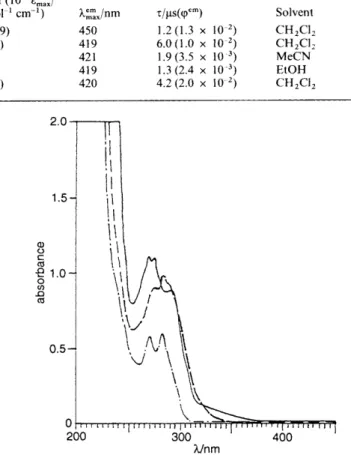
Spectroscopic Properties.-The spectroscopic and photo- physical data of the three gold(r)-acetylide complexes are summarised in Table 3. Fig. 2 depicts the UV/VIS absorption spectra of ~(PPh,),][Au(C=CPh),], [Au(PPh,)(C=CPh)] and [(Au(C=CPh)),(p-dppe)] in dichloromethane at room temperature. The three spectra are similar suggesting that [{Au(C=CPh)],(p-dppe)] can be viewed as two non-interacting Au(C=CPh) units, bridged by the dppe ligand. The intense absorption from 260 to 310 nm in each case arises from the intraligand n --+ x* transition of phenylacetylide. We do not rule out the possibility that the lower-energy absorption of [Au(C=CPh),] - at round 320 nm contains some metal-to- ligand charge-transfer (m.1.c.t.) Au-+n* character.
J. CHEM. SOC. DALTON TRANS.
1993
293
1Table 3 Spectroscopic and photophysical data of the gold(r)-acetylide complexes ( z 3.6 x mol dm-3) at room temperature
Complex
IR, v(C=C)/cm-' hktx/nm ( 10-4~,,,/
(Nujol) dm3 mol-' cm-') hk?Jnrn ~ / p s ( ( p ~ ~ ) Solvent
269 (1.99) 450 1.2(1.3 x CH,Cl, 284 (3.1) 419 6.0(1.0 x 10 2, CH,CIZ 42 1 1.9 (3.5 x 10 3, MeCN 419 1.3 (2.4 x 10⁻³) EtOH 284 (4.9) 420 4.2 (2.0 x 10 2, CH,Cl,
Q Q
Scheme 2Upon excitation at 280-350 nm, the gold(1)-acetylide complexes display intense emission. The spectra of [N(PPh,),]- [Au( C-CPh),] , [Au(PPh ,)(C=CPh)] and [ { Au(CzCPh))
,
-
(p-dppe)] are similar in solution at room temperature. Fig. 3 shows the spectra of [Au(PPh,)(CKPh)] in dichloromethane at room temperature and in ethanol-methanol (4 : 1 v/v) glass at 77 K . The well resolved vibrational fine structure displayed, which is due to a combination of the vibrations of the C=C and phenyl groups, is similar to that of the 3(n,n*) emission of co- ordinated phenylacetylide in [Pt(PEt,),(CsCPh),].''
Self- quenching of the emission of [Au(PPh,)(C=CPh)] was observed. A plot of the reciprocal of the lifetime uersus the concentration of the gold(r) complex gave a straight line with the self-quenching rate constant and lifetime at infinite dilution being (1.75 k 0.06) x lo* dm3 mol-' s-' and 10 k 0.5 ps respectively.In the solid state the emission maximum of [{Au(C=CPh)),- (p-dppe)] is dramatically red-shifted to 550 nm (Fig. 4). This emission energy is close to that of [Au2(p-dppm),12+
(A,,,
=570 nm)
'
2 u . b which has an intramolecular Au Au separation of 2.982(2)A.
From X-ray crystal analysis, two [(Au(C=CPh)} ,(p-dppe)] molecules are packed in the solid state with weak gold-gold interaction. With reference to previous works,1a,12,13 such interaction would give rise to p, as the lowest unoccupied molecular orbital and d6* as the highest occupied molecular orbital. Thus, in the solid state, the lowest electronic excited state is (d6*p,) in nature. In fluid solution the two [{ Au(C=CPh)),(p-dppe)] molecules separate and the intraligand phosphorescence becomes dominant. Cooling the solid sample to 77 K only leads to an increase in emission intensity. N o vibrational fine structure was observed.Photoredux Properties.-With long emission lifetimes, it is not surprising to find that the excited state of the gold(1)- acetylide complexes can participate in bimolecular redox reactions. The emissions are found to be quenched efficiently by methyl viologen ( 1,l '-dimethyl-4,4'-bipyridinium dichloride, [dmbipylCl,) in acetonitrile at room temperature. The corresponding quenching rate constant (k,) for [Au(PPh,)- (CAZPh)] [E" = -0.45 V us. sodium chloride saturated calomel electrode (SSCE)] has been measured to be 5.1 x 10' dm3 mol
'
s'
from a Stern-Volmer plot (z,/z = 1+
k,T,- [dmbipy2+]; to andz
are the lifetimes in the absence and2.0 1.5 Q) 0 t
g
1.0 D~:
0.5I
Fig. 2 The UVjVIS absorption spectra of [N(PPh3)2][Au(C=CPh),1 (-), [Au(PPh,)(C=CPh)] (- . -) and [{Au(C=CPh)),(p-dppe)] (- - -) in dichloromethane at room temperature
400 500 600
Unm
Fig. 3 Emission spectra of [Au(PPh,)(C-=CPh)] in dichloromethane
at room temperature (--) and in an ethanol-methanol (4: 1 v/v) glass at 77 K (- - - -)
presence of dmbipy2 '). The quenching mechanism is electron transfer in nature, as represented by equation (1).
[Au'(PPh,)(C=CPh)]*
+
dmbipy2 +-
[Au"(PPh,)(C=CPh)]+
+
dmbipy' (1) Evidence for the electron-transfer mechanism has been obtained from flash-photolysis experiments. The transient different absorption spectrum recorded 5 ps after flashing adegassed acetonitrile solution of [Au(PPh,)(CzCPh)] in the presence of methyl viologen is given in Fig. 5. The spectrum matches well the characteristic absorption of dmbipy + l 4
2932
J. CHEM. SOC. DALTON TRANS.1993
400 500 600 700 800
Unm
Fig. 4
methane (-) and the solid state (- - -) at room temperature
Emission spectra of [{Au(C&Ph)},(p-dppe)] in dichloro-
1.5 1
.o
q Qz
0.5 0.0 I I I I I 1 350 450 550 650 ?JnmFig. 5 Transient difference absorption spectrum recorded 5 ps after
flashing a degassed acetonitrile solution of [Au(PPh,)(CSPh)] (1 0-4 mol dm -,) with methyl viologen ( mol drn-,) at room temperature which is so intense that the absorption of [Au"(PPh,)(C=CPh)] + is obscured and could not be located
in the spectrum.
Conclusion
The work described together with previous studies on gold(1)
complexes of 2,2'-bibenzimidazolate and 7-azaindolate 2 b clearly suggests that co-ordination of organic molecules to Au' provides a new entry to a new class of emissive materials with long-lived electronic excited states. This may be of importance in the design of new photosensitizers for electron- and energy- transfer reactions.
Acknowledgements
We acknowledge support from the Hong Kong Research Grants Council, the Croucher Foundation of Hong Kong and National Science Council of Taiwan. C. M. C. is grateful for a visiting Professorship, administered by the National Taiwan University .
References
1 ( a ) D. Li, C. M. Che, S. M. Peng, S. T. Liu, Z . Y. Zhou and T. C. W.
Mak, J . Chem. SOC., Dalton Trans., 1993, 189; ( b ) S. J. Shieh, D. Li, S. M. Peng and C. M. Che, J. Chem. Soc., Dalton Trans., 1993,195; ( c )
C. F. Lee, K. F. Chin, S. M. Peng and C. M. Che, J. Chem. Soc.,
Dalton Trans., 1993,467.
2 (a) B. C. Tzeng, D. Li, C. M. Che and S. M. Peng, J. Chem. Soc., Dalton Trans., 1993,2365; ( b ) D. Li, K . K . Cheung and C. M. Che, unpublished work.
3 G. E. Coates and C. Parkin, J. Chem. Soc., 1962,3220.
4 0. M . Abu-Salah and A. R. A. Al-Ohaly, J. Chem. Soc., Dalton
5 J. N. Demas and G. A. Crosby, J. Phys. Chem., 1971,75,99.
6 E. J . Cabe, Y. Le Page, J.-P. Charland, F. L. Lee and P. S. White, 7 L. C. Porter, N. I. Md. Khan, C. King and J. P. Fackler, jun., Acta 8 M. I. Bruce and D. N. Duffy, Aust. J. Chem., 1986,39, 1697.
9 P. W. R. Corfield and H. M. M. Shearer, Acta Crystallogr., 1967,23, 156.
10 M. I. Bruce, E. Horn, J . G. Matisons and M. R. Snow, Aust. J . Chem.,
1984,37, 1 163.
11 L. Sacksteder, E. Baralt, B. A. DeGraff, C. M. Lukehart and J. N. Demas, Inorg. Chem., 1991,30,2468.
12 (a) C. M. Che, H. L. Kwong, V. W. W. Yam and K . C. Cho, J. Chem.
Soc., Chem. Commun., 1989,885; ( b ) C. M. Che, H. L. Kwong, C. K.
PoonandV. W. W. Yam, J. Chem. Soc., Dalton Trans., 1990,3215; ( c )
V. W. W. Yam, T. F. Lai and C. M. Che, J. Chem. Soc., Dalton Trans.,
1991,3747; ( d ) C. M. Che, H. K. Yip, V. W. W. Yam, P. Y. Cheung,
T. F. Lai, S. J. Shieh and S. M. Peng, J, Chem. Soc., Dalton Trans.,
1992,427.
13 C . King, J. C. Wang, N. I. Md. Khan and J. P. Fackler, jun., Znorg.
Chem., 1989,28,2145.
14 T. Watanabe and K. Honda, J . Phys. Chem., 1982,86,2617.
Trans., 1988, 2297.
J . Appl. Crystallogr., 1989, 22, 384.
Crystallogr., Sect. C, 1989,45, 947.
![Table 1 Atomic coordinates for non-hydrogen atoms of [{Au(C=CPh)},(p-dppe)]](https://thumb-ap.123doks.com/thumbv2/9libinfo/8875687.250117/2.891.103.818.117.827/table-atomic-coordinates-non-hydrogen-atoms-cph-dppe.webp)
![Fig. 5 Transient difference absorption spectrum recorded 5 ps after flashing a degassed acetonitrile solution of [Au(PPh,)(CSPh)] (1 0-4 mol dm -,) with methyl viologen ( mol drn-,) at room temperature which is so intense that the abs](https://thumb-ap.123doks.com/thumbv2/9libinfo/8875687.250117/4.891.83.422.92.302/transient-difference-absorption-spectrum-recorded-flashing-acetonitrile-temperature.webp)
