Adaptive Balanced Hybrid Data Delivery for Multi-Channel Data Broadcast
Chih-Lin Hu and Ming-Syan Chen
Department of Electrical EngineeringNational Taiwan University Taipei, Taiwan, R.O.C. Abstract— With the proliferation of wireless information applications
and services, data broadcasting known from radio networks has become an important mechanism for mobile data access in wireless communica-tion networks. Two data delivery techniques, push and pull, and their hybrid combination had been introduced to satisfy mobile user demands. However, most previous research efforts were elaborated upon the premise of a single channel with static workload and access pattern. Recently the emergence of a multi-channel broadcast paradigm has attracted much re-search attention in the data broadcast community. In this paper, we design an adaptive balanced scheme (ABS) which performs a heuristic search in pursuit of a fair balance of access time for a hybrid data delivery in a multi-channel data broadcast environment. The experimental results show that at the balanced point exploited by ABS, the result of channel partition and data item classification is very close to the optimal balance, and consequently, we are able to obtain the lowest mean access time in both push and pull channels simultaneously.
Keywords—Push, pull, data broadcast, mobile computing, wireless net-work.
I. INTRODUCTION
The wireless communication environment has a feature of bandwidth asymmetry since a downlink channel is of much larger bandwidth than the uplink channel. With the limited bandwidth capacity, it is essentially very difficult for a wire-less information server to handle a large population of mobile clients individually and simultaneously. Therefore, the asym-metry imposes constraints and challenges on the behavior be-tween clients and servers as well as on the design and develop-ment of wireless information applications and services.
Data broadcasting is a promising mechanism for resolving communication asymmetry against information dissemination in wireless network environments [1][7]. As the broadcast par-adigm, a server applies a broadcast cycle, which is a series of interleaved data slots, periodically delivering all data items in the database to clients through a shared medium. The benefits are twofold: (1) in the client side, data broadcasting achieves a total saving of all clients’ battery energy by avoiding per access request transmission, (2) an information server can moderately mitigate the inherent performance and scalability problems.
Originally a server can choose a pull- or push-based data de-livery to transmit data. However, a push dede-livery which broad-casts all items periodically can result in an unacceptable access time if the number of data items in the database is huge. In con-trast, a pull delivery responding to a client’s individual request inevitably incurs a scalability bottleneck with a heavy work-load. In view of this, a hybrid delivery is called for to strike a comparison between the trade-offs. Explicitly, data items are classified as hot (or popular) and cold (or unpopular) items ac-cording to their access frequencies, and data slots in a broad-cast cycle are partitioned into the push and pull sets. Push slots
carry hot items and a cold item is delivered on a pull slot by a request-response way. With the commonality of access inter-ests, a hybrid delivery mode provides an opportunity to make the access time malleable.
The recent advance of a multi-channel broadcast para-digm has a different utilization on downward bandwidth [6][9][10][11]. The downward bandwidth is divided into a number of sub-channels. Then, an adaptive hybrid data de-livery should periodically arrange the push and pull items and allocate push and pull channels in response to a traffic change, in order to attain an appropriate access time. However, most prior researches in the adaptation and balance of broadcast-ing mainly considered a sbroadcast-ingle channel scenario rather than a multi-channel one. In [2][3], the bandwidth assigned to push and pull slots is static and the contents of push and pull sets are constant, leading to no adaptation to various workloads. The work in [5] presents a feedback technique to understand the change of access pattern, assuming that all clients actively report access statistic. [12] presents a probing technique to collect changing access patterns and uses marginal gains to perform adaptation. [4] proposes an optimal cut-off scheme to determine the push and pull item sets. Recently, [9] is an analytical study about the multi-channel partition and [11] is designed for caching. [10] dynamically generates a broadcast disk program to improve energy saving and [6] devises an inter-polation search scheme for the adaptation extended from [10]. These works did not aim at the design of an adaptive balanced hybrid data delivery scheme.
Balancing push and pull response time is of vital importance, involving the channel allocation and data classification against traffic changes. In this paper we propose an adaptive balanced scheme (ABS) for a hybrid data delivery in a multi-channel data dissemination environment. ABS performs a determinis-tic search for a balanced point by adaptively allocating the push and pull channels and classifying the push and pull items in re-sponse to dynamic traffic changes. Therefore, ABS is able to discover the lowest balanced point where the mean access time is very close to the optimal one and the difference between the mean push and pull access time is minimized. The charac-teristic of its dynamic adaptability in a multi-channel scenario distinguishes ABS from the previous works. It is shown by the experimental results that ABS can obtain a balanced point with fairness in reducing both push access and pull response time.
The rest of the paper is organized as follows. Preliminary is given in Section 2. Section 3 presents the adaptive balanced scheme (ABS). Section 4 describes the simulation model and
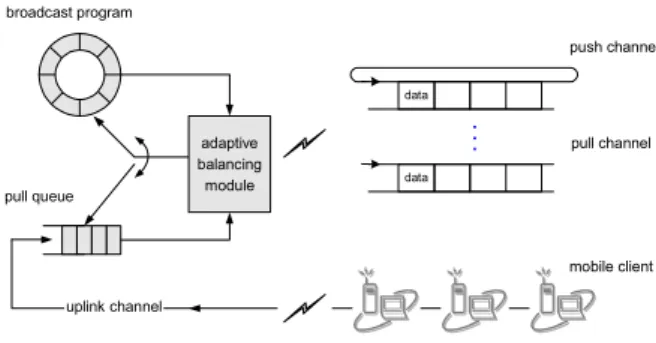
adaptive balancing module pull queue pull channel push channel . . . data data broadcast program mobile client uplink channel
Fig. 1. The integrated data broadcast in an asymmetric communication envi-ronment
demonstrates the experimental results. This paper concludes with Section 5.
II. PRELIMINARY
A. Model the Data Dissemination Environment
Fig. 1 illustrates a multi-channel hybrid data delivery in which we consider the adaptation and balance works. A wire-less information server interacts with clients in its service cov-erage over the wireless medium. The broadcast downlink bandwidth is divided into a number of sub-channels of smaller, equal bandwidths. The server contains a database including all broadcast items which are classified as hot or cold ones ac-cording to their previous access frequencies. The server broad-casts hot items over push channels periodically and delivers cold items by pull channels in response to clients’ explicit ac-cess requests. Moreover, a server provides an uplink channel to receive clients’ pull requests. The adaptive module attempts to balance mean access and response time of push and pull access respectively under a dynamic nature of broadcast traffic. The assumptions adopted in this study are as follows.
• The length of broadcast cycle is not fixed.
• Broadcast program is dynamic with various traffic factors. • Each item is self-identified and read-only.
• The uplink channel bandwidth is constant. There is only one
uplink channel in this model.
• A downlink channel is either in the pull or push mode, and
can alternatively be switched to complement other channels. Note that the model is similar to the data dissemination en-vironment in [9][10][12], while having a graceful extension for the multi-channel paradigm.
B. Measurement Formulation
Consider a server has a database that contains |D| = M items of equal size s. Assume that the request for each item di
forms a Poisson process of rate λiwith an order as λ1≤ λ2≤
.... ≤ λM. Then the total request arrival rate is λ =PMi=1λi.
The server has a service rate for each channel is µ = b/s. We let λpush = PMi=k+1λi be the push access rate and λpull =
λ − λpush=Pki=1λibe the pull request arrival rate.
B.1 Pull average response time in on-demand channel Since there is a single server, the pull delivery system can be modeled as a birth-death process with a birth rate λpulland a
constant death rate µpull= µ × cpull. Then cpullis the number
of pull channels as a control factor for dynamic channel allo-cation. Each pull channel is viewed identical and pull channels are coalesced, not merged, to serve the arrival requests. We then model this case as an M/M/m system [8] where m = cpull
is the number of pull channels and λpull< m × µ is the stable
condition. Consequently, the mean pull response time in the system is π0= "m−1 X k=0 (mρ)k k! + (mρ)m m!(1 − ρ) #−1 and tpull= 1 µ+ (mρ)m m!(mµ − λ)(1 − ρ)π0 (1)
where ρ = λ/mµ is the traffic intensity and π0is the
steady-state probability that no request waits in the queue. B.2 Push average response time in broadcast channel
tpush= sk (2bcpush) +s b = k 2µcpush + 1 µ (2)
where k is the number of items which are broadcast periodi-cally, s/b is the inverse of channel service rate and ks/(bcpush)
is the time period of a broadcast cycle bc.
III. DESIGN ANADAPTIVEBALANCEDSCHEME
The adaptive balanced scheme (ABS) we should devise will improve the adjustment of channel allocation and data group-ing under a variety of traffic factors, such as dynamic workload, client access pattern, user behavior, etc., and therefore achieve the fairness in terms of push and pull access/response time for a multi-channel data broadcast.
ABS begins with a broadcast mode that all channels are in the push mode and data in the broadcast program are sched-uled in ascending order of access frequencies. ABS firstly tries if altering a push channel as the pull mode will reduce both of tpushand tpull. According to (2), tpushhas a linear
progres-sion with the amount of push items, whereas tpullis vulnerable
to traffic intensity, especially request frequency, as expressed in (1). That is, ABS will do adaptive balancing by following Criterion-1 below. When a push channel is switched to the pull mode, a decrease of tpullcauses imbalance. Then ABS starts
to repeatedly demote an item of min{λi|di in push item set
Upush} into the pull item set Upull, and stops demotion as long
as an added item causes tpull to be larger than tpush. Since
an increased tpullmeans a decreased tpush, there exists a cross
point where ABS reaches a balanced point by monitoring the value of tpush. The trial process in a channel switch will stop
when ABS detects that a trial tpush goes up or all channels
have been switched as the pull mode. Some criteria of ABS are given below.
Criterion 1 At a local balanced point, tpullshould be lower
than tpushand have a minimal distance Min(tpull, tpush).
Criterion 2 ABS asserts an adaptation when tpushin a trial is
lower than the last tpush.
Criterion 3 An upward tpushin a trial indicates a worse
bal-anced point.
Criterion 4 If no push channel is available, that is, a pure pull-based mode, tpull will alternatively be used to compare
with the last tpush.
As mentioned above, ABS looks for a new proper balanced point when a traffic change causes imbalance. It is noted that as for the detection of access frequency, one can employ the prob-ing technique in [12] which has been used in [3] too. However, unlike prior works on a single channel paradigm where a data slot is the replacement unit, the switch unit in ABS is a channel as well as a series of item demotion/promotion. For interested readers, the algorithmic form of ABS is given as follows.
Input: Upush= {D}, Upull= {∅}, cdown, bc, µ, λ, buf f er
Output: Upush, Upull, cpush, cpull, tpush, tpull, bc
begin
1. t1push← evaluatePushTime(Upush, cpush, µ)
2. t1pull← evaluatePullTime(cpull, λpull, µ, b)
3. while cpushis not zero and Upushis not empty do
4. t1push← evaluatePushTime(Upush, cpush, µ)
5. t1pull← evaluatePullTime(cpull, λpull, µ, b)
6. cpush← cpush−1
7. if cpushis smaller than zero then
8. break
9. endif
10. cpull← cpull+1
11. while λpullis smaller than µ cpulldo
12. if Upush= {D} and cpushis larger than zero then
13. t0
2push← evaluatePushTime(Upush, cpush, µ)
14. t0
2pull← evaluatePullTime(cpull, λpull, µ, b)
15. else
16. λpull← λpull+ min{λi|di∈ Upush}
17. t0
2push← evaluatePushTime(Upush, cpush, µ)
18. t0
2pull← evaluatePullTime(cpull, λpull, µ, b)
19. t2push, t2pull←compareToLastDemotion(t02push, t02pull)
20. endif
21. endwhile
22. isBetter ←compareToLastBalance(t1push, t1pull, t2push, t2pull)
23. if isBetter is True then
24. return Upush, Upull, cpush, cpull, tpush, tpull, BM Cycle
25. else
26. continue
27. endif
28. endwhile
end
IV. EXPERIMENTS ANDRESULTS
A. Simulation Model
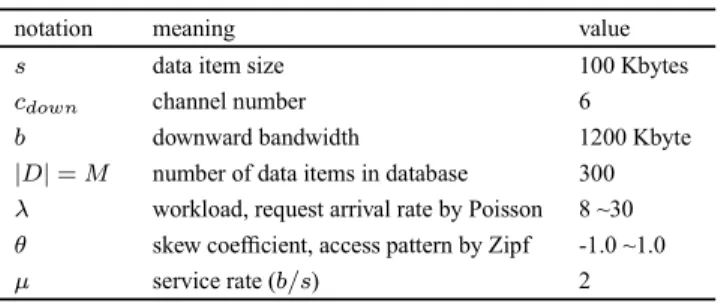
Table 1 lists the simulation parameters. We use a general Zipf distribution expressed as pi = (1i)θ/
PM
i=1( 1
i)θ, where θ
is a skew coefficient and 1 ≤ i ≤ M.
TABLE I
SIMULATION PARAMETERS DESCRIPTION
notation meaning value
s data item size 100 Kbytes
cdown channel number 6
b downward bandwidth 1200 Kbyte
|D| = M number of data items in database 300 λ workload, request arrival rate by Poisson 8 ~30 θ skew coefficient, access pattern by Zipf -1.0 ~1.0
µ service rate (b/s) 2
B. Sensitivity to Dynamic Access Frequency
Under a constant workload λ = 15, Fig. 2(a)-(c) show the curves of the push access and pull response time under a variety of dynamic access patterns. As shown, when a push channel is switched to the pull mode, ABS immediately demotes hot items into push channels so as to look for a new balance where tpull is lower than tpush and the distance between tpull and
tpushis minimal. A new tpushlower than that in the last trial
of a channel switch is preferable. Following this trial process, ABS continues until all 6 channels are in the pull mode, show-ing a pure pull delivery in this case. Because tpushis not
avail-able in this trial, ABS compares tpullwith tpushin the last trial.
If tpull is lower than the last tpush, ABS employs a pure pull
delivery.
In Fig. 2(a), both push and pull curves go up drastically as the last push channel is switched to the pull mode. The in-finite tpush indicates that some hot items remain in the push
set but there is no more push channel because the workload is larger than the pure pull service rate. Fig. 2(b) and (c) show a comparison by the skewed frequency distributions. Using θ = −0.5 generates a Zipf distribution that is close to an uni-form distribution, but a distribution with θ = 1 is very skewed. The latter has a much lower tpushthan the former. The reason
is that delivering a few items holding a major access frequency by the push mode can significantly reduce the pull traffic load. If a very hot item is incorrectly demoted as a cold one, surely high broadcast misses will result in many pull requests for it. With ABS, we observed that a less skewed frequency distribu-tion will have a higher tpush, and a hybrid data delivery favors a
high skewed access frequency distribution. Moreover, a larger mean access time does not imply a higher access frequency. Even though a static workload, a change of client access inter-est can result in a higher access time.
0 5 10 15 20 25 0 1 2 3 4 5 6
the number of push channels
th e av re ag e pus h r es pons e t im e push: 0.5 pull: 0.5
(a) dynamic access frequency (Zipf theta=0.5) vs. avreage access time
0 5 10 15 20 25 0 1 2 3 4 5 6
the number of push channels
th e av reag e p us h r es po ns e t im e push: 1.0 pull: 1.0
(c) dynamic access frequency (Zipf theta=1.0) vs. avreage access time
0 5 10 15 20 25 0 1 2 3 4 5 6
the number of push channels
th e av reag e p us h r es po ns e t im e push: -0.5 pull: -0.5
(b) dynamic access frequency (Zipf theta=-0.5) vs. avreage access time
Fig. 2. With dynamic data access frequency, ABS dynamically adjusts channel allocation and data classification for a balanced searching. (λ:15 req./sec)
C. Sensitivity to Dynamic Workload
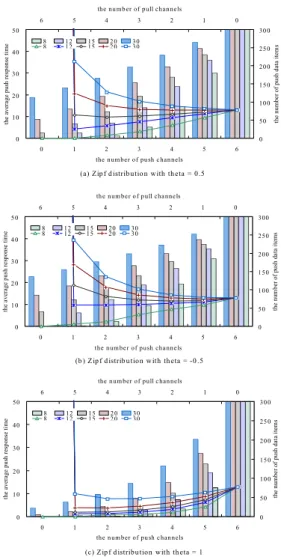
In general, a dynamic workload can be caused by a change of client population. Fig. 3 explicitly depicts the time curves ver-sus adaptive channel allocation, and the bar chart indicates the number of items delivered on push and pull channels respec-tively by adaptive item promotion/demotion with a channel al-location. Fig. 3(a) illustrates a Zipf distribution with θ = 0.5 under various workloads with a light load λ = 8 and 12 and a heavy load λ = 15, 20 and 30 respectively. Initially, all 6 channels are in the push mode and all 300 items are push items. ABS then looks for a local optimal balance by itera-tively switching a push channel and demoting push items as long as tpullis smaller than tpushand the pull aggregated
fre-quency does not reach the upper limit. If a new local balance is lower than the latest balance point, ABS will use the newly discovered local point as the new balanced point. As shown in the curve of workload λ = 8, ABS gets the best balance at all 6 channels as the pull mode in this case, showing a pure pull delivery. However with workload λ = 12, ABS suffers
0 50 10 0 15 0 20 0 25 0 30 0 6 5 4 3 2 1 0
the n um ber of pu sh c han nels
the numbe r of pus h dat a i tem s 0 10 20 30 40 50 0 1 2 3 4 5 6
the nu mb er of pull c han nels
th e avera ge pus h respo nse ti me 8 12 15 2 0 30 8 12 15 2 0 30
(a) Zip f d istrib utio n with th eta = 0 .5
0 50 100 150 200 250 300 6 5 4 3 2 1 0
the num be r of push cha nne ls
the nu m ber of p ush d ata ite ms 0 1 0 2 0 3 0 4 0 5 0 0 1 2 3 4 5 6
th e num be r o f p ull cha nne ls
the a verage push re spons e tim e 88 1212 1515 2020 3030
(b ) Zip f d istrib u tion w ith th eta = -0 .5
0 50 10 0 15 0 20 0 25 0 30 0 6 5 4 3 2 1 0
the n um ber of pu sh c han nels
the numbe r of pus h dat a i tem s 0 10 20 30 40 50 0 1 2 3 4 5 6
the n um ber of pull c han nels
th e avera ge pus h respo nse ti me 8 12 15 2 0 30 8 12 15 2 0 30
(c) Zip f d istribu tion with th eta = 1
Fig. 3. ABS searches a balance under dynamic workloads.
an unstable circumstance when it attempts to switch the last push channel to the pull mode. With 6 pull channels, all items have to be delivered by the pull mode. However, workload λ = 12 will make tpullunpredictable according to an M/M/m
queueing model. Hence ABS goes back to the last trial which allocates one push channel to contain 15 most hot items with tpush= 4.25 and 5 pull channels to deliver cold items. When
the workload is 15, 20 or 30 respectively, we can find that nei-ther pure push nor pull mode is suitable and ABS performs a hybrid delivery. Even though all channels are the pull mode, we can observe that some items are not on the pull channels yet because the pull workload has reached the upper limit. In this case, ABS will stop its search when it perceives that a channel switch from push to pull does not lead to a better balance.
In Fig. 3(c), most items are cold data and are delivered through 5 pull channels, except the case that workload is 30. Moreover, all the curves are lower than their corresponding curves in Fig. 3(a). This observation shows that given a very high skew access pattern, an increasing workload does not make tpush go up sharply and tpushis still lower than tpush
in a pure push delivery. It is interesting to note from Fig. 3(b) that if access pattern is not relatively skewed, a channel switch does not save too much tpushwhen the dynamic workload is
heavy. The length of inner histograms with a linear decrease of degree conforms with this observation. In this case, ABS finds that a pure push is preferable when the workload is very heavy. D. Dynamic Real Traffic Scenario
Fig. 4 presents an attractive scenario considering dynamic access frequency and request arrival rate simultaneously. To simplify a demonstration, we set that access frequency will in-crease linearly from 10 to 20 per broadcast cycle, and the ac-cess pattern is skewed by θ from 1.0 to -0.5. In Fig. 4(a), starting at λ = 10 and θ = 1.0, ABS finds the best balanced point at tpush = 0.78 when all channels are in the pull mode.
In the broadcast ABS detects a traffic change (λ = 12) and ac-cordingly searches a new balance at tpush = 1.75 with 5 pull
channels and 5 push items in one push channel. ABS iteratively repeats the same process, and finally, as λ = 20 ABS reaches a new balanced point at tpush = 12.2 with 5 push channels.
Note that tpush = 12.2 is better than the last two balanced
points because its access distribution is near an uniform distri-bution when θ is close to 0. This agrees with our intuition since a pure broadcast is suitable for a random access traffic.
Fig. 4(b) shows the comparison among pure push, pure pull and ABS delivery modes. Pure push’s tpushis a constant value
of 13. Oppositely, pure pull’s tpullis sensitive to the request
arrival rate. When the workload is larger than the available bandwidth, tpullbecomes unacceptable. For a hybrid delivery
mode, the response time is influenced by the access pattern and the request arrival rate. As the case of θ = 0.5 and λ = 20 that presents a higher and skewed workload, ABS can adaptively determine a better balanced point at tpush= 12.2.
V. CONCLUSIONS
In this paper we propose an adaptive balanced scheme (ABS) which aims at balancing the push and pull mechanisms for a hybrid data delivery in a multi-channel data dissemination environment. We model the adaptation of channel allocation and data classification as a deterministic searching for a lo-cal balance from the viewpoint of the access/response fairness. Rather than being dedicated to a specific traffic factor, ABS takes account of multiple traffic factors at a same time. The simulation result has shown the feasibility and the reliability of ABS, especially its adaptiveness to dynamic traffic changes.
ACKNOWLEDGEMENT
The authors were supported in part by the Ministry of Edu-cation Project No. 89-E-FA06-2-4-7 and the National Science Council, Project No. NSC 90-2213-E-002-086, Taiwan, Re-public of China.
REFERENCES
[1] S. Acharya, R. Alonso, M. J. Franklin, and S. B. Zdonik. Broadcast disks: Data management for asymmetric communications environments.
0 5 10 15 20 0 1 2 3 4 5 6 th e n u m b er o f p u sh ch an n els th e av re ag e p us h r es po ns e tim e 1 0, 1.0 1 2, 0.8 1 4, 0.3 1 6, 0.1 1 8, -0.1 2 0, -0.5
(a) A B S search es a b alan ce u n d er a d yn am ic traffic w ith m u lti-fa cto rs
0 5 10 15 20 10 12 14 16 18 20
th e n u m b er o f req u est arriv al rate
th e avr eage p us h r es pon se ti m e pu re pull pu re push a dap tive ba la nce
(b ) A B S b ala n c es th e m ean re sp o n e tim e
Fig. 4. ABS is adaptive to both dynamic access pattern and workload simul-taneously.
In Proceedings of the 1995 ACM International Conference on
Manage-ment of Data, pages 199–210, May 1995.
[2] S. Acharya, M. J. Franklin, and S. B. Zdonik. Balancing push and pull for data broadcast. In Proceedings of the 1997 ACM International
Con-ference on Management of Data, pages 183–194, May 1997.
[3] J. Cai and K.-L. Tan. Tuning integrated dissemination-based information systems. Data & Knowledge Engineering, 30(1):1–21, 1999.
[4] Y. Guo, S. K. Das, and C. M. Pinotti. A new hybrid broadcast scheduling algorithm for asymmetirc communication systems: Push and pull data based on optimal cut-off point. In Proceedings of the 4th ACM
Interna-tional Workshop on Modeling, Analysis and Simulation of Wireless and Mobile System, pages 123–130, July 2001.
[5] Q. Hu, D. L. Lee, and W.-C. Lee. Dynamic data delivery in wireless communication environments. In Proceedings of ER’98 Workshops on
Mobile Data Access, volume 1552 of Lecture Notes in Computer Science,
pages 218–229. Springer, 1998.
[6] J.-L. Huang, W.-C. Peng, and M.-S. Chen. Binary interpolation search for solution mapping on broadcast and on-demand channels in a mo-bile computing environment. In Proceedings of the 10th ACM
Interna-tional Conference on Information and Knowledge Management,
Novem-ber 2001.
[7] T. Imielinski, S. Viswanathan, and B. R. Badrinath. Data on air: Orga-nization and access. IEEE Transactions on Knowledge and Data
Engi-neering, 9(3):353–372, May/June 1997.
[8] K. Kleinrock. Queueing Systems, volume I: Theory. Wiley, New York, 1975.
[9] W.-C. Lee, Q. Hu, and D. L. Lee. A study on channel allocation for data dissemination in mobile computing environments. ACM/Baltzer Mobile
Networks and Applications, Special Issue on Resource Management in Wireless Systems, 4(2):117–129, 1999.
[10] W.-C. Peng and M.-S. Chen. Dynamic generation of data broadcasting programs for a broadcast disk array in a mobile computing environment. In Proceedings of the 9th ACM International Conference on Information
and Knowledge Management, November 2000.
[11] K. Prabhakara, K. A. Hua, and J. Oh. Multi-level multi-channel air cache designs for broadcasting in a mobile environment. In Proceedings of the
16th IEEE International Conference on Data Engineering, pages 167–
176, February 2000.
[12] K. Stathatos, N. Roussopoulos, and J. S. Baras. Adaptive data broadcast in hybrid networks. In Proceedings of the 23rd International Conference