
Synthesis ofAsymmetric Tolane Liquid Crystals for Display Application
Kuen-Torng Tsay and Chain-Shu HsuDepariment ofApplied Chemistry, National Chiao lung University
Hsinchu, Taiwan 30050 and Shin-Tson Wu
HRL Research Laboratories, 3011 Malibu Canyon Road Malibu, CA 90265
ABSTRACT
Four series of transcyc1ohexy1-based tolanes, i.e., 4(trans-4-a1ky1cyc1ohexy1)-4'-f1uoroto1anes,
4-(trans-4-alkyl-cyclohexyl)-3 ',4'difluoroto1anes, 4-[2-(trans-4-a1ky1cyc1o-hexy1)ethy1]-4'-a1ky1to1anes and fluorinated 442.. (trans-4-alkylcyclohexyl)ethyl] tolanes are prepared and characterized. All the obtained compounds display
nematic liquid crystalline phases. The results demonstrate that incorporation of a cyclohexyl ring in the
mesogen core structure leads to form a wide temperature range of mesophase. However it also increases the
tendency to form a smectic phase. The dielectric anisotropy ( E
)
and birefringence (z n) of some selectedcompounds were measured by a guest-host method. All of those compounds studied show relatively high
dielectric anisotropy and birefringence.
Keywords: nematic liquid crystals, fluorinated tolanes, trans-cychohexyl based liquid crystals.
1. INTRODUCTION
Nematic liquid crystals (LCs) with high birefringence (z n), low viscosity, low threshold voltage (Vth), and wide
nematic range are particularly useful for infrared light valves' and polymer dispersed LC displays2. High viscosity shortens the response times, and low V,,, simplifies the driving electronics. Low V,, is especially important for polymer dispersed LCs where a significant portion of the applied voltage is shielded by the
polymer matrix3, so that the voltage operating across the LC droplets is far less than the applied voltage. As a result, a relatively high voltage is needed to make the LC device active.
Recently, we synthesized several series of diphenyl-thacetylethc LC compounds which possess a high
birefringence47. However the highly conjugated molecules are often associated with a high melting point and
large viscosity. Therefore, their usefulness is quite limited. Fluorinated LC compounds8'° are known for their modest dielectric anisotropy and low viscosity. The goal of this study is to present the synthesis and
CPTP-nF, n=2—7 CPTP-nFF, n=27
J7—CH2CH2---CC—!__CnH2n+1
CEPTP-4n,n=46CH2CH2CcZ
CnH2n+ CEPTP-nF, X=H, Y=H, Z=F, n=4,5 CEPTP-nFF, X=F, Y=H, Z=F, n=4,5 CEPTP-nFFF, X=F, Y=F, Z=F, n=4,5Thestructure-property relationships for the compounds prepared are discussed.
2. EXPERIMENTAL
The synthetic route used to prepare the asymmetric tolanes is outlined in Schemes 1-3.
x
F/ \
1:X=HY=I 2: X=F, YBr Ph3P / Pd(Ph3P)2C12 / Gui Et3NCnH2n+
CPTP-nF, n=2-7, X=H7—CH2CH2—(—Br
CnH2n+t/CCH
Ph3P / Pd(Ph3P)2C12/ Gui Et3N 7_CH2CK2_(—CC_(—_CnH2n+1 CEPTP-4n, n=46Scheme 2: Synthesis of 4-[2-(tans-butyIcycIohexy1)ethy-4'-aIyoIanes
CnH2n+1
ZJCECH
Ph3P / Pd(Ph3P)2Ci2 / Gui Et3NCHj
CEPTP-nF, XH, YH, ZF, n=4,5 CEPTP-nFF, XF, YH, ZF, n4,5 CEPTP-nFFF, X=F, YF, Z=F, n4,54-(trans-4aIky1cyc1shexy1)pheny1acety1enes and l-(trans-4-a1kylcyclohexy1)2(4bromopheny1)ethanes were prepared according to the literature methods'°". 4-(trans-4-alkylcyclohexyl)-4'-fluorotolanes and
4-(irans-4-alkylcyclohexyl)-3', 4'-difluorotolanes were prepared respectively by the coupling of a
4-(trans..4-alkylcyclohexyl)phenylacetylene with 4-fluoroiodobenzene and 3,4-difluorobromobenzene7"2.
4-[2.<Trans-4-alkylcyclohexyl)ethyl}-4'-alkyltolanes and fluorinated 4-[2-(trans-4-alkylcyuclohexyl)ethy]tolanes were
prepared by the coupling of 1-(trans-4-alkylcyclohexyl)-2-(4-bromophenyl) tolane with 4-alkylphenylacetlyene and fluorophenyl acetylene. The products were purified several times by column chromatography and
recrystallization until gic proved that their purities were greater than 99 per cent.
3. RESULTS AND DISCUSSION
3.1 Phase fransitions ofCPTP-.nF and CPTP-nFF
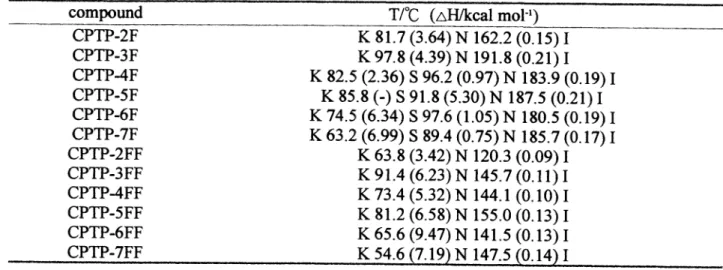
The phase transitions and corresponding enthalpy changes for compounds CPTPnF and CPTP-nFF are listed in
Table 1 .
All
of the synthesized compounds reveal mesomorphic properties. In the CPTPnF homologs, both Table 1 : Phase Transition temperatures and enthalpy changes ofcompounds CPTP-nF and CPTP-nFFcompound
__________
T/°C(H/kcal mol') ____
__________CPTP-2F K 81.7 (3.64) N 162.2 (0. 15) I CPTP-3F K 97.8 (4.39) N 191.8 (0.21) I CPTP-4F
K 82.5 (2.36) S 96.2 (O.97)N 183.9(0.19)1
CPTP5F
K 85.8 (-)S91.8 (5.30) N 187.5 (0.21)1CPTP6F
K 74.5 (6.34) S 97.6 (1.05) N 180.5 (0.19) I CPTP-7F K 63.2 (6.99) S 89.4 (0.75) N 185.7 (0. 17) I CPTP-2FF K 63.8 (3.42) N 120.3 (0.09) I CPTP-3FFK 91.4 (6.23) N 145.7(0.11)1
CPTP..4FF K 73.4 (5.32) N 144. 1 (0. 10) I CPTP-5FFK 81.2 (6.58) N 155.0(0.13)1
CPTP-6FF K 65.6 (9.47) N 141.5 (0.13)1 CPTP-7FF K 54.6 (7. 191N 147.5 (0.14) IK =
crystalN =
nematicS smectic
I =
isotropiccompounds with monofluoro-substitution, presumable because the lateral fluoro-substituent increases the intermolecular separation and therefore weaken the molecular altractive forces.
Figures 1 and 2 depict the effect of alkyl chain length on the phase transitions of both series of asymmetric
tolane LCs. The odd-even effect is observed for both series of compounds. Those compounds containing even carbon number on the alkyl chains show relatively lower melting points than the others. Generally
speaking, among both series of homologs, both CPTP-3F and CPTP-3FF show respectively a highest melting
point whereas both CPTP-7F and CPTP-7FF exhibit respectively a lowest melting point. Therefore both
CPTP-7F and CPTP-7FF also present respectively a widest temperature range of mesophase.
Fig.1 : The phase iransition temperature versus n
of CPTP-nF 250 200
e150
N 0 1 I 1 2 34
5 6 7Fig.2 : The phase transition temperature versus n of CPTP-nFF 200
-
—
— 150":
0 I I I 2 3 4 5 6 7Alkylchain length (n)
3.2 Phase transitions of CEPTP4n
The phase transitions and corresponding enthalpy changes of CEPTP4n are listed in Table 2.
Table 2 Transition temperatures and enthalpy changes of compounds of 4-[2-(trans-4-alkylcyclohexyl)ethyl]-.4'-alkyltolanes
Compound
T/°C (HIkcal mol')
CEPTP-44 K 53.4 (5.19)
N
125.2 (0.37)1CEPTP-45 K 47.3 (4.27) N 123.9 (0.35)
I
CEPTP-46 K 34.7 (-)S44.6 (5.64)
N
115.5 (0.18)1All three compounds show very wide temperature range of nematic phase. As the alkyl chain length increases, the melting point of the obtained compound decreases. Compound CEPTP4,6 show the lowest melting point and widest temperature range of mesophase. However it also form a smectic phase. The results demonstrate that incorporation of a tran-cyclohexylethyl group in the tolane mesogenic core can also increase dramatically
CEPTP-nFF and CEPTP..IiFFF. Four fluorinated and difluorinated tolanes, CEPTP-4F, CEPTP-5F, CEPTP-4FF and CEPTP-5FF, exhibit respectively a nematic phase. Both difluorinated tolanes reveal relatively lower phase transition temperature than both fluorinated tolanes reveal relatively lower phase transition temperatures than both fluorinated tolanes. This means that the lateral fluoro-substituent increases the intermolecular separation
and therefore weaken the molecular attractive forces. Both irifluorinated tolanes show veiy different
mesomorphic behavior in cmparison with that of fluorinated and difluorinated tolanes. Compound CEPTP-4FFF exhibit a nematic a smectic phases while CEPTP.5FFF reveals only a monotropic nematic phase. The reason could be due to the odd number carbon chain which is inconsistent with the trifluoro substituents in the molecular packing. Comparing the thennal behavior of this series of fluorinated and difluorinated compounds with that of corresponding CPTP-nF and CPTPnFF compounds, confirms that incorporating a flexible ethyl group in the mesogenic core decreases not only the phase transition temperatures but also the tendency to form a smectic phase.
3.4 Comparison of the mesomorphic behavior of CPTP-nF and CPTP.nFF with that of PTP -nF and
PTP-nFF
Table 3 : Transition temperatures and enthalpy changes for the fluorinated 4-[2(trans4-alkylcyclo-hexyl)ethyl]tolanes
Compound
T/°C (Hfkcal mol')
CEPTP-.4F K 76.2 (8.08) N 141.0 (0.36) I
CEPTP5F
K 77.4 (6.08) N 145.3 (0.30) I CEPTP-4FF K 60.3 (5.46)N
1 18. 1 (0.23) I CEPTP-5FF K 66.6 (6.60) N 133.0 (0.42) I CEPTP-4FFF K 89.3 (-) S 98.8 (7.26) N 120.3 (0.29) I CEPTP-5FFF K [97.2 (0. 16) } N 98.8 (1.26) I[ I : means monotropic transition
Table 4 reports the thermal transitions of 4-.alkyl-4'-fluorotolanes (PTPnF) and
4.-alkyl-3',4'-difluorotolane (PTP-nFF) which were reported previously'2. According to the data list in Table 4, both PTP-nF and PTP-.nFF homologs exhibit no mesophase. Comparing the thermal
behavior of both series of compounds with that of CPTPnF and CPTP-nFF, confirms that mcoorporation of a
cyclohexyl ring in the tolane mesogemc core increases dramatically the tendency to form a mesophase.
Finally, we use a guest-host method to measure the dielectric constants and refractive indices at room tnnperature (T=22°Cor Tr=0.86) The extrapolated Ln and z E valuesfor compounds CPTP-6F are 0.17 and
4.06 respectively, and those for compound CPTP-6FF areO. 15 and 5.82, respectively. Both compounds are useful in formulating eutectic mixtures with enhanced dielectric anisotropy.
Table 4 : Phase transition temperatures and enthalpy changes ofcompounds PTP-nF and PTP-nFF
CH2n+1CCF
Compound
x
T/°C(LH/kcal
mo11)PTP-3F
H
K 50.8(5.77) I
PTP-4FH
K 56.7(4.43) I
PTP-5FH
K 64.2(6. 12) I
PTP-6FH
K 45.8(5.33) I
PTP-2FFF
K 28.0(3.97) I
PTP3FF
F
K 37.8(6.35) I
PTP-4FFF
K 50.3(6.05) I
PTP-5FFF
K 49.4(5.29) I
PTP.6FF
F
K 41.7(5.811 I
4. CONCLUSION
Four series of asymmetric tolanes, 4-(trans-4-alkylcyclohexyl)-4'4luorotolanes, 4-(trans-4.albylcyclohexyl)-3',
4'difluorotolanes, 4-[2-(trans-4-a1kylcyc1ohexyl)ethyl]-4'alkyltolanes and fluorinated 4-[2(trans-4.-alkylcyclohexyl)ethyl]tolanes have been prepared and characterized. All four series of asymmetric tolanes
exhibit very wide temperature range of nematic phase. The results demostrate that incoorporation a cyclohexyl ring in the tolane mesogemc core, increases dramatically the tendency to form a mesophase. The synthesized
liquid ciystal compounds which show moderate L n value and high L\ e value, are useful in formulating
eutectic mixtures for display application.
5. ACKNOWLEDGEMENT
The authors are grateful to the national Science Council of the Republic of China (NSC81-O4O5EOO9O1) for
c661 '6Ot '61
![Table 2 Transition temperatures and enthalpy changes of compounds of 4-[2-(trans-4- 4-[2-(trans-4-alkylcyclohexyl)ethyl]-.4'-alkyltolanes](https://thumb-ap.123doks.com/thumbv2/9libinfo/7939639.157496/6.925.306.685.147.496/table-transition-temperatures-enthalpy-changes-compounds-alkylcyclohexyl-alkyltolanes.webp)

