Thickness dependence of Co anisotropy in TbFe/Co exchange-coupled bilayers
Chao-Cheng Lin, Chih-Huang Lai, D. H. Wei, Y. J. Hsu, and Han-Ping D. Shieh
Citation: Journal of Applied Physics 95, 6846 (2004); doi: 10.1063/1.1689911
View online: http://dx.doi.org/10.1063/1.1689911
View Table of Contents: http://scitation.aip.org/content/aip/journal/jap/95/11?ver=pdfcov Published by the AIP Publishing
Articles you may be interested in
Temperature dependence of large exchange-bias in TbFe-Co/Pt Appl. Phys. Lett. 101, 222404 (2012); 10.1063/1.4767142
Uncompensated antiferromagnetic moments in Mn-Ir/FM (FM=Ni-Co, Co-Fe, Fe-Ni) bilayers: Compositional dependence and its origin
J. Appl. Phys. 110, 123920 (2011); 10.1063/1.3672450
Magnetization reversal, asymmetry, and role of uncompensated spins in perpendicular exchange coupled systems
Appl. Phys. Lett. 89, 232507 (2006); 10.1063/1.2402882
Soft x-ray magnetic circular dichroism study of Mn – Ir Co – Fe bilayers with giant exchange anisotropy Appl. Phys. Lett. 89, 172501 (2006); 10.1063/1.2364116
Angular dependence of remanence of exchange-coupled CoFe/NiO bilayers J. Appl. Phys. 89, 7549 (2001); 10.1063/1.1354596
[This article is copyrighted as indicated in the article. Reuse of AIP content is subject to the terms at: http://scitation.aip.org/termsconditions. Downloaded to ] IP: 140.113.38.11 On: Thu, 01 May 2014 04:22:01
Thickness dependence of Co anisotropy in TbFe
Õ
Co
exchange-coupled bilayers
Chao-Cheng Lin and Chih-Huang Laia)
Department of Materials Science and Engineering, National Tsing Hua University, Hsinchu, 300, Taiwan
D. H. Wei and Y. J. Hsu
National Synchrotron Radiation Research Center, Hsinchu, 300, Taiwan Han-Ping D. Shieh
Institute of Electro-Optical Engineering, National Chiao Tung University, Hsinchu, 300, Taiwan
共Presented on 7 January 2004兲
The orientation of element-specific moments was determined by using x-ray magnetic circular dichroism spectroscopy to explore exchange anisotropy of TbFe/Co bilayers. Perpendicular anisotropy of 15 Å Co was induced by TbFe through exchange coupling, resulting in the out-of-plane Co moments. With increasing the thickness, Co moments were gradually tilted to the in-plane orientation because of increasing planar anisotropy. In the bilayer with thick Co, interfacial Fe moments were unidirectionally aligned in the plane, leading to in-plane exchange bias of Co. The coercivity and exchange bias field of Co in the bilayers exhibited a strong dependence on Co thickness. © 2004 American Institute of Physics. 关DOI: 10.1063/1.1689911兴
Extensive effort has been devoted to investigate the physical mechanisms of the exchange bias because of the fundamental interest and important technical applications.1 Most of the research focused on the investigation of the ex-change interaction between ferromagnetic共FM兲 and antifer-romagnetic共AFM兲 bilayers applied for storage industry. The planar exchange anisotropy was also found in the bilayers composed of ferromagnetic layer with in-plane anisotropy and ferrimagnetic rare-earth–transition-metal 共RE–TM兲 al-loys with perpendicular anisotropy.2Since RE–TM films are amorphous with strong exchange anisotropy coupled to FM, these bilayers can potentially replace the FM–AFM for applications.3– 6Cain and Smith proposed that the strong ex-change coupling between RE–TM and FM resulted from the existence of a homogeneous and continuous interface in the bilayers.3,4 However, the biasing mechanism was only de-scribed by indirect results because of difficulties in analyzing the orientation of magnetic moments in the films.6Over the last few years, the x-ray magnetic circular dichroism
共XMCD兲 technique has evolved into an important
magne-tometry tool.7 It possesses high sensitivity to element-specifically determine spin and orbital magnetic moments and their anisotropy in ferromagnets or ferrimagnet systems.8 –10 In this work, we deposited thin Co layers with various thicknesses on the TbFe to quantitatively derive the orientation of the moments at the interface from the XMCD measurement. By observing the variation of canting angle of Co and Fe with the thickness, we can concretely build up a scheme to clarify the source of exchange bias in the bilayers with perpendicular and longitudinal anisotropies.
The Tb21.3Fe78.7300 Å/Co x Å were deposited by
mag-netron sputtering at a base pressure of 3⫻10⫺7Torr onto Si substrates, where x varied from 5 to 150. The bilayers were sandwiched by SiNxlayers to prevent oxidation. An in-plane
field of 150 Oe was applied during the deposition to induce the exchange-biasing field. The single layer of Tb21.3Fe78.7 possessed the coercivity of 16.2 kOe in the out-of-plane di-rection and low magnetization of 15 emu/cm3. The low mag-netization was chosen to suppress the effect of dipole–dipole interaction on exchange bias. A vibrating sample magneto-meter and Kerr-effect tracer were used for measuring the magnetic properties. XMCD spectroscopy was utilized to de-rive the effective canting angles of Fe and Co in the bilayers through the total electron yield measurement. L-edge absorp-tion spectra of Fe and Co were, respectively, obtained within the energy range of 695–740 and 770– 810 eV. The energy resolution and degree of polarization at the Co, Fe edges are 0.2 eV and 60%. All of the XMCD measurements were per-formed at room temperature without applied fields.
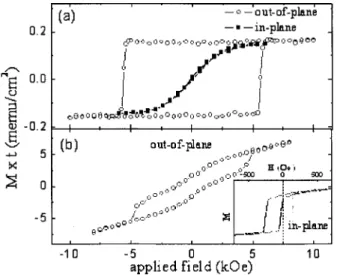
As 15 Å Co with in-plane anisotropy was deposited on 300 Å TbFe with the perpendicular anisotropy, not only the planar hysteresis loop disappeared but the remanence mag-netization was reduced as well, as shown in Fig. 1共a兲. In contrast, a square out-of-plane loop was obtained and its product of remanence magnetization and thickness ( Mrt)
was approximately equal to the Mrt sum of TbFe and Co. It
implied that Co moments were aligned in the perpendicular direction and coherently rotated with the TbFe under the ap-plied fields due to the strong exchange interaction between the bilayer. Similar to the effect of exchange coupling be-tween soft and hard magnetic films, the effective coercivity of TbFe decreased from 16.2 kOe of single layer to 5.7 kOe in the bilayer. As the Co thickness increased to more than 25 Å, in-plane shifted loops were observed in the film plane. As shown in Fig. 1共b兲, the in-plane loops of 50 Å Co in the
a兲Author to whom correspondence should be addressed; electronic mail:
JOURNAL OF APPLIED PHYSICS VOLUME 95, NUMBER 11 1 JUNE 2004
6846
0021-8979/2004/95(11)/6846/3/$22.00 © 2004 American Institute of Physics
[This article is copyrighted as indicated in the article. Reuse of AIP content is subject to the terms at: http://scitation.aip.org/termsconditions. Downloaded to ] IP: 140.113.38.11 On: Thu, 01 May 2014 04:22:01
bilayer exhibited a biasing field of 145 Oe and an enhanced coercivity of 106 Oe. The oblique out-of-plane loop indi-cated Co has a significant planar anisotropy in the bilayer.
The in-plane coercivity (Hc) and biasing field (Hb) of
Co also depended strongly on the Co thickness in the bilayer, as shown in Fig. 2. The Co in the bilayer possessed higher
Hcthan that in the single layer because of exchange
interac-tion between TbFe and Co. With increasing thickness, the in-plane anisotropy of Co became dominant because surface anisotropy was weakened.11As the Co increased from 25 to 40 Å, the in-plane anisotropy of Co was enhanced, which forced TbFe moments at the interface to align toward the in-plane orientation and led to the increased in-plane Hcand
Hb. With further increasing Co thickness, the in-plane
an-isotropy of Co was less changed; therefore, Hcand Hbwere
inversely proportional to Co thickness due to the character-istic of interfacial coupling of exchange bias, as observed in the in-plane FM/AFM bilayers.
XMCD spectroscopy was utilized to clarify the depen-dence of the Co and Fe moment orientation on Co thickness in the bilayers. Because of strong antiparallel exchange cou-pling between the TM and heavy RE moments,12 the
orien-tation of Tb was considered to be aligned in the opposite direction of Fe moments. In the XMCD measurement, the polarized x ray was incident to the samples at an angle of 65° from the surface normal, as illustrated in Figs. 3共a兲 and 3共b兲. If the direction of the in-plane component of the incident x ray is along the direction of the applied field during the depo-sition, we define it as the parallel共P兲 incidence, indicated in Fig. 3共a兲. The opposite is the antiparallel 共A兲 incidence, shown in Fig. 3共b兲. Right and left circular polarized x rays were sequentially illuminated to the bilayers to obtain L-edge absorption spectra of Fe and Co. All of the XMCDs of Co and Fe in the experiments were derived by subtracting the spectrum of the right circularly polarized x ray from that of the left. Taking sampling depth 共⬃8 nm兲 into the consider-ation, the XMCD signal of Co averaged over the entire the film, with the preponderance of the signal coming from the near-surface layers. On the other hand, the Fe signal came mainly from the interface region. As shown in Figs. 4共a兲 and 4共b兲, the normalized XMCDs of Co in P and A incidences are similar in the bilayer with 15 Å Co, but are almost re-versed in the bilayer with 50 Å Co. In principle, the XMCD
FIG. 1. In-plane and out-of-plane hysteresis loops of the bilayers with the Co of:共a兲 15 and 共b兲 50 Å.
FIG. 2. Dependence of coercivity Hcand exchange bias Hbon Co thickness
in the bilayers.
FIG. 3. Illustration of共a兲 P incidence and 共b兲 A incidence in XMCD mea-surement.
FIG. 4. Normalized XMCDs of P and A incidence in the TbFe/Co bilayer with the Co of:共a兲 15 Å and 共b兲 50 Å.
6847
J. Appl. Phys., Vol. 95, No. 11, Part 2, 1 June 2004 Linet al.
[This article is copyrighted as indicated in the article. Reuse of AIP content is subject to the terms at: http://scitation.aip.org/termsconditions. Downloaded to ] IP: 140.113.38.11 On: Thu, 01 May 2014 04:22:01
effect is quantitatively related to the amounts of magnetic moments and to the anisotropies of the spin density and or-bital moments.7,8 The dichroism effect in XMCD spectros-copy reaches the maximum if the photon spin and the mag-netization directions are parallel or antiparallel, and becomes zero if their directions are perpendicular to each other. There-fore, we can consider the XMCD intensity I of Co as
I⫽I0cos⍜, 共1兲
where I0 is the maximum intensity related to the amount of spin and orbital moments and ⍜ is the angle between the magnetization orientation and the incident x-ray direction. If the Co moments were entirely perpendicular to the surface, the XMCD intensity of P and A incidences should be iden-tical because the two incident x rays had the same angle of 65° from perpendicular moments. Therefore, the similarity of the dichroisms of P and A incidences in Fig. 4共a兲 implies that the perpendicular anisotropy of 15 Å Co in the bilayer was induced by strong exchange coupling from TbFe. In contrast, the reversed dichroism signals observed in 50 Å Co indicated that the Co moments in the bilayer preferred the in-plane alignment.
Furthermore, the orientation of Co moments near the surface and Fe moments near the interface of Co and TbFe in the bilayer can be quantitatively derived by XMCD measure-ments to concretely explore the origin of exchange bias in the TbFe/Co bilayers. As depicted in Fig. 3, if the orientation of the specific moment is aligned at an angle ⌽ from the surface normal, the dependence of XMCD intensity on the angle ⌽ can be given by
IL3,P⫽I0cos共180° – 65°⫺⌽兲⫽⫺I0cos共⌽⫹65°兲 共2兲 and
IL3,A⫽I0cos共180°⫹65°⫺⌽兲⫽⫺I0cos共⌽⫺65°兲. 共3兲 Here, LL3,P and IL3,A, respectively, expressed the XMCD intensity of the L3-edge of P and A incidences. Combining Eqs.共2兲 and 共3兲, the effective canting angle ⌽ of Co and Fe moments can be obtained by the following formula:
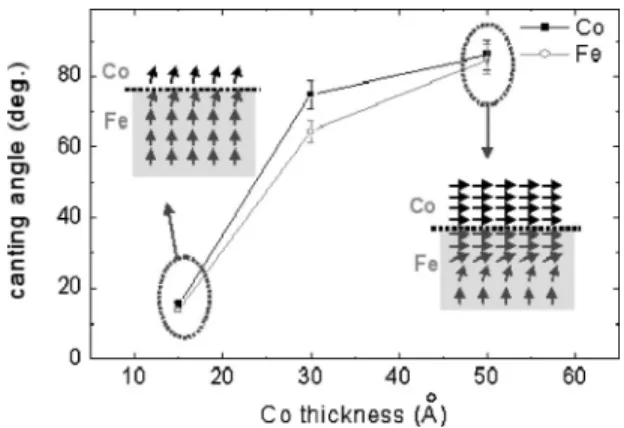
tan⌽⫽cot 65°⫻共LL3,A⫺IL3,p兲/共IL3,A⫹IL3,p兲. 共4兲 Figure 5 shows the variation of the⌽ of Co and Fe with the Co thickness in the bilayers. Since the majority of the XMCD effect comes from the regions close to the surface, the derived⌽ of Co and Fe in the bilayers particularly indi-cated the orientation of Co moments near the surface and the Fe moments in the interface region. The orientation of near-interface Co can be reasonably assumed being parallel to near-interface Fe because of strong exchange interaction be-tween Fe and Co moments. From Fig. 5, the canting angles of Co and the near-interface Fe are quite similar, implying that the orientation variation of the Co magnetization across the film thickness is negligible. In the bilayer with 15 Å Co, both Co and Fe moments preferred the out-of-plane align-ment because of their small ⌽ of 15.4° and 13.1° from the
surface normal. With increasing thickness, the Co and near-interface Fe gradually lie in the plane. The moment orienta-tion of Co and Fe at the interface is determined by the energy terms of spin–spin coupling, in-plane, and perpendicular an-isotropy. With decreasing thickness, the in-plane anisotropy of Co is reduced because surface anisotropy becomes signifi-cant in the thin films.11 Therefore, perpendicular anisotropy of TbFe dominated the orientation of moments at the inter-face in the bilayer with 15 Å Co, which induced the out-of-plane Co moments through exchange coupling to TbFe. As the Co thickness increased, in-plane anisotropy of Co be-came dominant, which led to the in-plane alignment of inter-facial Fe moments through the exchange coupling. Conse-quently, the existence of in-plane TbFe moments near the interface was responsible for the in-plane exchange bias in the TbFe/Co bilayers.
In conclusion, by utilizing XMCD spectroscopy, we quantitatively determined the orientation of moments in the TbFe/Co exchange-biased bilayers. Through the mechanism of exchange coupling, the perpendicular anisotropy of 15 Å Co was induced by TbFe. With increasing Co thickness, in-plane anisotropy of Co became dominant, resulting in the preferred in-plane moments of Co and TbFe near the inter-face. The existence of plane TbFe moments near the in-terface led to the in-plane exchange-bias fields.
1J. Nogues and I. K. Schuller, J. Magn. Magn. Mater. 192, 203共1999兲. 2F. Hellman, R. B. van Dover, and E. M. Gyorgy, Appl. Phys. Lett. 50, 296
共1987兲.
3
C. Cain and M. H. Kryder, J. Appl. Phys. 67, 5722共1990兲.
4N. Smith and W. C. Cain, J. Appl. Phys. 69, 2471共1991兲.
5J. N. Chapman, M. F. Gillies, and P. P. Freitas, J. Appl. Phys. 79, 6452
共1996兲.
6
O. Redon and P. P. Freitas, J. Appl. Phys. 83, 2851共1998兲.
7
J. Sto¨hr, J. Magn. Magn. Mater. 200, 470共1999兲.
8B. T. Thole, P. Carra, F. Sette, and G. van der Laan, Phys. Rev. Lett. 68,
1943共1992兲.
9P. Carra, B. T. Thole, M. Altarelli, and X. Wang, Phys. Rev. Lett. 70, 694
共1993兲.
10G. Schu¨tz, W. Wagner, W. Wilhelm, P. Kienle, R. Zeller, R. Frahm, and G.
Materlik, Phys. Rev. Lett. 58, 737共1987兲.
11Ultrathin Magnetic Structures, edited by B. Heinrich and J. A. C. Bland
共Springer, Berlin, 1994兲, Vol. 1.
12
E. P. Wohlfarth, J. Phys. F: Met. Phys. 9, L123共1979兲.
FIG. 5. Variations with Co thickness of canting angles of Co and interfacial Fe from the surface normal.
6848 J. Appl. Phys., Vol. 95, No. 11, Part 2, 1 June 2004 Linet al.
[This article is copyrighted as indicated in the article. Reuse of AIP content is subject to the terms at: http://scitation.aip.org/termsconditions. Downloaded to ] IP: 140.113.38.11 On: Thu, 01 May 2014 04:22:01