Lexical Aspect in Interaction with Grammatical
Aspect: A Study of English Aspect Acquisition in
Taiwanese Learners
Ai-li Hsin
National Kaohsiung Normal University [email protected]
Abstract
The study investigates the possible causes of delayed acquisition of Taiwanese EFL learners in mastering English aspect constructions by examining the lexical aspect of verbs in varied grammatical aspects via a cross-linguistic analysis of English and Chinese aspectual manifestations. Two groups of Chinese speakers of L2 English were invited to participate in an acceptability judgment test consisting of four situational types of verbs in interaction with two grammatical aspects. It was found that progressive aspect was conceptually simpler and acquired faster than perfective aspect, which was conceptually complicated with the addition of durative phrase or terminative phrase. Among the four situational types of verbs, states and activities progressed significantly greater than achievements and accomplishments, probably due to the fact that Chinese has only two primitive verbs, i.e., state and activity, and achievements and accomplishments are derived either morphologically with other verbs or syntactically with aspect markers or additional phrases. Achievements appeared difficult because Taiwanese EFL learners were not aware of the incompatibility of punctuality with the durative phrase, and accomplishments, the disagreement of telicity with the durative phrase but agreement with the terminative phrase. Without attending the required agreement, Taiwanese EFL learners dragged in the development of English aspect acquisition. Key Words: language acquisition, lexical/situational aspects,
INTRODUCTION
The acquisition of the English aspect system for EFL adult learners in Taiwan has always been a great challenge because of the distinction between English and Chinese (Wible & Huang, 2003). Whereas English has clear grammatical markings in both tense and aspect, Chinese lacks tense inflections but has aspect particles, such as le, guo, zai, and zhe. In English, the temporal concept and the verb phase condition are indicated in two grammatical systems; in Chinese, the aspect particles seem to play dual roles, displaying simultaneously the external deictic time of the situation and the internal structure of the action phase. The amphibious characteristics are discernible from the interpretations of aspect particles in relation to time in J.-W. Lin (2002), shown in (1) in the following.
1. Tense and aspect in modern Mandarin by J.-W. Lin (2002, p. 10)
a. If temporal adverbs exist in a sentence, the adverbs decide the tense, no matter whether there is a perfective or imperfect aspect.
b. If there be no temporal adverb in a sentence, imperfect aspects represent the present tense.
c. If there be no temporal adverb in a sentence, perfect aspects represent the past tense and represent the future tense with auxiliary verbs, such as “yao” and “hui.” Aspect can be divided into perfective and imperfective (Comrie, 1976) and J.-W. Lin (2002) proposed that le, guo are signs of
perfective aspect and zai, zhe imperfective aspect in modern Mandarin. Due to the fusion of tense-aspect concepts into one, Chinese EFL learners typically lack a clear understanding about English aspect and rely heavily on the syntactic forms in L2 acquisition. Without distinguishing clearly the syntactic concept of aspect and the semantic feature of a verb, EFL learners commonly produce awkward sentences such as “My family have moved to Kaohsiung City for twelve years” and “I’m feeling really happy when I listen to the song I love” (Huang, 1994). In addition, many learners are continually puzzled by the (un)grammaticality of the same verb in the same aspectual structure but different time frames, such as “John has arrived” but “*John has arrived for two days.”
Previous researchers tended to focus on investigating the acquisition of tense-aspect morphology (Bardovi-Harlig & Reynolds, 1995; Shirai & Andersen, 1995; Taiika, 1999, among others). Few studies have been identified to target mainly on aspect acquisition, especially with Chinese EFL learners. It is intriguing that while English tense acquisition is not quite problematic for most Chinese EFL learners, the aspect structure is often a pit for errors even for advanced learners, even though Chinese lacks tense, not aspect, morphology. The acquisition difficulty must arise from other causes instead of presence-absence contrast between L1 and L2. The present study is dedicated to extracting the possible sources of confusion and false interpretation of verb aspects by examining the lexical semantics of verbs in varied grammatical aspect forms across the two languages.
LITERATURE REVIEW
Previous SLA Research on Tense and Aspect
The acquisition of aspect has always been an important issue in second language acquisition (SLA) because every finite sentence has to linguistically encode either tense or aspect, or both. Previous studies on the tense-aspect verb morphology have found that L1 and L2 acquisitions are both strongly influenced by the inherent aspect of the verb to which the morphology is attached. For instance, learners of English initially give the past tense inflection predominantly to achievement verbs, and rarely to state verbs. Both L1 children and L2 adults restrict the progressive inflection to activity verbs; L1 children rarely overextend it to state verbs (Brown, 1973; Kuczaj, 1978), whereas adult L2 learners sometimes do (Robison, 1990). This tendency, later termed Aspect Hypothesis (Anderson & Shirai, 1994, 1996; Bardovi-Harlig, 1999; Bardovi-Harlig & Bergström, 1996; Robison, 1995; Shirai, 1991), occurs not only in frequency counts of oral and written production data but also in paper-and-pencil tests (Bardovi-Harlig & Reynolds, 1995). The major content is summarized as follows:
a. Learners use (perfective) past marking on achievement/accomplishment verbs, eventually extending use to activity and state verbs.
b. In languages that encode the perfective/imperfective distinction, imperfective past appears later than perfective past, and imperfective past marking begins with stative and
activity (i.e., atelic) verbs, then extends to accomplishment and achievement (i.e., telic) verbs.
c. In languages that have progressive aspect, progressive marking begins with activities, then extends to accomplishments and achievements.
d. Progressive markings are rarely incorrectly overextended to stative verbs (in L1 acquisition). (Bardovi-Harlig, 2000, p. 227)
Yet, not all research findings conformed to Aspect Hypothesis, and it is suggested that Aspect Hypothesis might not be a universal (Buczowska & Weist, 1991; Rohde, 1996). In addition, research findings have shown that many discrepancies between L1 and L2 aspect acquisition exist. One difference is the overuse of progressive on stative verbs in L2 acquisition, which is rarely observed in L1 acquisition (Kuczaj, 1978). Another difference is conceptual development. Children, due to their cognitive immaturity, start out with a “Speech Time System” whereas adult L2 learners can rely on their developed L1 temporal system, and start out with a “Reference Time System” (Buczowska & Weist, 1991). Learning strategies are also different in that while in L1 acquisition underextension of verb morphology (i.e., omission in obligatory contexts) predominates and overextension is rare, SLA shows overextension (i.e., overuse in inappropriate context) quite often (Robison, 1995). Moreover, L1 acquisition typically exhibits a natural tendency of untutored pattern; however, L2 learners are much influenced by the frequency of the input data and classroom instructions, and their mother languages.
English Aspect acquisition by learners of different L1 backgrounds also showed varied results due to L1 transfer. Slabakova (2001) did an experiment of L1 Bulgarian learners learning the aspects of L2 English and found that Bulgarian subjects had difficulty recognizing the feature of telicity in English because telicity in Bulgarian is marked on the verb while it is specified by the object in English. Li (2006) used a sentence completion task with pictures to study Taiwan college students’ production of English progressive and perfective aspects. The findings are the Aspect Hypothesis is observed in some cases (i.e., no incorrect overextension of state verbs in progressive aspect) but may be overridden by L1 transfer. For instance, Chinese learners conceive semelfactive verbs as activities while English speakers conceive them as achievements; in addition, most of the accomplishments in Chinese have the endpoint designated in the lexicon but the endpoint in English may be indicated by the object NP. The Markedness Differential Hypothesis was concluded to play no role in aspect acquisition from the study.
Verb Aspects
Definition of aspect. According to Comrie (1976, p. 3), aspect
characterizes “different ways of viewing the internal temporal constituency of a situation.” Unlike tense, aspect is an internal view of the situation as consisting of phases, and depends on how the speaker views or describes the internal temporal constituency of a situation. Comrie further stated that these aspects originate from the differences of “situation-internal time.” Unlike tense, which is “situation-external (Kibort, 2008),” the concern of aspect is not the
relation between specific time points. According to Smith (1997), aspect is a parameter, which is realized variously across languages.
Aspects belong to two types––grammatical and lexical. A grammatical aspect, also known as a viewpoint aspect (Smith, 1997), refers to an aspectual distinction marked with linguistic devices, generally auxiliaries or inflections, as in the English progressive and perfective (Verkuyl, 1993, 1999). A lexical aspect, or situation aspect, refers to characteristics inherent in the lexical items that describe the situation. Aspectual choices of the two levels, inherent lexical aspect and grammatical aspect, need to be in agreement to make a grammatical English sentence.
Categorization of situation aspect types. Verbs tend to have an
inherent aspectual meaning because the situations described by them tend to have inherent temporal properties. Utilizing the inherent semantics of verbs, Vendler (1967) distinguished situation verbs of four types. The four-way distinction, based on the temporal properties of verbs (or verb phrases), are state, activity, accomplishment and achievement, briefly stated in (2).
2. Situation verbs of four types according to Vendler (adopted from Shirai & Andersen, 1995, p. 744)
a. State: that which has no dynamics, and continues without additional effort or energy being applied (e.g., love, hate,
want).
b. Activity: that which has duration, but with an arbitrary endpoint, and is homogeneous in its structure. For example, in John is running, at every moment the fact of
his running has the same quality of running (e.g., run,
sing, dance).
c. Accomplishment: that which has some duration, but has a single clear inherent endpoint (e.g., run a mile, build a
house).
d. Achievement: that which takes place instantaneously, and is reducible to a single point in time (e.g., die, reach
the summit).
Classification based on semantic features. Each of Vendler’s
four situation types can be characterized in terms of the semantic features of dynamic, telic, and punctual, as shown in Table 1.
Table 1
Semantic Features of the Four Verb Classes
state activity accomplishment achievement
dynamic - + + +
telic - - + +
punctual - - - +
Dynamic denotes that energy is required for the situation to
exist or to continue, telic denotes having an inherent endpoint, and
punctual denotes having no duration. Hence, accomplishments and
achievements are both telic and dynamic but only achievements are punctual. Activities are dynamic, as are accomplishments and achievements, but are atelic and unpunctual. Finally, states have none of the three features (Kibort, 2008; Shirai & Andersen, 1995).
Compatibility of semantic features with syntactic aspect.
Aspectual meaning of a clause results from the interaction of aspectual viewpoint (i.e., grammatical aspect) and situation type (i.e., lexical aspect); they have hence to be in agreement in a sentence. The grammatical aspect is therefore not without constraint in verb choices. In general, states involve no dynamic and have no endpoint; they are thus incompatible with progressive or perfective forms, as shown in (3). As activities are dynamic, they can be in progressive forms, but, as they are atelic, the perfective form appears odd if there were no resultative adverbial or accompanying period of time, as illustrated in (4). Both achievements and accomplishments are telic actions and non-homogeneous in their internal structures and therefore cannot take progressive forms. This nature is seen in the ill form of their progressive aspect in (5a) and (6a). With telicity, they are in agreement with perfective form and even within a time frame, as in (5c) and (6c), but they cannot occur over time, as shown in (5b) and (6b). Achievement verbs capture the inception or the climax of an act, and are therefore instantaneous. They can be either dated or placed within a time frame, or even in a momentary progressive form, as in (6a), but they cannot occur over time. Accomplishments, in contrast, have duration intrinsically. The differences between achievements and accomplishments lie in duration (i.e., –punctual).
3. a. *He is wanting a new car.
b. *He has loved his wife (for 20 years). 4. a. He is running.
b. He has run *(away).
c. He has run *(for 30 minutes).
5. a. *He is running a mile.
b. He has run a mile (*for 20 minutes). c. He has run a mile in 20 minutes. 6. a. ??He is reaching the summit.
b. He has reached the summit (*for 20 minutes). c. He has reached the summit in 20 minutes. Chinese Aspectual System
Chinese verb aspectual marking. Four aspectual markers are
identified in Chinese: le (perfective), zai (progressive), zhe (durational imperfective) and guo (experiential) (Li & Thompson, 1981). The imperfective markers zai and zhe signify the progression of an action or an event. Zai is incompatible with state verbs, as a state verb is not qualified as action (Mourelatos, 1978). Zhe indicates that a situation is viewed as enduring or continuing (i.e., durative), and is incompatible with a state or resultative verb (Klein, Li, & Hendriks, 2000), as illustrated in (7).
7. a. Chen xiansheng you san-ge haizi. chen mister have three-CL child Mr. Chen has three children.
b. *Chen xiansheng (zheng)zai you san-ge haizi. chen mister ASP have three-CL child *Mr. Chen is having three children.
c. *Chen xiansheng you-zhe san-ge haizi. chen mister have-ASP three-CL child *Mr. Chen is having three children.
Le is generally considered a perfective marker; it denotes the
termination of an action and indicates the telicity of the event (Klein et al., 2000; Smith, 1994). Guo, the experience marker, is another perfective aspectual marker which concerns the external rather than the internal structure of the event. Without overt temporal expressions, both le and guo imply that the action occurs in the past and can correspond to a perfective reading in English, as indicated in (8).
8. a. Lisi qu-le meiguo. Lisi go-ASP America Lisi has gone to America. b. Lisi qu-guo meiguo. Lisi go-ASP America Lisi has been to America.
Chinese verb situational types. The situation types of Chinese
verbs are complicated as Chinese verbs can be monosyllabic or disyllabic, and the disyllabic verb compounds can evolve situation types different from their original monosyllabic ones. According to Tai (1984), there are only state and activity types for Chinese monosyllabic verbs. State verbs involve no dynamics and are therefore incompatible with progressive, but the original atelic nature can be altered to telic with an addition of a bounded phrase in a
perfective aspect with a verbal –le, as shown in (9). Activity verbs are dynamic and in agreement with progressive, but the atelic feature is incompatible with the perfective aspect, unless a bounded phrase is added, similar to states, as illustrated in (10) (Soh & Gao, 2006).
9. a. *ta (zheng)zai gao. (state V) he ASP tall
*He is being tall.
b. *ta danxin-le.1 (state V without bounded phrase) he worry-ASP
*He has worried.
c. ta danxin-le liang tian. (state V with bounded phrase) he worry-ASP two day
He has been worried for two days. 10. a. ta (zheng)zai youyong. (activity V)
he ASP swim He is swimming.
1 Though a state verb, dan-xin can appear in a negative imperative, such as in (i). In
Chinese, it is common to see some state verbs appear in the negative imperative sentence as an advisory suggestion, such as the examples in (ii):
i. Bu-yao dan-xin 不要擔心。 No-want worry
Don’t worry
ii. a. Bu-yao ai na-ge huai nan-ren 不要愛那個壞男人。 No-want love that-CL bad male-person
Don’t love that bad man.
b. Bu-yao you huai xi-guan 不要有壞習慣。 No-want have bad habit
Don’t get into bad habits. 98
b. *ta youyong-le.2 (activity V without bounded phrase) he swim-ASP
He started to swim.
c. ta you-yong-le liang xiashi. (activity V with bounded phrase) he swim-ASP two hour
He has swum for two hours.
Although whether Mandarin Chinese has achievement verbs or accomplishment verbs remains controversial (J. Lin, 2004; Soh & Kuo, 2005; Sybesma, 1997, 1999; Tai, 1984; among others), Soh and Kuo (2005) asserted that Mandarin Chinese has. The accomplishment verb can result from two major derivations: one type is a disyllabic verb compound, consisting of an activity verb and a completive marker such as wan (completed) or kuang (bare), such as in chiwan (eat up) and hua-kuang (spend all). The other type is a verb phrase, composed of a verb and a numeral complement, such as xie liang-feng
xin (write two letters). Unlike the English accomplishment verb that
has dual features of action and result, the Chinese accomplishment verb indicates only the result and is thus incompatible with progressive aspect, as exemplified in (11b-c).
11. a. John is writing a letter.
b. *Lisi (zheng)zai xie-wan xin. Lisi ASP write-complete letter *Lisi is finishing writing letters.
2 The sentence-final le only provides the inchoative reading to the sentence. The star
indicates that in terms of perfective reading, this sentence is ungrammatical. 99
c. *Lisi (zheng)zai xie liang-feng xin.3 Lisi ASP write two-CL letter Lisi is writing two letters.
J. Lin (2004) also maintained that Chinese verbs have only two primitive types––activity and state. Achievements and accomplishments are syntactically derived complicated categories. Achievements are obtainable on adding the perfective aspectual marking le to a static verb, and accomplishments, on adding the achievement verb to an activity verb, as shown in (12) and (13), respectively.
12. Zhangsan gao le. (achievement: state + le) Zhangsan tall ASP
Zhangsan becomes tall.
13. Zhangsan zhang-gao-le. (accomplishment: activity + achievement V (state + le))
Zhangsan grow-tall-ASP Zhangsan has grown tall.
3 This sentence can be grammatical only when the numeral complement “liang-feng
xin” is interpreted as specific reading. More examples are demonstrated below to prove the ungrammaticality of this type of sentences.
i. *Ta (zheng)zai du shi-ben shu he ASP read ten-CL book *He is reading 10 books.
ii. *Ta (zheng)zai you san-gungli he ASP swim three-kilometer *He is swimming 10 kilometers. 100
Variations in Grammatical Aspect
Besides the agreement between the lexical and grammatical aspects, additional phrases in the grammatical aspect also impose restriction on the compatibility of lexical and grammatical aspects. English perfective aspect are typically accompanied with a durative phrase “for + NP” or a terminative phrase “in + NP.” These two phrases impose an increased restriction on the choice of verbs although English perfective aspect generally accommodates all dynamic verbs. The durative phrase requires the verb to have a durative feature, and “arrive,” an achievement with [-durative] feature, is incompatible even though it can generally appear in the perfect aspect, shown in (14). The terminative phrase similarly requires the verb to have an internal endpoint; ‘sit,’ an activity with [atelic] feature, is not aligned with such a phrase, even though the verb can emerge in a perfect aspect, as shown in (15). In English, the lexical aspect needs to be in compatibility with not only the grammatical aspect itself but also the additional phrases in the grammatical aspect. The lexical aspect of the verb cannot be truly revealed until it is in total compatibility with all the phrases of the VP in which it occurs, and even with all other elements in the whole sentence.
14. a. The singer has arrived.
b. *The singer has arrived for 3 days. (durative phrase) 15. a. She has sat there for some time.
b. *She has sat there in 3 hours. (terminative phrase)
Cross-Linguistic Differences between English and Chinese Aspects
Many Chinese EFL learners mistakenly accept English ungrammatical perfective sentences such as in (16), because the corresponding Chinese sentences are grammatical, as in (17).
16. a. *They have broken up for a year. b. *Sarah has moved to Taipei for 5 years. 17. a. Tamen fen-shou yi-nian le.
they separate-hand one-year LE It has been a year since they broke up. b. Sala bandao Taibei wu-nian le. Sarah move-arrive Taipei five-year LE
It has been five years since Sarah moved to Taipei
Chinese has a distinct structure for sentences in (17). Instead of a simple perfective sentence with the durative phrase in English, it is a sentence with a sentential subject (Tamen fen-shou) and a temporal predicate (yi-nian le) in Chinese (Li & Thompson, 1981; Teng, 1975). We can therefore add an existential verb you before the main predicate in Chinese sentences, illustrated in (18). This L1 interference could cause confusion for Chinese EFL students.
18. a. Tamen fen-shou (you) yi-nian le. b. Sala bandao Taibei (you) wu-nian le.
Chinese state verbs, although incompatible with a progressive aspect because of a lack of dynamics, can be aligned with perfective aspect. The atelic feature in the state verbs can be terminated by the perfective aspect le or completed with a bounded phrase, and thus alters to telic. In addition, the sentence final le, a transition marker, can also alter the state to the opposite condition (E → ~E) and thus terminates the atelic state (Soh & Gao, 2006).4 Some examples appear in (19).
19. a. Ta yi-jing zhidao-le zhen-xiang. (with ASP –le) he already know-ASP true-picture
*He has already known the truth.
b. Ta yi-jing zhidao zhen-xian san-tien le. (sentence final le)
they already know true-picture three-day LE *He has already known the truth for three days.
c. Ta yi-jing you wu-tung fang-zi le. (bounded phrase + sentence final le)
4 The implication of opposite condition (E → ~E) only emerges in the state and
irrealis verbs, such as gao (tall), but not in realis activity verbs (verbs with aspect marker le), such as chi (eat). While the addition of sentence final le may alter the condition to the opposite, as shown in (i), the addition of sentence final le only imposes the feature of boundedness to the event denoted by the activity verb, as shown in (ii) in the following sentence.
i. ta gao le. ii. ta ci-le fan le.
he tall LE he eat-ASP rice LE
He has grown tall. (He was not tall before.) He has eaten the meal.
he already have five-CL house LE *He has already had five houses.
In sum, there exists a great cross-linguistic distinction between English and Chinese aspect systems: English requires a strict agreement between the lexical aspect of verbs and the grammatical aspect of the sentence; Chinese grammatical aspect interacts with the lexical aspect of verbs and thus affects the aspectual meaning of the verbs. With this discrepancy, the acquisition of the English aspect system is predicted to be difficult for Chinese EFL learners. Our research questions and possible hypotheses in this study are listed as follows:
a. Is English aspect acquisition complicated and difficult for Chinese EFL learners?
b. What is the acquisition order of English grammatical aspects? Will progressive aspect, being conceptually simpler, be easier than perfective aspect?
c. What is the acquisition order of the four situation types of English verbs? Will achievement and accomplishment verbs be more difficult to acquire than state and activity verbs since the two types of verbs have to be morphologically or syntactically derived in Chinese?
d. Will the agreement between lexical and grammatical aspects be an obstacle for Chinese EFL learners, especially in the cross-linguistically distinct areas?
e. Will the addition of durative phrase or terminative phrase in English perfective aspect increase difficulty for Chinese EFL learners?
METHOD
Subjects
In this work, we explore common error patterns and the profound causes of these errors made by Taiwan EFL learners in their acquisition development of English aspect constructions, focusing on feature matching between the lexical and the grammatical aspects. 134 subjects were invited, but after a qualification screening involving the validity of their responses, data of only 95 subjects were used in this research. The subjects were from two groups according to their proficiency and duration of learning English. Group 1, representing advanced learners was comprised of 41 undergraduate English majors in a university in southern Taiwan. Their average duration of learning English was 11.8 years and their grade levels were all above 12 in a 15-grade-level system in the collegiate entrance exam. Group 2, representing intermediate learners was comprised of 54 first-year high-school students in central Taiwan. Their average number of years of learning English was 6.5. They all passed the national high-school entrance exam to be admitted to high school, and their English score was no less than 60 on a 100-point scale. The purpose of setting two groups of distinct proficiency levels is to investigate the acquisition through the two proficiency levels, whether there are positive or negative L1 transfers, and what persistent errors exist for even advanced learners and the potential causes behind them.
Procedure and Linguistic Design
Subjects were guided to complete an acceptability judgment questionnaire comprised of 50 questions; they were directed to express their acceptability of each sentence by marking on a 5-point Likert scale (from 0 to 4), with 0 indicating the least acceptable, and 4 most acceptable. The 50 questions were carefully designed based on the lexical aspectual features of the verbs and the grammatical aspect of the sentence. Four situation types (state, activity, achievement, and accomplishment) interacted with progressive and perfective aspect with a durative phrase or a terminative phrase. The token of each verb type was controlled to be within the numbers 3 to 4 so that the number of sentences in the questionnaire did not exceed 50 in total.
All four situation types were tested in both progressive and perfective aspects to compare the acquisition order of these two major grammatical aspects in English. As there is compatibility requirement between each of the situation types with the grammatical aspect, we can observe the subjects’ acquisition of the situation types through their acceptability judgment. For instance, the –dynamic and –telic features of state verbs are not in agreement with progressive and perfective aspects, respectively,
The agreement between the other three non-state situation types with perfective aspect is even more complicated. English perfective aspect is a grammatical aspect used to describe a situation viewed as a simple whole, a unit without internal structure. An event whether occurring punctually or lasting for some time can hence be expressed in the perfective aspect as long as it agrees with the reference time, as shown in Figure 1. A durative activity verb can therefore be in
perfective aspect, as in (20a), so can a punctual achievement verb as in (20b), and a durative and telic accomplishment verb as in (20c).
Figure 1
English Perfective Aspect with Situational Verbs 20. a. He has worked on the project. (activity)
b. He has arrived at Taiwan. (achievement)
c. He has painted three pictures. (accomplishment)
When, however, the perfective aspect is imposed with a durative phrase, i.e., for + NP (indicating a period of time), the grammaticality condition for verbs of the three types becomes altered, as exemplified in (21). The activity verb is still grammatical as the verb is durative and atelic, but, for achievement and accomplishment verbs, the addition of the durative phrase makes the sentences ungrammatical, because telic verbs of achievement and accomplishment, which focus on the state after the endpoint of the event, are incompatible with the additional feature of durativity in the perfective aspect with for + NP phrase.
21. a. He has worked on the project for some time. (activity) b. *He has arrived at Taiwan for three days. (achievement) c. *He has painted three pictures for a year. (accomplishment)
To complicate the matter, when the perfective aspect is imposed with a terminative temporal phrase, i.e., in + NP (indicating a period of time), the situation would differ in grammaticality judgment, shown in (22). The terminative in-phrase adds a telecity feature to the perfective sentence, and thus makes the telic verbs of achievement and accomplishment agreeable but the atelic activity verb disagreeable in the sentence. As achievement verbs carry a punctual feature, the terminative phrase must meet the punctuality requirement. With the action of arriving in (22b) as an example, ‘two hours’ meets the requirement and is therefore grammatical, but ‘three years’ does not and hence becomes ungrammatical.
Accomplishment verbs generally comprise activity verbs followed by a numeral complement object, as exemplified in (22c). If an indefinite object NP, instead of a numeral one, follows the verb, it is only a transitive activity verb, not an accomplishment verb, and hence becomes incompatible with the perfective aspect with a terminative in-phrase, similar to activity verbs, as indicated in (22d).
22. a. ?He has worked on the project in a year. (activity) b. He has arrived at Taipei{in two hours/*in three years}. (achievement)
c. He has painted three pictures in a year. (accomplishment) d. *He has painted pictures in a year.
The test questions in the questionnaire were thus designed to observe if the subjects have developed the linguistic competence of agreement between situation aspects and grammatical aspects. The
sentence number and categorization of the questions are listed in Table 2. The entire questionnaire is provided in Appendix.
Table 2
Verb Categorization and Experiment Design in the Questionnaire
state activity accomplishment achievement progressive 7, 15, 16, 22 5, 17, 20, 8 3, 12, 33, 36, 40, 48 38, 41, 34 perfective 6, 37, 45 Perfective + for NP 1, 14, 28, 13 27, 49,46, 39 10, 25, 26, 31, 43, 44, 4, 32, 47 perfective + in NP 18, 19, 9, 24 11, 30, 23, 35, 42, 29 21, 50, 2 Data Analysis
The responses of subjects were collected for quantitative analysis. A screening was first conducted to eliminate the invalid questionnaires, such as follows: the same answer for all questions, more than one answer for a question, having unanswered questions, etc. There were eventually 95 valid questionnaires. Second, the acceptability value was adjusted to correctly display their English ability in judging the sentence. The value of subjects’ acceptability judgment was intact when the sentence was accurate; the value was shifted to the opposite in the sum of 4 (i.e., 0 exchanges with 4 and 1 with 3) if the sentence were inaccurate. The high acceptability value of correct sentences remained, but high acceptability value of incorrect sentences was reversed so as to show the subjects’ true acquisition condition, thus transforming the acceptability value to accuracy value. After this adjustment, the collected data were ready for statistical analysis. The statistical software SPSS was utilized to
examine the acquisition patterns and the distinctions between the two EFL proficiency groups in learning English aspect structures.
RESULTS AND DISCUSSION
Comparison of General Accuracy Averages between the Two Groups
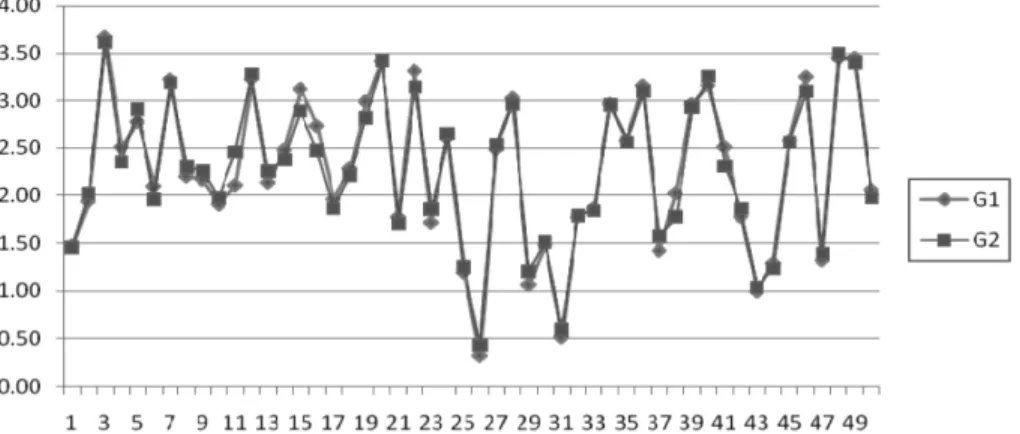
Figure 2 displays the accuracy averages of the 50 sentences between the two proficiency groups. The curves of G1 and G2 overlapped greatly, indicating that the degree of difficulty of questions for the two groups is similar despite the varied duration of learning English. The overall averages of G1 and G2 are 2.6985 and 2.6509, showing only a slight advancement of G1 over G2. Although, in some questions, the accuracy averages of G1 are greater than those of G2, such as in sentences 14-17, 22 etc., there are also questions in which G2 outperformed G1 and showed greater scores, such as in sentences 8-13, 40, 47 etc. The similar accuracy rates give the
Figure 2
The Accuracy Averages between the Two Proficiency Groups
impression that G1 improved little in the learning of English aspect structures relative to G2, despite their 5.3 more years (11.8-6.5) of learning English.
Acquisition Development of English Aspectual System in Verb Types
The accuracy means of all verbs and of each of four situational types of verbs––state, activity, achievement and accomplishment–– are displayed in Table 3. The overall means of the two proficiency groups (G1: 2.6985; G2: 2.6509) show little difference, as shown in the cell ‘all verbs’ in Table 3, but with further scrutiny into each situational type, the means of state and accomplishment verbs reveal a disparity between the two groups, especially in accomplishment verbs. An observation of the means among the four types indicates that, between the two groups, the activity verb has the least difference (t = 0.987, p > .05) and the accomplishment verb has the greatest difference (t = 4.352, p < .01), meaning that the activity verb is least problematic in accommodation with aspect, and the accomplishment verb, the most problematic. Between the two extremes, the state verbs develop rapidly, as shown in the greatest mean 3.0544 of G1, and thus generate a significant difference between the two proficiency groups (t = 2.778, p < .01). In contrast, achievement verbs reveal a slow development, as shown in the small means 2.2524 and 2.0513 in G1 and G2 respectively, and show no significant distinction between the two groups (t = 1.421, p > .05). Accomplishment verbs are difficult for both groups as shown in the small means of both groups. Although G1 did not show great advancement in accomplishments, this improvement made it significantly distinct from G2.
In sum, G1 advanced greatly in state and activity verbs, but lagged in achievement and accomplishment verbs; only the differential performance in knowing how states and accomplishments can combine with grammatical aspects is significant between the two groups.
Table 3
Means Comparison of Verb Types Between Two Proficiency Groups
Mean (SD) t-value sig.
G1 2.6585 (0.2549) All verbs G2 2.6509 (0.0071) 0.220 0.827 G1 3.0544 (0.5990) State verbs G2 2.6439 (0.7886) 2.778 p < .01 G1 2.9576 (0.6243) Activity verbs G2 2.8243 (0.6727) 0.987 0.326 G1 2.2524 (0.6559) Achievement verbs G2 2.0513 (0.7035) 1.421 0.159 G1 2.3800 (0.5128) Accomplishment verbs G2 1.9585 (0.4302) 4.352 p < .01
To probe further, we compared the means of each verb type to discern whether there exists differences in acquisition among them. Table 4 shows the mean differences of verbs of each type in comparison with the other three types. Tables 5 and 6 show the mean differences of verbs of each type in comparison with the other three types in G1 and G2, respectively.
According to these means, the general order of development of verbs of the four types is activity > state > achievement > accomplishment. On examination, the means in Table 4 roughly
Table 4
Mean Comparison among Four Verb Types in All Subjects Mean (SD) Activity
sig. Achievementsig. Accomplish sig. State 2.8211 (0.7383) t = -0.554 p > .05 t = 8.378 p < .01 t = 7.198 p < .01 Activity 2.8818 (0.6522) t = 6.554 p < .01 t = 8.556 p < .01 Achievement 2.1381 (0.6871) t = -0.025 p > .05 Accomplishment 2.1404 (0.5102)
divide the four verb types into two categories: state and activity, as the better developed verbs with means 2.8211 and 2.8818, and achievement and accomplishment as the slowly developed verbs with means 2.1381 and 2.1404. The significant differences also provide strong evidence between the two major divisions of verbs of the four types; that is, state is significantly better than achievement (t = 8.214,
p < .01) and accomplishment (t = 5.297, p < .01), respectively, and
likewise activity (achievement: t = 4.196, p < .01; accomplishment: t
= 4.357, p < .01); whereas no significant difference is observed
between state and activity (t = 0.631, p > .05), nor between achievement and accomplishment (t = -0.896, p < .05). This result indicates that Taiwanese EFL learners have difficulty in learning verbs of achievement and accomplishment types in aspect forms. This result concurs with J. Lin’s (2004) assertion that Chinese has only two primitive verbs, i.e., state and activity, and achievement and accomplishment are derived from the primitive verbs via interaction with the grammatical aspect or with other verbs.
Table 5
Mean Comparison among Four Verb Types in G1 Mean (SD) Activity
sig. Achievementsig. Accomplish sig. State 3.0544 (0.5990) t = 0.631 p > .05 t = 8.214 p < .01 t = 5.297 p < .01 Activity 2.9576 (0.6243) t = 4.196 p < .01 t = 4.357 p < .01 Achievement 2.2524 (0.6559) t = -0.896 p > .05 Accomplishment 2.3800 (0.5128) Table 6
Mean Comparison among Four Verb Types in G2 Mean (SD) Activity
sig. Achievementsig. Accomplish sig. State 2.6439 (0.7886) t = 1.180 p > .05 t = 4.852 p < .01 t = 5.024 p < .01 Activity 2.8243 (0.6727) t = 4.994 p < .01 t = 7.687 p < .01 Achievement 2.0513 (0.7035) t = 0.783 p > .05 Accomplishment 1.9585 (0.4302)
Tables 5 and 6 reveal the same pattern as in Table 4: state and activity verbs are better developed whereas achievement and accomplishment verbs are difficult and developed much more slowly in aspect sentences. The only difference is that the development order for G1 is state > activity > accomplishment > achievement, whereas the development order for G2 is activity > state > achievement > accomplishment. Within the two rapid-slow major categories, the order of the two verbs becomes switched, which seems to indicate
that in the early acquisition stage the activity verb is easier, but the state verb develops rapidly and outperforms the activity verb in the advanced stage. For the two slowly developing verbs, the accomplishment verb also develops rapidly and outperforms achievement verb in the advanced stage, but neither difference in the two pairs of verbs attains a significant level.
Acquisition Development of English Grammatical Aspects
Comparison of progressive and perfective aspects. Table 7
compares the means of progressive and perfective sentences in the entire group of subjects and within G1 and G2. The two grammatical aspect forms, i.e., progressive and perfective, demonstrate sharp and significant differences across all three comparisons (all: t = 15.355, p < .01; G1: t = 10.443, p < .01; G2: t = 11.191, p < .01), indicating the degree of ease that these two aspects might differ greatly. In form, the two aspects seem equally heavy in construction. The progressive constitutes a verb to be and a gerundive verb, (Be + Ving), and the perfective constitutes an auxiliary have and a past participle, (have + PP). In concept, the perfective aspect is much more complicated than the progressive aspect. The progressive simply means an action is in progress at the reference time. The perfective can mean several indications: a past experience, a past ended event, an event lasting from the past to the present, etc. To complicate further, the aspect form together with the temporal phrases it contains must agree with the lexical aspect of the verb so as to make the sentences grammatically correct, as indicated in the literature review section.
A further comparison between the two proficiency groups, as shown in Table 8, reveals that a significant difference exists in each
Table 7
Mean Comparisons between Progressive and Perfective Aspects
Mean (SD) t sig. All progressive 2.8936 (0.4006) perfective 2.0938 (0.3885) 15.355 p < .01 G1 progressive 3.0612 (0.3106) perfective 2.2578 (0.3933) 10.443 p < .01 G2 progressive 2.7663 (0.4166) perfective 1.9693 (0.3382) 11.191 p < .01
individual grammatical aspect form (progressive: t = 3.495, p < .01; perfective: t = 3.838, p < .01), indicating that the two aspects are difficult and require protracted learning. Although the greater means in the progressive aspect indicate more rapid improvement than the perfective aspect, the great distinction between G1 and G2 implies there is still much to acquire in the progressive aspect. The small means in the perfective aspect in both groups signifies that the perfective aspect is a major obstacle in learning English aspects.
Table 8
Mean Comparisons between Progressive and Perfective Aspects
Mean (SD) t sig.
Progressive G1 3.0612 (0.3106)
G2 2.7663 (0.4166) 3.495 p < .01
Perfective G1 2.2578 (0.3933)
G2 1.9693 (0.3382) 3.838 p < .01
Group comparison of verb types in the progressive aspect. To
probe the origin of difficulty, we further examined the means of verb
types in the progressive aspect between the two groups. Table 9 shows a comparison of means of verbs of each individual type. Statistical significance is observed in state (t = 2.070, p < .01), activity (t = 3.180, p < .01) and accomplishment (t = 2.074, p < .05) verbs between the two proficiency groups, implying that the progressive aspect improves in verbs of these three types during the additional 5.3 years of English learning between the two groups.
Table 9
Group Mean Comparison of Progressives among Four Verb Types
Mean (SD) t sig. G1 3.3415 (0.6726) State G2 2.9491 (1.0622) 2.070 p < .01 G1 3.0732 (0.5975) Activity G2 2.6481 (0.6791) 3.180 p < .01 G1 2.4878 (0.8437) Achievement G2 2.4120 (0.8414) 0.436 0.664 G1 3.3415 (0.6434) Accomplishment G2 3.0509 (0.7061) 2.074 p < .01
No difference is detected in the achievement verb (t = 0.436, p > .05), signifying that verbs of this type in the progressive form of sentence improves little in the 5.3 extra years of learning, and is the source of difficulty in progressive aspect learning. The small means in both G1 and G2 also indicate that the achievement verb in the progressive form is conceptually difficult for Taiwan EFL learners.
The difficulty of learning achievement verbs in progressive form might derive from the English conceptual incompatibility of instantaneous achievements with a durative progressive aspect. If the proposal that Chinese has only state and activity verbs and that
achievement verbs are derived from state verb plus a termination aspect le is true, the lack of achievement verbs in Chinese would be a possible source of difficulty. Next, building the conceptual incompatibility between achievements and the progressive aspect requires not only that learners’ English proficiency reach a certain level, but also that their sensitivity to subtle aspectual features of verbs, inspiration from linguistic input, or the directions of teachers do so as well. All these factors might contribute to the little or no improvement in achievement verbs in English progressive aspect.
Group comparison of verb types in perfective aspect. Table 10
displays a comparison of the G1-G2 means in perfective aspect among verbs of the four types. Whereas the means of state and accomplishment verbs in perfective aspect show significant differences between the two proficiency groups (state: t = 2.321, p < .05; accomplish: t = 3.103, p < .01), those of activity and achievement verbs do not (activity: t = -0.811, p > .05; achievement: t = 1.707, p > .05). As activity verbs are the type that develop first and most rapidly, as shown in the overall means of G2 in Table 3, it is natural to see G2 perform equally as well as or even better than G1, as shown in Table 10 (G2: 2.9954 > G1: 2.8354). No significant distinction is observed in achievement verbs, and both groups display small means here (G1: 2.0122; G2: 1.6852), indicating that little improvement exists in verbs of this type in perfective aspect form. Similar to the progressive aspect, achievement verbs are again a major obstacle in perfective aspect learning. Accomplishment verbs are also difficult to learn in the perfective aspect, as shown in the small means of both groups (G1: 1.4146; G2: 0.8611), and are to be discussed in detail in section 4.4.
One possible reason for the difficulty with achievement verbs might arise from the English-Chinese contrast in showing the perfectiveness with achievement verbs. In English, the instantaneous nature of the achievement verb is inherent in the lexical property of the verb, whereas in Chinese the achievement verb is formed externally, comprising a state verb plus a perfective aspect marker le or a verb plus an achievement verb (J. Lin, 2004). The inherent property of English achievement verbs would be consequently difficult for Taiwanese EFL learners to acquire because of the contrast of perfective formation in the linguistic systems.
Table 10
Group Comparison of Perfectives among Four Verb Types
Mean (SD) t sig. G1 2.7622 (0.9730) State G2 2.3333 (0.8256) 2.321 p < .05 G1 2.8354 (1.0210) Activity G2 2.9954 (0.8961) -0.811 0.419 G1 2.0122 (0.9337) Achievement G2 1.6852 (0.9178) 1.707 0.091 G1 1.4146 (0.8725) Accomplishment G2 0.8611 (0.8393) 3.103 p < .01
Secondly, the instantaneous nature of the English achievement verb is incompatible with the durative phrase in the perfective aspect, exemplified in (23a). In contrast, in Chinese the achievement verb can co-exist with the perfective aspect using the mechanism of sentential subject and temporal predicate (Li & Thompson, 1981; Teng, 1975), as shown in (23b). The little improvement of achievement verbs
(from G2: 1.6852 to G1: 2.0122) might thus be a result of negative L1 transfer from Chinese.
23. a. *Sarah’s father has died for more than 10 years. b. Sala de fu-qin si-le shi duo nian le Sarah poss. father die-ASP ten more year LE
It has been more than ten years since Sarah’s father died. Durativity and Telicity in the Perfective Aspect
As expected, the addition of a for-phrase and an in-phrase in the perfective aspect increases the complication of grammatical aspect in the sentence, which is reflected in the unexpected variability of accuracy means of G1 and G2 in Table 11 below. The accuracy means of activity verbs are greater than those of accomplishment and achievement verbs in sentences with both an in-phrase and a for-phrase. As only a for-phrase in the perfective aspect is taught in junior high school,5 the untaught in-phrase in the perfective naturally appears more difficult for both groups as indicated in the smaller accuracy means of both groups, and significant divergence is observed in this area (t = 2.091, p < .05), likely because of the extra 5.3 years of English learning. For achievement verbs, the acquisition situation is similar, with for-phrase sentences outperforming in-phrase
5 The grammar of perfective aspect with for NP is mentioned early in all textbooks
of junior high schools in Taiwan. Most books elaborate the aspect with the durative phrase “for +NP,” as indicated in the following publishers in Taiwan, but no perfective sentence has ever mentioned the completive “in + NP” in the perfective aspect.
Kanghsiung: Book 4, Lesson 8 Taiwan Pason: Book 4, Lesson 5 Hanlin: Book 5, Lesson 1 120
Table 11
Group Comparison of Perfectives with For-Phrase and In-Phrase
G1-G2 Comparison Mean (SD) of G1 Mean (SD) of G2 t sig. in NP 2.8049 (0.6835) 2.4769 (0.8087) 2.091 p < .05 Activity for NP 2.8354 (1.0210) 2.9954 (0.8961) -0.811 0.419 in NP 1.7439 (0.8487) 1.8472 (0.9827) -0.538 0.592 Achievement for NP 2.0122 (0.9337) 1.6852 (0.99178) 1.707 0.091 in NP 1.6159 (0.7007) 1.6528 (0.8074) -0.234 0.816 Accomplishment for NP 1.4146 (0.8725) 0.8611 (0.8393) 3.130 p < .01
sentences, but no significant difference is observed between the two groups. The in-phrase sentences of G2 has an unexpectedly greater accuracy mean than that of G1 and also than that of its own for-phrase sentences. The same phenomenon occurs in accomplishment verbs. For accomplishment verbs, the means are the least of the three verb types, indicating this to be the most confusing type of verb. In for-phrase perfective sentences, the G1-G2 group comparison shows a significant difference (t = 3.130, p < .01). In in-phrase perfective sentences, G2 performed even better than G1, although no significance is observed. This condition indicates there might exist a period of confusion with both accomplishment and achievement verbs as the in-phrase sentences had greater means than the for-phrase sentences, contrary to the normal development of verbs of other types. G2 might have answered sentences correctly for the wrong reasons, and hence surpassed G1 in achievement on in-phrase sentences, and the inverse could be true for G1 with respect to in-phrase and for-phrase sentences.
Durativity and Telicity in Interaction with Achievement Verbs As durativity (for-phrase) and telicity (in-phrase) in the grammatical aspect generally disagree with the lexical aspect of achievement verbs, we probe further to discover what acquisition order of this type of verb displays. Table 12 presents the accuracy means of achievement verbs in three types of perfective patterns in the experiment: perfectives with no phrasal modifier, perfectives with
for-NP, and perfectives with in-NP.
Table 12
Mean Comparison of Achievement Verbs in Three Perfective Aspect Patterns
Mean (SD) + no phrase + for NP G1 + no phrase 2.1298 (0.9859) + for NP 2.0122 (0.9337) t = 0.485 + in NP 1.7439 (0.8487) t = 2.155 t = 1.153 G2 + no phrase 2.1169 (0.9044) + for NP 1.6852 (0.9178) t = 2.129 + in NP 1.8472 (0.9827) t = 2.220 t = -0.725
Although achievement verbs reveal no distinction in durative perfectives (i.e., perfective + for NP) and telic perfectives (i.e., perfective + in-NP) or between G1-G2 groups (cf. Tables 10 and 11), an internal within-group scrutiny shows different results. According to Table 12, G1 showed a significant difference between pure (i.e., no-phrase) perfectives and in-NP perfectives (t = 2.155, p < .05) whereas G2 showed a significant difference not only between no-phrase perfectives and in-NP perfectives (t = 2.220, p < .05) but also
between no-phrase perfectives and for-NP perfectives (t = 2.129, p < .05). The means indicated that the pure perfective was the easiest type, followed by perfectives with for-phrase, which is again followed by perfectives with an in-phrase. The two significant distinctions in G2 indicate that the intermediate group is effective with only pure perfectives and had difficulty with perfectives added with other phrasal features. G1, the advanced group, improved in acquiring the
for-phrase and therefore showed no more distinction, but still
struggled with the in-phrase perfectives; the significant difference thus remained. For the two temporal phrases, the fact that the for-phrase is often taught together with perfectives in Taiwan whereas the
in-phrase is overlooked in formal English education makes the
acquisition of perfectives with these two phrases unequal in acquisition development. This result supports Buczowska and Weist’s (1991) relevance of pedagogical practices to the foreign language learning process.
CONCLUSION
We investigated the acquisition progress of Taiwanese EFL learners of the lexical aspect of verbs in interaction with grammatical aspects. For research question 1, English aspect constructions are found to be difficult for most learners; two groups with 5.3 years difference in learning English still patterned similarly and with no significant difference observed in judging the grammaticality of English sentences. For research question 2, progressive, in the two major types of aspect, is significantly easier than perfective between the two groups, probably because of the conceptual simplicity and the
lack of interference from cross-linguistic difference, i.e., the incompatibility of state verbs in progressive aspect in both languages. However, Chinese learners made errors in using achievements in the progressive aspect due to lack of primitive achievements in the lexicon and, thus, were insensitive to the compatibility requirement.
In terms of acquisition order of verbs of the four lexical types in research question 3, states and activities advanced much more rapidly than achievements and accomplishments in both proficiency groups, in agreement with J. Lin’s (2004) assertion that Chinese has only two primitive verbs, i.e., state and activity, and achievement and accomplishment are derived from the primitive verbs in interaction with grammatical aspect or with other verbs. Positive L1 transfer of state and activity verbs was observed here.
The perfective aspect was difficult for Taiwanese learners because, in addition to the complicated form of grammatical structure, i.e., have +PP., there was an internal agreement of lexical aspect of verbs with the concept of grammatical aspect. The hindrance was shown in the delayed development of achievement and accomplishment verbs in English aspect structures. The punctuality feature of achievements, incompatible with the durative phrase and occasionally with the terminative phrase, was acquired late only by advanced learners. Negative L1 transfers were typically seen in mistakenly regarding achievements in the perfective aspect as the Chinese sentential clause with a temporal predicate. Accomplishment verbs had no problem in the progressive aspect but appeared to be difficult in the perfective aspect, especially with durative and terminative phrases. There was even a period of confusion, during which the advanced learners performed worse than the intermediate
learners. The complication derived from the reason that the telicity feature of accomplishment verbs disagreed with the durative phrase but agreed with the terminative phrase. Hence, for research question 4, due to unawareness or insufficient knowledge about the agreement of lexical aspect in interaction with the grammatical aspect, Chinese EFL learners, often had prolonged laborious experiences in acquiring English aspect structures.
For research question 5, the addition of a durative for-phrase and a terminative in-phrase in the perfective aspect indeed increased the complication in the agreement of lexical-grammatical aspect in the sentence, which was reflected in the significantly low accuracy means in the two structures in comparison with the pure perfective structure. The in-phrase perfective was even more difficult than the
for-phrase perfective since the former was rarely taught in school,
whereas the latter was usually taught together with perfective structure in Taiwan. This result supports the effect of formal instruction in L2 acquisition proposed by Buczowska and Weist (1991).
Chinese monosyllabic verbs are only of two types: state and activity. Achievement and accomplishment verbs are morphologically derived by making verb compounds or syntactically derived by adding aspect marker le, or a terminative object NP. Hence, with the lexical aspect mingling with grammatical aspect, Chinese verbs have less lexical property division than English verbs, and matching is less strict between the lexical aspect and the grammatical aspect than in English since any atelic verb can be shifted to a telic verb with an addition of aspect marker le. These cross-linguistic complications make learning English aspect constructions difficult and require a
prolonged development. The telicity and punctuality features of lexical aspect of verbs in interaction with grammatical aspect are the major source of hardship for Taiwanese learners.
IMPLICATION FOR TEACHING
Unlike Chinese in which the sentence grammatical aspect is collaborated with the morphology and syntactic structure of the verb, English has lexical aspect of verbs and the grammatical aspect in distinct systems, which must agree to make sentences grammatical. The internal lexical aspect of verbs, such as dynamic, punctuality, telicity etc., and their compatibility with the external grammatical aspect, such as progressive and perfective should be emphasized to make English aspect teaching more effective in Taiwan. Students should be reminded that the lexical aspect (i.e., situational aspect) will not be revealed until it conforms not only with the form of grammatical aspect (i.e., have + PP, or Be + Ving) but also with all elements in the VP, and even with other elements in the whole sentence. Consequently, the addition of for phrase and in phrase in the VP imposes extra grammatical features of durativity and telicity and makes the compatibility of lexical aspects of verbs vary.
In learning the English perfective aspect, EFL learners in Taiwan commonly had a misconception that a perfective aspect can be formed simply by putting the verb in the frame of have/had + PP (past participle). As mentioned above, aspects are manifested in both lexical semantics of the verb and the grammatical form of the sentence. The English language requires lexical aspect of verbs to agree with the grammatical aspect; otherwise the created sentence is
ungrammatical. The teaching of English in Taiwan focuses too much on the form of grammatical aspect and too little on the semantics of both the lexical verb and the grammatical aspect; the mismatching errors from Taiwanese learners are hence observed. English aspect teaching should thus guide learners to understand the pure meaning of each aspect form and each lexical aspect, and the interaction between them. Achievement and accomplishment verbs, being the source of cross-linguistic differences and therefore learning difficulty, needs more pedagogical practices with the focus on the punctuality and telicity features in their lexical aspect. Grammatical aspect can also vary with additional phrases such as durative and terminative phrases, and needs to be attended with extra alert for the agreement of the lexical-grammatical aspect.
Although the morphological formation of verbs of situational types might differ, the inherent aspect of the four situational types, which is part of the universal grammar (UG), is similar across languages. For instance, state verbs cannot be in a progressive aspect and punctual verbs cannot associate with a durative phrase. English teachers can guide learners to utilize the semantic aspect of their L1 correspondents when learning English verbs, and the (in)agreement of lexical aspect and grammatical aspect can flow naturally from L1 to L2 without excessive effort. On devoting further attention to the lexical aspects and their compatibility with the grammatical aspect, the learning can be more natural and the acquisition memory last longer as it involves logical thinking instead of a forced memory. It is believed that the semantic approach is more effective than the memorization approach since the agreement between lexical and
grammatical aspects is universal and often observed in both L1 and L2 acquisitions (Bardovi-Harlig, 2000).
LIMITATION OF THE STUDY
As the sample of this study contains only 95 valid questions from two proficiency groups, the results should be interpreted with caution. The findings might not be generalizable to all EFL learners in Taiwan. Further research with more subjects and more proficiency levels is required before a more solid conclusion can be made. In addition, grammaticality judgment might not be the best approach to gather data for analysis since there is always the danger of guessing. Yet, it was chosen because it was controlled to the target structures and contrastive comparisons were able to be conducted between groups and between structures. Aspect is intriguing and sometimes hard to render grammaticality judgments when there is a single sentence. In the questionnaire, the background context was provided as much as possible, but probably was still not enough. Other experimental tasks, such as elicited translation or discourse production can be conducted to investigate how learners display the agreement between lexical aspect and grammatical aspects. Work from different perspectives will help us further understand the English aspect acquisition in Taiwan EFL learners.
REFERENCES
Anderson, R. W., & Shirai, Y, (1994). Discourse motivations for some cognitive acquisition principles. Studies in Second
Language Acquisition, 16, 133-156.
Anderson, R. W., & Shirai, Y, (1996). Primacy aspect in first and second language acquisition: The pidgin/creole connection. In W. C. Ritchie & T. K. Bhatia (Eds.), Handbook of second
language acquisition (pp. 527-570). San Diego, CA: Academic
Press.
Bardovi-Harlig, K. (1999). From morpheme studies to temporal semantics: Tense-aspect research in SLA. Studies in Second
Language Acquisition, 21, 341-382.
Bardovi-Harlig, K. (2000). Tense and aspect in second language
acquisition: Form, meaning, and use. Malden, MA: Blackwell.
Bardovi-Harlig, K., & Bergström, A. (1996). The acquisition of tense and aspect in SLA and FLL: A study of learner narratives in English (SL) and French (FL). Canadian Modern Language
Review, 52, 308-330.
Bardovi-Harlig, K., & Reynolds, D. W. (1995). The role of lexical aspect in the acquisition of tense and aspect. TESOL Quarterly,
29, 107-131.
Brown, R. (1973). A first language: The early stages. Cambridge, MA: Harvard University Press.
Buczowska, E., & Weist, R. M. (1991). The effect of formal instruction on the second-language acquisition of temporal location. Language Learning, 41, 535-554.
Comrie. B. (1976). Aspect. Cambridge, England: Cambridge University Press.
Huang, H. S. (1994). An analytic study on tense errors committed by
Chinese learners of English in Southern Taiwan (Unpublished
master thesis). National Kaohsiung Normal University, Kaohsiung, Taiwan.
Kibort, A. (2008). Aspect. Retrieved from http://www.grammaticalfeatures.net/features/aspect.html
Klein, W., Li, P., & Hendriks, H. (2000). Aspect and assertion in Mandarin Chinese. Natural Language and Linguistic Theory,
18, 723-770.
Kuczaj, S. A. (1978). Why do children fail to overgeneralize the progressive inflection? Journal of Child Langauge, 5, 167-171. Li, C., & Thompson, S. (1981). Mandarin Chinese: A functional
reference grammar. Berkeley, CA: University of California
Press.
Li, J.-I. (2006, April). Taiwan college students’ production of English
progressive and perfective aspect. Paper presented at the First
International Conference on Applied Linguistics, Chiayi, Taiwan.
Lin, J. (2004). Event structure and the encoding of arguments: The
syntax of the Mandarin and English verb phrase (Unpublished
doctoral dissertation). Massachusetts Institute of Technology, Cambridge, MA
Lin, J.-W. ( 林 若 望 ). (2002). 〈 論 現 代 漢 語 的 時 制 意 義 〉 [On temporal reference in modern Chinese],《語言暨語言學》 [Language and Linguistics],3(1),頁 1-25 [3(1), 1-25]。
Mourelatos, A. P. D. (1978). Events, processes, and states. Linguistics
and Philosophy, 2, 415-434.
Robison, R. E. (1990). The primacy of aspect: Aspectual marking in English inter-language. Studies in Second Language
Acquisition, 12, 315-330.
Robison, R. E. (1995). The Aspect Hypothesis revisited: A cross-sectional study of tense and aspect marking in interlanguage.
Applied Linguistics, 16, 334-370.
Rohde, A. (1996). The aspect hypothesis and the emergence of tense distinctions in naturalistic L2 acquisition. Linguistics, 34, 1115-1137.
Shirai, Y. (1991). Primacy of aspect in language acquisition:
Simplified input and prototype (Unpublished doctoral
dissertation). University of California, Los Angeles, CA.
Shirai, Y., & Andersen, R. W. (1995). The acquisition of tense-aspect morphology: A prototype account. Language, 71, 743-762. Slabakova, R. (2001). Telicity in the second language. Amsterdam,
The Netherlands: John Benjamins.
Smith, C. S. (1994). Aspectual viewpoint and situation type in Mandarin Chinese. Journal of East Asian Linguistics, 3, 107-146.
Smith, C. S. (1997). The parameter of aspect (2nd ed.). Dordrecht, The Netherlands: Kluwer Academic.
Soh, H. L., & Gao, M. (2006). Perfective aspect and transition in Mandarin Chinese: An analysis of double-le sentences. In P. Denis, E. McCready, A. Palmer, & B. Reese (Eds.),
Proceedings of the 2004 Texas Linguistic Society Conference
(pp. 107-122). Somerville, MA: Cascadilla Proceedings Project.
Soh, H. L., & Kuo, Y.-C. M. (2005). Perfective aspect and accomplishment situations in Mandarin Chinese. In A. van Hout, H. de Swart, & H. Verkuyl (Eds.), Perspectives on aspect (pp. 199-216). Dordrech, The Netherlands: Springer.
Sybesma, R. (1997). Why Chinese verb-le is a resultative predicate.
Journal of East Asian Linguistics, 6, 215-261.
Sybesma, R. (1999). The Mandarin VP. Dordrecht, The Netherlands: Kluwer Academic.
Tai, J. H.-Y. (1984). Verbs and times in Chinese: Vendler’s four categories. In D. Testen, V. Mishra, & J. Drogo (Eds.), Papaers
from the parasession of lexical semantics (pp. 289-296).
Chicago, IL: Chicago Linguistic Society.
Taiika, H. (1999). Variable patterns of tense/aspect marking in
interlanguage. Minneapolis, MN: University of Minnesota.
Teng, S.-H. (1975). A semantic study of transitivity relations in
Chinese. Berkeley, CA: University of California Press.
Vendler, Z. (1967). Linguistics in philosophy. New York, NY: Cornell University Press.
Verkuyl, H. J. (1993). A theory of aspectuality: The interaction
between temporal and atemporal structure. Cambridge,
England: Cambridge University Press.
Verkuyl, H. J. (1999). Events as dividuals: Aspectual composition and event semantics. In J. Higginbotham, F. Pianesi, & A. Varzi (Eds.), Speaking of events (pp. 169-206). New York, NY: Oxford University Press.
Wible, D., & Huang, P.-Y. (2003, March). Using learner corpora to
examine L2 acquisition of tense-aspect markings. Paper
presented at the Corpus Linguistics Conference 2003, Lancashire, England.
ABOUT THE AUTHOR
Aili Hsin, a senior English teacher who has dedicated herself in English teaching for more than 30 years, is currently a full professor at English Department of National Kaohsiung Normal University. Her research interest includes linguistic theories, formal syntax, second language acquisition, comparative linguistics and TESOL. Interlanguage variation in relation to UG (Universal Grammar) is her latest focus in research.