
A Secure and Efficient Model for Network Defensive Systems
6
0
0
全文
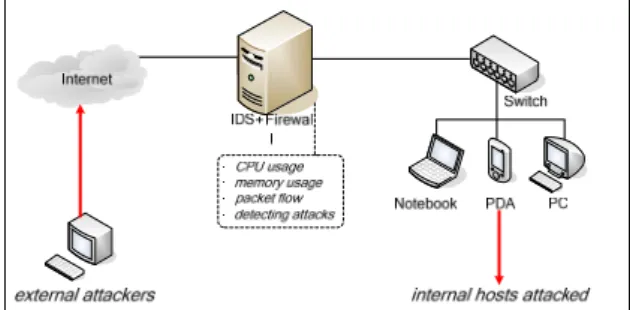
(2) when alerts occur. It would make the defensive system more intelligent responding to attacks. The rest of the paper is organized as follows. In Section 2, the basic idea of firewall is briefly described. In Section 3, briefly review the intrusion detection system. In Section 4, we give our proposed system architecture and the experiment design. In Section 5, the experimental results are present. Finally, we have a conclusion.. 2: FIREWALL Firewall is a system designed to prevent unauthorized access to or from a private network. Firewalls can be implemented in both hardware and software, or a combination of both. Firewalls are frequently used to prevent unauthorized users from accessing private networks connected to the Internet, especially intranets. All messages incoming or outgoing the intranet pass through the firewall, which examines each message and blocks those that do not meet the specified security criteria. There are several types of firewall techniques:. 2.1: Packet filter: Looks at each packet entering or leaving the network and accepts or rejects it based on user-defined rules. Packet filtering is fairly effective and transparent to users, but it is difficult to configure. In addition, it is susceptible to IP spoofing.. 2.2: Application gateway: Applies security mechanisms to specific applications, such as FTP and Telnet servers. This is very effective, but can impose performance degradation.. 2.3: Circuit-level gateway: Applies security mechanisms when a TCP or UDP connection is established. Once the connection has been made, packets can flow between the hosts without further checking.. suspicious patterns that may indicate a network or system attack from someone attempting to break into or compromise a system. There are several ways to categorize an IDS:. 3.1: Misuse detection vs. anomaly detection: In misuse detection, the IDS analyzes the information it gathers and compares it to large databases of attack signatures. Essentially, the IDS looks for a specific attack that has already been documented. Like a virus detection system, misuse detection software is only as good as the database of attack signatures that it uses to compare packets against. In anomaly detection, the system administrator defines the baseline, or normal, state of the network traffic load, breakdown, protocol, and typical packet size. The anomaly detector monitors network segments to compare their state to the normal baseline and look for anomalies.. 3.2: Network-based vs. host-based: In a network-based system, or NIDS, the every individual packet flowing through a network is analyzed. The NIDS can detect malicious packets that are designed to be overlooked by a firewall simplistic filtering rules. In a host-based system, the IDS examines at the activity on each individual computer or host.. 3.3: Passive vs. active: In a passive system, the IDS detects a potential security breach, logs the information and signals an alert. In an active system, the IDS responds to the suspicious activity by logging off a user or by reprogramming the firewall to block network traffic from the suspected malicious source. Though both are related to network security, an IDS differs from a firewall in that a firewall looks out for intrusions in order to stop them from happening. The firewall limits the access between networks in order to prevent intrusion and does not signal an attack from inside the network. An IDS evaluates a suspected intrusion once it has taken place and signals an alarm. An IDS also watches for attacks that originate from within a system.. 2.4: Proxy server: Intercepts all messages incoming or outgoing the network. The proxy server effectively hides the true network addresses. In practice, many firewalls use two or more of these techniques in concert. A firewall is considered as a front line of defense in protecting private information.. 4:. SYSTEM ARCHITECTURE EXPERIMENT DESIGN. AND. In this section, we propose the system architecture and our experiment design. Since internal host uses the public IP address but not private IP address, we design our system architecture as Figure 1.. 3: INTRUSION DETECTION SYSTEM An intrusion detection system (IDS) inspects all inbound and outbound network activities and identifies. - 857 -.
(3) Figure 3.. Using static routing mode. 5: EXPERIMENTAL RESULTS To show that the proposed system is feasible, we conduct a series of experiments using the static routing mode. We have some observations from the experimental results. Figure 1.. Observation 1: IDS should be separated from and set behind the firewalls.. System architecture. The IP addresses assigned for our experiment are listed as follows: • 140.128.98.80/255.255.255.240 • 140.128.98.96/255.255.255.240 Before conducting the experiments, we try two modes: the bridge mode and the static routing IP mode, and we found that the later can fit our requirement.. 4.1: Bridge mode In this case, we use bridge mode for each firewall, IDS and Dispatcher, respectively. We found that, using this mode, it has to start “promiscuous mode” and it will make the packets in an endless cycle between the front switch and the firewalls, shown as Figure 2. Therefore, we do not use the bridge mode.. Figure 2.. This observation includes two experiments, Experiment 1 and Experiment 2, and the system architectures are shown in Figure 4 and Figure 5, respectively. External attackers launch attacks through the Internet, using the famous “nmap” [4] as the attacking tool, to internal hosts.(IP Address: 140.128.98.98) We record the attacking information (e.g. system usage rate and packet flow, etc) and start to scan the port the IP opened as “%nmap -sT 140.128.98.98” at the 5th second. After every attack we take 0.5 seconds of rest and continue to conduct another scanning attack. Finally, we terminate the attacks at the 175th seconds, and stop recording data at the 180th seconds.. Figure 4.. System architecture for Experiment 1. Figure 5.. System architecture for Experiment 2. Using bridge mode. 4.2: Static Routing mode In this mode, we use static routing on Dispatcher, IDS and firewalls, and use private IP for Dispatcher and IDS. The static routing profile is depicted in Figure 3. This mode can meet our requirements to conduct the following experiments.. Experiment 1: As shown in Figure 4, we separate the IDS from and set it behind the firewalls and record the information. We record the system usage rate, the attacking packets, the intercepted attacks and packet flow between IDS and two firewalls. Then the external attacker starts. - 858 -.
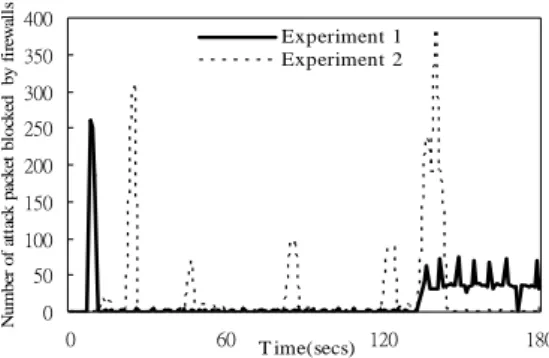
(4) 900. Experiment 2:. 600. Flow(KB). “nmap” scanning attacks to each internal host every 2 seconds.. As shown in Figure 5, we integrate the IDS and firewall into the same host. The conditions are the same as those of Experiment 1. The external attacker launches attacks to the internal hosts every 0.5 second, starting from the 5th second to the 175th second.. In Experiment 1, the IDS sends notice to the firewalls, on detecting the attacking packets. The firewall could update the rules accordingly, and thus the next incoming attacking packets could be blocked by the firewall immediately. Therefore, the detecting workload of the IDS can be decreased dramatically. And hence, the efficiency of IDS operation obtains a large-scale improvement due to the absence of evil packets blocked by the firewalls in advance. In Experiment 2, the IDS and firewall are put on the same host. On getting attacking packets, the libpcap [5] would intercept the packets and sends them to the IDS (snort) for analysis. And then, the IDS notices the firewall to block. It wastes the resource of the host because the IDS just handles the unnecessary work. For the same reason, it can protect the insiders when the firewall is set behind the IDS, while the IDS becomes an encumbrance.. 0 0. Figure 7.. 135. 180. Packets flow from the IDS for Experiment 2. 40 30 20 10 0 0. Figure 8.. 60. T ime(secs). 120. 180. (a) Packets detected by the IDS for Experiment 1. 300 Number of attack packet detected by IDS. Flow(KB). 90 T ime(secs). 50. 600. 0 0. Figure 6.. 45. Comparing the results of Experiment 1(Figure 6) and Experiment 2(Figure 7), we can see that the packets enter the IDS in Experiment 1 decreases significantly. Because the physical locations of firewalls and IDS are interchanged, they have different result (Figure 8(a)(b)). For the most attacking software, when the attacked host does not have any response, it may give up the subsequent attacks. On the other hand, to depress the attacker’s intention can also be viewed as a successful approach of improving system security. From Figure 9, the experimental evidence has shown that the number of attacking packets is reduced by using the system architecture in Experiment 1. Number of attack packet detected by IDS. After the experiments, we get the statistics of IDS packets flow, IDS system usage rate, packets detected by the IDS and blocked packets by the firewall.. 300. 45. 90 T ime(secs). 135. 180. Packet flow from the IDS for Experiment 1. 50 40 30 20 10 0 0. Figure 8.. - 859 -. 60. T ime(secs). 120. 180. (b)Packets detected by the IDS for Experiment 1.
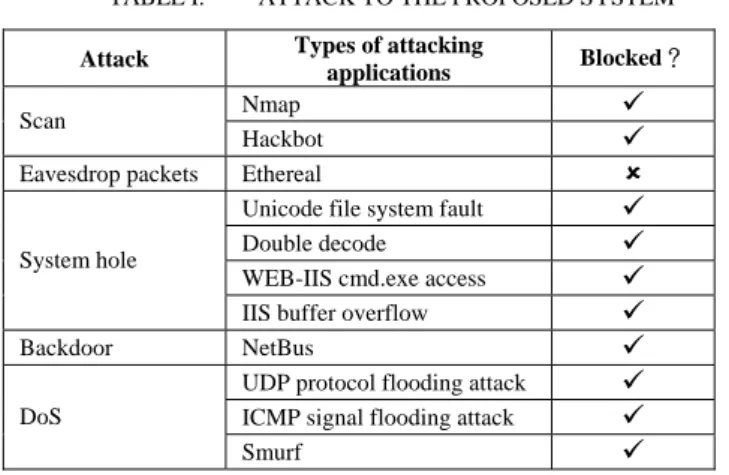
(5) Number of attack packet blocked by firewalls. Experiment 3:. 400 Experiment 1 Experiment 2. 350. In Experiment 3, we use three external FTP clients, and let them download the 50 files from the FTP server at the same time. It costs 126 seconds to complete. The analysis of packet flow is shown in Figure 12.. 300 250 200 150 100. Experiment 4:. 50 0 0. Figure 9.. 60. T ime(secs) 120. 180. Packets blocked by the firewall. Now, we would try that whether it has better performance for legitimate packet flow using a dispatcher and multiple firewalls. We design the Experiment 3(Figure 10) and Experiment 4(Figure 11). To distribute the incoming packets among the multiple firewalls, we apply the round-robin algorithm and “iproute2”, of which the most important are ip and traffic control.. The conditions are same as in Experiment 3, but we use only one firewall. When we let the three external FTP clients download the 50 files at the same time, it costs 188 seconds to complete. The analysis of packet flow is shown in Figure 13. Judged from the comparisons between Experiment 3 and Experiment 4, our proposed defensive mechanism has also shown that the excellent improvement figure can be up to 33% for legitimate packet flow in transfer-time performance. 20 Firewall1. 18. Firewall2. 16. T otal. Flow(MB). 14 12 10 8 6 4 2 0 0. 30. 60. 90. 120. Time(secs). Figure 12. Packet flow on firewall on Experiment 3 Figure 10. System architecture for Experiment 3 12 10. Flow(KB). 8 6 4 2 0 0. T ime(secs). 188. Figure 11. System architecture for Experiment 4. Figure 13. Packet flow on firewall on Experiment 4. Observation 2: Using a dispatcher has better performance.. In additional to the above experiments and observations, we also conduct several attacks to our system. It can be seen that our system can depress the types of attacks as shown in Table 1.. We let one of the hosts Serv-U 2.5 [6] to be an FTP server, and allow the external users to connect and to download files. There are 50 files in the FTP server for the experiments. Besides, we let an external user to use the CuteFTP Pro 3.0 [7], set the connection numbers up to 20 and download files by 4 parts.. 6: CONCLUSION In this article, we propose a network defensive system that incorporates intrusion detection with multi-firewalls and good efficiency and security has been obtained. We make use of a dispatcher and both of the characteristics of firewall and intrusion detection to. - 860 -.
(6) depress attacks. With the location interchange of firewalls and IDS, the experimental data has verified that our proposed approach can alleviate the bottleneck at IDS, and speedup the packet-flow rate for the whole system. Adopting multi-firewalls model, the vast of incoming packets can be distributed uniformly to two or more firewalls, mitigate the load of firewalls, and forward packets in different route successfully. By conducting a series of experiments, we can see that the proposed system is a feasible solution for both of security and efficiency. TABLE I. Attack Scan Eavesdrop packets. System hole. Backdoor DoS. [12] Brian hatch, James Lee and George Kurtz, “Hacking. Linux Exposed: Linux Security Secrets & Solutions,” published by McGraw-Hill, ISBN: 0-07-213140-3, 2001. [13] Joel Scambray and Stuart McClure, “Hacking Exposed Windows 2000: Network Security Secrets & Solutions,” published by McGraw-Hill, ISBN: 0-07-219262-3, 2001. [14] Raven Alder, Jacob Babbin, Adam Doxtater, James C. Foster, Toby Kohlenberg and Michael Rash, “Snort 2.1 Second Edition,” Published by Syngress, ISBN 1-931836-04-3, 2004.. ATTACK TO THE PROPOSED SYSTEM Types of attacking applications Nmap Hackbot Ethereal Unicode file system fault Double decode WEB-IIS cmd.exe access IIS buffer overflow NetBus UDP protocol flooding attack ICMP signal flooding attack Smurf. Blocked?. 9 9 8 9 9 9 9 9 9 9 9. ACKNOWLEDGEMENT This research is partially supported by the National Science Council, Taiwan, by contract no. NSC 94-2213-E-029-001.. REFERENCES [1]. [2]. [3]. [4]. [5] [6] [7] [8]. [9]. [10] [11]. U. Lindquist and E. Jonsson, “How to Systematically Classify Computer Security Intrusions,” Proceedings IEEE Symposium Research in Security and Privacy, Oakland, CA, 1997. K. Jackson, M. C. Neumann, D. Simmonds, C. Stallings, J. Thompson and G. Christoph, “An Automated Computer Misuse Detection System for UNICOS,” Proceedings of the Cray Users Group Conference, Tours, France, 1994. Enterasys Networks, “Intrusion Detection System: Hackers Are Getting Smarter,” Enterasys Networks, 2001. nmap, “Nmap - Free Security Scanner for Network Exploration & Security Audits,” http://www.insecure.org/nmap/. libpcap, http://sourceforge.net/projects/libpacp/. Serv-U, http:// www.serv-u.com/. CuteFTP, http://www.cuteftp.com/. Andre Zuequete, “Improving the Functionality of SYN Cookies,” Proceedings of 6th IFIP Communications and Multimedia Security Conference, pp. 57-77, Sep. 2002. John Ran, Anonymous, “Maximum Linux Security, 2nd Edition,” published by Sams ,ISBN: 067-2321-34-3, June 2001. Rob Flickenger, “Linux Server Hacks,” published by O’REILLY, ISBN: 986-7794-19-2, Jan. 2003. Michael D. Baure, “Building Secure Servers with Linux,” published by O’REELLY, Oct. 2002.. - 861 -.
(7)
數據

相關文件
In this paper, we evaluate whether adaptive penalty selection procedure proposed in Shen and Ye (2002) leads to a consistent model selector or just reduce the overfitting of
If the best number of degrees of freedom for pure error can be specified, we might use some standard optimality criterion to obtain an optimal design for the given model, and
It better deals with the tension between the modern transformation of Buddhism and the contradictions posed by modernity, providing a model for the development of
– The futures price at time 0 is (p. 275), the expected value of S at time ∆t in a risk-neutral economy is..
Interestingly, the periodicity in the intercept and alpha parameter of our two-stage or five-stage PGARCH(1,1) DGPs does not seem to have any special impacts on the model
Microphone and 600 ohm line conduits shall be mechanically and electrically connected to receptacle boxes and electrically grounded to the audio system ground point.. Lines in
Efficient training relies on designing optimization algorithms by incorporating the problem structure Many issues about multi-core and distributed linear classification still need to
• validation set blending: a special any blending model E test (squared): 519.45 =⇒ 456.24. —helped secure the lead in last
