Synthesis and Characterization of Organoaluminum
Complexes Containing Bi- or Tridentate-Substituted
Pyrrole Ligands
Jui-Hsien Huang,*
,†Hsing-Jen Chen,
†Jr-Chiuan Chang,
†Chong-Chin Zhou,
†Gene-Hsiang Lee,
‡and Shie-Ming Peng
‡Department of Chemistry, National Changhua University of Education, Changhua, Taiwan 500, and Department of Chemistry and Instrumentation Center,
National Taiwan University, Taipei, Taiwan 106 Received November 8, 2000
Summary: Reactions of AlCl3 with 1 equiv of Li-{C4H2N(CH2NMe2)2-2,5}or 2 equiv of Li{C4H3N(CH2 -NMe2)-2} in diethyl ether at -78 °C afforded AlCl2 -{C4H2N(CH2NMe2)2-2,5}(1) and AlCl{C4H3N(CH2NMe2 )-2}(2), respectively. Alkylation of 1 with MeLi in diethyl ether generates the aluminum dimethyl complex 3. Compound 2 is thermally unstable and was converted to uncharacterized product in CHCl3within 2 days at 80 °C. Compounds 1, 2, and 3 were characterized by NMR spectroscopy and X-ray structure determination.
Introduction
Lewis acidic aluminum halide or alkyl compounds, AlX3or AlR3, have been observed to form simple adducts with Lewis bases, such as amines1and ethers,2which normally adopt a monomeric, four-coordinate tetra-hedral geometry. Similarly, the use of bi- and tridentate ligands, such as arylamines,3bifunctional, multidentate phenolates,4 multidentate amides,5 and amidophos-phines,6in the preparation of high-coordinate group 13 metal complexes has seen widespread popularity.
Our investigations have noted that monoanionic, bi-and tridentate pyrrole ligbi-ands containing dimethyl-amino part(s) type ligands,{C4H3N(CH2NMe2)-2}-and {C4H2N(CH2NMe2)2-2,5}-, were first synthesized in 1947.7aHowever, very few examples of organometallic
complexes containing these bi- or tridentate ligands have been reported. In fact, thus far, only one com-pound, involving the monoanionic, bidentate ligand bound to a chromium atom, has been identified using X-ray diffraction.7
In continuing our efforts in the chemistry of substi-tuted pyrrolate compounds of early transition metals, we have focused our attention on group 13. Herein, we report the chemistry of aluminum chloride with bi- and tridentate-substituted pyrrolate ligands.
Results and Discussion
The reactions of AlCl3 with {C4H3N(CH2NMe2)-2} -and {C4H2N(CH2NMe2)2-2,5}- are summarized in Scheme 1.
Compound 1 was prepared in 84% yield by reacting AlCl3 and 1 equiv of Li{C4H2N(CH2NMe2)2-2,5} in diethyl ether at -78 °C. The five-coordinate aluminum compound 1 shows a geometry in solution that is
†National Changhua University of Education. ‡National Taiwan University.
(1) (a) Mole, T.; Jeffery, E. A. Organoaluminum Chemistry; Elsevi-er: New York, 1972. (b) Trepanier, S. J.; Wang, S. Organometallics 1994, 13, 2213.
(2) (a) Rosch, L.; Altman, G. J. Organomet. Chem. 1980, 195, 47. (b) Janik, J. F.; Duesler, E. N.; McNamara, W. F.; Westerhausen, M.; Paine, R. T. Organometallics 1989, 8, 506.
(3) (a) Schumann, H.; Seuss, T. D.; Just, O.; Wiemann, R.; Hemling, H.; Go¨rlitz, F. H. J. Organomet. Chem. 1994, 479, 171. (b) Coggin, D. K.; Fanwick, P. E.; Green, M. A. J. Chem. Soc., Chem. Commun. 1993, 1127. (c) Khan, M.; Steevensz, R. C.; Tuck, D. G.; Noltes, J. G.; Corfiel, P. W. R. Inorg. Chem. 1980, 19, 3407. (d) Olazabal, C. A.; Gabbai, F. P.; Cowley, A. H.; Carrano, C. J.; Mokry, L. M.; Bond, M. R. Organometallics 1994, 13, 421. (e) Mu¨ ller, J.; Schro¨der, R.; Wang, R. Eur. J. Inorg. Chem. 2000, 153. (f) Mu¨ ller, J.; Fischer, R. A.; Sussek, H.; Pilgram, P.; Wang, R.; Pritzkow, H.; Herdtweck, E. Organometallics 1998, 17, 161. (g) Hair, G. S.; Battle, S. L.; Decken, A.; Cowley, A. H.; Jones, R. A. Inorg. Chem. 2000, 39, 1150.
(4) (a) Hogerheide, M. P.; Wesseling, M.; Jastrzebski, J. T. B. H.; Boersma, J.; Kooijman, H.; Spek, A. L.; van Koten, G. Organometallics 1995, 14, 4483. (b) Lewinski, J.; Zachara, J.; Justyniak, I. Organome-tallics 1997, 16, 4597. (c) Lewinski, J.; Zachara, J.; Mank, B.; Pasynkiewicz, S. J. Organomet. Chem. 1993, 454, 5.
(5) Trepanier, S. J.; Wang, S. Can. J. Chem. 1996, 74, 2032. (6) Fryzuk, M. D.; Giesbrecht, G. R.; Olovsson, G.; Rittig, S. J. Organometallics 1996, 15, 4832.
(7) (a)Herz, W.; Dittmer, K. J. Am. Chem. Soc. 1947, 69, 1698. (b) Kim, H.; Elsenbaumer, R. L. Tetrahedron Lett. 1998, 39, 1087. (c) Drvs, H.; Schmeiber, A.; Hartung, H.; Baumeister, U. Chem. Ber. 1996, 129, 853.
Scheme 1
2647
Organometallics 2001, 20, 2647-2650
10.1021/om000951l CCC: $20.00 © 2001 American Chemical Society Publication on Web 05/15/2001
Downloaded by NATIONAL TAIWAN UNIV on August 18, 2009
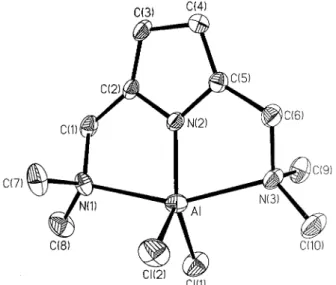
consistent with meridional bonding of the{C4H2N(CH2 -NMe2)2-2,5}. The methylene protons of 1 give rise to a sharp singlet in the proton NMR spectrum at 3.68 ppm. Similar proton NMR spectral patterns have been ob-served for analogous Ti8 and Zr9 derivatives with {C6H3(CH2NMe2)2-2,5}-as the ancillary ligand. The13C gated-decoupling NMR spectrum shows a triplet for the methylene carbon at 60.6 ppm with a normal sp3 coupling constant at 137 Hz. A crystal obtained from a saturated methylene chloride/diethyl ether solution of compound 1 was characterized by single-crystal X-ray structure analysis. The crystallographic data are sum-marized in Table 1. Selected bond distances and angles are listed in Table 2, and an ORTEP plot is depicted in Figure 1.
Compound 1 is best described as distorted trigonal bipyramidal with the tridentate monoanionic{ C4H2N-(CH2NMe2)2-2,5}-attached to aluminum in a meridi-onal geometry. The pyrrolate nitrogen atom is σ-bonded to aluminum with an Al-N distance of 1.827(3) Å, which is approximately 0.4 Å shorter than the mean bond
distance of the dimethylamino nitrogen atoms coordi-nated to aluminum. The two dimethylamino nitrogen atoms occupy axial positions, while the pyrrolate
nitro-(8) Gue´rin, F.; McConville, D. H.; Payne, N. C. Organometallics 1996, 15, 5085.
(9) Gue´rin, F.; McConville, D. H.; Vittal, J. J. Organometallics 1996, 15, 5586.
Table 1. Summary of Crystallographic Data for Compounds 1, 2, and 3
1 2 3
formula C10H18AlCl2N3 C14H22AlClN4 C12H24AlN3
fw 278.12 308.79 237.32
temp, K 150(1) 150(1) 150(1)
wavelength, Å 0.71073 0.71073 0.71073
diffractometer used SMART CCD SMART CCD SMART CCD
cryst syst orthorhombic orthorhombic orthorhombic
space group Pbca P212121 Pbca
a, Å 11.9929(8) 8.4637(2) 12.1410(2) b, Å 14.6956(9) 9.2139(2) 14.9987(2) c, Å 15.6033(9) 20.1903(3) 15.6734(1) volume (Å3), Z 2750.0(3), 8 1574.51(6), 4 2854.11(6), 8 density (cald), Mg/m3 1.344 1.303 1.105 absorp coeff, mm-1 0.515 0.295 0.124 F(000) 1168 656 1040 cryst size, mm 0.20× 0.15 × 0.13 0.20× 0.20 × 0.16 0.60× 0.60 × 0.40 θ range, deg 2.55 to 25.00 2.02 to 26.38 2.52 to 27.50
no. of reflns collected 8595 7497 19 162
no. of indep reflns 2394 (Rint)0.0767) 3190 (Rint)0.0503) 3266 (Rint)0.0266)
absorp corr empirical used SADABS
max. and min. trans 0.9280 and 0.8154 0.9280 and 0.7818 0.9280 and 0.8057
refinement method full-matrix least-squares on F2
no. of data/restraints/params 2394/0/146 3190/0/182 3266/0/152
goodness-of-fit on F2 1.185 1.056 1.142
final R indices [I>2σ(I)] R1 ) 0.0726, wR2 ) 0.0949 R1 ) 0.0502, wR2 ) 0.0887 R1 ) 0.0470, wR2 ) 0.1168 R indices (all data) R1 ) 0.1102, wR2 ) 0.1038 R1 ) 0.0670, wR2 ) 0.0943 R1 ) 0.0526, wR2 ) 0.1198
extinction coeff 0.0031(5) 0.0033(9) 0.0030(7)
largest diff peak and hole, e Å-3 0.343 and -0.260 0.292 and -0.218 0.339 and -0.281
structure determined program SHELXTL
Table 2. Selected Bond Distances (Å) and Angles (deg) for Compound 1, 2, and 3
1 2 3
Al-N(2) 1.827(3) Al-N(3) 1.896(3) Al-N(2) 1.8617(13)
Al-Cl(1) 2.135(2) Al-N(1) 1.906(3) Al-C(1) 1.980(2)
Al-Cl(2) 2.146(2) Al-N(4) 2.105(3) Al-C(2) 2.000(2)
Al-N(3) 2.211(3) Al-N(2) 2.110(3) Al-N(3) 2.426(2)
Al-N(1) 2.257(3) Al-Cl 2.1907(12) Al-N(1) 2.2838(14)
N(2)-Al-Cl(1) 130.61(11) N(3)-Al-N(1) 143.93(12) N(2)-Al-C(1) 126.45(7)
N(2)-Al-Cl(2) 118.20(11) N(3)-Al-N(4) 81.18(11) N(2)-Al-C(2) 116.99(6)
Cl(1)-Al-Cl(2) 111.17(6) N(1)-Al-N(4) 95.66(11) C(1)-Al-C(2) 116.54(7)
N(2)-Al-N(3) 77.63(12) N(3)-Al-N(2) 95.45(11) N(2)-Al-N(1) 76.55(5)
Cl(1)-Al-N(3) 96.31(9) N(1)-Al-N(2) 81.79(11) C(1)-Al-N(1) 98.54(6)
Cl(2)-Al-N(3) 96.05(9) N(4)-Al-N(2) 170.48(11) C(2)-Al-N(1) 97.05(6)
N(2)-Al-N(1) 77.12(12) N(3)-Al-Cl 108.94(9) N(2)-Al-N(3) 74.42(5)
Cl(1)-Al-N(1) 97.26(9) N(1)-Al-Cl 107.12(9) C(1)-Al-N(3) 95.21(6)
Cl(2)-Al-N(1) 99.04(9) N(4)-Al-Cl 94.34(8) C(2)-Al-N(3) 99.78(6)
N(3)-Al-N(1) 154.49(12) N(2)-Al-Cl 95.17(8) N(1)-Al-N(3) 150.66(5)
Figure 1. ORTEP plot of compound 1. Thermal ellipsoids
are drawn at the 50% probability level, and hydrogen atoms are omitted for clarity.
2648 Organometallics, Vol. 20, No. 12, 2001 Notes
Downloaded by NATIONAL TAIWAN UNIV on August 18, 2009
gen and two chlorides occupy the equatorial positions forming two five-membered rings with bond angles of N(2)-Al-N(3) and N(2)-Al-N(1) of 77.63(12)° and 77.12(12)°, respectively.
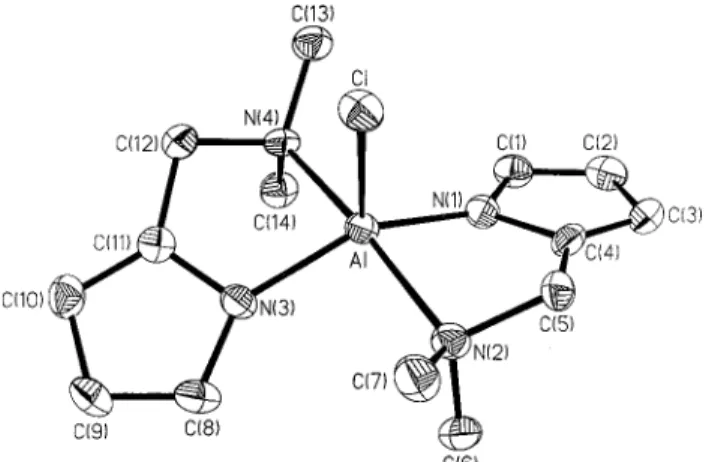
The analogous reaction of AlCl3 with 2 equiv of Li-{C4H3N(CH2NMe2)-2}in diethyl ether at -78 °C yielded an off-white compound, AlCl{C4H3N(CH2NMe2)-2}2(2), which was isolated in 84% yield. The1H NMR spectrum of 2 highlights the diasterotopic nature of the methylene protons, showing doublets at 4.10 and 3.79 ppm, while the dimethylamino protons give rise to doublets at 2.64 and 2.56 ppm. Crystals of 2 suitable for X-ray structure analysis were obtained from a diethyl ether solution. The crystallographic data are summarized in Table 1. Selected bond distances and angles are listed in Table 2, and an ORTEP plot is depicted in Figure 2.
Similar to 1, compound 2 can be described as a distorted trigonal bipyramid with the two dimethyl-amino nitrogen atoms occupying axial positions and with an angle of 170.48(11)°. The two pyrrolate nitrogen atoms and the chlorine atom form a trigonal plane with the sum of angles N(1)-Al-Cl, N(1)-Al-N(3), and N(3)-Al-Cl at nearly 360°. The aluminum to axial nitrogen bond distances (ca.. 2.1 Å) are 0.2 Å longer than aluminum to equatorial nitrogen distance (ca. 1.9 Å), indicating the σ-bonded anionic pyrrolate nitrogen atoms are bound more strongly than are the axial nitrogen atoms, which are bonded through lone-pair NfAl interactions.
Compound 2 is not thermally stable and is converted within 2 days to uncharacterized products when heated to 80 °C in deuterated chloroform in an NMR tube under an inert atmosphere. To eliminate the possible reaction of compound 2 with chloroform, benzene was used as solvent, and the same result was observed. However, the rate of decomposition of compound 2 in chloroform is much faster than that in benzene. Alkylation of compound 2 by MeLi or n-BuLi in diethyl ether was not successful, and Li{C4H3N(CH2NMe2)-2}was recovered. Alkylation of 1 with 2 equiv of MeLi afforded AlMe2-{C4H2N(CH2NMe2)2-2,5}, 3, in 85% yield. The1H NMR spectrum of 3 is consistent with a C2v symmetric structure with the two methyl groups observed as a singlet in the 1H NMR spectrum at -0.85 ppm. The region of the13C NMR spectrum associated with the methyl groups attached to aluminum shows a very weak
quartet due to the quadrupole interaction of aluminum (I ) 5/2),10which also has a low JCHcoupling constant at 111 Hz. Compound 3 is extremely air-sensitive and decomposes rapidly when exposed to the atmosphere. Colorless cube crystals were obtained from saturated diethyl ether solution, and X-ray analysis was per-formed. Crystallographic data and selected bond dis-tances and angles of compound 3 are summarized in Tables 1 and 2, respectively. An ORTEP plot of com-pound 3 is shown in Figure 3.
The structure of the methylaluminum compound 3 is very similar to that of compound 1, exhibiting a dis-torted trigonoal bipyramidal structure with the two dimethylamino nitrogen atoms occupying axial posi-tions. The pyrrolate nitrogen and the two methyl groups form a trigonal plane with the sum of bond angles of N(2)-Al-C(1), N(2)-Al-C(2), and C(1)-Al-C(2) at 359.98°. Surprisingly, compound 3 is quite thermally stable in CDCl3, showing no decomposition at 70 °C during 24 h. An attempt to synthesize AlMeCl{ C4H2N-(CH2NMe2)2-2,5}by reacting 1 with 1 equiv of MeLi in diethyl ether resulted in the formation of the dimethyl compound 3 and left unreacted 1. Moreover, upon mixing equimolar amounts of compounds 1 and 3 in C6D6 in an NMR tube fitted with a J. Young adapter and heated to 80 °C for 3 days, no reaction was observed. On careful examination of the1H NMR spectrum of compound 3, a small amount of isomer (ca. 5%) was found to be present, identified by a broad resonance at 2.10 ppm. This species could be converted to 3 in deuterated benzene or chloroform at 50 °C within 30 min. We suggest that this compound is the kinetic product, fac-coordinated AlMe2{C4H2N(CH2NMe2)2-2,5}, which can be converted to mer-coordinated compound 3. Similar results have been observed for gallium and indium complexes with the same ligand systems.11
Experimental Section
General Procedure. All the reactions were performed
using standard Schlenk techniques in an atmosphere of
high-(10) Similar phenomena have been seen, for example: Coles, M. P.; Swenson, D. C.; Jordan, R. F. Organometallics 1997, 16, 5183.
Figure 2. ORTEP plot of compound 2. Thermal ellipsoids
are drawn at the 50% probability level, and hydrogen atoms are omitted for clarity.
Figure 3. ORTEP plot of compound 3. Thermal ellipsoids
are drawn at the 50% probability level, and hydrogen atoms are omitted for clarity.
Notes Organometallics, Vol. 20, No. 12, 2001 2649
Downloaded by NATIONAL TAIWAN UNIV on August 18, 2009
purity nitrogen or in glovebox. AlCl3 was purchased from
Lancaster and used directly. Heptane and diethyl ether were dried over Na/benzophenone ketyl and distilled before use. {C4H4N(CH2NMe2)-2}and{C4H3N(CH2NMe2)2-2,5}were
syn-thesized according to published literature.7The lithium salts
were prepared by adding 1 molar equiv of n-BuLi to the substituted pyrrole at -78 °C followed by stirring at room temperature for 4 h. CDCl3was degassed by using
freeze-and-thaw cycles and dried over 4 Å molecular sieves.1H and13C
NMR spectra were measured on a Bruker AC200 instrument. Elemental analysis was performed on a Perkin-Elmer CHN-2400 or Heraeus CHN-OS Rapid. Due to the moisture sensi-tivity of the Al compounds, we could not get better elemental analysis data. The1H NMR spectra of compounds 1, 2, and 3
are included in the Supporting Information.
AlCl2{C4H2N(CH2NMe2)2-2,5}, 1. A 100 mL Schlenk flask containing AlCl3(3.0 g, 22 mmol) was cooled to -78 °C, and
20 mL of diethyl ether was added. To the AlCl3/ether solution
was added dropwise Li{C4H2N(CH2NMe2)2-2,5} (4.2 g, 22
mmol) in 20 mL of diethyl ether with stirring. The reaction mixture was stirred at room temperature for 12 h after the addition was completed. The resulting suspension was filtered through Celite, and the residue was extracted with 15 mL of diethyl ether in three portions and filtered through Celite again. The combined filtrate was concentrated to about 5 mL, and the product was crystallized at -20 °C to yield 5.26 g of white solid in 84% yield.1H NMR (CDCl
3): 5.90(s, 2H, C4H2N),
3.68(s, 4H, CH2NMe2), 2.56(s, 12H, NMe2).13C NMR (CDCl3):
129.7(s, Cipso), 105.2(d, JCH) 167 Hz, CH), 60.3(t, JCH) 137
Hz, CH2), 47.9(q, JCH) 137 Hz, CH3). Anal. Calcd for C10H18
-AlCl2N3: C, 43.18; H, 6.52; N, 15.10. Found: C,42.15; H, 7.74;
N, 15.64.
AlCl{C4H3N(CH2NMe2)-2}2, 2. A 100 mL Schlenk flask containing AlCl3(1.0 g, 7 mmol) was cooled to -78 °C, and 20
mL of diethyl ether was added. To the AlCl3/ether solution was
added dropwise Li{C4H3N(CH2NMe2)-2}(2.0 g, 15 mmol) in
20 mL of diethyl ether with stirring. The reaction mixture was stirred at room temperature for 12 h after the addition was completed. The resulting suspension was filtered through Celite, and the residue was extracted with 15 mL of dichlo-romethane in three portions and filtered through Celite again. The filtrate was concentrated to about 10 mL, and the product was crystallized at -20 °C to yield 1.78 g of white solid in 84% yield. 1H NMR (CDCl
3): 6.87(m, 2H, C4H3N), 6.18(m, 2H,
C4H3N), 6.07(m, 2H, C4H3N), 4.10(d, 2H, CHaNMe2), 3.79(d,
2H, CHbNMe2), 2.64(s, 6H, NMe2), 2.56(s, 6H, NMe2).13C NMR
(CDCl3): 134.5(s, pyrrole Cipso), 124.5(d, JCH) 178 Hz, pyrrole CH), 110.1(d, JCH) 167 Hz, pyrrole CH), 105.8(d, JCH) 168
Hz, pyrrole CH), 59.0(t, JCH) 140 Hz, CH2), 47.6(q, JCH)
138 Hz, NMe2), 45.8(q, JCH) 138 Hz, NMe2). Anal. Calcd for
C14H22AlClN4: C, 54.45; H, 7.18; N, 18.14. Found: C, 53.81;
H, 7.96; N, 17.48.
AlMe2{C4H2N(CH2NMe2)2-2,5}, 3. A 100 mL Schlenk flask containing compound 1 (3.0 g, 10.7 mmol) was cooled to -78 °C, and 20 mL of diethyl ether was added. To this solution was added dropwise MeLi (1.6 M, 13.4 mL, 21.4 mmol) in diethyl ether through Teflon tubing with stirring. The reaction mixture was stirred at room temperature for 4 h. The resulting suspension was filtered through Celite to remove LiCl, the resulting filtrate was vacuum-dried, and the product was recrystallized from diethyl ether at -20 °C to yield 2.18 g of white solid in 85% yield.1H NMR(CDCl
3): 5.86(s, 2H, C4H2N), 3.52(s, 4H, CH2), 2.34(s, 12H, NMe2), -0.87(s, 6H, AlMe2).13C NMR (CDCl3): 131.9(s, Cipos), 103.2(d, JCH) 165 Hz, pyrrole CH), 59.5(t, JCH) 137 Hz, CH2), 46.7(q, JCH) 136 Hz, NMe2),
-12.1(q, JCH) 111 Hz, AlMe2). Anal. Calcd for C12H24AlN2:
C, 60.73; H, 10.19 Found: C, 60.78; H, 10.34.
X-ray Structure Determination of Compounds 1, 2, and 3. The crystals were mounted on a glass fiber using epoxy
resin, transferred to a goniostat, and cooled to 150 K under liquid nitrogen vapor. Data were collected on a Bruker SMART CCD diffractometer with graphite-monochromated Mo KR radiation. Structural determinations were made using the SHELXTL package of programs. All refinements were carried out by full-matrix least squares using anisotropic displacement parameters for all non-hydrogen atoms. All the hydrogen atoms are calculated. The crystal data are summarized in Table 1.
Acknowledgment. We thank the National Science Council of Taiwan for financial support and the National Center for High-Performance Computing for database searching. We also thank Dr. Darin Tiedtke for helpful discussions and suggestions.
Supporting Information Available: 1H NMR spectra
and tables of crystal data for 1, 2, and 3 including tables of hydrogen coordinates, and U values, bond lengths, bond angles, anisotropic parameters, and data collection param-eters. This material is available free of charge via the Internet at http://pubs.acs.org.
OM000951L
(11) Both of mer- and fac-coordinated complexes of InMe2{C4H2N(CH2
-NMe2)2-2,5}and GaMe2{C4H2N(CH2NMe2)2-2,5}have been obtained
recently in our group. For example, the ratio of fac- to mer-isomers of InMe2{C4H2N(CH2NMe2)2-2,5}is ca. 1 to 3, and the fac-isomer could
be converted to the mer-isomer under very mild conditions. Manuscript is in preparation: Jui-Hsien Huang, Pei-Cheng Kuo, Gene-Hsiang Lee, Shie-Ming Peng.
2650 Organometallics, Vol. 20, No. 12, 2001 Notes
Downloaded by NATIONAL TAIWAN UNIV on August 18, 2009