
Temporal Error Concealment Using Self-Organizing Map*
6
0
0
全文
(2) Int. Computer Symposium, Dec. 15-17, 2004, Taipei, Taiwan.. fail in the case where there are edges across the damaged macroblock from left to right because of the lack of information on the left and right boundaries. We notice that the conventional temporal EC methods utilize different linear statistical relationships to conceal damaged macroblocks. However, if the motions of macroblocks in frames are irregular, the implementation will become inefficient, and then the schemes will product poor performance for error concealment. Thus, we desire to develop a simple and flexible temporal EC scheme to solve the problem. The artificial neural network (NN) techniques have been applied to solve complex problems in the field of image processing. The self-organizing map (SOM) has been introduced by T. Kohonen [9] as an effective neural network model for the visualization of high-dimensional data. SOM has been found to be particularly effective for problems that can make use of unsupervised training. The SOM learning algorithm is a type of unsupervised, iterative vector quantization that converts complex, nonlinear statistical data items from a high-dimensional space onto simple reference vectors in a low-dimensional space [10-14]. This study employs the SOM as a predictor to estimate the motion vector of the damaged macroblock. The estimation model proposed herein can exploit the nonlinearity property of the SOM to estimate lost motion vectors more accurately. The rest of this paper is organized as follows. Section 2 reviews the main features of the SOM neural networks. Section 3 describes the construction of the proposed temporal EC model based on SOM. Experimental results are given in Section 4 for image sequences outside the training set. Finally, conclusions are drawn in Section 5.. 1. 2. 3.. Initialization of the SOM weights to small random values. Establish the initial radials of the region for weight modification. Presentation of an N-dimension input vector x. Calculation of the distance dj between the current input vector and the weight vectors of all mapping array neurons according to the Euclidean distance function 2. d j = ∑ (xi − w ji ) N. i =1. 4. 5.. where xi is the i-th component of the input vector and wij is the i-th component of the weight vector wj. Determination of the output neuron o which is the one with minimal distance Update of all weight vectors of neurons lying with in the region of weight modification. Weight modification is given by ∆w ji = o jη (xi − w ji ). where η is the learning rate parameter. Repeat the steps above by presenting a new input vector until the given stop criterion is achieved. During the weight modification phase of the learning algorithm, the learning rate parameter and radial of the region of weight modification could be monotonically decreasing over time. This work can be used to minimize the distortion of the SOM. The SOM neural networks perform high unsupervised learning capability and computational efficiency. The SOM models perform high unsupervised learning capability and computational efficiency. The proposed temporal EC system estimates the motion vectors of damaged macroblocks by adding the final SOM mapping array. 6.. 3.. 2. Motion Vector Estimation Using SOM. Adaptive SOM Error Concealment Algorithm. Before any EC techniques can be applied to the compressed images, the locations of damaged macroblocks are necessary first to be found out. In this paper, we only focus on the problem of concealing the error macroblocks for block-based image coding systems. Thus, we assume that the locations of damaged macroblocks are known and discuss techniques for concealing the detected errors. The proposed temporal EC algorithm estimates the motion vectors of the damaged macroblocks by exploiting the information of four adjacent macroblocks (top, bottom, left, and right macroblocks). Let MVX represents motion vector of the damaged macroblock X. MVT, MVL, MVR and MVB represent the motion vector of top, left, right, and bottom macroblock surrounding X, respectively. By the spatial redundancy between the motion vectors of adjacent macroblocks, the SOM model utilizes the motion vectors of macroblocks. An SOM neural network [9] contains an input layer, a single hidden layer, and a mapping array of output, as illustrated in Fig. 2. It refers to the ability of unsupervised learning. The number of input neurons ensures from the dimension of the input vectors. In general, the SOM model defines a mapping from the higher dimension of input data space onto a regular two-dimensional mapping array. With every neuron in the mapping array, a parametric weight vector produced by learning algorithm is associated. An input vector will compare with all weight vectors, and the best match is defined as the SOM response. For a more useful analysis, each neuron in the mapping array may also be marked a class label using training samples. The learning algorithm for SOM is shortly described as the following steps:. 155.
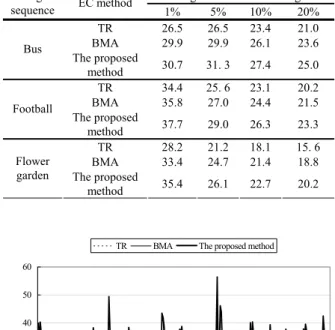
(3) Int. Computer Symposium, Dec. 15-17, 2004, Taipei, Taiwan.. surrounding the damaged macroblock to estimate the motion vector of the damaged macroblock. The proposed temporal EC algorithm described previously assumes that the errors are localized to separated macroblocks in the decompressed frames. In fact, errors typically propagate through several consecutive macroblocks for compressed frames and then yield some of adjacent lost macroblocks. In this condition, the conventional temporal EC techniques would fail to accurately estimate the motion vector of the damaged macroblock because there is no enough information. On the contrary, the SOM model has the possibility to estimate the motion vector of damaged macroblock by using incomplete input motion vectors. The SOM will compute the distance calculations and reference vector modification steps using the available data components. For example, partial data can still be used to determine the distribution statistics of the available vector components [9, 15]. Moreover, the proposed method performs a search within the previous frame for the best boundary match surrounding a damaged macroblock. Similar to the BMA, the proposed method selects a motion vector among a set of candidate vectors that minimizes the total variation between the boundaries of the damaged macroblock. Thus candidate vectors of the BMA method are added to the proposed to conceal the damaged macroblocks. Clearly, the proposed temporal EC method is always practical even if the motions in a frame are complex or irregular. The whole proposed method utilizes only one manner of neural network model - the SOM network. Thus, the architecture of the proposed temporal EC algorithm is simple, redressing easily, and suitable for hardware design. Moreover, the SOM neural networks are highly parallel computer architecture and, thus, offer the potential for realtime applications.. this study. In order to prove the precision of the proposed SOM estimation, we compare the results using the proposed EC algorithm and simulation results of temporal replacement (TR) method that replaced all damaged motion vectors by zero and the BMA method proposed in [6]. Table 1 shows the average PSNR values for reconstructed image sequences by using the three EC methods in average packet loss rates 1%, 5%, 10% and 20%. The proposed SOM method achieves the better performance than other methods. Figure 1, Fig. 2 and Fig. 3 show the PSNR values for individual frame of the reconstructed test sequences “bus”, “football” and “flower garden”, respectively. Table 1. Average PSNR values for the test sequences with different EC methods. Image sequence Bus. Football. Flower garden. EC method TR BMA The proposed method TR BMA The proposed method TR BMA The proposed method. TR. Average macroblock missing rate 1% 5% 10% 20% 26.5 26.5 23.4 21.0 29.9 29.9 26.1 23.6 30.7. 31. 3. 27.4. 25.0. 34.4 35.8. 25. 6 27.0. 23.1 24.4. 20.2 21.5. 37.7. 29.0. 26.3. 23.3. 28.2 33.4. 21.2 24.7. 18.1 21.4. 15. 6 18.8. 35.4. 26.1. 22.7. 20.2. BMA. The proposed method. 60 50. PSNR(dB). 40 30 20. 4. Experimental Results. 10. In this paper, three image sequences, “bus” (300 frames, CCIR601), “football” (150 frames, CCIR601) and “flower garden” (150 frames, CCIR601) were used in the simulations. The image sequences were encoded by MPEG-2 standard. Each group of picture (GOP) in encoded sequenced consists of 18 frames (1 I-frame, 5 P-frames, 12 Bframes) and the size of macroblock is 16 × 16. We perform a two-state Markov model, namely the Gilbert channel model, to simulate the transmission errors. The comparisons for EC methods were made in average macroblock missing rates 1%, 5%, 10% and 20%. The peak signal-to-noise ratio (PSNR) is used to give a quantitative evaluation on the quality of the reconstructed frame. The proposed method and other popular existing temporal EC approaches are implemented in. 0 1 16 31 46 61 76 91 106 121 136 151 166 181 196 211 226 241 256 271 Frame no.. Figure 1. PSNR values for frames of the test sequence “bus.” The sequence is affected by data losses with a 5% of macroblock missing. Figure 4(a) shows an error-free frame in test sequence “flower garden” and Fig. 4(b) is the damaged frame with no-overlapped stripes lost. The damaged macroblocks in the frame are replaced with gray-level 0. The reconstructed frames using the TR, BMA and the proposed method are shown in Fig. 4(c), (d) and (e), respectively. It was apparent that the reconstructed frame produced by TR was inferior to that of the BMA and the proposed method. The. 156.
(4) Int. Computer Symposium, Dec. 15-17, 2004, Taipei, Taiwan.. recovered image using the proposed method shows the improved subjective quality than other recovered images. Similarly, Figs. 5(a) and (b) show the undamaged and damaged frames from test sequence “bus”, respectively. The reconstructed frames using the TR, BMA and the proposed method are shown in Figs. 5(c), (d) and (e), respectively. The BMA shows that can produce acceptable recovered frames. However, it cannot successfully reconstruct the macroblocks that contain edges across the left and right boundaries. That is because the information of left and right macroblocks surrounding the damaged macroblock is not available. We observe that both the smooth and detailed regions in the reconstructed frames can obtain the good visual quality using the proposed EC algorithm. From the simulation results, we find that the proposed algorithm has very good performance. TR. BMA. and the proposed method are 0.062, 3.4138 and 3.8578 second, respectively. In the proposed method, the average execution time is slightly larger than other two methods. However, the proposed method achieves the better video quality. We conclude that the proposed robust error concealment technique can be a useful alternative to existing techniques due to its low computational complexity and acceptable PSNR performance.. The proposed method. 45 40. (a). 35 PSNR(dB). 30 25 20 15 10 5 0 1. 8. 15 22 29 36 43 50 57 64 71 78 85 92 99 106 113 Frame no.. Figure 2. PSNR values for frames of the test sequence “football.” The sequence is affected by data losses with a 5% of macroblock missing. (b) TR. BMA. The proposed method. 40 35. PSNR(dB). 30 25 20 15 10 5 0 1. 8. 15 22 29 36 43 50 57 64 71 78 85 92 99 106 113 Frame no.. (c). Figure 3. PSNR values for frames of the test sequence “flower garden.” The sequence is affected by data losses with a 5% of macroblock missing.. Figure 4. Subjective video quality comparison for frame 39 in test sequence “Flower Garden”: (a) original frame; (b) corrupted frame; (c) reconstructed frame using the TR method; (d) reconstructed frame using the BMA; and (e) reconstructed frame using the proposed method. (continued). To quantify the computational complexity of the EC methods, we measured the execution time required for each technique. The average execution time of reconstructed frames using the TR, the BMA. 157.
(5) Int. Computer Symposium, Dec. 15-17, 2004, Taipei, Taiwan.. sequences. The proposed temporal EC will be applicable to the video decoder requiring low computation complexity and the robust EC to high scene activity.. (d). (a). (e) Figure 4. Subjective video quality comparison for frame 39 in test sequence “Flower Garden”: (a) original frame; (b) corrupted frame; (c) reconstructed frame using the TR method; (d) reconstructed frame using the BMA; and (e) reconstructed frame using the proposed method.. (b). 5. Conclusions A new EC technique was presented in this paper, aimed at masking the loss of visual information due to erroneous transmission of coded digital video over unreliable networks. The method using the SOM neural network model overcomes the disadvantage of boundary matching algorithm at fail in areas with unsmooth motion and also for areas with low spatial correlation. The proposed method is able to reconstruct motion vector of the damaged macroblock by using incomplete information and increasing both the subjective and objective quality of the reconstructed frames even under the high packet losses. Even though the motion is extensive, the proposed EC method increase decoded video quality by using the nonlinear statistical relationships feature of the motion. The proposed method can estimate the motion vectors of the corrupted macroblocks even in the sequences including fast moving objects. Thus the high-motion sequences have better performance than the small-motion. (c) Figure 5. Subjective video quality comparison for frame 73 in test sequence “Bus”: (a) original frame; (b) corrupted frame; (c) reconstructed frame using the TR method; (d) reconstructed frame using the BMA; and (e) reconstructed frame using the proposed method. (continued). 158.
(6) Int. Computer Symposium, Dec. 15-17, 2004, Taipei, Taiwan.. [4] Y.W. and Q.F. Zhu, “Error control and concealment for video communication: a review”, Proc. IEEE, Vol. 86, May 1998, pp. 974-997. [5] P. Haskell and D. Messerschmitt, “Resynchronization of motion compensated video affected by atm cell loss”, ICASSP in Proc. IEEE, Vol. 3, March 1992, pp. 545-548. [6] W.M. Lam, A.R. Reibman, and B. Liu, “Recovery of lost or erroneously received motion vectors”, ICASSP in Proc. IEEE, Vol. 5, Mar. 1993, pp. 417–420.. (d). [7] C.S. Park, J. Ye, and S.U. Lee, “Lost motion vector recovery algorithm”, ISCAS in Proc. IEEE, Vol.3, 1994, pp. 229-232. [8] J. Feng, K.T. Lo, H. Mehrpour, and A. E. Karbowiak, “Cell loss concealment method for mpeg video in atm networks”, GLOBECOM in Proc. IEEE, Vol. 3, 1995, pp. 1925-1929. [9] T. Kohonen, Self-Organizing Maps, SpringerVerlag, Heidelberg, 1995. [10] N.V. Swindale1 and H.U. Bauer, “Application of Kohonen's self-organizing feature map algorithm to cortical maps of orientation and direction preference”, The Royal Society, January 1998, pp. 827-838.. (e) Figure 5. Subjective video quality comparison for frame 73 in test sequence “Bus”: (a) original frame; (b) corrupted frame; (c) reconstructed frame using the TR method; (d) reconstructed frame using the BMA; and (e) reconstructed frame using the proposed method.. [11] D. Cook, A. Buja, J. Cabrera, and C. Hurley, “Grand tour and projection pursuit,” Journal of Computational and Graphical Statistics, Vol. 4, no. 3, 1995, pp. 155-172. [12] M.A. Kraaijveld, J. Mao, and A.K. Jain, “A nonlinear projection method based on Kohonen's topology preserving maps,” IEEE Transactions on Neural Networks, Vol. 6, May 1995, pp. 548-559.. References [1] J.L. Mitchell, W.B. Pennebaker, C.E. Fogg, and D.J. LeGall, MPEG Video Compression Standard. London, U.K.: Chapman & Hall, 1997.. [13] J. Vesanto, “SOM-based data visualization methods," Intelligent Data Analysis, Vol. 3, April 1999, pp. 111-126.. [2] Y.C. Lee, Y. Altunbasak, R. Mersereau, “A temporal error concealment method for MPEG coded video using a multi-frame boundary matching algorithm”, International Conference on Image Processing, Vol. 1, Oct. 2001, pp. 990–993.. [14] I.S. Dhillon and D.S. Modha, “Concept decompositions for large sparse text data using clustering,” Machine Learning, January 2001, Vol. 42, pp. 143-175. [15] T. Samad, S.A. Harp. Self-organization with partial data. Network: Computation in Neural Systems, 1992, pp. 205-212.. [3] M.H. Jo and W.J. Song, “Error concealment for MPEG-2 video decoders with enhanced coding mode estimation”, IEEE Trans. on Consumer Electronics, Vol. 46, Nov. 2000, pp. 962-969.. 159.
(7)
數據


相關文件
Return address Local variables Previous frame pointer. Return
(A)憑證被廣播到所有廣域網路的路由器中(B)未採用 Frame Relay 將無法建立 WAN
影格速率(Frame Rate )是指 Flash 動畫每 秒鐘播放的影格數,預設是 12 fps(frame per second),也就是每秒播放 12
The PLCP Header is always transmitted at 1 Mbit/s and contains Logical information used by the PHY Layer to decode the frame. It
Pros: simple, error-free, easy to control Cons: time-consuming, rigid, poor scalability Semantic Frame Natural Language. confirm() “Please tell me more about the product your are
Add waiting time between each data frame before send out, the method slows down data transmission speed and reduces core working loading.. Loading-Aware
Secondly, the key frame and several visual features (soil and grass color percentage, object number, motion vector, skin detection, player’s location) for each shot are extracted and
However, in the mobile tags identification, tags do not have the frame size of the current read cycle immediately at the time of the tag arrives at the reader
