QoS-guaranteed Channel Selection Scheme for Cognitive Radio
Networks With Variable Channel Bandwidths
Samer T. Talat and Li-Chun Wang
Abstract- Cognitive radio (CR) network allows fast deploy-ment of wireless technologies to utilize spectrum channels, all with minimal impact on existing primary users. Another challenge in CR networks is the spectrum handoff issue when the primary user (PU) appears in the spectrum band being used by the secondary user (SU). In this paper, unlike the existing spectrum handoff schemes suitable for fixed channel bandwidth, we introduce the concept of the delay bandwidth product (DBP) to prioritize the channels with variable bandwidths. The delay in the proposed DBP index is defined as the difference of the maximum tolerable delay of the SU and the average occupation time of the PU. Based on the DBP index for the variable bandwidth channels, the SU selects the optimal channel and bandwidth that can deliver the highest throughput and guarantee its QoS requirement. Compared with other existing spectrum handoff schemes, the proposed DBP-based spectrum handoff can achieve 100% to 200% higher throughput subject to the delay requirements for supporting voice and web browsing services.
I. INTRODUCTION
Cognitive radio (CR) is an intelligent adaptive oppor-tunistic radio which can increase spectrum efficiency by dynamically identify the unused spectrum of the primary user (PU), and configuring it for the secondary user (SU). Moreover, CR networks should decide the best spectrum band to meet the QoS requirements [1]. To address these goals, the spectrum mobility protocol in CR networks should be designed to switch SU to other available channels when a PU appears. The efficiency of the spectrum mobility determines both the network throughput as well as the overall spectrum utilization.
Spectrum mobility is a key challenge in the design of CR networks. Intuitively, the purpose of spectrum mobility management is to make sure that such transitions can be as seamless as possible so that the CR user can perceive minimum performance degradation during spectrum handoff. However, this task is not easy since each time a SU changes its operational frequency, the network protocol may need to shift from one mode of operation to another. Also, the CR network protocols must adapt to the channel parameters of the operating frequency, and they should be transparent to spectrum handoff and the associated latency.
This work was supported in part by the MoE ATU Plan, the NCTUIITRI Joint Research Center, and the National Science Council under Grant 97W803C, Grant 97-2221- E-009-099- MY3, and Grant 96-2628- E-009-004-MY3
Samer T. Talat and Li-Chun Wang are with Department of Communication Engineering, National Chiao-Tung Univer-sity, Taiwan China stalat. crn92g@nctu. edu. tw, [email protected]
Although some spectrum mobility schemes have been proposed, current spectrum mobility solutions may not be suitable for the variable channel bandwidth case. Thus, we investigate that the variable channel-bandwidth spectrum handoff in CR network. To our knowledge, such adaptation has been issued by Microsoft research group: kognitiv net-working over white spaces (KNOWS) in [2], [3]. Adapting channel-bandwidths provide unique benefits, such as reduc-ing power and increasreduc-ing range simultaneously, improvreduc-ing flow throughput, fairness and balance load in WLANs, and enhancing the network capacity [2].
Several existing spectrum handoff schemes have been reported to achieve Cognitive radio goals, such as channel sensing [4], [5], [6], CSMA-like [7], [8], [9], channel allo-cation optimization [10], [11], and cross-layer optimization [12], [13]. The elegant option to achieve the goal for CR is the channel selection algorithm. Intuitively, the SU selects the optimal decision to stay in the same channel or switch to one of the candidate sensed channels when the PU appears. Through this selection process, the SU selects the optimal service channel which maximizes the total deliver bits [14], [15], [16], [17], [18], [19], [20].
The contribution of this paper is to design a feasible channel selection scheme from the SU perspective that allocate variable bandwidths to users effectively based on the concept of delay bandwidth product (DBP). The rest of this paper is organized as follows: Section II elaborates the DBP. Section III introduces the system model of DBP in the CR networks. Section IV discusses the system evaluation for the DBP. Section V presents simulation results. Finally, the conclusion is given in Section VI.
II. DELAY BANDWIDTH PRODUCT
There are many situations in which it is more important to know how long it takes to send a message from one end of a network to the other and back, rather than the one-way latency. Perceptively, it is also useful to consider the product of these two metrics, often called the delay bandwidth product. Intuitively, if we think of a channel between a pair of processes as a hollow pipe where the latency corresponds to the length of the pipe and the bandwidth gives the diameter of the pipe, then the delay bandwidth product gives the volume of the pipe the number of bits it holds [21].
In this paper, we develop a DBP-based channel selection
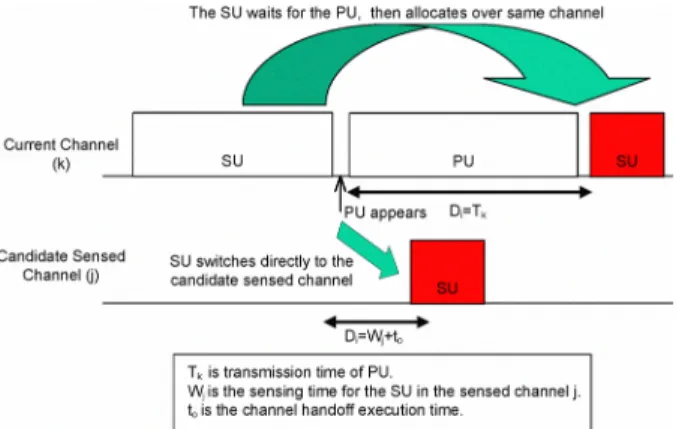
scheme. Refereing to Fig. 1, the total delay time (Di ) is
defined as the elapsed time until the SU can transmit its data again. In the proposed channel selection scheme, when the PU apperas, the SU can stay at the current channel and
Fig.I. The secondary user channel options.
wait for the PU to leave the spectrum band. The other option for SU is to move to other sensed channels as shown in Fig. 1. Clearly, the total delay Di is dependent on sensing time
in the candidate sensed channel(Wj ) ,the handoff execution
time (to), and the transmission time of PU (Tk ) .
In the proposed spectrum handoff scheme, suppose the SU successfully establishes a connection. The SU will use the current channel. Ifthe PU appears, the SU measures the channel priority index for the current channel and the candi-date sensed channel. This priority index depends on the delay bandwidth product. As a result, the SU will be allocated with the channel that has the highest channel priority index. The proposed spectrum handoff scheme ensures the optimal throughput for SU. Inherently, the less sensing time, the longer the transmission time. On the other hand, the higher the channel bandwidth is, the more the delivered bits are. Thus, it is required to compromise between the bandwidth of the channel and the effective delay required by the channel itself, especially in the variable channel bandwidth case.
(I) PB if 1
<
j<
N,j=I-
k ; j =k B_ _1
21'---IV. SYST EM EVAL UATIO N
In this section, we consider the two traffic scenarios for the PU : the Pareto distribution model and Markov state model. According to the channel selection decision of the SU as shown in Fig. I. Then, the total del ay time D ;of SU i can be expressed as :
Fig. 2. (a) A two-state Markov chain to model a channel. (b) Slotted frame structure.
- Frame Length (b)
P,
PU transmit SU transmit PU transmit SU transmit
~ ~ ~
(a)
least one available candidate sense channel. Then, we will con sider that the SU switches among those channel with variable bandwidths. As mentioned earlier, in a cognitive radio network, the SU performance depends on channel sel ection criteria (see Section II) and the PUs traffic beh avior in the N channels.
Over a period of time, these N channels can either carry traffic or be idle . In this paper, we consider two different traffic scenarios for PU transmission. This assumption is rea-sonable because we want to measure the DBP performance within various channel conditions. In the first traffic scenario, the PU follows the Pareto distribution model [22]. The Pareto distribution is a simple model for many practical applica-tions. In addition, Pareto distribution belongs to the so-called long-tailed distribution in which it has two parameters that can be easily determined to model different traffic models.
In the second ch annel traffic model, a commonly accepted model for artifici al conversational speech/voice channel is used in which the channel availability can be modelled using a simple two-state Markov chain [14], [23] as shown in Fig. 2 (a), where the states I and B represent a channel being available and unavailable re spectively at the curre nt channel k. Symbols PI and PB represent re spectively the probability that the channel stat e stays available or busy .
(1 - PI) and (1 - PB) represent their transition probabi lity from the state of availability to that of unavail ability, and vice versa, respectively. In other words, when the channel is in the available stat e, the SU can transmit. Otherwise, the PU can transmit as shown in Fig . 2 (b).
Tkis transmission time of PU.
~is the sensing time for the SU in the sensed channelJ.
tois the channel handoff execution time.
su
I I
PUt
4PUappears D,=Tk
SUSW1tCheSdirectly to
t~
candidate sensed channelCurrent c hann j
(k)
Candidate Sensed
ChannelOl
III. SYSTEM MOD EL
In this paper, the CR multiuser network con sists of N
variable bandwidth channels, each with bandwidth B, (i
=
1, .. .,N ). Each of the se N channels is allocated to a PU.
As sume the Current Channel (k) is defined as the channel which is at the present moment being used by the SU . The Candidate Sensed Channel (j) is defined as the channel which is sensed by the SU . Besides the option that the SU switches from the current channel to one of the sensed channels when the PU appears, we will study the option if SU stays in the channel till PU deactivates. Our concern is to select the optimal channel for the SU rather than to detect or sense the channel. Therefore, we assume that the SU is capable of listening to the channel and is aware that the PU transmits in the legacy system. For simplicity, we suppose each base station has one PU . Also, we assume a slotted system in which the users transmissions on the channel are partitioned into slots.
On the other hand, every SU contends for the available channel. However, just one transmission is permitted at one slot. In addition, we assume that SU performs reliable spectru m sens ing whenever needed and there will be at
00 T T h r e s h ol d P(Ts
<
TThreshold)=
L
P(Ts=
L) . (7) L=l (9) (8) Initial values:=0
de=o.c iI
c= O.{)Ol. a= O.OOII
/~~---S~rt-T~~'; U;;';i;i;s-(~e~ii';;pu~;Pe~~--{II,
=(I - <X)II, if P, :5 0.8I:)
Hi=(I+a )R, if P,2:0 .9 ",,__________________ .1 ./ --- --- --< ,--
Long Term Updat es (every 5Olimeslo l)[II,
I 'II,]
l'~' &
i f - - - I - < - 0' R * NJ~ , R ·....
Cj= C /+ D.c, if[II
-l...-- L-!...I 'II ]
> 1; R * N}.I R * W i=
E [Ts<
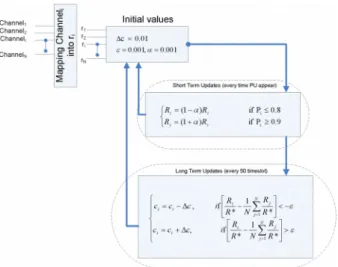
TThresholdJFig. 3. The delay bandwidth product control parameter.
Channel, Channel-Channel, Channef, R - { Ri (1 - a) , ifPi :::;0.8 ; (10) , - R i(1
+
a) , if Pi~ 0.9 .wherei = 1,2 , ... ,N. a is the rate smoothing parameter, and
a is equal to 0.001.Ifthe channel i has Pi higher 0.9, which
means the successful transmission rate is high, the value of instant data rate (Ri ) will increase. But if it is less than 0.8,
the channel condition is bad and we choose to decrease the instant data rate (Ri ) value.
Herein, the long term updating is made every 50 time
slots, the long term updating of C, is adjusted according to
Then, the average sensing time of a SUWi can be written
by:
T T h re s h ol d
L
LP(Ts= L) .L=l
Similarly, theTk can be calculated.
We also provide control parameter for the DBP priority index which builds on top of existing techniques for adapting channel conditions. The operation of this control parameter
(Ci ) is illustrated in Fig. 3. The main idea is to increase
or decrease the DBP index according to the channel condi-tions and the channel bandwidth ratio in reference to other channels' bandwidth.
In Fig. 3, C, is used to track the fast variations of the
channels caused by fading and mobility, and also, it is used to track the differences date rate between the different
channels. The value ofC,starts from one for all the channels
and updates as the PU appears in the channel i. This will
help SU to improve throughput. It is assumed that the
successful transmission probability is Pi , which is defined as the percentage of successful completed transmitted slots to the total transmitted slot in the channel i . The short term updates of instant data rate(Ri )of channelican be expressed
as: (3) (5) (4) (2)
x >O
otherwise Il B(i)=
PB(1 - PB) . F (x )= { 1 -(If)",
0, where A>
O,K>
o.
The Pareto distribution is characterized by a shape
pa-rameter K and a scale parameter A. The density f( x)
is a decreasing function of x and achieves its maximum
when x is smallest, i.e., when x = K. The web-browsing
packet transmission model with Pareto distribution packet length has been commonly used to assess the traffic carriage requirements for 3G cellular systems. According to [22], the
values ofK, Aare assumed to be 81.5 and 1.1 respecti vely.
Moreover, Wj is assumed to be variable in the range from
I msec to 25 msec.
Second, another widely-used traffic model for voice con-versation is the Markov state model [23]. Fig. 2(a) shows the state transition between PU appearance and SU availability. Let P rob(state
=
B)(i) be the state probability that thechannel i is busy for sending PU's traffic. Assume that
the SU probability transmission on different channels are
identical. We know that the PB represents the transition
probability for the channel to be busy. Then, the probability
Il B(i)
=
Prob(state=
B)(i) can be expressed as:In this paper, we assume the SU spendsT; slots for
sens-ing the available channel. Also, the SU maximum channel
sensing tolerant number of slot isTThreshold. Notice thatT;
is dependent on the IlB(i) ,we can express the mean ofTs
as:
E [Ts]=
L
LP(Ts= L) .L=l
The probability of T; being equal to L slots can be
expressed as:
The values ofTkandWj are dependent on the traffic models
as discussed in the following.
First, we choose the Pareto distribution model to de-scribe the PU transmission time. The distribution probability density function and the distribution cumulative distribution function for Pareto distribution [22] are described in the following formulas :
P(Ts
=
L)=
(IlB(i)) L-l(1 - IlB(i)) . (6)Besides, the probability ofT; to be less than TThreshold
v.
SIMULATION RESULTSIn this section we show in a CR network with variable bandwidth channels the effective data rate of SUo The transmissions of both PU and SU are partitioned into slots. The PU adopts the connection-oriented MAC protocol in which the user will establish a connection to transmit data according to the information broadcasted by the base station . We consider the situation where the SU switches among variable bandwidth channels range between 2Mbps to 54 Mbps. Moreover, the SU overhears the broadcasted message to synchronize the timing with the legacy system and acquire the schedule in order to avoid interfering with the PU transmissions. Here, we assume that the slot time, frame
error rate, radio sensing time, handoff execution time
to
are10usee, 10-2
rv 10-1, 1 msec rv 25 msec, and 1 msec rv
100 msec respectively.
In the numerical results, we refer to the DBP using the
control parameter C, as adaptive delay bandwidth product
(ADBP) scheme, and the direct switch scheme as the tra-ditional behavior of the SU when the PU appears, which is to switch to another channel directly. We compare them with the stochastic channel selection (SCS) algorithm [15]. One can see that SCS scheme does not achieve effective data rate as well as the ADBP does nor direct switching scheme, because the main goal of the SCS is to converge SU to maintain the chosen channel with the highest success-ful probability. Nevertheless, the channel with the highest successful probability may be not efficient for the SU to achieve better performance, especially if we use the SCS within variable channel bandwidth case. Moreover, the SCS scheme may not perform well when user mobility speeds is high, or the channel behavior has fast fading. Thus, in our simulation, we consider the users with random walk mobility in a time-varying channel.
As we can expect, if the Pareto distribution model is
used, the effective secondary user data rate increases as Wj
decreases. The ADBP scheme performs quite well as Wj
increases, compare to other schemes. Fig. 4 illustrates the
impact ofWj where the probability of PU appearance in any
time slot takes the value of 0.3. It shows that the adaptive channel allocation scheme performs well under the condition of a busy channel in respect to the Direct Switch scheme up to 200%. It is clear that the ADBP can ensure the SU
throughput even if Wj increases because it can adapt to the
channel condition as well as it ensures that the channel with higher bandwidth has more transmission time for the SUs.
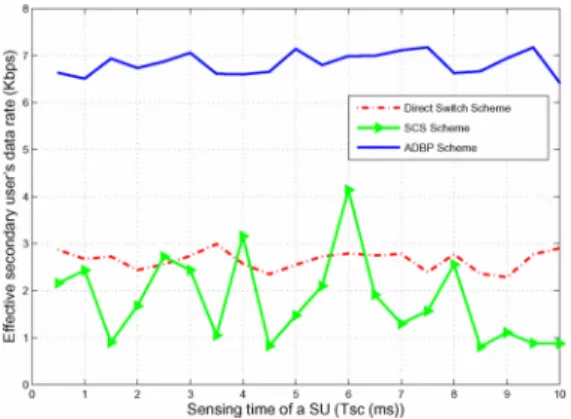
In Markov state model, the effective SU data rate increases
andWidecreases. The ADBP scheme performs quite well as
Wi increases compares with other schemes. Fig. 5 illustrate
the impact of Wi when the probability of which the channel
state is busy PB takes the value of 0.3. The ADBP
out-performs other schemes up to 100%. It is obvious that the DBP-based scheme performs well under different channel models. We conclude that the total effective data rate will be maximized as long as we stay over the channel with the highest DBP index. (13) (15) (14) (12) (16) k
==
Channel., N N ttotal==
L
t.s,+
L
o;
i=l i=lThus, the Effective Data Rate Ref f for SU is given by:
then
Finally, we calculate the performance of this proposed DBP-based scheme to determine whether it meets the re-quired service and reliability objectives. Now consider the impact of DBP allocation scheme on the delivered infor-mation bits during a given period of time. It is assumed that the successful transmission slot ists«.Also,ttotal is the total transmission time which is given by:
the difference between the ratio of the updated instant rate
R; to the target rate(R*)in the current channel kto the ratio
f the updated instant rate Rj to the target rate (R*) in the
sensed channels j. Therefore, theC, is performed according
to the following rule:
{
n..; -
Di)Bi, ifn,
~r.; ;
T/i
==
C,(
Tm a x - Di)Bi, otherwise; where i
==
1,2, ... ,N.The priority index represents the DBP-based scheme,
where (Tmax - Di ) part of this equation represents the
maximum allowable time for SU to transmit, while the
second part represents the Bi of SUo The priority index
increases as much as the DBP increases. It can be said the priority index represents the maximum capacity of channel i. Moreover, If the Di is larger than theTa v g ,the weight of
SU will be increased by the control parameter Ci . The Ci
ensures the channel with higher bandwidth as well higher successful transmission probability to have higher weight.
Now the channel selection in the time when PU appears is defined according to:
C. - {
c, -
~C,
if[~~
--k
2:f=l
~~]
<
-E ;•
~ Ci+~C, if[~~~k2:f=l~~]>E.
(11)
E is the threshold limit. The value of E is assumed to be
0.001. The ~C is the step parameter which is fixed at 0.01.
The values of both Eand ~C are designed parameter which
are chosen to achieve accurate channel measurement, where
the choice of ~C decide the C, adjustment for channel
i. Also, Bi is the average bandwidth of channel i. Tmax
is the maximum delay allowed of SUo In addition, the priority index differs according to predetermined average time (Ta v g ) . It is statical time that SU spend to switch for
other channel. Now, the priority index T/i can be expressed
[5] G. Ganesan and Y. Li, " Cooperative spectrum sensing in cognitive radio, part i: Two user networks," Wireless Communications, IEEE Transactions on, vol. 6, no. 6, pp. 2204-2213 , June 2007 .
[6] J. Yang, R. Brodersen, and D. Tse, "Addressing the dynamic range problem in cognitive radios ,"Communications, 2007. ICC '07. IEEE International Conference on, pp. 5183-5188, June 2007 .
[7] C. Han, J. Wang, and S. Li, "A spectrum exchange mechanism in cognitive radio contexts ," Personal, Indoor and Mobile Radio Communications, 2006 IEEE 17th International Symposium on, pp.
1-5, Sept. 2006.
[8] O. Holland , A. Attar, N. Olaziregi, N. Sattari, and A. Aghvami , "A universal resource awarene ss channel for cognitive radio," Personal, Indoor and Mobile Radio Communications. 2006 IEEE 17th Interna-tional Symposium on, pp. 1-5, Sept. 2006 .
[9] J. Acharya and R. Yates, "A framework for dynamic spectrum sharing between cognitive radios," Communications. 2007. ICC '07. IEEE International Confe rence on, pp. 5166-5171 , June 2007 .
[10] M. Thopp ian, S. Venkatesan, R. Prakash, and R. Chandras ekaran, "Mac-layer scheduling in cognit ive radio based multi-hop wireless networks ,"World of Wireless, Mobile and Multimedia Networks, 2006.
WoWMoM 2006. International Symposium on a, pp.10pp.-202 , 0-0
2006.
[II] A.T. Hoang, Y.-c. Liang , and M. Islam, "Maximizing throughput of cognitive radio networks with limited primary users' cooperation ,"
Communications, 2007. ICC '07. IEEE International Confe rence on,
pp. 5177-5182, June 2007 .
[12] F.-S. Chu and K-C. Chen, "Radio resource allocation in ofdma cognitive radio systems,"Personal, Indoor and Mobile Radio Com-munications, 2007. PIMRC 2007. IEEE 18th International Symposium on, pp. 1-5, Sept. 2007.
[13] S.-Y. Lien, Ci-C. Tseng , and K.-C. Chen , "N ovel rate-d istance adapta-tion of multiple access protocols in cognitive radio,"Personal, Indoor and Mobile Radio Communications. 2007. PIMRC 2007. IEEE 18th International Symposium on, pp. 1-5 , Sept. 2007 .
[14] Q. Zhao, L. Tong, and A. Swami , "Decentralized cognitive mac for dynamic spectrum acces s," New Frontiers in Dynamic Spectrum Access Networks, 2005. DySPAN 2005. 2005 First IEEE International Symposium on, pp. 224-232, Nov. 2005 .
[15] Y. Song, Y. Fang, and Y. Zhang, " Stochastic channel selection in cognitive radio networks ," Global Telecommunications Conference. 2007. GLOBECOM '07. IEEE, pp. 4878-4882 , Nov. 2007 .
[16] S.-C. Lo and C.-W. Tseng , "A novel multi-channel mac protocol for wireless ad hoc networks ," Vehicular Technology Conference, 2007. VTC2007-Spring. IEEE 65th, pp. 46-50, April 2007 .
[17] A. AI-Fuqaha, B. Khan , A. Rayes, M. Guizani, O. Awwad, and G. Ben Brahim, "Opportunistic channel selection strategy for better qos in cooperative networks with cognitive radio capabilities,"Selected
Areas in Communications. IEEE Journal on, vol. 26, no. I ,pp.
156-167, Jan. 2008.
[18] P. Zhu, J. Li, K. Han, and X. Wang, "A new channel parameter for cognitive radio;' Cognitive Radio Oriented Wireless Networks and Communications, 2007. CrownCom 2007. 2nd International Confer-ence on, pp. 482-486, Aug . 2007 .
[19] L.-c.Wang andc.-w.Wang, "Spectrum handoff for cognitive radio networks : Reactive-sensing or proact ive-sensins?"Performance, Com-puting and Communications Conference. 2008. IPCCC 2008. IEEE International, pp. 343-348, Dec. 2008 .
[20] M. Hoyhtya , S. Pollin, and A. Mammela , "Performance improvement with predictive channel selection for cogn itive radios," Cognitive Radio and Advanced Spectrum Management, 2008. CogART 2008. First International Workshop on, pp. 1-5 , Feb. 2008 .
[21] L. Peterson and B. Davie,Computer Networks: A System Approach,
3rd ed. Elsevier Science and Technology Books, 2003 .
[22] V. Paxson and S. Floyd , "Wide area traffic: the failure of poisson modeling ,"Networking. IEEE/ACM Transactions on, vol. 3, no. 3, pp.
226-244, Jun 1995.
[23] M. Sharma, A. Sahoo, and K. Nayak, "Channel selection under in-terference temperature model in multi-hop cognit ive mesh network s,"
New Frontiers in Dynamic Spectrum Access Networks, 2007. DySPAN 2007. 2nd IEEE International Symposium on, pp. 133-136, April
2007.
10
I
,- . - .Direct Switch Scheme
-+-SCS Scheme
- AOBP Scheme
10 15 ' 20
Waiting tim e of a SU (Wi) ms
3 4 5 6 7
Sensing time of asu(Tsc (msj}
...=
-. '.'
.
Fig. 4. Impact ofWj when probability of PU appearance is 0.3
Fig. 5. Effective secondary users data rate when the probability busy state
i P e)is 0.3
[I] I.F. Akyildiz,w.-Y. Lee, M.C.Vuran, and S. Mohanty, "Next gen-eration/dynamic spectrum access/cognitive radio wireless networks: a survey,"Comput. Netw., vol. 50, no. 13, pp. 2127-2159, 2006 .
[2] Y. Yuan, P. Bah], R. Chandra , T. Moscibroda, and Y. Wu, "Allocating dynamic time-spectrum blocks in cognitive radio networks ," in Mo-biHoc '07: Proceedings of the 8th ACM international symposium on
Mobile ad hoc networking and computing. New York, NY, USA:
ACM, 2007, pp. 130-139.
[3] R. Chandra , R. Mahajan , T. Moscibroda, R. Raghavendra, and P. Bahl, "A case for adapting channel width in wireless networks ," in SIG-COMM '08: Proceedings of the ACM SIGSIG-COMM 2008 conference
on Data communication. New York, NY, USA: ACM, 2008, pp.
135-146.
[4] E. Peh and Y.-c. Liang, "Optimization for cooperative sensing in cognitive radio networks ,"Wireless Communications and Networking Conference, 2007.WCNC 2007. IEEE, pp. 27-32, March 2007 .
R EF ER ENC ES
VI. CONCLUSIONS
In this work, delay bandwidth product-based channel selection scheme helps to select the optimal channels for
the secondary user in aCRnetwork with variable bandwidth
channels. Even with totally random exponential traffic pat-terns, the effective data rate in the DBP-based channel selec-tion scheme is higher than that in direct switch or stochastic channel selection (SCS) schemes. Numerical results give evidence of the desired behaviors of our proposed algorithm and also demonstrate that the algorithm can deliver a higher throughput subject to the delay requirements for supporting voice and web browsing services.