1270 IEEE PHOTONICS TECHNOLOGY LETTERS, VOL. 15, NO. 9, SEPTEMBER 2003
A Hybrid Star-Ring Architecture for
Fiber Bragg Grating Sensor System
Peng-Chun Peng, Hong-Yih Tseng, and Sien Chi
Abstract—In this letter, we present a hybrid star-ring architec-ture for a highly reliable fiber Bragg grating (FBG) sensor system and demonstrate its effectiveness. The main trunk of the proposed sensor network is star topology and the sensing branches comprise a series of concatenated ring subnets. The weakness in reliability of the star network is overcome by the ring subnets with a self-healing function based on the reconfigurable optical switches between each subnet. To enhance the signal-to-noise ratio (SNR) of the sensor system, we adopt a linear-cavity FBG laser scheme to construct our proposed hybrid star-ring architecture. Such a fiber-laser scheme results in the SNR over 48 dB for the sensor network. The network survivability of a ten-point FBG sensor is experimentally exam-ined. It is shown that the proposed FBG sensor system can increase the reliability of a sensing network.
Index Terms—Fiber Bragg grating (FBG), fiber laser, fiber sensor, sensor network, star-ring architecture.
I. INTRODUCTION
F
IBER BRAGG grating (FBG) sensors have been identified as important sensing elements, especially for the qua-sidistributed sensing in a smart structure [1]. The multiplexing capability is one of the features of an FBG sensor system. The techniques for multiplexing FBGs include the wavelength-di-vision multiplexing (WDM) technique, spatial-division multiplexing, time-division multiplexing, code-division multi-plexing access, intensity and wavelength-division multimulti-plexing, and frequency-modulated continuous-wave (CW) multiplexing [1]–[6]. According to these multiplexing schemes or their com-binations, we can construct a large-scale FBG sensor system. Therefore, how to enhance the reliability of FBG sensor sys-tems becomes a challenge for a sensor network. However, the general network architecture, such as the in-line topology, tree topology, or star topology, cannot protect the sensing network. To ensure the survivability of an FBG sensor system against the environmental accidents, the protection scheme will be a key issue for the practical fiber sensor application.Recently, the modified star-ring architecture has been proposed for subcarrier multiplexed passive optical network (SCM-PON) [7]. In this letter, we present a hybrid star-ring architecture for FBG sensor systems with a self-healing function to increase the reliability of the sensing network. The hybrid star-ring architecture consists of a star network on the upper level and a series of concatenated ring subnets on the
Manuscript received January 27, 2003; revised April 22, 2003. This work was supported by the Academic Excellence Program of Taiwan, R.O.C., Ministry of Education, under Contract 90-E-FA06-1-4-90X023.
The authors are with the Institute of Electro-Optical Engineering, National Chiao-Tung University, Hsinchu, Taiwan 300, R.O.C. (e-mail: [email protected]).
Digital Object Identifier 10.1109/LPT.2003.816699
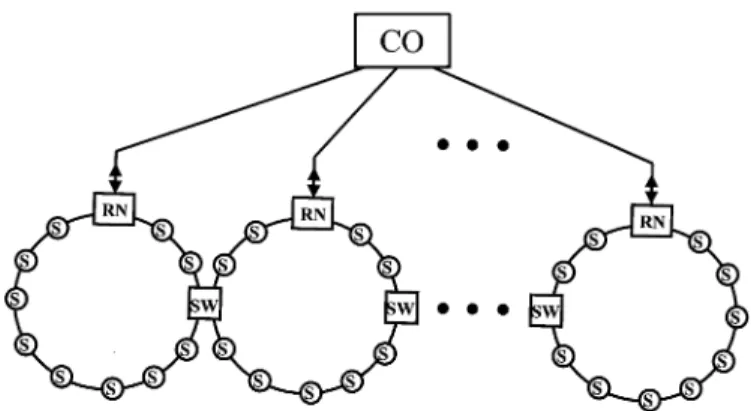
Fig. 1. Schematic diagram of a hybrid star-ring architecture for FBG sensor system (SW:2 2 2 optical switch. S: FBG).
lower level. The ring subnets with self-healing capabilities overcome the weakness in reliability of the star network. Such a self-healing function can be performed at remove notes (RNs) by using optical switches (SW) to reconfigure the ring subnets if any link fails. However, the switches in the network introduce extra loss and further reduce the signal-to-noise ratio (SNR) in the system. To solve this problem, we use a linear-cavity fiber-laser scheme for our proposed sensor network because the laser has intense output power, high SNR, and ability to be incorporated with fiber communication systems. The sensing FBGs in our proposed system are used simultaneously as the feedback elements of the fiber laser. The benefits of the fiber-laser scheme in conjunction with the hybrid star-ring architecture can facilitate highly reliable large-scale sensing in a smart structure.
II. PRINCIPLE
Fig. 1 shows the proposed configuration of a hybrid star-ring architecture for an FBG sensor system. The FBG sensor system consists of the sensing FBG network and a central office (CO) providing the light source and discriminating the signals from the sensing network. In the sensing network, the light sources are distributed to the RNs via the upper level star network, and then are further delivered to each FBG sensor through the lower level ring subnets. Every ring subnet is connected by a optical switch (SW). The function of RN is to properly transfer signals between the CO and lower level ring subnet, and to per-form a self-healing function if link failure occurs in the lower level ring subnets. As shown in Fig. 2, each RN comprises two optical switch (OS) and a optical coupler (C1). The states of the optical switches are normally set as shown in Fig. 3. The CO signal is properly forwarded to the RN1. If the corre-sponding link in the lower level ring subnets is broken, the con-1041-1135/03$17.00 © 2003 IEEE
PENG et al.: HYBRID STAR-RING ARCHITECTURE FOR FBG SENSOR SYSTEM 1271
Fig. 2. Schematic diagram of a remove node (OS:1 2 2 optical switch. C1:1 2 2 coupler).
Fig. 3. Schematic diagram (indicated by the dashed line) when the optical switch’s states are normally set.
Fig. 4. Schematic diagram when three breakpoints occur. (a) When the SW is in the bar state. (b) When the SW is in the cross state.
trol circuit will reconfigure the RN function as Fig. 4 such that the CO signal is forwarded to the RN1 and RN2. When the optical switch is at the bar state, as shown in Fig. 4(a), the FBGs ( and ) lose their sensing signals. However, the state of the optical switch at the cross state, as shown in Fig. 4(b), can be modified to reconfigure the signal of the FBGs ( and ). The drawback of this hybrid star-ring architecture for the FBG sensor system is that the switches in the network introduce extra loss and further reduce the SNR of the system. In order to enhance the SNR, we adopt a linear-cavity fiber-laser configu-ration. The sensing FBGs in our proposed sensor network are also used as the cavity mirrors of the fiber laser. The proposed system can result in a highly reliable sensing network for a mul-tipoint smart structure.
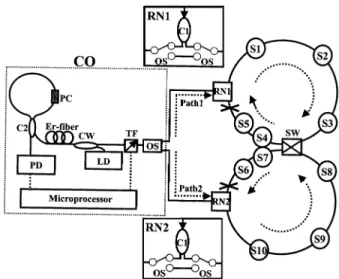
III. EXPERIMENTALRESULTS ANDDISCUSSION Fig. 5 shows the experimental setup for our proposed FBG sensor network. The center office in this system is comprised of a tunable bandpass filter (TF), a optical switch (OS), and a section of erbium-doped fiber (Er-fiber) pumped by a 980-nm laser diode (LD), and a fiber loop mirror with a polarization con-troller (PC) and a optical coupler (C2) as a cavity mirror.
Fig. 5. Experimental setup for the proposed FBG sensor network. We examine the case of two breakpoints occur (PC: polarization controller. Sm: FBG. C2:2 2 2 coupler. CW: WDM coupler).
The lower level ring subnets for this sensing network was
com-posed of the sensing FBGs ( ) and a optical
switch (SW). The insertion loss of each optical switch and optical switch were below 1 dB. Each of the sensing FBGs ( ) acted as another cavity mirror of the linear-cavity fiber laser. The Bragg wavelengths of the sensing FBGs from S1 to S10 sequentially were 1538.52, 1540.14, 1542.78, 1544.25, 1546.62, 1548.33, 1550.28, 1552.32, 1554.36, and 1556.34 nm. All the peak reflectivities of the FBGs were approximately 99% and their average 3-dB bandwidth were 0.2 nm. In the CO, the lasing wavelength of the linear-cavity fiber laser was determined by these sensing FBGs and the TF. The average 3-dB band-width of this TF was 0.37 nm. The average insertion loss of the filter was 3.42 dB in 1530–1560-nm wavelength region. A 980-nm LD with 120-mW output power pumped the Er-fiber via a 980/1550-nm WDM coupler (CW). In this linear-cavity fiber-laser scheme, the coupling ratio of the optical cou-pler (C2) for the fiber loop mirror was 30 : 70. In addition, the PC is arranged for the reflectivity of this fiber loop mirror. Hence, it is unnecessary for us to adjust the PC for each grating sensor or if a fault occurs in the sensing network. The lasing light emerging from the C2 arrived in a photodetector (PD). This signal from the PD finally was fed into a microprocessor for dis-crimination of the lasing wavelength. With sufficient gain, the system lases once the transmitted wavelength of the filter equals the wavelength reflected from the sensing grating. Thus, the lasing wavelength of the system can be used to accurately mea-sure the strain perturbation imposed on the FBGs. The filter was tuned by using a controller to select the transmitted wavelength over a working range from 1530 to 1560 nm. Hence, the tun-able transmitted wavelength of the filter tracked the ten wave-lengths of the sensing FBGs ( ). When the link failed,
the FBGs ( ) lost their sensing
informa-tion whenever CO was selected the RN1, as shown in Fig. 6. Nevertheless, the OS can be modified to reconfigure the fiber
link for FBGs ( ) that lost the sensing
information, as shown in Fig. 7. The average lasing peak power was 7.68 dBm leading to the SNR for the sensing network over
1272 IEEE PHOTONICS TECHNOLOGY LETTERS, VOL. 15, NO. 9, SEPTEMBER 2003
Fig. 6. When the link fails, the FBGsSm (m = 4; 5; 8; 9; 10) loses their sensing information.
Fig. 7. OS can be modified to reconfigure the fiber link for FBGsSm (m =
4; 5; 8; 9; 10) that lost the sensing information.
48 dB. Consequently, the self-healing ring architecture can re-generate the sensing signal.
In the experiment, we concentrated our study on how to achieve the star-ring architecture for an FBG sensor system. Thus, we only used an optical spectra analyzer (OSA) to mea-sure the lasing wavelength without considering the electronic signal processing. Under this condition, the filter controlled by a stepper motor provided a minimum resolvable wavelength shift of 0.1 nm corresponding to a minimum resolution 83 for the strain [1]. From 1530 to 1560 nm, the maximum tuning speed of the filter (TB45B from JDS Uniphase Co.) used in our experiment was 920 ms. Therefore, under the device restric-tions of our laboratory, the scanning rate is approximately 1 Hz from 1530 to 1560 nm. In addition, the switching time of each switch was 1 ms. If two breakpoints occur, as shown in Fig. 5, the reconfiguration time to address all FBGs in the sensing
network is at least 1841 ms ( ms). Because the
interrogation method relies on the tunable filter, the system is more suitable for static or low-frequency dynamic strain measurement. This limitation of response time can be improved by reducing the scale of sensing network and basically by using a faster tunable filter. For example, the resolution of the system in [8] was 60 for static strain, which was determined by the OSA resolution of 0.07 nm. Dynamic stain frequency is
limited less than 5 Hz because of the data processing speed of the system. Such a limitation can be further improved by using suitable electronic signal processing. In [1], the Fabry–Pérot filter, via a 16-b digital-to-analog converter, provides a min-imum resolvable wavelength shift of approximately 0.8 pm. The Fabry–Pérot filter can be scanned at rates 300 Hz.
Finally, the proposed sensor scheme is capable of supporting 20 WDM channels with 2 nm per channel. In this case, the range of the measurement for each sensing FBG has to be smaller than [ , 830] . However, a partially reflecting fracture of the fiber could result in redundant lasing light, which was examined in our experiment. Because such a redundant signal is weak, we can reduce the pump power to avoid the lasing due to the re-flection from a partially reflecting fracture of a fiber. Therefore, the pump power should be determined according to the tradeoff between the sensing scale and the environment that may lead to many fractures. Alternatively, a feedback-controlled circuitry [2] can be adopted to clarify whether the lasing light is a correct sensing signal. Moreover, because of our proposal string ar-chitecture, we can reconfigure the sensing branch even if the system lases off fracture.
IV. CONCLUSION
This letter presents a hybrid star-ring architecture for an FBG sensor system. We have demonstrated a ten-point FBG sensor based on our proposed configuration and examine its network survivability. Because of the intense lasing power from the linear-cavity fiber laser, the SNR for the sensor network can be over 48 dB. Furthermore, the self-healing function considered in our system can reconfigure the fiber link when a breakpoint suddenly occurs in the sensing network. The experimental results show that the proposed system can facilitate a highly reliable sensing network for a large-scale and multipoint smart structure.
REFERENCES
[1] A. D. Kersey, M. A. Davis, H. J. Partrick, M. Leblance, K. P. Koo, C. G. Askins, M. A. Putnam, and E. J. Friebele, “Fiber grating sensors,” J.
Lightwave Technol., vol. 15, pp. 1442–1463, Aug. 1997.
[2] Y. Yu, L. Lui, H. Tam, and W. Chung, “Fiber-laser-based wavelength-division multiplexed fiber Bragg grating sensor system,” IEEE Photon.
Technol. Lett., vol. 13, pp. 702–704, July 2001.
[3] C. C. Chan, W. Jin, H. L. Ho, and M. S. Demokan, “Performance analysis of a time-division-multiplexed fiber Bragg grating sensor array by use of a tunable laser source,” IEEE J. Select. Topics Quantum Electron., vol. 6, pp. 741–749, Oct. 2000.
[4] K. P. Koo, A. B. Tveten, and S. T. Vohra, “Dense wavelength division multiplexing of fiber Bragg grating sensors using CDMA,” Electron.
Lett., vol. 35, pp. 165–167, 1999.
[5] L. Zhang, Y. Liu, J. A. R. Wiliams, and I. Bennion, “Enhanced FBG strain sensing multiplexing capacity using combination of intensity and wavelength dual-coding technique,” IEEE Photon. Technol. Lett., vol. 11, pp. 1638–1641, Dec. 1999.
[6] P. K. C. Chan, W. Jin, and M. S. Demokan, “FMCW multiplexing of fiber Bragg grating sensors,” IEEE J. Select. Topics Quantum Electron., vol. 6, pp. 756–763, Oct. 2000.
[7] W. P. Lin, M. S. Kao, and S. Chi, “The modified star-ring architecture for high-capacity subcarrier multiplexed passive optical networks,” J.
Lightwave Technol., vol. 19, pp. 32–39, Jan. 2001.
[8] S. Kim, J. Kwon, S. Kim, and B. Lee, “Multiplexed strain sensor using fiber grating-tuned fiber laser with a semiconductor optical amplifier,”