Soft Thin Films
Winston Win, Chairman
Microstructure and magnetic properties of FeCoN thin films
P. C. Kuo, S. S. Chang, and C. M. Kuo
Institute of Materials Science and Engineering, National Taiwan University, Taipei, Taiwan Y. D. Yao
Institute of Physics, Academia Sinica, Taipei 115, Taiwan H. L. Huang
Department of Physics, National Taiwan University, Taipei, Taiwan
Effects of nitrogen contents and substrate temperatures to the microstructure and magnetic properties of the FeCoN films have been investigated. According to the TEM and x-ray Scherrer’s equation analyses, we found that the grain size of films with substrate temperature below 200 °C is roughly about 13 nm, however, it increases very fast for films with substrate temperature above 300 °C. N content in the films is saturated to 30 at. %, as N2flow ratio N2/~Ar1N2) is higher than 5 vol. %. From the magnetization studies, we have found that the saturation magnetization 4pMs
of the optimum samples~with the substrate temperature near 200 °C! is 23.9 kG. The improvement of the magnetic properties is attributed to the combination ofa-Fe with N to form the high magnetic moment FeN phases. © 1998 American Institute of Physics.@S0021-8979~98!35011-2#
I. INTRODUCTION
A soft magnetic film with high saturation magnetization 4pMsis required for use in a high-density magnetic
record-ing head. Recently, extensive efforts have been made to im-prove the soft magnetic properties of Fe-based films.1–7 Ac-cording to the Pauling–Slater curve, Fe–Co alloys have the highest magnetization of iron alloy. Takahashi et al.8 pre-pared FeCo nitride film onto a polyimide substrate by ion-assisted normally vapor deposition method. They found that the film was columnar structure with large grains of about 500 Å and maximum 4pMs occurred at the Co content of
about 32 at. %. Their films have large perpendicular mag-netic anisotropy and N content of the film is unknown. On the other hand, Liao9reported that electrodeposited Fe90Co10 films show a high 4pMs value of 19 kG and good soft
magnetic properties. Recently, Nakagawa et al.10 examined the FeCoN and FeCoTaN films which prepared by facing targets sputtering with N21Kr mixture gas. They found that 4pMs of the film was decreased with increasing N2partial pressure. Pure Fe90Co10 alloy film has an extremely large 4pMs of about 24 kG. In this report, we investigate the effect of substrate temperature and N content on the mag-netic properties and microstructures of sputtered FeCoN films.
II. EXPERIMENT
(Fe0.9Co0.1)1002xNx films with x50 – 30 were prepared
on a precleaned glass substrate by reactive RF magnetron sputtering in N2and Ar mixed atmosphere. The flow ratio of nitrogen to argon and nitrogen, i.e., N2/(Ar1N2), during sputtering was varied between 0 and 10 vol. %. The substrate temperature was varied between 25 and 400 °C. Composite
target consisting of pure Fe disk overlaid with Co pieces was used in this experiment. The base pressure in the system with a turbo pump was 131026 Torr, and after the high purity Ar–N2 mixed gas was introduced, sputtering pressure was 131023Torr. Thickness of the films was about 200 nm.
Structure and grain size of the films were determined by using x-ray diffractometer ~XRD!. Thickness of the films was measured by a Sloan DEKTAK-3-0305ST a-step pro-filometer. Magnetic properties of the films were measured with vibrating sample magnetometer ~VSM! at room tem-perature with maximum applied field of 12 kOe. Composi-tion, N content, and homogeneity of the films were deter-mined by depth profiling analysis of Auger electron spectroscopy ~AES!.
III. RESULTS AND DISCUSSION
Figure 1 shows the N contents in pure Fe, Co, and Fe90Co10 films as a function of N2flow ratio during sputter-ing, i.e., ~N2/Ar1N2)3100%, with the substrate tempera-ture Ts kept at 25 °C. It can be seen that N content in the
films increases dramatically with increasing N2 flow ratio when N2flow ratio is lower than 5 vol. %. This is because N atoms can easily occupy interstitial sites of crystal lattice during deposition as N2flow ratio is lower than 5 vol. %. N content in the film is saturated as N2flow ratio is higher than 5 vol. % for all films. This is due to that all interstitial sites of crystal lattices in the film are occupied. Saturated N con-tent of Fe film is about 32 at. % which is equal to the N content ofz-Fe2N phase.11z-Fe2N phase is nonmagnetic and has maximum equilibrium N content in Fe–N binary system.12 The maximum N contents of Fe90Co10 and Co films are 30 and 23 at. %, respectively. Figure 2 presents a
JOURNAL OF APPLIED PHYSICS VOLUME 83, NUMBER 11 1 JUNE 1998
6643
0021-8979/98/83(11)/6643/3/$15.00 © 1998 American Institute of Physics
typical depth profile of a FeCoN film analyzed by Auger electron spectroscopy~AES!. We can see that the composi-tion of this film is approximately (Fe0.9Co0.1)70N30. It is cali-brated by a standard of bulk Fe50Co50 alloy. Because the films were exposed to air prior to AES analysis, near the surface of the films, O and C were always observed as shown in Fig. 2.
Typical microstructure of the (Fe0.9Co0.1)1002xNx films
is shown in Fig. 3. Figure 3~a! is a TEM photograph of the (Fe0.9Co0.1)77N23 film with substrate temperature of 25 °C. We can see that the film has a nanocrystalline structure and its average grain size is about 13 nm. In Fig. 3~b!, from the diffraction lines of the electron diffraction pattern of this film, we noticed that e-Fe223N, Co2N, g
8
2Fe4N, andz-Fe2N phases are included.
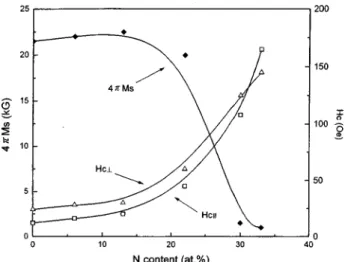
Figure 4 shows the saturation magnetization 4pMs and
coercivity Hc as a function of N content in
(Fe0.9Co0.1)1002xNx films with its substrate temperature at
25 °C. It is clear that 4pMs, and both in-plane coercivity
Hci and perpendicular coercivity Hc' of the films increase
slowly from 22 to 22.8 kG, 12 to 18 Oe, and 22 to 30 Oe, respectively, for N less than roughly 13 at. %. However,
4pMsdecreases and both Hc’s increase rapidly as N content
is larger than 13 at. %. When N content is approached to 30 at. %, both Hcincrease to about 150 Oe and 4pMsdecreases to about 2 kG due to the formation of z-Fe2N phase in the film. The perpendicular coercivity Hc'is slightly higher than that of the in-plane coercivity Hci. This indicates that the film is almost magnetic isotropy as substrate temperature is kept at 25 °C.
Figure 5 shows the relation between 4pMs, Hci, Hc'
and substrate temperature Tsof the (Fe0.9Co0.1)1002xNxfilms
prepared with the flow ratio of N2 at 1 vol. % during sput-tering. According to the AES analysis, the N content of the FIG. 1. Variation of N content with N2flow ratio of Fe, Fe90Co10and Co
films. The substrate temperature is kept at 25 °C.
FIG. 2. Auger depth profile of a (Fe0.9Co0.1)70N30film.
FIG. 3. TEM micrograph and electron diffraction pattern of (Fe0.9Co0.1)77N23film with Ts525 °C. ~a! is the microstructure of planar section and~b! is the corresponding electron diffraction pattern.
FIG. 4. Effect of N content on the 4pMs, Hci, and Hc' of
(Fe0.9Co0.1)1002xNxfilms. The substrate temperature is kept at 25 °C.
6644 J. Appl. Phys., Vol. 83, No. 11, 1 June 1998 Kuoet al.
film was found to decrease from 13 at. % for Ts525 °C to
10 at. % for Ts5100 °C, 8 at. % for Ts5200 °C, and 3 at. %
for Ts5400 °C. It can be seen that Hci increases
monoto-nously from 25 to 165 Oe when Ts increasing from 25 to
400 °C, but Hc' of the film is increased rapidly from 25 to
530 Oe. It is obvious that magnetic easy axis is in the film plane, as Tsis higher than 25 °C. The increasing of
coercivi-ties with Ts is owing to that N content of the film is
de-creased with increasing Ts. From the x-ray diffraction
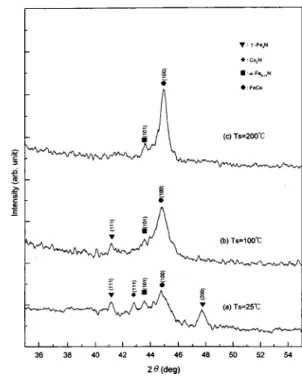
pat-terns study of the films at various Ts, we found that the
amount of high coercivity FeCo phase is increased with Ts. For example, Fig. 6 shows curves ~a! to ~c! with their sub-strate temperatures at 25, 100, and 200 °C, respectively. When Ts is higher than 300 °C, only the FeCo peak can be detected by x-ray diffractometer. According to the x-ray Scherrer’s equation analysis from the diffraction peak of FeCo~100!, we found that the grain size of the films with substrate temperature below 200 °C is roughly about 13 nm, however, it increases very fast for films with substrate tem-perature above 300 °C.
The 4pMs in Fig. 5 shows a minimum value of 21.7 kG
around 100 °C, and a maximum value of 24 kG at Ts
>200 °C. Comparing with the x-ray diffraction peaks of Figs. 6~a!, 6~b!, and 6~c!, we can see that these films all contain high moment FeCo anda82Fe6210N phases.13From this point of view, variation of the 4pMs of film with Ts is
due to the change of N content in the film, i.e., amounts of various FeN, FeCo, CoN, a-Fe phases in the film are changed.
IV. CONCLUSIONS
In conclusion, effects of nitrogen contents and substrate temperatures to the microstructure and magnetic properties of the (Fe0.9Co0.1)1002xNx films with x50 – 30 films have been investigated. TEM observation found that they have nanocrystalline structure. When N content of the film is
lower than 13 at. %, it contains high moment
a
8
2Fe6210N, FeCo, and g8-Fe4N phases. The (Fe0.9Co0.1)92N8 film which prepared at substrate tempera-ture of about 200 °C and N2flow ratio of 1 vol. % has maxi-mum 4pMs of 23.9 kG. As N content of the film is higherthan 20 at. %, 4pMsof the film decreases rapidly due to the
formation of nonmagneticz-Fe2N phase in the film.
ACKNOWLEDGMENTS
This work was supported by the National Science Coun-cil of ROC through Grant Nos. NSC 86-2216-E-002-029 and NSC 86-2112-M001-020.
1
K. Nago, H. Sakahima, K. Ihara, and K. Osano, IEEE Trans. Magn. 28, 2943~1992!.
2B. Viala, M. K. Minor, and J. A. Bamard, IEEE Trans. Magn. 32, 3506
~1996!.
3
B.-II Cho, W. Win, Eui-Jung Yun, and R. M. Walser, IEEE Trans. Magn.
31, 3859~1995!.
4P. Pain, J. P. Eymery, M. F. Denanot, and J. F. Dinhut, J. Magn. Magn. Mater. 133, 493~1994!.
5
D. J. Rogers, S. Wang, D. E. Laughlin, and M. H. Kryder, IEEE Trans. Magn. 28, 2418~1992!.
6J. Ching, L.-J. Chen, and C.-J. Chen, IEEE Trans. Magn. 30, 3912~1994!. 7M. Takahashi, H. Shoji, H. Takahashi, H. Nashi, and T. Wakiyama, J.
Appl. Phys. 76, 6642~1994!. 8
S. Takahashi, M. Kume, and K. Matsuura, IEEE Trans. Magn. 36, 1632 ~1992!.
9S. H. Liao, IEEE Trans. Magn. MAG-23, 2981~1987!.
10S. Nakagawa, S. Tanaka, K. Sumitsu, and M. Naoe, J. Appl. Phys. 79, 5156~1996!.
11
G. Hagg, Nature~London! 122, 962 ~1928!.
12O. Kubaschewski, Iron-Binary Phase Diagrams~Springer, Berlin, 1982!, p. 67.
13K. H. Jack, Proc. R. Soc. London, Ser. A 208, 200~1951!. FIG. 5. The change of 4pMs, Hci, and Hc' against Ts for
(Fe0.9Co0.1)1002xNxfilms. N2flow ratio is 1 vol. % during sputtering.
FIG. 6. X-ray diffraction patterns of various (Fe0.9Co0.1)1002xNxfilms. N2 flow ratio is 1 vol. % during sputtering and substrate temperatures are~a! Ts525 °C, ~b! Ts5100 °C, and ~c! Ts5200 °C.
6645 J. Appl. Phys., Vol. 83, No. 11, 1 June 1998 Kuoet al.