0272-8842(95)001 16-6
Printed in Great Britain. All rights reserved 0272~8842/96 Sl5.00+ .OO
Phasic and Microstructural
Developments
of Pb(Nil~3Nb~~~)0~ Prepared by the
Columbite
Precursor Process
Chung-Hsin Lu” & Wen-Jeng Hwang
Department of Chemical Engineering, National Taiwan University, Taipei, Taiwan (Received 7 July 1995; accepted 1 September 1995)
Abstract: The phasic and microstructural developments of perovskite Pb(Ni,,s-
Nb2,,)Os during reaction processes using NiNb20n columbite precursor were investigated. Increasing the purity of NiNbzOh in specimens efficiently enhanced the yield of the perovskite phase. Heating lOOO”C-calcined NiNb20e with PbO at 880°C resulted in 97.5% perovskite phase. When NiNb206 was over-calcined, the grains of formed Pb(Ni1,sNb2,s)03 tended to grow significantly. The formation processes of Pb(Ni,,sNbz,s)Os were elucidated to be a reaction between PbO and NiNb*O, to form a pyrochlore phase with a small amount of NiO at above 600°C. Then the pyrochlore phase partially decomposed to generate a trace of PbO from 7Oo”C, and rapidly transformed to a perovskite phase at above 880°C. Pure Pb(Nit,sNbz,s)Os was unable to synthesize when no excess of starting materials was added. However, adding excess 1 wt% NiO and 5 wt% PbO induced the generation of the monophasic Pb(NiI,sNb2,s)0s perovskite. The excess amount of PbO not only increased the grain size markedly, but also enhanced the structural stability of the perovskite phase at elevated temperatures. cs 1996 Elsevier Science Limited and Techna S.r.1.
1 INTRODUCTION
Lead nickel niobate (Pb(Ni1,~Nb2,s)03) is a member
belonging to the lead-containing complex perov-
skite group with the general formula Pb(Bi, B2)03.
This material exhibits a perovskite structure and
typical relaxor ferroelectric properties. Its dielectric
maximum and Curie temperature depend strongly
on measured frequencies.‘,2 Pb(Ni1,3Nb2,3)03-
based systems, such as Pb(Nil,3Nb2,3)03-Pb(Fel,2-
Nbi,90s3 and Pb(Nii,3Nb2,s)Os-Pb(Mgi/2Wi/2)-
Os-PbTiOs, 4 have been evaluated to possess low
sintering temperatures and high dielectric con-
stants. As a result of the excellent sintering and
dielectric characteristics, Pb(Niii3Nb2i3)03-based
materials can be applied for fabricating multilayer
capacitors with low-temperature melting inner
electrodes.
In spite of the success in applying Pb(Nii ,3Nb2,3)- *To whom correspondence should be addressed.
0s to dielectric devices, the synthesis of mono-
phasic Pb(Nii,sNb2,s)03 is difficult. Agranov-
skaya5 reported that the conventional mixed-oxide
method failed to obtain the pure perovskite phase
of Pb(Nii,sNb2,s)03. After a calcination at 115O”C,
a trace of a parasitic pyrochlore phase is coexistent
with the perovskite phase. The presence of the
pyrochlore phase tends to deteriorate the dielectric
properties of Pb(Ni1,3Nb2,s)03. Therefore, the
elimination of the pyrochlore phase becomes an
important subject. Swartz and Shrou@ proposed a
columbite precursor process to fabricate pyrochlore- free Pb(Mg1,3Nb2,3)03. In this process, a columbite
precursor MgNb206 is prepared first, followed by
the consequent reaction between the MgNb206
and PbO. This process can bypass the formation of
the pyrochlore phase, resulting in the yield of a
pure perovskite phase. 6,7 A similar process was
utilized by Veitch,* and by Sharama9 for preparing
Pb(Ni l,3Nb2,3)03 by using columbite NiNb206.
The former group could prepare pyrochlore-free
Pb(Nii,sNb2,3)03; however, the latter group could
not synthesize the pure Pb(Nii1sNb2,s)03. In addi-
tion, the former group obtained a higher dielectric constant than the latter one, implying the impurity
effect on the dielectric properties. The incon-
sistency in the above results indicates that the
influence of processing conditions on the formation of Pb(Ni1,3Nb&03 should be investigated in detail.
In this report the reaction occurring between
NiO and Nb205 for formulating columbite pre-
cursor NiNbzOe is investigated first. Then the
influence of the calcination conditions of NiNbzOe
on the formation process of Pb(Ni1,3Nb2,3)03 is
elucidated. The perovskite yields in the columbite
precursor process and the conventional mixed-
oxide method are compared. The reaction mechan-
ism of Pb(Nii,3Nb2,3)03 prepared by the columbite
precursor process is explored from the phasic and
microstructural developments during heating.
Furthermore, the effect of excess amounts of NiO
and PbO on the generation of the monophasic
perovskite phase of Pb(Ni1,3Nb2,3)03 is examined.
mation and crystallographic structure in specimens
was examined by X-ray powder diffraction (XRD)
analysis using CuKa radiation. The perovskite
content in the specimens was calculated from the
ratio of the diffraction intensity of the perovskite
(110) peak to the sum of both the diffraction
intensity of the perovskite (110) peak and that of
the pyrochlore (222) peak. The microstructural
evolution of specimens in reaction was observed
via a scanning electron microscope (SEM).
In order to synthesize the pure perovskite
Pb(Nii,3Nb2,3)03, excess NiO and PbO were added
in the columbite precursor process. Excess
amounts of NiO (1 wt%) were added in the mixing
process of NiNb206 followed by calcining at
1000°C for 2 h. Next, excess amounts of PbO (up
to 5 wt%) were added in the second mixing process
with NiNb206. Isothermal calcination was per-
formed at 900°C for 2 h. Nitric acid was used to
remove the excess PbO present after calcination.
The products and microstructure of obtained
specimens were investigated by XRD and SEM.
2 EXPERIMENTAL 3 RESULTS AND DISCUSSION
NiNbzOe powders were prepared by mixing pro-
portionate amounts of reagent-grade NiO and
Nb205. Both oxides were ball-milled thoroughly
using zirconia balls in a polyethylene jar. Ball-
milling was undertaken for 48 h in ethanol. Follow-
ing drying in a rotary evaporator under reduced
pressure, the mixed powders were calcined from
600°C to 1200°C for 2 h. The NiNb206 powders
heated at various temperatures were mixed in pro-
portion with PbO followed by the analogous ball-
milling and drying processes as stated earlier. The
raw materials of Pb(Nii,sNb&Os were also pre-
pared by mixing directly PbO, NiO and Nb205 via ball-milling for 48 h for examining the difference
between NiNb206-precursor method and the con-
ventional mixed-oxide method. These two kinds of
raw materials for Pb(Ni1,3Nb2,3)03 were uniaxially
pressed into pellets of 8 mm in diameter under a
pressure of 196 MPa and calcined from 800°C to
900°C for 2 h. In the case of controlling PbO
atmosphere, pellets were heated within a powder-
bed of raw materials.
The raw materials containing lOOO”C-calcined
NiNbzOh precursor were examined by differential
thermal analysis (DTA) and thermogravimetry
analysis (TGA). The heating rate was lO”C/min
and alumina powder was used as reference. In an
electric furnace specimens were heated at the same heating rate as DTA, and quenched in air at vari-
ous temperatures. The variation in the phase for-
3. I Heat- treatment and thermal analysis
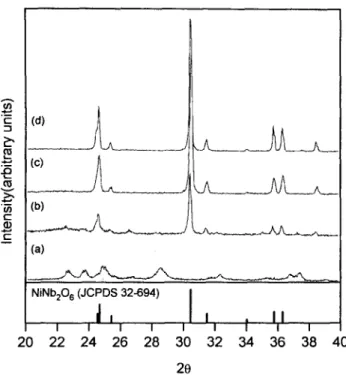
The XRD patterns for the raw materials of
NiNb206 calcined at various temperatures for 2 h
are illustrated in Fig. 1. This figure indicates that
the formation of NiNb206 did not take place at
600°C. At 800°C a large amount of NiNb206 was
formed, but accompanied with a trace of uni-
dentified phase. When the temperature reached
lOOO”C, pure NiNbzOe was generated completely.
Its diffraction pattern was the same as that listed in
JCPDS (File No. 32-694). At 1200°C the diffrac-
tion pattern of NiNbzOe remained similar to that
at lOOO”C, but with improved crystallinity. The
microstructures of the raw materials of NiNb206
calcined at 8OO”C, 1000°C and 1200°C are shown in Fig. 2 (a), (b) and (c). The grain size of powders
calcined at 800°C and 1000°C lay in a sub-
micrometer range. The former was estimated to be
around 0.24.3 pm, and the latter 0.3-0.4 pm.
Besides the difference in grain size, the 8OO”C-
calcined powders tended to formulate aggregates;
in contrast, the lOOO”C-calcined powders were
formed in a well dispersive state with a more uni- form distribution of grain size. When the tempera-
ture was increased to 12OO”C, the grain size of
NiNbzOe increased significantly one order of mag-
nitude to become around 2.04.5 pm. Conse-
quently, the morphology of NiNbzOe powders was
W (a)
NiNb,O, (JCPDS 32-694) 1
20 22 24 26 28 30 32 34 36 38 40
20
Fig. 1. X-ray diffraction patterns of the mixtures of NiO
and Nbz05 calcined at (a) 6Oo”C, (b) 8OO”C, (c) 1000°C and (d) 1200°C.
The NiNb206 calcined at 800°C was mixed with PbO, followed by heating at temperatures ranging from 800°C to 900°C for 2 h with or without a powder bed. The raw materials of Pb(Nii,sNb&- 0s prepared by the conventional mixed-oxide method were also heated in the same processes. Figure 3 indicates the formation amount of the perovskite phase in different processes. As shown in this figure, no Pb(Nii,sNb&Os was generated when the specimens were heated up to 850°C. At 880°C a large amount of Pb(Ni1,sNb2,3)03 was formed in all the specimens with a small amount of pyrochlore phase. After 900”C-calcination, how- ever, the formation amount of Pb(Ni1,sNb2,s)0s for all processes was reduced. The formation amount of Pb(Ni1,sNb2,s)03 in the columbite pre- cursor process was found to be higher than that in the conventional process at all temperatures with or without a powder bed. Therefore, the positive effect on the perovskite yield by using NiNb206 columbite precursor was confirmed. In both pro- cesses, the pellets heated within the powder bed contained a higher yield of perovskite phase than those heated without a powder bed. Hence, the powder bed likely created lead atmosphere to effi- ciently suppress the violation of lead species from specimens. The decline in perovskite content at 900°C is considered to be related directly to the evaporation of lead species, leading to the decom- position of the perovskite phase to the pyrochlore phase.
Fig. 2. Scanning electron micrographs of NiNbaOe calcined
at (a) 8OO”C, (b) 1000°C and (c) 1200°C.
The effects of calcination temperatures for NiNb206 powders on the yield of Pb(Ni1,sNb2,s)- 0s are indicated in Fig. 4. The specimens were calcined within a powder bed of raw materials. At 880°C Pb(Ni1,3Nb2,3)03 began to appear in all the specimens. The formation amount of Pb(Ni1$Jb2j3)- O3 prepared from lOOO“C- and 1200”C-calcined NiNb206 reached to about 97.5%; while the perovskite yield from 800”Ccalcined NiNb206 was only 96%. This implies that the low purity of NiNbzOe in the 800”C-calcined specimens (see Fig. 1) resulted in the low formation amount of Pb(Ni1,sNb2,s)03. As the temperature increased to 3OO”C, the perovskite yield was reduced for all three samples. It is found that the 800”C-calcined
NiNb206 led to the lowest yield of the perovskite phase. The SEM images of the NiNb*Ob-contain- ing samples calcined at 880°C for 2 h are shown in Fig. 5 (a), (b), and (c), respectively. The grain sizes of Pb(Ni1,3Nb2&03 using 8OO”C- and lOOO”C- calcined NiNbzOe were about 1-2 pm; however, the grain size of Pb(Ni1,3Nb2$03 using 12OO”C- calcined NiNb206 was increased greatly to around 3-4 pm. This increase in the Pb(Nil,3Nb2,3)03 grain size is regarded to be caused by the large NiNb206 grains used (see Fig. 2 (c)). From the results shown in Fig, 4, the optimum synthesis process is considered to be heating the precursors containing lOOO”C-calcined NiNb206 at 880°C within a powder bed. Nevertheless, the mono- phasic perovskite phase of Pb(Ni1,3Nb2,3)03 was unable to obtain even at the optimum condition.
-
Columbite-percusor process 0 With powder-bed 0 Without powder-bed775 800 625 850 075 900
Calcinatoin temperature (“C)
Fig. 3. Formation percentage of the perovskite phase
obtained by the columbite precursor process and the conven- tional mixed-oxide method.
100
- 8 - 600°Cx-alcined NiNb,O, S 1000°C-calcined NiNb*O,
-. A-. 1200”Ccalcined NiNb,O,
800 825 850 675 900 925
Calcination temperature (“C)
Fig. 4. Formation percentage of the perovskite phase
obtained from various NiNbzOb precursors.
Fi
PI
g. 5. Scanning electron micrographs of Pb(Ni1,3Nbzj3)03
,epared from the precursors NiNbz06 calcined at (a) 8OO”C, (b) 1000°C and (c) 1200°C.
TGA
500 600 700 600 900 Temperature(‘C)
Fig. 6. Differential thermal and thermogravimetric analysis of
3.2 Formation mechanism
The formation mechanism of Pb(Ni1,sNb&03 was examined via DTA and TGA. The results are illustrated in Fig. 6. A large exothermic peak occurred at 300°C associated with a large amount of weight loss. This exothermic peak resulted from the combustion of the contaminant of polyethylene during ball-milling. A slight weight gain began to occur in the TGA curve above 400°C. Then a broad exothermic peak took place from 600°C to 7OO”C, overlapping with an endotherm peak at 575°C. At the same temperature, a weight loss of about 2.5% was also found. At 840°C and 890°C the other two endothermic peaks were observed.
The starting materials were heated and quenched at expected temperatures to analyse the formation mechanism. The variation of the resultant phases versus quenching temperatures is plotted in Fig. 7. At 500°C Pb304 was found to be present in speci- mens. This formation of Pbs04 was related to the weight gain from above 400°C. Above 600°C the pyrochlore phase began to form in specimens, and its amount increased significantly with increasing temperatures. The formation of the pyrochlore phase was associated with the appear- ance of NiO, and the disappearance of Pbs04 and NiNb206. From the results indicated in Figs 6 and 7, the formation of the pyrochlore phase is con- sidered to cause the broad exothermic peak from 600°C; in addition, the reduction of Pbs04 to PbO led to the occurrence of the 575°C endothermic peak and weight loss. At 800°C orthorhombic PbO was found to appear in specimens. At 850°C this PbO transformed to exhibit a tetragonal structure. A similar phase transformation of PbO was reported
6000 5000 B s * 4000 E z k 3000 .i-? E 3 2000 5 1000 0 - Pb,O, + Pyrochlore -A- NiO -TF- NiNb,O, + Pb(Ni,,Nb&O, -+ PbO (ofthorhombic) + PbO (tetragonal) 600 700 600 900 Temperature (“C)
Fig. 7. The variation of resultant phases versus the quenching
temperature during the reaction process of Pb(Ni1,3Nb&03.
in the reaction processes of Pb(Zr,Ti)Os.‘O The endothermic peak at 840°C was attributed to the phase transformation of PbO. The appearance of NiO and PbO during heating was also observed in Sakaki’s report. l1 As seen in Fig. 7, Pb(Nit,s- Nb&Os initiated to generate at 88O”C, and its amount increased rapidly at 910°C. Therefore, the 890°C endothermic reaction in Fig. 6 is ascribed to the formation of Pb(Ni1,sNb&03. During heating the diffraction patterns of the pyrochlore phase were found to shift gradually to a high angle side, implying a variation of the chemical composition in the pyrochlore phase.
The microstructures of quenched specimens observed via SEM are shown in Fig. 8. Large
Fig. 8. Scanning electron micrographs of the raw materials
of Pb(Ni,,jNb&03 quenched at (a) 8OO”C, (b) 880°C and (c) 910°C.
grains with a size of about 5-8 pm were found to distribute among the matrix at 800°C (see Fig. 8(a)). Through EDS analysis, these grains were confirmed to be lead oxide. This result was in agreement with that illustrated in Fig. 7. These large lead oxide grains disappeared at 880°C as shown in Fig. 8 (b). Up to 910°C Pb(Nii,sNb&Os grains with a cubic shape were rapidly formed (see Fig. 8(c)). From the results indicated in Figs 6-8, the formation mechanism of Pb(Nii,sNb&03 is delineated as follows: 4oo”c-55o”c PbO + O2 + Pb304 (1) 55O”C-600°C Pb304 > PbO + O2 (2) 6OO”C-700°C
PbO + NiNbzOh ---+ PYl + NiO (3) 7OO”C-800°C
PYl > PY2 + PbO (4) 88O”C-910°C
PY2 + PbO + NiO -+ Pb(Ni1,3Nb2,3)03 (5) where PYl and PY2 indicate pyrochlore phases with different compositions.
3.3 Effects of excess lead and nickel oxides on the formation of Pb(Nil@b&Os
As illustrated in the previous section, during the formation of the pyrochlore phase, NiO is formed from the decomposition of NiNb206. Then the pyrochlore phase will be decomposed to form a small amount of PbO from above 700°C. EDS results also indicated that the lead and nickel con-
P : Pb(Ni,,,Nb,,j)O, Y : Pyrochlore M : PbO P Y --.A- Y h_ Y P - Y A M MT
Fig. 9. X-ray diffraction patterns of the specimens heated at
900°C for 2 h. The excess amount of NiO for all specimens is 1 wt%, and the excess amount of PbO for (a) is 0 wt%, (b) 2.5 wt% and (c) and (d) 5 wt%. Specimen (d) is specimen
(c) washed by nitric acid to remove residual PbO.
tents in impure Pb(Niij3Nb&0s were less than the stoichiometric values. In order to obtain the monophasic perovskite phase of Pb(Nii,sNb&Os,
1 wt% excess amounts of NiO were added in the synthesis process of NiNb206. Then various excess amounts of lead oxide were added in the mixing process of lead oxide and NiNb206. The resultant XRD patterns of specimens calcined at 900°C for 2 h are illustrated in Fig. 9. Under the condition of 1 wt% excess NiO, the perovskite content was increased significantly with the amount of PbO. When no excess PbO was added, the calcined specimens were only composed of 88% of the perovskite phase (as seen in Fig. 9 (a)). With
Fig. 10. Scanning electron micrographs of 900”C-calcined
Pb(Nir13Nb2,s)03. The excess amount of NiO for all speci- mens is 1 wt%, and the excess amount of PbO for (a) is
2.5 wt% excess amount of PbO, the perovskite
content was increased to 9 1 Oh. When the excess
amount of PbO increased to 5 wt%, pure perov-
skite phase was formed without the presence of the pyrochlore phase, as seen in Fig. 9(c); however, a
small amount of PbO was left. After residual PbO
was moved by nitric acid, monophasic Pb(Ni,,,-
Nb&Os without the presence of the pyrochlore
phase was yielded (see Fig. 9(d)).
The microstructures of obtained specimens are
shown in Fig. 10. Diphasic microstructures were
observed in the specimens when the excess amounts of PbO were zero and 2.5 wt% (see Fig. 10 (a) and
(b)). The Pb(Nit13Nb2,s)03 grains had a cubic
shape, while the pyrochlore grains were formed as
a powder-form. As the excess amount of PbO was
increased to 5 wt%, no presence of pyrochlore
phase can be found in the microstructure (see
Fig. 10 (c)); further, the grain size of Pb(Ni1,3Nb2,3)-
O3 was increased rapidly to 334 pm. The rapid
grain growth is considered to be related with the
liquid phase sintering through the melting of
residual PbO. The PbO melt is also considered to
facilitate the formation of perovskite phase to be
complete. Without utilizing excess amounts of
PbO, the perovskite phase of Pb(NiI13Nb2,s)03
tended to decompose at 9OO”C, as indicated in
Fig. 4. However, Pb(Ni1,3Nb213)03 can maintain its
perovskite structure at 900°C when excess
amounts of PbO are coexistent with Pb(Nir,sNb&-
03. This phenomena implies that the stability of
Pb(Ni 1 pNb2/3)03 at elevated temperatures is
enhanced through the presence of excess PbO.
Consequently, the excess PbO present not only
accelerates the formation of Pb(Nit,3Nb2,s)03
perovskite, but also increases its structural stability.
4 CONCLUSIONS
Lead nickel niobate was synthesized through the
columbite precursor process. This process was
confirmed to produce higher yield of Pb(Nit13Nb2,,)-
O3 than the conventional mixed-oxide method.
Heating lOOO”C-calcined NiNb20e with PbO at
880°C resulted in 97.5% perovskite phase. When
NiNb206 was calcined at 12OO”C, the grains of
Pb(Ni1,3Nb213)03 formed tended to grow signifi-
cantly. Through thermal analysis and XRD exami-
nation, the formation mechanism of Pb(Ni1,3Nb2,3)-
03 was characterized to be a reaction between PbO
and NiNbzOd to form the pyrochlore phase with a
small amount of NiO at above 600°C. From 700°C
the pyrochlore phase decomposed partially and
generated PbO. At above 880°C the pyrochlore
phase transformed rapidly to the perovskite phase.
The appearance of NiO and PbO in the com-
plicated reaction processes seems to be responsible for the failure in synthesizing pure perovskite when
no excess of starting materials was added. How-
ever, adding excess 1 wt% NiO and 5 wt% PbO
resulted in the formation of the monophasic
Pb(Ni1,3Nb213)03 perovskite. The excess amount
of PbO not only significantly increased the grain
size through the mechanism of liquid-phase sinter-
ing, but also enhanced the structural stability of
the perovskite phase at elevated temperatures.
ACKNOWLEDGEMENT
The authors would like to thank the National
Science Council, Taiwan, the Republic of China,
for financial support of this study under Contract No. NSC 83-0405-E002-071. REFERENCES I. 2. 3. 4. 5. 6. 7. 8. 9. IO. Il.
MYL’NIKOVA, I. E. & BOKOV, V. A., Some dielectric properties of single crystals of Pb(Niii3Nb2,s)03. Sov. Phys. Crys., 4 (1959) 4088409.
BOKOV, V. A. & MYL’NIKOVA, I. E., Electrical and optical properties of single crystals of ferroelectrics with a diffused phase transition. Sov. Phys. So/id State. 3 (1961) 613-623.
SHROUT, T. R., SWARTZ, S. L. & HAUN, M. J., Dielectric properties in the Pb(Fei,2Nbi,z)03-Pb(Nii,3 Nb2,s)03 solid-solution system. Am. Ceram. Sot. Bull., 63 (I 984) 808-8 IO, 820.
YONEZAWA, M., New low-firing materials for multi- layer capacitors. Ferroelectrics, 68 (1986) 181-189. AGRANOVSKAYA, A. I., Physical<hemical investi- gation of the formation of complex ferroelectrics with the perovskite structure. Bull. Acad. Sci. USSR Phys. Ser., 1 (1960) 1271-1277.
SWARTZ, S. L. & SHROUT, T. R., Dielectric proper- ties of pyrochlore lead magnesium niobate. J. Mater. Res. Bull., 17 (1982) 1245-1250.
LU, C. H. & LEE, J. T., Effects of columbite MgNbzOh on the perovskite formation and microstructure of Pb(Mg1,3Nb&03 ceramics. J. Ceram. Sot. Jpn, 103 (1995) 1122-l 128.
VEITCH, L., Dielectric properties of Pb(Nii:3Nb2,3)03. B.S. Thesis, Pennsylvania State University, University Park, PA, 1982.
SHARAMA, S., SATI, R. & CHOUDHARY, R. N. P., Relaxation behavior of Pb(Nii,sNbz,s)Os ceramics. Can. J. Phys., 71 (1993) 322-325.
CHEN, S. Y., CHENG, S. Y. & WANG, C. M., Poly- morphic phase transformation of lead monoxide and its influence on lead zirconate titanate formation. J. Am. Ceram. Sot., 73 (1990) 232-236.
SAKAKI, Y., NAGAI, A. & YOSHIMOTO, T., Mechanism of PNN based perovskite ceramics formation (NIST special publication 804). Chem. Electr. Ceram. Mater. (1991) 99-103.