1. Introduction
Over the past decades, polymer solar cells (PSCs)
based on conjugated polymers have attracted
con-siderable attention because of their potential use for
future cheap and renewable energy production [1–
3]. In particular, the polymer solar cell has the
advantage over all photovoltaic technologies that
the possible manufacturing speed is very high and
the thermal budget is low because no high
tempera-tures are needed [4]. Efficient polymer-based solar
cells utilize donor–electron acceptor (D–A) bulk
heterojunction (BHJ) films as active layers [1, 2].
The donor is typically a kind of conjugated
poly-mer, while the acceptor is generally a type of
organic or inorganic molecule. The most exploited
donor polymers is regioregular
poly(3-hexylthio-phene) (P3HT), while the acceptor materials are
generally the fullerene derivatives such as
[6,6]-phenyl C
61butyric acid methyl ester (PCBM). A
bulk heterojunction photovoltaic device combining
regioregular P3HT as the electron donor with
func-tionalized fullerenes as the electron acceptor has
demonstrated power conversion efficiencies (PCEs)
up to 7% [5, 6].
Photovoltaic properties and annealing effects of a low
bandgap copolymer containing dithienothiophene and
benzothiadiazole units
T. L. Wang
1*, Y. T. Shieh
1, C. H. Yang
1, T. H. Ho
2, C. H. Chen
31Department of Chemical and Materials Engineering, National University of Kaohsiung, 811 Kaohsiung, Taiwan,
Republic of China
2Department of Chemical and Materials Engineering, National Kaohsiung University of Applied Sciences, 807
Kaohsiung, Taiwan, Republic of China
3Department of Electronic Engineering, Cheng Shiu University, 833 Kaohsiung, Taiwan, Republic of China
Received 13 June 2012; accepted in revised form 29 August 2012
Abstract. A conjugated alternating copolymer as the donor material of the active layer in polymer solar cells has been
designed and synthesized via Stille coupling reaction. The alternating structure consisted of 3,5-didecanyldithieno[3,2-b:2!,3!-d]thiophene (DDTT) donor unit and 5,6-bis(tetradecyloxy)benzo-2,1,3-thiadiazole (BT) acceptor unit. Since both units have been attached pendant chains, the polymer was soluble in common organic solvents. UV-vis spectrum exhibited a broad absorption band in the range of 270–780 nm and a low bandgap of 1.83 eV. The highest occupied molecular orbital (HOMO) and lowest unoccupied molecular orbital (LUMO) energy levels of the polymer were estimated to be –5.10 and –3.27 eV, respectively. Based on the ITO/PEDOT:PSS/PDDTTBT:PCBM/Al device structure, the power conversion effi-ciency (PCE) under the illumination of AM 1.5 (100 mW/cm2) was 0.127%. The effects of annealing temperature (50–
150°C) for 30 min on the device performance were studied. It was found that PCE of 0.292% could be acquired under the annealing condition at 50°C for 30 min. The improved device efficiency under the optimal condition was confirmed by the higher light harvest in UV-vis spectra, the enhanced quenching of photoluminescence (PL) emission, and the improved nanoscale morphology by atomic force microscopy (AFM) examination.
Keywords: nanomaterials, polymer solar cells, low bandgap, annealing
However, the performance of the photovoltaic cells
with these conjugated polymers is considerably
limited by their relatively large bandgaps, which
result in the mismatch of the absorption spectrum of
the active layer and the solar emission, especially in
the red and near-infrared ranges. Therefore, the
development of the low bandgap donor polymers is
of crucial importance for increasing the efficiency.
One of the most promising strategies to tailor the
energy levels of conjugated polymer is the
donor-acceptor route because of the vast possibility in the
unit combinations [7–11] Many D–A type
copoly-mers have been used in PSCs to achieve PCEs
above 5% with extensive device engineering efforts
[7, 12–14].
For the D–A type copolymers, much research work
has been devoted to using the fused thiophene
fam-ily as the donor due to its stable quinoid form
resulting in a low bandgap accompanied by good
electrochemical stability [15–17]. Molecules
con-taining fused-ring systems can make the polymer
backbone more rigid and coplanar, therefore
enhanc-ing effective !-conjugation, lowerenhanc-ing bandgap and
extending absorption. Introduction of
thienothio-phene units tends to stabilize the quinoid structure
in the polymer chain and thus enhances the
pla-narity along the polymer backbone. The high power
conversion efficiency can be attributed to the
rigid-ity and planarrigid-ity of the polymer backbone, leading
to a high hole mobility of the copolymer. In the case
of fused-ring systems,
dithieno[3,2-b:2!,3!-d]thio-phene (DTT) is well known as an important
build-ing block due to its high mobility [18, 19]. Recently,
organic field-effect transistors (OFET) [20, 21] and
PSCs [22, 23] containing
dithieno[3,2-b:2!,3!-d]thio-phene (DTT) building block in the D–A type
copoly-mers have been reported.
Recently, 2,1,3-benzothiadiazole (BT) has been
uti-lized to construct some n-type semiconducting
polymers showing high electron mobility [24–26].
It has also been used as the acceptor unit in
cooper-ation with varieties of electron-donating (D) units
as low bandgap donors in bulk heterojunction
poly-mer solar cells [23, 27–30]. High hole mobility and
wide optical absorption band could be achieved for
the D–A type BT-containing polymers. Hence, this
category of polymer donors has been extensively
studied and has shown outstanding photovoltaic
performances.
Based on this vision, the copolymer consisting of
alternating DTT and BT units, where DTT and BT
are adopted as the donor and acceptor segments,
should be a promising material for the active layer
of solar cells. Recently, this copolymer has been
prepared and explored in roll-to-roll coating
experi-ments [31–33]. However, the acquired PCEs of
photovoltaic devices based on this polymer are still
low. It may be helpful to raise the PCE via the
bandgap engineering strategy. Since only alkyloxy
side chains were attached on the BT unit in this
copolymer, the highest occupied molecular orbital
(HOMO) and lowest unoccupied molecular orbital
(LUMO) energy levels of the polymer may be
mod-ified if pendant chains are attached to both the
donor and acceptor units . Herein, we have
synthe-sized a new D-A type copolymer consisting of
alter-nating DTT and BT units, where the DTT and BT
unit has pendent alkyl chains and alkyloxy chains,
respectively. The optoelectronic properties, PCE
and the effect of thermal annealing of the fabricated
PSCs were investigated.
2. Experimental
2.1. Materials
Tetrabromothiophene (Alfa Aesar, USA), undecanal
(Alfa Aesar, USA), ethyl mercaptoacetate (Acros,
Belgium), n-butyllithium (Acros, Belgium), lithium
hydroxide (Alfa Aesar, USA), tin(II) chloride (Alfa
Aesar, USA), sodium bichromate (Showa Chemical
Co., Japan), potassium carbonate (Showa Chemical
Co., Japan), triethylamine (Acros, Belgium),
N-thionylaniline (TCI, Japan), trimethyltin chloride
(Acros, Belgium), bis(triphenylphosphine)
palla-dium(II) dichloride (Alfa Aesar, USA),
poly(3,4-ethylenedioxythiophene)-poly(styrenesulfonate)
(PEDOT:PSS, Aldrich, USA) and phenyl-C
61-butyric acid methyl ester (PCBM, FEM Tech.,
Ger-many) were used as received. All other reagents
were used as received.
2.2. Synthesis
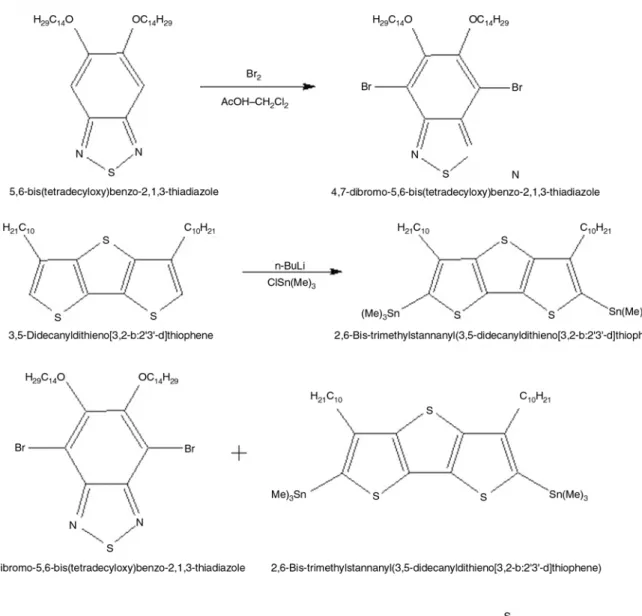
The donor material,
3,5-didecanyldithieno[3,2-b:2!,3!-d]thiophene (DDTT), was prepared
accord-ing to a reported literature method [34]. The
accep-tor material,
5,6-bis(tetradecyloxy)benzo-2,1,3-thiadiazole (BT) was prepared according to the
published procedures [35]. The copolymer
poly(3,5-
didecanyldithieno[3,2-b:2!,3!-d]thiophene-2,6-diyl-
alt-5,6-bis(tetradecyloxy)benzo-2,1,3-thiadiazole-4,7-diyl) (PDDTTBT) was synthesized via Stille
coupling reaction of the donor unit of
2,6-bis-trimethylstannanyl-3,5-didecanyl dithieno[3,2-b:
2!,3!-d]thiophene with the acceptor unit of
4,7-
dibromo-5,6-bis(tetradecyloxy)benzo-2,1,3-thiadi-azole.
2.2.1.
2,6-Bis-trimethylstannanyl(3,5-didecanyldithieno[3,2-b:2!3!-d]thiophene)
To a solution of 3,5-didecanyldithieno[3,2-b:2!,3!-d]
thiophene (1.12 mmol) in THF (40 mL) was added
dropwise n-BuLi (2.5 mmol, 1.6 M in hexane) at
–78°C under argon. The reaction was keep at –78°C
for 2 h. Then trimethylchlorostannane (2.5 mmol)
ent at 364 and 446 nm, the obtained EQE is only
10.4 and 6.2%, correspondingly. After thermal
treat-ment for the blend films, the EQE is significantly
improved with minor changes in the peak position.
Among the EQE spectra taken at different
anneal-ing temperatures, the film annealed at 50°C almost
demonstrates the highest EQE in the most
illumi-nated regions by possessing the EQE of two
domi-nant bands, at 377 and 460 nm, respectively,
reach-ing ca. 20.2 and 9.3%. Consequently, the highest
power conversion efficiency (0.292%) has been
achieved by this blend film. However, the EQE
val-ues are still small compared to those of high
per-formance PSCs. The low EQE may be attributed to
the high recombination rate of charge carriers in the
PDDTTBT/PC61BM blend system, which results
in the low photocurrent.
4. Conclusions
The D–A type copolymer PDDTTBT based on
DDTT and BT units has been synthesized and
employed as the donor material in the active layer
of BHJ-type polymer solar cells. UV-vis absorption
spectra indicated that a low bandgap polymer with a
wide absorption band has been obtained. After
annealing treatment, an irregular absorption trend
in UV-vis spectra was observed due to both donor
and acceptor segments possessing pendent side
chains. When the blend film was treated at an
opti-mum condition (50°C/30 min), the PV cell
per-formance was dramatically improved and the power
conversion efficiency of device reached to 0.292%
under white light illumination (100 mW/cm
2). We
attribute the higher efficiency to enhanced 3-D
interpenetrating networks in the active layer,
increase of light absorption, and improved carrier
mobility.
Acknowledgements
We gratefully acknowledge the support of the National Sci-ence Council of Republic of China with Grant NSC 99-2221-E-390 -001-MY3.
References
[1] Inganäs O., Svensson M., Zhang F., Gadisa A., Pers-son N. K., Wang X., AndersPers-son M. R.: Low bandgap alternating polyfluorene copolymers in plastic photo-diodes and solar cells. Applied Physics A: Materials Science and Processing, 79, 31–35 (2004).
DOI:10.1007/s00339-003-2498-5
[2] Zhang F., Mammo W., Andersson L. M., Admassie S., Andersson M. R., Inganäs O.: Low-bandgap alternat-ing fluorene copolymer/methanofullerene heterojunc-tions in efficient near-infrared polymer solar cells. Advanced Materials, 18, 2169–2173 (2006).
DOI:10.1002/adma.200600124
[3] Gadisa A., Mammo W., Andersson L. M., Admassie S., Zhang F., Andersson M. R., Inganäs O.: A new donor–acceptor–donor polyfluorene copolymer with balanced electron and hole mobility. Advanced Func-tional Materials, 17, 3836–3842 (2007).
DOI:10.1002/adfm.200700441
[4] Espinosa N., Hösel M., Angmo D., Krebs F. C.: Solar cells with one-day energy payback for the factories of the future. Energy and Environmental Science, 5, 5117–5132 (2012).
DOI:10.1039/C1EE02728J
[5] Zhao G., He Y., Li Y.: 6.5% efficiency of polymer solar cells based on poly(3-hexylthiophene) and indene-C60 bisadduct by device optimization. Advanced Materials,
22, 4355–4358 (2010).
DOI:10.1002/adma.201001339
[6] Chang C-Y., Wu C-E., Chen S-Y., Cui C., Cheng Y-J., Hsu C-S., Wang Y-L., Li Y.: Enhanced performance and stability of a polymer solar cell by incorporation of vertically aligned, cross-linked fullerene nanorods. Angewandte Chemie International Edition, 50, 9386– 9390 (2011).
DOI:10.1002/anie.201103782
[7] Peet J., Kim J. Y., Coates N. E., Ma W. L., Moses D., Heeger A. J., Bazan G. C.: Efficiency enhancement in low-bandgap polymer solar cells by processing with alkane dithiols. Nature Materials, 6, 497–500 (2007).
DOI:10.1038/nmat1928
[8] Wang E. G., Wang L., Lan L. F., Luo C., Zhuang W., Peng J., Cao Y.: High-performance polymer hetero-junction solar cells of a polysilafluorene derivative. Applied Physics Letters, 92, 033307/1–033307/3 (2008).
DOI:10.1063/1.2836266
Figure 10. EQE spectra of PDDTTBT:PC61BM blend
films after annealing at different temperatures for 30 min
[9] Zhan X., Tan Z., Domercq B., An Z., Zhang X., Bar-low S., Li Y., Zhu D., Kippelen B., Marder S. R.: A high-mobility electron-transport polymer with broad absorption and its use in field-effect transistors and all-polymer solar cells. Journal of the American Chemical Society, 129, 7246–7247 (2007).
DOI:10.1021/ja071760d
[10] Zhou E., Yamakawa S., Tajima K., Yang C., Hashimoto K.: Synthesis and photovoltaic properties of diketopy-rrolopyrrole-based donor–acceptor copolymers. Chem-istry of Materials, 21, 4055–4061 (2009).
DOI:10.1021/cm901487f
[11] Li Y.: Molecular design of photovoltaic materials for polymer solar cells: Toward suitable electronic energy levels and broad absorption. Accounts of Chemical Research, 45, 723–733 (2012).
DOI:10.1021/ar2002446
[12] Hou J., Chen H-Y., Zhang S., Li G., Yang Y.: Synthe-sis, characterization, and photovoltaic properties of a low band gap polymer based on silole-containing polythiophenes and 2,1,3-benzothiadiazole. Journal of the American Chemical Society, 130, 16144–16145 (2008).
DOI:10.1021/ja806687u
[13] Liang Y., Wu Y., Feng D., Tsai S-T., Son H-J., Li G., Yu L.: Development of new semiconducting polymers for high performance solar cells. Journal of the Ameri-can Chemical Society, 131, 56–57 (2009).
DOI:10.1021/ja808373p
[14] Park S. H., Roy A., Beaupré S., Cho S., Coates N., Moon J. S., Moses D., Leclerc M., Lee K., Heeger A. J.: Bulk heterojunction solar cells with internal quan-tum efficiency approaching 100%. Nature Photonics,
3, 297–302 (2009).
DOI:10.1038/nphoton.2009.69
[15] Lee K., Sotzing G. A.: Poly(thieno[3,4-b]thiophene). A new stable low band gap conducting polymer. Macro-molecules, 34, 5746–5747 (2001).
DOI:10.1021/ma0106245
[16] Sotzing G. A., Lee K.: Poly(thieno[3,4-b]thiophene): A p- and n-dopable polythiophene exhibiting high optical transparency in the semiconducting state. Macromolecules, 35, 7281–7286 (2002).
DOI:10.1021/ma020367j
[17] Lee B., Yavuz M. S., Sotzing G. A.: Poly(thieno[3,4-b] thiophene)s from three symmetrical thieno[3,4-b]thio-phene dimers. Macromolecules, 39, 3118–3124 (2006).
DOI:10.1021/ma0526746
[18] Sun Y. M., Ma Y. Q., Liu Y. Q., Lin Y. Y., Wang Z. Y., Wang Y., Di C. A., Xiao K., Chen X. M., Qiu W. F., Zhang B., Yu G., Hu W. P., Zhu D. B.: High-perfor-mance and stable organic thin-film transistors based on fused thiophenes. Advanced Functional Materials,
16, 426–432 (2006).
DOI:10.1002/adfm.200500547
[19] Sun Y., Liu Y., Ma Y., Di C., Wang Y., Wu W., Yu G., Hu W., Zhu D.: Organic thin-film transistors with high mobilities and low operating voltages based on 5,5!-bis-biphenyl-dithieno[3,2-b:2!,3!-d]thiophene semi-conductor and polymer gate dielectric. Applied Physics Letters. 88, 242113/1–242113/3 (2006).
DOI:10.1063/1.2209213
[20] Li J., Qin F., Li C. M., Bao Q., Chan-Park M. B., Zhang W., Qin J., Ong B. S.: High-performance thin-film transistors from solution-processed dithienothio-phene polymer semiconductor nanoparticles. Chem-istry of Materials, 20, 2057–2059 (2008).
DOI:10.1021/cm703567g
[21] Lu K., Di C., Xi H., Liu Y., Yu G., Qiu W., Zhang H., Gao X., Liu Y., Qi T., Du C., Zhu D.: Novel copoly-mers incorporating dithieno[3,2-b:2!,3!-d]thiophene moieties for air-stable and high performance organic field-effect transistors. Journal of Materials Chemistry,
18, 3426–3432 (2008).
DOI:10.1039/B801603H
[22] Millefiorini S., Kozma E., Catellani M., Luzzati S.: Dithienothiophene based polymer as electron donor in plastic solar cells. Thin Solid Films, 516, 7205–7208 (2008).
DOI:10.1016/j.tsf.2007.12.077
[23] Zhang S., Guo Y., Fan H., Liu Y., Chen H-Y., Yang G., Zhan X., Liu Y., Li Y., Yang Y.: Low bandgap #-conju-gated copolymers based on fused thiophenes and ben-zothiadiazole: Synthesis and structure-property rela-tionship study. Journal of Polymer Science Part A: Polymer Chemistry, 47, 5498–5508 (2009).
DOI:10.1002/pola.23601
[24] Chen J., Cao Y.: Development of novel conjugated donor polymers for high-efficiency bulk-heterojunc-tion photovoltaic devices. Accounts of Chemical Research, 42, 1709–1718 (2009)
DOI:10.1021/ar900061z
[25] Arias A. C., MacKenzie J. D., Stevenson R., Halls J. J. M., Inbasekaran M., Woo E. P., Richards D., Friend R. H.: Photovoltaic performance and morphology of poly-fluorene blends: A combined microscopic and photo-voltaic investigation. Macromolecules, 34, 6005–6013 (2001).
DOI:10.1021/ma010240e
[26] Snaith H. J., Greenham N. C., Friend R. H.: The origin of collected charge and open-circuit voltage in blended polyfluorene photovoltaic devices. Advanced Materi-als, 16, 1640–1645 (2004).
DOI:10.1002/adma.200305766
[27] Svensson M., Zhang F., Veenstra S. C., Verhees W. J. H., Hummelen J. C., Kroon J. M., Inganäs O., Anders-son M. R.: High-performance polymer solar cells of an alternating polyfluorene copolymer and a fullerene derivative. Advanced Materials, 15, 988–991 (2003).
[28] Boudreault P-L. T., Michaud A., Leclerc M.: A new poly(2,7-dibenzosilole) derivative in polymer solar cells. Macromolecular Rapid Communications 28, 2176–2179 (2007).
DOI:10.1002/marc.200700470
[29] Blouin N., Michaud A., Leclerc M.: A low-bandgap poly(2,7-carbazole) derivative for use in high-perfor-mance solar cells. Advanced Materials, 19, 2295–2300 (2007).
DOI:10.1002/adma.200602496
[30] Moulé A. J., Tsami A., Bünnagel T. W., Forster M., Kronenberg N. M., Scharber M., Koppe M., Morana M., Brabec C. J., Meerholz K., Scherf U.: Two novel cyclopentadithiophene-based alternating copolymers as potential donor components for high-efficiency bulk-heterojunction-type solar cells. Chemistry of Materials, 20, 4045–4050 (2008).
DOI:10.1021/cm8006638
[31] Bundgaard E., Hagemann O., Manceau M., Jørgensen M., Krebs F. C.: Low band gap polymers for roll-to-roll coated polymer solar cells. Macromolecules, 43, 8115–8120 (2010).
DOI:10.1021/ma1015903
[32] Bundgaard E., Hagemann O., Jørgensen M., Krebs F. C.: Low band gap polymers for roll-to-roll coated organic photovoltaics – Design, synthesis and charac-terization. Green, 1, 55–64 (2011).
DOI:10.1515/green.2011.005
[33] Wang T-L., Yeh A-C., Yang C-H., Shieh Y-T., Chen W-J., Ho T-H.: Synthesis and photovoltaic properties of a low bandgap donor–acceptor alternating copolymer with benzothiadiazole unit. Solar Energy Materials and Solar Cells, 95, 3295–3302 (2011).
DOI:10.1016/j.solmat.2011.07.021
[34] He M., Zhang F.: Synthesis and structure of alkyl-sub-stituted fused thiophenes containing up to seven rings. The Journal of Organic Chemistry, 72, 442–451 (2007).
DOI:10.1021/jo061853y
[35] Bouffard J., Swager T. M.: Fluorescent conjugated polymers that incorporate substituted 2,1,3-benzooxa-diazole and 2,1,3-benzothia2,1,3-benzooxa-diazole units. Macromole-cules, 41, 5559–5562 (2008).
DOI:10.1021/ma8010679
[36] Tauc J.: Amorphous and liquid semiconductors. Plenum Press, New York (1974).
[37] Cervini R., Holmes A. B., Moratti S. C., Köhler A., Friend R. H.: Synthesis of new conjugated thiophene polymers. Synthetic Metals, 76, 169–171 (1996).
DOI:10.1016/0379-6779(95)03445-P
[38] Li Y., Xue L., Li H., Li Z., Xu B., Wen S., Tian W.: Energy level and molecular structure engineering of conjugated donor–acceptor copolymers for photo-voltaic applications. Macromolecules, 42, 4491–4499 (2009).