3752 IEEE TRANSACTIONS ON MAGNETICS, VOL. 47, NO. 10, OCTOBER 2011
Design, Fabrication, and Characterization of a 3-D CMOS Fluxgate
Magnetometer
Chih-Cheng Lu
1, Wen-Sheng Huang
1, Yu-Ting Liu
1, and Jen-Tzong Jeng
2Institute of Mechatronic Engineering, National Taipei University of Technology, Taipei 10608, Taiwan Department of Mechanical and Precision Engineering, National Kaohsiung University of Applied Sciences,
Kaohsiung 80778, Taiwan
A dual-core 3-D microfluxgate magnetometer fabricated by a simple and inexpensive fabrication process is described in this paper. The microfluxgate is able to operate along a nearly linear – relationship at the second harmonic frequency and features good char-acteristics of high sensitivity and low noise response. These characteristic results indicate a field-to-voltage transfer coefficient of 11 V/T measured at the second harmonic frequency, power consumption of 67.3 mW, and a field noise response less than 12 nT/ Hz at 1 Hz. In brief, our proposed device not only enhances responsivity capability and linear – characteristics, but also is CMOS process com-patible, which is considered both function-efficient and cost-effective.
Index Terms—Magnetometers, magnetic field measurement, 3-D CMOS microfluxgate.
I. INTRODUCTION
A
MONG classes of magnetic sensors for the detection of low magnetic fields, fluxgate magnetometers mainly benefit from room temperature operation, tiny zero-point drift, and significant linearity, and allow detection of dc magnetic fields down to 0.1 nT [1], [2]. Recently, interesting applications using fluxgate sensors have been electronic compasses, current inspectors, bioimaging systems, space exploration, and even consumer electronics [3]. However, the large volume and high power consumption of the traditional fluxgates have imposed some limitations on their applications. To meet the requirements for emerging miniature systems, microfluxgate sensors have been recently developed and fabricated via CMOS and MEMS technologies [4]–[7], [11]. This class of magnetic sensors features miniature structure, planar or 3-D design, and more importantly, consumes lower electric power than traditional devices. However, by shrinking the sensor size, the tradeoff is the enhanced field noise level. Among the reported miniature fluxgates, it was shown that the dual-core (Vacquier-type) microfluxgates could achieve a relatively low noise level down to 5 nT/ Hz at 10 Hz [6].Although the commercial off-the-shelf-magnetoresistance sensors have even lower noise levels ranging from 0.3 to 3 nT/ Hz at 1 Hz [8], their response to an external dc field is hysteretic. To effectively eliminate hysteresis, ac field biasing [9], [10] is necessary. By diminishing hysteresis, the field noise at very low frequency ( Hz) can be reduced. However, it was found that the noise floor at higher frequency ( Hz) is enhanced to the level of a microfluxgate [9], [10]. In addi-tion, the driving circuit for ac-field biasing actually makes the magnetoresistance sensor system quite similar to a fluxgate magnetometer [10].
Manuscript received February 22, 2011; revised May 01, 2011, May 18, 2011; accepted May 19, 2011. Date of current version September 23, 2011. Corre-sponding author: J.-T. Jeng (e-mail: [email protected]).
Color versions of one or more of the figures in this paper are available online at http://ieeexplore.ieee.org.
Digital Object Identifier 10.1109/TMAG.2011.2158409
For the Vacquier-type microfluxgate in [6], the excitation and pick-up coils tightly wound on the sputtered multilayer mag-netic cores could ensure sufficient excitation amplitude and high responsivity, but the electroplating and sputtering processes for making coils and cores could lead to a high cost in mass produc-tion. In our previous work, a planar microfluxgate composed of an amorphous magnetic core, an excitation coil, and two pick-up coils was reported [11]. The magnetic cores were aligned to the planar coils on the chip implemented with the standard CMOS process. In this paper, a low-noise dual-core microfluxgate mag-netometer based on the standard CMOS fabrication process and wire-bonding technique is presented. The details of post-CMOS manufacturing process are given, and the measurement results on responsivity and field noise response are discussed.
II. SENSORDESIGN ANDFABRICATIONPROCESS The dual-core device is mainly configured by two 3-D excitation coils formed by the wire-bonding technique and four planar pick-up coils fabricated on silicon substrate via the standard CMOS process. The ferromagnetic cores provided by Metglas™ Ltd. (product code:2714A) have a low saturation magnetic flux of 10 T by nature [12]. Our fabrication concept mainly differs from those recently developed 3-D CMOS flux-gate sensors, which were considered more process complicated [5]–[7]. The proposed device features miniature dimensions and standard CMOS process, as illustrated in Fig. 1(a). The square microfluxgate chip was measured 2.5 mm and manufac-tured by a TSMC 0.35 m mixed-signal CMOS process. The bottom part of the excitation coils was patterned by the CMOS process and made of two levels of metal (metal 3 and metal 4), which were 180 m wide and duplicated with 24 turns. To complete 3-D excitation, two excitation coils enclosing the ferromagnetic cores were conductively formed by the common Al wire-bonding technique. Two pairs of planar pick-up coils (metal 1) were allocated beneath each single ferromagnetic core to sense the variation of magnetic flux within the core caused by the external (measured) field, and thus induced voltage output through the coils. The line width of the pick-up coil was 5 m 0018-9464/$26.00 © 2011 IEEE
LU et al.: DESIGN, FABRICATION, AND CHARACTERIZATION OF A 3-D CMOS FLUXGATE MAGNETOMETER 3755
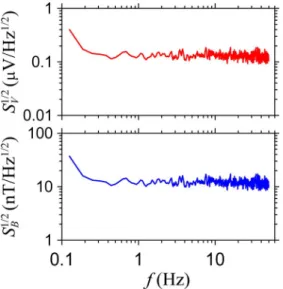
Fig. 7. Voltage noise (up) and field noise (bottom) response versus frequency of the microfluxgate.
voltage amplification circuit can be integrated on the same chip to enhance the signal level of our microfluxgate system.
IV. CONCLUSION
Design, fabrication, and harmonic characterizations of a novel 3-D CMOS fluxgate magnetometer are briefly reported in this paper. The dual-core design with a simple but effective fabrication process for a 3-D microfluxgate is described and implemented in a CMOS silicon chip. It is found that the completed microfluxgate is able to operate along a nearly linear – region around the zero point and at the second harmonic frequency in reference to the excitation frequency. These characterized results include that the field-to-voltage transfer coefficient (i.e., responsivity) is 11 V/T and power consumption is 67.3 mW when driven by a 50-kHz and 105-mA excitation current. The noise response to output voltage and magnetic field is as low as 0.14 V/ Hz and 12 nT/ Hz at 1 Hz, respectively. In conclusion, our proposed device not only has reasonable field-to-voltage transfer coefficients and excellent linear – characterization, but also is volume-miniature and
CMOS process compatible while compared with conventional and planar fluxgate sensors.
ACKNOWLEDGMENT
The authors would like to thank the National Chip Implemen-tation Center (CIC) for chip fabrication. They would also like to thank Metglas™ Inc. for providing the core material. The work is financially supported by National Science Council, Taiwan, under grants NSC 98-2221-E-027-066 and NSC 98-2112-M-151-002-MY3.
REFERENCES
[1] P. Ripka, “Review of fluxgate sensors,” Sens. Actuators: A, Phys., vol. 33, no. 3, pp. 129–141, Jun. 1992.
[2] T. M. Liakopoulos and C. H. Ahn, “Micro-fluxgate magnetic sensor using micromachined planar solenoid coils,” Sens. Actuators A, Phys., vol. 77, no. 1, pp. 66–72, Sep. 28, 1999.
[3] J. Lenz and A. S. Edelstein, “Magnetic sensors and their applications,” IEEE Sens. J., vol. 6, no. 3, pp. 631–649, Jun. 2006.
[4] A. Baschirotto, E. Dallago, P. Malcovati, M. Marchesi, and G. Venchi, “A fluxgate magnetic sensor: From PCB to micro-integrated tech-nology,” IEEE Trans. Instrum. Meas., vol. 56, no. 1, pp. 25–31, Feb. 2007.
[5] C. Lei, R. Wang, Y. Zhou, and Z. Zhou, “MEMS micro fluxgate sensors with mutual vertical excitation coils and detection coils,” Microsyst. Technol., vol. 15, no. 7, pp. 969–972, Jul. 2009.
[6] E. Delevoye, M. Audoin, M. Beranger, R. Cuchet, R. Hida, and T. Jager, “Microfluxgate sensors for high frequency and low power appli-cations,” Sens. Actuators A, Phys., vol. 145-146, pp. 271–277, Jul./Aug. 2008.
[7] O. Zorlu, P. Kejikb, and W. Teppan, “A closed core microfluxgate sensor with cascaded planar FeNi rings,” Sens. Actuators A, Phys., vol. 162, pp. 241–247, 2010.
[8] N. A. Stutzke, S. E. Russek, and D. P. Pappas, “Low-frequency noise measurements on commercial magnetoresistive magnetic field sensors,” J. Appl. Phys., vol. 97, 2005.
[9] P. Ripka, M. Tondra, J. Stokes, and R. Beech, “AC-driven AMR and GMR magnetoresistors,” Sens. Actuators A, vol. 76, pp. 225–230, 1999.
[10] M. Vopálenský, P. Ripka, and A. Platil, “Precise magnetic sensors,” Sens. Actuators A, vol. 106, pp. 38–42, 2003.
[11] W.-S. Huang, C.-C. Lu, and J.-T. Jeng, “Multiple frequency character-izations of a CMOS planar fluxgate magnetic sensor,” in Proc. 2nd Int. Conf. Mech. Electron. Eng., Kyoto, Japan, Aug. 1–3, 2010, vol. 1, pp. 409–412.
[12] Metglas Inc. [Online]. Available: http://www.metglas.com/, website [13] W.-S. Huang, C.-C. Lu, and J.-T. Jeng, “Harmonic frequency
charac-terisations of a CMOS micro fluxgate sensor for low magnetic field detection,” in Proc. Eurosens. XXIV, Linz, Austria, Sep. 5–8, 2010, pp. 993–996.