國
立
交
通
大
學
資訊科學與工程研究所
碩
士
論
文
在 LTE 資料排程中考量通道環境及 QoS 限制以
最小化耗電
Minimizing Power Consumption in LTE Data Scheduling with
the Constraints of Channel Condition and QoS
研 究 生:郭昱賢
指導教授:林盈達 教授
在 LTE 資料排程中考量通道環境及 QoS 限制以最小化耗電
Minimizing Power Consumption in LTE Data Scheduling with the
Constraints of Channel Condition and QoS
研 究 生:郭昱賢 Student:Yu-Hsien Kuo
指導教授:林盈達 Advisor:Dr. Ying-Dar Lin
國 立 交 通 大 學
資 訊 科 學 與 工 程 研 究 所
碩 士 論 文
A Thesis
Submitted to Institute of Computer Science and Engineering College of Computer Science
National Chiao Tung University in partial Fulfillment of the Requirements
for the Degree of Master in Computer Science June 2013 Hsinchu, Taiwan
中華民國一百零二年六月
I
在 LTE 資料排程考量通道環境及 QoS 限制以最小化耗電
學生: 郭昱賢 指導教授: 林盈達
國立交通大學資訊科學與工程研究所
摘要
LTE 已成為新一代的通訊技術,其擁有高傳輸率及廣涵蓋率,但也因此產生 高耗電的問題。為此 LTE 制定了 Discontinuous Reception (DRX)省電機制,原理 為周期性的關閉射頻電路以達到省電效果,但在關閉期間無法接收封包,而影響 服務品質。為了最小化耗電並滿足服務品質,需要找出一組在最佳的 DRX 參數 設定,但在變動的通道環境下,此參數設定也會有所變動。因此本論文提出一稱 為 Dynamic Scheduling with Extensible Allocation and Dispersed Offsets (DXD)的 方法,其分為兩個演算法:DRX 參數決定演算法及 DRX-aware 排程演算法,DRX 參數決定演算法會考量通道環境及服務品質限制以決定出最佳的 DRX 周期,並 分散各使用者的開啟時間,使其在射頻電路開啟時,能完整利用 LTE 頻寬來快 速傳輸資料,即有更多的時間關閉射頻電路以達到省電效果。而 DRX-aware 排 程演算法判斷是否延長電路開啟時間使得服務品質不會受到 DRX 影響。實驗結 果可發現 DXD 與未採用 DRX 省電機制時相比,最多可節省 96.9%的耗電,在 服務品質滿足率方面,亦可接近未採用 DRX 省電機制的效能。 關鍵字: LTE,DRX,省電,服務品質,通道環境,排程II
Minimizing Power Consumption in LTE Data Scheduling with the
Constraints of Channel Condition and QoS
Student: Yu-Hsien Kuo Advisor: Dr. Ying-Dar Lin
Department of Computer and Information Science
National Chiao Tung University
Abstract
LTE has become the next generation of communication technology. It has high data rate and broad network coverage, but it conversely introduces high power consumption. To resolve this problem, 3GPP has developed the Discontinuous Reception (DRX) power saving mechanism, which periodically turns off the radio interface to reduce power consumption. However, packets cannot be received during the turn-off time, as a result that the Quality of Services (QoS) may be violated. Therefore, optimal DRX parameters should be configured. In addition, channel condition may be unstable during the transmission, so the optimal DRX parameters should also be dynamically adjusted. In this thesis, we propose the Dynamic Scheduling with Extensible Allocation and Dispersed Offsets (DXD) scheme, which is composed of two algorithms, DRX parameter decision algorithm and DRX-aware scheduling algorithm. DRX parameter decision algorithm determines the DRX period by considering channel condition and QoS constraints, and then interlaces the turn-on time of each user. The scheduling algorithm determines whether to extend the turn-on time or not, so that QoS will not be affected by DRX. Simulation results demonstrate that our DXD approach can reduce power consumption up to 96.9% compared to No DRX scheme and guarantee QoS as good as No DRX scheme.
III
致謝
能夠有今日的研究成果,首先要感謝林盈達教授、賴源正教授及童莉萍教授 的盡心指導。在指導的過程老師們總是能不厭其煩的給予指教與包容,昱賢在這 兩年的研究生涯真的是受益良多。尤其在與童莉萍教授亦師亦友相處下,除了使 研究所生活更加有趣、充實,在待人處事上亦是有所精進。而對於高速網路實驗 室的同儕們,總是能在我遇到困難時伸出援手,感激之情當然難以言表,對於長 期相處下來的感情在此時刻總有些依依不捨,但相信大家在未來必能有所成就。 此外對於 BML、NBL、EBL 及交大的教職員們感謝你們提供的資源與協助,昱 賢在此感激不盡。最後由衷的感謝長期給予我支持與鼓勵的家人、朋友,使我能 無後顧之憂並一路順遂的完成碩士學位。IV
Contents
List of Figures ... VI List of Tables ... VII
Chapter 1 Introduction ... 1
Chapter 2 Background ... 5
2.1 Discontinuous Reception ... 5
2.2 Channel Condition ... 6
2.3 QoS Class Identifier (QCI) ... 7
2.4 Scheduling ... 8
2.5 Related Work ... 9
Chapter 3 Problem Statement ... 12
3.1 Definition ... 12
3.2 Problem Description ... 13
Chapter 4 Dynamic Scheduling with Extensible Allocation and Dispersed Offsets Scheme ... 14
4.1 Overview ... 14
4.2 Detailed Operations of DXD ... 16
4.2.1 Allocation - Period Decision... 16
4.2.2 Scheduling - Start Offset Decision ... 17
4.2.3 Allocation Extension - DRX-aware Scheduling ... 19
4.3 Example... 20
4.4 System Overhead Analysis ... 22
V
5.1 Simulation Environment ... 24
5.2 Parameter Setting ... 25
5.3 Adaptability to Channel Condition ... 26
5.4 Multiple Services Handling ... 28
5.5 System Capacity Problem ... 31
Chapter 6 Conclusion ... 33
VI
List of Figures
Figure 1: Operation of DRX ... 6
Figure 2: Radio frame structure ... 9
Figure 3: Dynamic Scheduling with Extensible Allocation and Dispersed Offsets (DXD) architecture ... 15
Figure 4: The parameters used in the period decision method ... 17
Figure 5: The impact of other UEs for UEx ... 18
Figure 6: Example for start offset decision... 22
Figure 7: LTE radio protocol stack architecture ... 24
Figure 8: Power consumption model... 25
Figure 9: adaptability to channel condition (a) delay satisfaction ratio (b) power consumption ... 28
Figure 10 : Multiple services handling (a) Delay satisfaction ratios (b) Power consumptions ... 30
Figure 11: Delay satisfaction ratios of different services of multiple services handling ... 31
Figure 12: System capacity problem (a) delay satisfaction ratios (b) power consumptions ... 32
VII
List of Tables
Table 1: 4-bit CQI Table ... 7
Table 2: Standardized QCI characteristics ... 8
Table 3: Related work comparison table ... 11
Table 4: Definition of Symbols ... 13
Table 5: Example for period decision ... 20
Table 6: Example for start offset decision ... 21
1
Chapter 1 Introduction
Nowadays, a variety of powerful smart devices are designed to handle a wide range of traffic, such as VoIP, video streaming, mobile gaming, and so on. In order to satisfy the growing traffic demand for wireless communications, the Third Generation Partner Project (3GPP) Long Term Evolution (LTE) has been developed to support higher transmission rate by adopting some novel technologies, such as Multi-input Multi-output (MIMO) and Orthogonal Frequency-Division Multiple Access (OFDMA). However, the high complexity of these new technologies may introduce large power consumption.
Discontinuous reception (DRX) vs. QoS
While the LTE transmission rate is many times faster than the 3G rate, the battery, the power source of mobile devices, has not any sizeable advancement. Thus, power saving is still one of the important issues for mobile devices. To save the energy of mobile devices, 3GPP LTE has defined the discontinuous reception (DRX) scheme to allow devices to turn off their radio interface and go for a sleep state for a length of time, while staying connected to the network, thereby reducing the power consumption when there is no data transmission. Nevertheless, if packets arrive at sleep state, these packets would pose unexpected delay, which may affect their Quality of Service (QoS) requirements. Thus, how to determine DRX parameters to minimize the power consumption and guarantee QoS simultaneously is still an open issue.
2
When Channel Condition is Considered
Further, channel condition should be considered when the DRX parameters are determined. The adaptive modulation and coding (AMC) in LTE offers a link adaptation method that can dynamically choose the modulation and coding scheme (MCS) according to current channel condition for each user, known as UE (user equipment). The UE uses channel quality indicator (CQI) [1] to report channel condition for base station, also called evolved Node B (eNB), to decide the MCS level. A higher MCS level (i.e., with 64 Quadrature Amplitude Modulation (64QAM) modulation) has higher transmission rate but is more prone to errors due to interference and noise. A lower MCS level (i.e., QPSK modulation) has lower rate but can tolerate a higher level of interference. When channel condition is good, AMC assign a higher MCS, which means that the UE can transmit data with a higher transmission rate during a short period. Thus, the UE can turn off its radio interface for a long period for power saving. In contrast, when channel condition is bad, AMC assign a lower MCS, which has a lower transmission rate. Thus, the UE needs to extend the turn-on duration in order to meet the QoS requirements. Therefore, CQI information should be considered when determining optimal DRX parameters.
Related Work
Previous studies have investigated how to dynamically adjust the DRX parameters based on channel condition [5, 6]. A multi-threshold adaptive DRX (M-ADRX) mechanism [5] is proposed, where UEs are divided into several states according to their channel condition. UEs with better channel condition will be configured with lower power consumption parameters, and vice versa. In [6], DRX parameters are adjusted depending on the system load and the channel variation to
3
improve power saving efficiency. For UEs with slow-varying channel, power saving parameter is used. In order to obtain an accurate channel condition, i.e., up-to-date channel condition information, for packet scheduling and DRX parameter setting, an update period of channel condition before the actual turn-on time is proposed by [7]. However, this work does not consider the QoS features, such as packet delay, packet loss rate, and required data rates. A DRX-aware scheduling scheme [8] is proposed to reduce the packet loss rate due to DRX sleep, but it increases power consumption. In [11], they study the use of DRX for VoIP traffic under different scheduling strategies. Instead of proposing new adaptive DRX scheme, they only use several specific parameter settings to observe the power savings and QoS impact. In [15], the authors determine DRX parameters by considering the QoS requirements for Internet of Thing (IoT) applications, but it does not dynamically adjust the DRX parameters based on channel condition. In addition, they propose DRX aware scheduling algorithm, but it increases power consumption too.
Dynamic Scheduling with Extensible Allocation and Dispersed Offsets (DXD)
In this study, a novel DRX scheme, called Dynamic Scheduling with Extensible Allocation and Dispersed Offsets (DXD) scheme, is proposed to meet QoS requirements, minimize power consumption, and increase system capacity in the DRX mode. In order to maximize of power savings, the UE should turn off the radio interface as long as possible under the QoS constraints. The proposed scheme dynamically determines DRX parameters depending on QoS. On the other hand, when the UE turns on the radio interface, the buffered packets should be forwarded as soon as possible. Thus, we disperse turn-on time of UEs so that each UE can fully utilize the bandwidth for resource efficiency and fast transmission. In addition, the
4
proposed method includes a DRX-aware scheduler. It can determine whether or not to extend the turn-on time for QoS satisfaction. If system loading is high, extension may not improve QoS but only increases power consumption.
The rest of this thesis is organized as follows. In Chapter 2, we firstly describe the operations of DRX in LTE systems, and review relevant literature to justify the issues. The problem statement and its notations are defined in Chapter 3. In Chapter 4, we describe the proposed DXD algorithm and illustrate the detailed operations with an example. In Chapter 5, the simulation results are presented. Finally, we conclude this work in Chapter 6.
5
Chapter 2 Background
There is a tradeoff between system performance and power consumption when DRX scheme is applied in the LTE systems. The parameters of DRX configuration could be optimized depending on some factors, such as channel condition, QoS, and scheduling.
2.1 Discontinuous Reception
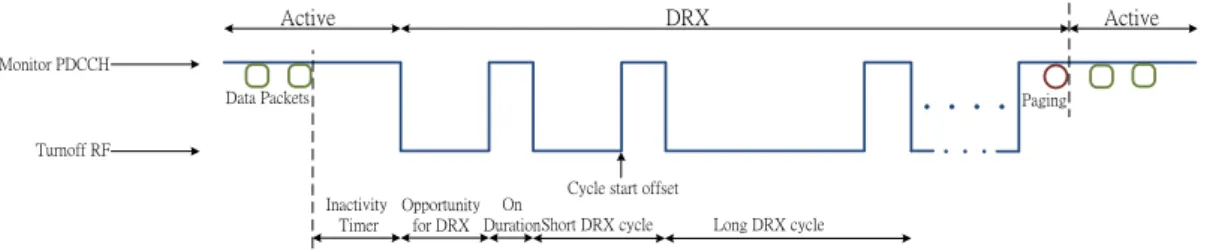
DRX is a power saving mechanism in LTE system. When applying the DRX scheme, the UE periodically turn off the receiving circuit to save power. During the period in which the receiver is in the active state, the UE monitors Physical Downlink Control Channel (PDCCH) in order to check for incoming packets or paging signals, as shown in Figure 1. If paging signals or packets arrive, the UE stays active until no more packets are received for a period of time, i.e., Inactivity Timer. When the Inactivity Timer expires, the UE go to DRX sleep state. The DRX behavior can be configured by the DRX parameters including On-Duration Timer, Opportunity for DRX, Short/Long DRX Cycle, DRX Short Cycle Timer, Inactivity Timer, and Cycle Start Offset. The DRX operation and the related parameters are illustrated in Figure 1.
On-Duration denotes the time period in which the UE wakes up and monitors PDCCH. Opportunity for DRX denotes the time period in which the UE sleeps for power saving. DRX Cycle denotes the cycle by which On-Duration repeats periodically. A UE can be configured by two types of DRX cycles, short DRX cycle and long DRX cycle. The UE first adopts short DRX cycles and then changes to long DRX cycles for power saving. DRX Short Cycle Timer defines the repetition count of short cycles. Long DRX cycle follows after DRX Short Cycle timer expires. Inactivity
6
Timer denotes the time period after the last scheduling that the UE should remain awake. If the UE does not receive any packet, this timer is decreased by one macro second. On the contrary, if the UE is scheduled, the Inactivity Timer is reset. Hence, this parameter provides means for the network to keep a UE awake beyond the On-Duration period when data is buffered. Cycle Start Offset denotes start time of On-Duration in each cycle.
Active DRX Active Inactivity Timer Opportunity for DRX On
DurationShort DRX cycle Long DRX cycle Data Packets
Turnoff RF Monitor PDCCH
Paging Cycle start offset
Figure 1: Operation of DRX
DRX parameters of all UEs are determined by the eNB. The eNB use Radio Resource Configuration (RRC) control signal to configure or update these DRX parameters. Then the UE updates its configuration after receiving the parameters from the eNB.
2.2 Channel Condition
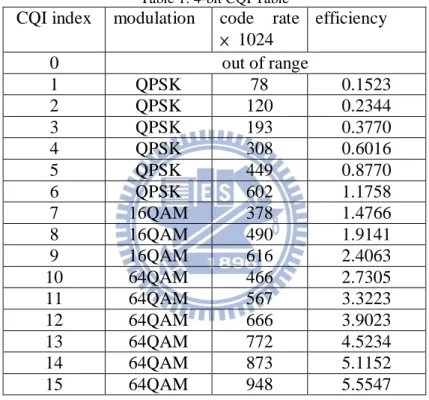
Channel condition changes rapidly in wireless networks. Since the channel condition will affect the network capacity, we should take it into consideration when designing the scheduling algorithm or determining the DRX parameters. The UE uses CQI reporting [1] to report channel condition to the eNB, which can decide the adaptive MCS level. The CQI index is between 1 and 15 as shown in Table 1. Each CQI index corresponds to a MCS, including modulation, code rate, and efficiency. The modulation order is the number of bits per symbol. The higher modulation is the more information a symbol can carry. In order to protect data, data will be coded before transmission. To recover from transmission errors, the parity bits are added.
7
Coding rate is diverse in different coding, and it is the ratio of the number of information bits to the number of total bits. The higher the code rate is, the less the number of parity bits is. Efficiency is the number of information bits that can be carried within a symbol. It can be calculated using modulation order and code rate (efficiency = modulation order × code rate). So a higher MCS level has a higher transmission bit rate but is more prone to errors due to interference and noise. A lower MCS level has a lower bit rate but can tolerate higher levels of interference.
Table 1: 4-bit CQI Table CQI index modulation code rate
× 1024 efficiency 0 out of range 1 QPSK 78 0.1523 2 QPSK 120 0.2344 3 QPSK 193 0.3770 4 QPSK 308 0.6016 5 QPSK 449 0.8770 6 QPSK 602 1.1758 7 16QAM 378 1.4766 8 16QAM 490 1.9141 9 16QAM 616 2.4063 10 64QAM 466 2.7305 11 64QAM 567 3.3223 12 64QAM 666 3.9023 13 64QAM 772 4.5234 14 64QAM 873 5.1152 15 64QAM 948 5.5547
2.3 QoS Class Identifier (QCI)
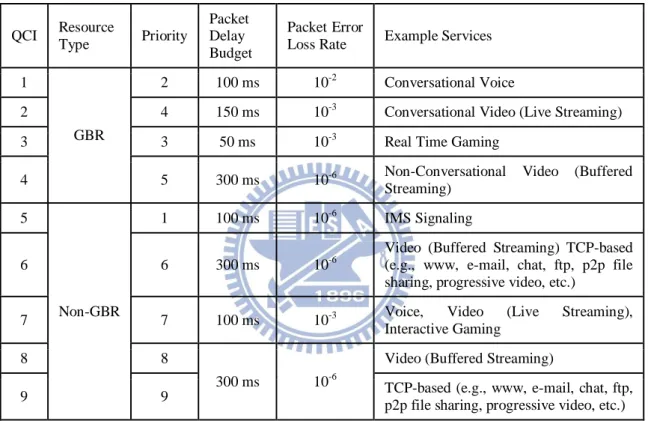
As the wireless communication prevails, the traffic, such as VoIP, video streaming, becomes more abundant and complicated. In order to meet all the requirements of all kinds of traffic, LTE specifically defines the QCI [2] metric, which grades the QoS in nine classes as shown in Table 2. Each class contains quadruple, i.e., resource type, priority, packet delay budget, and packet error loss rate. Resource type denotes whether the traffic needs guaranteed bit rate (GBR) and its value if any. For priority, the smaller the number is, the higher priority the traffic
8
owns. Packet delay budget puts the constraint on the transmission delay of each packet, and packet error loss rate claims on the acceptable error rate of traffic. An evolved packet system (EPS) bearer is the tunnel for transporting traffic between the UE and the external network. Different QCI configuration could be adopted to an EPS bearer depending on what quality the application needs.
Table 2: Standardized QCI characteristics QCI Resource Type Priority Packet Delay Budget Packet Error
Loss Rate Example Services 1
GBR
2 100 ms 10-2 Conversational Voice
2 4 150 ms 10-3 Conversational Video (Live Streaming)
3 3 50 ms 10-3 Real Time Gaming
4 5 300 ms 10-6 Non-Conversational Video (Buffered Streaming)
5
Non-GBR
1 100 ms 10-6 IMS Signaling
6 6 300 ms 10-6
Video (Buffered Streaming) TCP-based (e.g., www, e-mail, chat, ftp, p2p file sharing, progressive video, etc.)
7 7 100 ms 10-3 Voice, Video (Live Streaming),
Interactive Gaming
8 8
300 ms 10-6
Video (Buffered Streaming)
9 9 TCP-based (e.g., www, e-mail, chat, ftp,
p2p file sharing, progressive video, etc.)
2.4 Scheduling
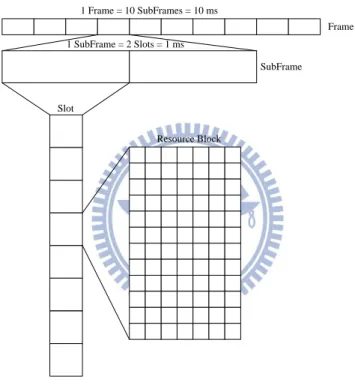
When the UE wants to upload or download packets, packets will be buffered in a RLC (Radio Link Control) buffer and wait for scheduling. Each RLC buffer corresponds to a bearer. LTE do the scheduling process according to radio frame structure as shown in Figure 2. One frame is 10 ms. Each frame is divided into 10 subframes and thus one subframe is 1 ms. Each subframe is divided into 2 slots, and each slot is 0.5 ms. Each slot is further divided into multiple Resource Blocks (RBs) in frequency domain. A group of RBs are combined into one Resource Block Group
9
(RBG). The basic unit of scheduling is RB or RBG. The scheduling priority can be calculated based on different factors (e.g. CQI, QCI). In addition, it determines how many RBs are allocated. The resource allocation information will be carried in PDCCH to indicate the PDSCH attributes: 1) where are the resource blocks, and 2) which MCS scheme should be used in the resource block. Both scheduler and DRX are implemented in the eNB, but they operate independently. If the scheduler considers the DRX parameters, system performance can be further improved.
Slot Resource Block Frame SubFrame 1 Frame = 10 SubFrames = 10 ms 1 SubFrame = 2 Slots = 1 ms
Figure 2: Radio frame structure
2.5 Related Work
Previous studies have investigated how to dynamically adjust the DRX parameters, e.g., inactivity timer and on-duration timer, based on channel conditions [5, 6]. A multi-threshold adaptive DRX (M-ADRX) mechanism [5] is proposed, where UEs are divided into several groups according to their CQI values. UEs with a higher CQI will be configured with shorter DRX inactivity timer, and vice versa. In [6], the on-duration timer and inactivity timer would be adjusted depending on the
10
system load and the channel variation to improve power saving efficiency. For UEs with a slow-varying channel, shorter DRX inactivity timer is used. Furthermore, in order to obtain the accurate channel condition, i.e., up-to-date CQI information for packet scheduling and DRX parameter settings, the CQI preamble period is proposed before the actual on-duration [7].
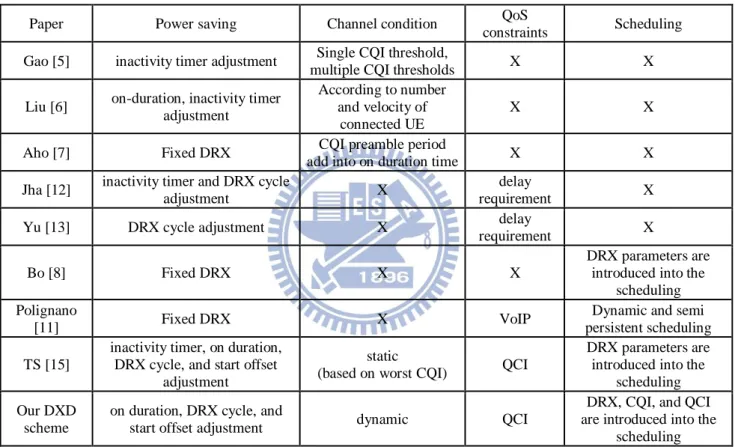
In [12] and [13], the work considers the QoS requirements with multiple traffics when determining the DRX parameters. However, the channel condition is not taken into consideration. In [12], DRX parameters are configured based on delay requirement and power saving constraint. The proposed algorithm optimizes one of these two performance metrics while satisfying a pre-defined level of performance guarantee for the other. In addition, the proposed algorithm only focuses on the DRX inactivity timer and DRX cycles with filev DRX on duration. A traffic-based DRX cycles adjustment (TDCA) [13] scheme is proposed to improve power saving. It employs the partially observable Markov decision process (POMDP) to conjecture the present traffic status for DRX parameters selection while the packet delay constraint can still be satisfied.
When designing the scheduling algorithm, DRX operations should be also taken into consideration [8, 11]. The consideration means that DRX parameters are introduced into the scheduling determinants, so as to reduce packet loss or packet delay caused by the sleeping process during DRX. A DRX-aware scheduling scheme [8] is proposed to reduce the packet loss rate due to DRX sleep. The scheduler takes inactivity timer into consideration. If inactivity timer is smaller, the UE would be given a higher priority in order to meet delay requirements. In [11], the impact on the QoS requirements of VoIP is analyzed with dynamic and semi persistent packet scheduling schemes. In [10, 15], the Three-Stage (TS) scheme determines DRX parameters by considering the QoS requirements for Internet of Thing (IoT)
11
applications. In addition, they also propose DRX-aware scheduling algorithm. However, there are some differences between TS and our work. First, they only consider the application with the strictest QCI to determine on duration even though the UE has to serve multiple services. Second, they use static DRX configurations which based on the worst CQI report. We summarize the related work in terms of issues in Table 3.
Table 3: The comparison of related work
Paper Power saving Channel condition QoS
constraints Scheduling Gao [5] inactivity timer adjustment Single CQI threshold,
multiple CQI thresholds X X
Liu [6] on-duration, inactivity timer adjustment
According to number and velocity of
connected UE
X X
Aho [7] Fixed DRX CQI preamble period
add into on duration time X X Jha [12] inactivity timer and DRX cycle
adjustment X
delay
requirement X
Yu [13] DRX cycle adjustment X delay
requirement X
Bo [8] Fixed DRX X X
DRX parameters are introduced into the
scheduling Polignano
[11] Fixed DRX X VoIP
Dynamic and semi persistent scheduling TS [15]
inactivity timer, on duration, DRX cycle, and start offset
adjustment
static
(based on worst CQI) QCI
DRX parameters are introduced into the
scheduling Our DXD
scheme
on duration, DRX cycle, and
start offset adjustment dynamic QCI
DRX, CQI, and QCI are introduced into the
12
Chapter 3 Problem Statement
In this chapter, we define related parameters. Then we present the problem statement and the objective.
3.1 Definition
In this study, we consider the LTE network of an evolved Node B eNB serves N User Equipment , where is the i-th UE. Each has application services, which denoted as . Each is assigned to a QoS class identifier including Packet Delay Budget (ms) and Guaranteed Bit Rate (bits/s). Each is configured with a set of DRX parameters , where is execution subframe. The DRX parameters includes On Duration Timer (ms), Opportunity for DRX (ms), Long DRX Cycle (ms), Inactivity Timer (ms), and Cycle Start Offset (ms). We denote and as channel quality indicator and power consumption of at subframe .
13
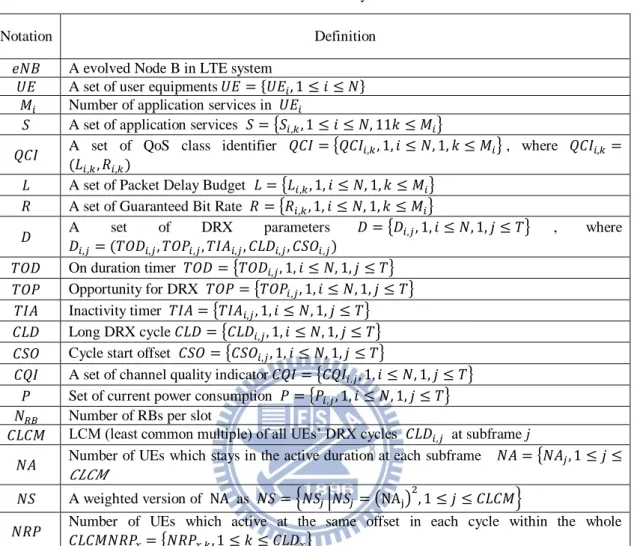
Table 4: Definition of Symbols
Notation Definition
A evolved Node B in LTE system
A set of user equipments Number of application services in
A set of application services
A set of QoS class identifier , where
A set of Packet Delay Budget
A set of Guaranteed Bit Rate
A set of DRX parameters , where
On duration timer
Opportunity for DRX
Inactivity timer
Long DRX cycle
Cycle start offset
A set of channel quality indicator
Set of current power consumption Number of RBs per slot
LCM (least common multiple) of all UEs’ DRX cycles at subframe j
Number of UEs which stays in the active duration at each subframe A weighted version of as
Number of UEs which active at the same offset in each cycle within the whole
3.2 Problem Description
The DRX parameters optimization problem is described as follows. Given an
eNB, a set of user equipments , which have a set of services
and . The objective is to design an approach to allocate the resource blocks and optimize the DRX parameters, , of each , including , , , , and depending on the channel conditional , such that the QoS requirement can be satisfied as good as the no DRX situation and power consumption for each can be minimized at the same time.
14
Chapter 4 Dynamic Scheduling with Extensible Allocation
and Dispersed Offsets Scheme
In this chapter, we discuss how DXD scheme works. Then, some examples are demonstrated.
4.1 Overview
First, we determine the optimal DRX period by considering channel condition and QoS constraints under the assumption that the UE can fully utilize the resource. Thus, the buffered packets can be transmitted within the on duration without violating their QoS requirements. Since the network resources are shared by multiple UEs, we need to disperse the on duration of UEs to let the UE fully utilize the bandwidth during the on duration and finish its transmission as soon as possible to go to sleep for more time. DRX parameters are taken into consideration during scheduling process so that the active period can be dynamically extended or not.
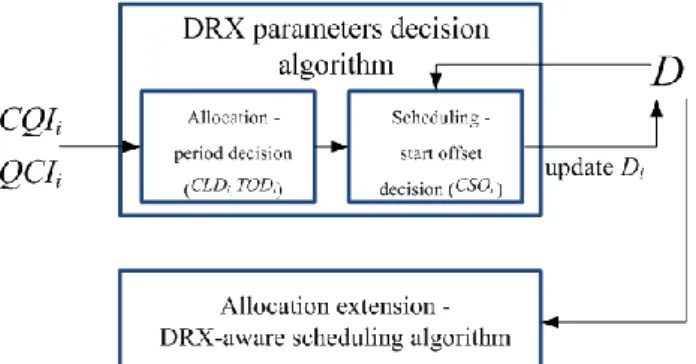
In this study, a novel DRX scheme, called Dynamic Scheduling with Extensible Allocation and Dispersed Offsets (DXD), is proposed with the objectives of satisfying the QoS requirements, minimizing the power consumption, and increasing the system capacity with DRX operations. As illustrated in Figure 3, the architecture of DXD is implemented in the eNB, and it can be divided into two parts: 1) DRX parameter decision algorithm, and 2) DRX-aware scheduling algorithm.
15
Figure 3: Dynamic Scheduling with Extensible Allocation and Dispersed Offsets (DXD) architecture DRX parameter decision algorithm will be executed when one of UE ( ) needs to update its DRX parameters ( ). DRX parameter decision algorithm includes two parts. In the first part, period decision method determines how much turn-on time is allocated to as well as the long DRX Cycle so that the UE can turn off the radio interface as long as possible to maximize the power saving but without violating the QoS requirement. Thus, we set the value of as large as the delay constraint. On the other hand, the packets arrived during the turn-off time period will be buffered and should be forwarded immediately when the UE turns on the radio interface. Thus, we also need to set the On Duration, , as the transmission time for all buffered packets. Here, the packet transmission time will be estimated based on the channel quality . In the second part, the start offset decision determines when the turn-on time is allocated to . We need to determine the cycle start offset to disperse the active period of UEs. In this way, the UE can fully utilize the resource blocks so that the buffered packets could be forwarded as soon as possible with a minimal active time period. When finishing the transmission, the UE can turn off the radio interface immediately to save power.
In addition to determine the DRX parameters, we also design a new scheduler, called DRX-aware scheduling, which cooperates with the DRX parameter decision algorithm to extend the turn-on time. DRX-aware scheduling algorithm takes the DRX parameter D into account. When the UE is able to turn off its radio circuit, but
16
some packets have not been serviced, the active period would be extended to satisfy QoS with DRX.
4.2 Detailed Operations of DXD
4.2.1 Allocation - Period Decision
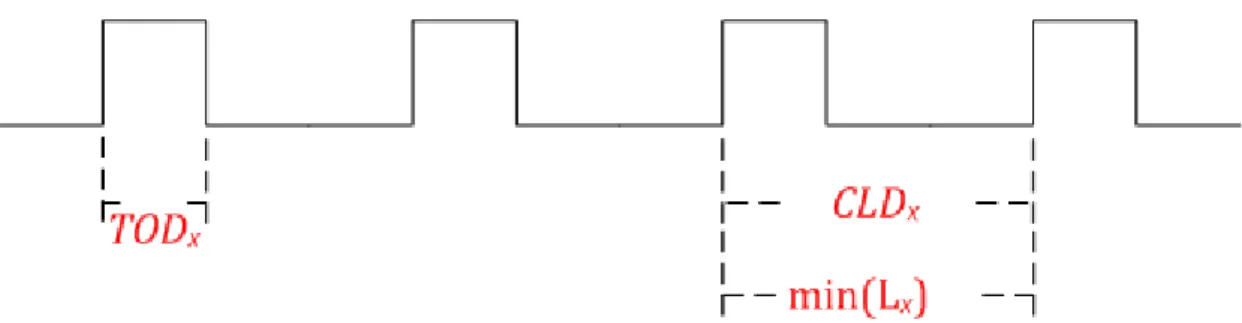
When the x-th UE, attaches to the eNB or detects the change of channel condition, period decision algorithm calculates DRX cycle and on duration , as shown in Figure 4. To maximize power saving and meet the strictest delay budget, we set long DRX cycle as the minimum delay budget in each service as follows:
In order to save power, should turn off the circuit immediately after its all packets are transmitted. Therefore, we set its on duration as the expected transmission time according to its channel quality indicator . is obtained as
is obtained from multiplying the long DRX cycle, , by the ratio of the sum of guaranteed bit rate, , to the available transmission rate. Available transmission rate is obtained based on current channel condition, thus we use to denote the number of bits could be carried in one Resource Block (RB) by looking up the CQI table. Let denote the number of RBs per slot, which length is 0.0005 seconds. If the required data rates is larger than the available transmission rate, we set the on duration as the DRX cycle .
17
Figure 4: The parameters used in the period decision method
4.2.2 Scheduling - Start Offset Decision
In order to improve radio resource efficiency in the active period, we disperse the on duration of each UE by assigning different cycle start offsets. It can fully utilize the bandwidth during the on duration if it does not overlap with other UEs.
We maintain , in which is the number of UEs which stays in the active duration at subframe j. Let denote the least common
multiple (LCM) of all long DRX cycles i.e.,
. If current least common multiple, , which is recalculated with the , is larger than the original then we should update current according by original , where . That is, is formed by combing multiple of because is multiple of . Otherwise, and remain unchanged. Since the long DRX cycle will repeat multiple times within the time period, so we use in unit of to indicate the number of UEs which active at the same offset in each cycle within the whole . So, we have as:
mod . Then, the cycle start offset can be found by
18
The formula means that during the on duration of , the number of UEs which stay in the on duration is minimal within the whole time period. Therefore, can fully utilize the bandwidth during the on duration if it does not overlap with other UEs, finish its transmission as soon as possible, and go to sleep for more time.
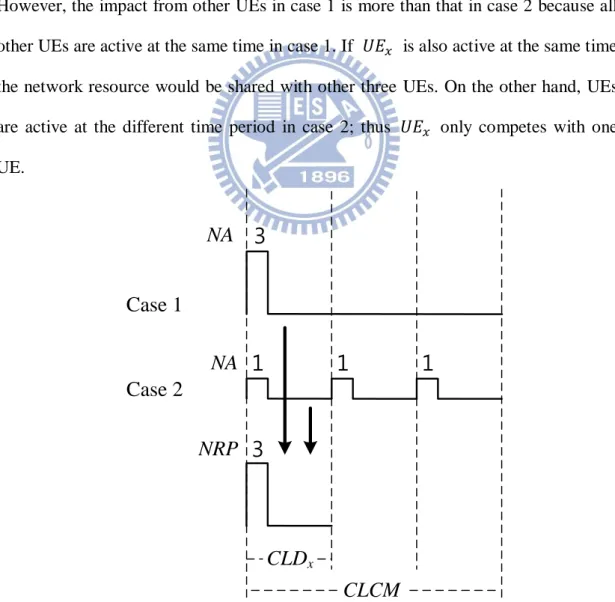
However, we observe that the value of may not be sufficient to grasp the impact come from other UEs. Take Figure 5 as an example. Here, there are 3 UEs with different long DRX cycles and UEs may active at the same time (case 1) or active at different time (case 2). According to the definition of , the value of in both cases are the same (i.e., and if . However, the impact from other UEs in case 1 is more than that in case 2 because all other UEs are active at the same time in case 1. If is also active at the same time, the network resource would be shared with other three UEs. On the other hand, UEs are active at the different time period in case 2; thus only competes with one UE.
Case 1
Case 2
3
1
1
1
3
NA
NA
NRP
CLCM
CLD
x19
So we consider a weighted version of as
in order to differentiate the degree of dispersion of UEs’ on duration. A
subframe with more active users makes more impacts on the decision of start offset. So we utilize the square function to emphasize such phenomenon. Then, we have the new as
Then, the optimal cycle start offset ( ) can be found by
4.2.3 Allocation Extension - DRX-aware Scheduling
The DRX aware scheduling in [15] dynamically extends the active period in order to increase the satisfaction ratio on delay budget. DRX inactivity timer will be reset if the UE is scheduled. With this feature, the UE that will be closed at the next subframe is scheduled one RBG to extend the inactivity timer if RLC buffer, which is waiting transmission queue, is not empty. However, frequent extending the active period will significantly increase power consumption especially in the case of poor channel condition or high system load. It is because the system does not have sufficient radio resources that can be allocated to the UE in UE’s extended active period. Therefore, our scheme does not extend the active period of UE if the system is unable to serve the UE in the current active period. The detail formula of scheduling priority handling is described as follow,
α
20
where denotes priority of original scheduling which can be any scheduling scheme. denotes DRX-aware scheduling at subframe for , respectively. Let denotes the total loading of active UEs whose priorities are higher than , and it is calculated by and which are average data rate and achievable data rate depending on at subframe , respectively. Let denotes the ratio of opportunity for DRX to DRX cycle. So means that system loading is too high to serve UEx during the rest of time in its DRX
cycle. Therefore, when will turn off its radio interface at the next subframe (i.e., ) and the system load is less than the free resource from turn-off, the priority of UE will be increased by α. Here, we let α to raise the priority of UE which need to be scheduled.
4.3 Example
In this sub section, we give some examples to illustrate the algorithm.
Example for period decision
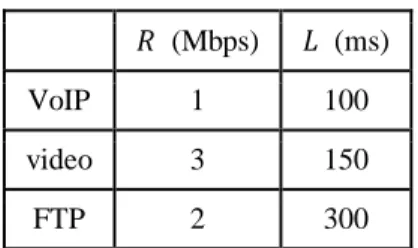
There are three services in . The required data rate and delay budget for each service are shown in Table 5. The system bandwidth is 20MHz which has 100 RBs, and the channel condition is 15.
Table 5: Application services in UEx
(Mbps) (ms)
VoIP 1 100
video 3 150
FTP 2 300
DRX cycle and on duration are calculated as follows: ,
21
where one RB has symbols. Each symbol can carry 5.55 bits depending on the CQI table.
Example for start offset decision
is attaching to the eNB and needs to determine its cycle start offset . The relevant DRX parameters are shown in Table 6. Figure 6 shows how to determine the start offset for .
Table 6: Example of start offset decision DRX cycle On duration Cycle start offset
100 ms 50ms
First, we assume lowest common multiple is 300. We maintain the number of awaken UEs, , in 300 subframes. Then we generates square weighted value, , from . Since the DRX cycle of UEx ( ) is 100ms, so is divided into three
cycles (i.e., ). Then, we have the value. The value of is 4 when j = 1 to 25 and the value of is 1 when j = 26 to 100. Therefore, we can find that could be set within the range of 26 to 100, which means that the impact from other UEs during the on duration is minimal. Since the start offset in this case is not a unique value, we use the following formula to obtain a unique start offset for the UE.
.
Thus, we obtained the start offset as 25 + 75 = 100. The reason is that we can uniformly interlace the on duration of all UEs.
22 NRP NA NS
UE
x CSOx=1 CSOx=k CLD x CLCM=300 CLDx=100 ms TODx=50 msFigure 6: Example for start offset decision
4.4 System Overhead Analysis
We discuss signaling overhead of DRX parameters configuration first. Since our approach only configure one UE at a time and does not affect settings of other UEs, when there are UEs attaching the network one by one, the signal overheads will be . TS algorithm, which is similar to our work, need to recalculate parameters of all UEs when one particular UE needs to configure DRX parameters, so the signal overhead is .
For the time complexity part, we assume that the maximum least common multiple of DRX cycle is . Since is the maximum LCM, we need to update , and the cost is Therefore, the time complexity of obtaining is .
23 The calculation of each needs
additions. Thus, the total number of operations is
and the cost is also For the loading of calculating each , we have
Therefore, the number of operations is . In the worst case, . Thus, the cost is , and the selection of the smallest loading is . Finally, the overall time complexity of cycle start offset decision is .
24
Chapter 5 Performance Evaluations
First, we describe the simulation environment and parameter settings in Section 5.1. Then, we present the simulation results, such as adaptability to channel condition, multiple services handling, and system capacity problem.
5.1 Simulation Environment
We developed the proposed DXD scheme in NS-3 simulator [14]. Since NS-3 did not support DRX mechanism yet, we implemented the DRX module in NS-3. Figure 7 shows the radio protocol stack architecture. DRX scheme is added into the MAC [3] layer. Radio Resource Control (RRC) [4] layer sets DRX parameters by RRC signaling. The packets of each service are buffered in a different Radio Link Control (RLC) buffer to wait for scheduling. The architecture is associated with service access points (SAPs) between different components. DRX and Scheduler can communicate with each other via SAP to implement DRX aware scheduling scheme.
LteEnbPhy LteEnbMac FfMacScheduler LteEnbRrc LteRlc LteRlc LteRlc LteMacSap LteEnbCmacSap FfCschedSap FfSchedSap DRX LteEnbPhySap
25
5.2 Parameter Setting
The power consumption model [10] as shown in Figure 8 is used to simulate the power consumption of UE. It includes four states which are deep sleep, light sleep, active with no data rx, and active with data rx. The UE has different power consumption in each state and during state transitions. Deep sleep and light sleep correspond to long DRX cycle and short DRX cycle, respectively.
Active with data rx Light sleep Deep sleep Active with no data rx 11 mw/ TTI 1TTI 22 mw/ TTI 0 mw/ TTI 0 TTI 255.5 mw/ TTI 500 mw/ TTI 1TTI 39 mw/ TTI
Figure 8: Power consumption model
We design three simulations according to adaptability to channel condition, multiple services handling, and system capacity problem to verify the effectiveness of our proposed approach. Simulation configurations of three simulations are shown in Table 7. The system bandwidth is 5 MHz which has 12 RBG at each subframes. If DRX scheme is enabled with a set of static settings, the default DRX parameters listed in Table 7 are used. Otherwise, the DRX parameters will be obtained from the proposed approach. Furthermore, the scheduler used in our simulation is our DRX aware algorithm Proportional Fair (PF) scheduler [16]. Our proposed DRX aware scheduling is also integrated with the PF scheduler.
26
Table 7: Simulation configuration Adapt to channel condition Multiple services handling System capacity problem Bandwidth 5 MHz Number of 8 5~30 default DRX parameters
Scheduler Proportional Fair
VoIP G.711, 64Kbps, 160 bytes payload, QCI: 1 Video streaming MPEG 4, peak/ mean bit rate = 2.1/ 0.1 Mbps, QCI: 4
Services of UE VoIP VoIP and video streaming
Channel condition 1~15 random
DXD is compared with "No DRX" scheme and TS scheme in the following sections. Performance metrics of measurement are: delay satisfaction ratio and power consumption. Delay satisfaction ratio indicates the percentage of packets that satisfy the delay budget.
5.3 Adaptability to Channel Condition
In order to observe the adaptability to channel condition, we investigate the relationship between CQI and delay satisfaction ratio in Figure 9 (a). A scheme has higher adaptability to channel condition means it achieves high delay satisfactory ratio regardless of the channel condition.
In Figure 9 (a), “No DRX” label represents the case where DRX is not enabled. “No DRX” scenario has the highest adaptability to channel condition but also has the highest power consumption as shown in Figure 9 (b). We observe the results of fixed DRX with different lengths of DRX cycles. DRX scheme with longer DRX cycles has lower power consumption. Nevertheless, if the DRX cycle is longer than the delay budget of the services, delay budget cannot be satisfied even in the best channel
27
condition. In addition, the results under the fixed DRX scheme with fixed 100ms DRX cycle shows that when CQI decreases, delay satisfaction ratio also decreases significantly. The reason is that when CQI decreases, the UE needs more radio resources to maintain the required data rate. If active periods of UEs are not interlaced, the performance will decrease seriously. Thus, it is obvious that delay satisfaction ratio can be significantly improved when start offset decision is applied. DRX (100 ms) with start offset also reduces resource competition at the same time so active period is seldom extended and the power consumption is decreased significantly as well. DXD has the best satisfaction ratio even in a poor channel condition because it dynamically determines the on duration to finish the data transmission as soon as possible.
Compared with TS algorithm, DXD has better performance of delay satisfaction ratio and the power consumption of DXD is lower than TS in CQI 4~15. The reduction of power consumption compared to “No DRX” and TS is up to 96.9% and 45.7% respectively because DXD dynamically configures on duration according to channel condition (i.e., CQI). However, in TS algorithm, the on duration is determined by one packet transmission time with the worst possible channel condition. That is, the on duration is static and not responsive to the channel condition. In addition, the on duration may be too small to satisfy the QoS in the worst channel condition because TS determines on duration only according to one packet size of service.
28 (a)
(b)
Figure 9: adaptability to channel condition (a) delay satisfaction ratio (b) power consumption
5.4 Multiple Services Handling
There are two services, VoIP and video, in each UE in this set of simulations. Figure 10 (a) shows the delay satisfaction ratio of multiple services under different DRX algorithms. We can find that the delay satisfaction ratio of DXD is as good as
29
that of “No DRX” scheme. In addition to high adaptability to channel condition, DXD determines the on duration based on the total required transmission rate of all GBR services. However, TS algorithm only considers the required data rate of services which have the strictest delay budget.
In DXD, the UE usually extends its active period due to the bursty characteristic of video traffic. The scheduler will allocate one RBG to the UE so as to extend the active period (i.e., the inactivity timer will be reset). No matter how many RBGs are allocated to the UE, the UE stays at the “active with data rx” state with power consumption of 500 mW/TTI. As the channel condition worsens or the system load increases, the radio resource may not be allocated to the UE during its extended time period. Thus, TS algorithm need to allocate more time period to transmit data, and in consequence consumes more power compared to the “No DRX” scheme, as shown in Figure 10 (b). Furthermore, the UE will stays at the “active with no data rx” state (i.e., with 255.5mw/TTI) if the radio resource may not be allocated to the UE during its
extended time period. Therefore, the scheduler of DXD algorithm will not extend the
active period to reduce the power consumption. The overall reduction ratio on power consumption of DXD compared to TS is 11.4%~54.3% in CQI 1~15.
The delay satisfaction ratios of VoIP and video services are illustrated in Figure 11. Compared with the VoIP service, the video service has lower delay satisfaction ratio. The reason is that the guaranteed bit rate for video service is set as the mean data rate, not the peak data rate, in our proposed algorithm. Due to the bursty characteristic of video traffic, it is more challenging to guarantee the transmission delay of video traffic. Furthermore, TS algorithm does not take the guaranteed bit rate of video service into consideration when determining the on period because the delay budget of video service is 300 ms which is not the strictest one. Therefore, the results show that the delay satisfaction ratio of TS is worse than DXD.
30 (a)
(b)
31
Figure 11: Delay satisfaction ratios of different services of multiple services handling
5.5 System Capacity Problem
The effect of system loading upon QoS satisfaction and power consumption are shown in Figure 12 (a) and Figure 12 (b) receptivity. The performance of our proposed DXD approach is as good as that of “No DRX” scheme in a lightly-load environment. When the system loading gradually increases, the requirement of delay satisfaction ratio could be improved by applying the DRX-aware scheduling. In the high system load environment, the performance of DXD algorithm is better than that of “No DRX” scheme. The number of satisfied UEs in the DXD algorithm is more than that in “No DRX” algorithm with PF scheduler. Because PF scheduler usually serves UEs with high CQI firstly, these UEs have low delay but delay of other UEs must be very high. However in DXD algorithm, if the UE turns off radio interface, it can only be served at next DRX cycle and in consequence the transmission delay in DXD algorithm approaches its delay budget. Thus, the delay satisfaction ratio of DXD can be better than “No DRX” scheme.
32
high. Power consumption can reduce up to 41.1%. The main reason is that TS algorithm will continue to extend the active periods, but our approach will determine whether it is necessary to extend or not. DXD only closes UEs which are impossibly served according to system loading and next on duration time. So power can be saved without affecting performance. In addition, our approach can determine cycle start offset of one UE, but power consumption is not increased by our approach.
(a)
(b)
33
Chapter 6 Conclusion
In this thesis, we propose the Dynamic Scheduling with Extensible Allocation and Dispersed Offsets (DXD) scheme to reduce power consumption and meet QoS in unstable channel condition. DXD is composed of period decision, start offset decision, and DRX aware scheduling. First, in order to enhance the channel condition adaptability and satisfy multiple services in a UE, period decision method configures an optimal DRX period according to CQI and QCI of each service. Second, start offset decision method effectively disperses on duration of each UE so that the radio resource can be utilized more efficiently. In addition, it can flexibly determine DRX start offset of one UE without updating the other UEs’ DRX parameters. Hence, it can reduce signaling overhead. Third, the proposed DRX aware scheduling will dynamically extend the active period of UEs to increase delay satisfaction ratio for the bursty traffic.
Simulation results show the outperformance of our approach. In the case of dynamic channel condition, the delay satisfaction ratio is only slightly lower than that of “No DRX” scheme in poor channel condition. In the meantime, the power consumption can be reduced by 45.7% compared to the TS algorithm in good channel condition. In multiple services environment, our approach is able to satisfy the constraint of delay budgets as good as “No DRX” scheme. Compared to the TS algorithm, the power consumption is reduced between 11.4% and 54.3% depends on different channel conditions. When the number of UEs increases gradually, the power consumption is reduced up to 41.1%, compared to the TS algorithm. Our approach effectively reduces power consumption from TS in unstable channel condition and high loading system. Furthermore, the delay satisfaction ratio is better than TS.
34
period according to other environmental factors. For example, if the UE does not have traffic for a period of time, the state of the UE turns into RRC idle mode to reduce the consumption of system resources. In order to minimize power consumption of UEs which stay in RRC idle mode, we will investigate the DRX mechanism in RRC idle mode.
35
References
[1] 3GPP TS 36.213: “Technical Specification Group Radio Access Network; Evolved Universal Terrestrial Radio Access (E-UTRA); Physical layer procedures”.
[2] 3GPP TS 23.203: “Policy Control and Charging architecture”.
[3] 3GPP, TS 36.321, “Evolved Universal Terrestrial Radio Access (E- UTRA) Medium Access Control (MAC) protocol specification”.
[4] 3GPP TS 36.331: “Technical Specification Group Radio Access Network; Evolved Universal Terrestrial Radio Access (E-UTRA) Radio Resource Control (RRC); Protocol specification”.
[5] Songtao Gao, Hui Tian, Jianchi Zhu, and Lan Chen, “A more power-efficient adaptive discontinuous reception mechanism in LTE,” in Proc. IEEE Vehicular
Technology Conference (VTC-2011 Fall),pp. 5-8, Sept. 2011.
[6] Liu Liu, Xiaoming She and Lan Chen, “Multi-user and channel dependent scheduling based adaptive power saving for LTE and beyond system ,” in Proc.
Asia-Pacific Conference on Communications (APCC 2011), Oct. 31 2010-Nov.
3 2010.
[7] Kari Aho, Jani Puttonen, Tero Henttonen, and Lars Dalsgaard, “Channel quality indicator preamble for discontinuous reception,” in Proc. IEEE Vehicular
Technology Conference (VTC 2010-Spring), pp. 16-19, May 2010.
[8] Huang Bo, Tian Hui, Chen Lan, and Zhu Jianchi, “DRX-aware scheduling method for delay-sensitive traffic,” IEEE Communications Letters, vol. 14, no. 12, pp. 1113-1115, December 2010.
[9] Jen-Jee Chen, Jia-Ming Liang, and Yu-Chee Tseng, “An Energy Efficient Sleep Scheduling Considering QoS Diversity for IEEE 802.16e Wireless Networks”, in Proc. IEEE International Conference on Communications (ICC 2010), 2010. [10] Nokia, R2-071285, “DRX parameters in LTE,” March 2007.
[11] Michele Polignano, Dario Vinella, Daniela Laselva, Jeroen Wigard, and Troels B. Sørensens, “Power savings and QoS impact for VoIP application with DRX DTX feature in LTE,” in Proc. IEEE Vehicular Technology Conference (VTC 2011-Spring), pp. 15-18, May 2011.
[12] Satish Chandra Jha, Ali Taha Koc, and Rath Vannithamby, “Optimization of Discontinuous Reception (DRX) for Mobile Internet Applications Over LTE,” in Proc. IEEE Vehicular Technology Conference (VTC 2012-Fall), 2012.
[13] Yu-Ping Yu; Kai-Ten Feng, “Traffic-Based DRX Cycles Adjustment Scheme for 3GPP LTE Systems,” in Proc. IEEE Vehicular Technology Conference
36 (VTC2012-Spring), 2012.
[14] “Network Simulator 3:,” available at: http://www.nsnam.org/.
[15] Jen-Jee Chen, Hung-Hsin Cheng, Yu-Chee Tseng , “An Energy-Efficient Sleep Scheduling With QoS Consideration in 3GPP LTE-Advanced Networks for Internet of Things,” IEEE Journal on Emerging and Selected Topics in Circuits
and Systems, vol. 3, no. 1, pp.13-22, March 2013.
[16] Frank Kelly, “Charging and rate control for elastic traffic,” European Trans.