
Convectional, Sedimentation and Drying Dissipative Patterns of Colloidal Dispersions and Polymer solutions
6
0
0
全文
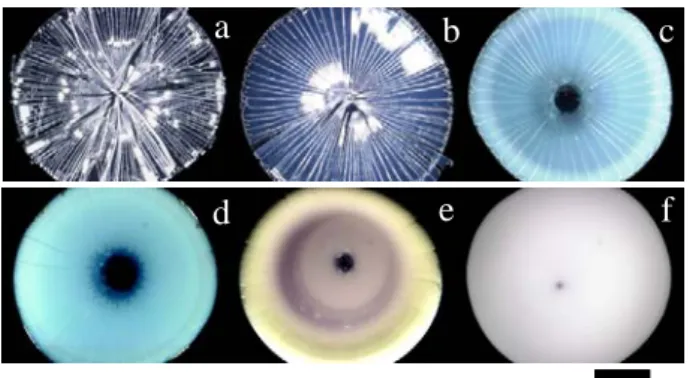
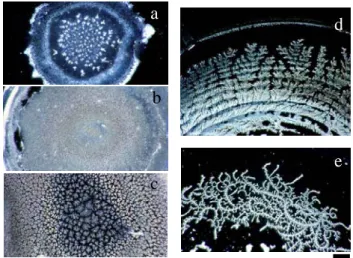
(2) a. b. c. d. e. f. Fig. 1. Drying patterns of colloidal silica spheres on a cover glass at 25 o. C. a CS22p (29 nm in diameter), b CS45 (56.3 nm), c CS82 (103 nm), d CS161 (183 nm), e CS301 (311 nm), f CS1001 (1.09 m), in water, = 0.0333, 0.1 ml, length of the bar is 5 mm.. A main cause for the broad ring is due to the convectional flow of solvent and colloidal spheres. Especially, the flow of the colloidal spheres from the central area toward outside edges in the lower layer of the liquid drop is important, which was observed directly from the movement of the very rare aggregates of the particles [30]. The flow is enhanced by the evaporation of water at the liquid surface, resulting in lowering of the suspension temperature in the upper region of the liquid. When the spheres reach the edges of the drying frontier at the outside region, a part of spheres will return upwards and go back to the central region. However, the movement of most spheres may stop at the frontier region because of the disappearance of water. These processes must be followed by the broad ring-like accumulation of the spheres near the round edges. It should be noted here that the importance of the convectional flow of colloidal spheres in the ring formation has been often reported in the process of film formation [16].. a. b. c. d. Fig. 2. Drying patterns of polystyrene spheres (D1W52, 88 nm in diameter) on a cover glass at 25 oC. In water, a = 0.011, 0.2 ml, length of the bar is 1.0 mm, b 0.011, 0.2 ml, 0.2 mm, c 0.001, 0.1 ml, d (a) D1W52, 0.000885, 0.1 ml, 10 m, (b) CS82 (103 nm in diameter), 0.00133, 0.1 ml, 10 m.. Figure 2 shows the drying patterns from macro- to micro-scale. Most extended micro-scale. Most extended micro-scale patterns of colloidal crystals of polystyrene and silica spheres are shown in Fig. 2(d), left- and right-hand side, respectively. Clearly, the stratified structures from macro to micro scales. These. microscopic patterns must be made by the movement of spheres to associate with each other, especially in the final stage of drying processes. Branch-like fractal patterns were observed for a series of colloidal silica spheres ranging from 29 nm to 311 nm and in the only limited conditions of sphere concentrations. The fractal dimensions of drying patterns of polystyrene and silica spheres were 1.45 and between 1.3 and 1.9 [29], respectively. Interestingly, the single crystals were observed during the drying processes. The size of single crystals increased in the course of drying, which clearly shows that the contamination of the suspensions with air, especially carbon dioxide, progresses with time. It is well known that the crystal size becomes largest at the salt concentration of crystal melting [1,5]. The crystal size began to decrease after passing the maximum as time proceeded. The single crystals were not recognized in the wet drying state. However, the peak appeared even for the wet film and for the completely dried film in the reflection spectroscopy. The peak wavelength at the beginning stage of drying shifted to the longer wavelengths, and then decreased with time, especially drastically in the final stage of drying [28]. Drying patterns of colloidal crystals of silica spheres in water, methyl alcohol, ethyl alcohol with other solvents have been studied on a cover glass [51]. The broad rings were observed. Much distinct broad rings appeared in the inner area when solvents were ethyl alcohol, methyl alcohol and their mixtures. Profiles of the thickness of the dried films were sensitive to kind of the organic solvents, and explained well with changes in the surface tensions, boiling points and viscosities of the solvents. Drying patterns of the binary mixture of colloidal silica spheres in a watch glass were composed of the outer broad ring of small spheres and the inner ring of large spheres. The width ratio of the rings changed in proportion to the mixing ratio in volume fraction [52]. On a cover glass the width of the broad rings of small spheres at the outside edges increased as the mixing ratio of small spheres increased. Clearly, observation of the sedimentation and drying patterns is one of the novel semi-quantitative analysis techniques. 2.2 Drying Patterns of Spherical Colloidal Suspensions Including Colloidal Crystals Drying patterns of fractionated bentonite suspensions were studied [32]. The broad rings were observed and their widths increased sharply as particle concentration increased. There appeared a hill in the central region in addition to the broad ring at the outside edge. These hills in the central area have not been observed for the suspensions of any kind of spherical particles. The rotational movement must be highly restricted for the anisotropic-shaped particles (plate-like ones here), and the sliding movement will be in major especially in the area close to the substrate. This restricted Brownian movement must be correlated deeply with the appearance of the hill in the center. Figure 3 shows the pattern formation processes of the bentonite suspension. The drying frontier moves from right to left with time in the pictures. The border between the liquid and solid regions is the frontier zone of drying. Soon after setting the suspensions, vague wrinkle patterns appeared. As time elapsed, the drying frontier moved to the left side, and the vague patterns formed in the liquid phase became clearer and finer in the course of solidification. These observations suggest strongly that the patterns grow and already fixed in the suspension phase. Broad ring patterns in the deionized suspensions shifted toward the single round hill pattern by the addition of sodium chloride. Association of the plate-like particles is highly plausible. Substantial decrease in the translational movement of the.
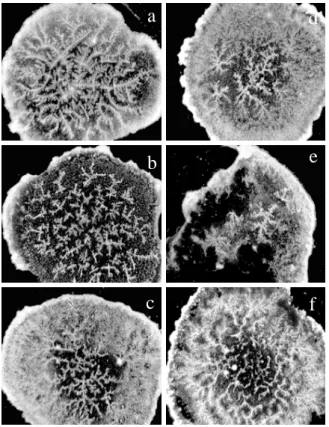
(3) associated particles is one of the main reasons for the very interesting change in the patterns.. a. b. associate weakly to each other, whereas the gels at high temperatures shrink and move rather freely with the convectional flow of water, though the very weak inter-gel attractions still remain. It should be mentioned that the flickering spoke-like patterns show the traces of the cell convection of water and gels.. a. c. d. d. b. e c Fig. 3. Patterns formed in the drying process of bentonite particles on a cover glass at 25oC. In water, w = 4.6 mg/ml, 0.05 ml, a 46 min 30 s after dropping the suspension, b 48 min, c 48 min 45 s, d 49 min 50 s, length of the bar is 10 m. Drying patterns of Chinese black ink on an unrinsed cover glass have been studied. The broad rings are observed at the outer edges irrespective of concentration. The width of the broad ring regions increased when ink concentration increased. The spoke-like hills appeared but cracks did not. Chinese ink contains the glue component and the film must be strong enough to make cracks.. Fig. 4. Patterns formed for poly (allylamine hydrobromide) on a cover glass at 25 oC. In water, 0.1.ml, length of the bar is 0.2 mm, a 1x10⁻⁷ monoM, b 1x10⁻⁶ monoM, c 1x10⁻⁵ monoM, d 1x10⁻⁴ monoM, e 1x10⁻³ monoM.. a. b. c. d. 3. Drying Patterns of Solutions 3.1 Drying Patterns of Polymers Including Gels Drying patterns of poly (allylamine hydrochloride), one of the cationic polyelectrolytes, were studied on a cover glass [41]. Figure 4 shows the typical examples of the patterns. Fractal dimension increased from 1.2 to 1.6 as polymer concentration increased from 1x10⁻⁶ monoM to 0.01 monoM. Drying patterns of poly (4-N-alkylpyridinium Halide) were studied [54]. The patterns were influenced significantly with the hydrophobicities of the polyelectrolytes. Drying patterns of aqueous solutions of biological polyelectrolytes, sodium poly (, L-glutamate) and poly (L-lysine hydrobromide) were studied on a cover glass [43]. Below the critical polymer concentration, m* the dried patterns shrank only around the critical area. Above m*, on the other hand, drying area extended throughout the initial solution area. The macroscopic broad rings and the spoke-like crack patterns were observed. Microscopic patterns such as cross-like, rod-like, block-like and further city road-like patterns appeared. Drying dissipative patterns of thermo-sensitive gels of poly (N-isopropyl acrylamide) were studied on a cover glass [44]. As the suspension temperature rose, the small size of drying area extended transitionally at the critical temperature ca. 35 oC. The principal patterns at 25 oC were the single or multiple broad rings of the hill accumulated with gels. At 50 oC, on the other hand, the beautiful flickering spoke-like patterns were observed at the inner area of the broad ring (see Fig. 5). These observations support that the extended gel spheres at low temperatures apt to associate weakly to each other, whereas the gels at high temperatures apt to. Fig. 5. Drying patterns of thermo-sensitive gels. In water, 0.05 ml, w = 0.01 g/ml, a 25 oC, length of the bar is 2.0 mm, b 25 oC, 0.5 mm, c 45 oC, 2.0 mm, d 45 oC, 0.5 mm.. 3.2 Drying Patterns of Ionic and Non-ionic Detergents Cationic surfactant of n-dodecyltrimethylammonium chloride (DTAC) was studied [45]. At low concentrations the pattern area shrank in the center and the broad ring region distributed roundly in the outer edges. At the highest concentration at 0.01 M a broad ring was observed. Clearly, the microscopic patterns of DTAC are cross-like irrespective of the location. The microscopic patterns of DTAC coexisting KCl, CaCl2 and LaCl3 were also studied. When the concentrations of detergent and salt are comparable to each other, tree branch-like and arc-like patterns were observed, which are entirely different from those of the.
(4) purely detergent or salt solutions. The patterns are also similar to the microscopic structures of poly (allylamine hydrochloride) [41]. These results suggest that the micelle structure of DTAC is in the form of a long rod in the solution just before the solidification. The drying patterns of a series of anionic ones of sodium n-alkyl sulfates were studied on a cover glass [46]. The broad ring patterns are formed. The microscopic patterns of the small blocks, star-like and branched strings are formed. Figure 6 shows the typical examples of the drying patterns.. were formed in the solidification processes. Change in the functional side group moieties of the dye gave the strong effect on the microscopic patterns even the main chemical structures are same. Kinetic aspect of the drying patterns was also studied. Drying patterns of KCl, NaCl, CaCl2 and LaCl3 and the binary mixtures among them were studied on a cover glass [56]. Patterns were determined greatly in the process of the solidification, i.e., crystallization. 4. Sedimentation and Convectional Patterns of Suspensions. a. d. b. e. c. f. 4.1 Sedimentation Patterns of Colloidal Dispersions The author observed the sedimentation dissipative structures, which must play an important role for the drying patterns, for several kinds of colloidal suspensions. Frankly speaking, the author became aware of the importance of the convectional flow for the broad ring formation of Ocha (plate-like and colloidal size of Japanese green tea particles, ca. 7 mm in the largest axis) accumulating on the slope of the inner surface of an Ochawan (tea bowl) [34]. The sedimentation patterns of broad rings have been always observed when Ocha was prepared by swing a tea bag in an Ochawan containing hot water. Formation of the broad-ring patterns were retarded when a tea cup is covered with a cap, which demonstrates the important role of convectional flow of water and tea particles. The sedimentary particles were suspended above the substrate of the cell and always moved by the convectional flow of water. The broad ring patterns became sharp just before the solidification occurs. Interestingly, the broad rings were formed even in an inclined glass dish, though the rings were transformed slightly, which demonstrates the strong convectional flow of tea particles. The drying broad rings and the microscopic fine structures were formed in the solidification processes on the basis of the convectional and sedimentation patterns in suspension state.. a. b. c. d. Fig. 6. Patterns formed for the anionic detergents on a cover glass at 25oC. In water, 0.1 ml, w = 1x10⁻⁷ M, a S6S, b S8S, c S10S, d S12S, e S16S, f S18S, length of the bar is 200 m. The drying patterns of aqueous solutions of polyoxyethylene alkyl ethers have been studied [47]. The shift from the single round hill to the broad ring patterns occurred as the HLB (hydrophile-liophile balance) of the surfactant molecules increases. Microscopic patterns of small blocks, star-like patterns and branched strings are formed. Size and shape of the surfactant molecules and their micelles themselves influence the drying patterns. The pattern area and the time to dryness have been discussed as a function of surfactant concentration and HLB of the surfactants. 3.3 Drying Patterns of Dyes and Simple Electrolytes Drying dissipative structural patterns formed in the course of drying ethyl alcohol solutions of rhodamine 6G, uranine, 7-hydroxy coumarin and 7-amino-4-(trifluoro methyl) coumarin were studied on a cover glass [55]. The macroscopic broad ring patterns formed for all the solutions examined, which supported importance of the convectional flow of ethyl alcohol and dye solutions. Dried area increased as dye concentration increased above the critical dye concentration. Microscopic fine patterns including street-like, needle-like and flower-like crystal structures. Fig. 7. Microscopic drying patterns of silica spheres (1.205 m in diameter) in a glass dish at 24 oC. = 0.00129, 10 ml, a [NaCl] = 0.0003 M, b 0.0006 M, c 0.001 M, d 0.003 M. Systematic studies on the sedimentation patterns have been made for colloidal silica spheres of 1.2 m and 305 nm in diameter on a glass dish, a watch glass and a cover glass [35, 36, 40]. The macroscopic broad ring patterns were formed on the inner inclined watch glass in suspension state within a short time after suspension was set [35]. It was clarified that the sedimentary spheres move toward upper and outer edges along the inclined cell wall by the cell convection and hence the patterns are formed by the balancing between the outside movement and the.
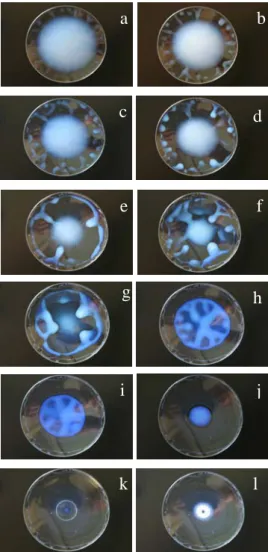
(5) downward sedimentation of the spheres. Beautiful microscopic drying patterns were observed from the optical microscopy. It should be mentioned here that the drying patterns of the colloidal silica spheres containing NaCl were star-like ones, which strongly supports the synchronous cooperative interactions between the salt and colloidal spheres in the suspension state. Figure 7 shows the typical examples of the dendric drying patterns of silica spheres with coexistence of small amount of NaCl and the star-like patterns of NaCl surrounded by the dendrite patterns of silica spheres at high salt concentrations on a glass dish. 4.2 Convectional Patterns of Colloidal Dispersions At the special experimental conditions on the convectional patterns of Chinese black ink, 0.001 g/ml at 25 oC, the convectional flow of the particles was visible with the naked eye [30]. At 1 min after setting, the particles met together and the associated particles distributed at random. However, after 36 min,. a. b. c. d. e. f. g. h. i. j. k. l. lines both in the liquid and in the solid phases just coincided to each other. This observation supports that the spoke-lines were already formed in the suspension phase by the convectional flow. The drying frontier at the border between gray (center part) and black regions (edges) moved inside with time. The clear-cut spoke-lines appeared especially around the outside region of the liquid area. A further study on the convectional flow in the course of drying was made using a large amount of the ink suspension in a glass dish on a hot plate keeping the suspension temperatures between 25 and 80 oC [30]. (a) Cyclic cell convections around the outside edges of the suspension, (b) grain-like convection patterns and (c) smoke-like convectional patterns were observed. The patterns of the dried films were spoke-like lines, fine circles and the surface patterns of the Japanese earthenware called “Shigaraki Yaki”, respectively. Dissipative structural patterns formed in the course of drying ethyl alcohol suspensions of colloidal silica spheres (110 nm in diameter) were studied in a glass dish and a watch glass [33]. Figure 8 is the typical examples showing the dynamic change of the patterns. Vigorous cell convectional flow was observed with the naked eyes, and the patterns changed dynamically with time. Within 50 min after suspension was set, the spoke-like patterns formed outside of the mother suspension in the central area. The suspension drops in the outer region were bridged sometimes with the mother suspension in the central area, disappeared when most of the suspension drops flow down to the mother suspension, and then the suspension flow takes place from the mother suspension pool toward outside edges resulting in the appearance of the spoke-like suspension drops again. Between 60 min and 75 min, the mother suspension area decreased with time and the initial patterns changed drastically to the different kind of patterns like the section of lotus-root. After 90 min the suspension remained in the central area only, and the broad rings were formed in the final course of dryness. Broad-ring-like sedimentation patterns were observed in the suspension state just before the suspension was dried up, and the principal macroscopic drying pattern was also broad-ring, though the colorful and fine microscopic structures were observed from the microscopy. Acknowledgements Coworkers cited in the references, especially Professors Akira Tsuchida and Hiroshi Kimura of Gifu University are acknowledged deeply for their cooperation in the studies. The Ministry of Education, Culture, Sports, Science and Technology is thanked for grants-in-aid for Exploratory Research (17655046) and Scientific Research (B) (18350057). Drs. Komatsu and Nishida are acknowledged for their kind providing a series of samples of colloidal silica spheres. References. Fig. 8. Convectional, sedimentation and drying patterns of 100% ethanol suspensions of colloidal silica spheres (110 nm in diameter) in a watch glass at 25 oC. = 0.00427, 4 ml, a after 7 min, b 25 min, c 40 min, d 50 min, e 60 min, f 62 min, g 65 min, h 70 min, i 75 min, j 90 min, k 122 min, and l 125 min, dry the particles started to orient themselves as a result of the convectional flow. Surprisingly, after 136 min, the spoke-like. [1] T. Okubo, Acc. Chem. Res., 21, 281 (1988). [2] T. Okubo, Prog. Polymer Sci., 18, 481 (1993). [3] T. Okubo, Macro-ion Characterization. From Dilute Solutions to Complex Fluids; Schmitz, K. L., Ed., American Chemical Society, Washington, DC, pp 364-380 (1994). [4] T. Okubo, Curr. Topics Colloid Interface Sci., 1, 169 (1997). [5] T. Okubo, Encyclopedia of Surface and Colloid Science, A.Hubbard, Ed., Dekker, New York, p1300 (2002). [6] T. Okubo, Structural Colors in Biological Systems. Principles and Applications, S. Kinoshita & S. Yoshioka, Ed., Osaka Univ. Press, Osaka, pp267-286 (2005)..
(6) [7] A. Tsuchida and T. Okubo, Molecular and Colloidal Electro-optics, S. Stoylov & M. Stoimenova, Ed., CRC Press, Boca Raton, pp447-455 (2006). [8] J. W. Vanderhoff, E. B. Bradford, W. K. Carrington, J. Polymer Sci., Stmp., 41, 155 (1973). [9] G. Nicolis, I. Prigogine, Self-organization in Nonequilibrium Systems, Wiley, New York (1977). [10] M. C. Cross, J. R. Heath and W. M. Gelbart, Rev. Modern Phys., 65, 851 (1993). [11] P. C. Ohara, J. R. Heath and W. M. Gelbart, Angew. Chem. Intern. Ed. English, 36, 1078 (1997). [12] P. C. Ohara, J. R. Heath and W. M. Gelbart, Langmuir, 14, 3418 (1998). [13] K. Uno, K. Hayashi, T. Hayashi, K. Ito, H. Kitano, Colloid Polymer Sci., 276, 810 (1998). [14] W. M. Gelbart, R. P. Sear, J. R. Heath, S. Chang, Farady Discuss. 112, 299 (1999). [15] B. van Duffel, R. A. Schoonheydt, C. P. M. Grim and F. C. De Schryver, Langmuir, 15, 957 (1999). [16] S. Maenosono, C. D. Dushkin, S. Saita and Y. Yamaguchi, Langmuir, 15, 957 (1999). [17] S. L. Brock, M. Sanabria, S. L. Suib, V. Urban, P. Thiyagarajan and D. I. Potter, J. Phys. Chem., 103, 7416 (1999). [18] B. Nikoobakht, Z. L. Wang and M. A. El-Sayed, J. Phys. Chem., 104, 8635 (2000). [19] G. Ge and L. Brus, J. Phys. Chem., 104, 9573 (2000). [20] K. M. Chen, X. Jiang, L. C. Kimerling and P. T. Hammond, Langmuir, 16, 7825 (2000). [21] X. M. Lin, H. M. Jaenger, C. M. Sorensen and K. J. Klabunde, J. Phys. Chem., 105, 3353 (2001). [22] E. Kokkoli and C. F. Zukoski, Langmuir, 17, 369 (2001). [23] T. Ung, L. M. Liz-Marzan and P. Mulvaney, J. Phys. Chem., 105, 3441 (2001). [24] M. D. Haw, M. Gilli and W. C. K. Poon, Langmuir, 18, 1626 (2002). [25] T. Narita, C. Beauvais, P. Hebrand and F. Lequeux, Eur. Phys. J., E, 14, 287 (2004). [26] M. S. Tirumkudulu and W. B. Russel, Langmuir, 21, 4938 (2005). [27] Shimomura and T. Sawadaishi, Curr. Opinion Colloid Interf. Sci., 6, 11 (2001). [28] T. Okubo, S. Okuda and H. Kimura, Colloid Polymer Sci., 280, 454 (2002). [29] T. Okubo, K. Kimura and H. Kimura, Colloid Polymer Sci., 280, 1001 (2002). [30] T. Okubo, H. Kimura, T. Kimura, F. Hayakawa, T. Shibata and K. Kimura, Colloid Polymer Sci., 283, 1 (2005).. [31] T. Okubo, T. Yamada, K. Kimura and A. Tsuchida, Colloid Polymer Sci., 283, 1007 (2005). [32] T. Yamaguchi, K. Kimura, A. Tsuchida, T. Okubo and M. Matsumoto, Colloid Polymer Sci., 283, 1123 (2005). [33] T. Okubo, Colloid Polymer Sci., 285, 225 (2006). [34] T. Okubo, Colloid Polymer Sci., 285, 331 (2006). [35] T. Okubo, Colloid Polymer Sci., 284, 1191 (2006). [36] T. Okubo, Colloid Polymer Sci., 284, 1395 (2006). [37] T. Okubo, M. Nozawa and A. Tsuchida, Colloid Polymer Sci., in press. [38] T. Okubo, K. Kimura and A. Tsuchida, Colloids Surfaces B, in press. [39] T. Okubo, N. Nakagawa and A. Tsuchida, Colloid Polymer Sci., submitted. [40] T. Okubo, J. Okamoto and A. Tsuchida, Colloid Polymer Sci., in press. [41] T. Okubo, S. Kanayama, H. Ogawa, M. Hibino and K. Kimura, Colloid Polymer Sci., 282, 230 (2004). [42] T. Okubo, T. Yamada, K. Kimura and A. Tsuchida, Colloid Polymer Sci., 284, 396 (2006). [43] T. Okubo, D. Onoshima and A. Tsuchida, Colloid Polymer Sci., in press. [44] T. Okubo, E. Itoh, A. Tsuchida and E. Kokufuta, Colloid Polymer Sci., 285, 339 (2006). [45] T. Okubo, S. Kanayama and K. Kimura, Colloid Polymer Sci., 282, 486 (2004). [46] K. Kimura, S. Kanayama,A. Tsuchida and T. Okubo, Colloid Polymer Sci., 283, 898 (2005). [47] T. Okubo, C. Shinoda, K. Kimura and A. Tsuchida, Langmuir, 21, 9889 (2005). [48] T. Terada, R. Yamamoto and T. Watanabe, Proc. Imper. Acad. Tokyo, 10, 10 (1934). [49] T. Terada, R. Yamamoto and T. Watanabe, Sci. Paper Inst. Phys. Chem. Res. Japan, 27, 75 (1934). [50] T. Terada, R. Yamamoto and T. Watanabe, Proc. Imper. Acad. Tokyo, 11, 214 (1935). [51] T. Okubo, Colloid Polymer Sci., submitted. [52] T. Okubo, J. Okamoto and A. Tsuchida, publication in preparation. [53] T. Okubo, J. Okamoto and A. Tsuchida, publication in preparation. [54] T. Okubo, H. Ogawa and A. Tsuchida, publication in preparation. [55] T. Okubo, N. Yokota and A. Tsuchida, Colloid Polymer Sci., submitted. [56] T. Okubo, H. Togawa and A. Tsuchida, publication in preparation..
(7)
數據
相關文件
Quadratically convergent sequences generally converge much more quickly thank those that converge only linearly.
denote the successive intervals produced by the bisection algorithm... denote the successive intervals produced by the
Study the following statements. Put a “T” in the box if the statement is true and a “F” if the statement is false. Only alcohol is used to fill the bulb of a thermometer. An
Wang, Solving pseudomonotone variational inequalities and pseudocon- vex optimization problems using the projection neural network, IEEE Transactions on Neural Networks 17
Define instead the imaginary.. potential, magnetic field, lattice…) Dirac-BdG Hamiltonian:. with small, and matrix
In an Ising spin glass with a large number of spins the number of lowest-energy configurations (ground states) grows exponentially with increasing number of spins.. It is in
files Controller Controller Parser Parser.
Microphone and 600 ohm line conduits shall be mechanically and electrically connected to receptacle boxes and electrically grounded to the audio system ground point.. Lines in
